
The GATT History GATT 1947 Foundation Status Role

- Slides: 11
The GATT: History
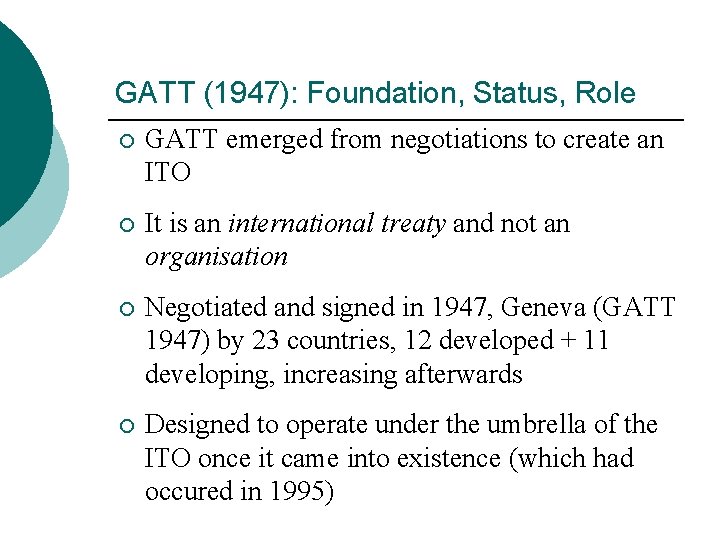
GATT (1947): Foundation, Status, Role ¡ GATT emerged from negotiations to create an ITO ¡ It is an international treaty and not an organisation ¡ Negotiated and signed in 1947, Geneva (GATT 1947) by 23 countries, 12 developed + 11 developing, increasing afterwards ¡ Designed to operate under the umbrella of the ITO once it came into existence (which had occured in 1995)
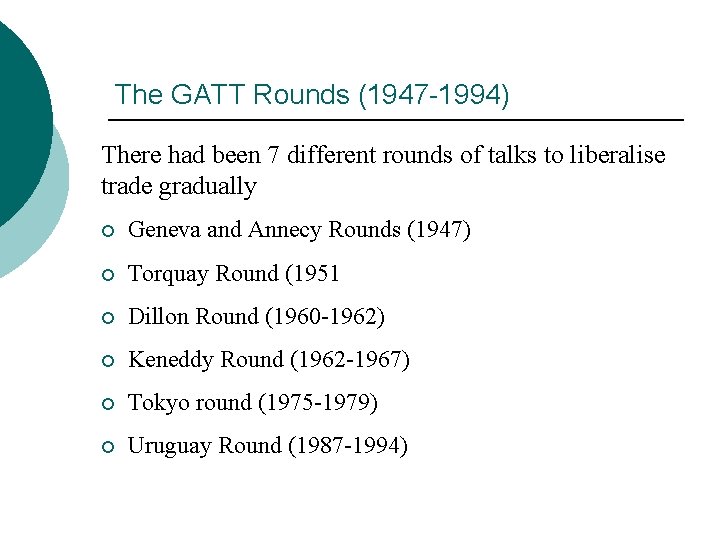
The GATT Rounds (1947 -1994) There had been 7 different rounds of talks to liberalise trade gradually ¡ Geneva and Annecy Rounds (1947) ¡ Torquay Round (1951 ¡ Dillon Round (1960 -1962) ¡ Keneddy Round (1962 -1967) ¡ Tokyo round (1975 -1979) ¡ Uruguay Round (1987 -1994)
GATT Working Methods ¡ Rounds of multilateral trade negotiations ¡ Contracting parties (CP’s) usually met every six months for several weeks at regular sessions ¡ Interim Commission for ITO (ICITO), since Havana ¡ Later, ICITO transformed into GATT Secretariat ¡ In earlier GATT rounds, reciprocal tariff reductions were of primary concern. Later, other issues became more important (NTBs, trade in services. . . )
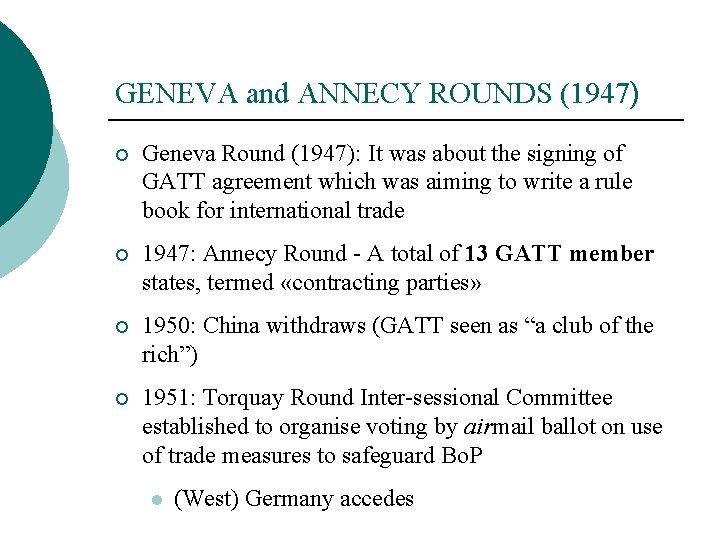
GENEVA and ANNECY ROUNDS (1947) ¡ Geneva Round (1947): It was about the signing of GATT agreement which was aiming to write a rule book for international trade ¡ 1947: Annecy Round - A total of 13 GATT member states, termed «contracting parties» ¡ 1950: China withdraws (GATT seen as “a club of the rich”) ¡ 1951: Torquay Round Inter-sessional Committee established to organise voting by airmail ballot on use of trade measures to safeguard Bo. P l (West) Germany accedes
Dillon Round (1960 -1962) ¡ Focus on negotiating compensation for traditional exporters for loss of markets due to EEC (1957) and its common external tariff ¡ Agricultural issues were a particular area of conflict l EEC’s move to a common external tariff with variable levies replacing import duties violated previous bindings l “Chicken war” of 1962: EC levy system for imports tripled the level of protection to the poultry industry => US took the matter to GATT and an independent panel found that US was entitled to compensation of $ 26 m => US withdrew concessions on potato starch, light trucks, brandy
6 th Kennedy Round (1964 -1967) ¡ Benefits to agricultural trade again far less significant than those to manufacturing l l ¡ Non-tariff barriers not addressed although widespread EEC and US reluctant to subject domestic agro-policy to GATT scrutiny Conflicting interests of the major players l l The U. S. , the world’s largest exporter of agricultural products, demanded trade liberalisation and greater reliance on market forces EEC, world’s largest importer of agricultural products, favoured a system of managed markets via international commodity agreements
GATT 7 th Tokyo Round (1973 -1979) ¡ Agricultural issues blocked successful conclusion for a long time (U. S. vs. EEC) ¡ Agreement finally reached in 1979 but without addressing contentious issues in agriculture ¡ Results l Average tariff on manufactured products levied by industrialized countries declined to 6% (reduction of 34%) l Legalisation of preferential tariff and non-tariff treatment in favour of developing countries ( lecture 3) l First success in limiting spread of non-tariff barriers through codes of conduct on technical barriers etc. (but no formal expansion of GATT principles as opposed by develop. countries) l Multifibre Arrangement signed in 1974 as part of negotiations, formalising existing restrictions and limiting growth of textile imports ( lecture 6)
GATT 8 th Uruguay Round (1986 -1994) ¡ New GATT areas like services trade and creation of WTO ( lecture 7) ¡ Manufactured goods l Developed countries reduced tariffs on average by 40% (from 6. 3 to 3. 8%) l Effective reductions for developing countries slightly smaller (30%), but larger than in previous rounds ¡ Textiles and clothing: agreement to phase out multifibre agreement until 2005 ( lecture 6) ¡ Agriculture effectively integrated into GATT negotiations for the first time ( lecture 7)
Summary and Learning Outcomes ¡ The principal historical events that led to the establishment of GATT (but not ITO) ¡ The key functions of the international trading system ¡ The five key principles of GATT ¡ l Nondiscrimination l Reciprocity l Enforceable commitments l Transparency l Safety valves The GATT rounds: key dates, recurring issues
GATT Principles: Non-Discrimination ¡ Key rules: MFN and National Treatment Principles. ¡ Most-Favoured Nation (MFN), embodied in Art. I: l l l ¡ A product made in one member country (or CP, initially) cannot be treated less favourably than a like product originating in any other country The benchmark for MFN is thus the best treatment (e. g. 5% tariff) offered to a country (including nonmembers to GATT, as initial CPs were only 23) Three areas of application under WTO: goods (GATT), services (GATS) and intellectual property (TRIPs) MFN is a basic pillar of GATT/WTO l l Applies unconditionally, e. g. not conditional on reciprocity Disputes can be brought alleging both de jure et de facto violation