
The Gas Cooled Fast Reactor Dr Richard Stainsby
The Gas Cooled Fast Reactor Dr Richard Stainsby AMEC Booths Park, Chelford Road, Knutsford, Cheshire, UK, WA 16 8 QZ Phone: +44 (0)1565 684903, Fax +44 (0)1565 684876 e-mail: Richard. stainsby@amec. com
Contents 1. Why have fast reactors ? 2. Gas cooled fast reactor concept: a historical perspective 3. The present day: Generation IV gas cooled fast reactors 4. R&D requirements for the Gen IV GFR system 5. Specific challenges 6. Plant layouts 7. ALLEGRO: a GFR demonstrator 2
What is a fast reactor ? § A fast reactor makes use of fission induced by fast neutrons (E > 0. 1 Me. V). § Characterised by having a compact core (no moderator) and a high power density (~400 MW/m 3 compared with ~5 MW/ m 3 for thermal reactors). 3
Why have fast reactors ? § Only 0. 72% of natural uranium is fissile. For nuclear power to be § § § sustainable it is essential we make better use of the natural resource. Breeding of plutonium from uranium-238 in fast reactors allows considerably more of the natural uranium to be used. Both breeding and the utilisation of plutonium are more efficient in fast fission systems. Long lived minor actinides that occur in nuclear waste (americium, neptunium and curium) can be burned. § Reduces radiotoxicity of wastes § Significantly reduces waste storage times (~300 years) 4

Plutonium Breeding Reaction Starts with neutron capture in uranium-238 Uranium-239 has a half-life of 23 minutes and decays to neptunium-239 by beta decay Neptunium-239 has a half life of 2. 3 days and decays to plutonium 239 by a further beta decay 5
Why have gas cooled fast reactors ? § § § Fast reactors are important for the sustainability of nuclear power: § More efficient use of fuel § Reduced volumes and radiotoxicity of high level waste Sodium cooled fast reactors are the shortest route to FR deployment, but: § The sodium coolant has some undesirable features: – Chemical incompatibility with air and water – The strongly positive void coefficient of reactivity – Avoiding sodium boiling places a restriction on achievable core outlet temperature. Gas cooled fast reactors do not suffer from any of the above: § Chemically inert, void coefficient is small (but still positive), single phase coolant eliminates boiling. But … § Gaseous coolants have little thermal inertia – rapid heat-up of the core following loss of forced cooling; – Compounded by the lack of thermal inertia of the core structure + very high power density Motivation is two-fold: enhanced safety and improved performance (c. f. SFR) 6
Gas cooled fast reactor concepts: a historical perspective § US, General Atomics – The GCFR programme § Started in the 1960’s § Capitalised upon High Temperature (thermal) Reactor (HTR) experience: – Peach Bottom and Fort St Vrain § § Funded by US DOE § Collaboration with European partners Helium cooled reactor with a multi-cavity pre-stressed concrete pressure vessel. Featured a vented fuel pin fuel element design to reduce fuel clad stresses. 7
General Atomics GCFR concept 8
Germany: the Gas Breeder Memorandum § Germany: the Gas Breeder Memorandum (1969) § The German research centres at Karlsruhe and Jülich, together with industrial partners, § Defined three concepts, all cooled by helium, § Fuel assemblies extrapolated from sodium cooled fast reactors, § Pre-stressed concrete pressure vessels § Steam cycle, § Some work was carried out on coated particle fuels and direct cycle power cycles. 9
Europe: the Gas Breeder Reactor Association (1970 - 1981) § A number of organisations joined to form the Gas Breeder Reactor § § Association. The first design produced by the group was GBR-1, a 1000 MWe helium cooled reactor with metallic clad pin type fuel and a secondary steam cycle. GBR-2, 1000 MWe reactor using coated particle fuel, slightly elevated outlet temperature, helium coolant, GBR-3 1000 MWe reactor using coated particle fuel, CO 2 coolant GBR-4 design was developed to overcome the complexities of the particle bed fuel elements. § metallic clad fuel pins held in spacer grids. § the clad surface was ribbed to maximise the core outlet temperature whilst respecting clad temparture limit. 10
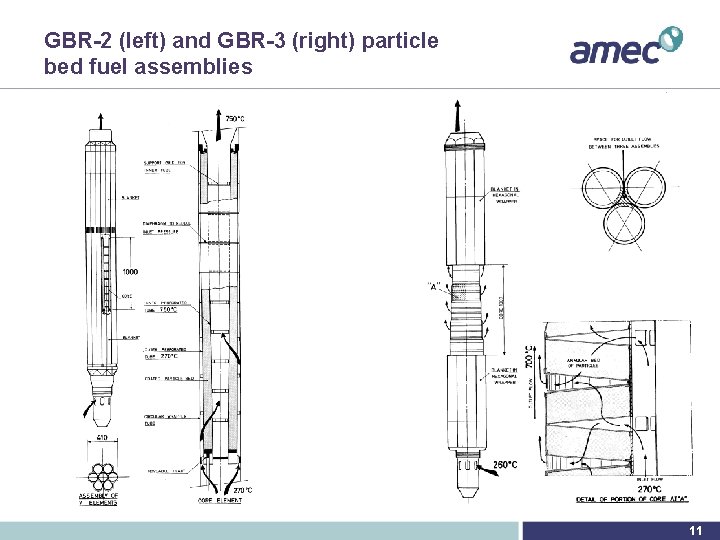
GBR-2 (left) and GBR-3 (right) particle bed fuel assemblies 11
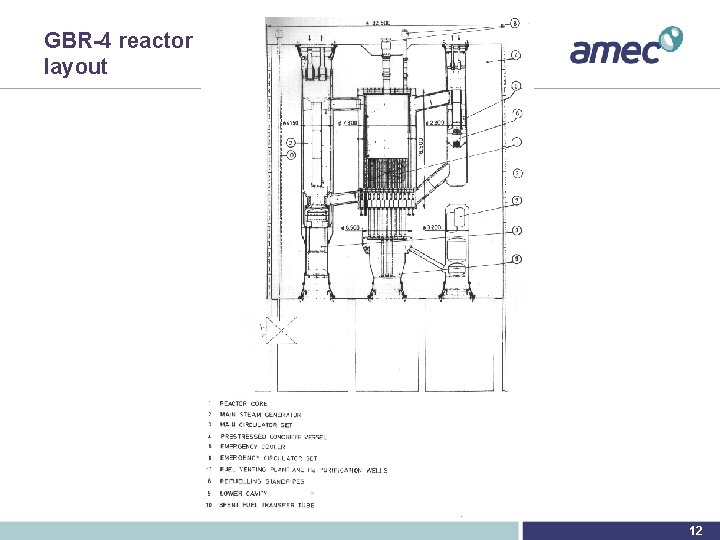
GBR-4 reactor layout 12
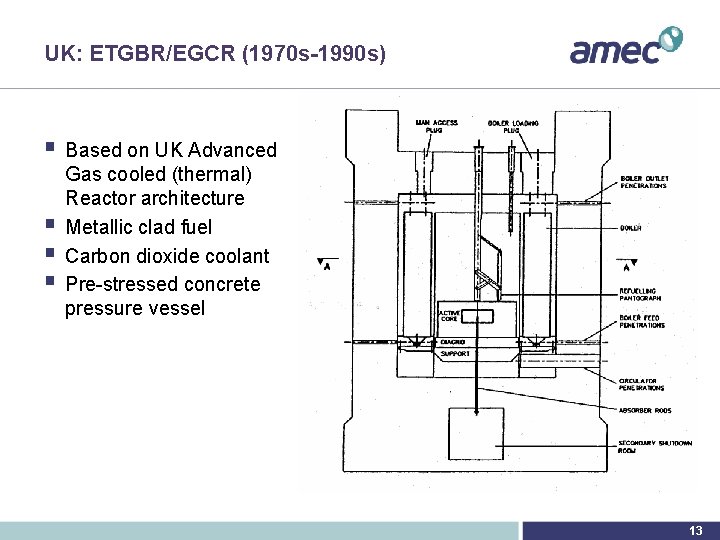
UK: ETGBR/EGCR (1970 s-1990 s) § Based on UK Advanced § § § Gas cooled (thermal) Reactor architecture Metallic clad fuel Carbon dioxide coolant Pre-stressed concrete pressure vessel 13
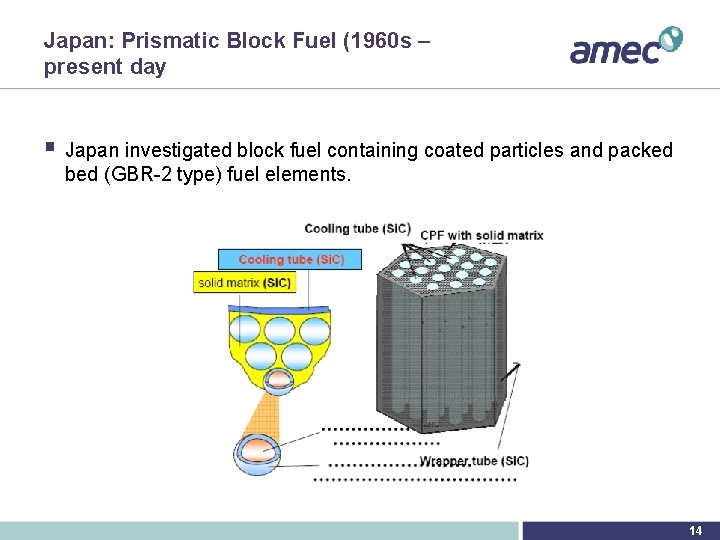
Japan: Prismatic Block Fuel (1960 s – present day § Japan investigated block fuel containing coated particles and packed bed (GBR-2 type) fuel elements. 14
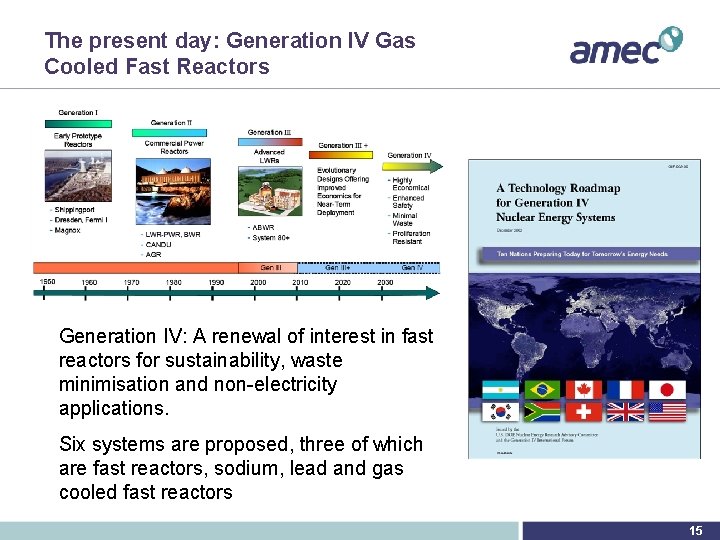
The present day: Generation IV Gas Cooled Fast Reactors Generation IV: A renewal of interest in fast reactors for sustainability, waste minimisation and non-electricity applications. Six systems are proposed, three of which are fast reactors, sodium, lead and gas cooled fast reactors 15
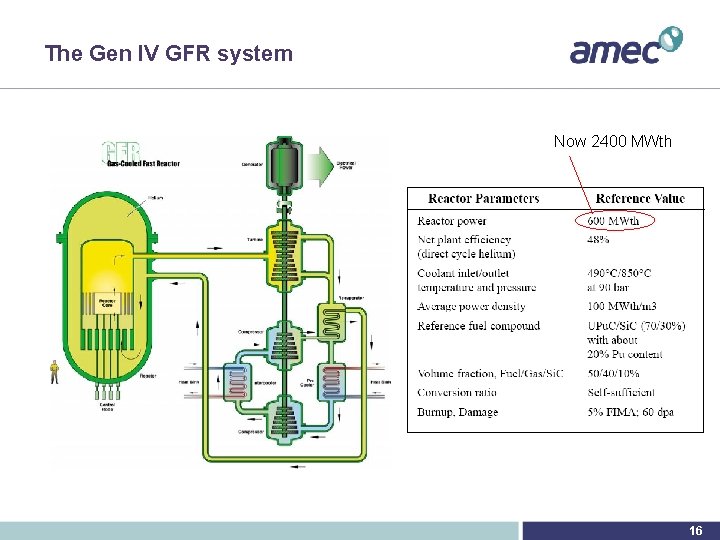
The Gen IV GFR system Now 2400 MWth 16
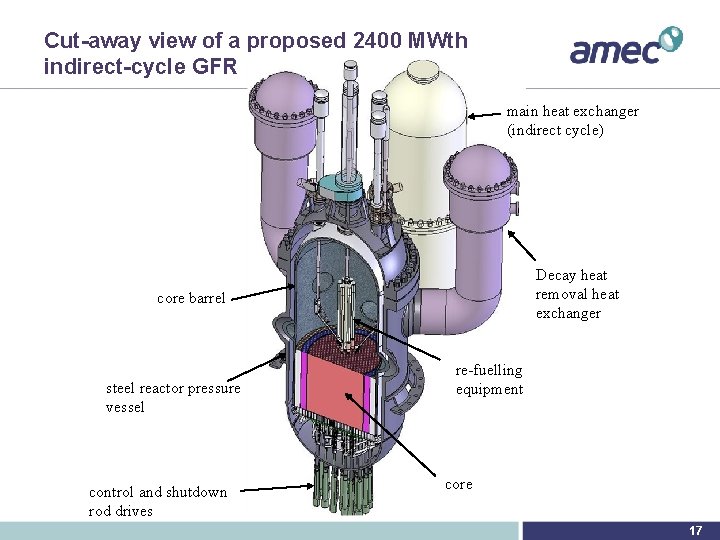
Cut-away view of a proposed 2400 MWth indirect-cycle GFR main heat exchanger (indirect cycle) Decay heat removal heat exchanger core barrel steel reactor pressure vessel control and shutdown rod drives re-fuelling equipment core 17
R&D Requirements § § § Definition of a GFR reference conceptual design and operating parameters meeting the following requirements: § Self-breeding cores with optional need for fertile blankets. § Capability for multi-recycling of plutonium and minor actinides. § Selection of an adequate core power density to meet requirements of economics, reactor fleet deployment, and management of safety issues. § Coupling between the reactor and process heat applications. Identification and study of alternative design features (lower temperatures, indirect cycle). Definition of an appropriate safety architecture for the reference GFR system and its alternatives, considering that: § Implementation of defence-in-depth is a key to achieving a robust safety architecture. § Probabilistic methods will complement the deterministic approach. Definition of the ALLEGRO conceptual design and its safety architecture, in coherence with that of the GFR. Development and validation of computational tools needed to analyze performance and operating transients (design basis accidents and beyond). 18
GFR Performance requirements § Self-generation of plutonium in the core to ensure uranium resource § § § saving. Optional fertile blankets to reduce the proliferation risk. Limited mass of plutonium in the core to facilitate the industrial deployment of a fleet of GFRs. Ability to transmute long-lived nuclear waste resulting from spent fuel recycling, without lowering the overall performance of the system. Favourable economics owing to a high thermal efficiency. The proposed safety architecture fits with the objectives considering the following elements: § Control of reactivity/heat generation by limiting the reactivity swing over the operating cycle; the coolant void reactivity effect is minor. § Capacity of the system to cool the core in all postulated situations, provision of different systems (redundancy and diversification). § A “refractory” fuel element capable of withstanding very high temperatures (robustness of the first barrier and confinement of radioactive materials). 19
Specific Challenges (1): Fuel § The greatest challenge facing the GFR is the development of robust high temperature refractory fuels and core structural materials, § Must be capable of withstanding the in-core thermal, mechanical and radiation environment. § Safety (and economic) considerations demand a low core pressure drop, which favours high coolant volume fractions. § Minimising the plutonium inventory leads to a demand for high fissile material volume fractions. § Candidate compositions for the fissile compound include carbides, § nitrides, as well as oxides. Favoured cladding materials include: § oxide dispersion strengthened steel (ODS) and Si. C for pin formats § ceramic matrices (e. g. Si. C, Zr. C, Ti. N) for dispersion fuels in a plate format 20
Potential Gen. IV GFR fuel forms Ceramic pin e Ceramic plate 21
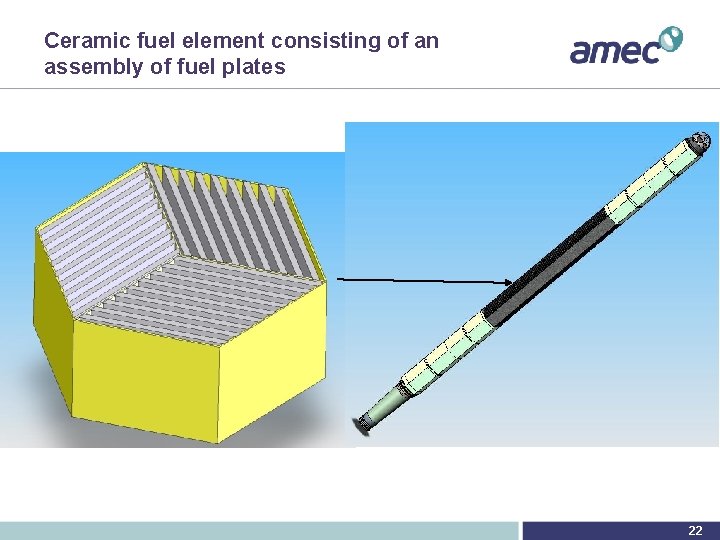
Ceramic fuel element consisting of an assembly of fuel plates 22
Specific challenges (2): Decay heat removal (DHR) § HTR “conduction cool-down” will not work in a GFR § High power density, low thermal inertia, poor conduction path and small surface area of the core conspire to prevent conduction cooling. § A convective flow is required through the core at all times; § A natural convection flow is preferred following shutdown – This is possible when the circuit is pressurised § A forced flow is required immediately after during when depressurised: – Gas density is too low to achieve enough natural convection – Power requirements for the blower are very large at low pressure § The primary circuit must be reconfigured to allow DHR § Main loop must be isolated § DHR loop(s) must be connected across the core Conclusion: the reliability of the DHR function is dependent on the reliability of the primary circuit valves. 23
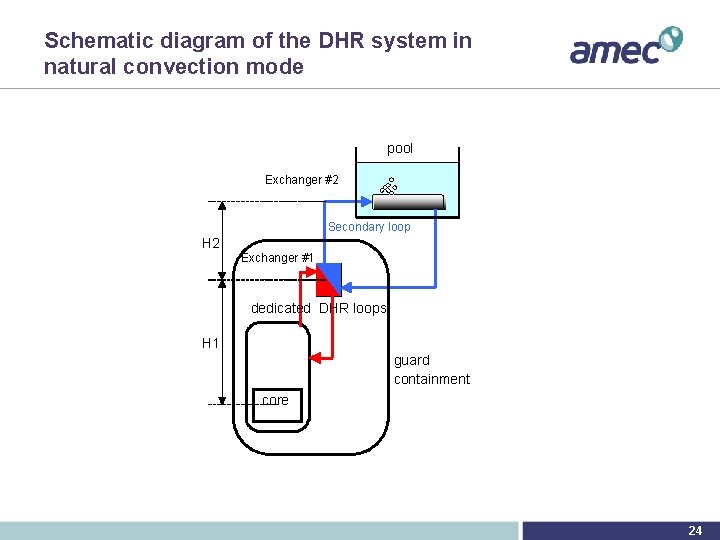
Schematic diagram of the DHR system in natural convection mode pool Exchanger #2 Secondary loop H 2 Exchanger #1 dedicated DHR loops H 1 guard containment core 24
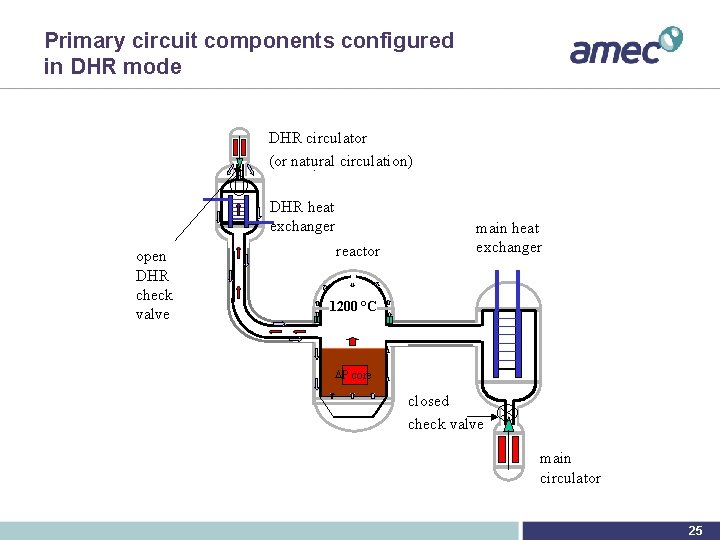
Primary circuit components configured in DHR mode DHR circulator (or natural circulation). DHR heat exchanger open DHR check valve reactor main heat exchanger 1200 °C DP core closed check valve main circulator 25
Depressurised DHR § For depressurised conditions, it would always be possible to generate § § § enough flow through the core using a large enough fan. If the primary circuit has depressurised to atmospheric pressure, the power consumption isvery large and the duration could be very long Proposed solution is to surround all the primary circuit components by another pressure vessel (known as the guard containment). Pressure within the guard containment would be controlled such that; § After the LOCA, a minimum pressure of 10 bar remains within the primary circuit. § This back pressure allows the power of the DHR fan to be low enough to be supplied by batteries for the first 24 hours, afterwards, the decay heat power is low enough for natural convection to cope. § The back pressure is a compromise between the performance and power requirements of the DHR fan and the structural complexity of the guard vessel. 26
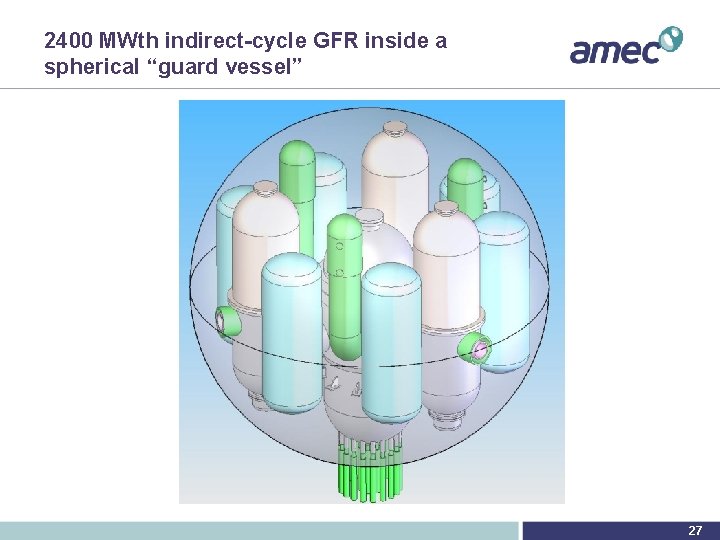
2400 MWth indirect-cycle GFR inside a spherical “guard vessel” 27
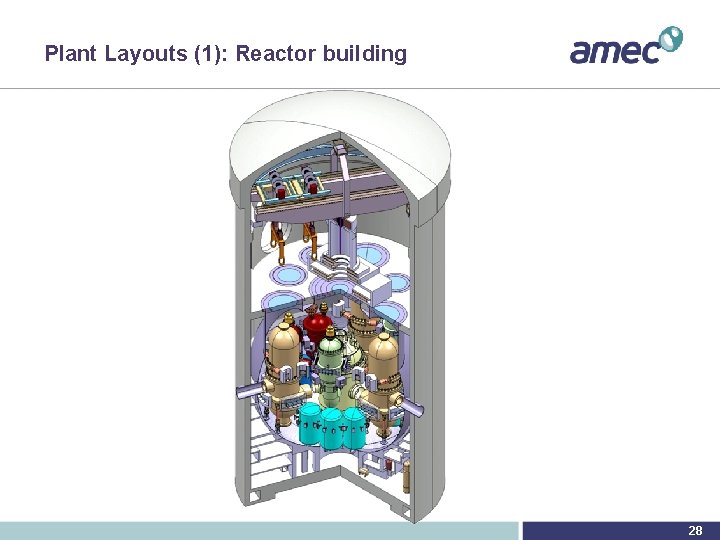
Plant Layouts (1): Reactor building 28
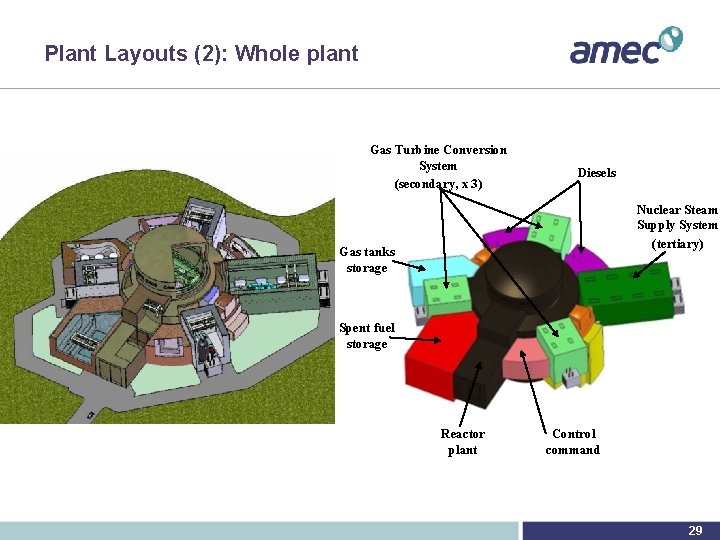
Plant Layouts (2): Whole plant Gas Turbine Conversion System (secondary, x 3) Diesels Nuclear Steam Supply System (tertiary) Gas tanks storage Spent fuel storage Reactor plant Control command 29
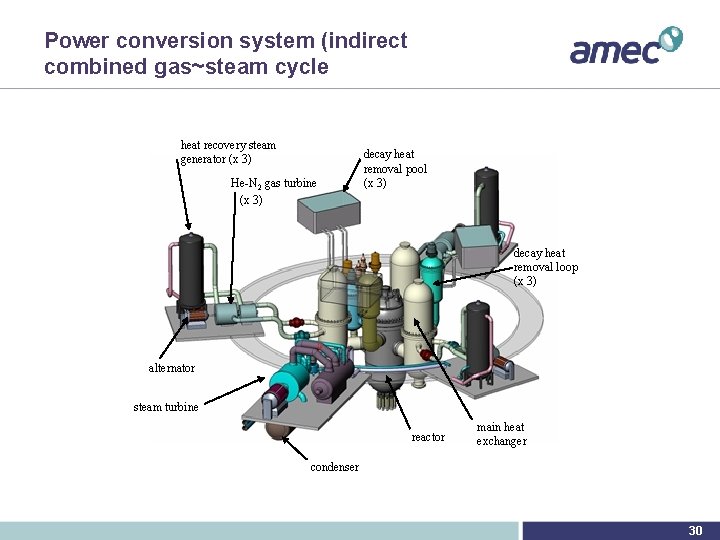
Power conversion system (indirect combined gas~steam cycle heat recovery steam generator (x 3) He-N 2 gas turbine (x 3) decay heat removal pool (x 3) decay heat removal loop (x 3) alternator steam turbine reactor main heat exchanger condenser 30
ALLEGRO: a GFR demonstrator § An experimental reactor is an essential step to establish confidence in § § § the innovative GFR technology. ALLEGRO, would be the first ever gas cooled fast reactor to be constructed. A small experimental reactor with a power of around 80 MWth. The objectives of ALLEGRO are to demonstrate the viability and to qualify specific GFR technologies such as § the fuel and the fuel elements § specific safety systems, in particular, the decay heat removal function, § together with demonstrating that these feature can be integrated successfully into a representative system. § ALLEGRO has a low power output, and will not have a power conversion system. 31
ALLEGRO (continued) § ALLEGRO is intended to have three distinct phases of operation based on three different core configurations; § A starting core, § A starting core in which some of the fuel elements are replaced by modified GFR ceramic fuel elements, § A GFR-style all-ceramic demonstration core. § The starting core is based on metallic hexagonal sub-assemblies § containing metal-clad fuel pins which contain mixed-oxide ceramic fuel pellets. § Outlet temperature of the starting core will be limited to 550 o. C. Demonstration elements will be irradiated within a limited number of positions within the starting core, § These will contain high-temperature ceramic fuel plates or pins contained within an internally insulated metallic hex-tube. § The final demonstration elements will be representative of the GFR core and will feature ceramic hex-tubes, such that the core outlet temperature can be increased to 850 o. C. 32
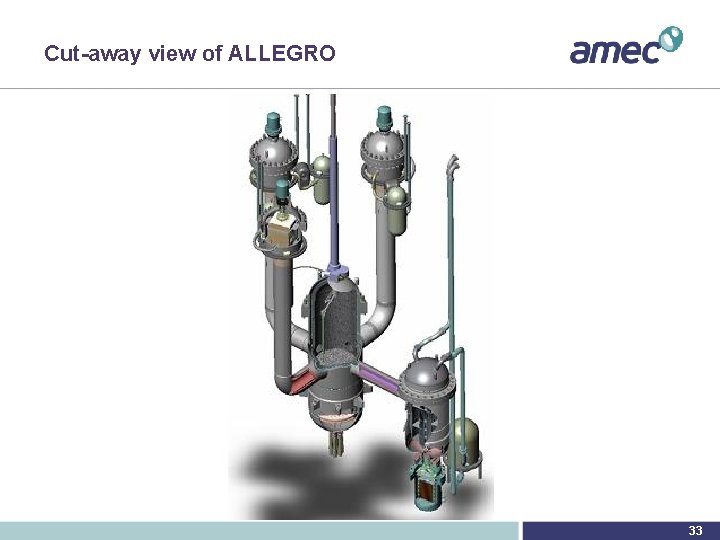
Cut-away view of ALLEGRO 33
- Slides: 33