
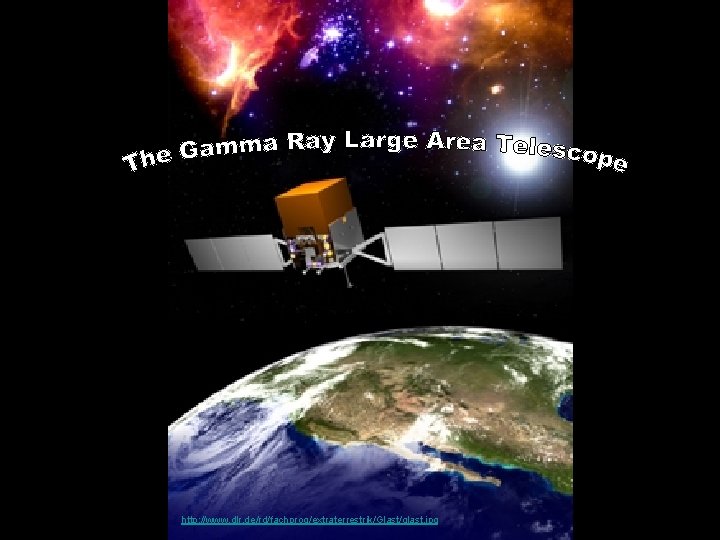
The Gamma Ray Large Area Space Telescope GLAST
- Slides: 32
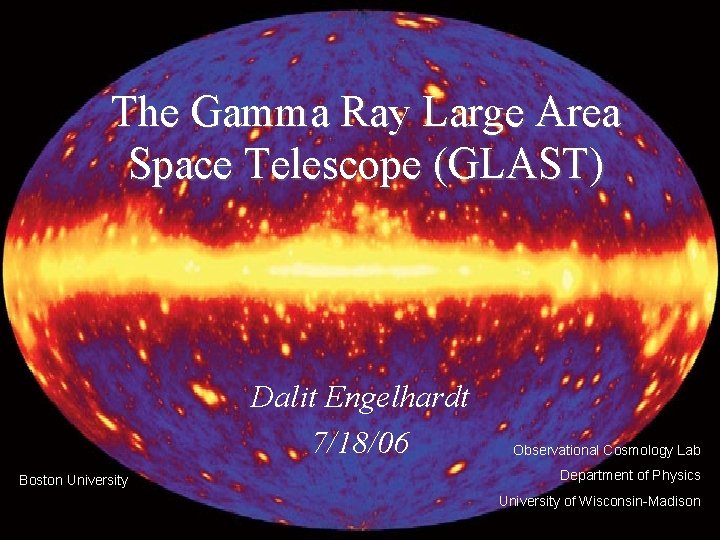
The Gamma Ray Large Area Space Telescope (GLAST) Dalit Engelhardt 7/18/06 Boston University Observational Cosmology Lab Department of Physics University of Wisconsin-Madison
Outline • Gamma ray basics • Brief History of gamma-ray experiments • The Gamma-Ray Large Area Space Telescope (GLAST) – General mission information – Scientific goals – Instrumentation
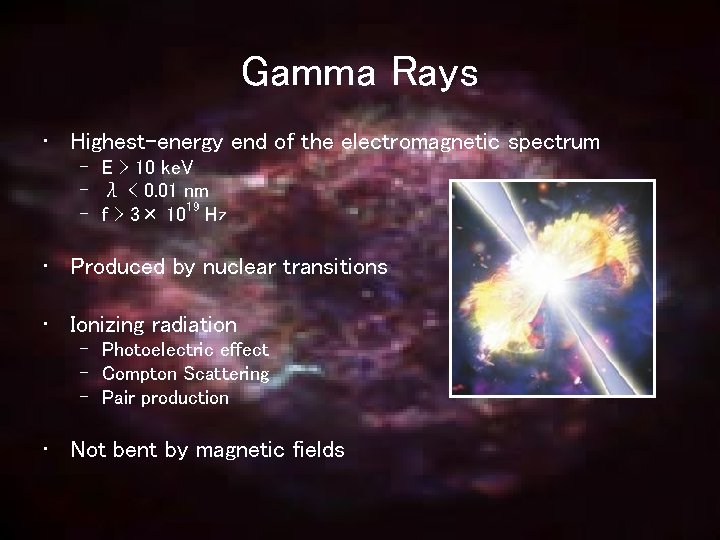
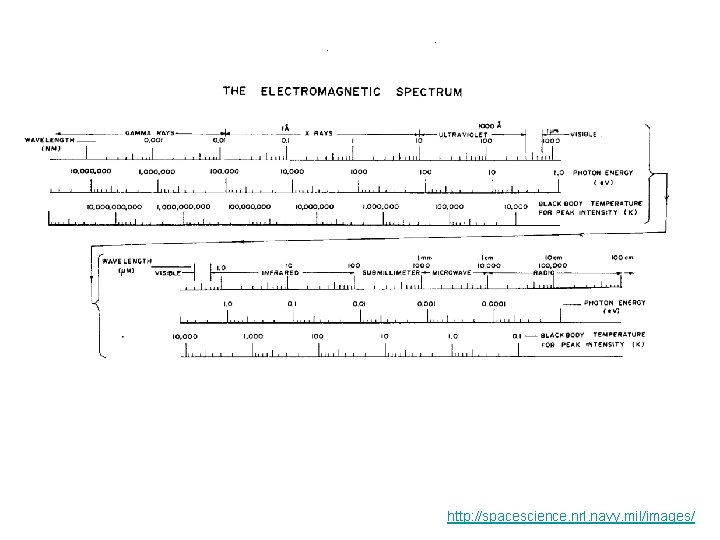
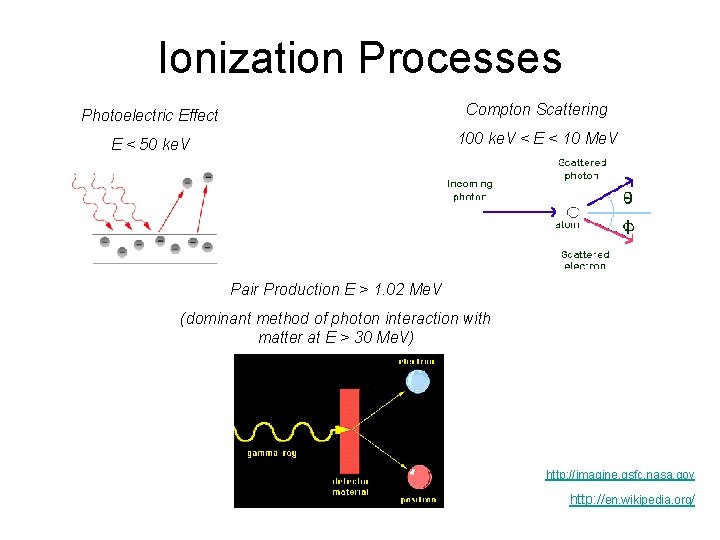
Gamma Rays • Highest-energy end of the electromagnetic spectrum – E > 10 ke. V – λ < 0. 01 nm 19 – f > 3× 10 Hz • Produced by nuclear transitions • Ionizing radiation – Photoelectric effect – Compton Scattering – Pair production • Not bent by magnetic fields
http: //spacescience. nrl. navy. mil/images/
Ionization Processes Photoelectric Effect Compton Scattering E < 50 ke. V 100 ke. V < E < 10 Me. V Pair Production E > 1. 02 Me. V (dominant method of photon interaction with matter at E > 30 Me. V) http: //imagine. gsfc. nasa. gov http: //en. wikipedia. org/
Gamma Rays – Some History (I) • 1900 – Paul Ulrich Villard observed a new type of rays not bent by magnetic fields • 1910 – William Henry Bragg showed that the rays observed by Villard ionized gas in a similar way to x-rays • 1914 – Ernest Rutherford and Edward Andrade showed that the rays were a type of electromagnetic radiation by measuring their wavelengths (crystal diffraction), coined the term “gamma” rays
Gamma Rays – Some History (II) • 1948 -1958 – works by Feenberg and Primakoff (1948), Hayakawa and Hutchinson (1952), and Morrison (1958) led scientists to believe that a number of different processes which were occurring in the universe would result in gamma-ray emission – Cosmic ray interactions with interstellar gas, supernovae, interactions of energetic electrons with magnetic fields • 1961 – first gamma-ray telescope, carried into orbit by Explorer XI satellite – Picked up < 100 cosmic gamma-ray photons – Apparent “uniform gamma-ray background” • SAS-2 (1972), COS-B (1975 -1982) satellites – Confirmed earlier findings of gamma-ray background – First detailed map of the sky at gamma-ray wavelengths – Detection of a few point sources, but poor resolution prevented identification of most of these with individual stars or stellar systems.
Gamma Rays – Some History (III) • Late 1960’s – early 1970’s: Vela military satellite series – Designed to detect gamma ray flashes from nuclear bomb blasts, recorded gamma-ray bursts from outer space instead • 1991 – launch of NASA’s Compton Gamma Ray Observatory (CGRO) – De-orbited in 2002 due to technical failure • 2002 – launch of the ESA’s International Gamma-Ray Astrophysics Laboratory (INTEGRAL). Achievements include: – Spectral measurement of gamma-ray sources – Detection of GRBs – Mapping of the galactic plane in gamma-rays
Gamma Rays – Some History (IV) • Ground-based experiments: – Only very high-energy gamma ray permeate through the earth’s atmosphere: currently earth-based experiments can only detect gamma-ray photons of energies greater than 1 Te. V – Imaging Atmospheric Cherenkov Telescope technique • HESS, VERITAS, MAGIC, High-Energy-Gamma. Ray Astronomy (HEGRA) telescopes
http: //www. dlr. de/rd/fachprog/extraterrestrik/Glast/glast. jpg
General Mission Information • Space-based – Lower-energy gamma rays are blocked by the earth’s atmosphere • Joint venture of NASA and the U. S. Department of Energy and other physics and astrophysics programs in the partner countries of France, Germany, Italy, Japan, and Sweden • Construction completed in May 2006 – Currently undergoing environmental testing in the U. S. Naval Laboratory in Washington, D. C. • Projected launch: September 2007 (on a Delta 2920 H-10 launch vehicle) – Low-earth circular orbit (565 km altitude) at 28. 5 degree inclination, period: 95 minutes – Scan the entire sky every three hours – Mission designed for a lifetime of 5 years, with a goal of 10 years of operation – Mission will start with a one-year all-sky survey of gamma-ray sources, after which guest observers will be able to apply for observation time
Scientific Goals • • • Blazar-class active galactic nuclei (AGNs) Pulsars Solar flares Unidentified Gamma-ray sources Gamma-ray bursts Dark matter
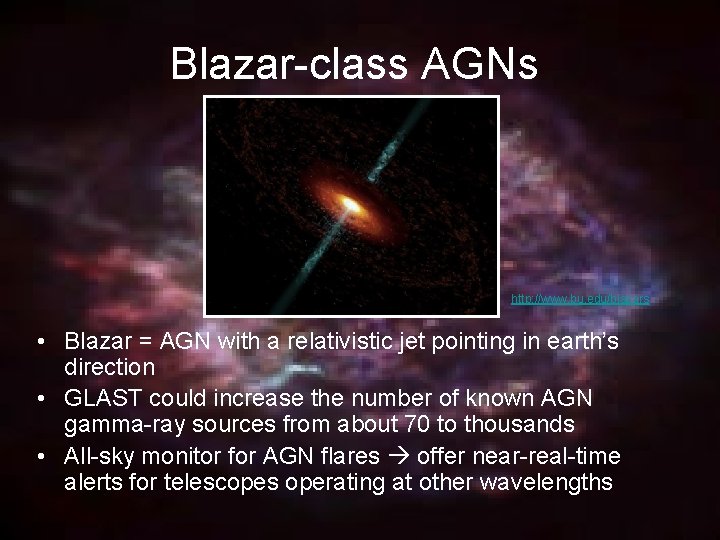
Blazar-class AGNs http: //www. bu. edu/blazars • Blazar = AGN with a relativistic jet pointing in earth’s direction • GLAST could increase the number of known AGN gamma-ray sources from about 70 to thousands • All-sky monitor for AGN flares offer near-real-time alerts for telescopes operating at other wavelengths
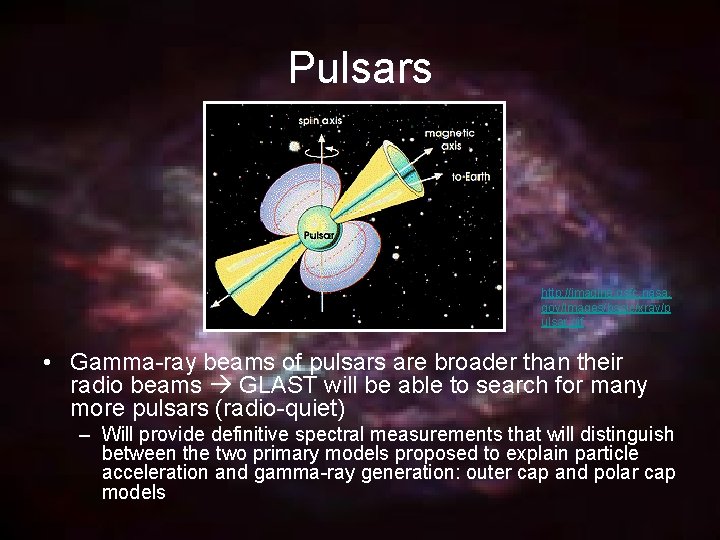
Pulsars http: //imagine. gsfc. nasa. gov/Images/basic/xray/p ulsar. gif • Gamma-ray beams of pulsars are broader than their radio beams GLAST will be able to search for many more pulsars (radio-quiet) – Will provide definitive spectral measurements that will distinguish between the two primary models proposed to explain particle acceleration and gamma-ray generation: outer cap and polar cap models
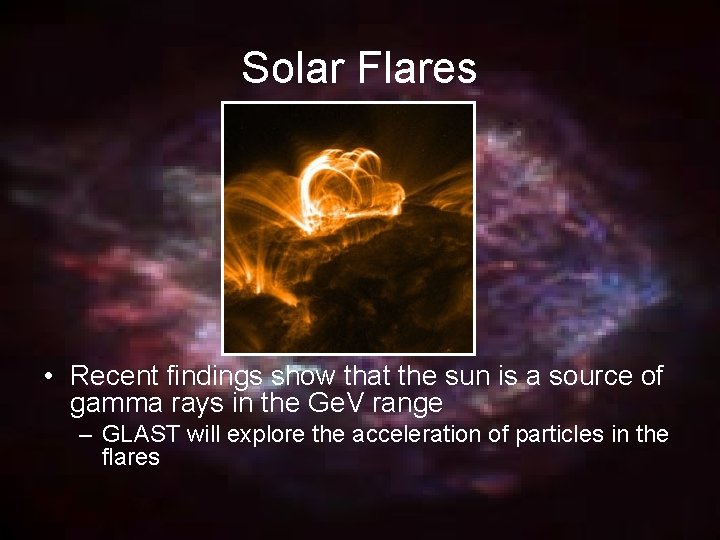
Solar Flares • Recent findings show that the sun is a source of gamma rays in the Ge. V range – GLAST will explore the acceleration of particles in the flares
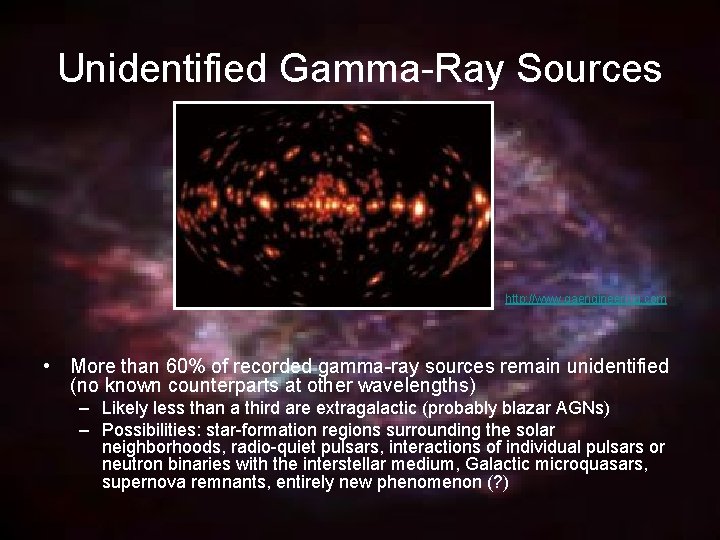
Unidentified Gamma-Ray Sources http: //www. gaengineering. com • More than 60% of recorded gamma-ray sources remain unidentified (no known counterparts at other wavelengths) – Likely less than a third are extragalactic (probably blazar AGNs) – Possibilities: star-formation regions surrounding the solar neighborhoods, radio-quiet pulsars, interactions of individual pulsars or neutron binaries with the interstellar medium, Galactic microquasars, supernova remnants, entirely new phenomenon (? )
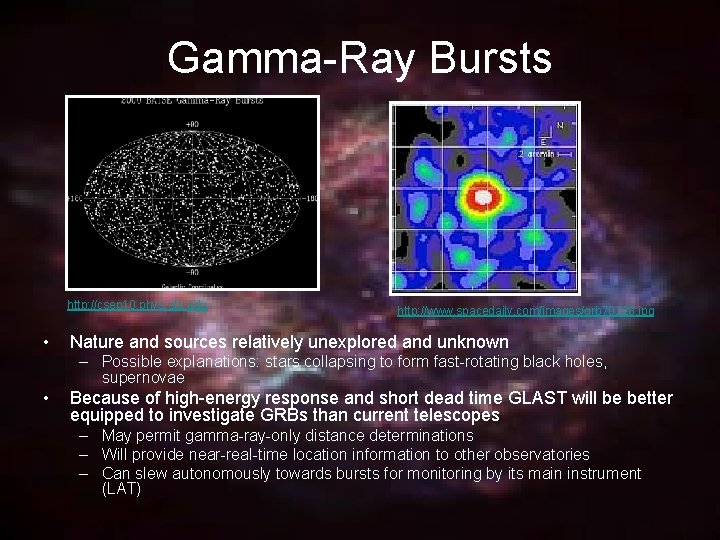
Gamma-Ray Bursts http: //csep 10. phys. utk. edu • http: //www. spacedaily. com/images/grb 70228. jpg Nature and sources relatively unexplored and unknown – Possible explanations: stars collapsing to form fast-rotating black holes, supernovae • Because of high-energy response and short dead time GLAST will be better equipped to investigate GRBs than current telescopes – May permit gamma-ray-only distance determinations – Will provide near-real-time location information to other observatories – Can slew autonomously towards bursts for monitoring by its main instrument (LAT)
Dark Matter It would be very nice if I could get a picture for this one… • Theory: weakly interacting massive particles (WIMPs) annihilating each other, thus producing gamma rays – Can expect a spatially diffuse, narrow emission line peaked toward the galactic center • GLAST will resolve the isotropic background detected by earlier observations into discrete AGN sources – Large area, low instrumental background • Other possibility: diffuse, cosmic residual possible connection with particle decay in the early universe
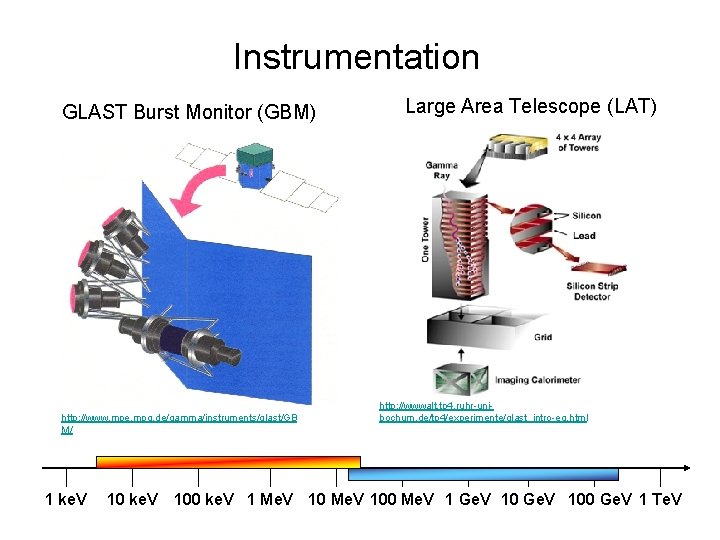
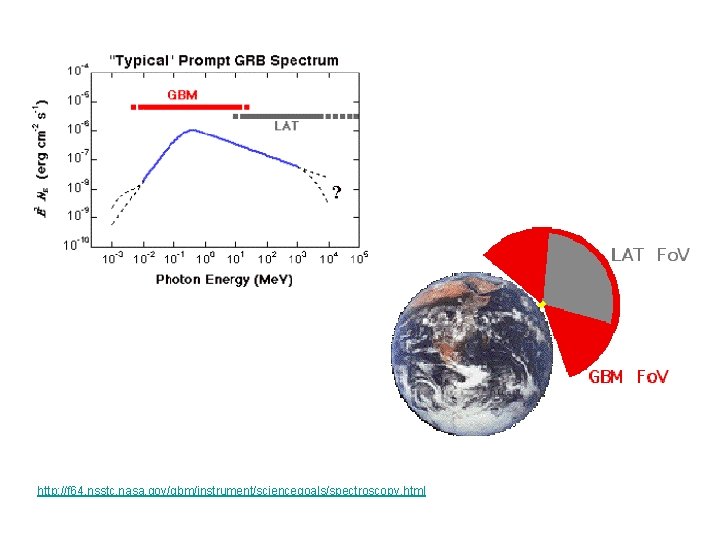
Instrumentation GLAST Burst Monitor (GBM) http: //www. mpe. mpg. de/gamma/instruments/glast/GB M/ 1 ke. V 10 ke. V Large Area Telescope (LAT) http: //wwwalt. tp 4. ruhr-unibochum. de/tp 4/experimente/glast_intro-eg. html 100 ke. V 1 Me. V 100 Me. V 1 Ge. V 100 Ge. V 1 Te. V
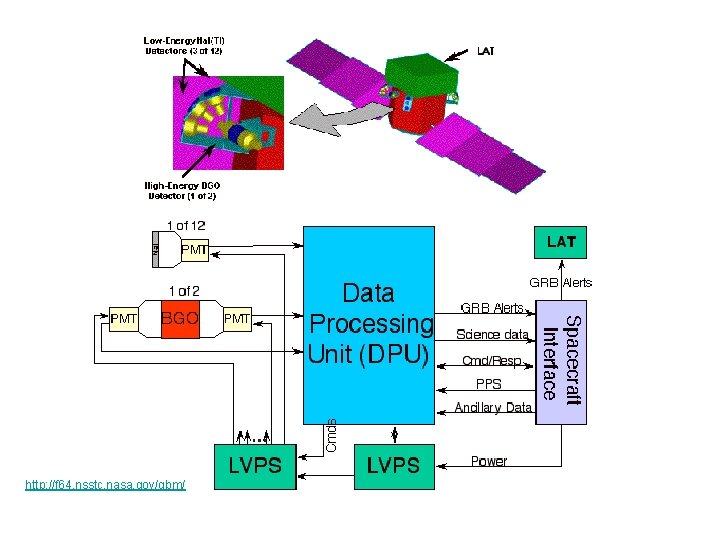
GLAST Burst Monitor (GBM) • Collaborative effort between the National Space Science and Technology Center in the U. S. and the Max Planck Institute for Extraterrestrial Physics (MPE) in Germany • Primary objective: to augment the GLAST LAT scientific return from gamma-ray bursts – Extend the energy range of burst spectra down to 5 ke. V – providing real time burst location data over a wide field-of-view (FOV) with sufficient accuracy to repoint the GLAST spacecraft – Provide near-real-time burst data to observatories (either groundor space-based operating at other wavelengths) to search for counterparts • Sensitive to x-rays and gamma rays with 5 ke. V < E < 25 Me. V
http: //f 64. nsstc. nasa. gov/gbm/instrument/sciencegoals/spectroscopy. html
http: //f 64. nsstc. nasa. gov/gbm/
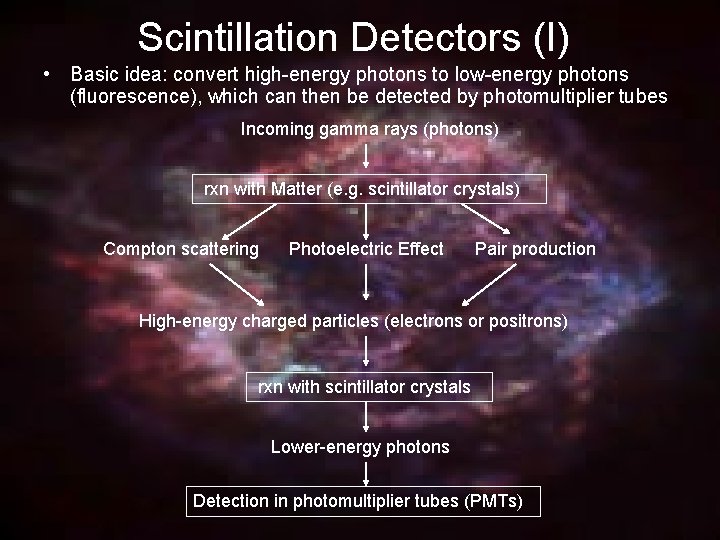
Scintillation Detectors (I) • Basic idea: convert high-energy photons to low-energy photons (fluorescence), which can then be detected by photomultiplier tubes Incoming gamma rays (photons) rxn with Matter (e. g. scintillator crystals) Compton scattering Photoelectric Effect Pair production High-energy charged particles (electrons or positrons) rxn with scintillator crystals Lower-energy photons Detection in photomultiplier tubes (PMTs)
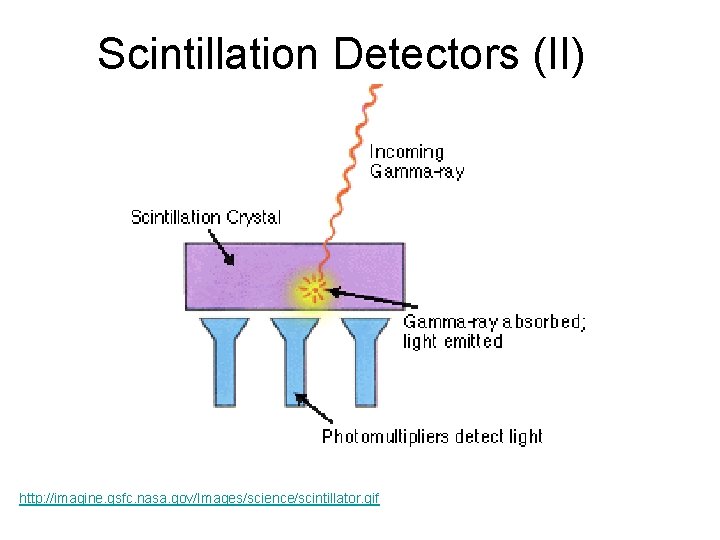
Scintillation Detectors (II) http: //imagine. gsfc. nasa. gov/Images/science/scintillator. gif
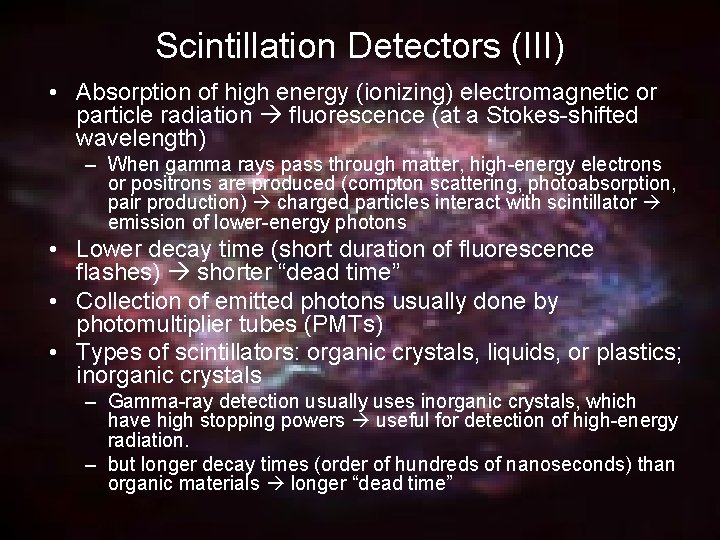
Scintillation Detectors (III) • Absorption of high energy (ionizing) electromagnetic or particle radiation fluorescence (at a Stokes-shifted wavelength) – When gamma rays pass through matter, high-energy electrons or positrons are produced (compton scattering, photoabsorption, pair production) charged particles interact with scintillator emission of lower-energy photons • Lower decay time (short duration of fluorescence flashes) shorter “dead time” • Collection of emitted photons usually done by photomultiplier tubes (PMTs) • Types of scintillators: organic crystals, liquids, or plastics; inorganic crystals – Gamma-ray detection usually uses inorganic crystals, which have high stopping powers useful for detection of high-energy radiation. – but longer decay times (order of hundreds of nanoseconds) than organic materials longer “dead time”
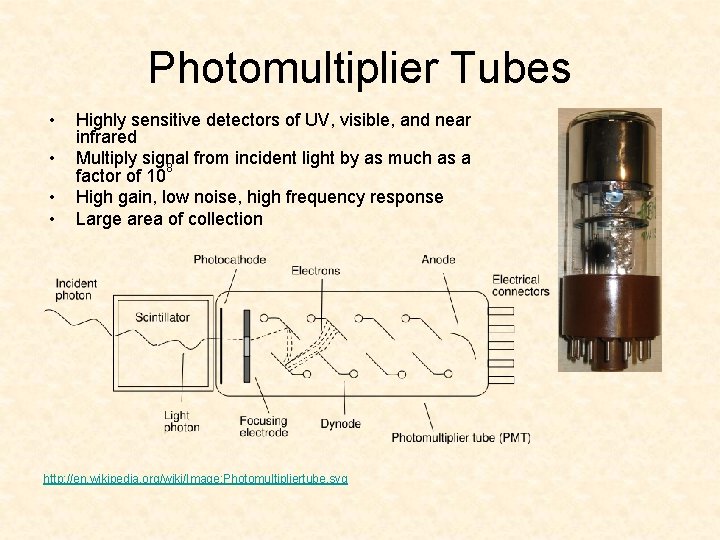
Photomultiplier Tubes • • Highly sensitive detectors of UV, visible, and near infrared Multiply signal from incident light by as much as a 8 factor of 10 High gain, low noise, high frequency response Large area of collection http: //en. wikipedia. org/wiki/Image: Photomultipliertube. svg
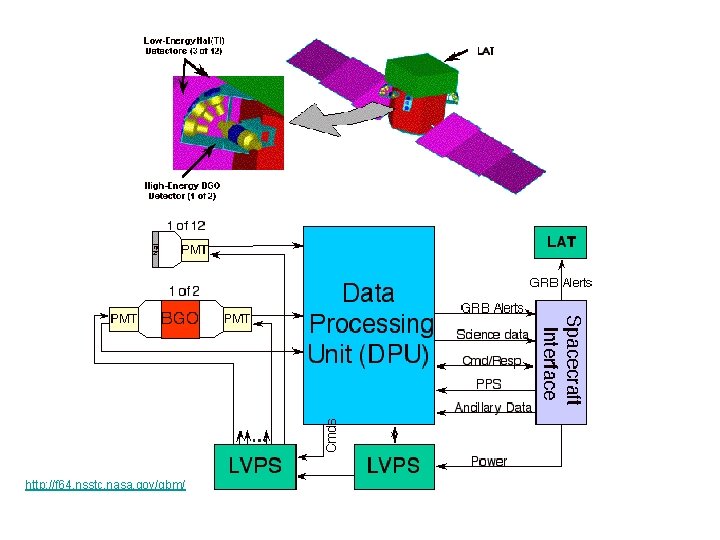
http: //f 64. nsstc. nasa. gov/gbm/
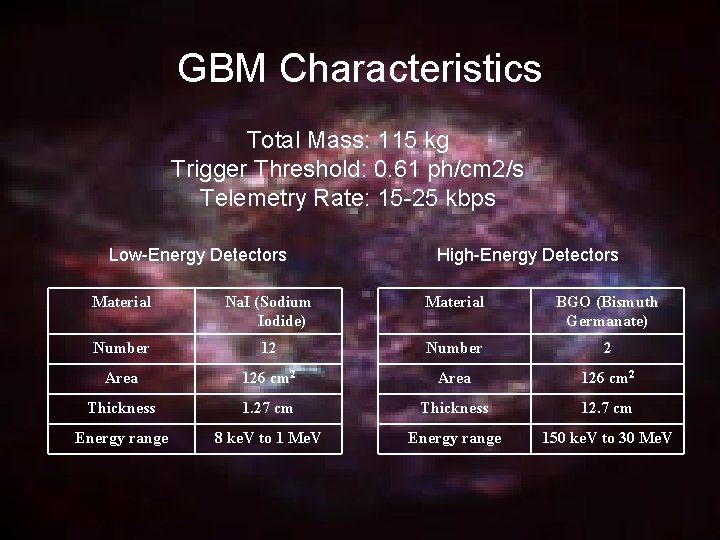
GBM Characteristics Total Mass: 115 kg Trigger Threshold: 0. 61 ph/cm 2/s Telemetry Rate: 15 -25 kbps Low-Energy Detectors High-Energy Detectors Material Na. I (Sodium Iodide) Material BGO (Bismuth Germanate) Number 12 Number 2 Area 126 cm 2 Thickness 1. 27 cm Thickness 12. 7 cm Energy range 8 ke. V to 1 Me. V Energy range 150 ke. V to 30 Me. V
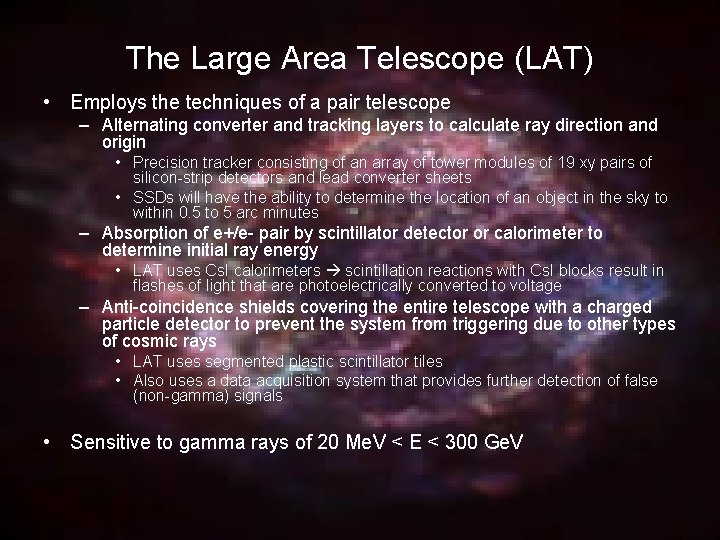
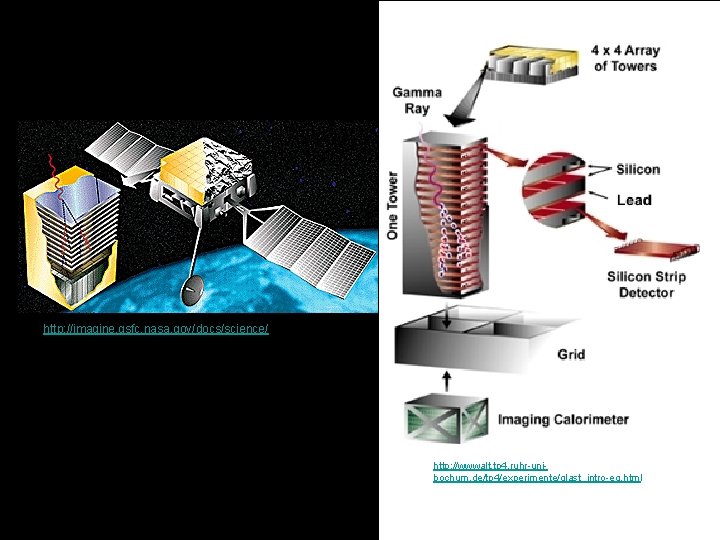
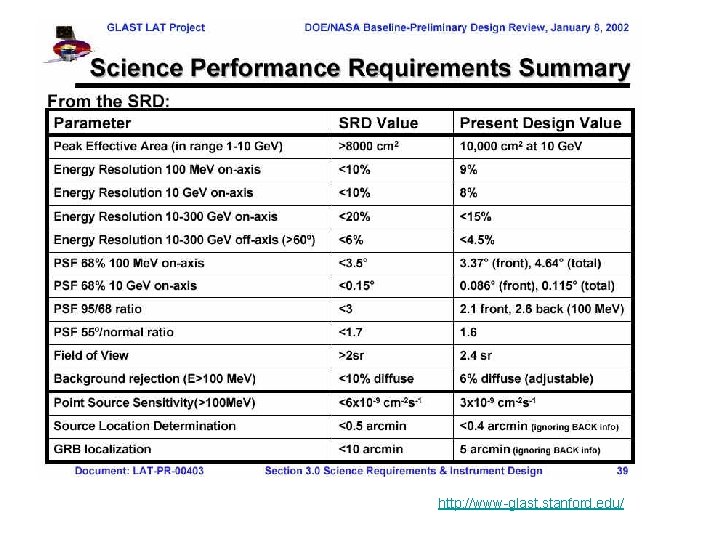
The Large Area Telescope (LAT) • Employs the techniques of a pair telescope – Alternating converter and tracking layers to calculate ray direction and origin • Precision tracker consisting of an array of tower modules of 19 xy pairs of silicon-strip detectors and lead converter sheets • SSDs will have the ability to determine the location of an object in the sky to within 0. 5 to 5 arc minutes – Absorption of e+/e- pair by scintillator detector or calorimeter to determine initial ray energy • LAT uses Cs. I calorimeters scintillation reactions with Cs. I blocks result in flashes of light that are photoelectrically converted to voltage – Anti-coincidence shields covering the entire telescope with a charged particle detector to prevent the system from triggering due to other types of cosmic rays • LAT uses segmented plastic scintillator tiles • Also uses a data acquisition system that provides further detection of false (non-gamma) signals • Sensitive to gamma rays of 20 Me. V < E < 300 Ge. V
http: //imagine. gsfc. nasa. gov/docs/science/ http: //wwwalt. tp 4. ruhr-unibochum. de/tp 4/experimente/glast_intro-eg. html
• http: //www-glast. stanford. edu/
Sources • • • GLAST Stanford Home: http: //www-glast. stanford. edu/ GLAST NASA Homepage: http: //glast. gsfc. nasa. gov/ NASA’s Imagine the Universe: http: //imagine. gsfc. nasa. gov/ The Space Science Division at the Naval Research Lab: http: //spacescience. nrl. navy. mil/ Max Planck Institute for Extraterrestrial Physics (Germany): http: //www. mpe. mpg. de Boston University’s Institute for Astrophysical Research: http: //www. bu. edu/blazars G & A Engineering: http: //www. gaengineering. com Ruhr-Universitat Bochum (Germany): http: //wwwalt. tp 4. ruhr-unibochum. de/tp 4/experimente/glast_intro-eg. html The Gamma Ray Astronomy Team at NASA: http: //f 64. nsstc. nasa. gov/gbm/ Space Daily: http: //spacedaily. com Wikipedia: http: //www. wikipedia. org