
The Gamma Factory PBC workshop CERN June 2018
The Gamma Factory PBC workshop, CERN, June 2018 Reyes Alemany-Fernandez, CERN representing the Gamma Factory study group 1
Gamma Factory group members 2
Outline 1. Gamma Factory & fundamental and applied physics highlights 2. 2017 Xe+39 MDs results 3. Plans for the 2018 MDs with PB+54, Pb+80 and PB+81 4. Preliminary results of the SPS MD 06. 2018 5. GF software development 6. Towards the Po. P experiment in the SPS 7. Impact/synergy of the GF activities on the on-going and future CERN research programme: - AWAKE - HL-LHC with iso-scalar beams - GF and the CERN muon collider studies (ARIES workshop, July 2018) 9. The way forward 3
What is Gamma Factory? 4
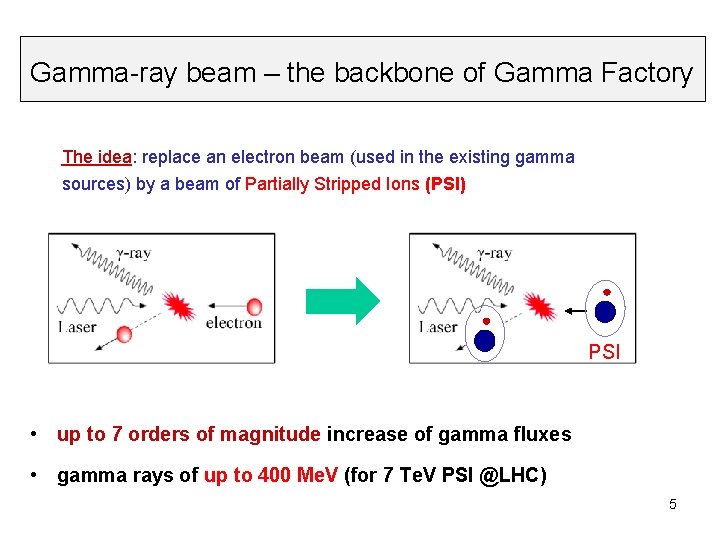
Gamma-ray beam – the backbone of Gamma Factory The idea: replace an electron beam (used in the existing gamma sources) by a beam of Partially Stripped Ions (PSI) PSI • up to 7 orders of magnitude increase of gamma fluxes • gamma rays of up to 400 Me. V (for 7 Te. V PSI @LHC) 5
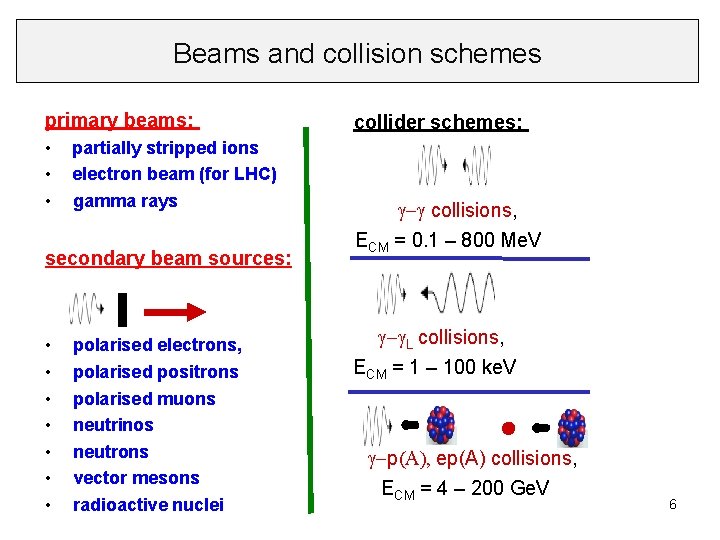
Beams and collision schemes primary beams: • • • partially stripped ions electron beam (for LHC) gamma rays secondary beam sources: • • polarised electrons, polarised positrons polarised muons neutrinos neutrons vector mesons radioactive nuclei collider schemes: g-g collisions, ECM = 0. 1 – 800 Me. V g-g. L collisions, ECM = 1 – 100 ke. V g-p(A), ep(A) collisions, ECM = 4 – 200 Ge. V 6
Using the EXISTING world unique opportunities offered by the CERN accelerator complex and scientific infrastructure 7
Basic and applied physics highlights 8
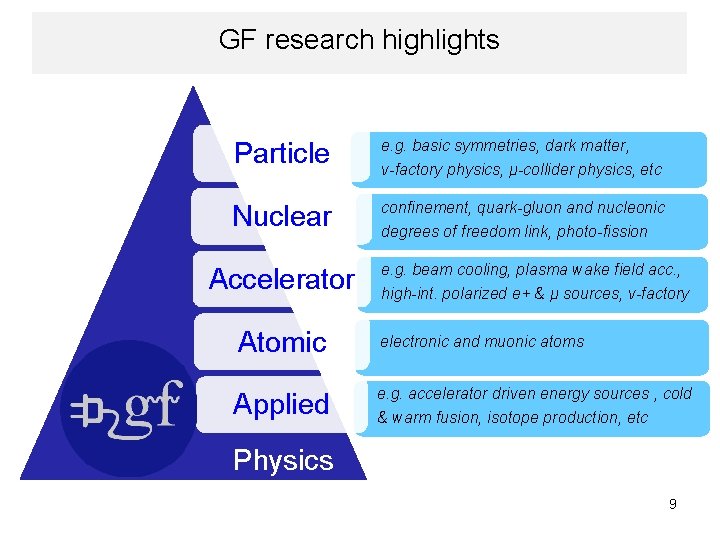
GF research highlights Particle e. g. basic symmetries, dark matter, ν-factory physics, μ-collider physics, etc Nuclear confinement, quark-gluon and nucleonic degrees of freedom link, photo-fission Accelerator e. g. beam cooling, plasma wake field acc. , high-int. polarized e+ & μ sources, ν-factory Atomic electronic and muonic atoms Applied e. g. accelerator driven energy sources , cold & warm fusion, isotope production, etc Physics 9
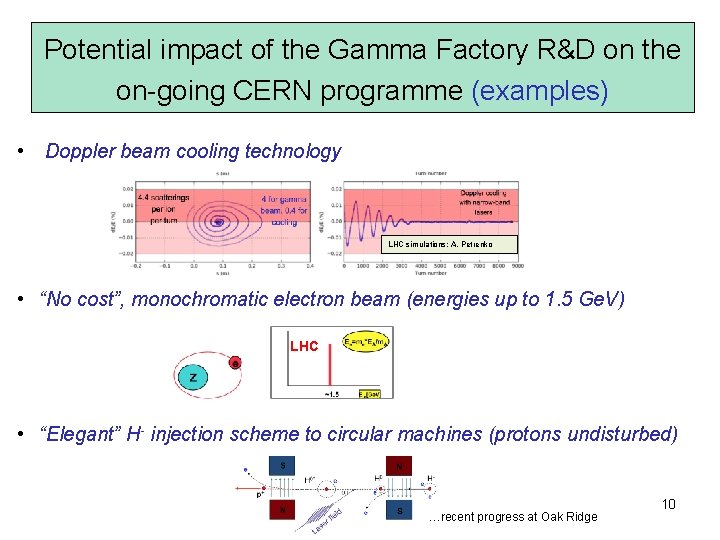
Potential impact of the Gamma Factory R&D on the on-going CERN programme (examples) • Doppler beam cooling technology LHC simulations: A. Petrenko • “No cost”, monochromatic electron beam (energies up to 1. 5 Ge. V) LHC • “Elegant” H- injection scheme to circular machines (protons undisturbed) …recent progress at Oak Ridge 10
Results of the 2017 Xe+39 MDs and their role in preparation of the 2018 MDs 11
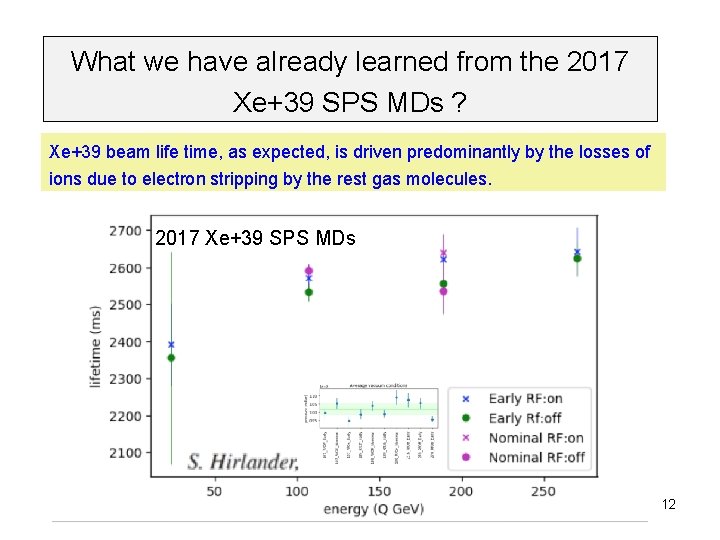
What we have already learned from the 2017 Xe+39 SPS MDs ? Xe+39 beam life time, as expected, is driven predominantly by the losses of ions due to electron stripping by the rest gas molecules. 2017 Xe+39 SPS MDs 12
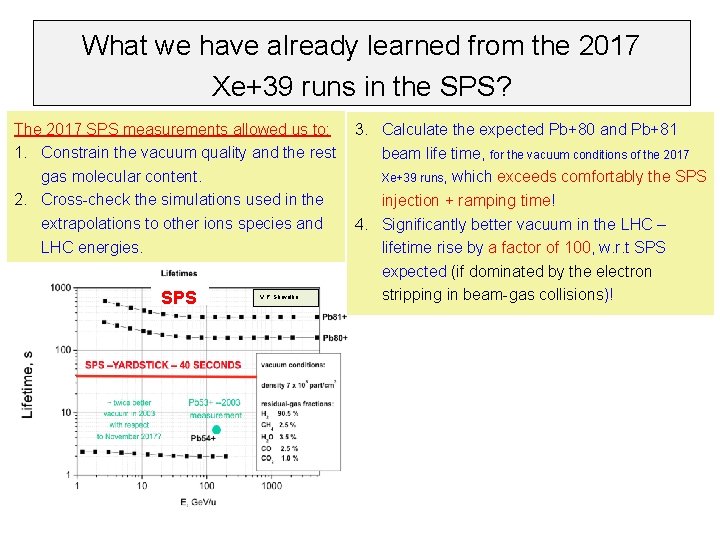
What we have already learned from the 2017 Xe+39 runs in the SPS? The 2017 SPS measurements allowed us to: 1. Constrain the vacuum quality and the rest gas molecular content. 2. Cross-check the simulations used in the extrapolations to other ions species and LHC energies. SPS V. P. Shevelko 3. Calculate the expected Pb+80 and Pb+81 beam life time, for the vacuum conditions of the 2017 Xe+39 runs, which exceeds comfortably the SPS injection + ramping time! 4. Significantly better vacuum in the LHC – lifetime rise by a factor of 100, w. r. t SPS expected (if dominated by the electron stripping in beam-gas collisions)!

Plans for the 2018 MDs 14
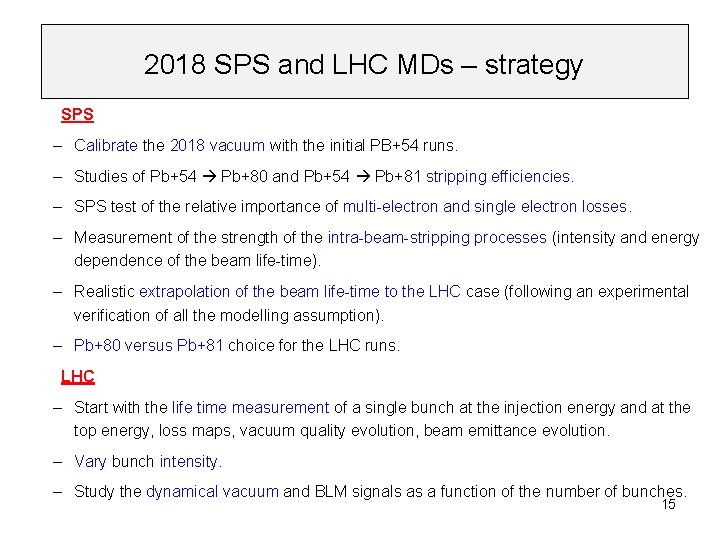
2018 SPS and LHC MDs – strategy SPS – Calibrate the 2018 vacuum with the initial PB+54 runs. – Studies of Pb+54 Pb+80 and Pb+54 Pb+81 stripping efficiencies. – SPS test of the relative importance of multi-electron and single electron losses. – Measurement of the strength of the intra-beam-stripping processes (intensity and energy dependence of the beam life-time). – Realistic extrapolation of the beam life-time to the LHC case (following an experimental verification of all the modelling assumption). – Pb+80 versus Pb+81 choice for the LHC runs. LHC – Start with the life time measurement of a single bunch at the injection energy and at the top energy, loss maps, vacuum quality evolution, beam emittance evolution. – Vary bunch intensity. – Study the dynamical vacuum and BLM signals as a function of the number of bunches. 15
First results of the 2018 MDs 16
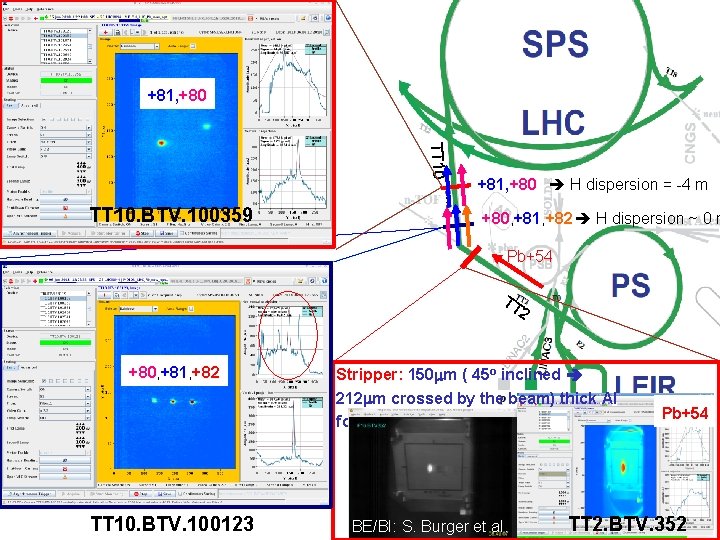
+81, +80 TT 10. BTV. 100359 +81, +80 H dispersion = -4 m +80, +81, +82 H dispersion ~ 0 m Pb+54 TT 2 +80, +81, +82 Stripper: 150 mm ( 45 o inclined 212 mm crossed by the beam) thick Al foil Pb+54 17 TT 10. BTV. 100123 BE/BI: S. Burger et al. TT 2. BTV. 352
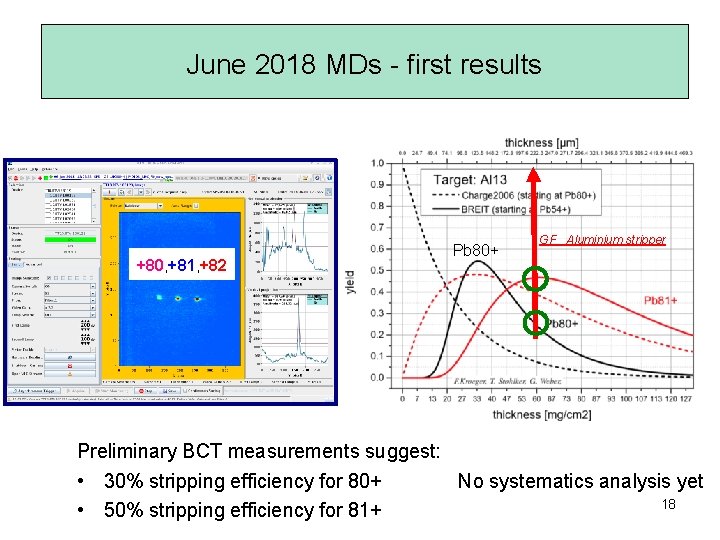
June 2018 MDs - first results +80, +81, +82 Pb 80+ GF _Aluminium stripper Preliminary BCT measurements suggest: • 30% stripping efficiency for 80+ No systematics analysis yet 18 • 50% stripping efficiency for 81+
GF software development 19
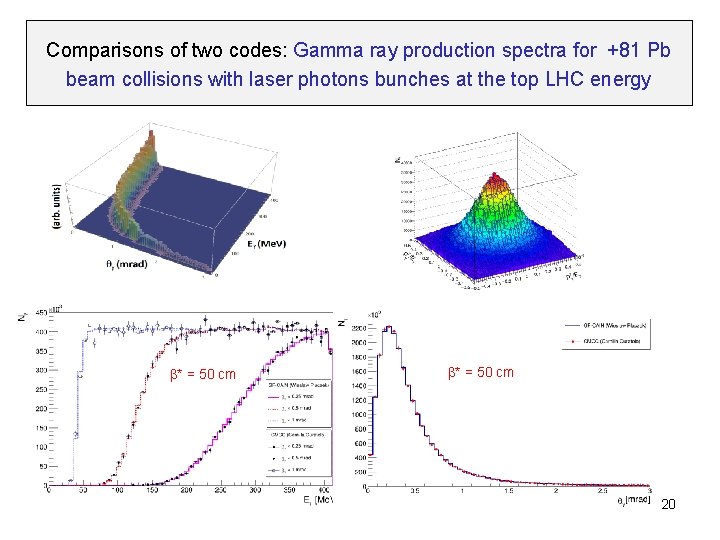
Comparisons of two codes: Gamma ray production spectra for +81 Pb beam collisions with laser photons bunches at the top LHC energy b* = 50 cm 20
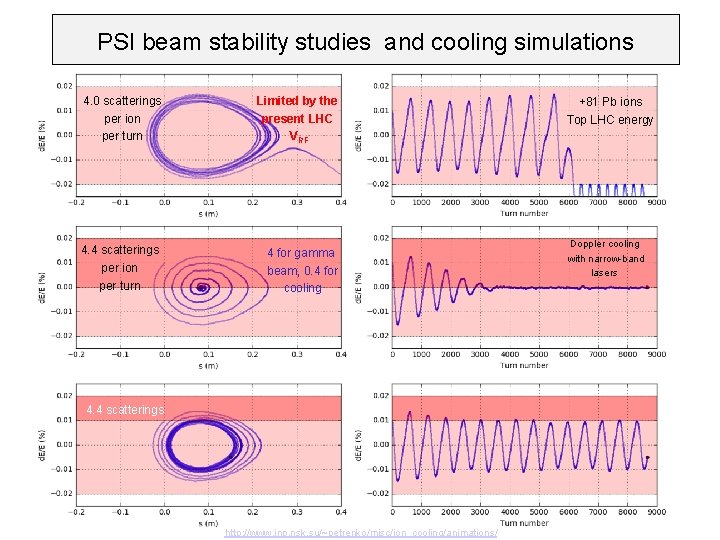
Longitudinal laser cooling is important to stabilize the ion motion: PSI beam stability studies and cooling simulations 4. 0 scatterings per ion per turn Limited by the present LHC VRF 4. 4 scatterings per ion per turn 4 for gamma beam, 0. 4 for cooling 4. 4 scatterings Simulation details: http: //www. inp. nsk. su/~petrenko/misc/ion_cooling/animations/ +81 Pb ions Top LHC energy Doppler cooling with narrow-band lasers
Towards the Po. P experiment in the SPS 22
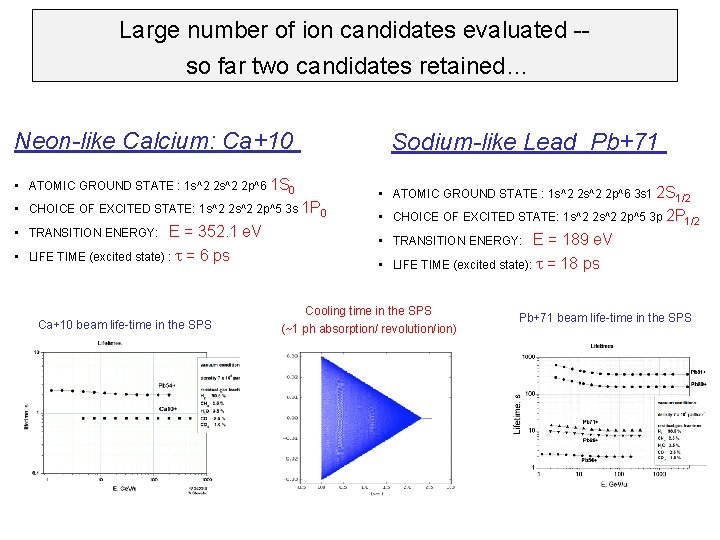
Longitudinal laser cooling important to stabilize the -ion motion: Large number of is ion candidates evaluated so far two candidates retained… Neon-like Calcium: Ca+10 • ATOMIC GROUND STATE : 1 s^2 2 p^6 1 S 0 • CHOICE OF EXCITED STATE: 1 s^2 2 p^5 3 s 1 P 0 E = 352. 1 e. V LIFE TIME (excited state) : t = 6 ps • TRANSITION ENERGY: • Ca+10 beam life-time in the SPS Sodium-like Lead Pb+71 • ATOMIC GROUND STATE : 1 s^2 2 p^6 3 s 1 2 S 1/2 • CHOICE OF EXCITED STATE: 1 s^2 2 p^5 3 p 2 P 1/2 E = 189 e. V LIFE TIME (excited state): t = 18 ps • TRANSITION ENERGY: • Cooling time in the SPS (~1 ph absorption/ revolution/ion) Pb+71 beam life-time in the SPS
Impact/synergy of the GF activities on the on-going and future CERN research programme: 24
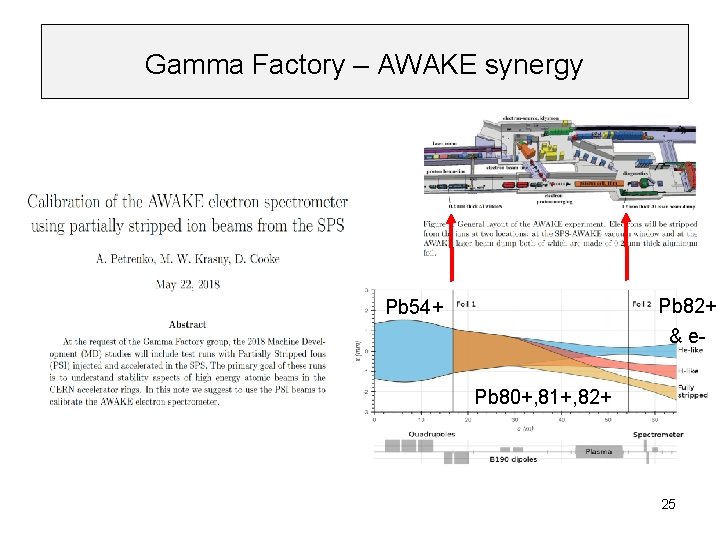
Gamma Factory – AWAKE synergy Pb 82+ & e- Pb 54+ Pb 80+, 81+, 82+ 25
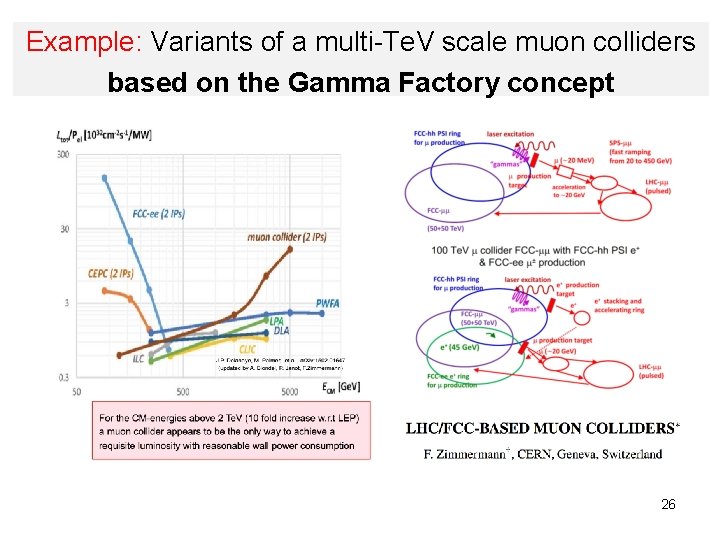
Example: Variants of a multi-Te. V scale muon colliders based on the Gamma Factory concept 26
27
The way forward – The GF document for European Strategy Process 28
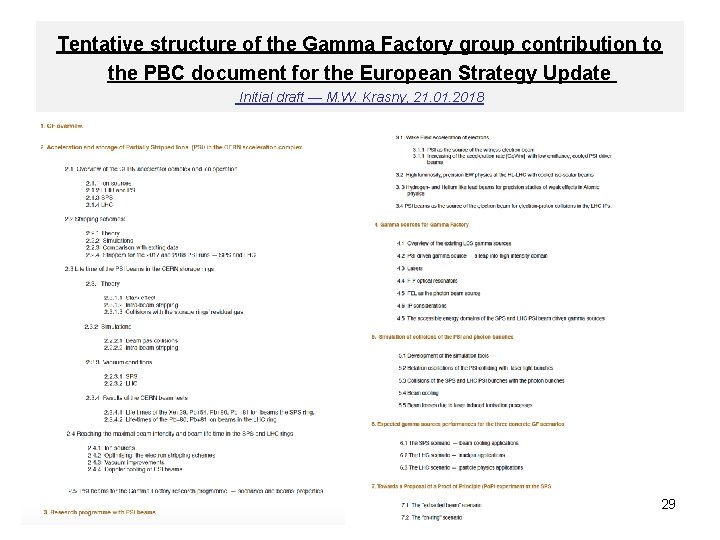
Tentative structure of the Gamma Factory group contribution to the PBC document for the European Strategy Update Initial draft — M. W. Krasny, 21. 01. 2018 29
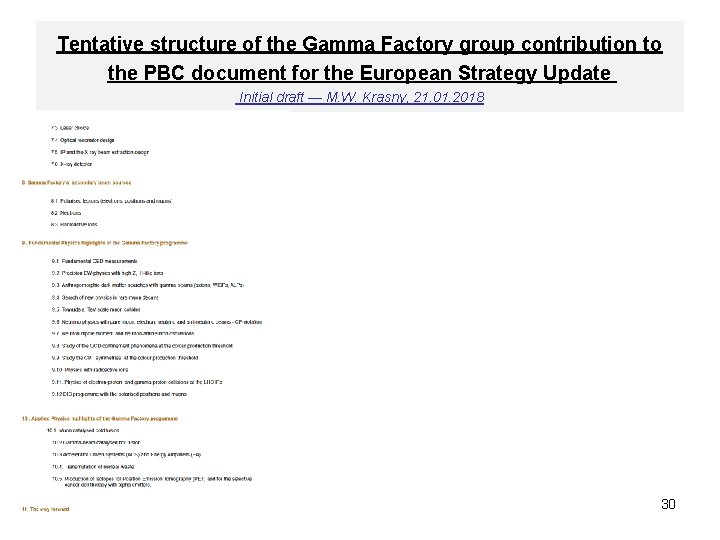
Tentative structure of the Gamma Factory group contribution to the PBC document for the European Strategy Update Initial draft — M. W. Krasny, 21. 01. 2018 30

Spares 31
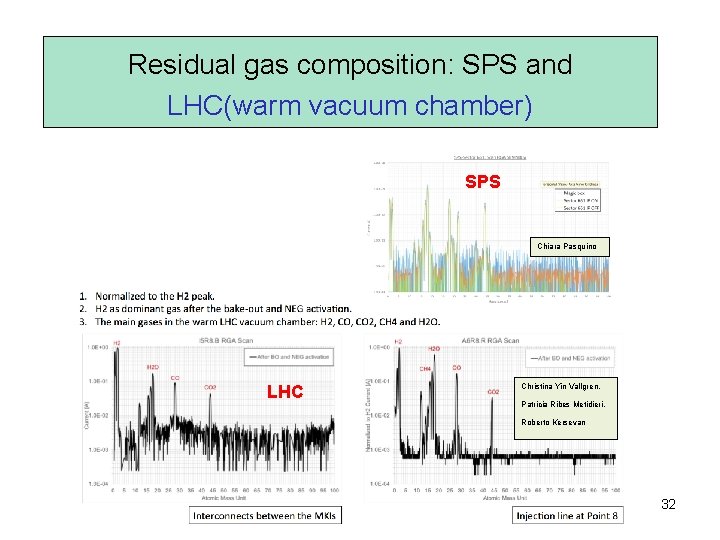
Residual gas composition: SPS and LHC(warm vacuum chamber) SPS Chiara Pasquino LHC Christina Yin Vallgren, Patricia Ribes Metidieri, Roberto Kersevan 32
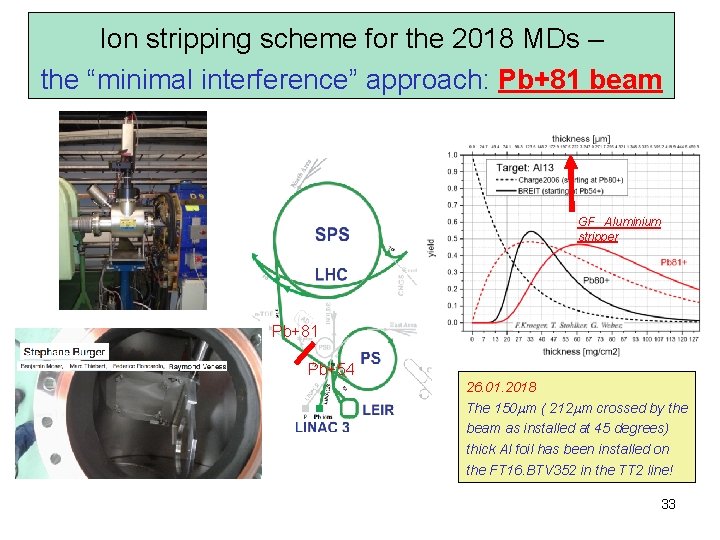
Ion stripping scheme for the 2018 MDs – the “minimal interference” approach: Pb+81 beam GF _Aluminium stripper Pb+81 Pb+54 26. 01. 2018 The 150 mm ( 212 mm crossed by the beam as installed at 45 degrees) thick Al foil has been installed on the FT 16. BTV 352 in the TT 2 line!. 33
GF research highlights • • • particle physics (studies of the basic symmetries of the universe, dark matter searches, precision QED studies, rare muon decays, neutrino-factory physics, precision-support measurements for the LHC - DIS physics, muon collider physics) nuclear physics (confinement phenomena, link between the quark-gluon and nucleonic degrees of freedom, photo-fission research program) accelerator physics (beam cooling techniques, low emittance hadronic beams, plasma wake field acceleration, high intensity polarized positron and muon sources, secondary beams of radioactive ions and neutrons, neutrinofactory) atomic physics (electronic and muonic atoms), applied physics (accelerator driven energy sources , cold and warm fusion research, isotope production: e. g alpha-emitters for medical applications, …). 34
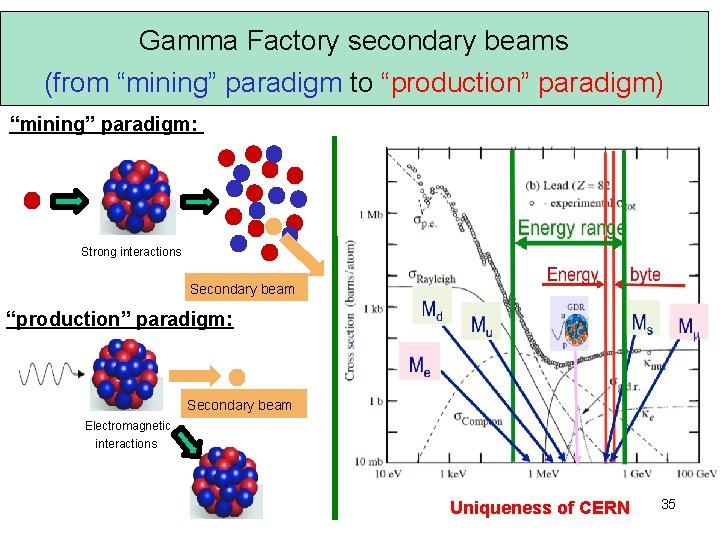
Gamma Factory secondary beams (from “mining” paradigm to “production” paradigm) “mining” paradigm: Strong interactions Secondary beam “production” paradigm: Secondary beam Electromagnetic interactions Uniqueness of CERN 35

Particle Physics • basic symmetries • ν-factory physics • precision QED dark matter μ-collider physics rare μ-decays Nuclear Physics • confinement • quark-gluon and nucleonic degrees of freedom link • photo-fission up p to a factor 104 gain in intensity w. r. t to e. g. ALTO Accelerator Physics • second. beams of radioact. ions/neutrons beam cooling • plasma wake field acceleration low emittance hadron beams • high-intensity polarized e+ & μ ν-factory Atomic Physics • electronic and muonic atoms up to a factor 103 gain in intensity w. r. t to PSI muon source up to a factor of 104 gain in intensity w. r. t KEK positron source Applied Physics up to a factor of 104 in number of • accelerator driven energy sources neutrons per 1 k. W of the driver beam • cold & warm fusion power 36 • isotope production for medical applications
The Gamma Factory beam intensity/quality promise • Highly ionised atoms – new at relativistic energies • Photons – up to a factor of 107 gain in intensity w. r. t the present gamma sources • Polarised positrons – up to a factor of 104 gain in intensity w. r. t KEK positron source • Polarised muons - up to a factor 103 gain in intensity w. r. t to PSI muon source – (low emittance beams muon collider, neutrino beams) • Neutrons – up to a factor of 104 in number of neutrons per 1 k. W of the driver beam power • Radioactive ions – up p to a factor 104 gain in intensity w. r. t to e. g. ALTO 37
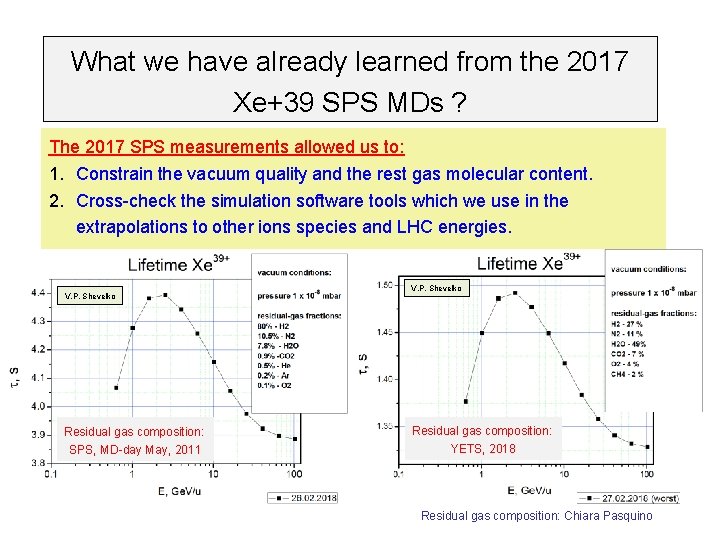
What we have already learned from the 2017 Xe+39 SPS MDs ? The 2017 SPS measurements allowed us to: 1. Constrain the vacuum quality and the rest gas molecular content. 2. Cross-check the simulation software tools which we use in the extrapolations to other ions species and LHC energies. V. P. Shevelko Residual gas composition: SPS, MD-day May, 2011 V. P. Shevelko Residual gas composition: YETS, 2018 Residual gas composition: Chiara Pasquino 38
- Slides: 38