
The Galactic diffuse emission Sabrina Casanova MPIK Heidelberg

The Galactic diffuse emission Sabrina Casanova, MPIK Heidelberg XXth RENCONTRES DE BLOIS 18 th - 23 rd May 2008, Blois

Outline Motivations : Sources of cosmic rays and galactic diffuse gamma emission Ge. V excess measured by EGRET Pinpointing the sources of cosmic rays Te. V observations with HESS and Milagro ‘’Truly’’ diffuse emission and unresolved sources Goals of future observations and theoretical speculations
Do -rays answer the open questions concerning the origin of cosmic rays ? What are the cosmic ray accelerators and the primary spectra ? -rays are produced by cosmic-ray interactions in their sources and point back to the production locations How high in energy can galactic sources produce particles? The highest energy particles produce highest energy -rays. Are the accelerators of hadrons different from electrons? Hadronic and leptonic mechanisms produce different energy spectra and -ray time variability How do cosmic rays propagate in the Galaxy ? What is the rate of production of relativistic particles ? Gamma ray spectrum and spatial distribution provide spectra and density of hadrons and leptons in different regions of the Galaxy
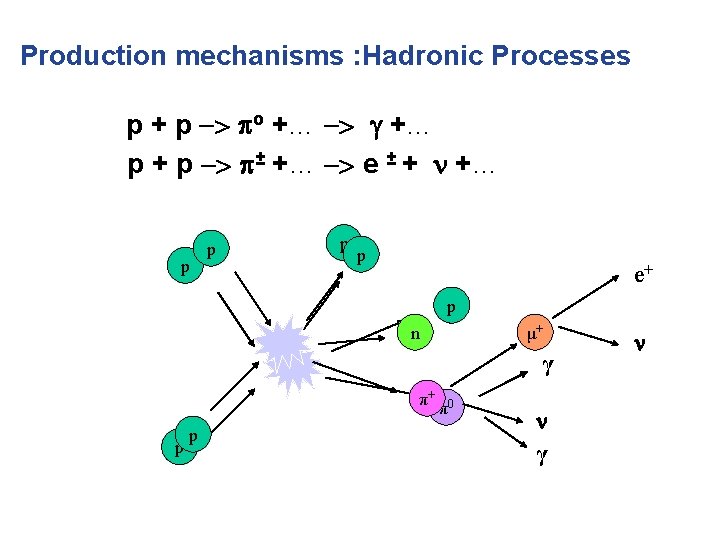
Production mechanisms : Hadronic Processes p + p -> o +… -> +… p + p -> ± +… -> e ± + n +… p p e+ p n μ+ γ π+ π0 p p n γ n
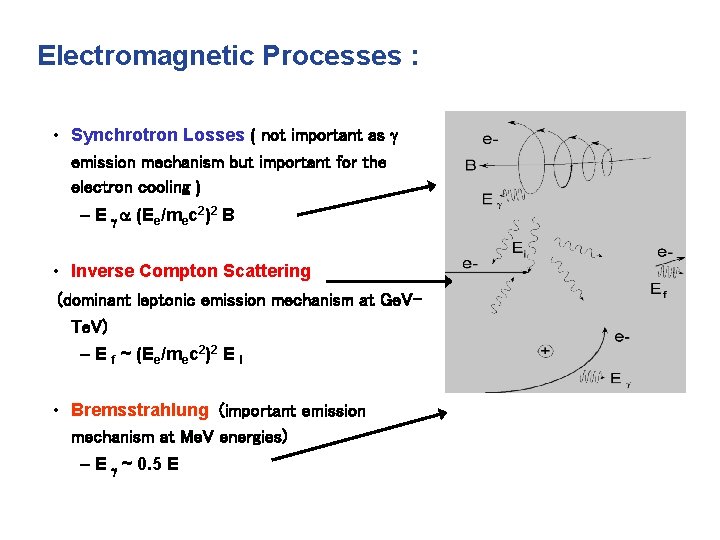
Electromagnetic Processes : • Synchrotron Losses ( not important as emission mechanism but important for the electron cooling ) – E a (Ee/mec 2)2 B • Inverse Compton Scattering (dominant leptonic emission mechanism at Ge. VTe. V) – E f ~ (Ee/mec 2)2 E I • Bremsstrahlung (important emission mechanism at Me. V energies) – E ~ 0. 5 E
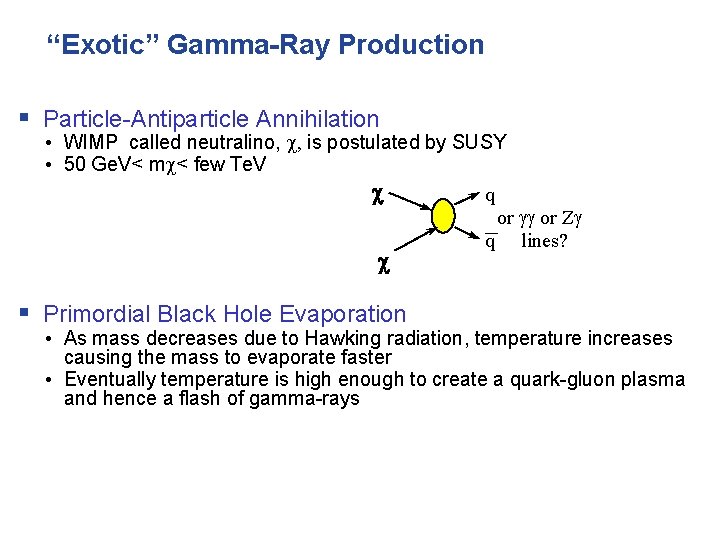
“Exotic” Gamma-Ray Production Particle-Antiparticle Annihilation • WIMP called neutralino, c, is postulated by SUSY • 50 Ge. V< mc< few Te. V c q or gg or Zg q lines? c Primordial Black Hole Evaporation • As mass decreases due to Hawking radiation, temperature increases causing the mass to evaporate faster • Eventually temperature is high enough to create a quark-gluon plasma and hence a flash of gamma-rays
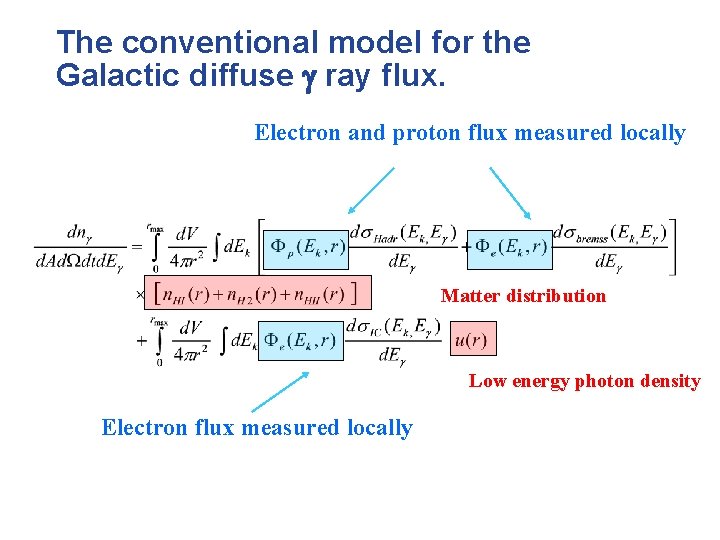
The conventional model for the Galactic diffuse ray flux. Electron and proton flux measured locally Matter distribution Low energy photon density Electron flux measured locally
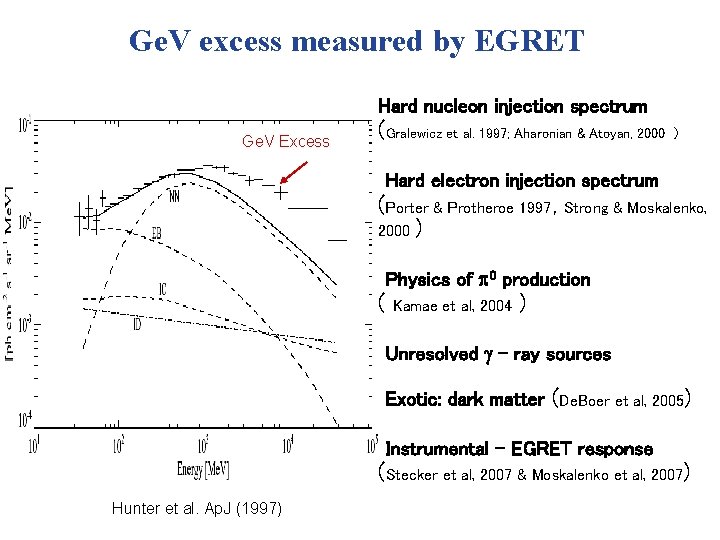
Ge. V excess measured by EGRET Hard nucleon injection spectrum Ge. V Excess (Gralewicz et al. 1997; Aharonian & Atoyan, 2000 ) Hard electron injection spectrum (Porter & Protheroe 1997, 2000 ) ( Strong & Moskalenko, Physics of 0 production Kamae et al, 2004 ) Unresolved - ray sources Exotic: dark matter (De. Boer et al, 2005) Instrumental – EGRET response (Stecker et al, 2007 & Moskalenko et al, 2007) Hunter et al. Ap. J (1997)
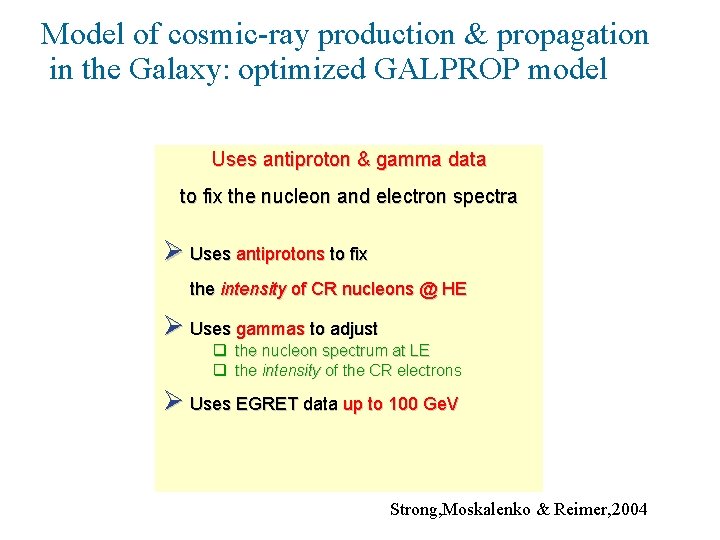
Model of cosmic-ray production & propagation in the Galaxy: optimized GALPROP model Uses antiproton & gamma EGRETdata to. COMPTEL fix the nucleon and electron spectra o inverse Uses antiprotons to. Compton fix TOTAL the intensity of CR nucleons @ HE brems Uses gammas to adjust strahlung the nucleon spectrum at LE extragalactic the intensity of the CR electrons background Uses EGRET data up to 100 Ge. V Strong, Moskalenko & Reimer, 2004
CONVENTIONAL MODEL: the electron and proton spectra locally measured are representative of the Galactic cosmic ray spectrum everywhere in the Galaxy (Bertsch et al, 1993). OPTIMIZED GALPROP MODEL: the proton and electron densities are allowed to vary roughly of a factor 2 and 4 in order to match the EGRET data (Strong, Moskalenko & Strong, 2004). Cosmic ray injection is a stochastic process : The cosmic ray spectra close to injection sources vary in both spectral index and normalization with respect to the so called ‘’sea’’ of cosmic rays due to energy dependent diffusion processes. The cosmic ray spectra close to sources are time dependent due to injection and diffusion history.
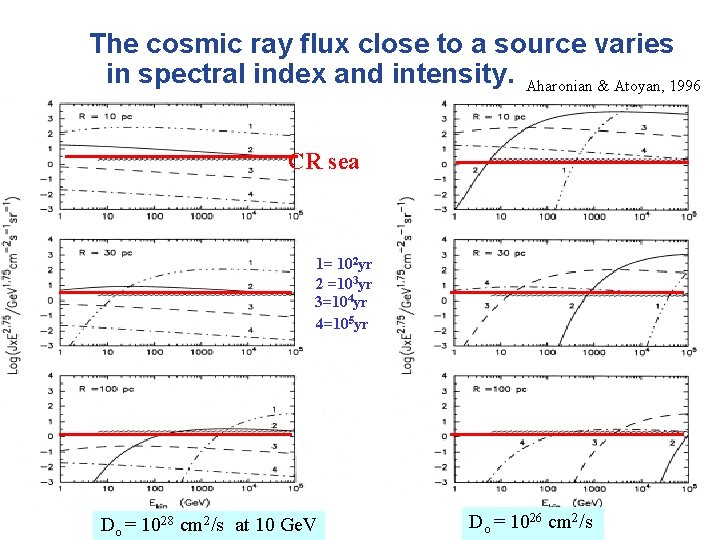
The cosmic ray flux close to a source varies in spectral index and intensity. Aharonian & Atoyan, 1996 CR sea 1= 102 yr 2 =103 yr 3=104 yr 4=105 yr Do = 1028 cm 2/s at 10 Ge. V Do = 1026 cm 2/s
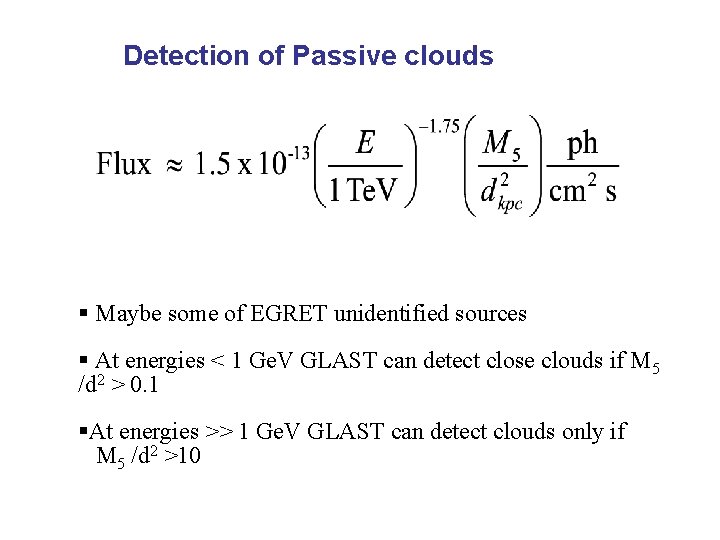
Detection of Passive clouds Maybe some of EGRET unidentified sources At energies < 1 Ge. V GLAST can detect close clouds if M 5 /d 2 > 0. 1 At energies >> 1 Ge. V GLAST can detect clouds only if M 5 /d 2 >10
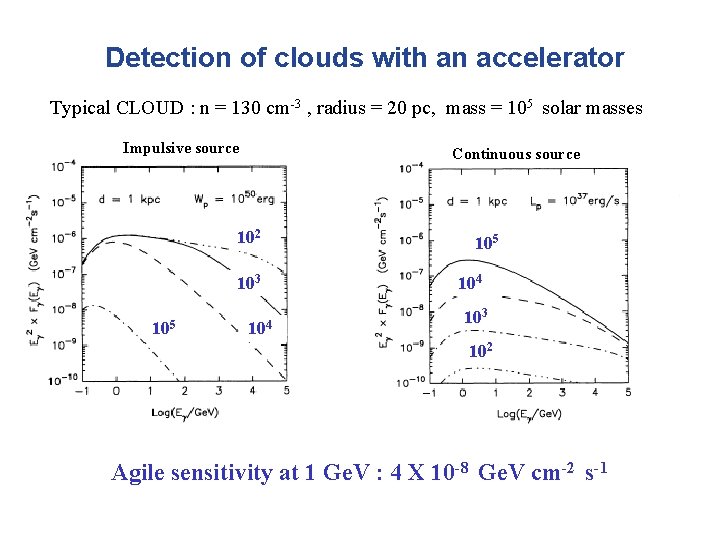
Detection of clouds with an accelerator Typical CLOUD : n = 130 cm-3 , radius = 20 pc, mass = 105 solar masses Impulsive source Continuous source 102 103 105 104 103 102 Agile sensitivity at 1 Ge. V : 4 X 10 -8 Ge. V cm-2 s-1
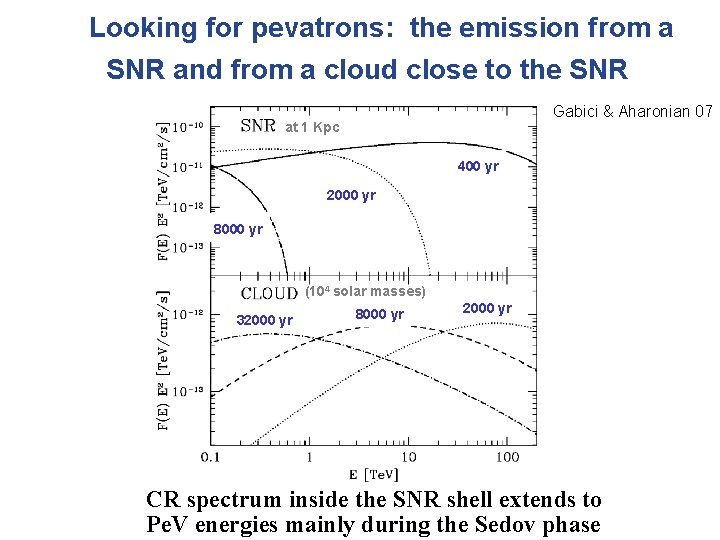
Looking for pevatrons: the emission from a SNR and from a cloud close to the SNR Gabici & Aharonian 07 at 1 Kpc 400 yr 2000 yr 8000 yr (104 solar masses) 32000 yr 8000 yr 2000 yr CR spectrum inside the SNR shell extends to Pe. V energies mainly during the Sedov phase
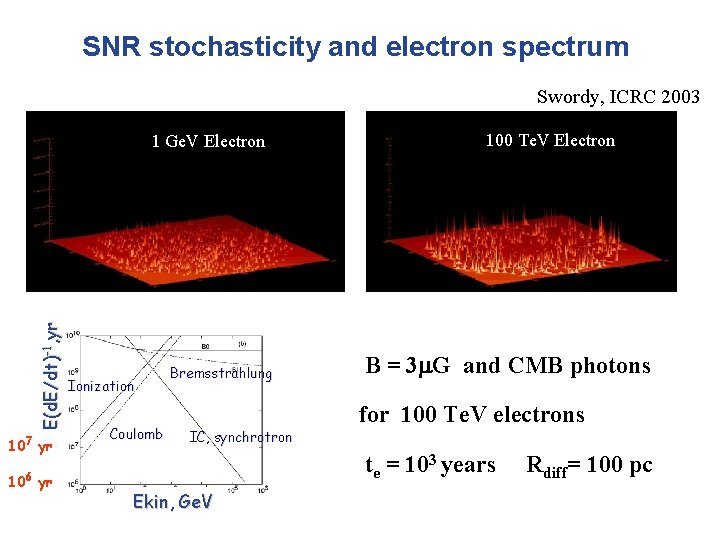
SNR stochasticity and electron spectrum Swordy, ICRC 2003 E(d. E/dt)-1, yr 1 Ge. V Electron 107 yr 106 yr Ionization Coulomb Bremsstrahlung IC, synchrotron 100 Te. V Electron B = 3 m. G and CMB photons for 100 Te. V electrons te = 103 years Ekin, Ge. V Rdiff= 100 pc
Te. V observations of diffuse sources
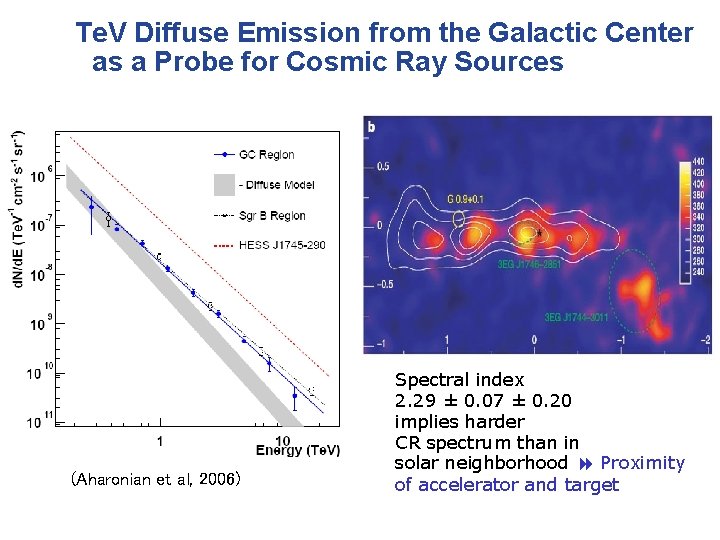
Te. V Diffuse Emission from the Galactic Center as a Probe for Cosmic Ray Sources (Aharonian et al, 2006) Spectral index 2. 29 ± 0. 07 ± 0. 20 implies harder CR spectrum than in solar neighborhood Proximity of accelerator and target
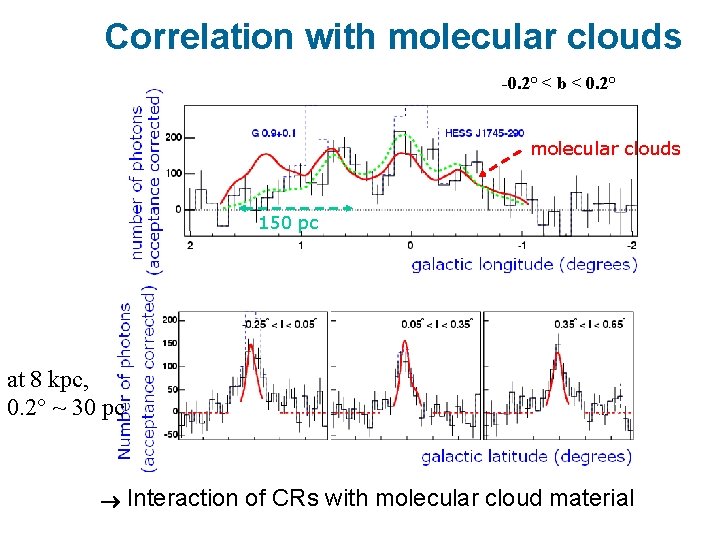
Correlation with molecular clouds -0. 2° < b < 0. 2° molecular clouds 150 pc at 8 kpc, 0. 2° ~ 30 pc Interaction of CRs with molecular cloud material
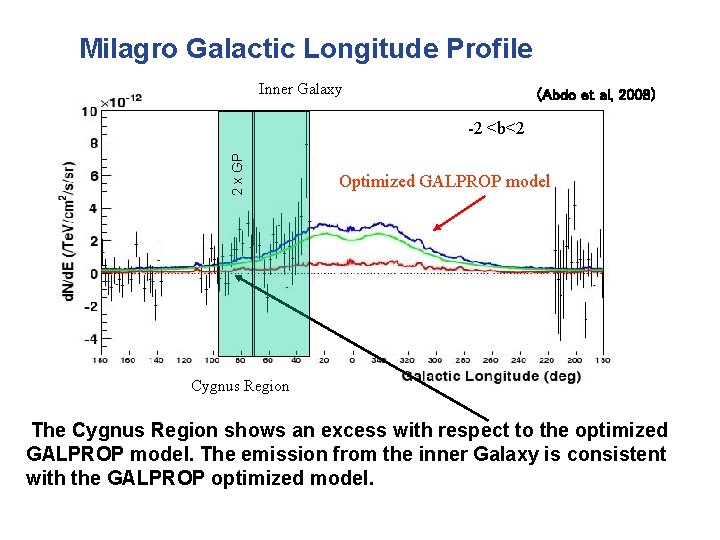
Milagro Galactic Longitude Profile Inner Galaxy (Abdo et al, 2008) 2 x GP -2 <b<2 Optimized GALPROP model Cygnus Region The Cygnus Region shows an excess with respect to the optimized GALPROP model. The emission from the inner Galaxy is consistent with the GALPROP optimized model.
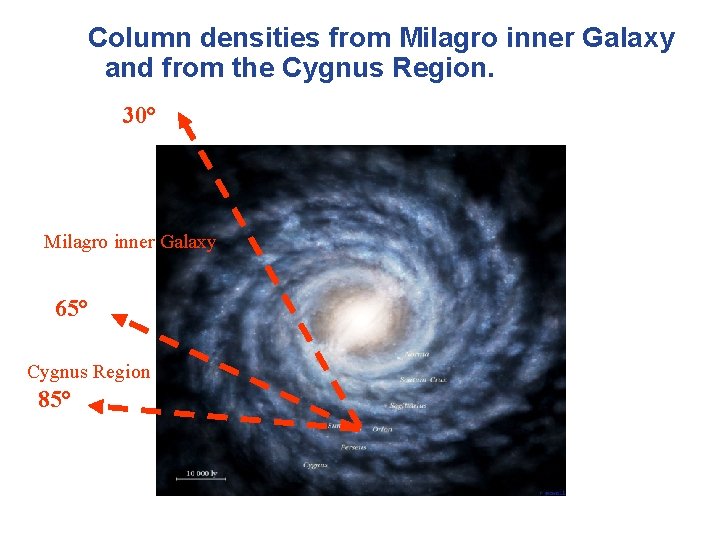
Column densities from Milagro inner Galaxy and from the Cygnus Region. 30° Milagro inner Galaxy 65° Cygnus Region 85°
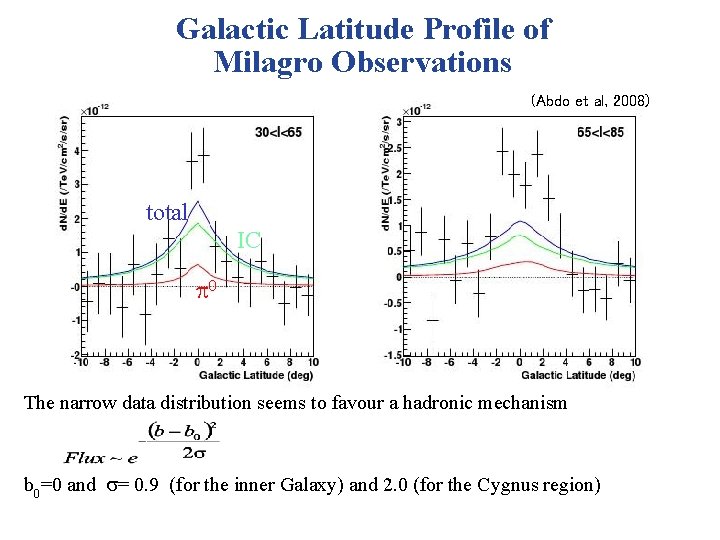
Galactic Latitude Profile of Milagro Observations (Abdo et al, 2008) total IC 0 The narrow data distribution seems to favour a hadronic mechanism b 0=0 and s= 0. 9 (for the inner Galaxy) and 2. 0 (for the Cygnus region)
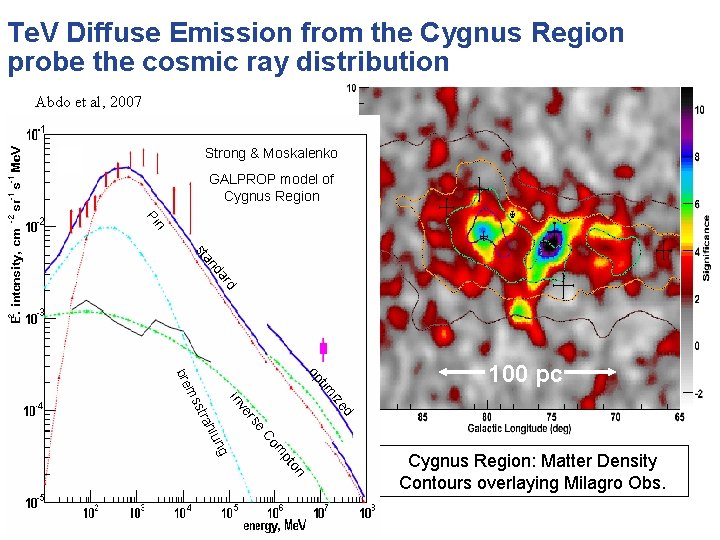
Te. V Diffuse Emission from the Cygnus Region probe the cosmic ray distribution Abdo et al, 2007 Strong & Moskalenko GALPROP model of Cygnus Region n Pi d ar d an st d rs ve In e on pt m Co g lun ah str ms ize im t op bre 100 pc Cygnus Region: Matter Density Contours overlaying Milagro Obs.

“Truly” diffuse emission or unresolved sources ?
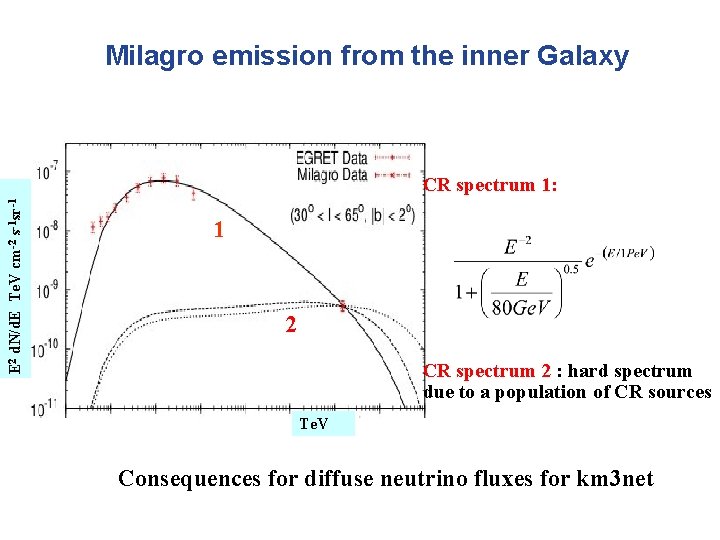
Milagro emission from the inner Galaxy E 2 d. N/d. E Te. V cm-2 s-1 sr-1 CR spectrum 1: 1 2 CR spectrum 2 : hard spectrum due to a population of CR sources Te. V Consequences for diffuse neutrino fluxes for km 3 net
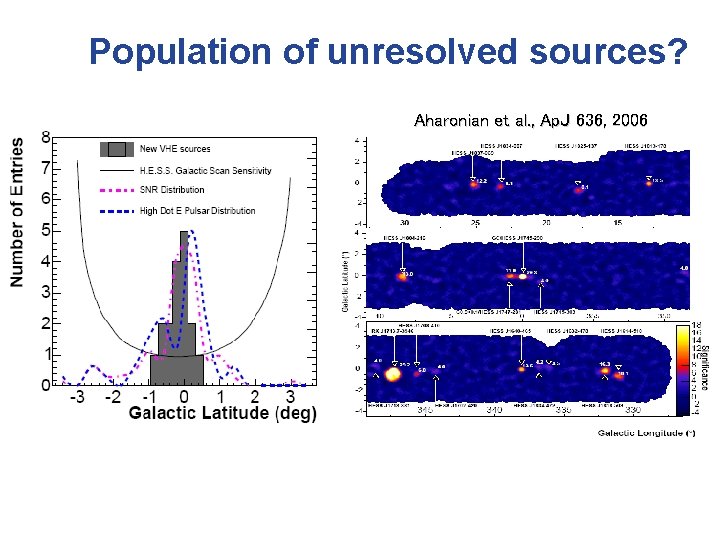
Population of unresolved sources? Aharonian et al. , Ap. J 636, 2006
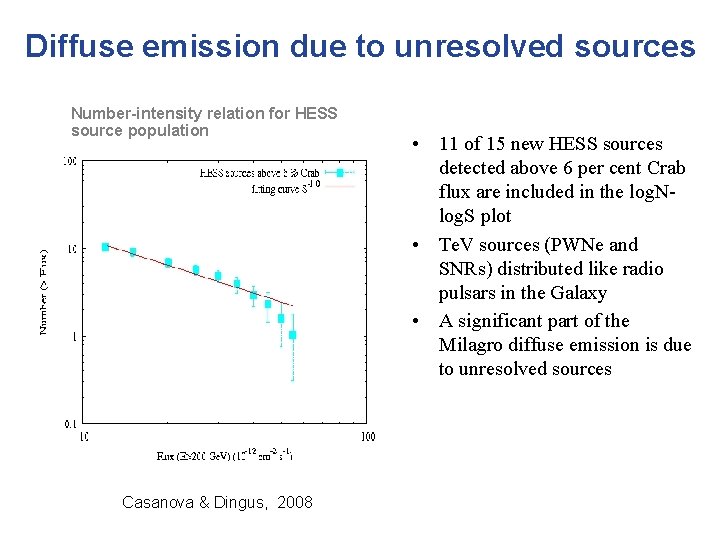
Diffuse emission due to unresolved sources Number-intensity relation for HESS source population Casanova & Dingus, 2008 • 11 of 15 new HESS sources detected above 6 per cent Crab flux are included in the log. Nlog. S plot • Te. V sources (PWNe and SNRs) distributed like radio pulsars in the Galaxy • A significant part of the Milagro diffuse emission is due to unresolved sources
Cosmic ray injection is a stochastic process : The cosmic ray spectra close to injection sources vary in both spectral index and normalization with respect to the so called ‘’sea’’ of cosmic rays due to energy dependent diffusion processes. The cosmic ray spectra close to sources are time dependent due to injection and diffusion history.
Goals of Observations of Diffuse Sources Image spectrum + spatial distribution of large scale Galactic diffuse emission Determine level of small scale emission that is clumpy (clouds) Compare morphology of diffuse emission at the resolution of H 2 and H 1 survey Compare images + spectra with those from other wavelengths Observe all possible photons energy fluxes
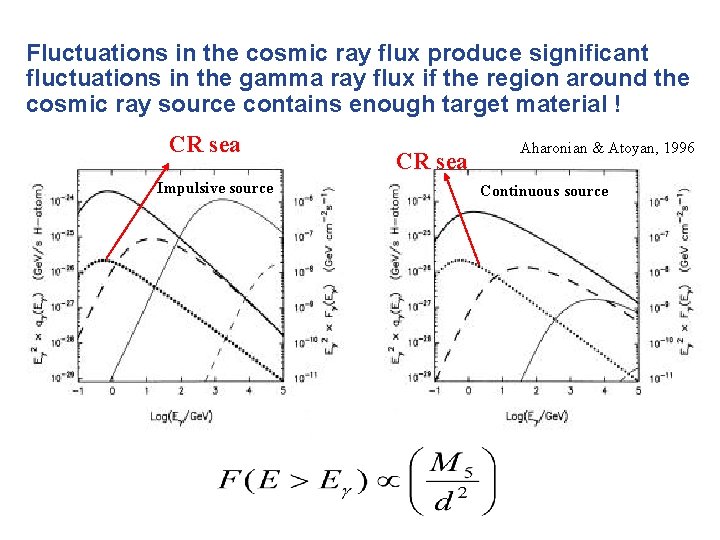
Fluctuations in the cosmic ray flux produce significant fluctuations in the gamma ray flux if the region around the cosmic ray source contains enough target material ! CR sea Impulsive source CR sea Aharonian & Atoyan, 1996 Continuous source
- Slides: 29