
The future WAYS OF REFERRING TO THE FUTURE

- Slides: 11
The future WAYS OF REFERRING TO THE FUTURE
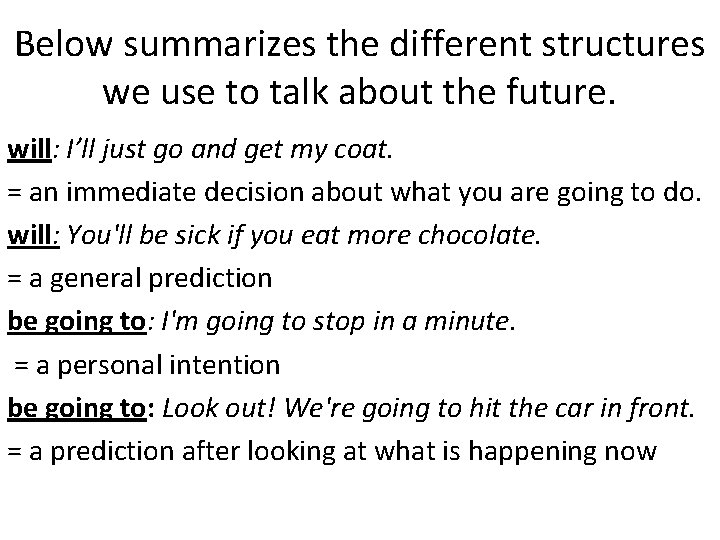
Below summarizes the different structures we use to talk about the future. will: I’ll just go and get my coat. = an immediate decision about what you are going to do. will: You'll be sick if you eat more chocolate. = a general prediction be going to: I'm going to stop in a minute. = a personal intention be going to: Look out! We're going to hit the car in front. = a prediction after looking at what is happening now
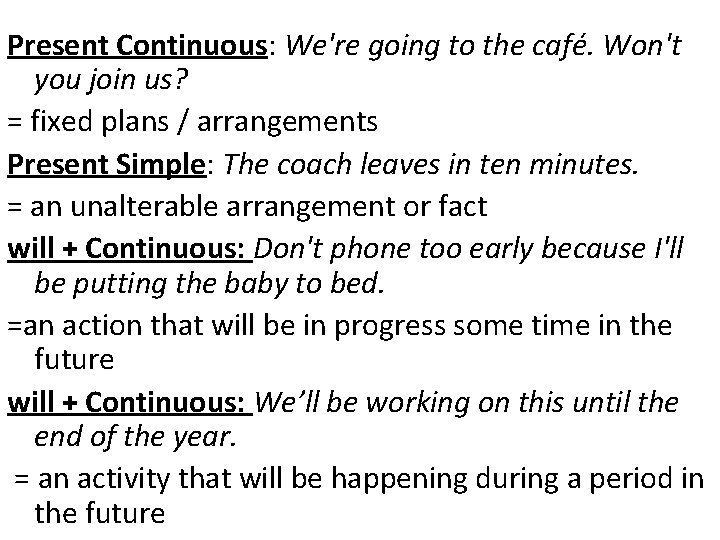
Present Continuous: We're going to the café. Won't you join us? = fixed plans / arrangements Present Simple: The coach leaves in ten minutes. = an unalterable arrangement or fact will + Continuous: Don't phone too early because I'll be putting the baby to bed. =an action that will be in progress some time in the future will + Continuous: We’ll be working on this until the end of the year. = an activity that will be happening during a period in the future
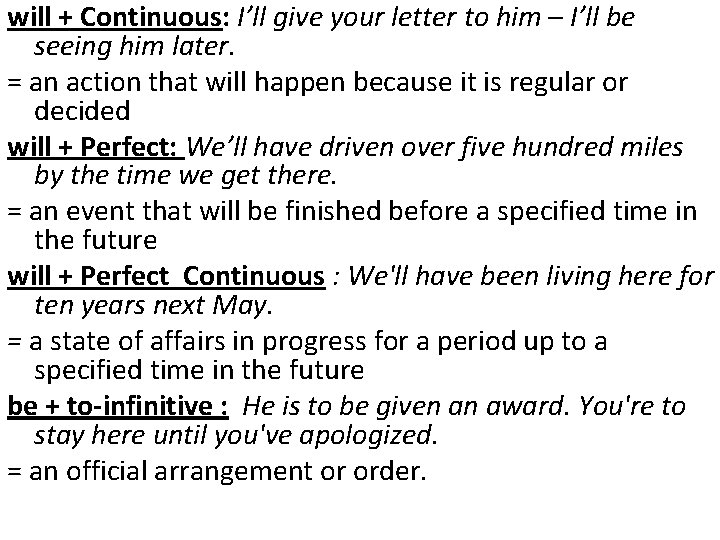
will + Continuous: I’ll give your letter to him – I’ll be seeing him later. = an action that will happen because it is regular or decided will + Perfect: We’ll have driven over five hundred miles by the time we get there. = an event that will be finished before a specified time in the future will + Perfect Continuous : We'll have been living here for ten years next May. = a state of affairs in progress for a period up to a specified time in the future be + to-infinitive : He is to be given an award. You're to stay here until you've apologized. = an official arrangement or order.
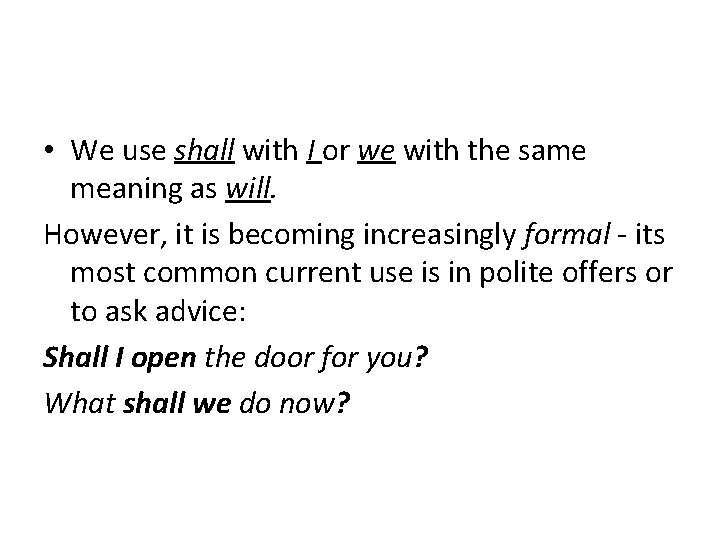
• We use shall with I or we with the same meaning as will. However, it is becoming increasingly formal - its most common current use is in polite offers or to ask advice: Shall I open the door for you? What shall we do now?
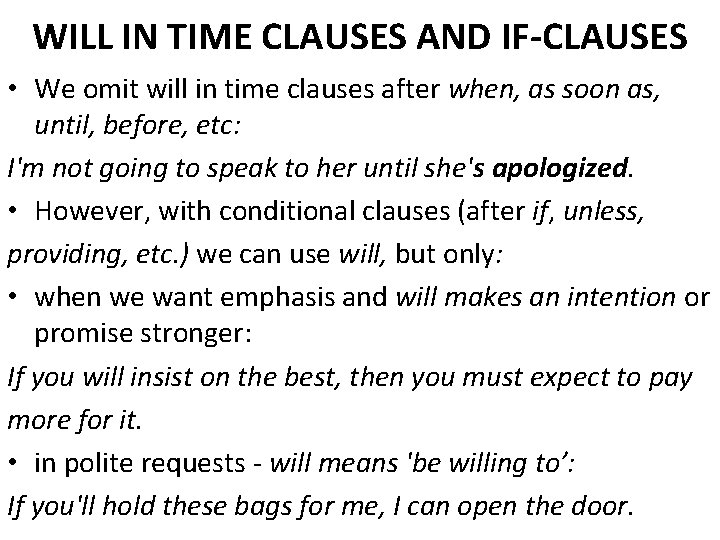
WILL IN TIME CLAUSES AND IF-CLAUSES • We omit will in time clauses after when, as soon as, until, before, etc: I'm not going to speak to her until she's apologized. • However, with conditional clauses (after if, unless, providing, etc. ) we can use will, but only: • when we want emphasis and will makes an intention or promise stronger: If you will insist on the best, then you must expect to pay more for it. • in polite requests - will means 'be willing to’: If you'll hold these bags for me, I can open the door.
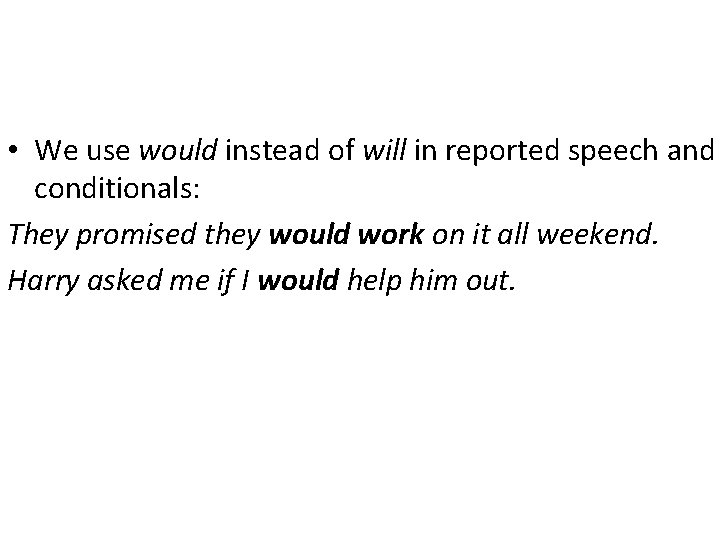
• We use would instead of will in reported speech and conditionals: They promised they would work on it all weekend. Harry asked me if I would help him out.
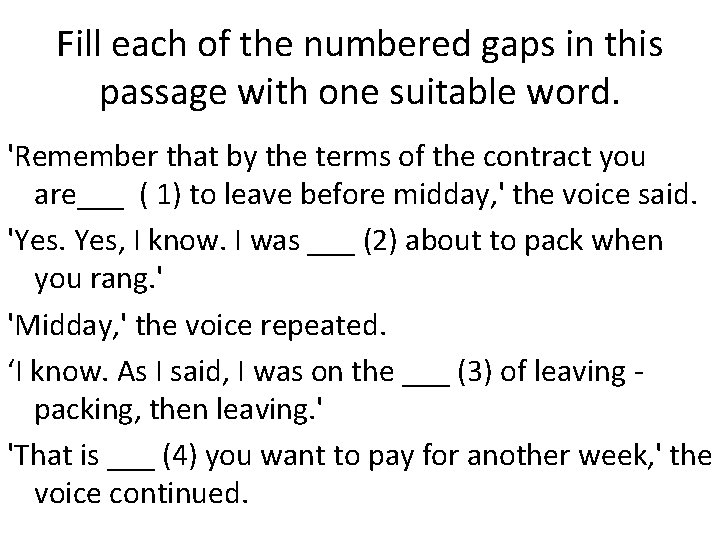
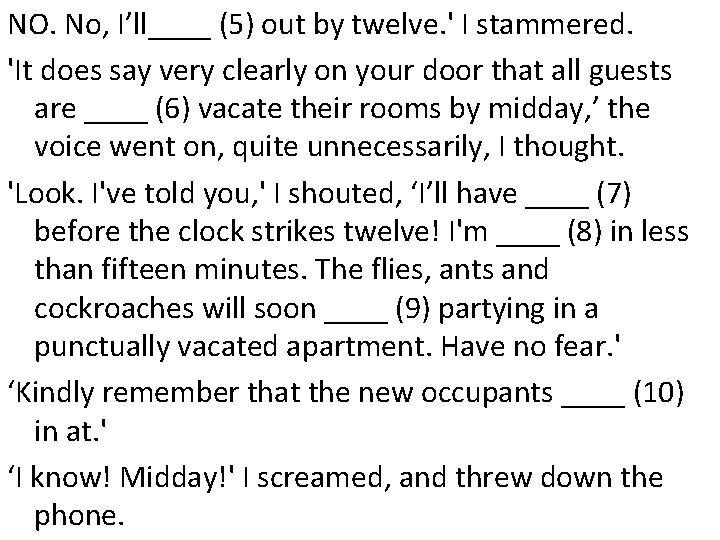
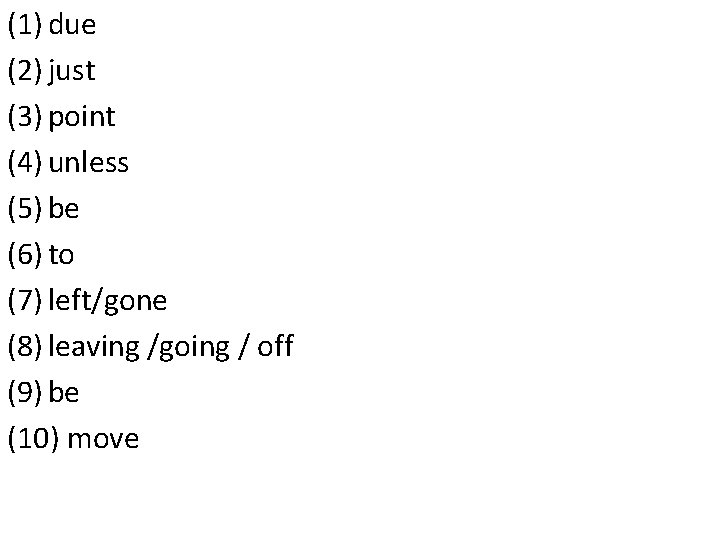
Fill each of the numbered gaps in this passage with one suitable word. 'Remember that by the terms of the contract you are___ ( 1) to leave before midday, ' the voice said. 'Yes. Yes, I know. I was ___ (2) about to pack when you rang. ' 'Midday, ' the voice repeated. ‘I know. As I said, I was on the ___ (3) of leaving packing, then leaving. ' 'That is ___ (4) you want to pay for another week, ' the voice continued.
NO. No, I’ll____ (5) out by twelve. ' I stammered. 'It does say very clearly on your door that all guests are ____ (6) vacate their rooms by midday, ’ the voice went on, quite unnecessarily, I thought. 'Look. I've told you, ' I shouted, ‘I’ll have ____ (7) before the clock strikes twelve! I'm ____ (8) in less than fifteen minutes. The flies, ants and cockroaches will soon ____ (9) partying in a punctually vacated apartment. Have no fear. ' ‘Kindly remember that the new occupants ____ (10) in at. ' ‘I know! Midday!' I screamed, and threw down the phone.
(1) due (2) just (3) point (4) unless (5) be (6) to (7) left/gone (8) leaving /going / off (9) be (10) move
STOP