
The Future of Telepresence Alex Eleftheriadis alexvidyo com
- Slides: 26
The Future of Telepresence Alex Eleftheriadis, alex@vidyo. com
What is Telepresence? Wikipedia: Telepresence refers to a set of technologies which allow a person to feel as if they were present, to give the appearance that they were present, or to have an effect, at a location other than their true location. Alternatively: Videoconferencing sucks! What can you do to make it better if you have all the money you need? 2 IMTC 2010/06/15
Lessons Learned Elsewhere Computing Networking Communications 3 IMTC 2010/06/15
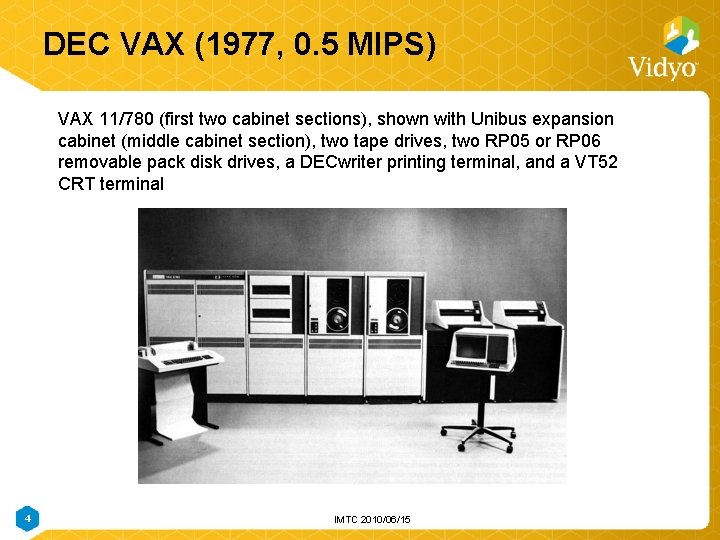
DEC VAX (1977, 0. 5 MIPS) VAX 11/780 (first two cabinet sections), shown with Unibus expansion cabinet (middle cabinet section), two tape drives, two RP 05 or RP 06 removable pack disk drives, a DECwriter printing terminal, and a VT 52 CRT terminal 4 IMTC 2010/06/15
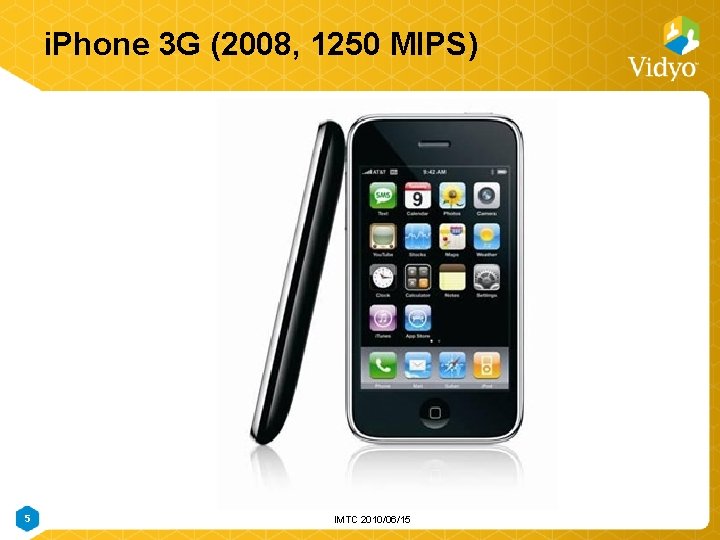
i. Phone 3 G (2008, 1250 MIPS) 5 IMTC 2010/06/15
Lessons Learned Elsewhere Computing Fast Personal Portable Networking Scalable Ubiquitous Communications Reliable Ubiquitous Mobile 6 IMTC 2010/06/15
Telepresence Today Extremely expensive Not scalable Not portable Not personal Very high quality => Traditional videoconferencing: same, but sacrifices quality for low cost. 7 IMTC 2010/06/15
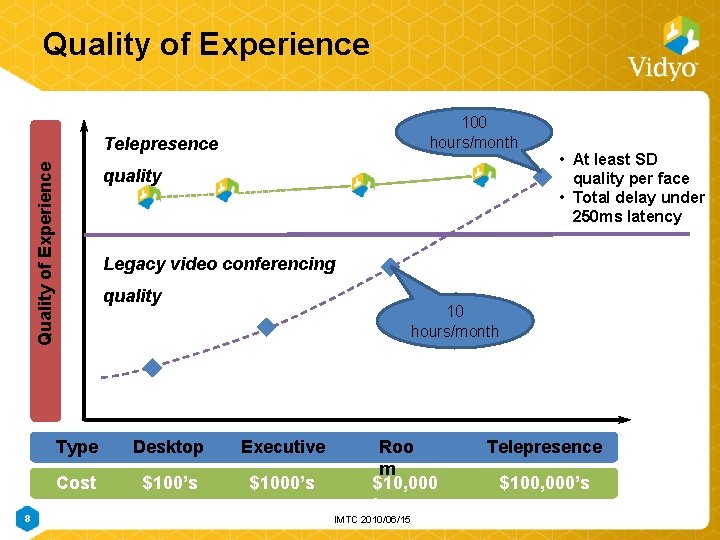
Quality of Experience 100 hours/month Quality of Experience Telepresence 8 quality • At least SD quality per face • Total delay under 250 ms latency Legacy video conferencing quality 10 hours/month Type Desktop Executive Cost $100’s $1000’s Roo m $10, 000 ’s IMTC 2010/06/15 Telepresence $100, 000’s
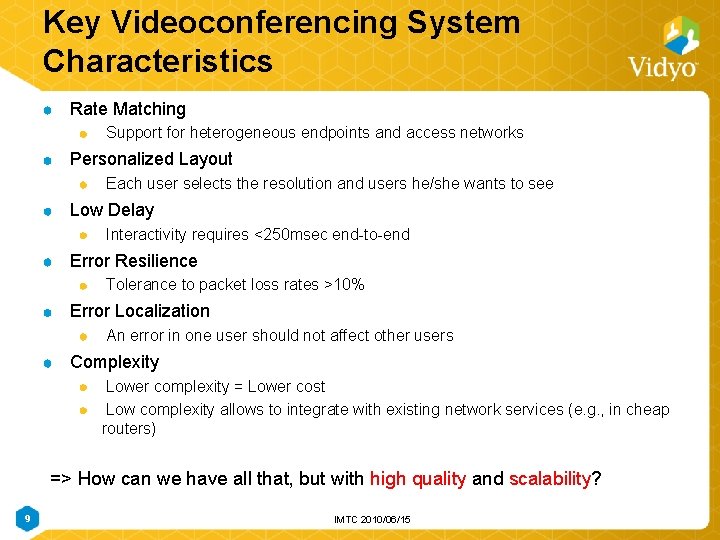
Key Videoconferencing System Characteristics Rate Matching Support for heterogeneous endpoints and access networks Personalized Layout Each user selects the resolution and users he/she wants to see Low Delay Interactivity requires <250 msec end-to-end Error Resilience Tolerance to packet loss rates >10% Error Localization An error in one user should not affect other users Complexity Lower complexity = Lower cost Low complexity allows to integrate with existing network services (e. g. , in cheap routers) => How can we have all that, but with high quality and scalability? 9 IMTC 2010/06/15
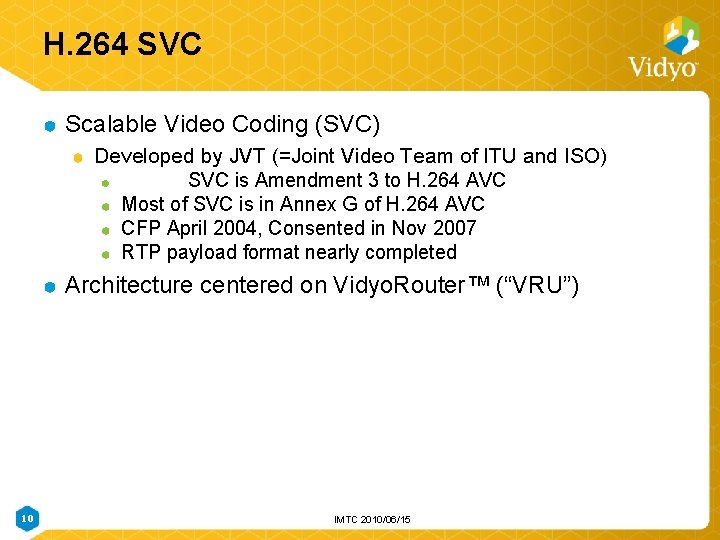
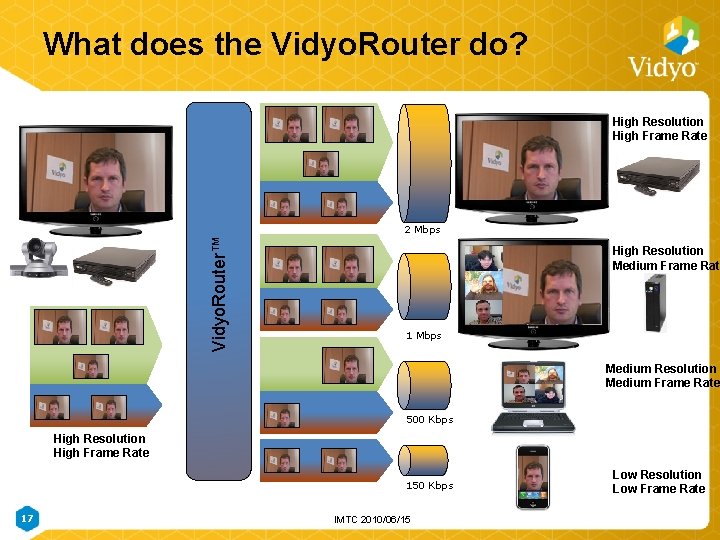
H. 264 SVC Scalable Video Coding (SVC) Developed by JVT (=Joint Video Team of ITU and ISO) SVC is Amendment 3 to H. 264 AVC Most of SVC is in Annex G of H. 264 AVC CFP April 2004, Consented in Nov 2007 RTP payload format nearly completed Architecture centered on Vidyo. Router™ (“VRU”) 10 IMTC 2010/06/15
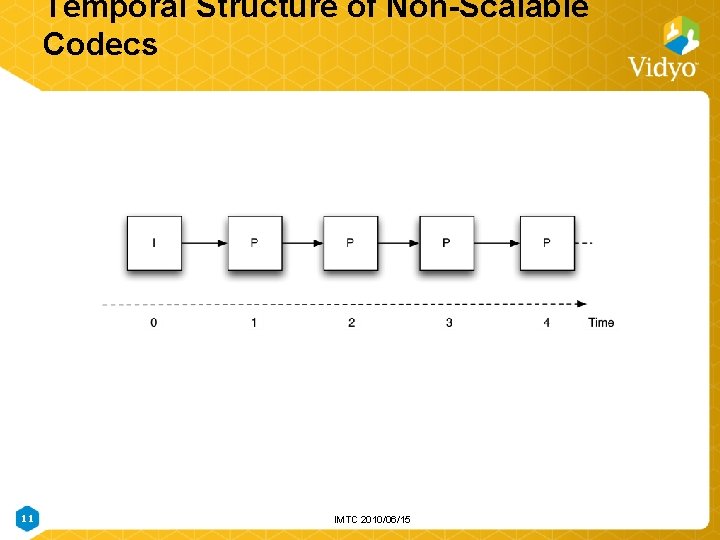
Temporal Structure of Non-Scalable Codecs 11 IMTC 2010/06/15
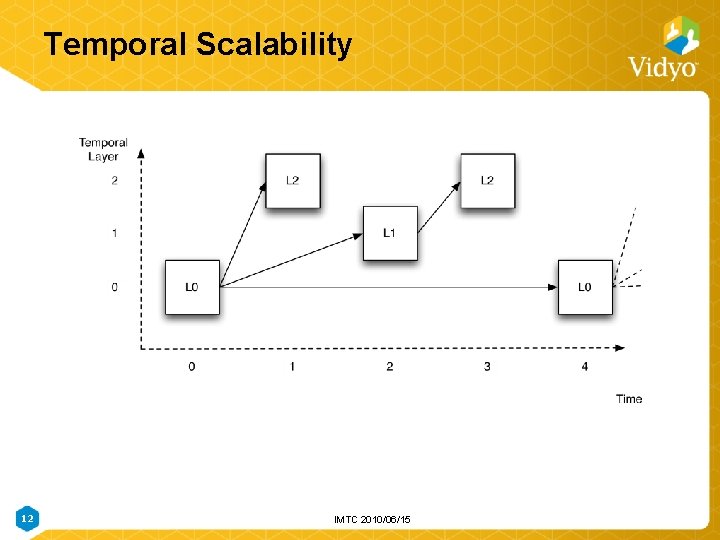
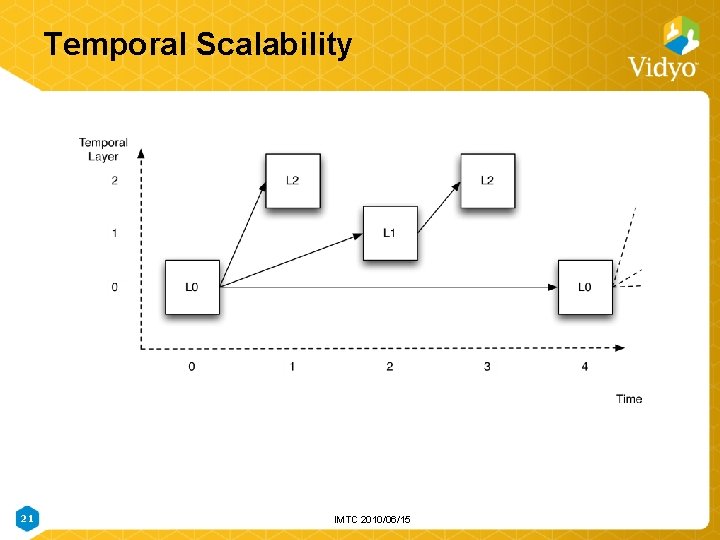
Temporal Scalability 12 IMTC 2010/06/15
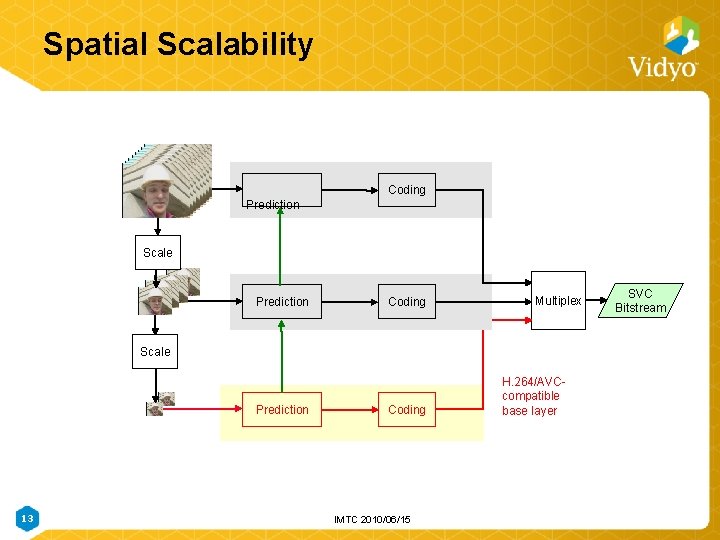
Spatial Scalability Coding Prediction Scale Prediction Coding Multiplex Scale Prediction 13 Coding IMTC 2010/06/15 H. 264/AVCcompatible base layer SVC Bitstream
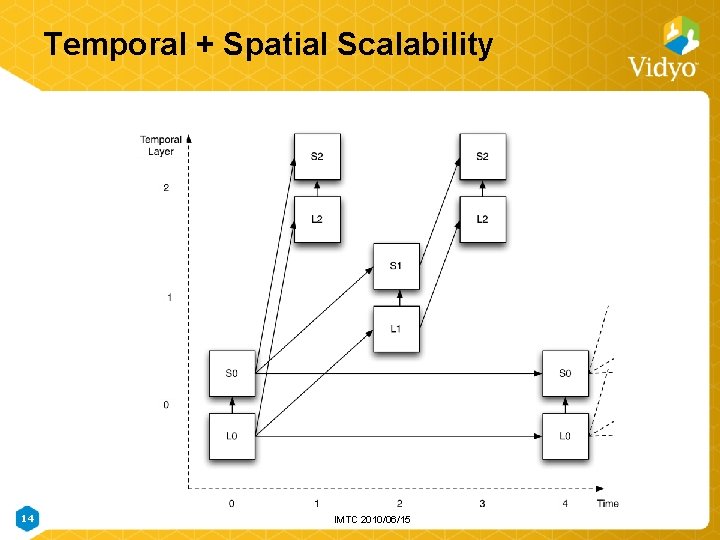
Temporal + Spatial Scalability 14 IMTC 2010/06/15
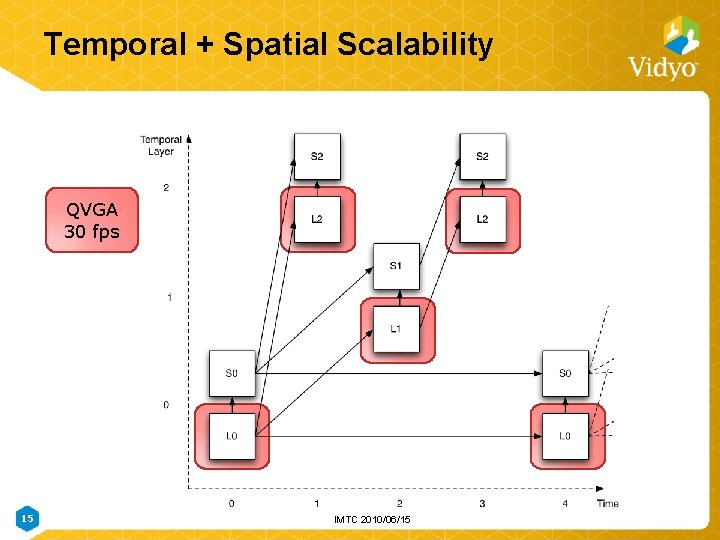
Temporal + Spatial Scalability QVGA 30 fps 15 IMTC 2010/06/15
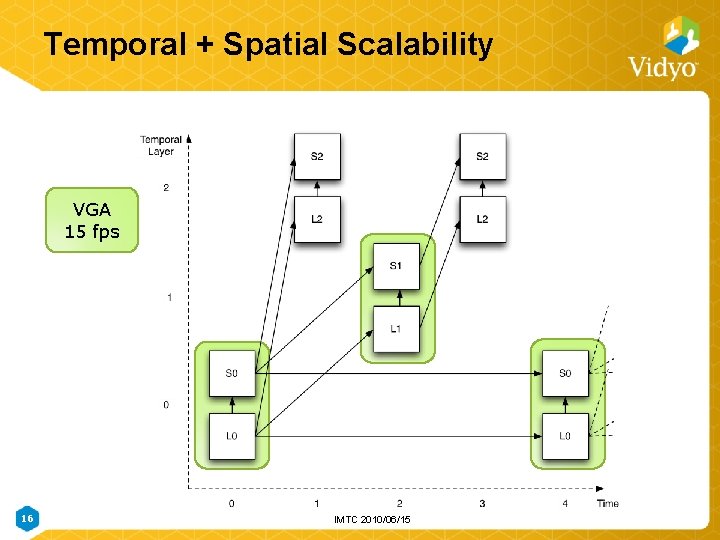
Temporal + Spatial Scalability VGA 15 fps 16 IMTC 2010/06/15
What does the Vidyo. Router do? Vidyo. Router™ High Resolution High Frame Rate 2 Mbps High Resolution Medium Frame Rat 1 Mbps Medium Resolution Medium Frame Rate 500 Kbps High Resolution High Frame Rate 150 Kbps 17 IMTC 2010/06/15 Low Resolution Low Frame Rate
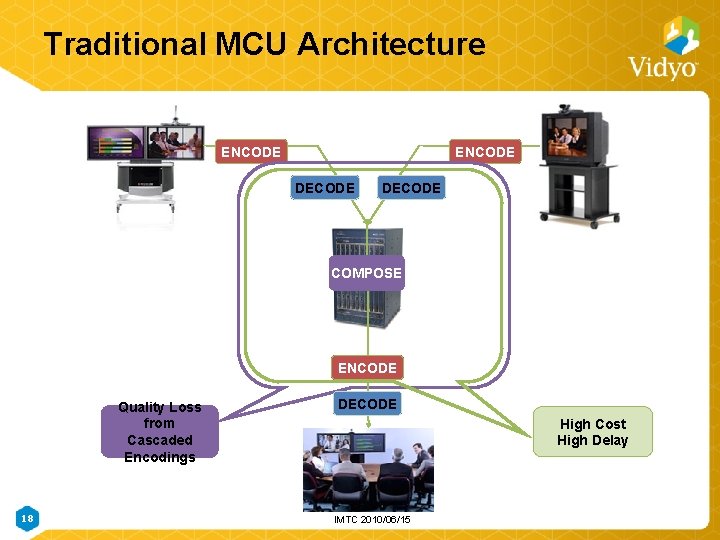
Traditional MCU Architecture ENCODE DECODE COMPOSE ENCODE Quality Loss from Cascaded Encodings 18 DECODE High Cost High Delay IMTC 2010/06/15
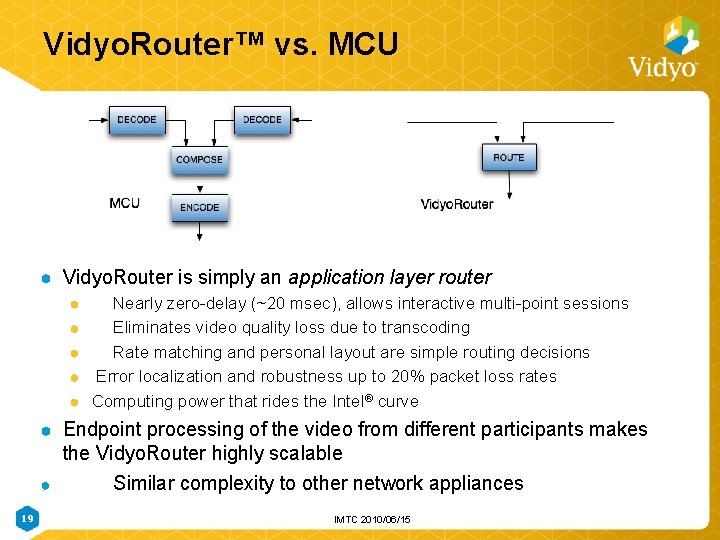
Vidyo. Router™ vs. MCU Vidyo. Router is simply an application layer router Nearly zero-delay (~20 msec), allows interactive multi-point sessions Eliminates video quality loss due to transcoding Rate matching and personal layout are simple routing decisions Error localization and robustness up to 20% packet loss rates Computing power that rides the Intel® curve Endpoint processing of the video from different participants makes the Vidyo. Router highly scalable Similar complexity to other network appliances 19 IMTC 2010/06/15
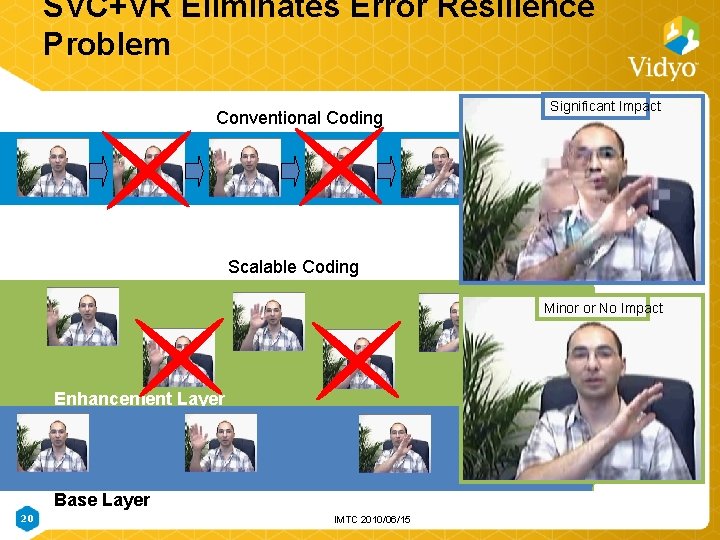
SVC+VR Eliminates Error Resilience Problem Conventional Coding Significant Impact Scalable Coding Minor or No Impact Enhancement Layer Base Layer 20 IMTC 2010/06/15
Temporal Scalability 21 IMTC 2010/06/15
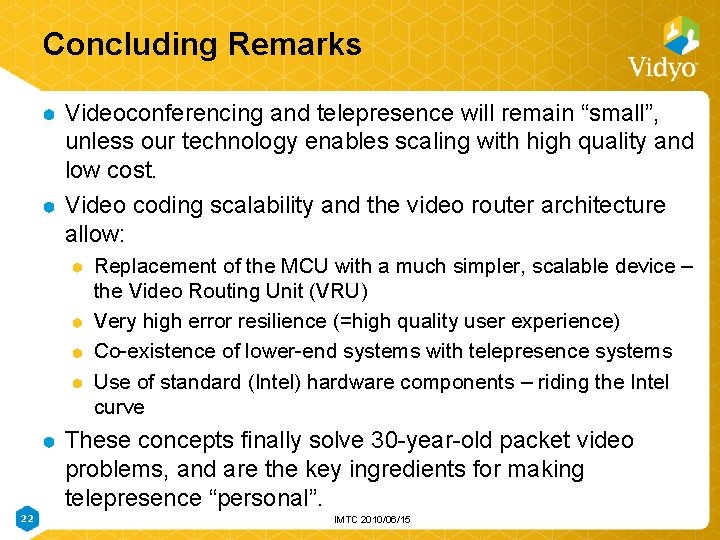
Concluding Remarks Videoconferencing and telepresence will remain “small”, unless our technology enables scaling with high quality and low cost. Video coding scalability and the video router architecture allow: Replacement of the MCU with a much simpler, scalable device – the Video Routing Unit (VRU) Very high error resilience (=high quality user experience) Co-existence of lower-end systems with telepresence systems Use of standard (Intel) hardware components – riding the Intel curve These concepts finally solve 30 -year-old packet video problems, and are the key ingredients for making telepresence “personal”. 22 IMTC 2010/06/15
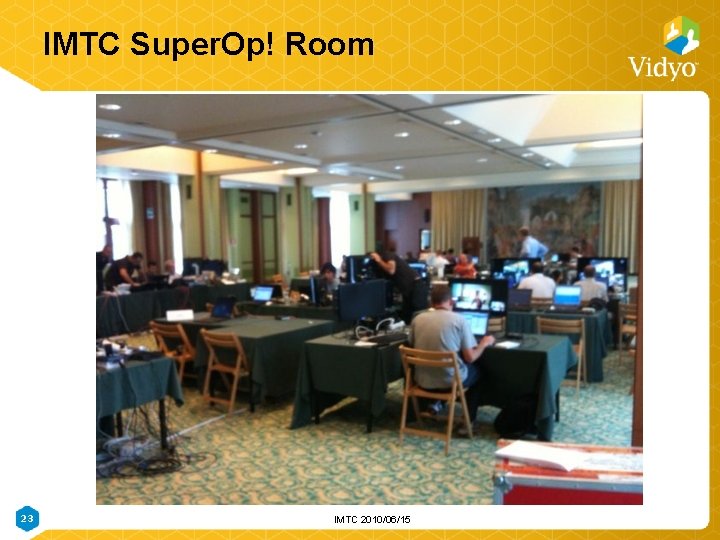
IMTC Super. Op! Room 23 IMTC 2010/06/15
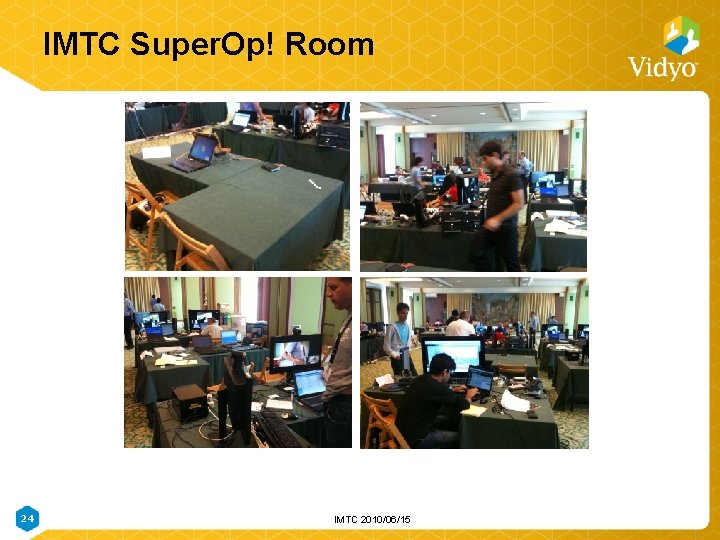
IMTC Super. Op! Room 24 IMTC 2010/06/15
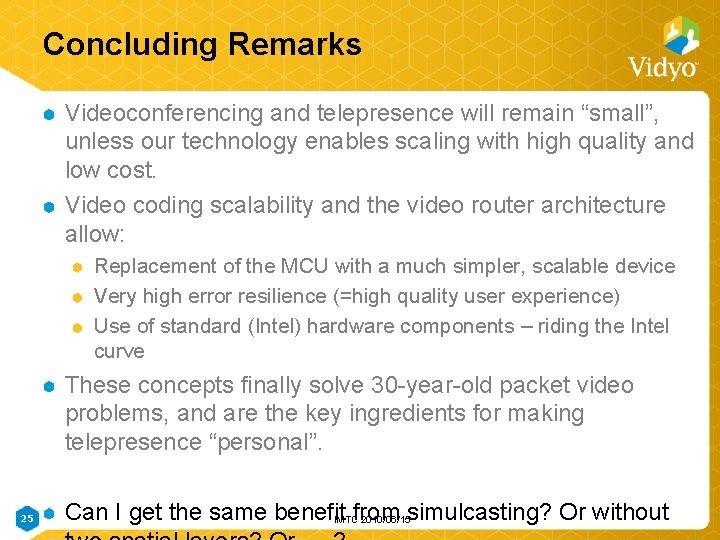
Concluding Remarks Videoconferencing and telepresence will remain “small”, unless our technology enables scaling with high quality and low cost. Video coding scalability and the video router architecture allow: Replacement of the MCU with a much simpler, scalable device Very high error resilience (=high quality user experience) Use of standard (Intel) hardware components – riding the Intel curve These concepts finally solve 30 -year-old packet video problems, and are the key ingredients for making telepresence “personal”. 25 Can I get the same benefit from IMTC 2010/06/15 simulcasting? Or without
Thank You!