
The Future of Taxpayer Funded Research Who Will

- Slides: 11
The Future of Taxpayer Funded Research: Who Will Control Access to It Elliot E. Maxwell n Fellow, Communications Program, Johns Hopkins University and Fellow, e-Business Research Center, Pennsylvania State University Digital Connections Council, Committee for Economic Development n February 7, 2012
NIH Public-Access Policy: Keep, Extend or Reverse It n n n n Went from voluntary to mandatory in 2008 Requires grantees to give NIH non-exclusive license and deposit peer-reviewed manuscript accepted for publication into Pub. Med Central-made public no later than 12 months after publication Costs $4 million to operate NIH-$30 billion budget leads to 90, 000 articles/year Other taxpayer-funded STM publishing $30 billion FRPAA- would apply policy to other STM extramural funding Research Works Act would reverse it by requiring publisher approval to make manuscript freely available Focused on access to manuscript, not sub-parts and does not increase rights to use what is now accessible
Four Recent Papers Examine the Impact of Increased Openness n n Climbing Stop the Shoulders of Giants: The Impact of Institutions on Cumulative Research Of Mice and Academics: Examining the Effects of Openness on Innovation Intellectual Property Rights and Innovation: Evidence from the Human Genome Scientific Problem Solving through Broadcast Search: Inno. Centive. com
Climbing atop the Shoulders of Giants n n n By Jeffrey L. Furman and Scott Stern Compares citations in follow-on research using materials from open Biological Resource Centers vs closed archives Articles based on BRC materials got 220 percent more citations Citation rates increased by 50 -125 percent for materials transferred to open archives 3 to 10 times more cost effective to increase funding of BRCs than funding new research
Of Mice and Academics n n n By Fiona Murray, Phillippe Aghion, Mathias Dewatripont, Julian Kolev and Scott Stern Compares citations in follow-on research to research on “open” vs “IP-protected” mice "may increase the overall flow of research output” “closely associated with the…exploration of entirely new research lines. " IP reduces the “diversity of experimentation that follows from a single idea“ –important as progress in science is not “linear” Citations more likely to be found in applied as opposed to basic research journals
Intellectual Property Rights and Innovation n n By Heidi Williams Compares publications and commercial developments resulting from Celera’s IP protected sequencing vs Human Genome Project’s findings IP reduces the “diversity of scientific experimentation”. Reductions on the order of 30% in subsequent gene -level scientific research and product development (gene-based diagnostic tests) Celera's short-term IP appears to have had persistent negative effects on subsequent research and product development compared with HGP data that was always in the public domain
Scientific Problem Solving Through Broadcast Search n n n By Karim Lakhani Inno. Centive “broadcast” problems to 80 K self-selected “solvers” and paid them for best solutions Many winning solvers came from outside the problem’s field. “Local search” limited solution set; alternative approaches ignored—or not perceived
The Impact of Increased Openness n n n Leads to increased citations in follow-on research Promotes diversity in follow-on research and pursuit of new research pathways Encourages “intensity of research and movement toward applied research” Speeds commercialization of research results Demonstrates value of “unforeseen contributors” Together these papers show that increased openness has clear and demonstrable benefits
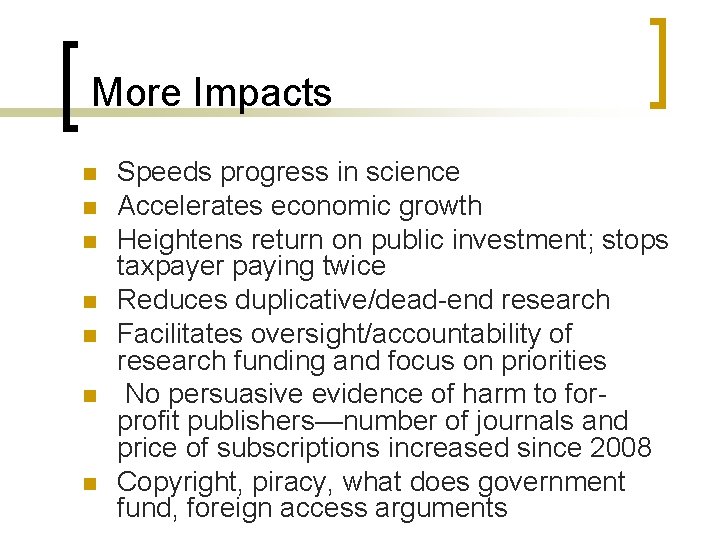
More Impacts n n n n Speeds progress in science Accelerates economic growth Heightens return on public investment; stops taxpayer paying twice Reduces duplicative/dead-end research Facilitates oversight/accountability of research funding and focus on priorities No persuasive evidence of harm to forprofit publishers—number of journals and price of subscriptions increased since 2008 Copyright, piracy, what does government fund, foreign access arguments
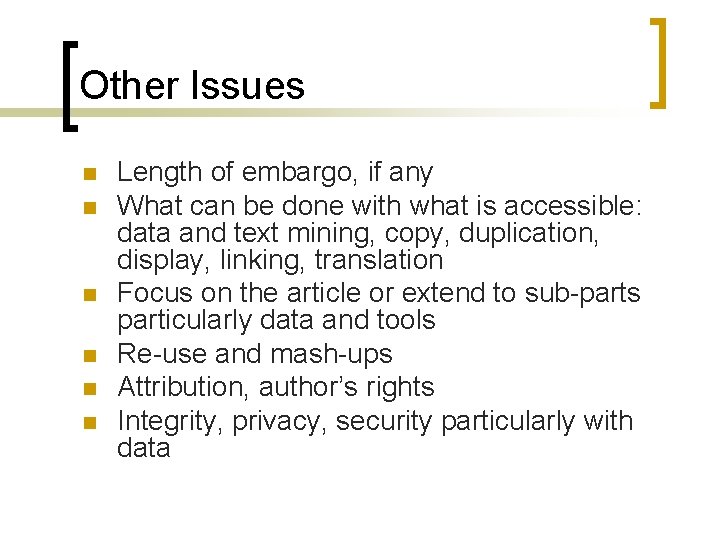
Other Issues n n n Length of embargo, if any What can be done with what is accessible: data and text mining, copy, duplication, display, linking, translation Focus on the article or extend to sub-parts particularly data and tools Re-use and mash-ups Attribution, author’s rights Integrity, privacy, security particularly with data
Contact Information Elliot E. Maxwell emaxwell@emaxwell. net www. emaxwell. net