
The future of policy and regulation Unlocking the

- Slides: 27
The future of policy and regulation. Unlocking the Treasures of Utility Regulation, Annual Meeting, National Conference of Regulatory Attorneys, Tampa, Florida David E. Dismukes, Ph. D. Center for Energy Studies Louisiana State University June 20, 2016
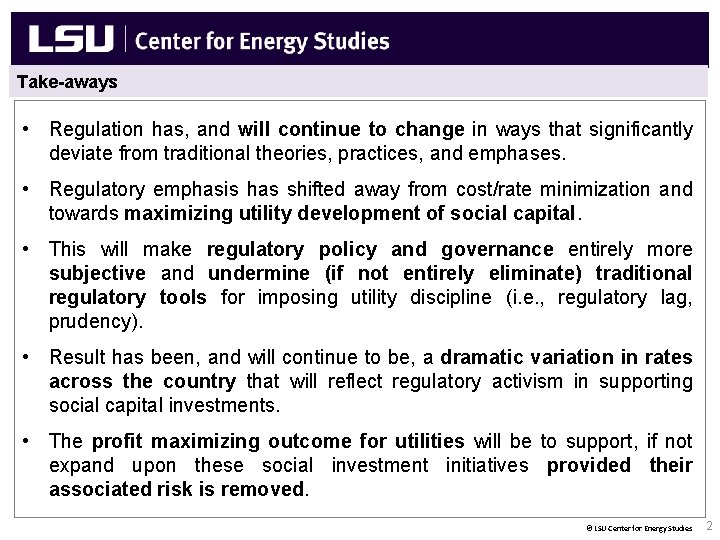
Take-aways New Natural Gas End Uses & Fuel Diversity Concerns • Regulation has, and will continue to change in ways that significantly deviate from traditional theories, practices, and emphases. • Regulatory emphasis has shifted away from cost/rate minimization and towards maximizing utility development of social capital. • This will make regulatory policy and governance entirely more subjective and undermine (if not entirely eliminate) traditional regulatory tools for imposing utility discipline (i. e. , regulatory lag, prudency). • Result has been, and will continue to be, a dramatic variation in rates across the country that will reflect regulatory activism in supporting social capital investments. • The profit maximizing outcome for utilities will be to support, if not expand upon these social investment initiatives provided their associated risk is removed. © LSU Center for Energy Studies 2
Center for Energy Studies Traditional Regulation: Theory and Practice © LSU Center for Energy Studies 3
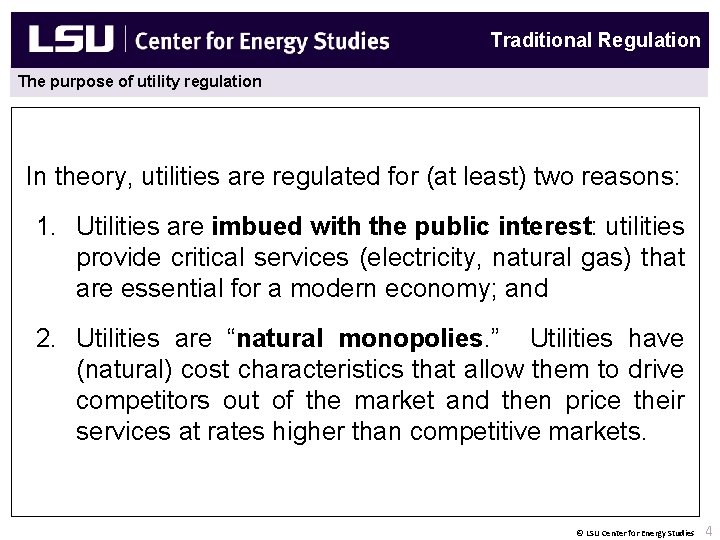
Center for Energy Studies The purpose of utility regulation Monopoly Traditional Regulation In theory, utilities are regulated for (at least) two reasons: 1. Utilities are imbued with the public interest: utilities provide critical services (electricity, natural gas) that are essential for a modern economy; and 2. Utilities are “natural monopolies. ” Utilities have (natural) cost characteristics that allow them to drive competitors out of the market and then price their services at rates higher than competitive markets. © LSU Center for Energy Studies 4
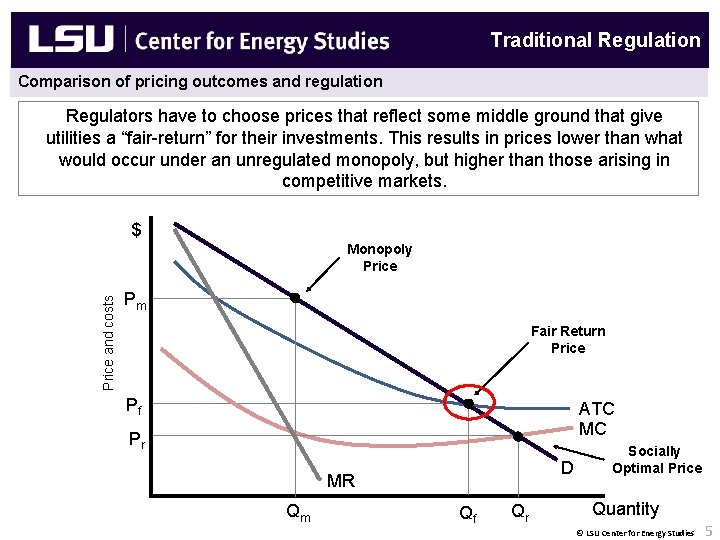
Traditional Regulation Center for Energy Studies Comparison of pricing outcomes and regulation Regulators have to choose prices that reflect some middle ground that give utilities a “fair-return” for their investments. This results in prices lower than what would occur under an unregulated monopoly, but higher than those arising in competitive markets. $ Price and costs Monopoly Price Pm Fair Return Price Pf ATC MC Pr D MR Qm Qf Qr Socially Optimal Price Quantity © LSU Center for Energy Studies 5
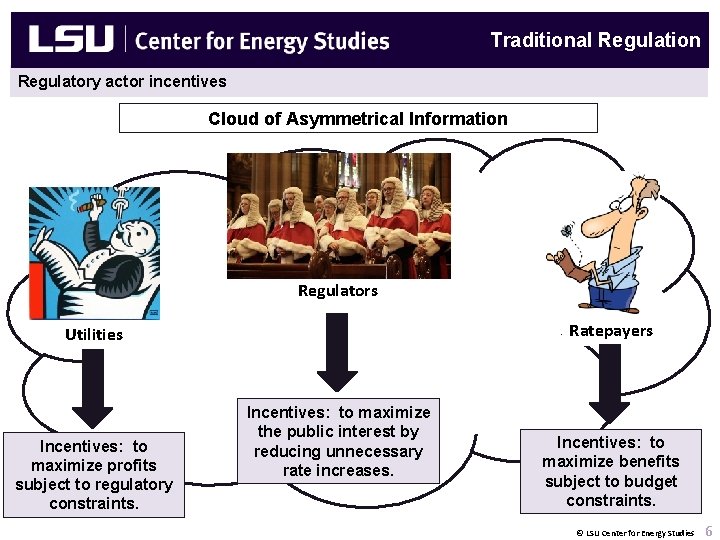
Center for Energy Studies Regulatory actor incentives Monopoly Traditional Regulation Cloud of Asymmetrical Information Regulators Ratepayers Utilities Incentives: to maximize profits subject to regulatory constraints. Incentives: to maximize the public interest by reducing unnecessary rate increases. Incentives: to maximize benefits subject to budget constraints. © LSU Center for Energy Studies 6
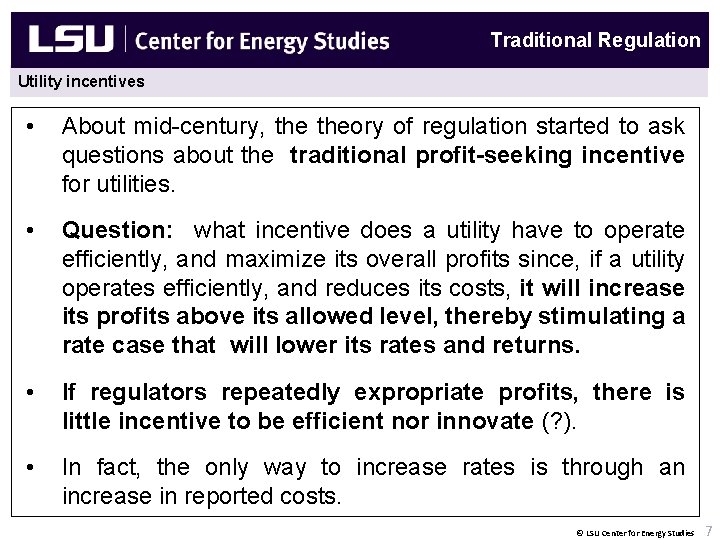
Center for Energy Studies Utility incentives Monopoly Traditional Regulation • About mid-century, theory of regulation started to ask questions about the traditional profit-seeking incentive for utilities. • Question: what incentive does a utility have to operate efficiently, and maximize its overall profits since, if a utility operates efficiently, and reduces its costs, it will increase its profits above its allowed level, thereby stimulating a rate case that will lower its rates and returns. • If regulators repeatedly expropriate profits, there is little incentive to be efficient nor innovate (? ). • In fact, the only way to increase rates is through an increase in reported costs. © LSU Center for Energy Studies 7
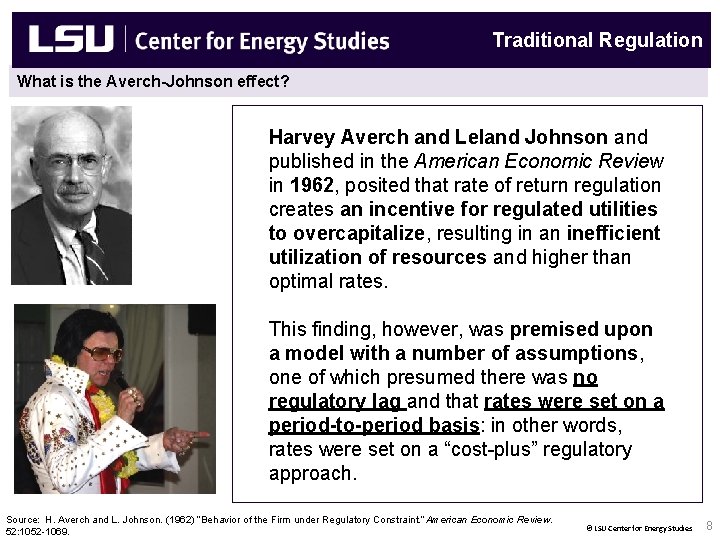
Center for Energy Studies Traditional Regulation What is the Averch-Johnson effect? Harvey Averch and Leland Johnson and published in the American Economic Review in 1962, posited that rate of return regulation creates an incentive for regulated utilities to overcapitalize, resulting in an inefficient utilization of resources and higher than optimal rates. This finding, however, was premised upon a model with a number of assumptions, one of which presumed there was no regulatory lag and that rates were set on a period-to-period basis: in other words, rates were set on a “cost-plus” regulatory approach. Source: H. Averch and L. Johnson. (1962) “Behavior of the Firm under Regulatory Constraint. ” American Economic Review. 52: 1052 -1069. © LSU Center for Energy Studies 8
Center for Energy Studies Traditional Regulation Follow-Up A-J research Soon after its publication, Averch’s and Johnson’s article was met with a flurry of scholarly research attempting to empirically verify the A-J effect, as well as examining the conditions under which the effect would, and would not, be sustained. Rejoinders to the research noted that two characteristics of the regulatory process tended to temper the likelihood and prevalence of the A-J effect and other inefficiency incentives: 1. the possibility of disallowances through the prudence review process and 2. the positive efficiency incentives created by regulatory lag. In fact, a series of articles published soon afterwards noted that regulatory lag typically creates incentives for utilities to seek efficiency opportunities between rate cases since the gains (profits) from those investments inure to shareholders instead of ratepayers. © LSU Center for Energy Studies 9
Center for Energy Studies Traditional Regulation Regulatory lag as a form of market discipline Regulatory lag is often defined as the period of time between when a utility’s rates go into effect and its next rate case and is an important means by which traditional regulation is thought to inject discipline upon utilities similar to that arising in competitive markets. Under traditional regulation, rates are set on a utility’s prudently-incurred costs: • If a utility improves its operating/investment efficiencies after a rate case, then the increased profits associated with these actions accrue to the utility much like they would in a competitive market. • The inverse occurs if a utility becomes less efficient or is unable to contain its costs after a rate case: profits will fall much like they would in a competitive market. © LSU Center for Energy Studies 10
New Natural Gas End Uses & Fuel Diversity Concerns Social Capital © LSU Center for Energy Studies 11
Social Capital Market failures New Natural Gas End Uses & Fuel Diversity Concerns Today’s social investment policies are intended to address a variety of perceived energy market failures: Natural monopolies/market power: when you have few firms and/or one firm controls/dominates the market. Externalities: when one party’s actions impose an unaccounted for cost (or benefit) onto another party. Asymmetric information: when one party has more information than another and uses that information for strategic gain. Risk & Uncertainty: arises in markets influenced by a variety of random factors that can be partially known (can be assigned probabilities) or entirely unknown (cannot be assigned probabilities). © LSU Center for Energy Studies 12
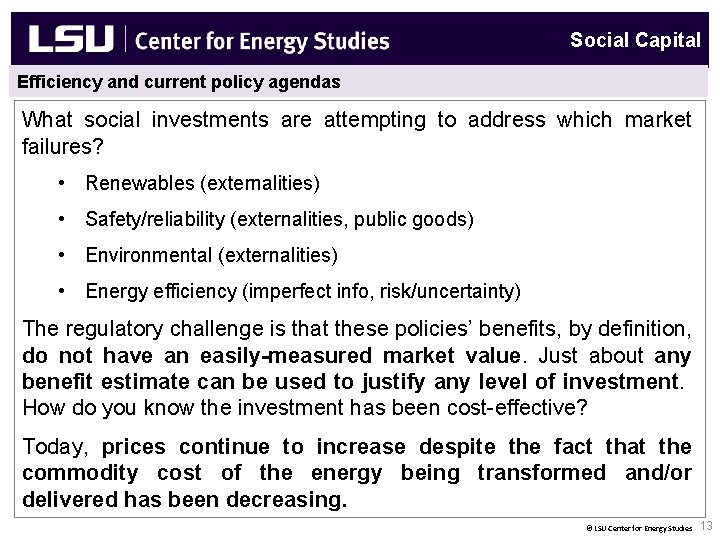
Social Capital Efficiency and current policy agendas New Natural Gas End Uses & Fuel Diversity Concerns What social investments are attempting to address which market failures? • Renewables (externalities) • Safety/reliability (externalities, public goods) • Environmental (externalities) • Energy efficiency (imperfect info, risk/uncertainty) The regulatory challenge is that these policies’ benefits, by definition, do not have an easily-measured market value. Just about any benefit estimate can be used to justify any level of investment. How do you know the investment has been cost-effective? Today, prices continue to increase despite the fact that the commodity cost of the energy being transformed and/or delivered has been decreasing. © LSU Center for Energy Studies 13
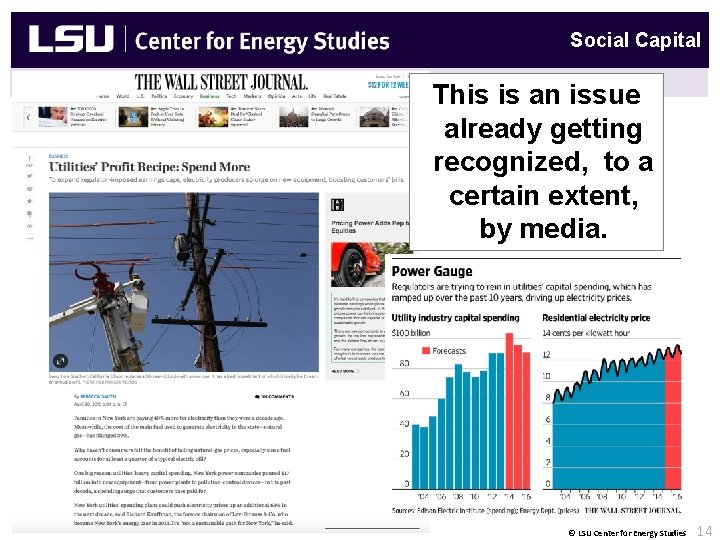
Center for Energy Studies Monopoly Traditional Regulation Social Capital This is an issue already getting recognized, to a certain extent, by media. © LSU Center for Energy Studies 14
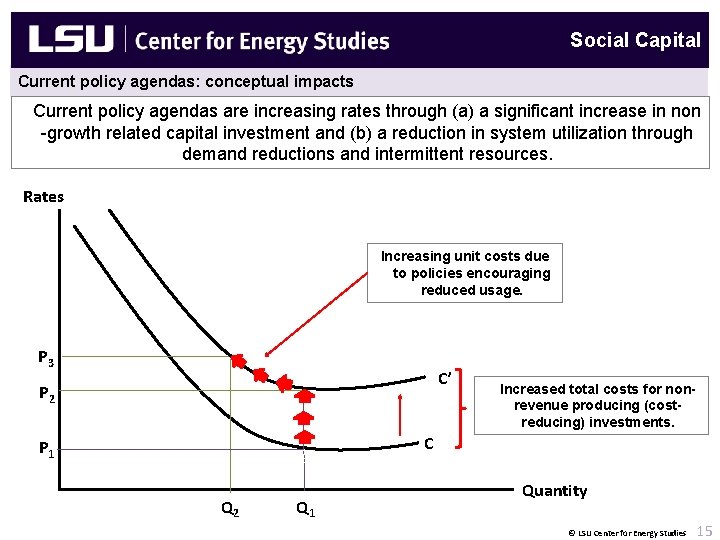
Social Capital Center for Energy Studies Current policy agendas: conceptual impacts Current policy agendas are increasing rates through (a) a significant increase in non -growth related capital investment and (b) a reduction in system utilization through demand reductions and intermittent resources. Rates Increasing unit costs due to policies encouraging reduced usage. P 3 C’ P 2 Increased total costs for nonrevenue producing (costreducing) investments. C P 1 Q 2 Q 1 Quantity © LSU Center for Energy Studies 15
New Natural Gas End Uses & Fuel Diversity Concerns Rate Implications & Impacts © LSU Center for Energy Studies 16
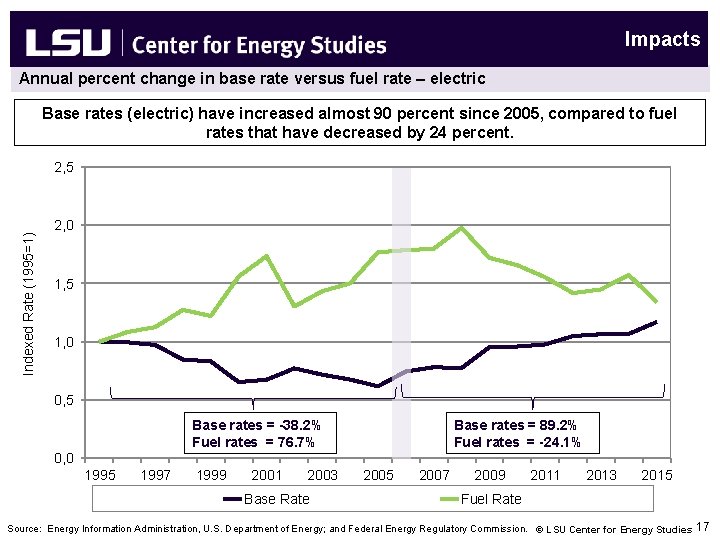
Impacts Annual percent change in base rate versus fuel rate – electric Base rates (electric) have increased almost 90 percent since 2005, compared to fuel rates that have decreased by 24 percent. Indexed Rate (1995=1) 2, 5 2, 0 1, 5 1, 0 0, 5 Base rates = -38. 2% Fuel rates = 76. 7% Base rates = 89. 2% Fuel rates = -24. 1% 0, 0 1995 1997 1999 2001 2003 Base Rate 2005 2007 2009 2011 2013 2015 Fuel Rate Source: Energy Information Administration, U. S. Department of Energy; and Federal Energy Regulatory Commission. © LSU Center for Energy Studies 17
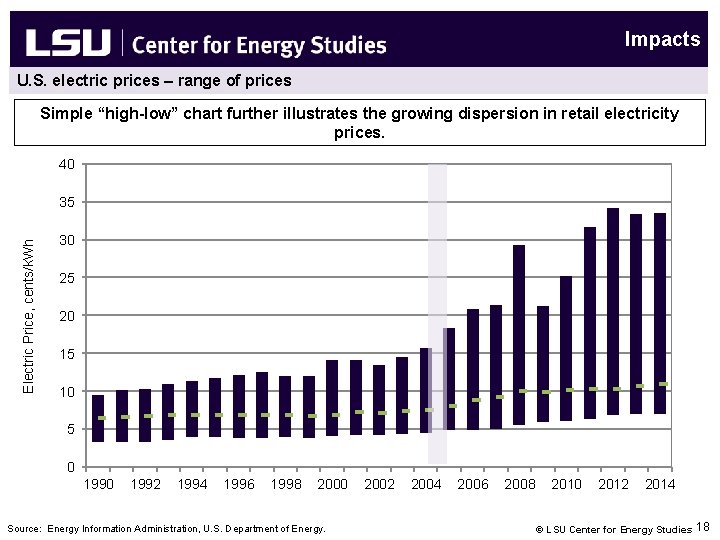
Impacts U. S. electric prices – range of prices Simple “high-low” chart further illustrates the growing dispersion in retail electricity prices. 40 Electric Price, cents/k. Wh 35 30 25 20 15 10 5 0 1992 1994 1996 1998 2000 Source: Energy Information Administration, U. S. Department of Energy. 2002 2004 2006 2008 2010 2012 2014 © LSU Center for Energy Studies 18
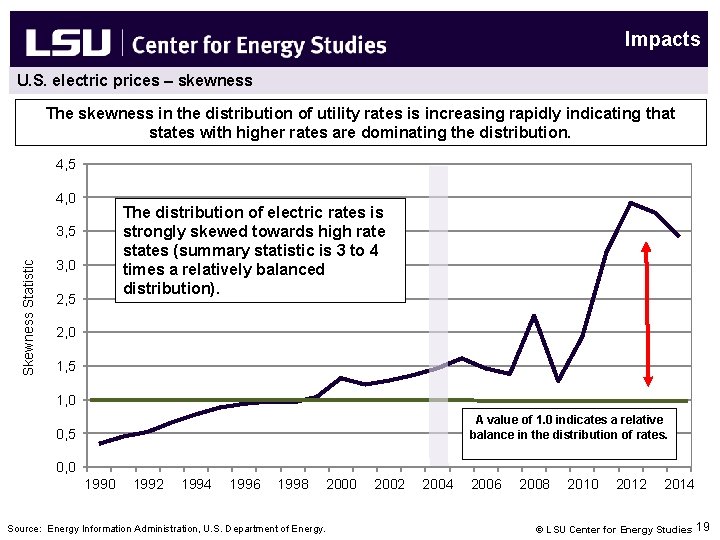
Impacts U. S. electric prices – skewness The skewness in the distribution of utility rates is increasing rapidly indicating that states with higher rates are dominating the distribution. 4, 5 4, 0 The distribution of electric rates is strongly skewed towards high rate states (summary statistic is 3 to 4 times a relatively balanced distribution). Skewness Statistic 3, 5 3, 0 2, 5 2, 0 1, 5 1, 0 A value of 1. 0 indicates a relative balance in the distribution of rates. 0, 5 0, 0 1992 1994 1996 1998 2000 Source: Energy Information Administration, U. S. Department of Energy. 2002 2004 2006 2008 2010 2012 2014 © LSU Center for Energy Studies 19
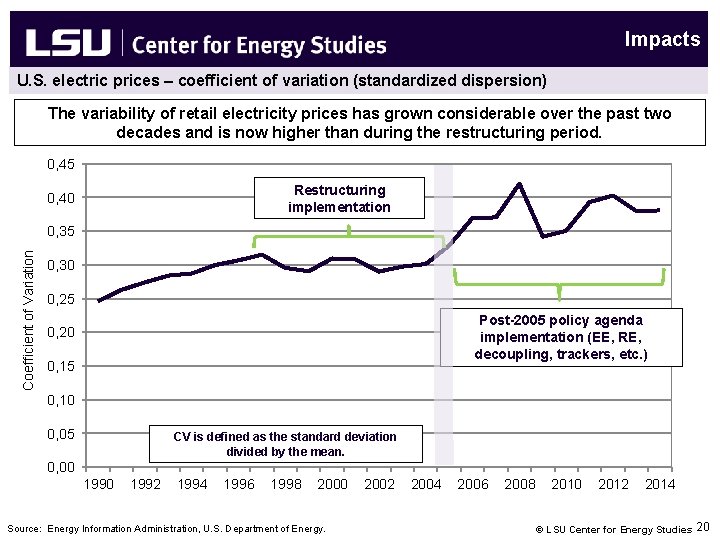
Impacts U. S. electric prices – coefficient of variation (standardized dispersion) The variability of retail electricity prices has grown considerable over the past two decades and is now higher than during the restructuring period. 0, 45 Restructuring implementation 0, 40 Coefficient of Variation 0, 35 0, 30 0, 25 Post-2005 policy agenda implementation (EE, RE, decoupling, trackers, etc. ) 0, 20 0, 15 0, 10 0, 05 CV is defined as the standard deviation divided by the mean. 0, 00 1992 1994 1996 1998 2000 Source: Energy Information Administration, U. S. Department of Energy. 2002 2004 2006 2008 2010 2012 2014 © LSU Center for Energy Studies 20
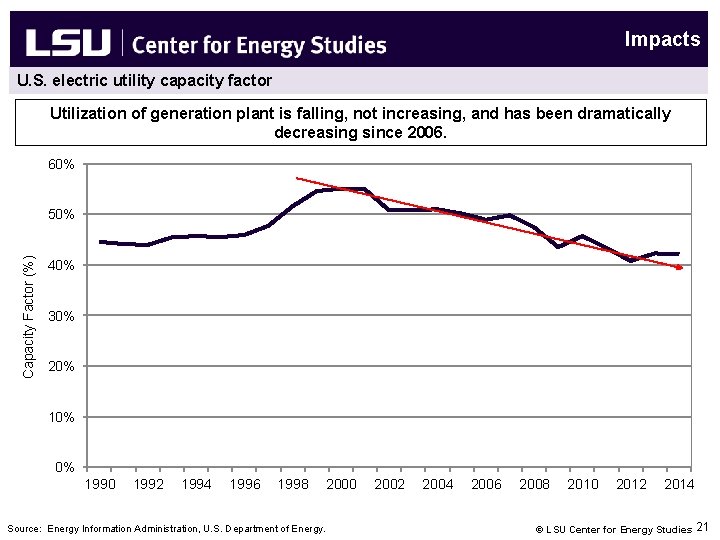
Impacts U. S. electric utility capacity factor Utilization of generation plant is falling, not increasing, and has been dramatically decreasing since 2006. 60% Capacity Factor (%) 50% 40% 30% 20% 10% 0% 1990 1992 1994 1996 1998 2000 Source: Energy Information Administration, U. S. Department of Energy. 2002 2004 2006 2008 2010 2012 2014 © LSU Center for Energy Studies 21
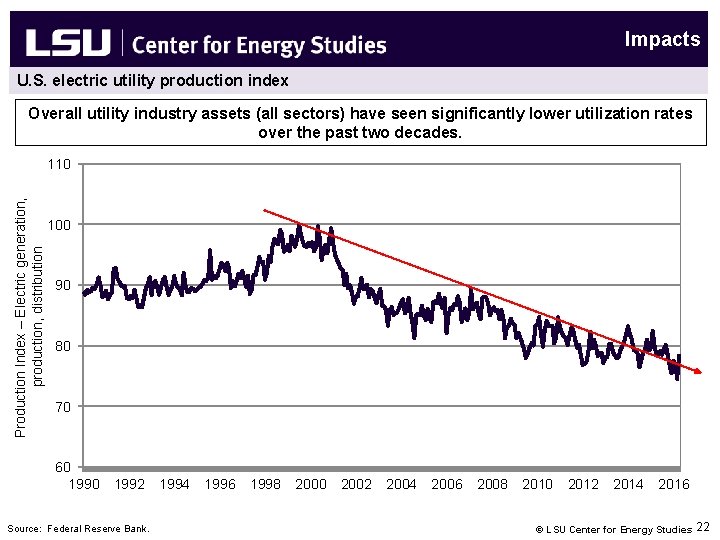
Impacts U. S. electric utility production index Overall utility industry assets (all sectors) have seen significantly lower utilization rates over the past two decades. Production Index – Electric generation, production, distribution 110 100 90 80 70 60 1992 Source: Federal Reserve Bank. 1994 1996 1998 2000 2002 2004 2006 2008 2010 2012 2014 2016 © LSU Center for Energy Studies 22
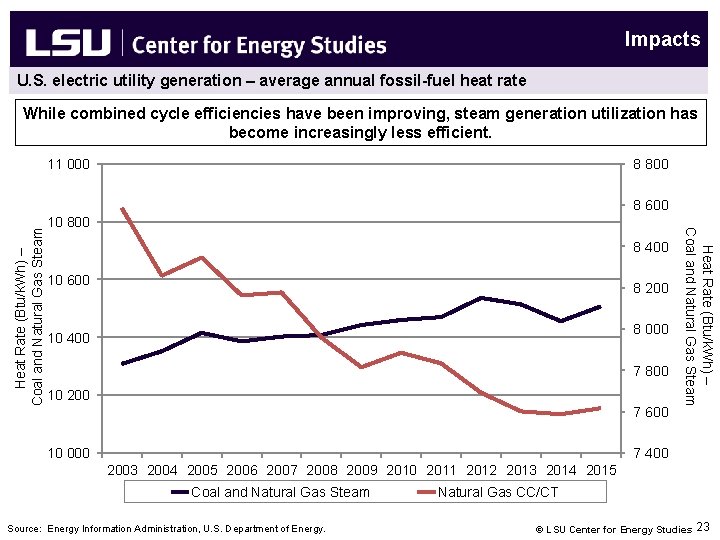
Impacts U. S. electric utility generation – average annual fossil-fuel heat rate While combined cycle efficiencies have been improving, steam generation utilization has become increasingly less efficient. 11 000 8 800 10 800 8 400 10 600 8 200 8 000 10 400 7 800 10 200 7 600 10 000 Heat Rate (Btu/k. Wh) – Coal and Natural Gas Steam 8 600 7 400 2003 2004 2005 2006 2007 2008 2009 2010 2011 2012 2013 2014 2015 Coal and Natural Gas Steam Source: Energy Information Administration, U. S. Department of Energy. Natural Gas CC/CT © LSU Center for Energy Studies 23
Center for Energy Studies Conclusions © LSU Center for Energy Studies 24
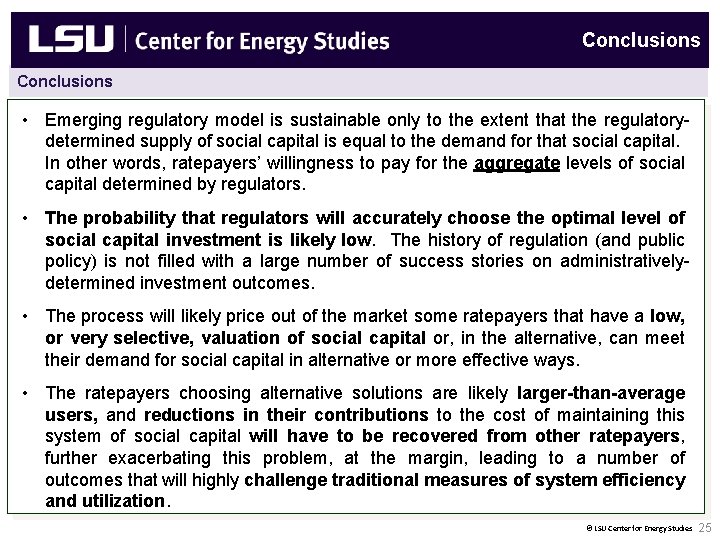
Conclusions • Emerging regulatory model is sustainable only to the extent that the regulatorydetermined supply of social capital is equal to the demand for that social capital. In other words, ratepayers’ willingness to pay for the aggregate levels of social capital determined by regulators. • The probability that regulators will accurately choose the optimal level of social capital investment is likely low. The history of regulation (and public policy) is not filled with a large number of success stories on administrativelydetermined investment outcomes. • The process will likely price out of the market some ratepayers that have a low, or very selective, valuation of social capital or, in the alternative, can meet their demand for social capital in alternative or more effective ways. • The ratepayers choosing alternative solutions are likely larger-than-average users, and reductions in their contributions to the cost of maintaining this system of social capital will have to be recovered from other ratepayers, further exacerbating this problem, at the margin, leading to a number of outcomes that will highly challenge traditional measures of system efficiency and utilization. © LSU Center for Energy Studies 25
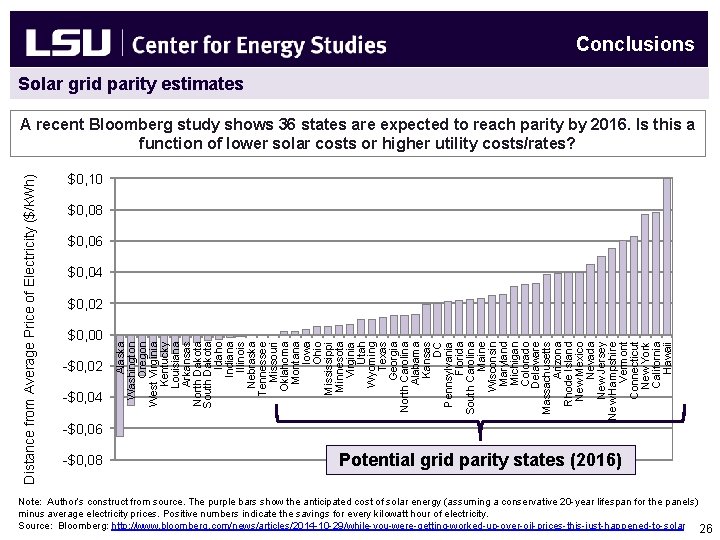
Conclusions Solar grid parity estimates $0, 10 $0, 08 $0, 06 $0, 04 $0, 02 $0, 00 -$0, 02 -$0, 04 Alaska Washington Oregon West Virginia Kentucky Louisiana Arkansas North Dakota South Dakota Idaho Indiana Illinois Nebraska Tennessee Missouri Oklahoma Montana Iowa Ohio Mississippi Minnesota Virginia Utah Wyoming Texas Georgia North Carolina Alabama Kansas DC Pennsylvania Florida South Carolina Maine Wisconsin Maryland Michigan Colorado Delaware Massachusetts Arizona Rhode Island New Mexico Nevada New Jersey New Hampshire Vermont Connecticut New York California Hawaii Distance from Average Price of Electricity ($/k. Wh) A recent Bloomberg study shows 36 states are expected to reach parity by 2016. Is this a function of lower solar costs or higher utility costs/rates? -$0, 06 -$0, 08 Potential grid parity states (2016) Note: Author’s construct from source. The purple bars show the anticipated cost of solar energy (assuming a conservative 20 -year lifespan for the panels) minus average electricity prices. Positive numbers indicate the savings for every kilowatt hour of electricity. Source: Bloomberg: http: //www. bloomberg. com/news/articles/2014 -10 -29/while-you-were-getting-worked-up-over-oil-prices-this-just-happened-to-solar 26
Questions, Comments and Discussion dismukes@lsu. edu www. enrg. lsu. edu