
The Future of Manure Digesters in Wisconsin February
The Future of Manure Digesters in Wisconsin February 25 th 2020 Mark Hill Vice President of Dairy RNG Operations
Agenda Overview of DTE Biomass Energy’s Wisconsin Projects The Present State of Digesters and RNG The Future of Digestion and How to Attract Development 2
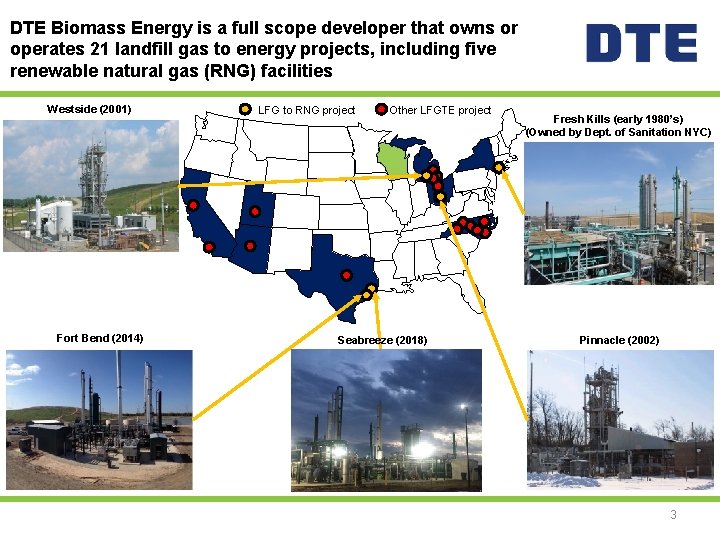
DTE Biomass Energy is a full scope developer that owns or operates 21 landfill gas to energy projects, including five renewable natural gas (RNG) facilities Westside (2001) Fort Bend (2014) LFG to RNG project Other LFGTE project Seabreeze (2018) Fresh Kills (early 1980’s) (Owned by Dept. of Sanitation NYC) Pinnacle (2002) 3
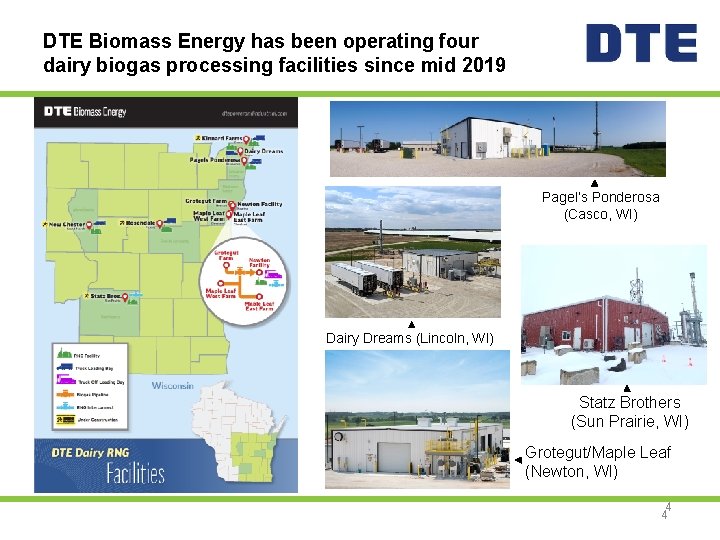
DTE Biomass Energy has been operating four dairy biogas processing facilities since mid 2019 Pagel’s Ponderosa (Casco, WI) Dairy Dreams (Lincoln, WI) Statz Brothers (Sun Prairie, WI) Grotegut/Maple Leaf (Newton, WI) 4 4
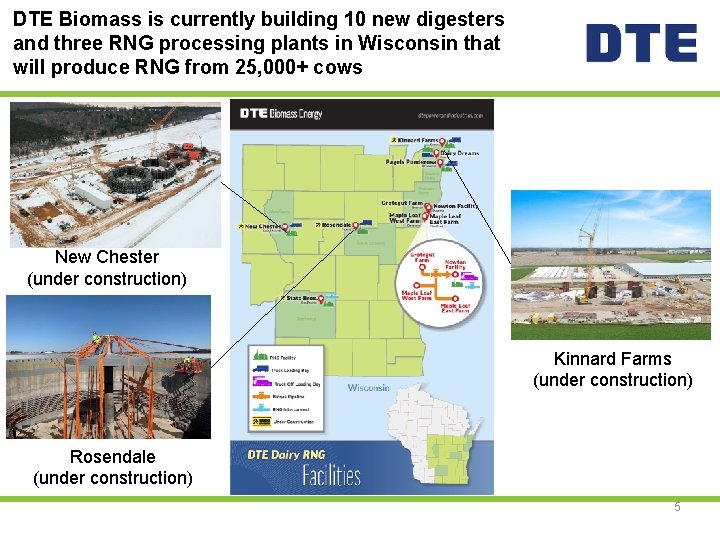
DTE Biomass is currently building 10 new digesters and three RNG processing plants in Wisconsin that will produce RNG from 25, 000+ cows New Chester (under construction) Kinnard Farms (under construction) Rosendale (under construction) 5

RNG Biogas Processing Plant Process Flow with Local Pipeline Interconnect Biogas (when process is not available) Biogas 60% Methane 40% Carbon Dioxide Sump Water returned to digester Water Knockout Compressor and Membrane Gas Separation System Condensed water to sump Flare H 2 S Scavenger Media Natural Gas (when process is not within product specifications) Gas Dryer Metering /Quality Check 99% Methane Renewable Natural Gas CO 2 and H 2 S Sump Thermal Oxidizer Compressor Water for disposal Condensed Water Interconnection to Pipeline 6
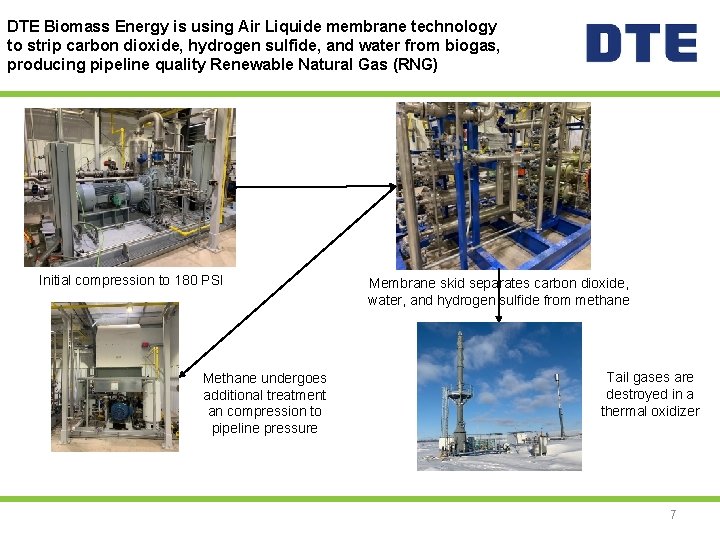
DTE Biomass Energy is using Air Liquide membrane technology to strip carbon dioxide, hydrogen sulfide, and water from biogas, producing pipeline quality Renewable Natural Gas (RNG) Initial compression to 180 PSI Methane undergoes additional treatment an compression to pipeline pressure Membrane skid separates carbon dioxide, water, and hydrogen sulfide from methane Tail gases are destroyed in a thermal oxidizer 7
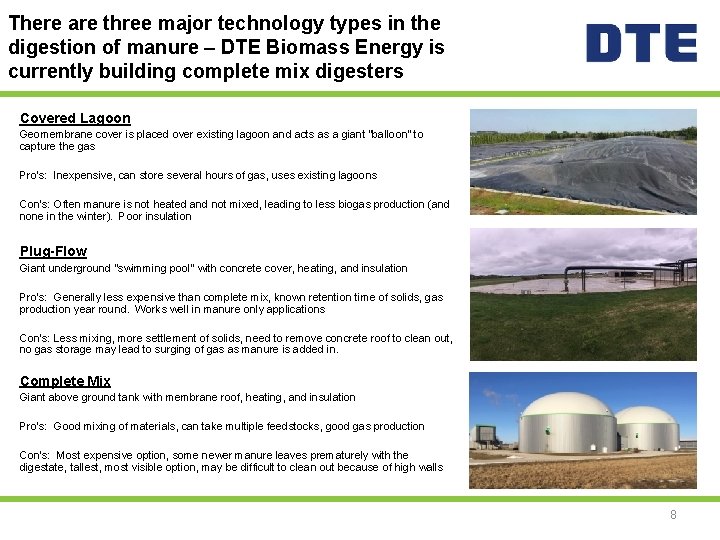
There are three major technology types in the digestion of manure – DTE Biomass Energy is currently building complete mix digesters Covered Lagoon Geomembrane cover is placed over existing lagoon and acts as a giant “balloon” to capture the gas Pro’s: Inexpensive, can store several hours of gas, uses existing lagoons Con’s: Often manure is not heated and not mixed, leading to less biogas production (and none in the winter). Poor insulation Plug-Flow Giant underground “swimming pool” with concrete cover, heating, and insulation Pro’s: Generally less expensive than complete mix, known retention time of solids, gas production year round. Works well in manure only applications Con’s: Less mixing, more settlement of solids, need to remove concrete roof to clean out, no gas storage may lead to surging of gas as manure is added in. Complete Mix Giant above ground tank with membrane roof, heating, and insulation Pro’s: Good mixing of materials, can take multiple feedstocks, good gas production Con’s: Most expensive option, some newer manure leaves prematurely with the digestate, tallest, most visible option, may be difficult to clean out because of high walls 8
Agenda Overview of DTE Biomass Energy’s Wisconsin Projects The Present State of Wisconsin Digesters and RNG The Future of Digestion and How to Attract Development 9
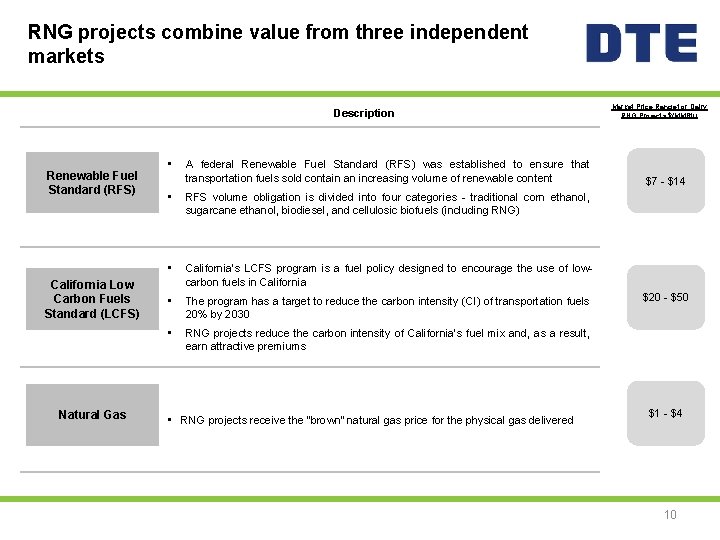
RNG projects combine value from three independent markets Description Renewable Fuel Standard (RFS) California Low Carbon Fuels Standard (LCFS) Natural Gas • A federal Renewable Fuel Standard (RFS) was established to ensure that transportation fuels sold contain an increasing volume of renewable content • RFS volume obligation is divided into four categories - traditional corn ethanol, sugarcane ethanol, biodiesel, and cellulosic biofuels (including RNG) • California’s LCFS program is a fuel policy designed to encourage the use of lowcarbon fuels in California • The program has a target to reduce the carbon intensity (CI) of transportation fuels 20% by 2030 • RNG projects reduce the carbon intensity of California’s fuel mix and, as a result, earn attractive premiums • RNG projects receive the “brown” natural gas price for the physical gas delivered Market Price Range for Dairy RNG Projects $/MMBtu $7 - $14 $20 - $50 $1 - $4 10
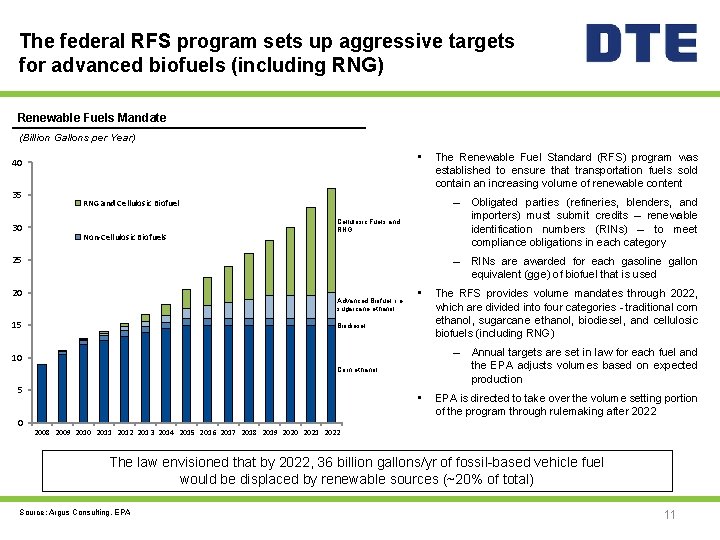
The federal RFS program sets up aggressive targets for advanced biofuels (including RNG) Renewable Fuels Mandate (Billion Gallons per Year) • 40 35 30 RNG and Cellulosic Biofuel Non-Cellulosic Biofuels Advanced Biofuel, i. e. sugarcane ethanol 15 • Biodiesel Obligated parties (refineries, blenders, and importers) must submit credits – renewable identification numbers (RINs) – to meet compliance obligations in each category – RINs are awarded for each gasoline gallon equivalent (gge) of biofuel that is used The RFS provides volume mandates through 2022, which are divided into four categories - traditional corn ethanol, sugarcane ethanol, biodiesel, and cellulosic biofuels (including RNG) – 10 Corn ethanol 5 0 – Cellulosic Fuels and RNG 25 20 The Renewable Fuel Standard (RFS) program was established to ensure that transportation fuels sold contain an increasing volume of renewable content • Annual targets are set in law for each fuel and the EPA adjusts volumes based on expected production EPA is directed to take over the volume setting portion of the program through rulemaking after 2022 2008 2009 2010 2011 2012 2013 2014 2015 2016 2017 2018 2019 2020 2021 2022 The law envisioned that by 2022, 36 billion gallons/yr of fossil-based vehicle fuel would be displaced by renewable sources (~20% of total) Source: Argus Consulting, EPA 11
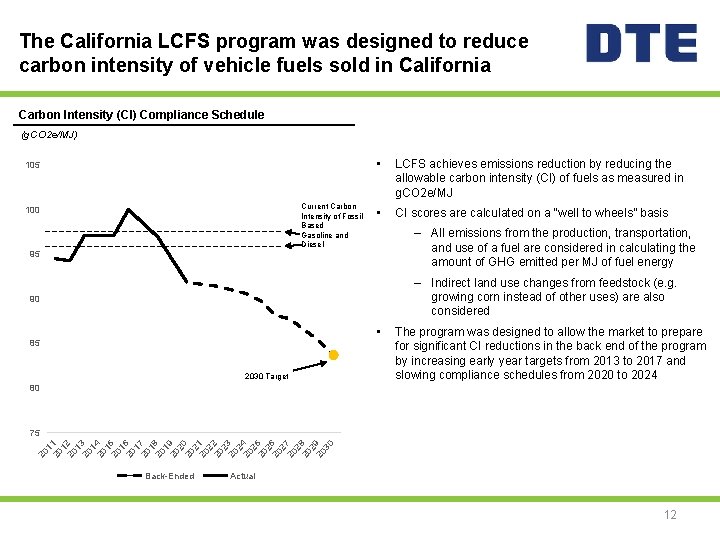
The California LCFS program was designed to reduce carbon intensity of vehicle fuels sold in California Carbon Intensity (CI) Compliance Schedule (g. CO 2 e/MJ) 105 Current Carbon Intensity of Fossil Based Gasoline and Diesel 100 • LCFS achieves emissions reduction by reducing the allowable carbon intensity (CI) of fuels as measured in g. CO 2 e/MJ • CI scores are calculated on a “well to wheels” basis – All emissions from the production, transportation, and use of a fuel are considered in calculating the amount of GHG emitted per MJ of fuel energy 95 – Indirect land use changes from feedstock (e. g. growing corn instead of other uses) are also considered 90 • 85 2030 Target The program was designed to allow the market to prepare for significant CI reductions in the back end of the program by increasing early year targets from 2013 to 2017 and slowing compliance schedules from 2020 to 2024 80 20 1 12 20 1 20 3 1 20 4 15 20 1 20 6 1 20 7 1 20 8 1 20 9 2 20 0 2 20 1 2 20 2 2 20 3 2 20 4 2 20 5 2 20 6 2 20 7 2 20 8 2 20 9 30 75 Back-Ended Actual 12
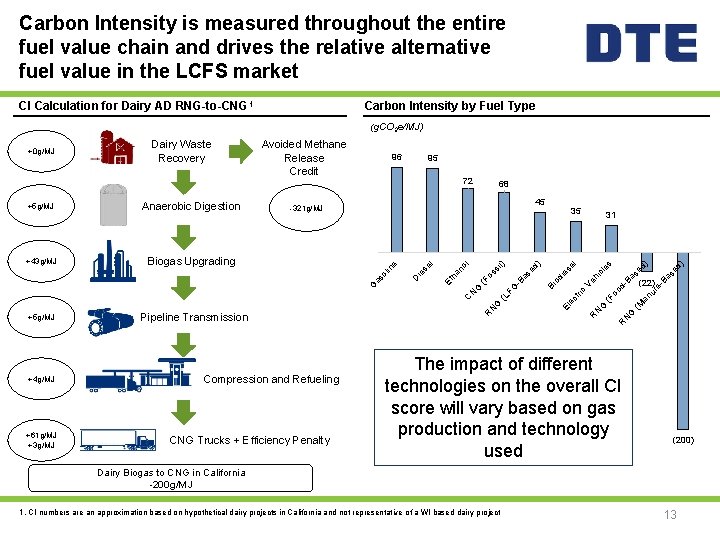
Carbon Intensity is measured throughout the entire fuel value chain and drives the relative alternative fuel value in the LCFS market Carbon Intensity by Fuel Type CI Calculation for Dairy AD RNG-to-CNG 1 (g. CO 2 e/MJ) 68 CNG Trucks + Efficiency Penalty ) ed as e. B an (M (F G G N R R (22) ur oo d c tri -B as hi c Ve di ec El ed ) le s el 31 es ) as -B FG (L R N G +61 g/MJ +3 g/MJ Compression and Refueling Bi o si os (F G N C +4 g/MJ Pipeline Transmission ed l) l l an o ol G as +5 g/MJ 35 N 45 -321 g/MJ Et h Biogas Upgrading 72 se +43 g/MJ 95 ie Anaerobic Digestion 96 in +5 g/MJ Avoided Methane Release Credit D Dairy Waste Recovery e +0 g/MJ The impact of different technologies on the overall CI score will vary based on gas production and technology used (200) Dairy Biogas to CNG in California -200 g/MJ 1. CI numbers are an approximation based on hypothetical dairy projects in California and not representative of a WI based dairy project 13
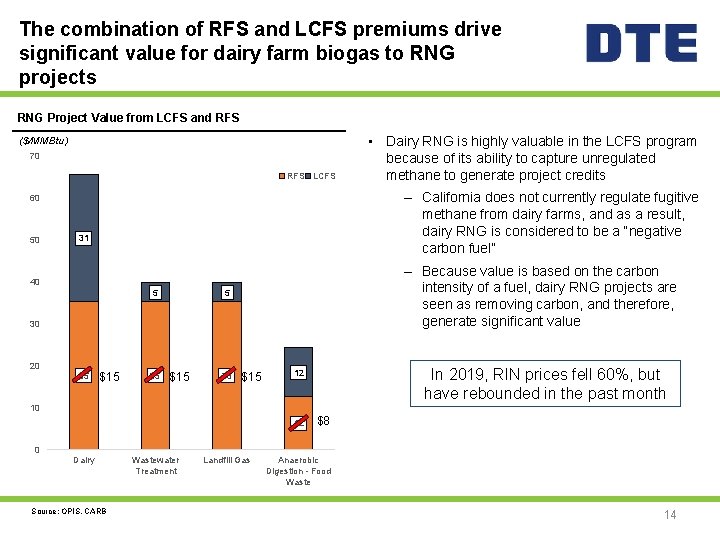
The combination of RFS and LCFS premiums drive significant value for dairy farm biogas to RNG projects RNG Project Value from LCFS and RFS ($/MMBtu) 70 RFS LCFS – California does not currently regulate fugitive methane from dairy farms, and as a result, dairy RNG is considered to be a “negative carbon fuel” 60 50 31 – Because value is based on the carbon intensity of a fuel, dairy RNG projects are seen as removing carbon, and therefore, generate significant value 40 5 5 30 20 35 • Dairy RNG is highly valuable in the LCFS program because of its ability to capture unregulated methane to generate project credits $15 35 $15 In 2019, RIN prices fell 60%, but have rebounded in the past month 12 10 12 $8 0 Dairy Source: OPIS, CARB Wastewater Treatment Landfill Gas Anaerobic Digestion - Food Waste 14
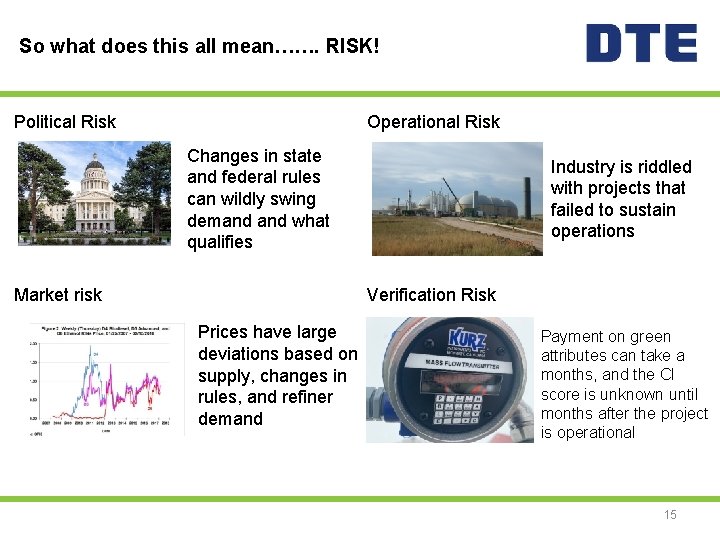
So what does this all mean……. RISK! Political Risk Operational Risk Changes in state and federal rules can wildly swing demand what qualifies Market risk Industry is riddled with projects that failed to sustain operations Verification Risk Prices have large deviations based on supply, changes in rules, and refiner demand Payment on green attributes can take a months, and the CI score is unknown until months after the project is operational 15
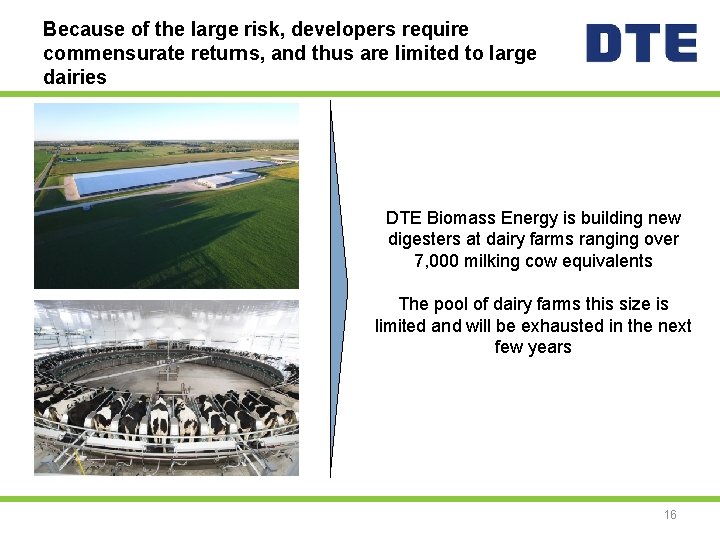
Because of the large risk, developers require commensurate returns, and thus are limited to large dairies DTE Biomass Energy is building new digesters at dairy farms ranging over 7, 000 milking cow equivalents The pool of dairy farms this size is limited and will be exhausted in the next few years 16
Agenda Overview of DTE Biomass Energy’s Wisconsin Projects The Present State of Digesters and RNG The Future of Digestion and How to Attract Development 17
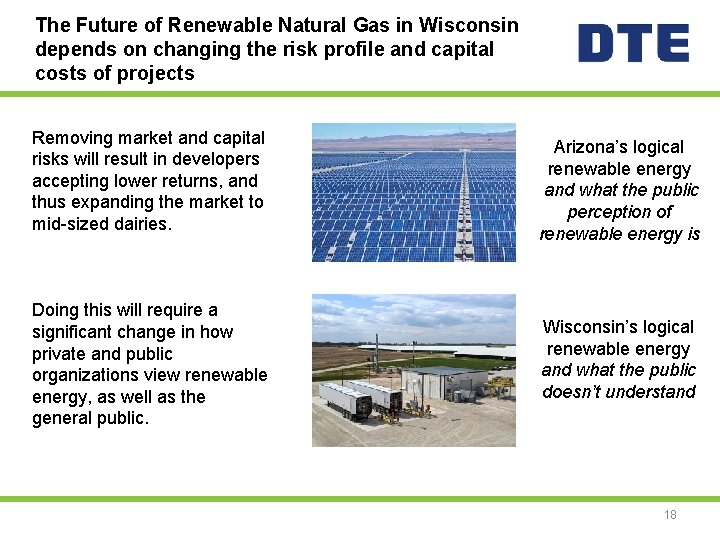
The Future of Renewable Natural Gas in Wisconsin depends on changing the risk profile and capital costs of projects Removing market and capital risks will result in developers accepting lower returns, and thus expanding the market to mid-sized dairies. Doing this will require a significant change in how private and public organizations view renewable energy, as well as the general public. Arizona’s logical renewable energy and what the public perception of renewable energy is Wisconsin’s logical renewable energy and what the public doesn’t understand 18
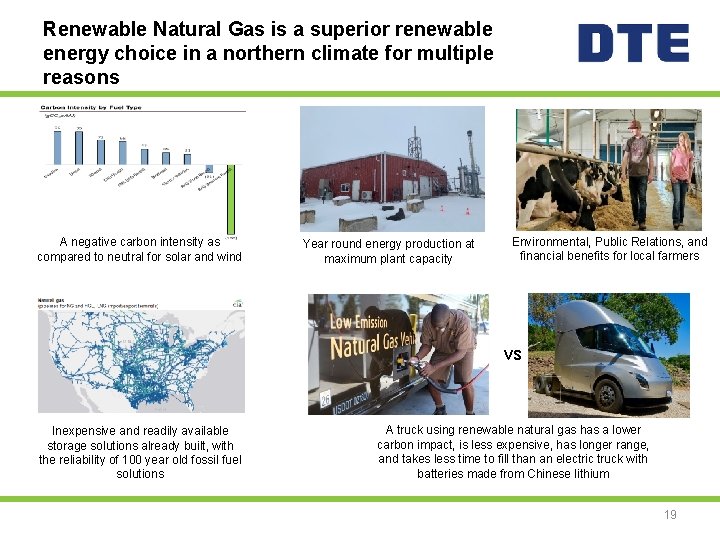
Renewable Natural Gas is a superior renewable energy choice in a northern climate for multiple reasons A negative carbon intensity as compared to neutral for solar and wind Year round energy production at maximum plant capacity Environmental, Public Relations, and financial benefits for local farmers vs Inexpensive and readily available storage solutions already built, with the reliability of 100 year old fossil fuel solutions A truck using renewable natural gas has a lower carbon impact, is less expensive, has longer range, and takes less time to fill than an electric truck with batteries made from Chinese lithium 19
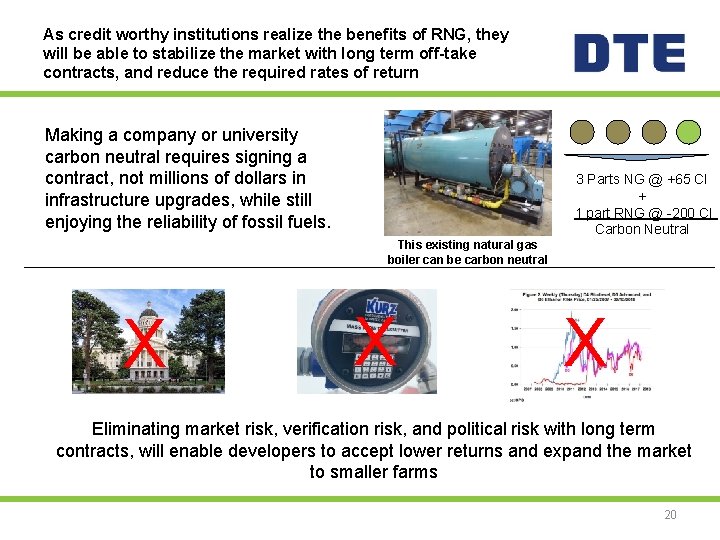
As credit worthy institutions realize the benefits of RNG, they will be able to stabilize the market with long term off-take contracts, and reduce the required rates of return Making a company or university carbon neutral requires signing a contract, not millions of dollars in infrastructure upgrades, while still enjoying the reliability of fossil fuels. 3 Parts NG @ +65 CI + 1 part RNG @ -200 CI Carbon Neutral This existing natural gas boiler can be carbon neutral X X X Eliminating market risk, verification risk, and political risk with long term contracts, will enable developers to accept lower returns and expand the market to smaller farms 20
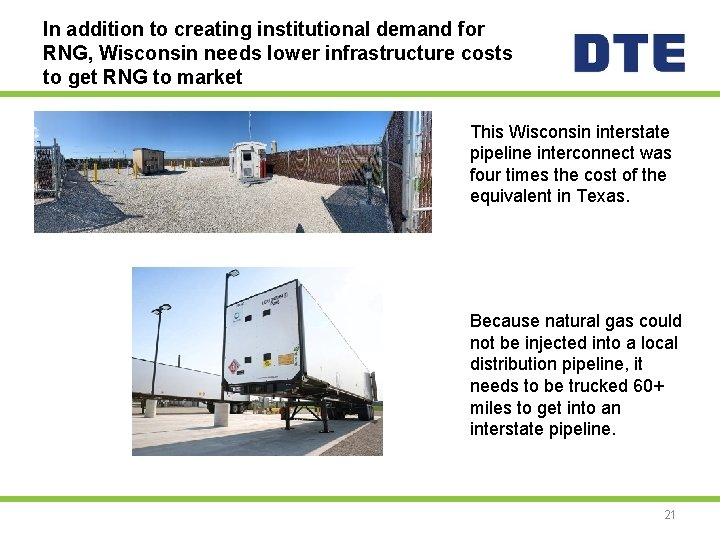
In addition to creating institutional demand for RNG, Wisconsin needs lower infrastructure costs to get RNG to market This Wisconsin interstate pipeline interconnect was four times the cost of the equivalent in Texas. Because natural gas could not be injected into a local distribution pipeline, it needs to be trucked 60+ miles to get into an interstate pipeline. 21
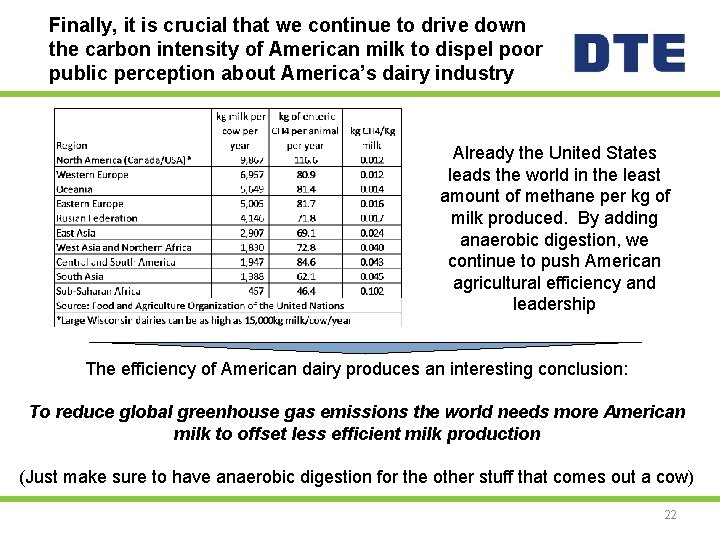
Finally, it is crucial that we continue to drive down the carbon intensity of American milk to dispel poor public perception about America’s dairy industry Already the United States leads the world in the least amount of methane per kg of milk produced. By adding anaerobic digestion, we continue to push American agricultural efficiency and leadership The efficiency of American dairy produces an interesting conclusion: To reduce global greenhouse gas emissions the world needs more American milk to offset less efficient milk production (Just make sure to have anaerobic digestion for the other stuff that comes out a cow) 22
Contact Information Kevin Dobson Vice President of Business Development kevin. dobson@dteenergy. com Mark Hill Vice President of Dairy RNG Operations mark. hill@dteenergy. com Krista Hofmann Wisconsin Regional Operations Manager Krista. hofmann@dteenergy. com 23
- Slides: 23