
THE FUTURE OF LIBRARIES New Technologies New Models
THE FUTURE OF LIBRARIES New Technologies, New Models, and Strategic Transition Marshall Breeding Independent Consult, Author, Founder and Publisher, Library Technology Guides www. librarytechnology. org/ twitter. com/mbreeding 18 Dec 2012 The Future of Libraries: New Technologies, New Models and Strategic Transition Conference on Chinese Academic Library Technology & Development 2012
Summary Cloud computing in Libraries: trends related to the adoption of cloud computing technologies for library management and discovery products.
Summary Cloud computing is one of the most important technology trends of the times. The phase of client/server computing is fading into obsolescence, replaced by entirely web-based systems, increasingly deployed through Saa. S. Libraries and other technology-oriented organizations now have options through infrastructure-as-a-service offerings such as Amazon’s Elastic Compute Cloud and Simple Storage Service to ramp up computing capabilities quickly, enjoy free access for smaller projects, and take advantage of usage- based subscription models for larger-scale production projects. Breeding expands on these topics and provides a basic explanation of cloud computing that focuses on real advantages and disadvantages for libraries.
Agenda 9: 00 -10: 00 Section 1 � Global Trends in Information Technology in Libraries 13: 30 -15: 00 Section 2 � Trends in Library Automation Software implementation 15: 10 -16: 40 � Global Section 3 business arena, Questions and Discussion
Global Trends in Information Technology in Libraries • • Cloud Computing Web-based systems Mobile Evolution of Legacy systems Expanding scope of library mission: electronic resource management, Creating and curating digital collections, Digital preservation 9: 00 -10: 00 Section 1
Redefining Libraries Future Service and Development Models
Appropriate Automation Infrastructure Current automation products out of step with current realities Majority of library collection funds spent on electronic content Majority of automation efforts support print activities Management of e-content continues with inadequate supporting infrastructure New discovery solutions help with access to econtent Library users expect more engaging socially aware interfaces for Web and mobile
Key Context: Libraries in Transition Academic Shift from Print > Electronic E-journal transition largely complete � Circulation of print collections slowing � E-books now in play (consultation > reading) � Public: Emphasis on Patron Engagement Increased pressure on physical facilities � Increased circulation of print collections � Dramatic increase in interest in e-books � All libraries: Need better tools for access to complex multi-format collections � Strong emphasis on digitizing local collections � Demands for enterprise integration and interoperability �
Key Context: Technologies in transition � Client / Server > Web-based computing � Natively social computing Integration � Local of social computing into core infrastructure computing shifting to cloud platforms Application Service Provider offerings standard New expectations for multi-tenant software-as-aservice � Full spectrum of devices full-scale / net book / tablet / mobile Mobile the current focus, but is only one example of device and interface cycles
Key Context: Changed expectations in metadata management Moving away from individual record-by-record creation Life cycle of metadata � Manage metadata in bulk when possible � E-book collections Highly shared metadata � Metadata follows the supply chain, improved and enhanced along the way as needed E-journal knowledge bases (Knowledge. Works / 360 Core) Great interest in moving toward semantic web and open linked data � � � Very little progress in linked data for operational systems AACR 2 > RDA MARC > RDF: Bibliographic Framework Transition Initiative http: //www. loc. gov/marc/transition/
Key Context: Research Data Academic libraries have increased library involvement with research data Facilitate data management plans for research projects Lend Library expertise to organization and management Preservation
Surging Interest in the Semantic Web Open Linked Data Bibliographic data sets released through Creative Commons Public Domain License (CC 0) � Europeana, Harvard, etc. Databases that natively manage RDF triple stores Currently at Early stages of introducing semantic technologies in discovery Relational databases continue to power business systems
Each Library Type Distinctive Academic – Public – School – Special Academic: Emphasis on subscribed electronic resources Public: Engaged in the management of print collections � Dramatic increase in interest in E-books School: Age-appropriate resources (print and Web), textbook and media management Special: Enterprise knowledge management (Corporate, Law, Medical, etc)
Cooperation and Resource sharing Efforts on many fronts to cooperate and consolidate Many regional consortia merging (Example: suburban Chicago systems) State-wide or national implementations Software-as-a-service or “cloud” based implementations � Many libraries share computing infrastructure and data resources
Cloud Computing and Services
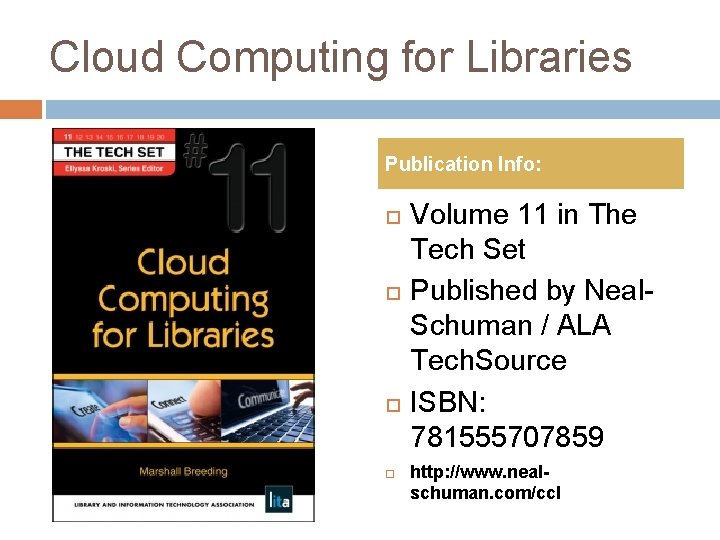
Cloud Computing for Libraries Book Image Publication Info: Volume 11 in The Tech Set Published by Neal. Schuman / ALA Tech. Source ISBN: 781555707859 http: //www. nealschuman. com/ccl
Cloud computing as marketing term Cloud computing used very freely, tagged to almost any virtualized environment Any arrangement where the library relies on some kind of remote hosting environment for major automation components Includes almost any vendor-hosted product offering
Cloud computing – characteristics Web-based Interfaces Externally hosted Pricing: subscription or utility Highly abstracted computing model Provisioned on demand Scaled according to variable needs Elastic – consumption of resources can contract and expand according to demand
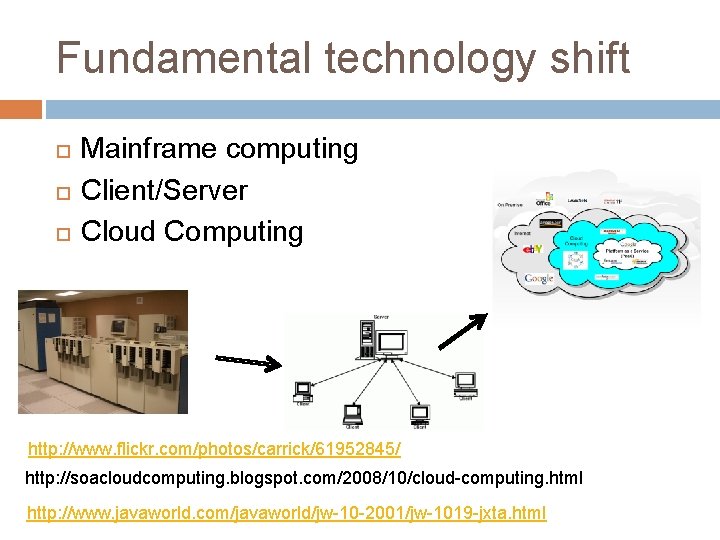
Fundamental technology shift Mainframe computing Client/Server Cloud Computing http: //www. flickr. com/photos/carrick/61952845/ http: //soacloudcomputing. blogspot. com/2008/10/cloud-computing. html http: //www. javaworld. com/javaworld/jw-10 -2001/jw-1019 -jxta. html
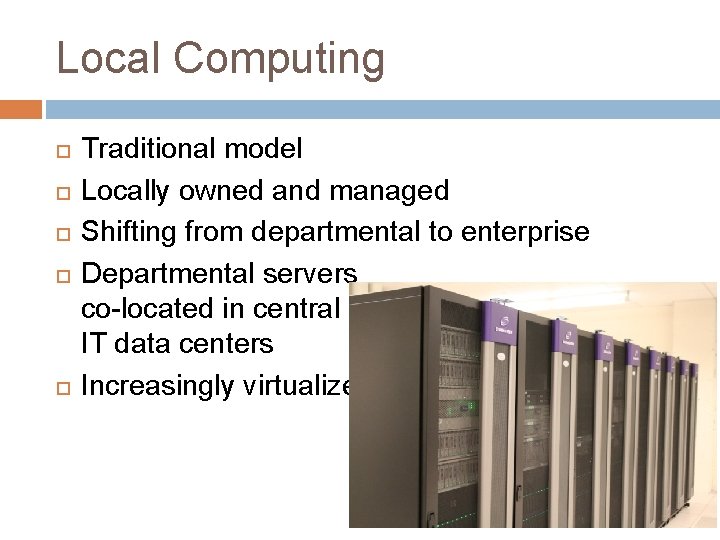
Local Computing Traditional model Locally owned and managed Shifting from departmental to enterprise Departmental servers co-located in central IT data centers Increasingly virtualized
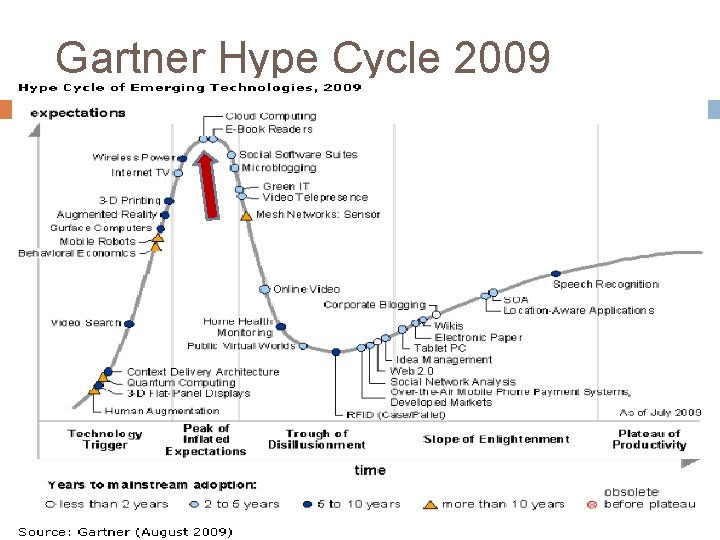
Gartner Hype Cycle 2009
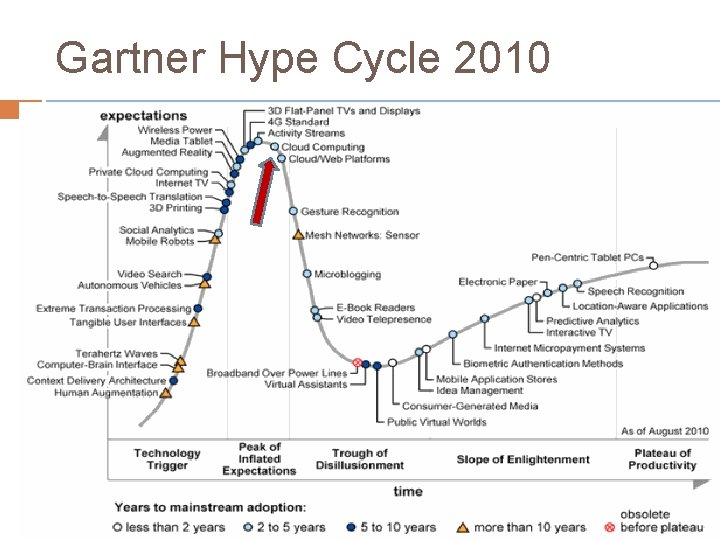
Gartner Hype Cycle 2010
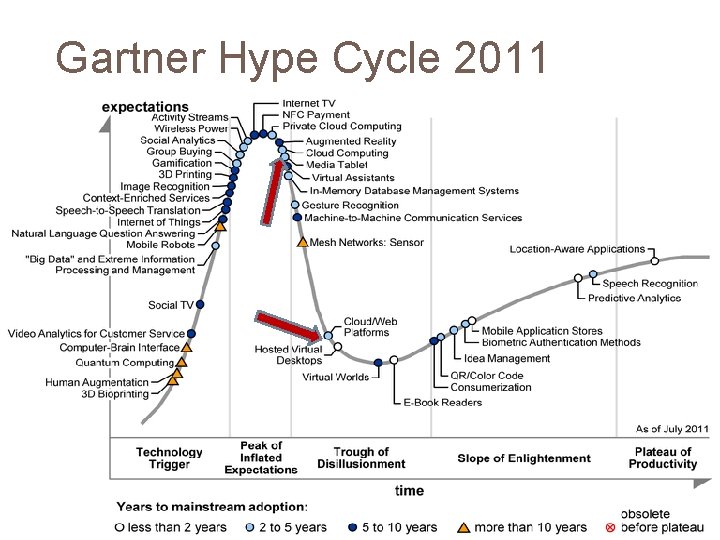
Gartner Hype Cycle 2011
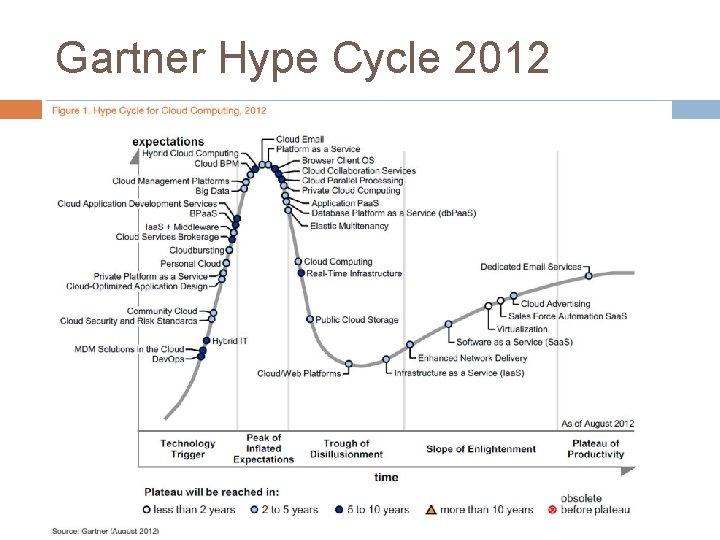
Gartner Hype Cycle 2012
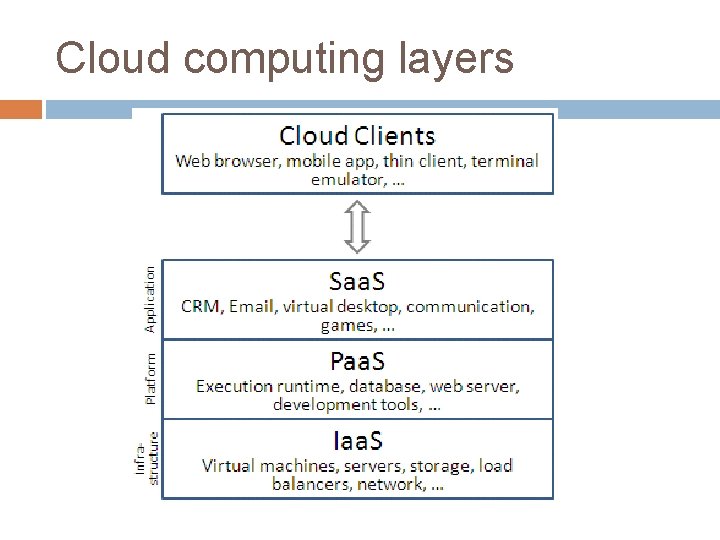
Cloud computing layers
Infrastructure-as-a-service Provisioning of Equipment Servers, storage � Virtual server provisioning Examples: Amazon Elastic Compute Cloud (EC 2) Amazon Simple Storage Service (S 3) Rackspace Cloud www. rackspacecloud. com/) EMC 2 Atmos (www. atmosonline. com/)
Software-as-a-Service Complete software application, customized for customer use Software delivered through cloud infrastructure, data stored on cloud Eg: Salesforce. com—widely used business infrastructure Multi-tenant: all organizations that use the service share the same instance (codebase, hardware resources, etc) � Often partitioned to separate some groups of subscribers
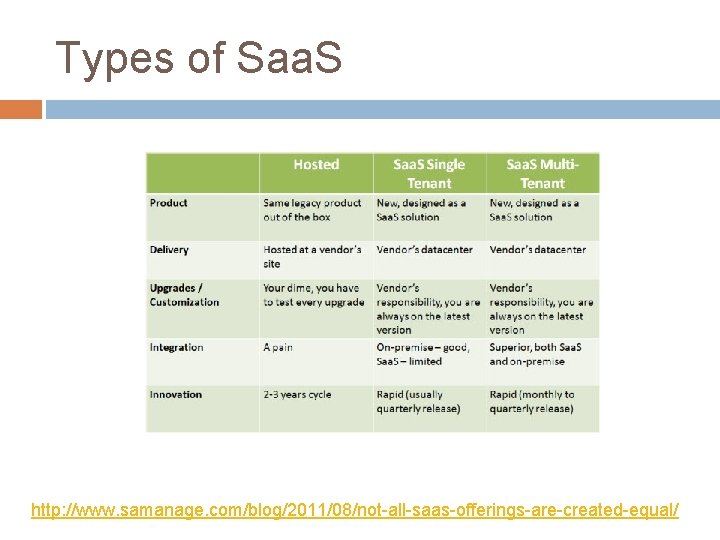
Types of Saa. S http: //www. samanage. com/blog/2011/08/not-all-saas-offerings-are-created-equal/
Application service provider Legacy business applications hosted by software vendor Standalone application on discrete or virtualized hardware Staff and public clients accessed via the Internet Same user interfaces and functionality as if installed locally Established as a deployment model in the 1990’s Can be implemented through Infrastructure-as-a Service � Individual instances of legacy system hosted in EC 2
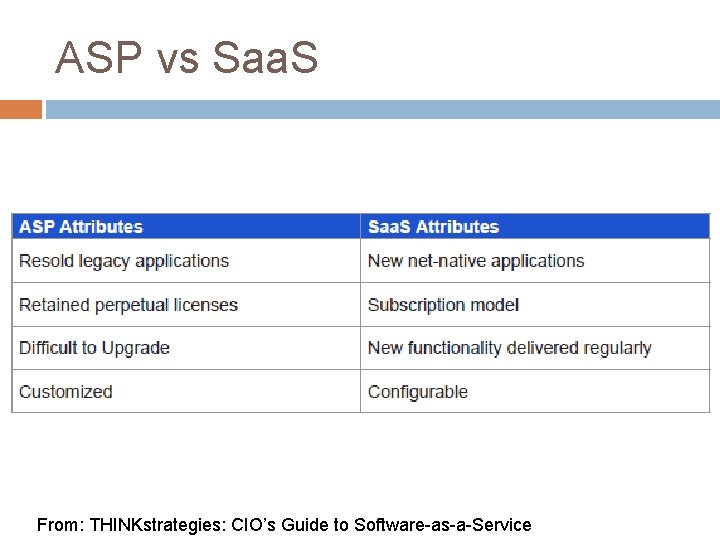
ASP vs Saa. S From: THINKstrategies: CIO’s Guide to Software-as-a-Service
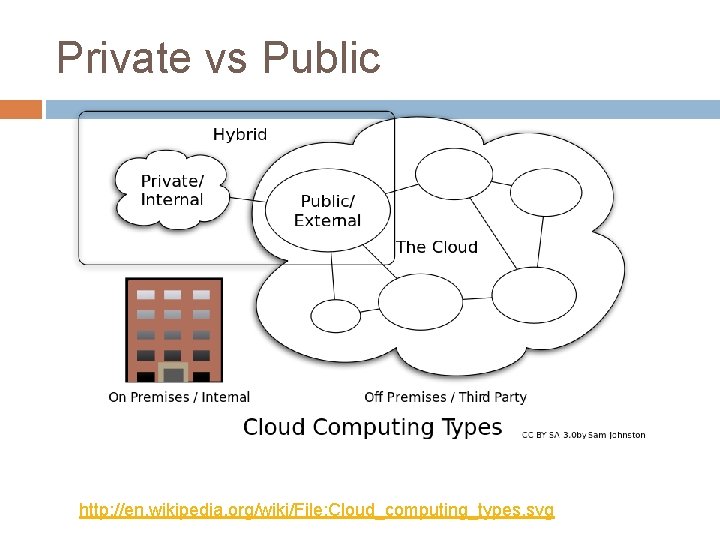
Private vs Public http: //en. wikipedia. org/wiki/File: Cloud_computing_types. svg
Storage-as-a-Service Provisioned, on-demand storage Bundled to, or separate from other cloud services Examples: � Enterprise: Amazon S 3 (Simple Storage Service) � Consumer: Dropbox
Data as a service General opportunity to move away from library-bylibrary metadata management to globally shared workflows Shared knowledge bases � E-resource holdings � Bibliographic services � Linked data applications Key Issues � Data ownership � Creative commons license � Data portability across competing providers
Cloud computing trends for libraries Increased migration away from local computing toward some form of remote / hosted / virtualized alternative Cloud computing especially attractive to libraries with few technology support personnel Adequate bandwidth will continue to be a limiting factor
Data in the cloud Storage as a service Informal / small-scale � Dropbox (2 GB+) � Microsoft Skydrive (7 GB+) � Mostly used as supplemental storage and for sharing Institutional / Larger-scale � Local storage still dominant � When using cloud storage for institutional data Multiple tiers of backup with SLA � Dura. Cloud, S 3, many others
Platform-as-a-Platform as a Service Virtualized computing environment for deployment of software Application engine, no specific server provisioning Examples: � Google SDKs App Engine for Java, Python � Heroku: ruby platform � Amazon Web Service Library Specific platforms
Library automation through Saa. S Almost all library automation products offered through hosted options Saa. S or ASP?
Data as a service Saa. S provides opportunity for highly shared data models General opportunity to move away from libraryby-library metadata management to globally shared workflows
Caveats and concerns with Saa. S Libraries must have adequate bandwidth to support access to remote applications without latency Quality of service agreements that guarantee performance and reliability factors Configurability and customizability limitations Access to API’s Ability to interoperate with 3 rd party applications � Eg: Connect Saa. S ILS with discovery product from another vendor
Maintain institutional branding Using cloud computing does not mean giving up your identity Be sure that your services delivered through your own URL Most cloud services support domain aliases Accomplished through DNS configuration � Implemented by your network administrator � Create CNAME entry to redirect cloud service to a subdomain associated with your library: � S 3. mylibrary. org = s 3. amazonaws. com.
Cost implications Total cost of ownership Do all cost components result in increased or decreased expense � Personnel costs – need less technical administration � Hardware – server hardware eliminated � Software costs: subscription, license, maintenance/support � Indirect costs: energy costs associated with power and cooling of servers in data center Iaa. S: balance elimination of hardware investments for ongoing usage fees � Especially attractive for development and prototyping
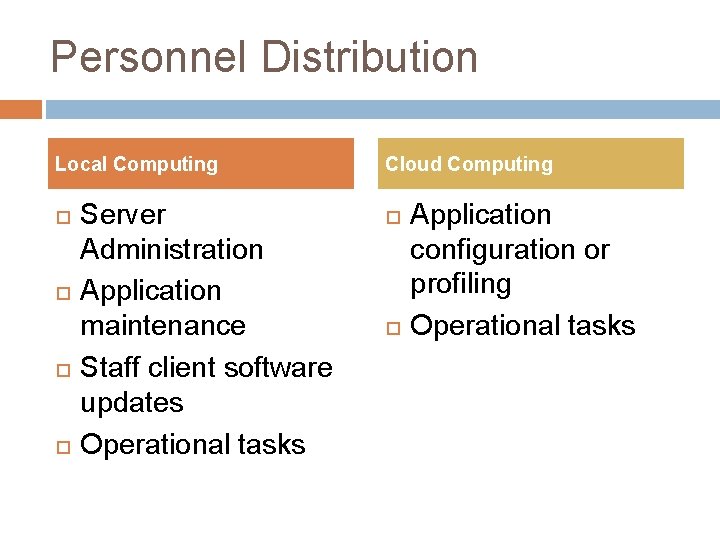
Personnel Distribution Local Computing Server Administration Application maintenance Staff client software updates Operational tasks Cloud Computing Application configuration or profiling Operational tasks
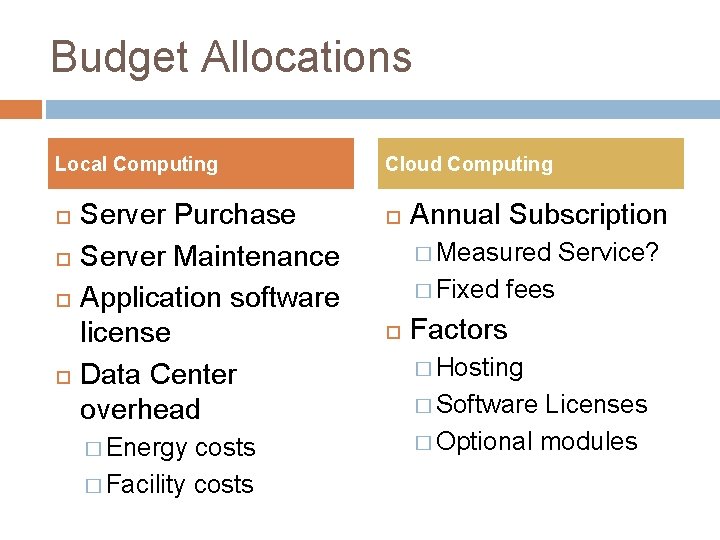
Budget Allocations Local Computing Server Purchase Server Maintenance Application software license Data Center overhead � Energy costs � Facility costs Cloud Computing Annual Subscription � Measured � Fixed Service? fees Factors � Hosting � Software Licenses � Optional modules
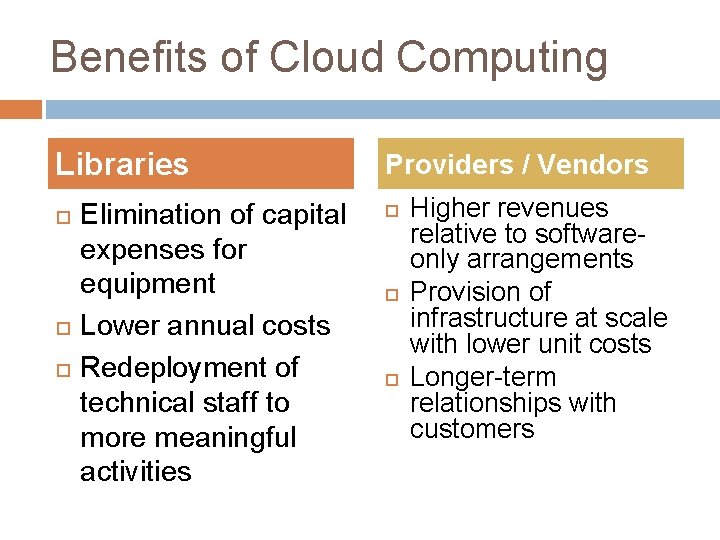
Benefits of Cloud Computing Libraries Elimination of capital expenses for equipment Lower annual costs Redeployment of technical staff to more meaningful activities Providers / Vendors Higher revenues relative to softwareonly arrangements Provision of infrastructure at scale with lower unit costs Longer-term relationships with customers
Risks and concerns Privacy of data � Policies, Ownership of data � Avoid regulations, jurisdictions vendor lock-in Integrity of Data � Backups and disaster recovery � Opportunities for increased redundancy
Security issues Most providers implement stronger safeguards beyond the capacity of local institutions Virtual instances equally susceptible to poor security practices as local computing
Cloud computing trends for libraries Increased migration away from local computing toward some form of remote / hosted / virtualized alternative Cloud computing especially attractive to libraries with few technology support personnel Adequate bandwidth will continue to be a limiting factor
Relevant trends No technical limitations on scalability of infrastructure General move toward ever larger implementations of automation infrastructure National infrastructure (beginning with smaller countries) US: Statewide and regional projects
Resource sharing opportunities Larger instances of automation systems or participation in multi-tenant services provide inherent resource sharing capabilities Ever larger repositories of metadata Simpler mechanisms for patron requests of items not in local collections
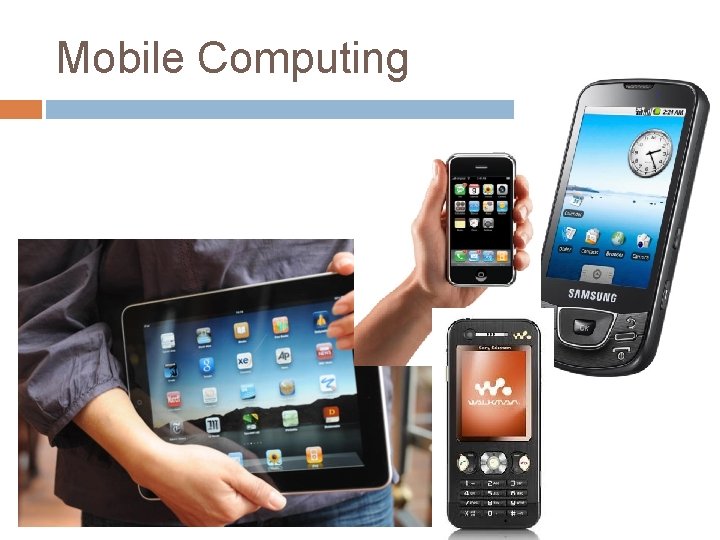
Mobile Computing
Trends in Library Automation Software implementation • • • Trend toward large-scale implementations Emphasis on resource sharing Impact of Technology on library service 13: 30 -15: 00 Section 2
Resource Discovery Services
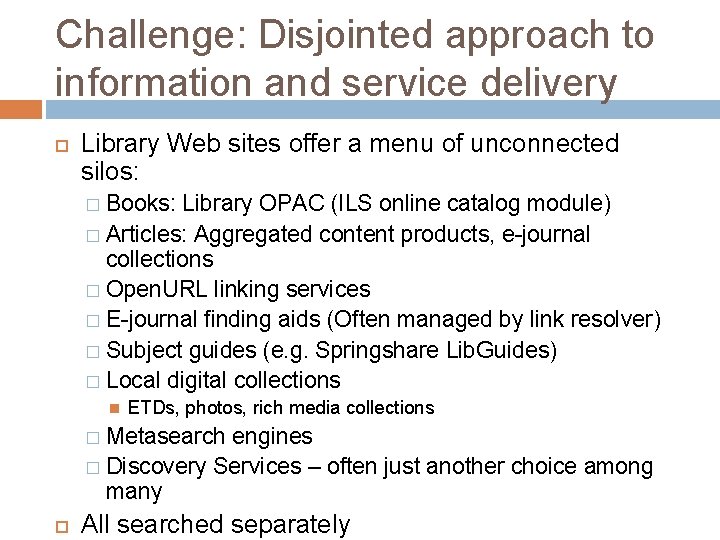
Challenge: Disjointed approach to information and service delivery Library Web sites offer a menu of unconnected silos: Books: Library OPAC (ILS online catalog module) � Articles: Aggregated content products, e-journal collections � Open. URL linking services � E-journal finding aids (Often managed by link resolver) � Subject guides (e. g. Springshare Lib. Guides) � Local digital collections � ETDs, photos, rich media collections Metasearch engines � Discovery Services – often just another choice among many � All searched separately
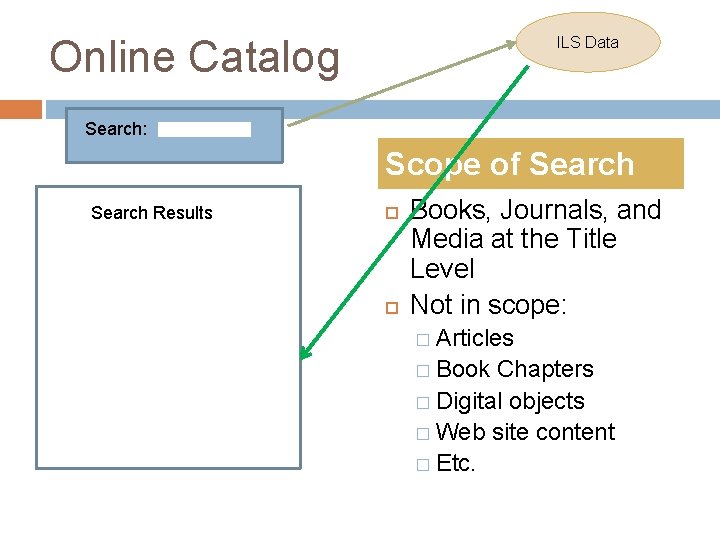
Online Catalog ILS Data Search: Scope of Search Results Books, Journals, and Media at the Title Level Not in scope: � Articles � Book Chapters � Digital objects � Web site content � Etc.
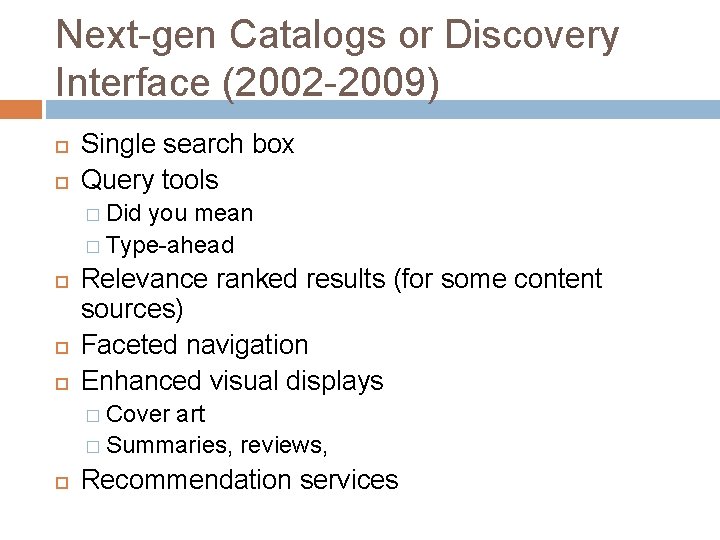
Next-gen Catalogs or Discovery Interface (2002 -2009) Single search box Query tools � Did you mean � Type-ahead Relevance ranked results (for some content sources) Faceted navigation Enhanced visual displays � Cover art � Summaries, reviews, Recommendation services
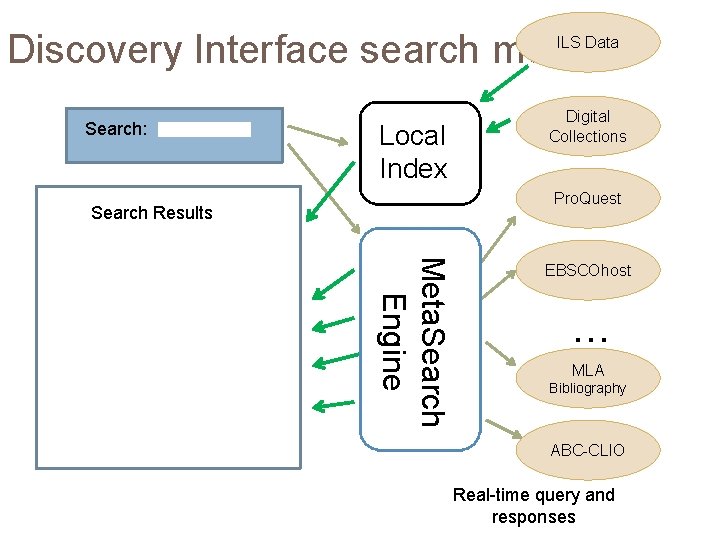
Discovery Interface search model ILS Data Search: Local Index Digital Collections Pro. Quest Search Results Meta. Search Engine EBSCOhost … MLA Bibliography ABC-CLIO Real-time query and responses
Differentiation in Discovery Products increasingly specialized between public and academic libraries Public libraries: emphasis on engagement with physical collection Academic libraries: concern for discovery of heterogeneous material types, especially books + articles + digital objects
Discovery from Local to Webscale Initial products focused on technology � Aqua. Browser, Endeca, Primo, Encore, Vu. Find, � LIBERO Uno, Civica Sorcer, Axiell Arena � Mostly locally-installed software Current phase is focused on pre-populated indexes that aim to deliver Web-scale discovery � Primo Central (Ex Libris) � Summon (Serials Solutions) � World. Cat Local (OCLC) � EBSCO Discovery Service (EBSCO) � Encore with Article Integration (no index, though)
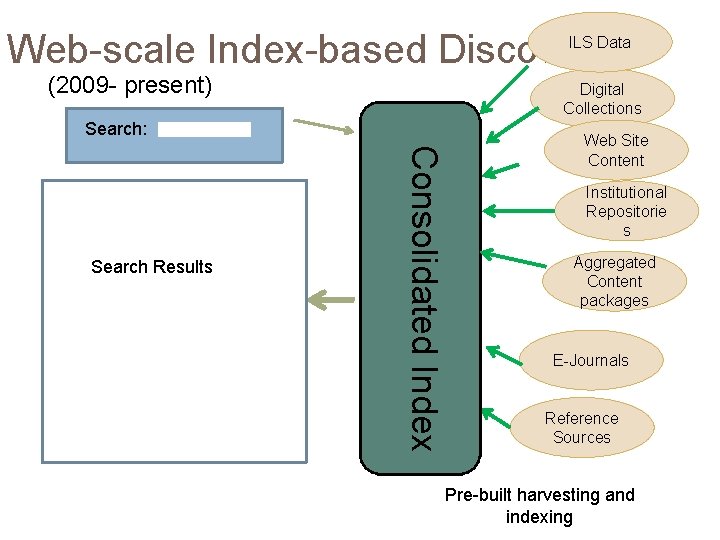
Web-scale Index-based Discovery ILS Data (2009 - present) Digital Collections Search: Consolidated Index Search Results Web Site Content Institutional Repositorie s Aggregated Content packages … E-Journals Reference Sources Pre-built harvesting and indexing
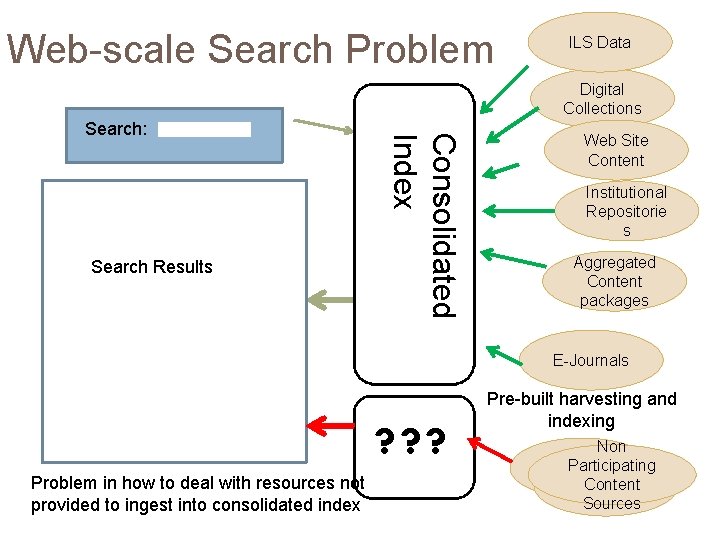
Web-scale Search Problem ILS Data Digital Collections Search Results Consolidated Index Search: Web Site Content Institutional Repositorie s Aggregated Content packages … E-Journals ? ? ? Problem in how to deal with resources not provided to ingest into consolidated index Pre-built harvesting and indexing Non Participating Content Sources
Adoption of Discovery Services Next-gen catalogs or discovery services have been around since 2002 Many mature products Continuing to evolve and expand Online catalog components of ILS products have taken on many of the characteristics of discovery layers
Full-text Book indexing Hathi. Trust: 11 million volumes, 5. 3 million titles, 263, 000 serial titles, 3. 5 billion pages Hathi. Trust in Discovery Indexes � Primo Central (Jan 20, 2012) [previously indexed only metadata] � EBSCO Discovery Service (Sept 8 2011) � World. Cat Local (Sept 7, 2011) � Summon (Mar 28, 2011)
Challenge for Relevancy Technically feasible to index hundreds of millions or billions of records through Lucene or SOLR Difficult to order records in ways that make sense Many fairly equivalent candidates returned for any given query Must rely on use-based and social factors to improve relevancy rankings
Challenges for Collection Coverage To work effectively, discovery services need to cover comprehensively the body of content represented in library collections What about publishers that do not participate? Is content indexed at the citation or full-text level? What are the restrictions for non-authenticated users? How can libraries understand the differences in coverage among competing services?
Evaluating the Coverage of Indexbased Discovery Services Intense competition: how well the index covers the body of scholarly content stands as a key differentiator Difficult to evaluate based on numbers of items indexed alone. Important to ascertain now your library’s content packages are represented by the discovery service. Important to know what items are indexed by citation and which are full text Important to know whether the discovery service favors the content of any given publisher
The rise of e-books Academic libraries: e-books included in aggregated content packages � E-books used primarily for research and consultation, not long reading Public Libraries: Subscriptions to e-book services that provide an outsourced collection of loanable e-books K-12 Schools, Colleges, Universities: interest in electronic textbooks
Integrating e-Books into Library Automation Infrastructure Current approach involves mostly outsourced arrangements Collections licensed wholesale from single provider Hand-off to DRM and delivery systems of providers Loading of MARC records into local catalog with linking mechanisms No ability to see availability status of e-books from the library’s online catalog or discovery interface
Technology Issues Access to materials controlled through Digital Rights Management Closed ecosystems that control content through identity management and rights policies Imposes significant overhead on the user experience: � Download an install DRM components � Establish user credentials in site trusted by DRM � Works only with devices that comply with DRM restrictions
Global business arena, Questions and Discussion • • • Consolidation of International Companies Product offerings Position of local companies Product development trends Questions and Discussion 15: 10 -16: 40 Section 3
Next Generation Library Management
Is the status quo sustainable? ILS for management of (mostly) print Duplicative financial systems between library and campus Electronic Resource Management (non-integrated with ILS) Open. URL Link Resolver w/ knowledge base for access to full-text electronic articles Digital Collections Management platforms (CONTENTdm, Digi. Tool, etc. ) Institutional Repositories (DSpace, Fedora, etc. ) Discovery-layer services for broader access to library collections No effective integration services / interoperability among disconnected systems, non-aligned metadata schemes
Integrated Library Systems Model for library automation since 1970’s Modules � Circulation � Cataloging � Acquisitions � Serials � Authority Control � Public Catalog Oriented to Print / Physical Materials
ILS now restricts Innovation Business models hard-coded in ILS no longer represent current library realities Force disproportionate levels of personnel attention toward print Personnel involved in non-print areas forced to work on other platforms Libraries now organized around idiosyncrasies of the ILS
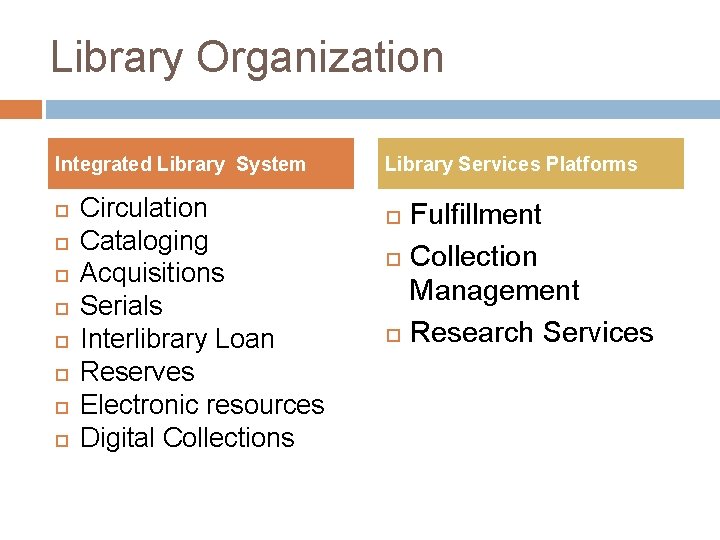
Library Organization Integrated Library System Circulation Cataloging Acquisitions Serials Interlibrary Loan Reserves Electronic resources Digital Collections Library Services Platforms Fulfillment Collection Management Research Services
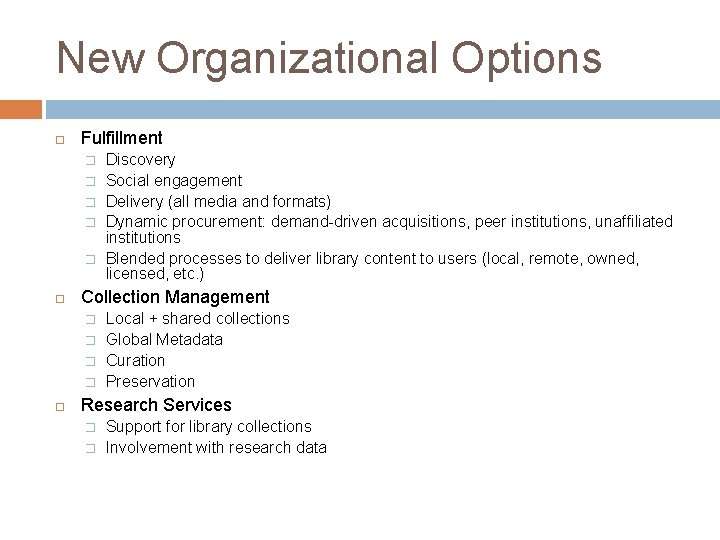
New Organizational Options Fulfillment � � � Collection Management � � Discovery Social engagement Delivery (all media and formats) Dynamic procurement: demand-driven acquisitions, peer institutions, unaffiliated institutions Blended processes to deliver library content to users (local, remote, owned, licensed, etc. ) Local + shared collections Global Metadata Curation Preservation Research Services � � Support for library collections Involvement with research data
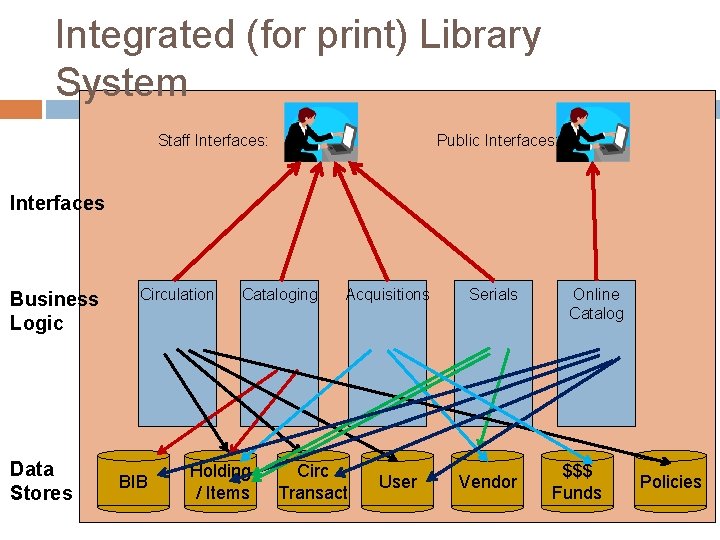
Integrated (for print) Library System Public Interfaces: Staff Interfaces: Interfaces Business Logic Data Stores Circulation BIB Cataloging Holding / Items Acquisitions Circ Transact User Serials Vendor Online Catalog $$$ Funds Policies
Electronic Resource Management
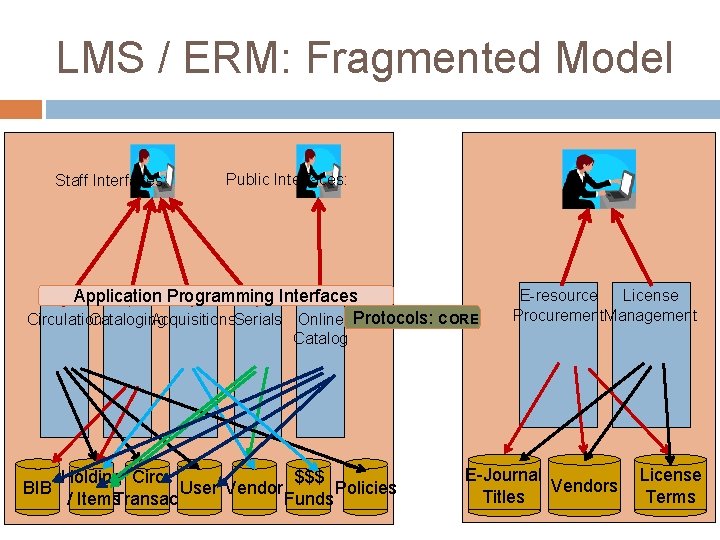
LMS / ERM: Fragmented Model Staff Interfaces: Public Interfaces: Application Programming Interfaces Circulation Cataloging Acquisitions. Serials Online Protocols: CORE ` E-resource License Procurement. Management Catalog BIB Holding Circ $$$ User Vendor Policies / Items. Transact Funds E-Journal Vendors Titles License Terms
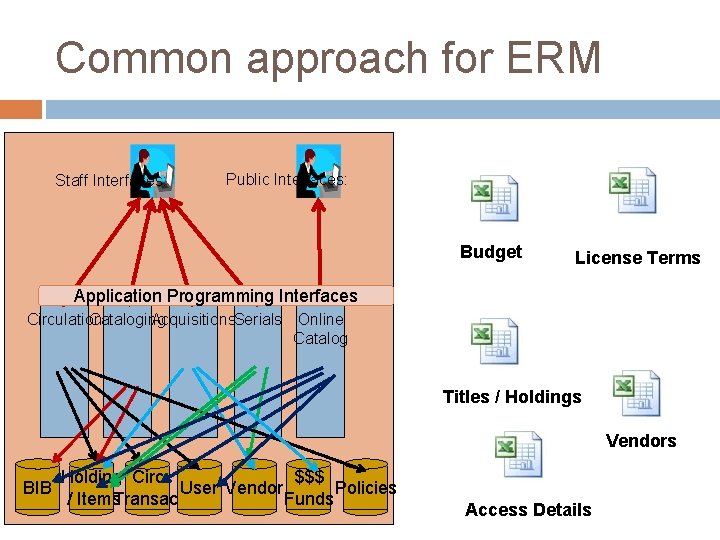
Common approach for ERM Staff Interfaces: Public Interfaces: Budget License Terms Application Programming Interfaces Circulation Cataloging Acquisitions. Serials Online Catalog Titles / Holdings Vendors BIB Holding Circ $$$ User Vendor Policies / Items. Transact Funds Access Details
Comprehensive Resource Management No longer sensible to use different software platforms for managing different types of library materials ILS + ERM + Open. URL Resolver + Digital Asset management, etc. very inefficient model Flexible platform capable of managing multiple type of library materials, multiple metadata formats, with appropriate workflows
Libraries need a new model of library automation Not an Integrated Library System or Library Management System The ILS/LMS was designed to help libraries manage print collections Generally did not evolve to manage electronic collections Other library automation products evolved: � Electronic Resource Management Systems – Open. URL Link Resolvers – Digital Library Management Systems -- Institutional Repositories
Beyond the legacy Library Management System Find a new term for the successor to the LMS Library Management System now viewed as print-centric Need to designate a name for the new genre of automation products
Library Services Platform Library-specific software. Designed to help libraries automate their internal operations, manage collections, fulfill requests, and deliver services Service oriented architecture � Exposes Web services and other API’s � Facilitates the services libraries offer to their users � Platform General infrastructure for library automation � Consistent with the concept of Platform as a Service � Library programmers address the APIs of the platform to extend functionality, create connections with other systems, dynamically interact with data �
Library Services Platform Characteristics Highly Shared data models Knowledgebase architecture � Some may take hybrid approach to accommodate local data stores � Delivered through software as a service � Multi-tenant Unified workflows across formats and media Flexible metadata management MARC – Dublin Core – VRA – MODS – ONIX � New Bibliographic Framework � New structures not yet invented � Open APIs for extensibility and interoperability
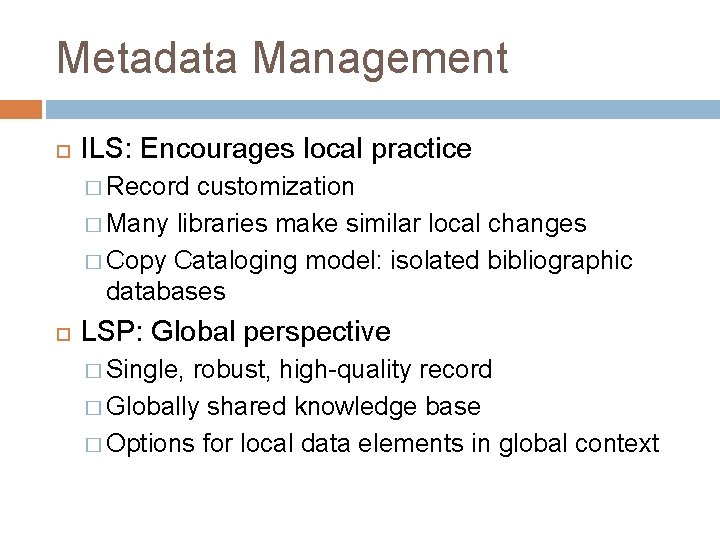
Metadata Management ILS: Encourages local practice � Record customization � Many libraries make similar local changes � Copy Cataloging model: isolated bibliographic databases LSP: Global perspective � Single, robust, high-quality record � Globally shared knowledge base � Options for local data elements in global context
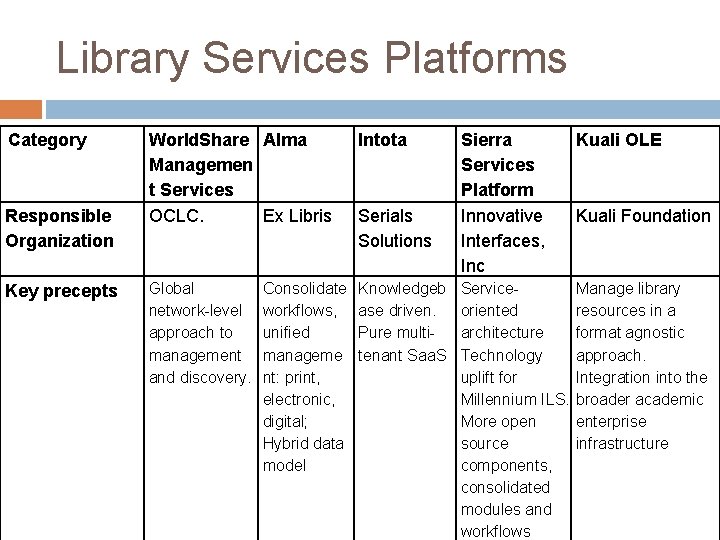
Library Services Platforms Category Responsible Organization Key precepts World. Share Alma Managemen t Services OCLC. Ex Libris Intota Global network-level approach to management and discovery. Knowledgeb ase driven. Pure multitenant Saa. S Consolidate workflows, unified manageme nt: print, electronic, digital; Hybrid data model Serials Solutions Sierra Services Platform Innovative Interfaces, Inc Kuali OLE Serviceoriented architecture Technology uplift for Millennium ILS. More open source components, consolidated modules and workflows Manage library resources in a format agnostic approach. Integration into the broader academic enterprise infrastructure Kuali Foundation
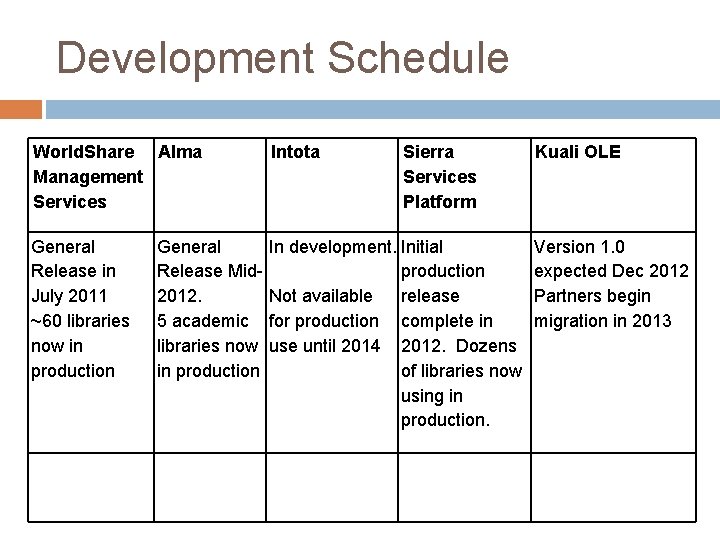
Development Schedule World. Share Alma Management Services Intota General Release in July 2011 ~60 libraries now in production In development. Initial production Not available release for production complete in use until 2014 2012. Dozens of libraries now using in production. General Release Mid 2012. 5 academic libraries now in production Sierra Services Platform Kuali OLE Version 1. 0 expected Dec 2012 Partners begin migration in 2013
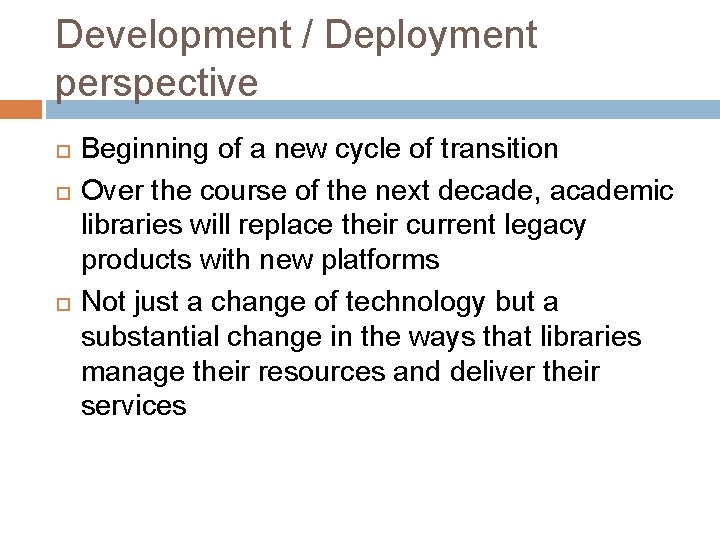
Development / Deployment perspective Beginning of a new cycle of transition Over the course of the next decade, academic libraries will replace their current legacy products with new platforms Not just a change of technology but a substantial change in the ways that libraries manage their resources and deliver their services
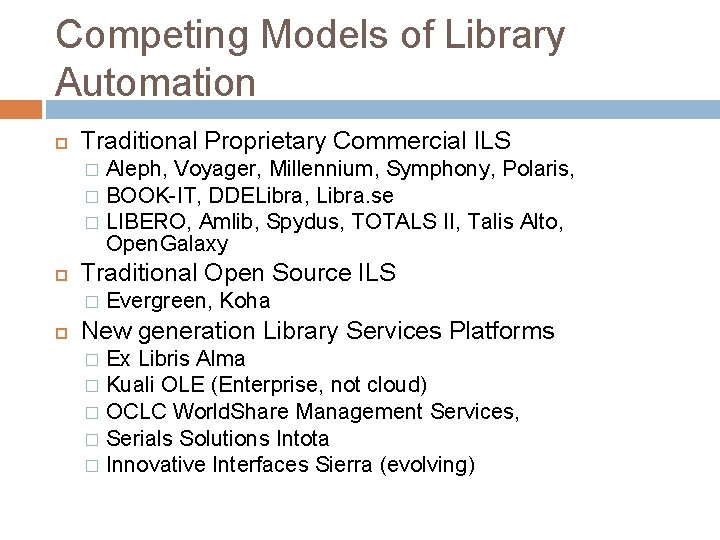
Competing Models of Library Automation Traditional Proprietary Commercial ILS Aleph, Voyager, Millennium, Symphony, Polaris, � BOOK-IT, DDELibra, Libra. se � LIBERO, Amlib, Spydus, TOTALS II, Talis Alto, Open. Galaxy � Traditional Open Source ILS � Evergreen, Koha New generation Library Services Platforms Ex Libris Alma � Kuali OLE (Enterprise, not cloud) � OCLC World. Share Management Services, � Serials Solutions Intota � Innovative Interfaces Sierra (evolving) �
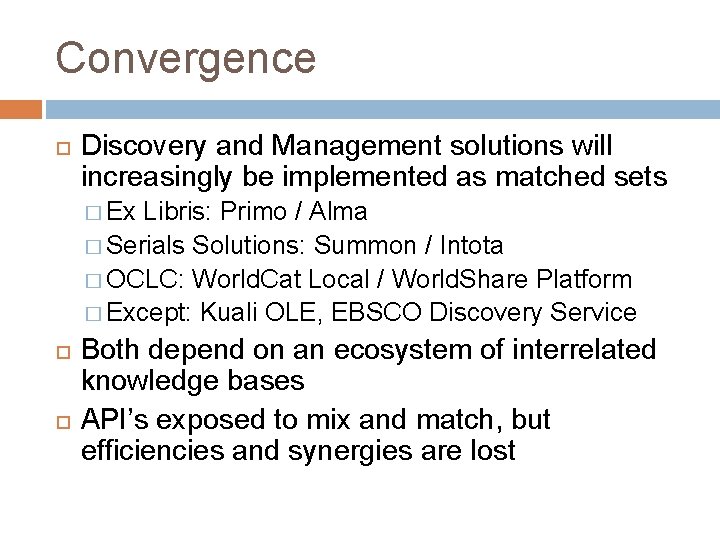
Convergence Discovery and Management solutions will increasingly be implemented as matched sets � Ex Libris: Primo / Alma � Serials Solutions: Summon / Intota � OCLC: World. Cat Local / World. Share Platform � Except: Kuali OLE, EBSCO Discovery Service Both depend on an ecosystem of interrelated knowledge bases API’s exposed to mix and match, but efficiencies and synergies are lost
New Models of Resource sharing
Current models Based on local collections by individual ILS Complex add-on components for resource sharing and consortial borrowing Interlibrary loan infrastructure separate
Future options Increasingly shared infrastructure Highly-shared collections � Electronic – physical – digital Built-in capacity for fulfillment through peer institutions Global discovery / global fulfillment infrastructure
Library Consolidation Libraries remain independent… …but, belong to ever larger resource sharing alliances Amalgamation of library services, consortia, etc. Libraries shifting from Local to ILS to shared infrastructure Global trend: fewer number of larger automation implementations
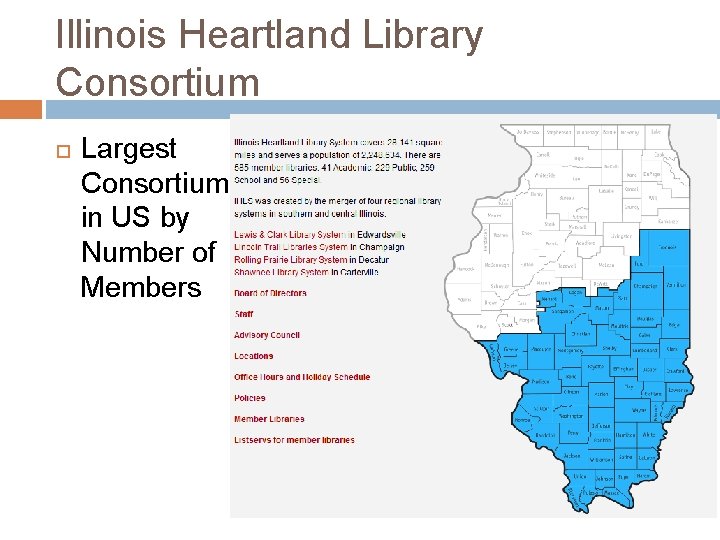
Illinois Heartland Library Consortium Largest Consortium in US by Number of Members
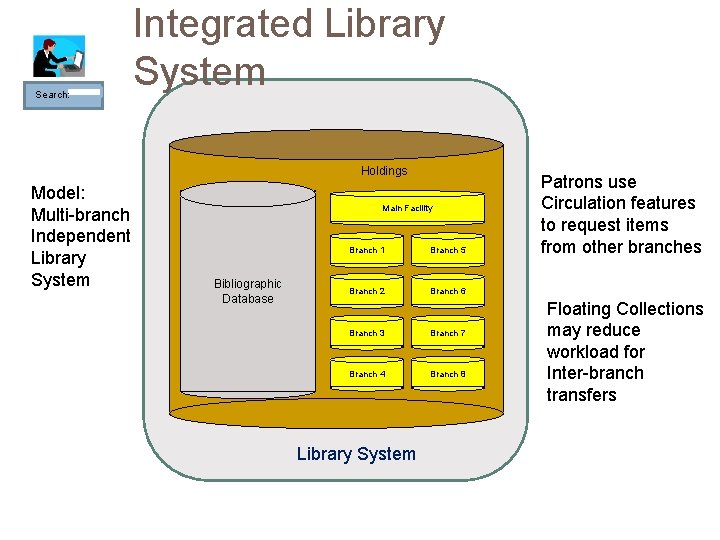
Search: Integrated Library System Holdings Model: Multi-branch Independent Library System Main Facility Bibliographic Database Branch 1 Branch 5 Branch 2 Branch 6 Branch 3 Branch 7 Branch 4 Branch 8 Library System Patrons use Circulation features to request items from other branches Floating Collections may reduce workload for Inter-branch transfers
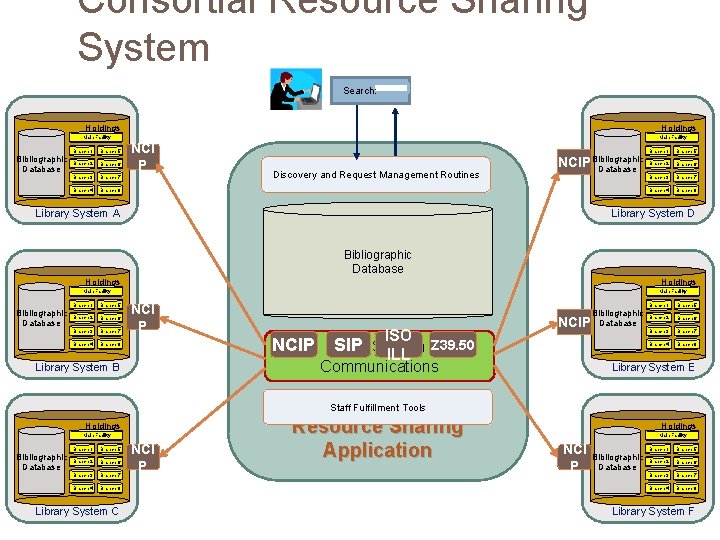
Consortial Resource Sharing System Search: Holdings Main Facility Bibliographic Database Branch 1 Branch 5 Branch 2 Branch 6 Branch 3 Branch 7 Branch 4 Branch 8 Main Facility NCI P Discovery and Request Management Routines NCIP Bibliographic Database Library System A Branch 1 Branch 5 Branch 2 Branch 6 Branch 3 Branch 7 Branch 4 Branch 8 Library System D Bibliographic Database Holdings Main Facility Bibliographic Database Branch 1 Branch 5 Branch 2 Branch 6 Branch 3 Branch 7 Branch 4 Branch 8 Main Facility NCI P Library System B ISO Z 39. 50 NCIP SIP Inter-System ILL Communications Bibliographic NCIP Database Branch 1 Branch 5 Branch 2 Branch 6 Branch 3 Branch 7 Branch 4 Branch 8 Library System E Staff Fulfillment Tools Holdings Main Facility Bibliographic Database Branch 1 Branch 5 Branch 2 Branch 6 Branch 3 Branch 7 Branch 4 Branch 8 Library System C NCI P Resource Sharing Application Holdings Main Facility NCI P Bibliographic Database Branch 1 Branch 5 Branch 2 Branch 6 Branch 3 Branch 7 Branch 4 Branch 8 Library System F
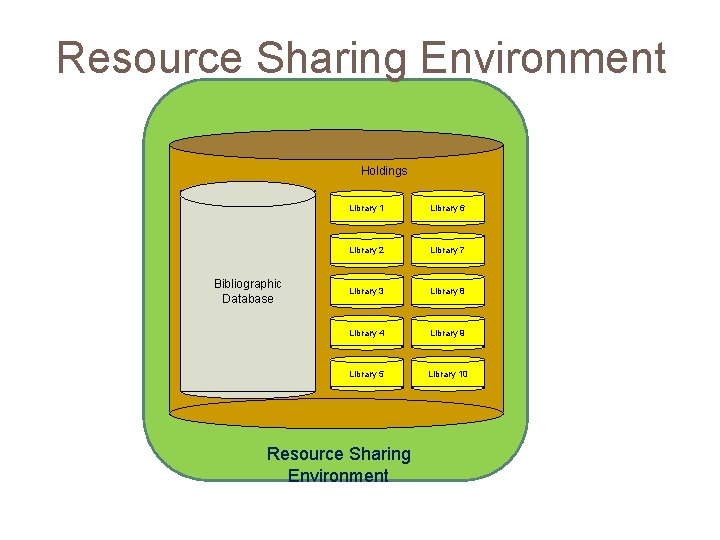
Resource Sharing Environment Holdings Bibliographic Database Library 1 Library 6 Library 2 Library 7 Library 3 Library 8 Library 4 Library 9 Library 5 Library 10 Resource Sharing Environment
Thoughts for the Future Options and Opportunities for CALIS
Shift from ILS toward LSP model Current model of Local ILS in each library Comprehensive management of library resources Shift toward Library Services Platforms � Created for Chinese libraries by local developers � Offerings from international organizations Interoperability essential forward development
Cloud-based Library Management Shift from library-by-library ILS to cloud-based, highly shared library services platform Move from an environment where each library replicates the efforts of its peers to one where all libraries benefit from each other’s contributions Shift from copy-cataloging model to a shared knowledge base model
Enhanced Resource Discovery Index-based discovery for National + International Resources Combination of National, Regional and International Beyond MARC-based union catalogs to comprehensive index-based discovery service spanning print, electronic and digital resources Increased full-text indexing Phased implementation of open linked data and semantic discovery mechanisms
Resource Sharing Opportunity to consolidate National and global discovery will stimulate increased demand for materials Design automation environment to natively support resource sharing � Not an after-thought or add-on
Modernize library automation Facilitate internal library workflows to maximize all components of library collections Synchronize technology infrastructure with strategic library missions and operations
Libraries in the Cloud Shared infrastructure Shared collections Efficiencies of large scale
- Slides: 105