
The Future of Libraries Digital Resources in Collection
The Future of Libraries: Digital Resources in Collection Development Future Shock Digital Assessment Team April Dain, Jacob Longshore, Paul Naxer
Emerging Trends
Emerging Trends � Historical shift is happening now in libraries � Increased usage for most types of libraries � E-books and electronic resources are on the � Budgets are getting better but not fast enough rise � Consortial membership continues to grow
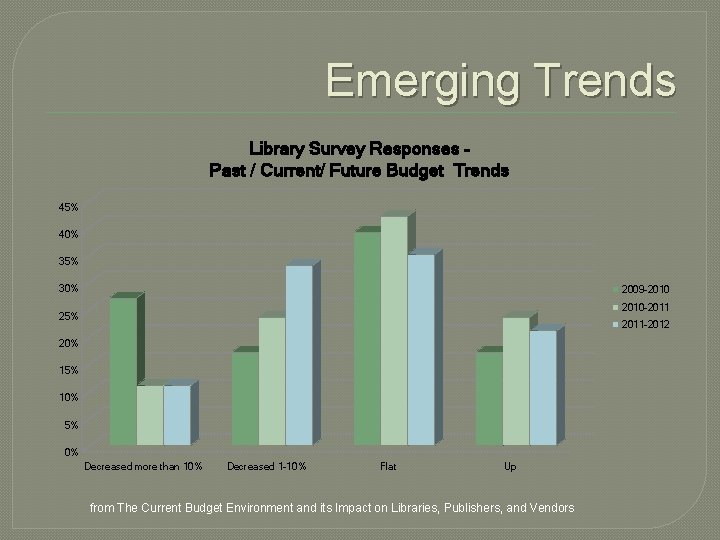
Emerging Trends Library Survey Responses – Past / Current/ Future Budget Trends 45% 40% 35% 30% 2009 -2010 -2011 25% 2011 -2012 20% 15% 10% 5% 0% Decreased more than 10% Decreased 1 -10% Flat Up from The Current Budget Environment and its Impact on Libraries, Publishers, and Vendors
Emerging Trends: Academic Libraries � Open access � Decline � Rage of print against the big dealers � Pricing models � Usage statistics � Social media � Mobile access
Emerging Trends: Public Libraries �Transition from print to online, driven by user needs �Deliberate financial planning and reallocation of funds �Continual utilization of data for collection development decision making
Twenty-Year Outlook: 2033
Twenty-Year Outlook: 2033 �Be prepared for good and bad budgets – plan! �The development of the digital resource business model – fight for it! �Our mission is changing because information is changing – are you ready?
2033: Academic Libraries �Consortial �Open membership access �Institutional repositories
2033: Academic Libraries �Less print, more e-reading �Digitizing �More unique collections engagement with scholarly processes
2033: Public Libraries Variables in libraries now: � Rising costs • Cost inflation • Revenue stagnation � Changes � User in technology expectations � Library environment * From Bosch, (2012) Coping with the Terrible Twins.
2033: Public Libraries �Participation �Nearly in consortia is critical. resolved issues: • Awareness • Technical issues �Ongoing issues with E-books: • Price • Selection
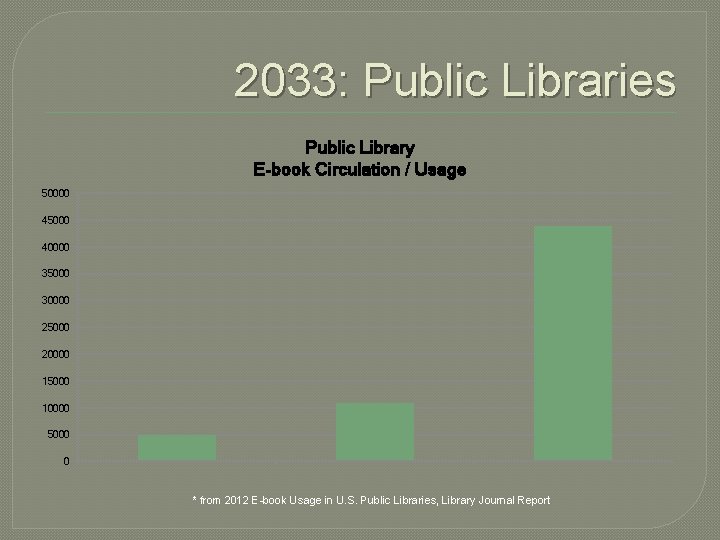
2033: Public Libraries Public Library E-book Circulation / Usage 50000 45000 40000 35000 30000 25000 20000 15000 10000 5000 0 * from 2012 E-book Usage in U. S. Public Libraries, Library Journal Report
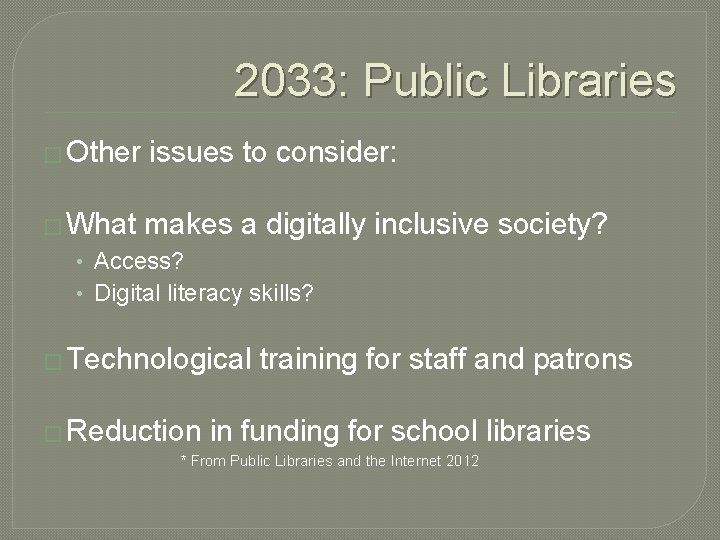
2033: Public Libraries � Other issues to consider: � What makes a digitally inclusive society? • Access? • Digital literacy skills? � Technological � Reduction training for staff and patrons in funding for school libraries * From Public Libraries and the Internet 2012
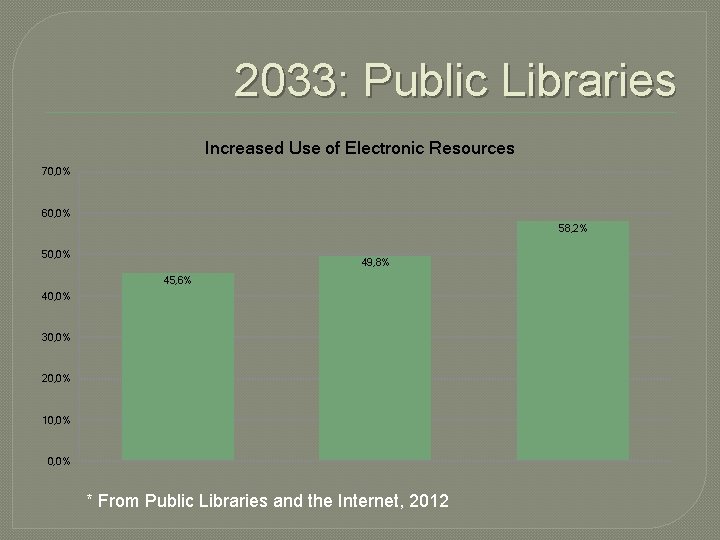
2033: Public Libraries Increased Use of Electronic Resources 70, 0% 60, 0% 58, 2% 50, 0% 49, 8% 45, 6% 40, 0% 30, 0% 20, 0% 10, 0% * From Public Libraries and the Internet, 2012
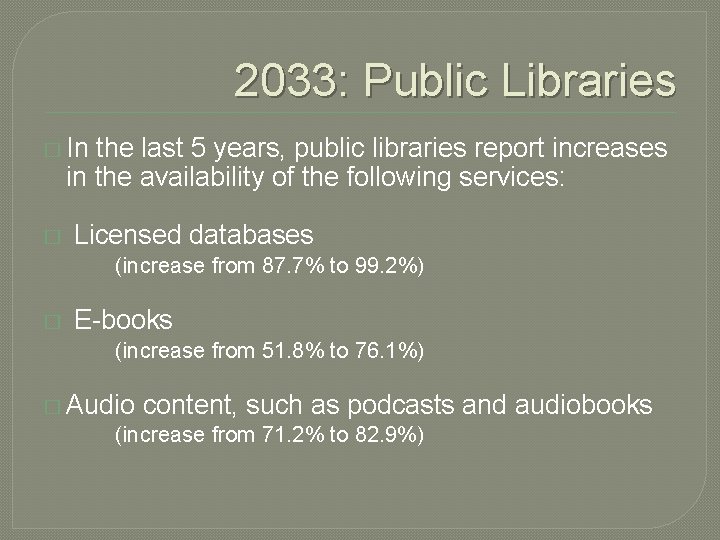
2033: Public Libraries � In the last 5 years, public libraries report increases in the availability of the following services: � Licensed databases (increase from 87. 7% to 99. 2%) � E-books (increase from 51. 8% to 76. 1%) � Audio content, such as podcasts and audiobooks (increase from 71. 2% to 82. 9%)
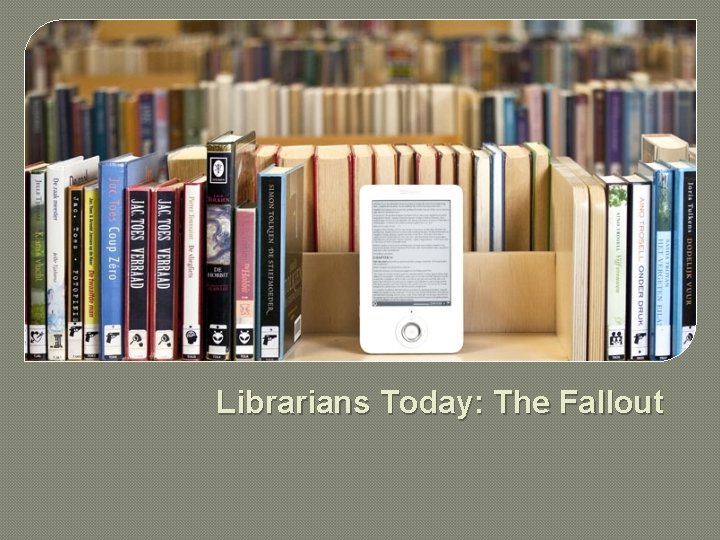
Librarians Today: The Fallout
Librarians in Today’s Future �Customer service is more important than ever �Delivering richer and more targeted resources to constituencies �Be set willing to change and adapt your skill
Today’s Future: Academic Libraries � PATRONS – ISSUES TO BE ADDRESSED • E-book usage varies among disciplines • Not everyone literate regarding e-books Publishers – Issues to be addressed • Business models not established • Trust between providers and libraries not yet established
Today’s Future: Academic Libraries LIBRARIANS – ISSUES TO BE ADDRESSED � Librarians want perpetual access to titles � Faculty and librarians uncomfortable with deaccessioning print � What would be proper conditions for deaccession?
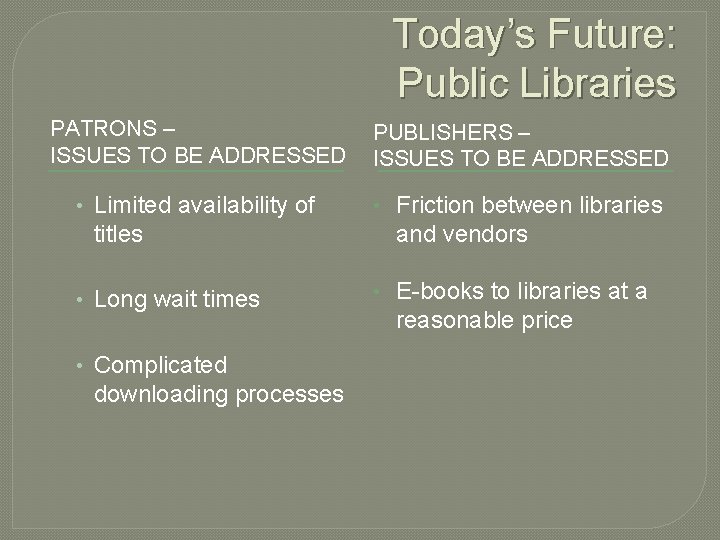
Today’s Future: Public Libraries PATRONS – ISSUES TO BE ADDRESSED PUBLISHERS – ISSUES TO BE ADDRESSED • Limited availability of • Friction between libraries titles • Long wait times • Complicated downloading processes and vendors • E-books to libraries at a reasonable price
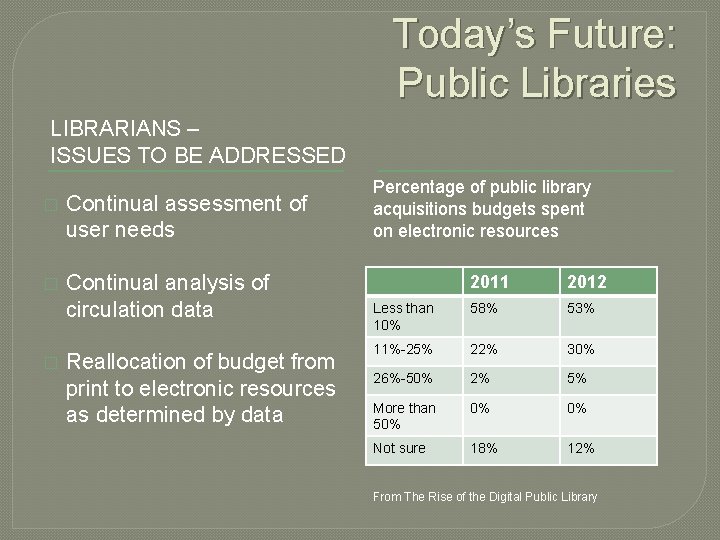
Today’s Future: Public Libraries LIBRARIANS – ISSUES TO BE ADDRESSED � Continual assessment of user needs � Continual analysis of circulation data � Reallocation of budget from print to electronic resources as determined by data Percentage of public library acquisitions budgets spent on electronic resources 2011 2012 Less than 10% 58% 53% 11%-25% 22% 30% 26%-50% 2% 5% More than 50% 0% 0% Not sure 18% 12% From The Rise of the Digital Public Library
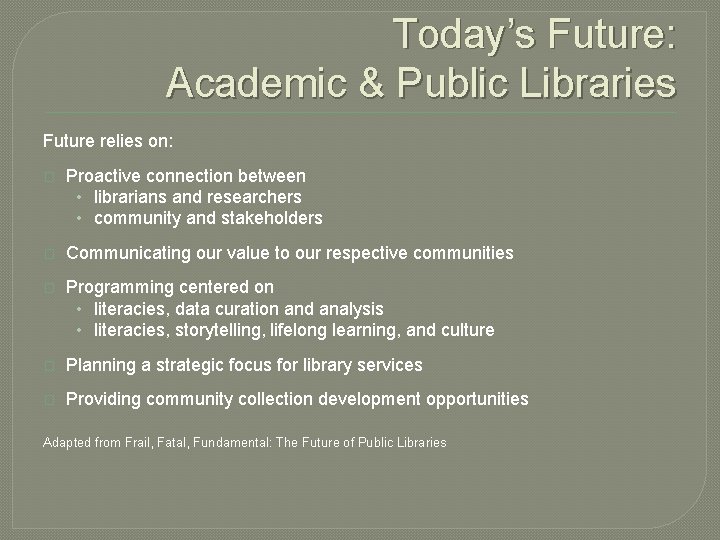
Today’s Future: Academic & Public Libraries Future relies on: � Proactive connection between • librarians and researchers • community and stakeholders � Communicating our value to our respective communities � Programming centered on • literacies, data curation and analysis • literacies, storytelling, lifelong learning, and culture � Planning a strategic focus for library services � Providing community collection development opportunities Adapted from Frail, Fatal, Fundamental: The Future of Public Libraries
~ Fin ~
câu hỏi? des questions? ﺍﻷﺴﺌﻠﺔ؟ ερωτήσεις; Preguntas? Fragen? 質問はありますか? Questions?
Sources 2012 Library Ebook Usage Reports from Library Journal & School Library Journal. (2012). Retrieved from http: //www. thedigitalshift. com/research/ebook-usage-reports/ Bertot, J. C. , Gorham, U. , Jaeger, P. T. & Taylor, N. G. (2012). Public Libraries and the Internet 2012: Key Findings, Recent Trends, and Future Challenges. Public Library Quarterly, 31(4), 303 -325. Bosch, S. , & Hender, K. (2012, April 30). Coping with the Terrible Twins | Periodicals Price Survey 2012. Library Journal. Retrieved March 31, 2013, from http: //lj. libraryjournal. com/2012/04/funding/coping-with-theterrible-twins-periodicals-price-survey-2012/ Breeding, M. (2012). The Library Information Landscape approaching the year 2050. In G. Marchionini & B. Moran (Eds. ), Information Professionals 2050: Educational Possibilities and Pathways (pp. 113– 126). Retrieved from http: //sils. unc. edu/news/2012/ip 2050 -book-video
Carrico, S. , & Leonard, M. (2011). Patron-Driven Acquisitions and Collection: Building Initiatives at UF. Florida Libraries, 54(1), 14– 17. Collins, T. (2012). The Current Budget Environment and its Impact on Libraries, Publishers, and Vendors. Journal of Library Administration, 52(1), 18 -35. Committee, A. R. P. and R. (2012). 2012 top ten trends in academic libraries A review of the trends and issues affecting academic libraries in higher education. College & Research Libraries News, 73(6), 311– 320. Connaway, L. S. , & Dickey, T. J. (2010). The digital information seeker: Findings from selected OCLC, RIN and JISC user behaviour projects. Retrieved from http: //www. jisc. ac. uk/publications/reports/2010/digitalinformationseekers. aspx De Fino, M. , & Lo, M. L. (2011). New Roads for Patron-Driven E-Books: Collection Development and Technical Services Implications of a Patron. Driven Acquisitions Pilot at Rutgers. Journal of Electronic Resources Librarianship, 23, 327– 338.
Dempsey, L. (2012). Libraries and the informational future: some notes. In G. Marchionini & B. Moran (Eds. ), Information Professionals 2050: Educational Possibilities and Pathways (pp. 113– 126). Retrieved from http: //sils. unc. edu/news/2012/ip 2050 -book-video Detmering, R. , & Sproles, C. (2012). Reference in transition: a case study in reference collection development. Collection Building, 31(1), 19– 22. Erway, R. (2012). Increasing Access to Special Collections. LIBER Quarterly, 21(2), 294– 307. Hodges, D. , Cyndi, P. , & Hamilton, M. J. (2010). Patron-Initiated Collection Development: Progress of a Paradigm Shift. Part of a special issue Patrondriven acquisitions: current successes and future directions, 35(3/4), 208– 221. Jones, D. (2011). On-Demand Information Delivery: Integration of Patron-Driven Acquisition into a Comprehensive Information Delivery System. Journal of Library Administration, 51(7/8), 764– 776.
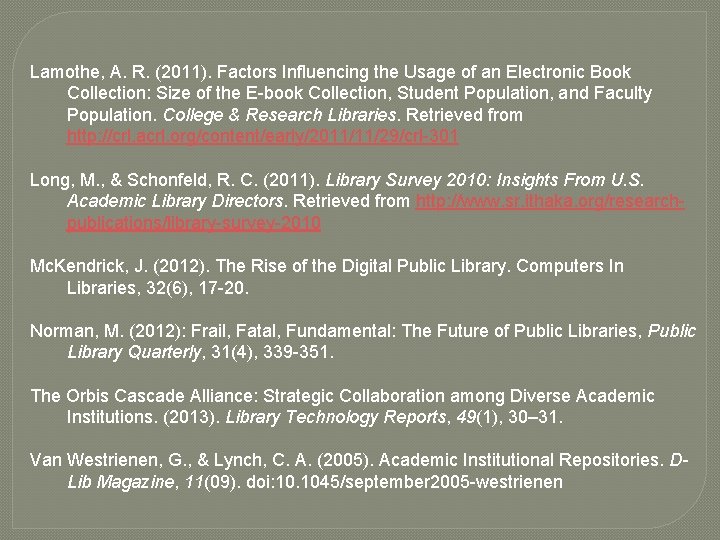
Lamothe, A. R. (2011). Factors Influencing the Usage of an Electronic Book Collection: Size of the E-book Collection, Student Population, and Faculty Population. College & Research Libraries. Retrieved from http: //crl. acrl. org/content/early/2011/11/29/crl-301 Long, M. , & Schonfeld, R. C. (2011). Library Survey 2010: Insights From U. S. Academic Library Directors. Retrieved from http: //www. sr. ithaka. org/researchpublications/library-survey-2010 Mc. Kendrick, J. (2012). The Rise of the Digital Public Library. Computers In Libraries, 32(6), 17 -20. Norman, M. (2012): Frail, Fatal, Fundamental: The Future of Public Libraries, Public Library Quarterly, 31(4), 339 -351. The Orbis Cascade Alliance: Strategic Collaboration among Diverse Academic Institutions. (2013). Library Technology Reports, 49(1), 30– 31. Van Westrienen, G. , & Lynch, C. A. (2005). Academic Institutional Repositories. DLib Magazine, 11(09). doi: 10. 1045/september 2005 -westrienen
- Slides: 29