
THE FUTURE OF GEO Background paper highlights Global
THE FUTURE OF GEO: Background paper highlights Global Consultation Session 1 Prof. Laszlo Pinter IISD and CEU Lead, Consulting Team September 10, 2020
UNEA mandate • “the options document should address the role of the Global Environment Outlook process in regularly preparing independent analyses of the state of and trends in the global environmental situation” 2
Background paper structure • • Learning from the history and evolution of GEO Assessment functions Assessment governance Assessment process and methods Outputs of the assessment Uptake, use and learning Assessment finance 3

Learning from the history and evolution of GEO …as well as other global assessments: Global Sustainable Development Report, Intergovernmental Science-Policy Platform on Biodiversity and Ecosystem Services, Intergovernmental Panel on Climate Change, Global Chemicals Outlook etc. 4
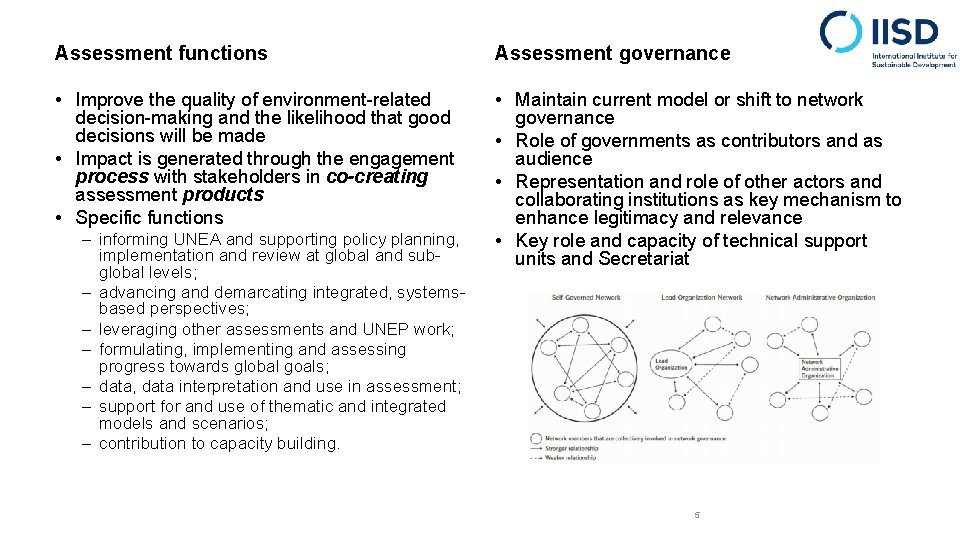
Assessment functions Assessment governance • Improve the quality of environment-related decision-making and the likelihood that good decisions will be made • Impact is generated through the engagement process with stakeholders in co-creating assessment products • Specific functions • Maintain current model or shift to network governance • Role of governments as contributors and as audience • Representation and role of other actors and collaborating institutions as key mechanism to enhance legitimacy and relevance • Key role and capacity of technical support units and Secretariat – informing UNEA and supporting policy planning, implementation and review at global and subglobal levels; – advancing and demarcating integrated, systemsbased perspectives; – leveraging other assessments and UNEP work; – formulating, implementing and assessing progress towards global goals; – data, data interpretation and use in assessment; – support for and use of thematic and integrated models and scenarios; – contribution to capacity building. 5

Assessment process and methods Outputs of the assessment • There is a wide range of design options to ensure saliency, credibility and legitimacy of the assessment • Author selection is key and influenced by timing, resources, assessment purpose etc. • Scoping the assessment: narrow or broad • Construction and role of the summary for policymakers: narrow or broad participation and rights of approval • Product and/or service orientation • Length, level of detail and frequency of outputs, geared towards stakeholder needs and architecture • Input to the Global Sustainable Development Report • Interoperable data platform (statistical, geospatial, quantitative/qualitative) • Role of capacity building 6
Assessment uptake, use & learning Assessment finance • Matching products with audiences and their needs – UNEA, MEA Secretariats, governments, stakeholders • Reference document, contextualizing regional and national knowledge and initiatives • Localizing and increasing the ownership of global assessment through local assessment processes and products • Imperative of outreach and impact assessment functions and capacity • Adequacy and stability of financing • Financing model: voluntary, trust fund, regular UN budget, other? • Short and long-term impact of COVID • Accountability and transparency of financial management system of the assessment 7

THANK YOU FOR YOUR ATTENTION 8
- Slides: 8