
The future of European integrated Telcos Evolution and
- Slides: 42
The future of European integrated Telcos Evolution and challenges from the capital markets standpoint Workshop Material June, 2001
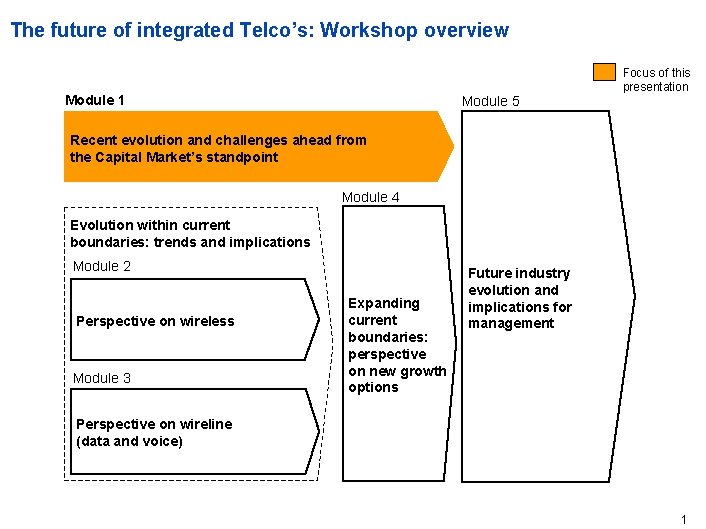
The future of integrated Telco’s: Workshop overview Module 1 Module 5 Focus of this presentation Recent evolution and challenges ahead from the Capital Market’s standpoint Module 4 Evolution within current boundaries: trends and implications Module 2 Perspective on wireless Module 3 Expanding current boundaries: perspective on new growth options Future industry evolution and implications for management Perspective on wireline (data and voice) 1
Content 1. Capital markets’ performance of Integrated European Telcos 2. Causes behind capital markets’ evolution 3. Differences in performance between Telcos 4. Challenges ahead for integrated players 5. Changes needed 2
1. Capital markets’ performance of integrated European Telcos European integrated telecom players went through a shakeup period 3
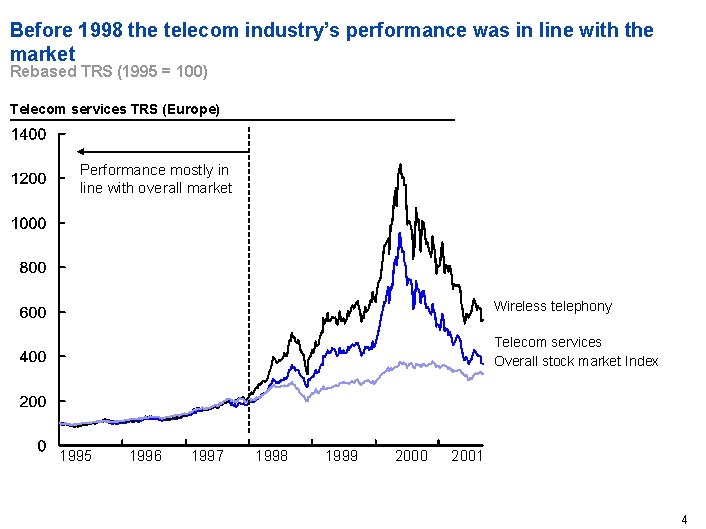
Before 1998 the telecom industry’s performance was in line with the market Rebased TRS (1995 = 100) Telecom services TRS (Europe) Performance mostly in line with overall market Wireless telephony* Telecom services** Overall stock market Index*** 1995 1996 1997 *Europe-DS-Telecom, Wireless Index **Europe-DS-Telecom, Services Index ***Europe-DS-Market Source: Datastream 1998 1999 2000 2001 4
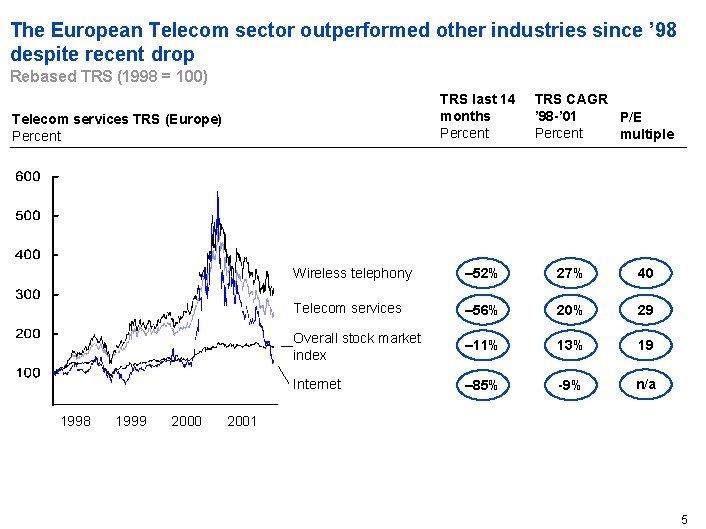
The European Telecom sector outperformed other industries since ’ 98 despite recent drop Rebased TRS (1998 = 100) TRS last 14 months* Percent Telecom services TRS (Europe) Percent 1998 1999 2000 TRS CAGR ’ 98 -’ 01 P/E Percent multiple** Wireless telephony – 52% 27% 40 Telecom services*** – 56% 20% 29 Overall stock market index – 11% 13% 19 Internet – 85% -9% n/a 2001 *The telecom stocks peaked in March 2000 31, 2001 ***Includes wireline, wireless and data network companies Source: Datastream **May 5
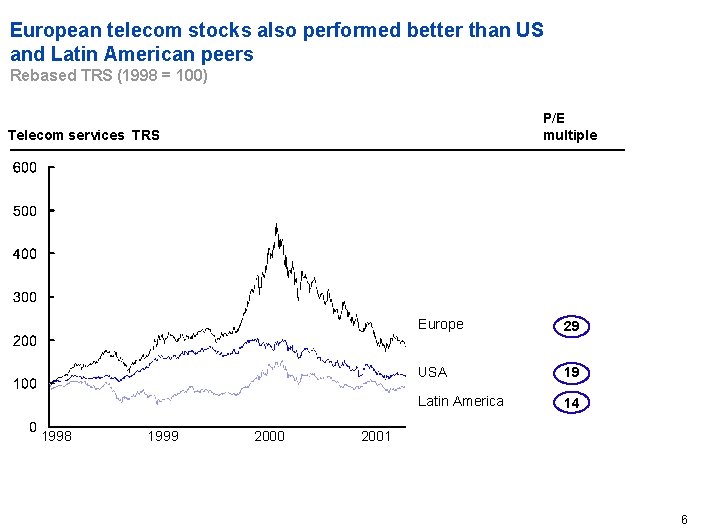
European telecom stocks also performed better than US and Latin American peers* Rebased TRS (1998 = 100) P/E multiple*** Telecom services TRS** 1998 1999 2000 *Indices denominated in local currency **Includes wireline, wireless and data network companies ***As per May 31, 2001 Source: Datastream Europe 29 USA 19 Latin America 14 2001 6
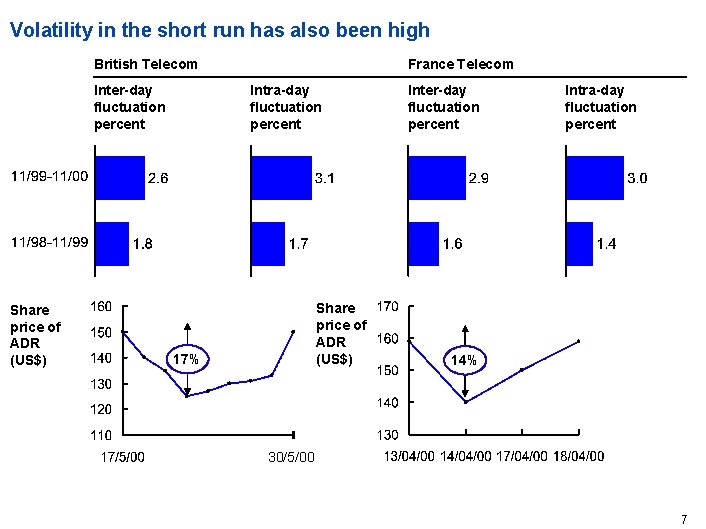
Volatility in the short run has also been high British Telecom Inter-day fluctuation percent Share price of ADR* (US$) France Telecom Intra-day fluctuation percent Share price of ADR* (US$) 17% Inter-day fluctuation percent Intra-day fluctuation percent 14% 30/5/00 *American Depository Receipts Source: Bloomberg; Mc. Kinsey analysis 7
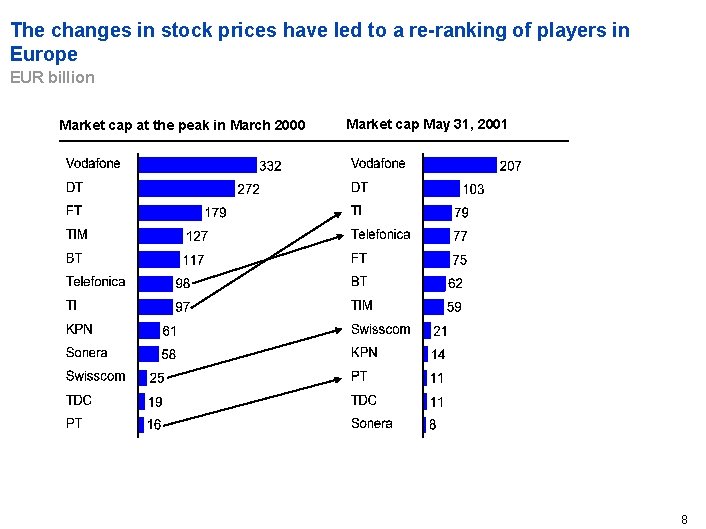
The changes in stock prices have led to a re-ranking of players in Europe EUR billion Market cap at the peak in March 2000 Market cap May 31, 2001 Note: DT (Deutsche Telekom), FT (France Telecom), BT (British Telecom), TIM (Telecom Italia Mobile), TI (Telecom Italia), PT (Portugal Telecom) Source: Datastream 8
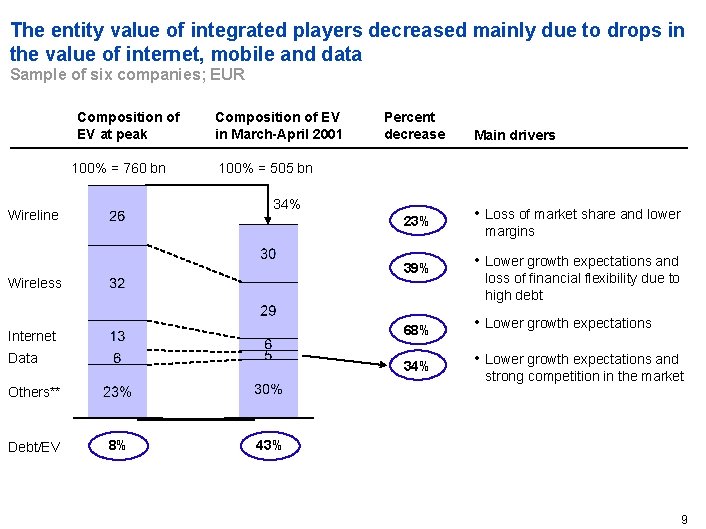
The entity value of integrated players decreased mainly due to drops in the value of internet, mobile and data Sample of six companies; EUR Composition of EV at peak* 100% = 760 bn Composition of EV in March-April 2001 Percent decrease 100% = 505 bn 34% Wireline Main drivers Wireless Internet Data 23% • Loss of market share and lower 39% • Lower growth expectations and 68% • Lower growth expectations 34% • Lower growth expectations and margins loss of financial flexibility due to high debt strong competition in the market Others** Debt/EV 8% 43% *As per March 2000 **Others include associates’ stakes, mixed business lines etc. Source: Broker reports on a sample of 6 companies (BT, DT, Telefonica, Telecom Italia, KPN, Sonera) 9
2. Causes behind capital market’s evolution There are three root causes of the volatility 10
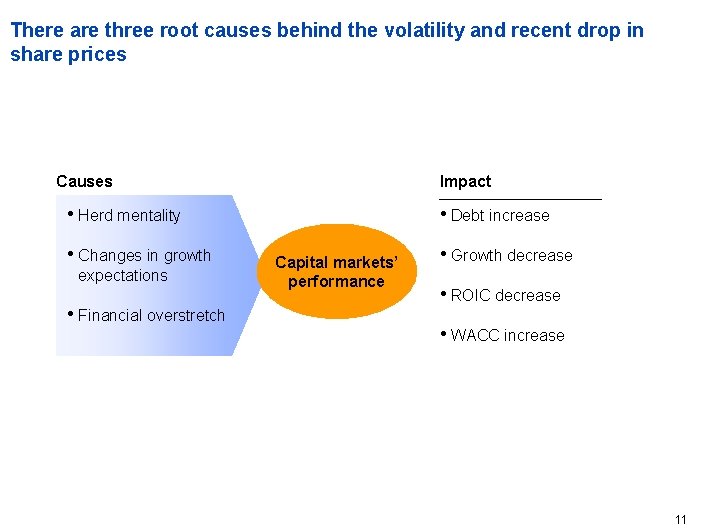
There are three root causes behind the volatility and recent drop in share prices Causes Impact • Herd mentality • Changes in growth expectations • Financial overstretch • Debt increase Capital markets’ performance • Growth decrease • ROIC decrease • WACC increase 11
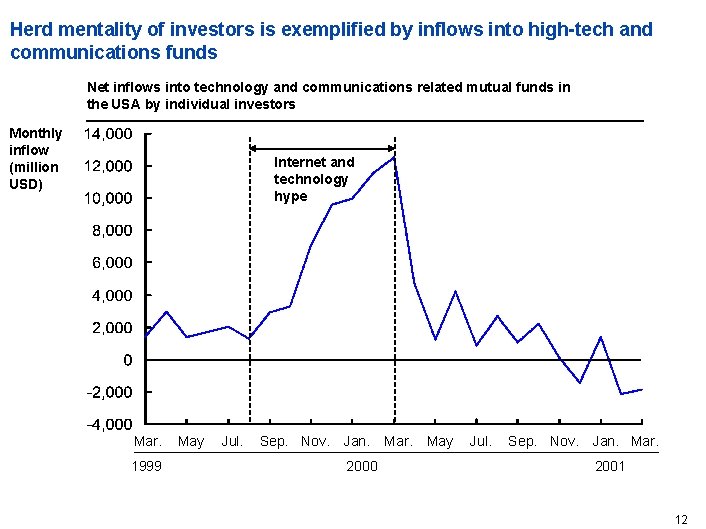
Herd mentality of investors is exemplified by inflows into high-tech and communications funds Net inflows into technology and communications related mutual funds in the USA by individual investors Monthly inflow (million USD) Internet and technology hype Mar. 1999 May Jul. Sep. Nov. Jan. 2000 Mar. May Jul. Sep. Nov. Jan. Mar. 2001 Note: These figures reflect the investments of the individual investors, which tend to chase ‘yesterday’s hot product’. This explains why there is still a net inflow for a couple of months after the hype peaked in March 2000 Source: Morningstar 12
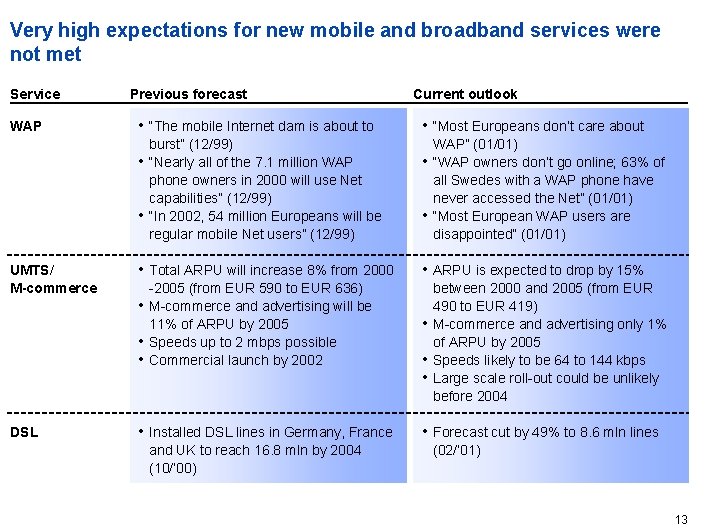
Very high expectations for new mobile and broadband services were not met Service WAP Previous forecast • “The mobile Internet dam is about to • • UMTS/ M-commerce • Total ARPU will increase 8% from 2000 • • • DSL burst” (12/99) “Nearly all of the 7. 1 million WAP phone owners in 2000 will use Net capabilities” (12/99) “In 2002, 54 million Europeans will be regular mobile Net users” (12/99) -2005 (from EUR 590 to EUR 636) M-commerce and advertising will be 11% of ARPU by 2005 Speeds up to 2 mbps possible Commercial launch by 2002 • Installed DSL lines in Germany, France and UK to reach 16. 8 mln by 2004 (10/’ 00) Source: Forrester Research; CSFB; Ovum; Wall Street Journal (16/03/01) Current outlook • “Most Europeans don’t care about • • WAP” (01/01) “WAP owners don’t go online; 63% of all Swedes with a WAP phone have never accessed the Net” (01/01) “Most European WAP users are disappointed” (01/01) • ARPU is expected to drop by 15% • • • between 2000 and 2005 (from EUR 490 to EUR 419) M-commerce and advertising only 1% of ARPU by 2005 Speeds likely to be 64 to 144 kbps Large scale roll-out could be unlikely before 2004 • Forecast cut by 49% to 8. 6 mln lines (02/’ 01) 13
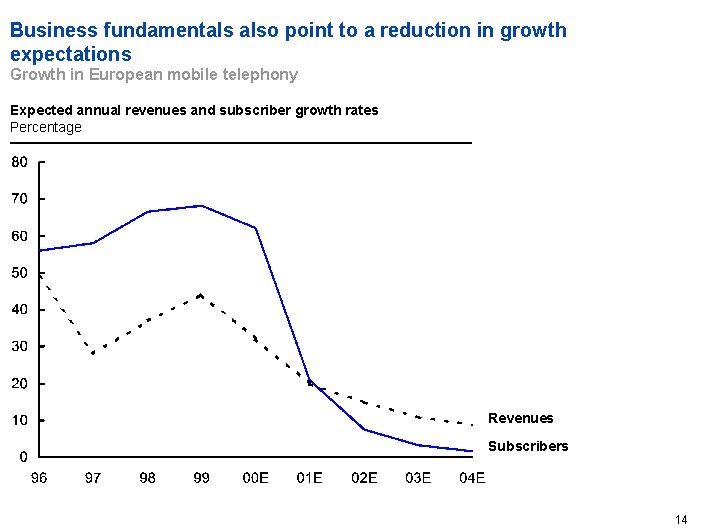
Business fundamentals also point to a reduction in growth expectations Growth in European mobile telephony Expected annual revenues and subscriber growth rates Percentage Revenues Subscribers Source: Dataquest 14
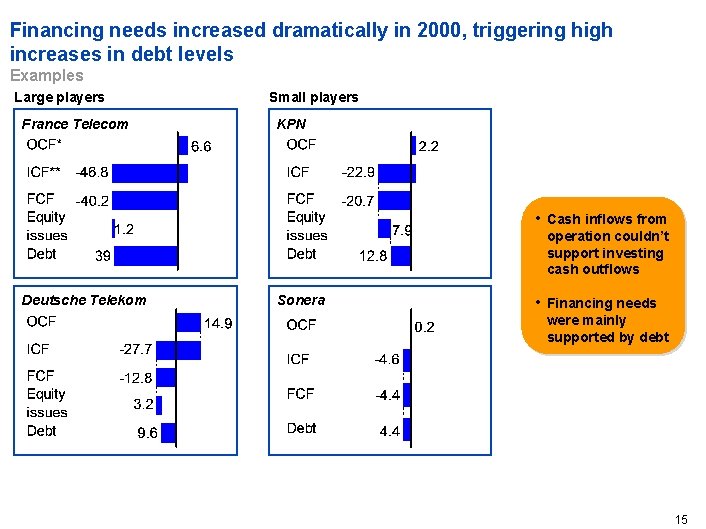
Financing needs increased dramatically in 2000, triggering high increases in debt levels Examples Large players France Telecom Small players KPN • Cash inflows from operation couldn’t support investing cash outflows Deutsche Telekom Sonera • Financing needs were mainly supported by debt *Operating CF = Net income + non-cash expenses (Depreciation & amortization) – change in working capital **Investing CF (ICF) = Acquisitions of assets (companies, intangibles, equipment, minority stakes) – disposal of assets/FCF= Financing cash flows Source: Annual reports 15
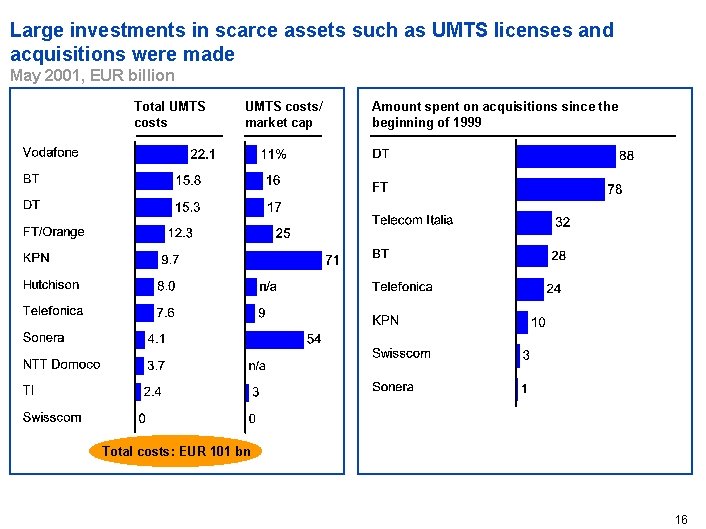
Large investments in scarce assets such as UMTS licenses and acquisitions were made May 2001, EUR billion Total UMTS costs/ market cap* Amount spent on acquisitions since the beginning of 1999** Total costs: EUR 101 bn * May 31, 2001 ** Only acquisitions over 100 mln $ included Source: UBS Warburg; SDC; EMC; Bloomberg 16
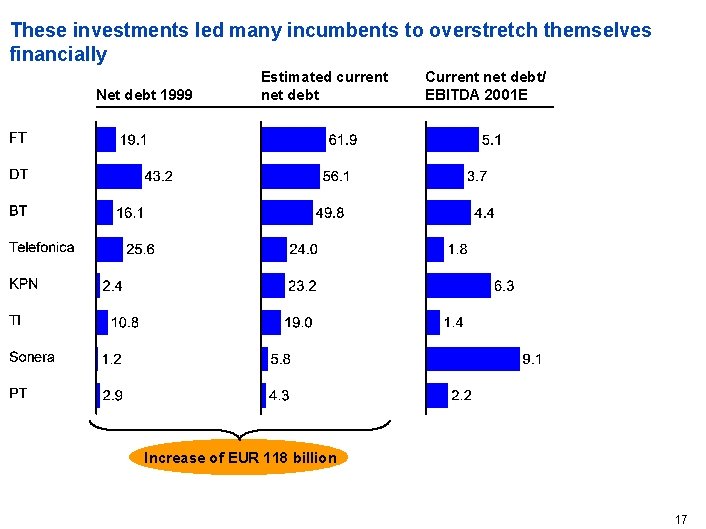
These investments led many incumbents to overstretch themselves financially Net debt 1999 Estimated current net debt Current net debt/ EBITDA 2001 E Increase of EUR 118 billion Note: BT excludes recent sell-off of J-Phone and equity rights issue; Sonera excludes cash generated from Voicestream deal Source: Annual Reports; Broker reports 17
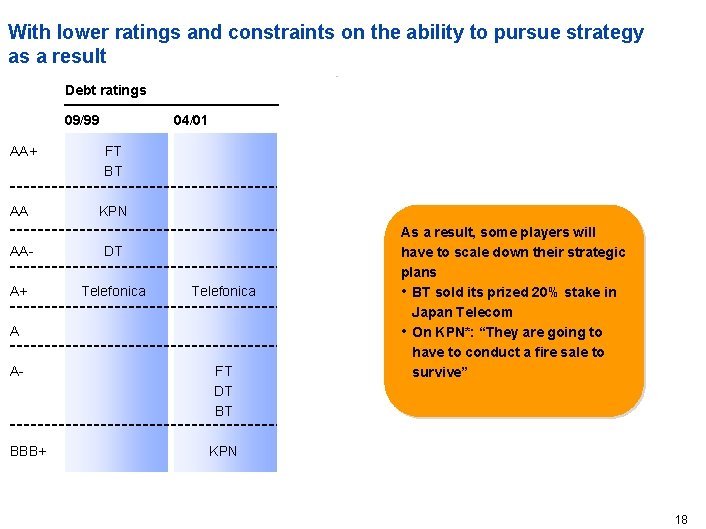
With lower ratings and constraints on the ability to pursue strategy as a result Debt ratings 09/99 04/01 AA+ FT BT AA KPN AA- DT A+ Telefonica A A- BBB+ FT DT BT As a result, some players will have to scale down their strategic plans • BT sold its prized 20% stake in Japan Telecom • On KPN*: “They are going to have to conduct a fire sale to survive” KPN *Quote from David Thomson of FOR Securities Source: Team analysis; Broker reports; Standard & Poors 18
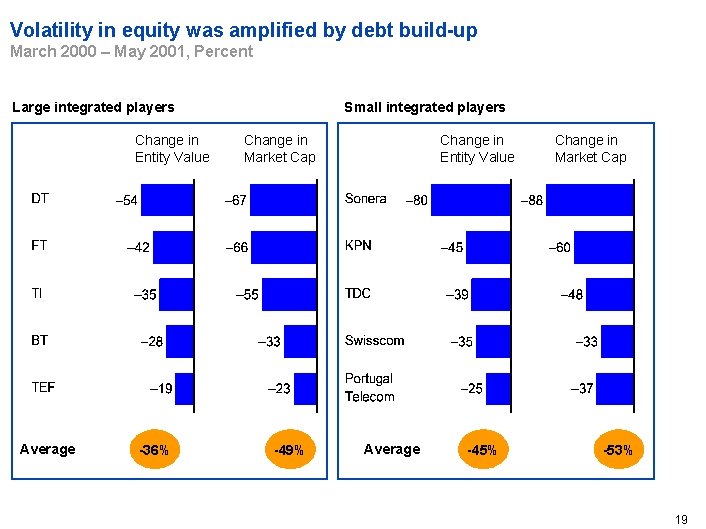
Volatility in equity was amplified by debt build-up March 2000 – May 2001, Percent Large integrated players Change in Entity Value Average -36% Source: Datastream; Team analysis Small integrated players Change in Market Cap -49% Change in Entity Value Average -45% Change in Market Cap -53% 19
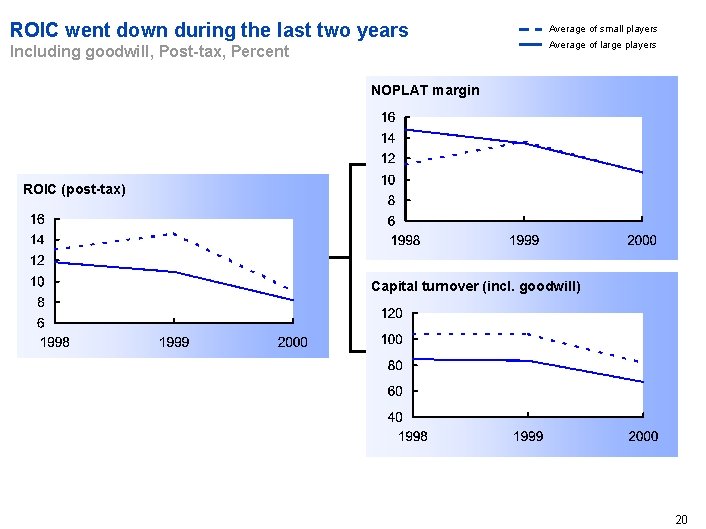
ROIC went down during the last two years Including goodwill, Post-tax, Percent Average of small players* Average of large players* NOPLAT margin ROIC (post-tax) Capital turnover (incl. goodwill) *Small players: Sonera, KPN, Swisscom, TDC, Portugal Telecom (not for 2000); large players: DT, FT, TI, Telefonica, BT Source: Annual reports; Team analysis 20
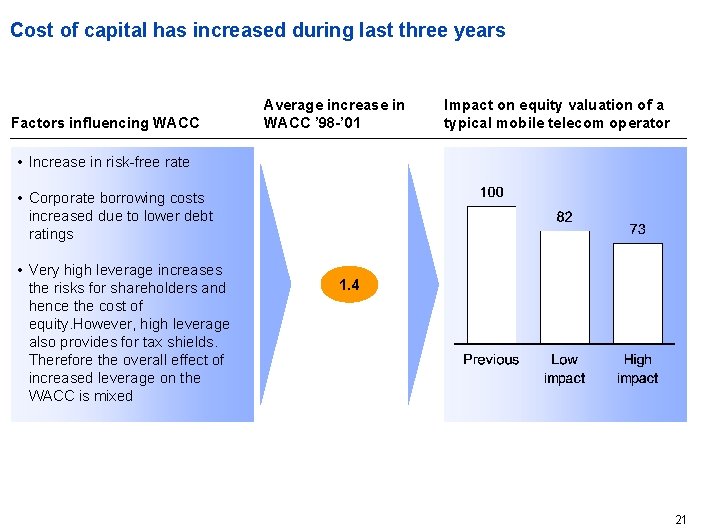
Cost of capital has increased during last three years Factors influencing WACC Average increase in WACC ’ 98 -’ 01* Impact on equity valuation of a typical mobile telecom operator** • Increase in risk-free rate • Corporate borrowing costs increased due to lower debt ratings • Very high leverage increases the risks for shareholders and hence the cost of equity. However, high leverage also provides for tax shields. Therefore the overall effect of increased leverage on the WACC is mixed 1. 4 *Average of all integrated players **Based on DCF valuation models of various mobile players in Europe with high growth assumption of the Spring 2000 Source: Team analysis 21
3. Differences in performance between Telcos Large integrated Telcos seem to be better positioned going forward 22
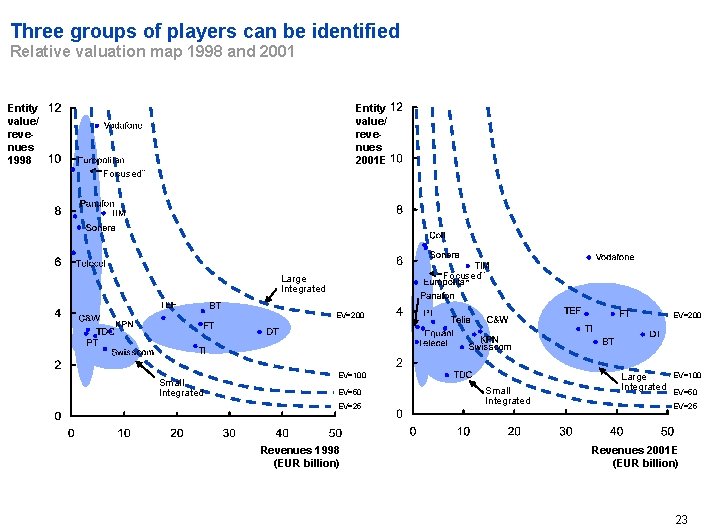
Three groups of players can be identified Relative valuation map 1998 and 2001* Entity value/ revenues 1998 Entity value/ revenues 2001 E Focused** Large Integrated EV=200 EV=100 Small Integrated EV=50 EV=25 Revenues 1998 (EUR billion) * As per April 30, 2001 ** With the exception of Cable & Wireless, TIM and Vodafone Source: Global Vantage, Bloomberg Small Integrated Large Integrated EV=100 EV=50 EV=25 Revenues 2001 E (EUR billion) 23
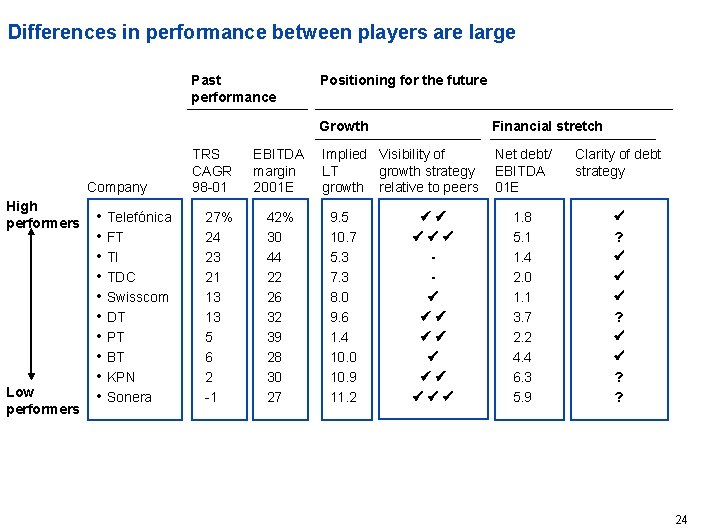
Differences in performance between players are large Past performance Company High performers Low performers • • • Telefónica FT TI TDC Swisscom DT PT BT KPN Sonera** TRS CAGR 98 -01 27% 24 23 21 13 13 5 6 2 -1 EBITDA margin 2001 E 42% 30 44 22 26 32 39 28 30 27 Positioning for the future Growth Financial stretch Implied Visibility of LT growth strategy growth* relative to peers Net debt/ EBITDA 01 E Clarity of debt strategy 1. 8 5. 1 1. 4 2. 0 1. 1 3. 7 2. 2 4. 4 6. 3 5. 9 ? ? ? ? 9. 5 10. 7 5. 3 7. 3 8. 0 9. 6 1. 4 10. 0 10. 9 11. 2 *EBITDA CAGR 2004 -2020 **Since listing Source: Bloomberg, Press reports, Broker reports, Annual reports, Team analysis 24
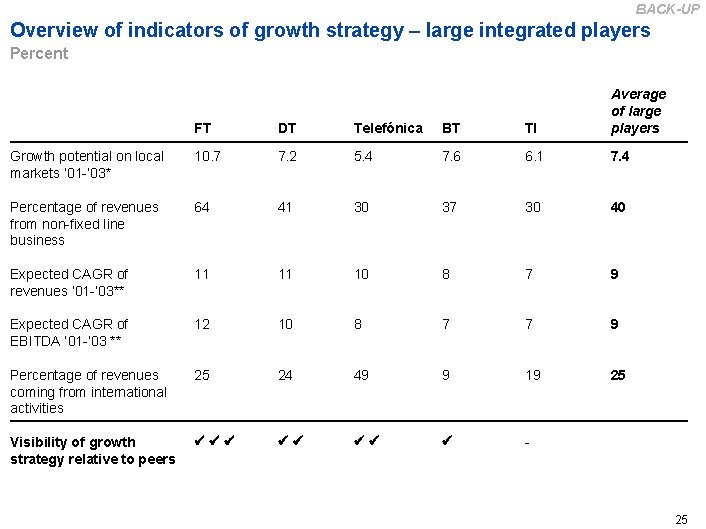
BACK-UP Overview of indicators of growth strategy – large integrated players Percent FT DT Telefónica BT TI Average of large players Growth potential on local markets ’ 01 -’ 03* 10. 7 7. 2 5. 4 7. 6 6. 1 7. 4 Percentage of revenues from non-fixed line business 64 41 30 37 30 40 Expected CAGR of revenues ’ 01 -’ 03** 11 11 10 8 7 9 Expected CAGR of EBITDA ’ 01 -’ 03 ** 12 10 8 7 7 9 Percentage of revenues coming from international activities 25 24 49 9 19 25 Visibility of growth strategy relative to peers - *Average of expected revenue CAGR 2001 -2003 of fixed and mobile in each home market **Consensus analyst expectations 2001 -2003 Source: EMC, Multex, Gardner, Broker reports, Annual reports; Company presentations 25
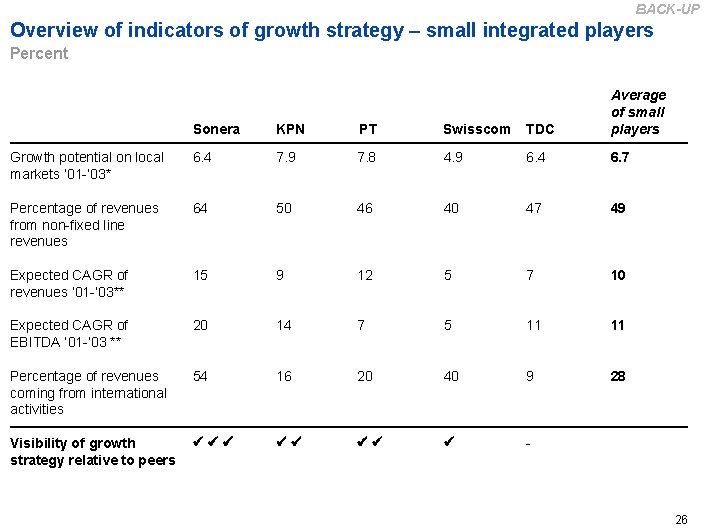
BACK-UP Overview of indicators of growth strategy – small integrated players Percent Sonera KPN PT Swisscom TDC Average of small players Growth potential on local markets ’ 01 -’ 03* 6. 4 7. 9 7. 8 4. 9 6. 4 6. 7 Percentage of revenues from non-fixed line revenues 64 50 46 40 47 49 Expected CAGR of revenues ’ 01 -’ 03** 15 9 12 5 7 10 Expected CAGR of EBITDA ’ 01 -’ 03 ** 20 14 7 5 11 11 Percentage of revenues coming from international activities 54 16 20 40 9 28 Visibility of growth strategy relative to peers - *Average of expected revenue CAGR 2001 -2003 of fixed and mobile in each home market **Consensus analyst expectations 2001 -2003 Source: EMC, Multex, Gardner, Broker reports, Annual reports; Company presentations 26
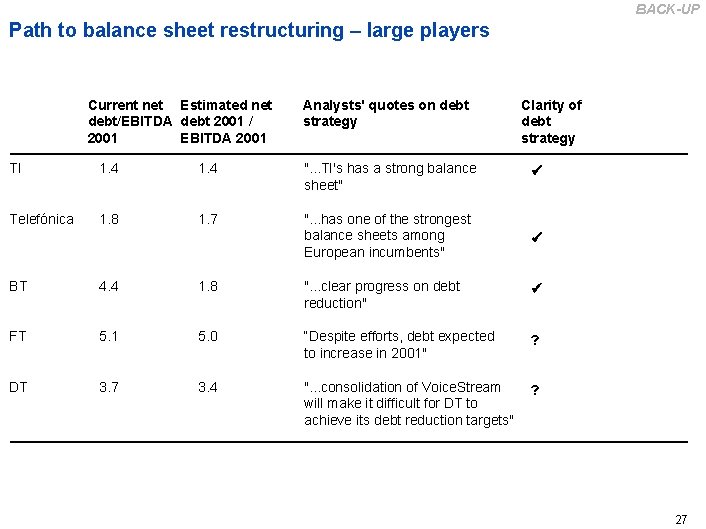
BACK-UP Path to balance sheet restructuring – large players Current net Estimated net debt/EBITDA debt 2001*/ 2001 EBITDA 2001 Analysts' quotes on debt strategy Clarity of debt strategy TI 1. 4 ". . . TI's has a strong balance sheet" Telefónica 1. 8 1. 7 ". . . has one of the strongest balance sheets among European incumbents" BT 4. 4 1. 8 ". . . clear progress on debt reduction" FT 5. 1 5. 0 “Despite efforts, debt expected to increase in 2001" ? DT 3. 7 3. 4 ". . . consolidation of Voice. Stream will make it difficult for DT to achieve its debt reduction targets" ? *Net debt 2001 is calculated on the assumption that all announced sales for which buyers have been identified are going to be executed this year and all proceeds will be used to repay the debt principal. Excess cash levels are assumed to remain constant. Announced sales for which no buyers have been identified are assumed not to take place this year Source: Broker reports, company presentations 27
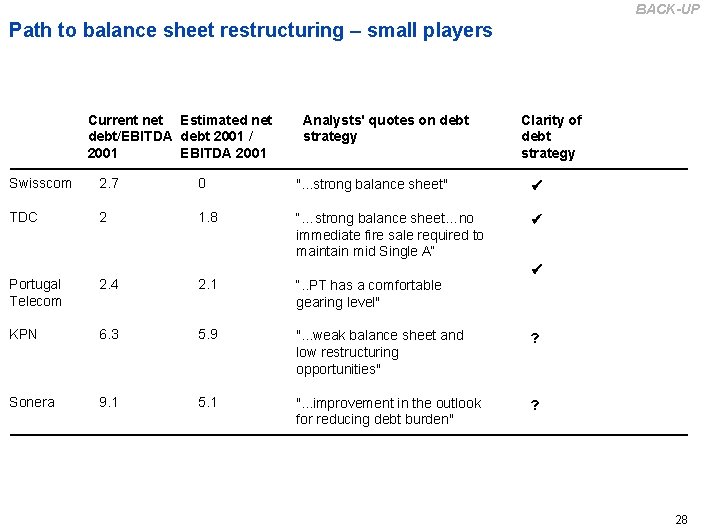
BACK-UP Path to balance sheet restructuring – small players Current net Estimated net debt/EBITDA debt 2001*/ 2001 EBITDA 2001 Analysts' quotes on debt strategy Clarity of debt strategy Swisscom 2. 7 0 ". . . strong balance sheet" TDC 2 1. 8 “…strong balance sheet…no immediate fire sale required to maintain mid Single A“ Portugal Telecom 2. 4 2. 1 “. . PT has a comfortable gearing level" KPN 6. 3 5. 9 ". . . weak balance sheet and low restructuring opportunities" ? Sonera 9. 1 5. 1 ". . . improvement in the outlook for reducing debt burden" ? *Net debt 2001 is calculated on the assumption that all announced sales for which buyers have been identified are going to be executed this year and all proceeds will be used to repay the debt principal. Excess cash levels are assumed to remain constant. Announced sales for which no buyers have been identified are assumed not to take place this year Source: Broker reports, company presentations 28
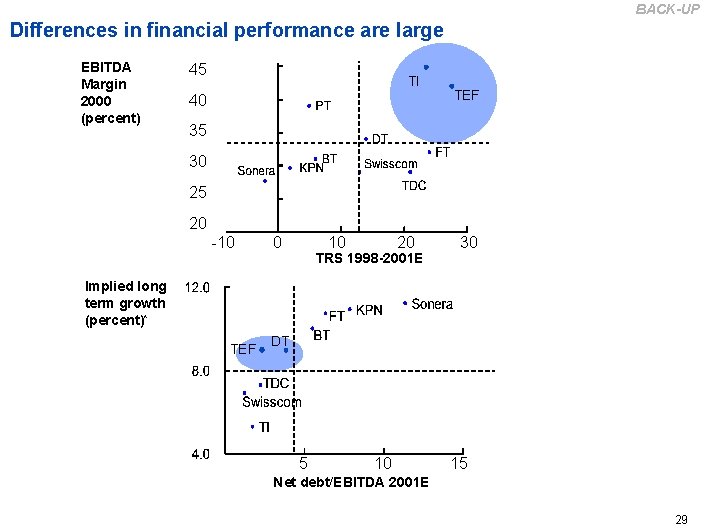
BACK-UP Differences in financial performance are large EBITDA Margin 2000 (percent) 45 TI 40 TEF 35 30 25 20 -10 0 10 20 TRS 1998 -2001 E 30 Implied long term growth (percent)* TEF DT 5 10 15 Net debt/EBITDA 2001 E *Implied EBITDA growth 2004 -2020 based on Entity Value as per May 31 Source: Team analysis 29
4. Challenges ahead for integrated players Challenges will remain 30
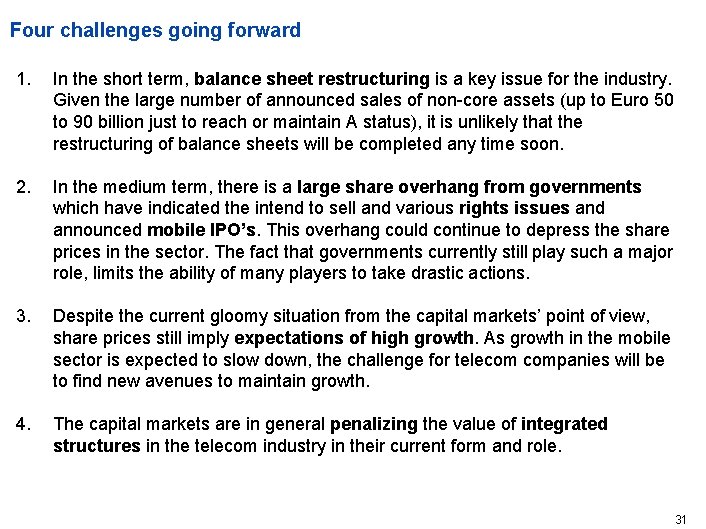
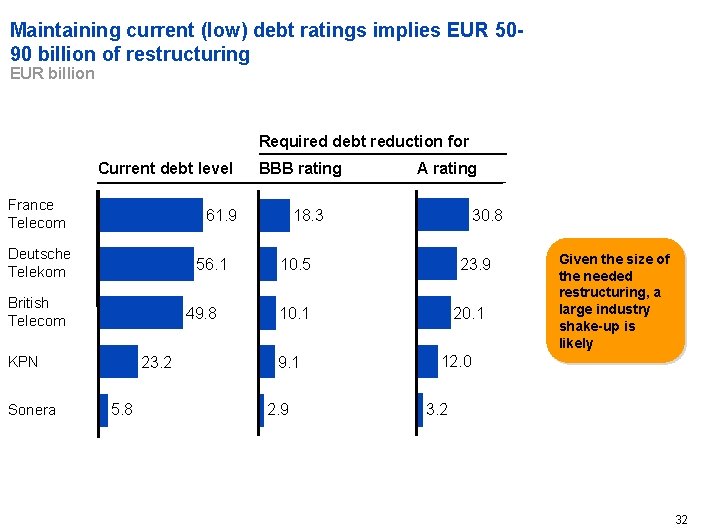
Four challenges going forward 1. In the short term, balance sheet restructuring is a key issue for the industry. Given the large number of announced sales of non-core assets (up to Euro 50 to 90 billion just to reach or maintain A status), it is unlikely that the restructuring of balance sheets will be completed any time soon. 2. In the medium term, there is a large share overhang from governments which have indicated the intend to sell and various rights issues and announced mobile IPO’s. This overhang could continue to depress the share prices in the sector. The fact that governments currently still play such a major role, limits the ability of many players to take drastic actions. 3. Despite the current gloomy situation from the capital markets’ point of view, share prices still imply expectations of high growth. As growth in the mobile sector is expected to slow down, the challenge for telecom companies will be to find new avenues to maintain growth. 4. The capital markets are in general penalizing the value of integrated structures in the telecom industry in their current form and role. 31
Maintaining current (low) debt ratings implies EUR 5090 billion of restructuring EUR billion Required debt reduction for Current debt level France Telecom 61. 9 Deutsche Telekom 56. 1 British Telecom 49. 8 KPN Sonera BBB rating 23. 2 5. 8 Source: Financial Times (16/03/01) A rating 30. 8 18. 3 23. 9 10. 5 20. 1 10. 1 9. 1 2. 9 Given the size of the needed restructuring, a large industry shake-up is likely 12. 0 3. 2 32
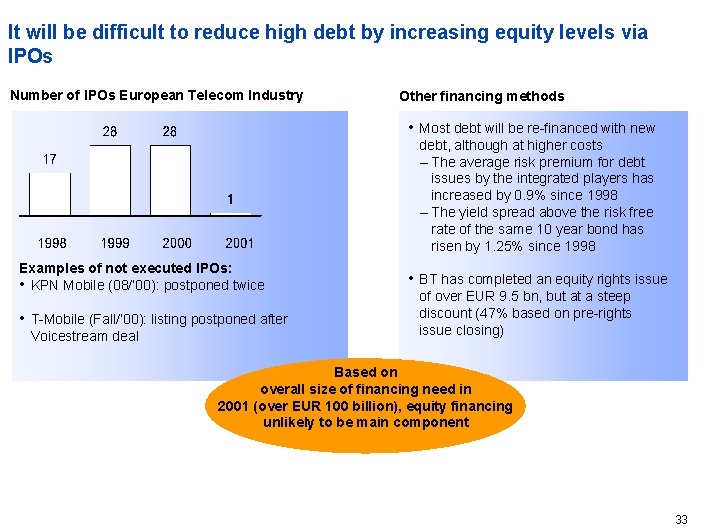
It will be difficult to reduce high debt by increasing equity levels via IPOs Number of IPOs European Telecom Industry Other financing methods • Most debt will be re-financed with new debt, although at higher costs – The average risk premium for debt issues by the integrated players has increased by 0. 9% since 1998 – The yield spread above the risk free rate of the same 10 year bond has risen by 1. 25% since 1998 Examples of not executed IPOs: • KPN Mobile (08/’ 00): postponed twice • T-Mobile (Fall/’ 00): listing postponed after Voicestream deal • BT has completed an equity rights issue of over EUR 9. 5 bn, but at a steep discount (47% based on pre-rights issue closing) Based on overall size of financing need in 2001 (over EUR 100 billion), equity financing unlikely to be main component *In same period in 2000, 16 issues Source: IFR; Press clippings; Team analysis 33
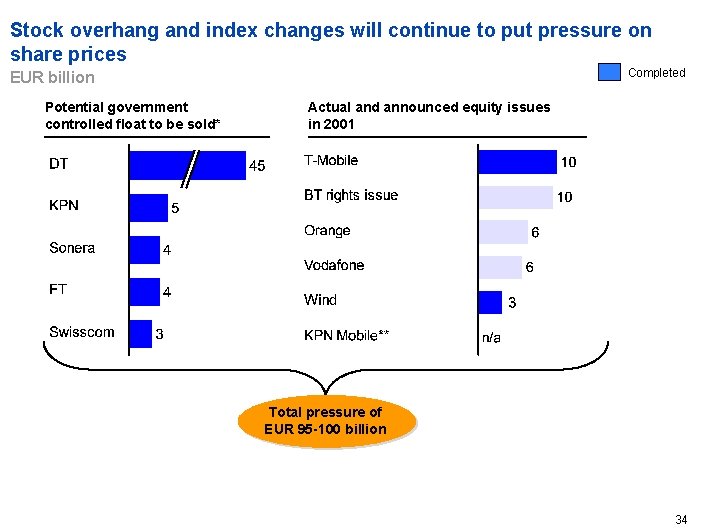
Stock overhang and index changes will continue to put pressure on share prices Completed EUR billion Potential government controlled float to be sold* Actual and announced equity issues in 2001 Total pressure of EUR 95 -100 billion *Based on market cap of May 31, 2001 and on indications from the respective government about which percentage of their share holding they are planning to sell in the coming months/years **KPN Mobile IPO postponed – timing probably dependent on new strategy in combination with rights issue Source: Broker reports, Bloomberg, press reports, Financieel Dagblad, team analysis 34
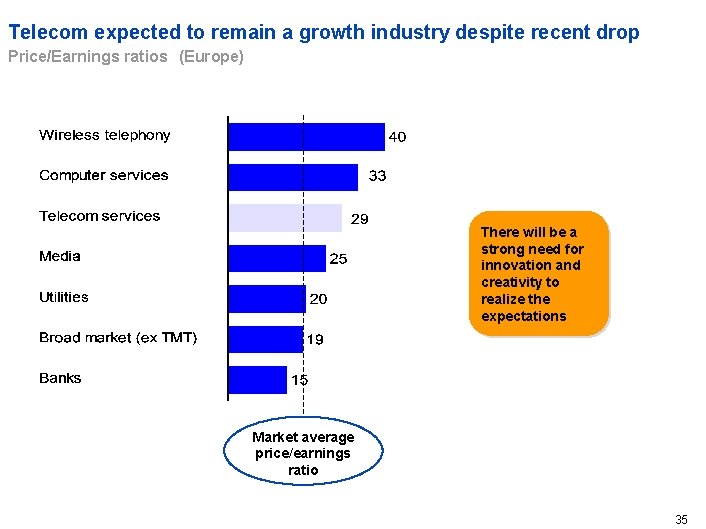
Telecom expected to remain a growth industry despite recent drop Price/Earnings ratios* (Europe) There will be a strong need for innovation and creativity to realize the expectations Market average price/earnings ratio *As per May 31, 2001; Based on 2000 earnings Source: Datastreem 35
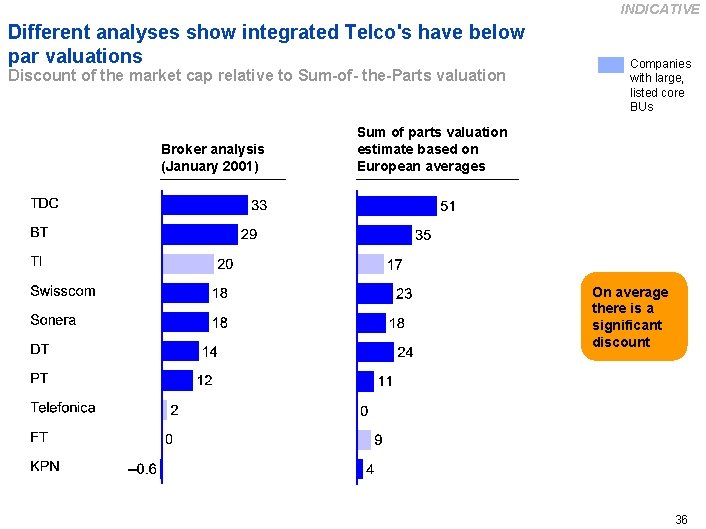
INDICATIVE Different analyses show integrated Telco's have below par valuations Discount of the market cap relative to Sum-of- the-Parts valuation Broker analysis (January 2001) Companies with large, listed core BUs Sum of parts valuation estimate based on European averages On average there is a significant discount Source: Broker reports; UBS Warburg; Team analysis 36
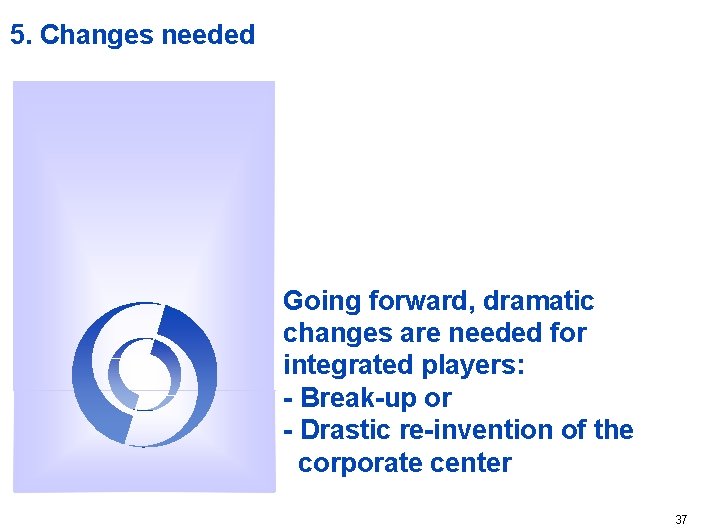
5. Changes needed Going forward, dramatic changes are needed for integrated players: - Break-up or - Drastic re-invention of the corporate center 37
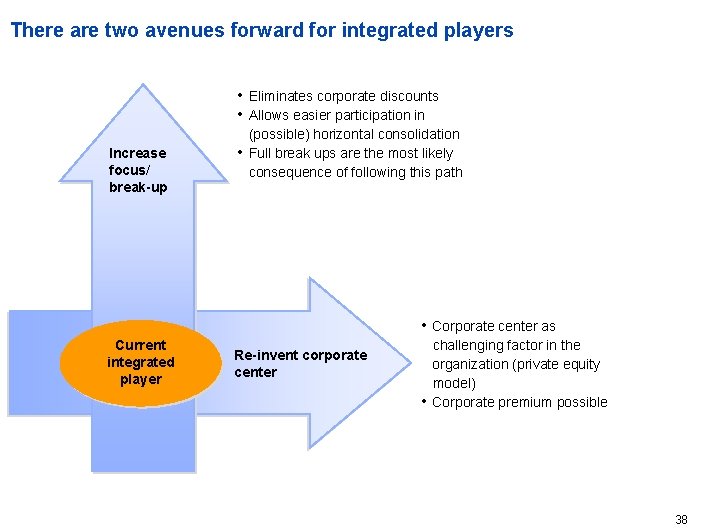
There are two avenues forward for integrated players • Eliminates corporate discounts • Allows easier participation in Increase focus/ break-up • (possible) horizontal consolidation Full break ups are the most likely consequence of following this path • Corporate center as Current integrated player Re-invent corporate center • challenging factor in the organization (private equity model) Corporate premium possible 38
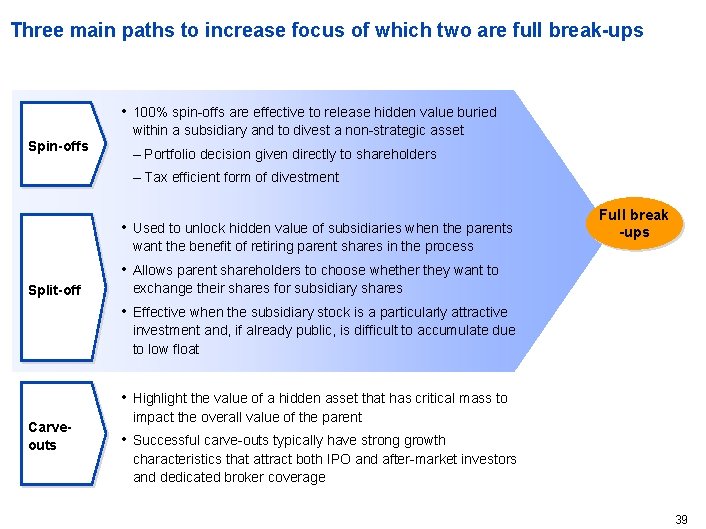
Three main paths to increase focus of which two are full break-ups • 100% spin-offs are effective to release hidden value buried Spin-offs within a subsidiary and to divest a non-strategic asset – Portfolio decision given directly to shareholders – Tax efficient form of divestment • Used to unlock hidden value of subsidiaries when the parents want the benefit of retiring parent shares in the process Full break -ups • Allows parent shareholders to choose whether they want to Split-off exchange their shares for subsidiary shares • Effective when the subsidiary stock is a particularly attractive investment and, if already public, is difficult to accumulate due to low float • Highlight the value of a hidden asset that has critical mass to Carveouts impact the overall value of the parent • Successful carve-outs typically have strong growth characteristics that attract both IPO and after-market investors and dedicated broker coverage Source: Credit Suisse First Boston 39
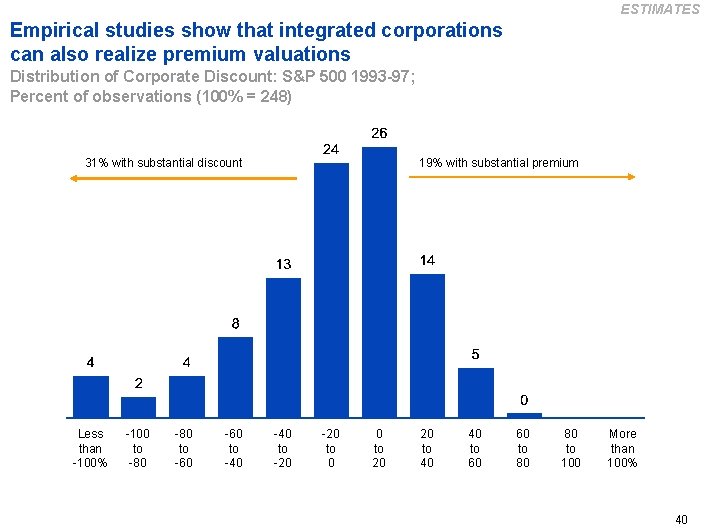
ESTIMATES Empirical studies show that integrated corporations can also realize premium valuations Distribution of Corporate Discount: S&P 500 1993 -97; Percent of observations (100% = 248) 31% with substantial discount Less than -100% -100 to -80 to -60 to -40 19% with substantial premium -40 to -20 to 0 0 to 20 20 to 40 40 to 60 60 to 80 80 to 100 More than 100% Note: Discount is calculated relative to current share price, e. g. discount of 100% means that the share would trade at double the price if there were no discount Source: Compustat; Mc. Kinsey analysis 40
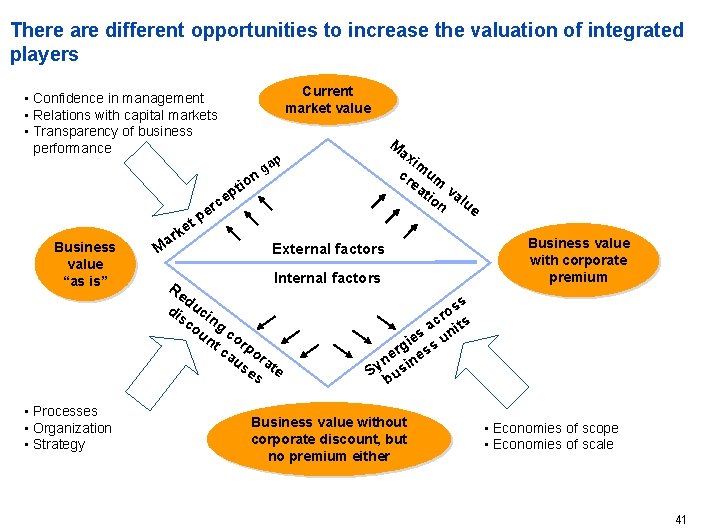
There are different opportunities to increase the valuation of integrated players Current market value • Confidence in management • Relations with capital markets • Transparency of business performance M n io pt ap g ax e t Business value “as is” • Processes • Organization • Strategy* e rk a M rc pe im u ea m v tio al n ue cr External factors Internal factors Re d ss di uci o sc ng r ac nits ou c s nt or ie s u p g ca o er nes us rat n es e Sy usi b Business value without corporate discount, but no premium either Business value with corporate premium • Economies of scope • Economies of scale *Processes: Incentive systems, performance measurement and accountability of BUs; Organization: Wrong corporate focus, mixed organization of not clearly defined BUs; Strategy: Unaligned between corporate and BUs, lack of aspiration to be best of breed 41