
The Future of Climate Change and Alternative Energy
- Slides: 13
The Future of Climate Change and Alternative Energy
Climate Change cli· mate change (noun) a change in global or regional climate patterns, in particular a change apparent from the mid to late 20 th century onwards and attributed largely to the increased levels of atmospheric carbon dioxide produced by the use of fossil fuels.
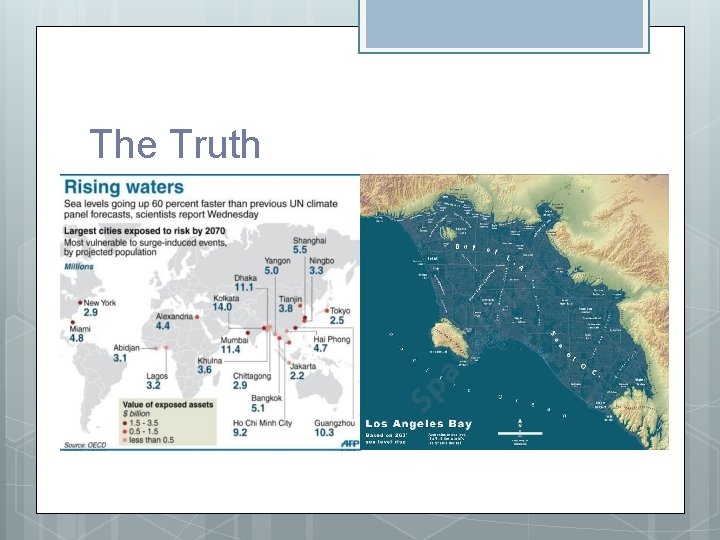
Statistics CO 2 levels at their highest in 650, 000 years 9 of the 10 warmest years on record have occurred since 2000 The Arctic Ice Minimum has been going down at a rate of 13. 3% per decade Between 1996 and 2005, the loss of ice in Greenland has doubled Sea level has risen & inches in the past 100 years
Consequences Destabilizing effects of droughts, storms, and floods Domestically Overwhelm disaster-response capabilities Internationally Humanitarian Disasters Contribute to political disasters Undermine weak governments
Military Impacts It is no longer just an economic or moral problem Obama recently spoke of climate change in a strictly military context for the first time: "The Pentagon says that climate change poses immediate risks to our national security, " he said in his State of the Union address. "We should act like it. "
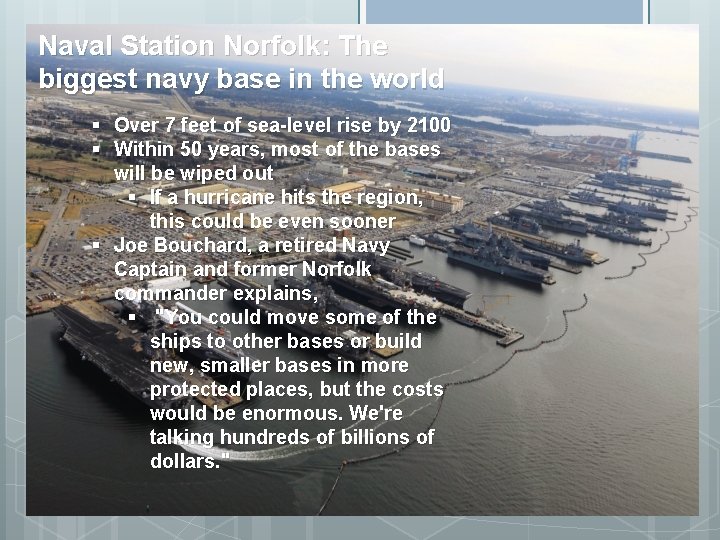
Naval Station Norfolk: The biggest navy base in the world § § Over 7 feet of sea-level rise by 2100 Within 50 years, most of the bases will be wiped out § If a hurricane hits the region, this could be even sooner § Joe Bouchard, a retired Navy Captain and former Norfolk commander explains, § "You could move some of the ships to other bases or build new, smaller bases in more protected places, but the costs would be enormous. We're talking hundreds of billions of dollars. "
Those Who Don’t Agree On January 21, 2015, the Senate voted on an amendment for whether or not climate change is real- all but one (Roger Wicker, MS) said yes In a second amendment stating that humans are to blame, 50 said yes and 49 said no So, almost half of our senators, representing our nation, believe that another species is responsible for the CO 2 emissions…?
The Future President? Ted Cruz, a declared Republican presidential candidate, has voiced his opinion on climate change. He has acknowledged the reality of it, yet is a skeptic that humancaused climate change is happening right now “My view actually is simple. Debates on this should follow science and should follow data. And many of the alarmists on global warming, they’ve got a problem cause the science doesn’t back them up. And in particular, satellite data demonstrate for the last 17 years, there’s been zero warming. None whatsoever. It’s why — you remember how it used to be called ‘global warming’ and then magically theory changed to ‘climate change’? The reason is it wasn’t warming, but the computer models still say it is, except the satellites show it’s not. ”
The Truth
The Cost It is difficult to place an estimate on the cost of actively taking action to counter climate change, but Sir Nicholas Stern, former chief economist for the World Bank answered the frequently asked question in an interview on November 26, 2007: NS: “If we do such reductions well, it will cost around 1 percent of the world's gross domestic product, subject to pluses or minuses. You must think in terms of ranges rather than just point estimates. A rich country, say, spends 4 percent of GDP or so on primary energy. If the effective cost of energy went up 30 to 40 percent, that figure would go up 1 to 1. 5 percent. It could be less if we learn quickly; find more energy efficiency. It could be more if we do it badly. Still, I think it's a very reasonable insurance premium to pay for the kinds of damages to be avoided. ”
But We Have Options! Foregoing Fossil Fuels Perhaps the most daunting task on the agenda, yet undoubtedly the most important, steps need to be taken now to ensure our world doesn’t suffer the consequence of our greed for oil. Divesting in oil stocks Investing in carbon capture and storage Looking towards alternative energy NOW
What You Can Do Consume Make Less greener purchases- hybrid cars, more efficient appliances, less packaging on products Simple things- turn of the lights, drive a well taken care of car Go vegetarian? - Each meat-eating American produces about 1. 5 tons more greenhouse gases through their food choices than their vegetarian peers
Our Solution It may take time, but changes need to start happening now. Individual daily choices affect our environment and future just as much as how and for whom we vote to lead our country through tis crisis. Climate change won’t just fix itself- it’ll take awareness and action to ensure our world is kept beautiful and sustainable for all the generations to come.