
The Future of Artificial Intelligence John Paxton Montana

- Slides: 34
The Future of Artificial Intelligence John Paxton Montana State University August 14, 2003
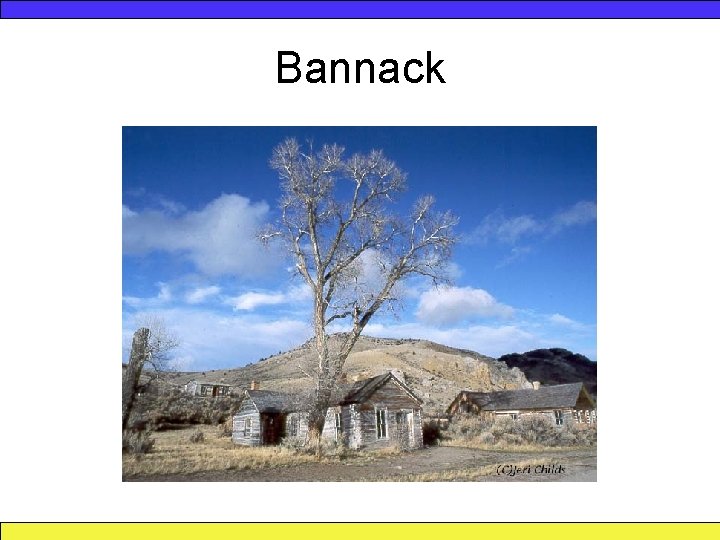
Bannack
What makes AI difficult? • Different problems have inherently different complexities to solve.
The Sorting Problem • Input: 2 4 6 7 5 3 1 • Output: 1 2 3 4 5 6 7
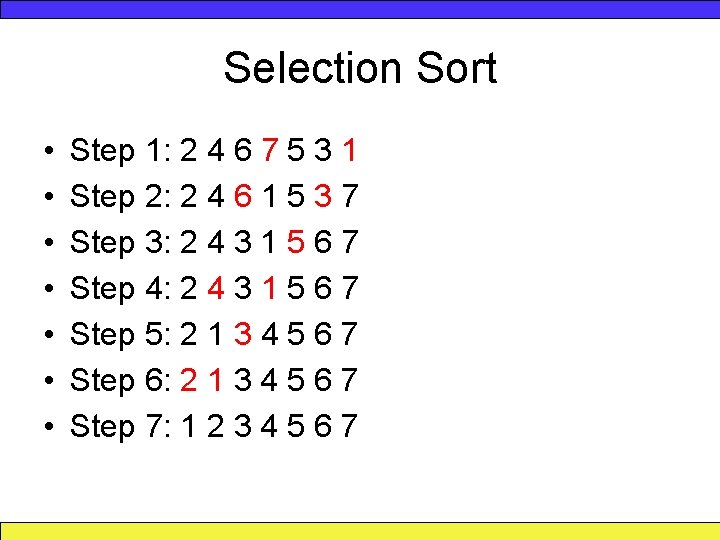
Selection Sort • • Step 1: 2 4 6 7 5 3 1 Step 2: 2 4 6 1 5 3 7 Step 3: 2 4 3 1 5 6 7 Step 4: 2 4 3 1 5 6 7 Step 5: 2 1 3 4 5 6 7 Step 6: 2 1 3 4 5 6 7 Step 7: 1 2 3 4 5 6 7
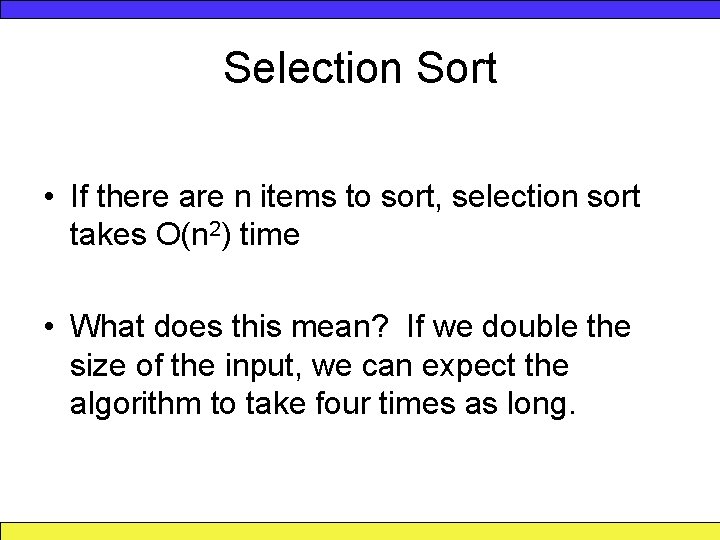
Selection Sort • If there are n items to sort, selection sort takes O(n 2) time • What does this mean? If we double the size of the input, we can expect the algorithm to take four times as long.
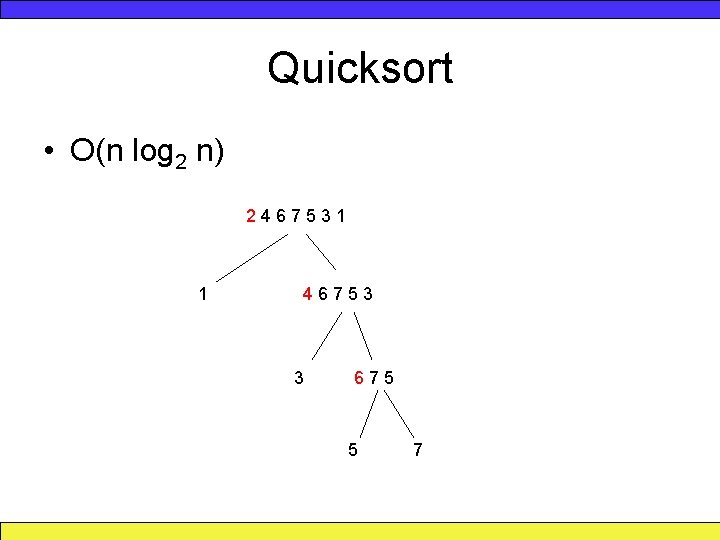
Quicksort • O(n log 2 n) 2467531 1 46753 3 675 5 7
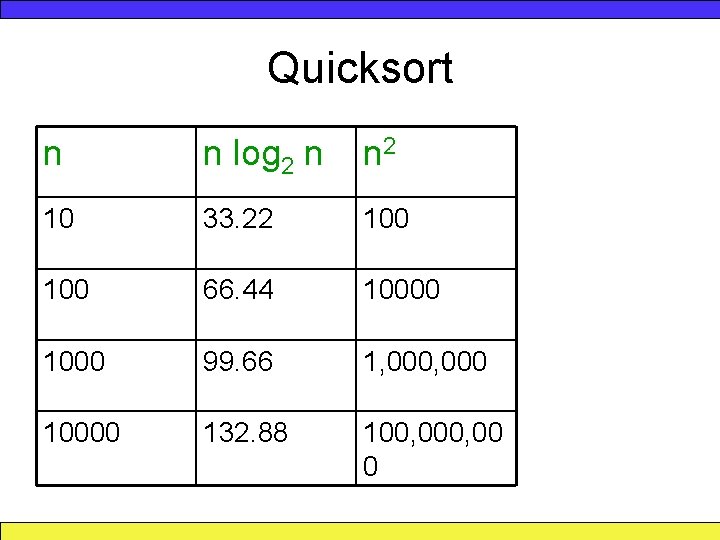
Quicksort n n log 2 n n 2 10 33. 22 100 66. 44 10000 1000 99. 66 1, 000 10000 132. 88 100, 00 0
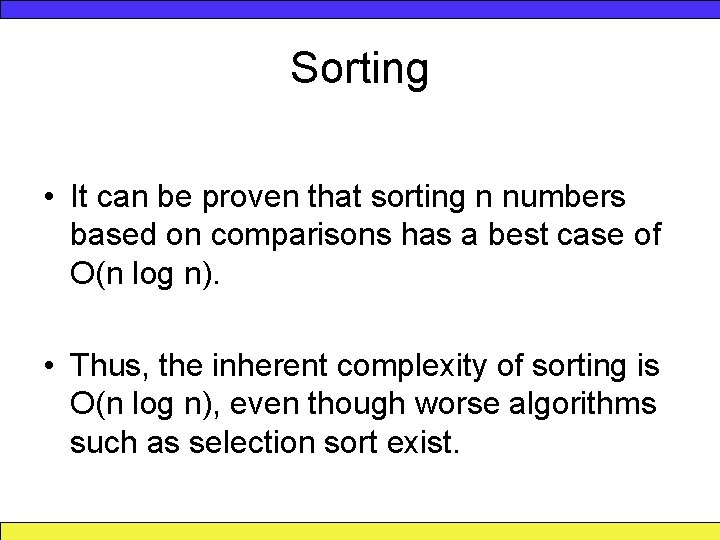
Sorting • It can be proven that sorting n numbers based on comparisons has a best case of O(n log n). • Thus, the inherent complexity of sorting is O(n log n), even though worse algorithms such as selection sort exist.
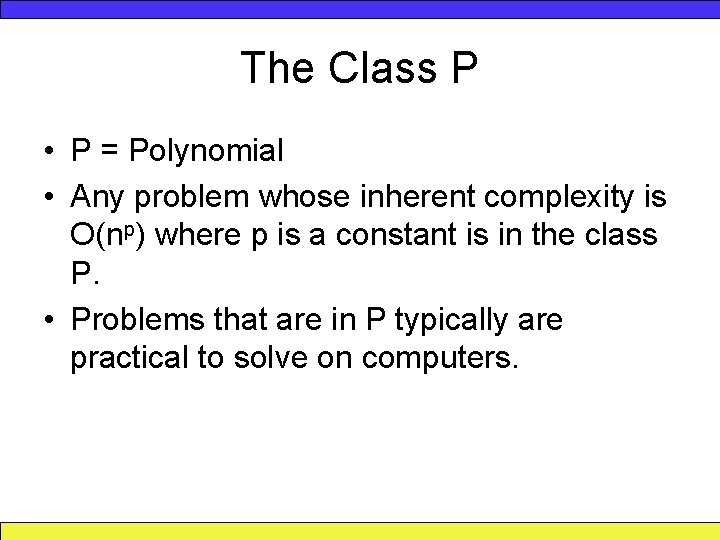
The Class P • P = Polynomial • Any problem whose inherent complexity is O(np) where p is a constant is in the class P. • Problems that are in P typically are practical to solve on computers.
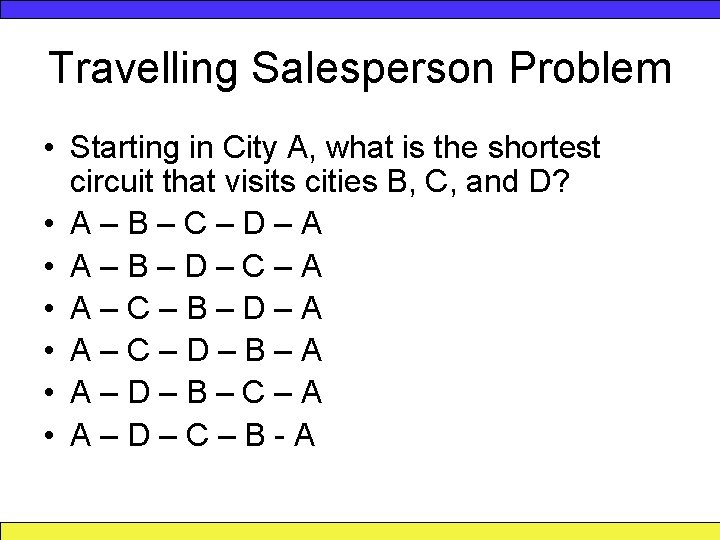
Travelling Salesperson Problem • Starting in City A, what is the shortest circuit that visits cities B, C, and D? • A–B–C–D–A • A–B–D–C–A • A–C–B–D–A • A–C–D–B–A • A–D–B–C–A • A–D–C–B-A
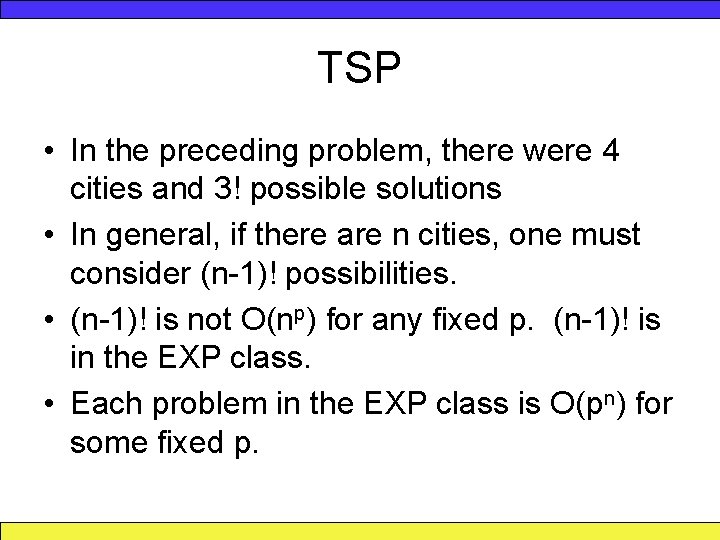
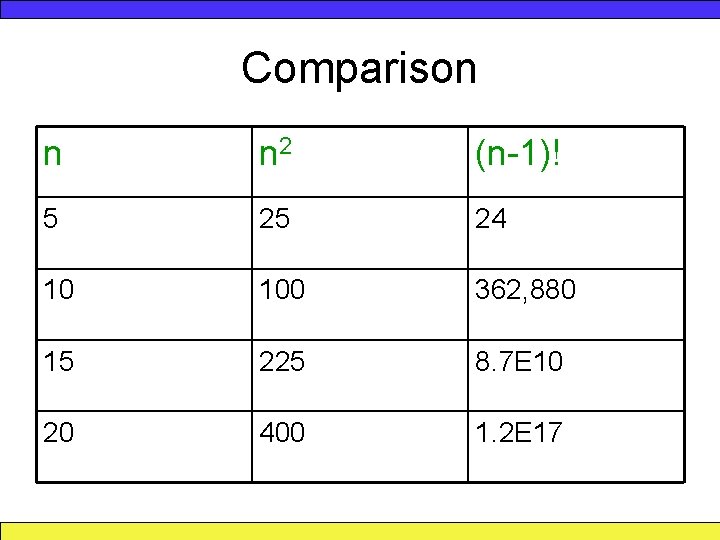
TSP • In the preceding problem, there were 4 cities and 3! possible solutions • In general, if there are n cities, one must consider (n-1)! possibilities. • (n-1)! is not O(np) for any fixed p. (n-1)! is in the EXP class. • Each problem in the EXP class is O(pn) for some fixed p.
Comparison n n 2 (n-1)! 5 25 24 10 100 362, 880 15 225 8. 7 E 10 20 400 1. 2 E 17
The Class EXP • As you can see from the preceding table, problems that are in the class EXP do not have practical solutions on computers
Relevance to AI • Unfortunately, many interesting problems in AI are in the class EXP. • For example, the TSP problem.
Satisficing • What can be done? • Instead of settling for the optimal answer, look for a “pretty good” solution instead. This technique is also known as satisficing.
Satisficing Example
Heuristics • A “heuristic” is a rule-of-thumb that works in practice, but has no guarantee of being optimal.
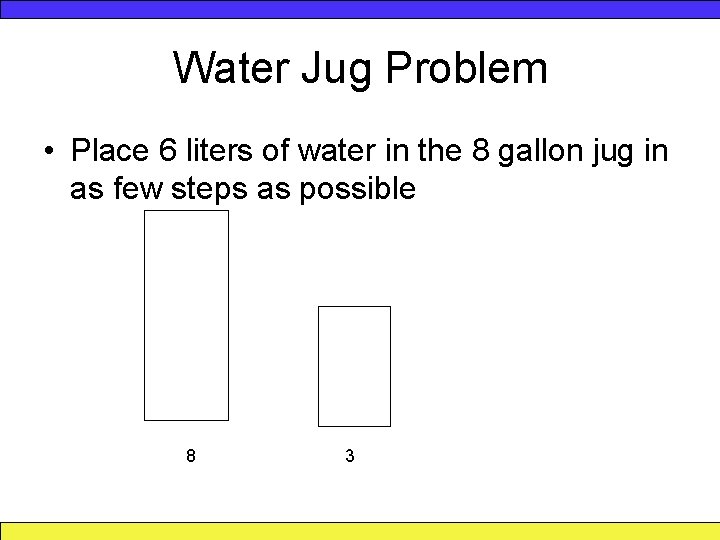
Water Jug Problem • Place 6 liters of water in the 8 gallon jug in as few steps as possible 8 3
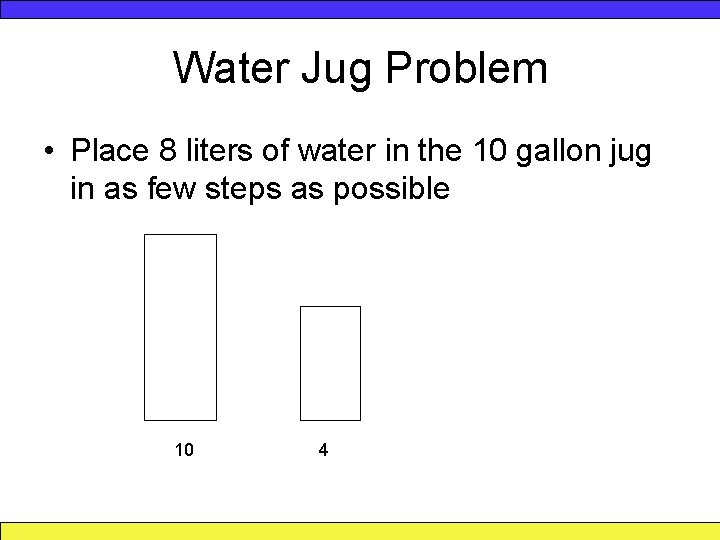
Water Jug Problem • Place 8 liters of water in the 10 gallon jug in as few steps as possible 10 4
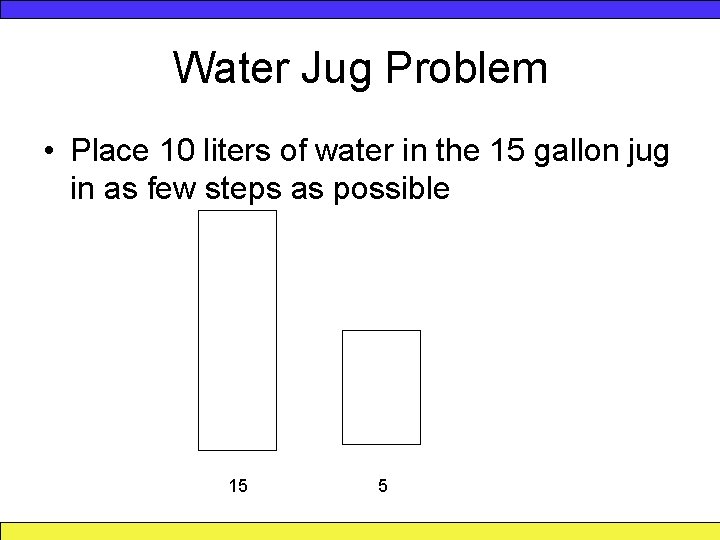
Water Jug Problem • Place 10 liters of water in the 15 gallon jug in as few steps as possible 15 5
Past AI Predictions • Game Playing. Researchers thought that AI chess playing programs would beat the best humans by 1970. • Machine Translation. – The spirit is willing, but the flesh is weak. – The whisky is strong, but the meat is rotten.
Objections to AI • • • Theology Heads-in-the-Sand Mathematical Self Awareness Capability X is lacking (e. g. enjoy ice cream) Lady Lovelace’s objection Continuity of nervous system Informality of behavior (no rules) ESP
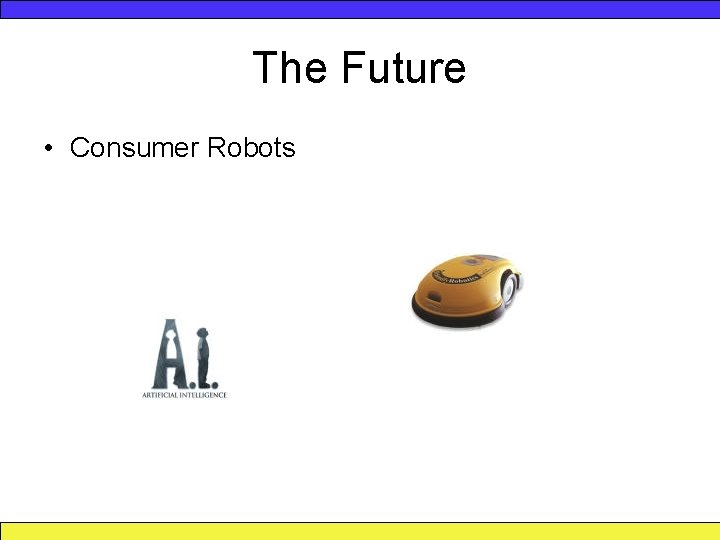
The Future • Consumer Robots
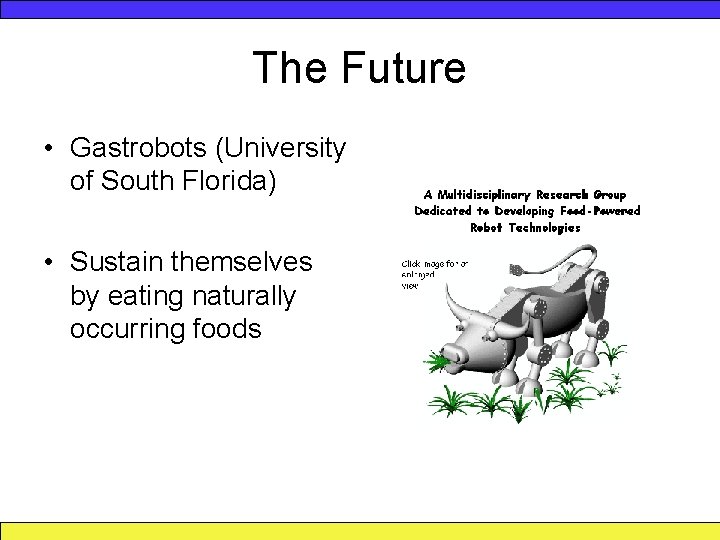
The Future • Gastrobots (University of South Florida) • Sustain themselves by eating naturally occurring foods
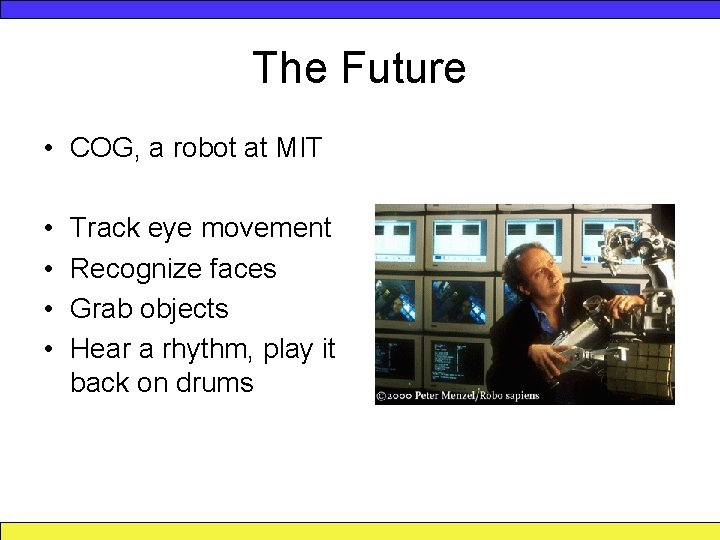
The Future • COG, a robot at MIT • • Track eye movement Recognize faces Grab objects Hear a rhythm, play it back on drums
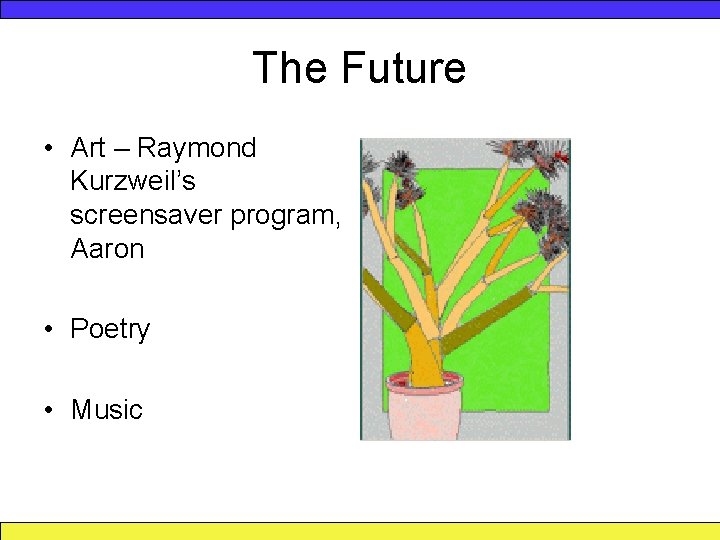
The Future • Art – Raymond Kurzweil’s screensaver program, Aaron • Poetry • Music
The Future • Natural Language • Charles Schwab incorporates i. Phrase at its web site to allow users to use natural language to ask questions. For example, “Which of these stocks has the highest revenues? ”
The Future • Products that do one thing well. • For example, Continental Divide Robotics has developed a system based on GPS that can locate any person or any object anywhere in the world and notify a user if it is “out of bounds”. This could help a parent monitor a child, for example.
The Future • Companionship • At Microsoft, a product is under development that learns about you. Who is important to you? Are you busy? The product can then monitor incoming e-mails and phone calls.
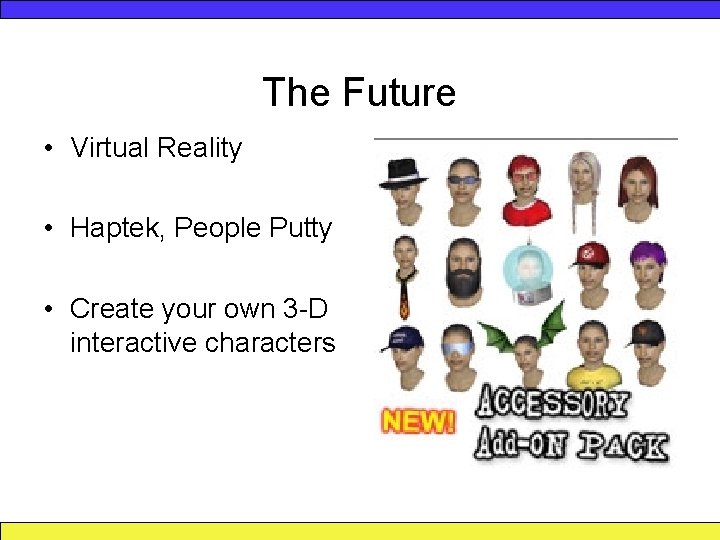
The Future • Virtual Reality • Haptek, People Putty • Create your own 3 -D interactive characters
The Future • Computers will get faster • Software will get better • AI will creep closer to human capabilities (search, learning, knowledge representation)
The Future • There are lots of potential benefits! • There are certainly some potential drawbacks! • Most AI researchers believe humans will stay in control
Questions?