
The Future Internet Public Private Partnership Objectives 1
The Future Internet Public Private Partnership Objectives 1. 7 – 1. 10 NCP Info Day Brussels, 23 June 2010 Dr Max Lemke, Deputy Head of Unit European Commission - DG INFSO New Paradigms and Experimental Facilities "The views expressed in this presentation are those of the author and do not necessarily reflect the views of the European Commission" 1
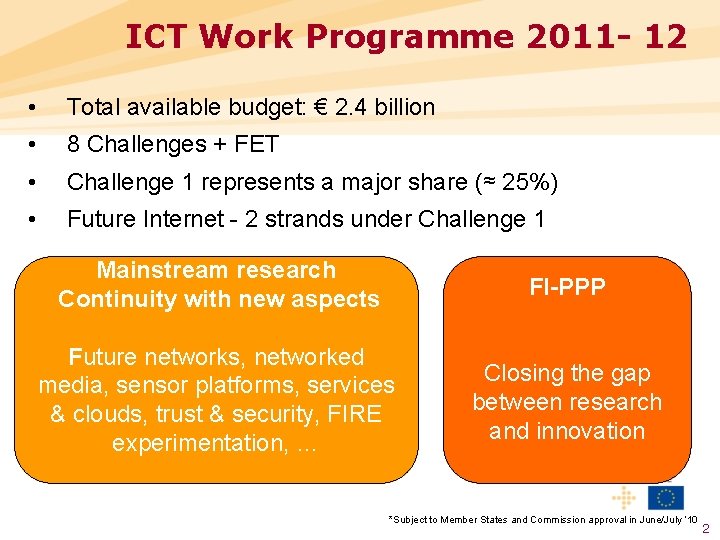
ICT Work Programme 2011 - 12 • Total available budget: € 2. 4 billion • 8 Challenges + FET • Challenge 1 represents a major share (≈ 25%) • Future Internet - 2 strands under Challenge 1 Mainstream research Continuity with new aspects FI-PPP Future networks, networked media, sensor platforms, services & clouds, trust & security, FIRE experimentation, … Closing the gap between research and innovation *Subject to Member States and Commission approval in June/July ‘ 10 2
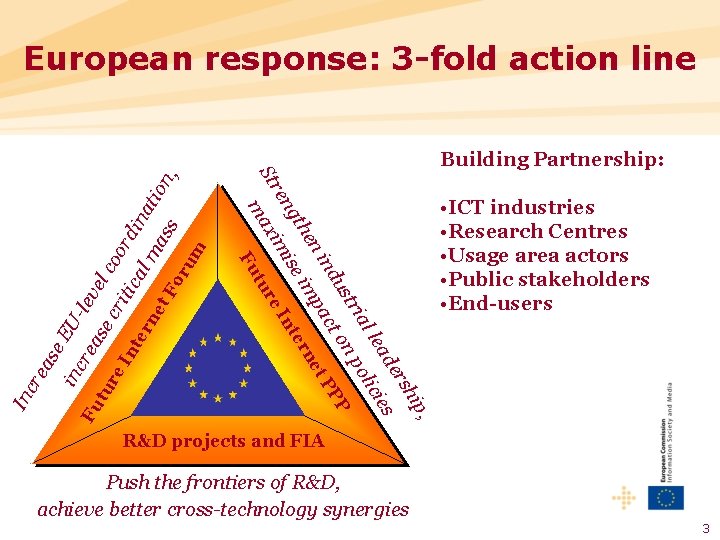
European response: 3 -fold action line m ru ip, rsh de s cie lea al poli tri P us t on c PP nd et n i mpa i rn he te gt ise In cre en xim ure t Fu In Str ma as e. E inc Ur Fu ea leve se tu l re cri coo rd In tic te a l m inat rn ion et a s Fo s , Building Partnership: • ICT industries • Research Centres • Usage area actors • Public stakeholders • End-users R&D projects and FIA Push the frontiers of R&D, achieve better cross-technology synergies 3
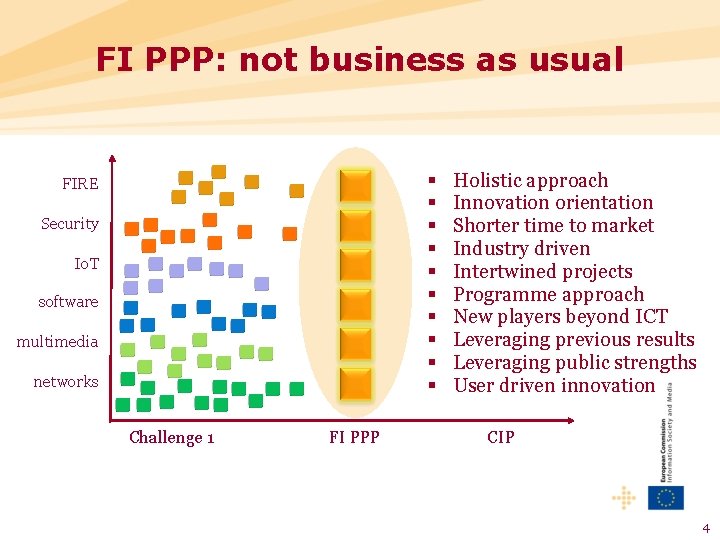
FI PPP: not business as usual § § § § § FIRE Security Io. T software multimedia networks Challenge 1 FI PPP Holistic approach Innovation orientation Shorter time to market Industry driven Intertwined projects Programme approach New players beyond ICT Leveraging previous results Leveraging public strengths User driven innovation CIP 4
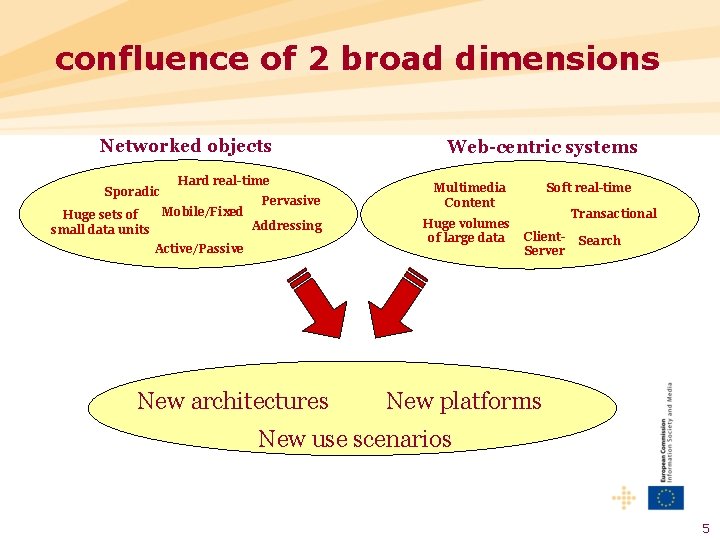
confluence of 2 broad dimensions Networked objects Sporadic Huge sets of small data units Hard real-time Mobile/Fixed Pervasive Addressing Active/Passive New architectures Web-centric systems Soft real-time Multimedia Content Huge volumes of large data Transactional Client. Server Search New platforms New use scenarios 5
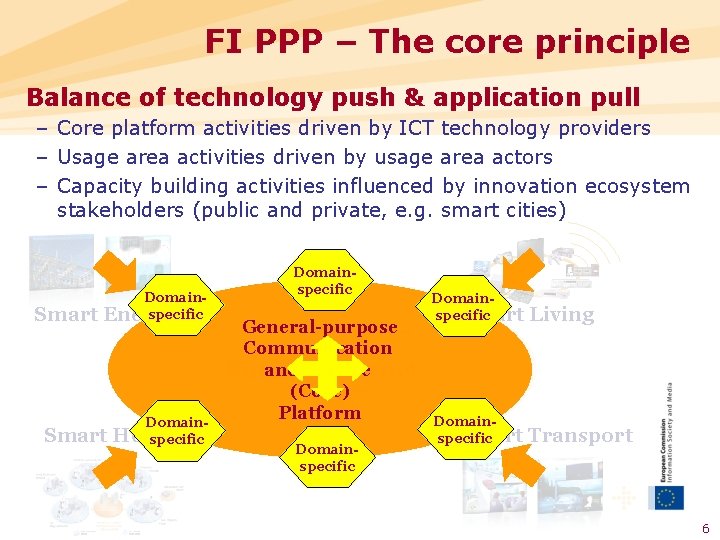
FI PPP – The core principle Balance of technology push & application pull – Core platform activities driven by ICT technology providers – Usage area activities driven by usage area actors – Capacity building activities influenced by innovation ecosystem stakeholders (public and private, e. g. smart cities) Smart Domainspecific Energy Smart Domain. Health specific Domainspecific General-purpose Communication and Service Future Internet (Core) Platform Domainspecific Smart Living Domain. Smart specific Transport 6
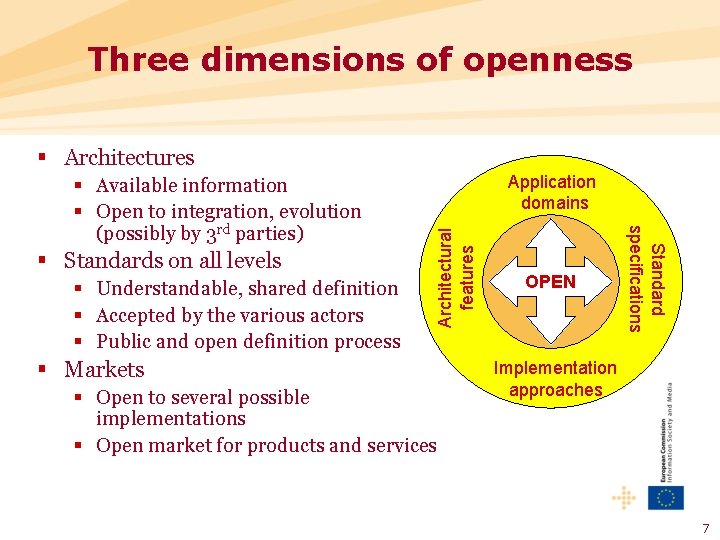
Three dimensions of openness § Architectures § Understandable, shared definition § Accepted by the various actors § Public and open definition process Architectural features § Standards on all levels Application domains § Markets § Open to several possible implementations § Open market for products and services OPEN Standard specifications § Available information § Open to integration, evolution (possibly by 3 rd parties) Implementation approaches 7
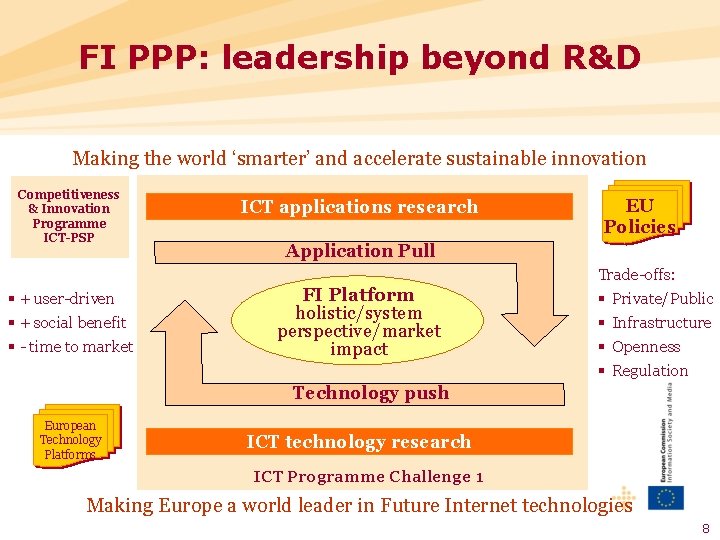
FI PPP: leadership beyond R&D Making the world ‘smarter’ and accelerate sustainable innovation Competitiveness & Innovation Programme ICT-PSP § + user-driven § + social benefit § - time to market ICT applications research EU Policies Application Pull FI Platform holistic/system perspective/market impact Trade-offs: § Private/Public § Infrastructure § Openness § Regulation Technology push European Technology Platforms ICT technology research ICT Programme Challenge 1 Making Europe a world leader in Future Internet technologies 8
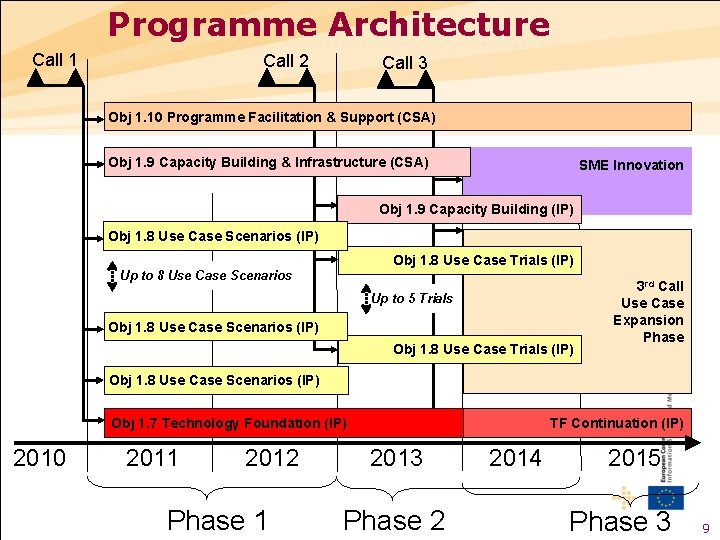
Programme Architecture Call 1 Call 2 Call 3 Obj 1. 10 Programme Facilitation & Support (CSA) Obj 1. 9 Capacity Building & Infrastructure (CSA) SME Innovation Obj 1. 9 Capacity Building (IP) Obj 1. 8 Use Case Scenarios (IP) Obj 1. 8 Use Case Trials (IP) Up to 8 Use Case Scenarios Up to 5 Trials Obj 1. 8 Use Case Scenarios (IP) Obj 1. 8 Use Case Trials (IP) 3 rd Call Use Case Expansion Phase Obj 1. 8 Use Case Scenarios (IP) Obj 1. 7 Technology Foundation (IP) 2010 2011 2012 Phase 1 TF Continuation (IP) 2013 Phase 2 2014 2015 Phase 3 9
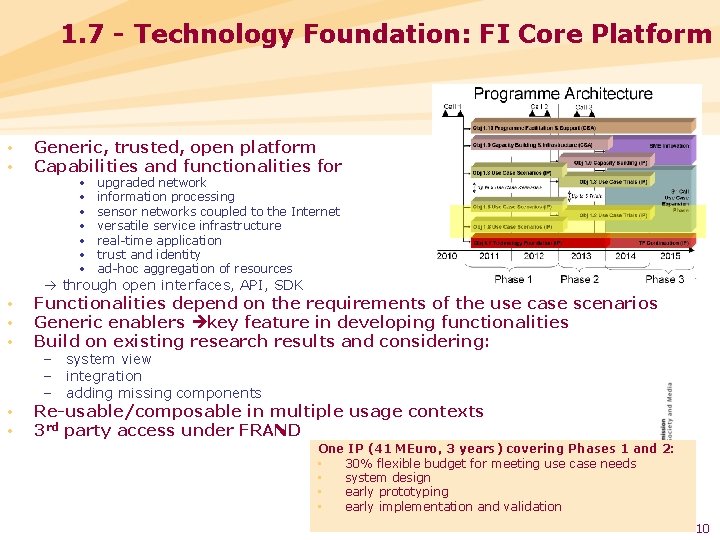
1. 7 - Technology Foundation: FI Core Platform • • Generic, trusted, open platform Capabilities and functionalities for • • upgraded network information processing sensor networks coupled to the Internet versatile service infrastructure real-time application trust and identity ad-hoc aggregation of resources through open interfaces, API, SDK • • • Functionalities depend on the requirements of the use case scenarios Generic enablers key feature in developing functionalities Build on existing research results and considering: • • Re-usable/composable in multiple usage contexts 3 rd party access under FRAND – system view – integration – adding missing components One IP (41 MEuro, 3 years) covering Phases 1 and 2: • 30% flexible budget for meeting use case needs • system design • early prototyping • early implementation and validation 10
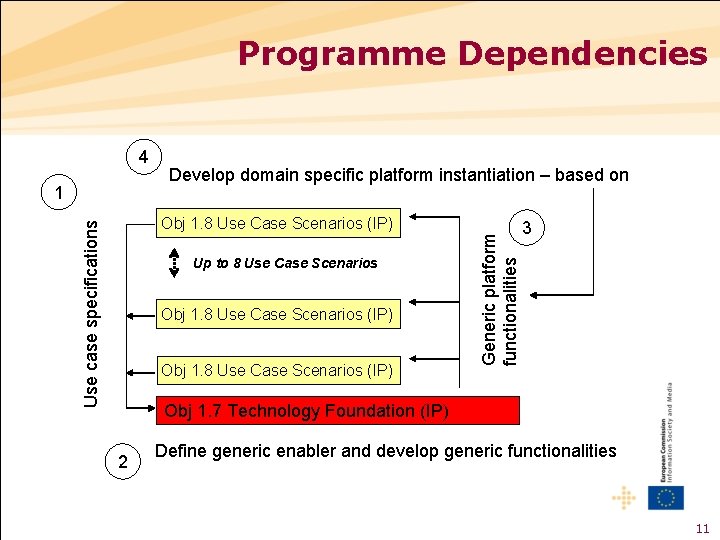
Programme Dependencies 4 1 Develop domain specific platform instantiation – based on Up to 8 Use Case Scenarios Obj 1. 8 Use Case Scenarios (IP) Generic platform functionalities Use case specifications Obj 1. 8 Use Case Scenarios (IP) 3 Obj 1. 7 Technology Foundation (IP) 2 Define generic enabler and develop generic functionalities 11
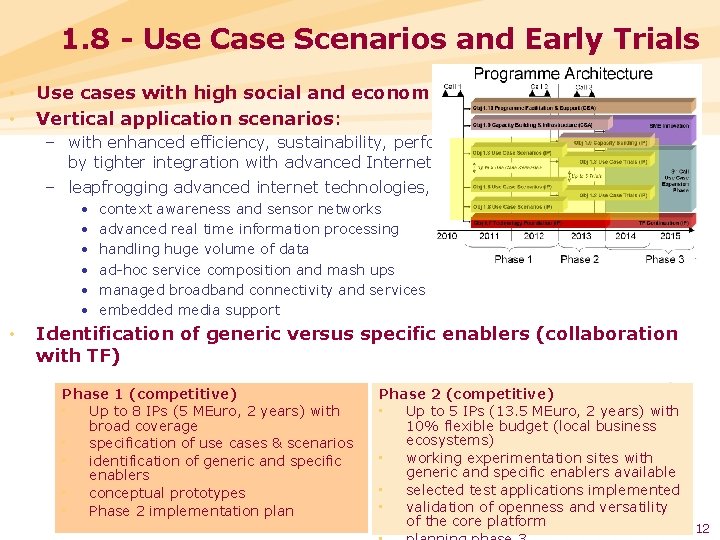
1. 8 - Use Case Scenarios and Early Trials • • Use cases with high social and economic impact Vertical application scenarios: – with enhanced efficiency, sustainability, performance by tighter integration with advanced Internet capabilities – leapfrogging advanced internet technologies, such as • • context awareness and sensor networks advanced real time information processing handling huge volume of data ad-hoc service composition and mash ups managed broadband connectivity and services embedded media support Identification of generic versus specific enablers (collaboration with TF) Phase 1 (competitive) • Up to 8 IPs (5 MEuro, 2 years) with broad coverage • specification of use cases & scenarios • identification of generic and specific enablers • conceptual prototypes • Phase 2 implementation plan Phase 2 (competitive) • Up to 5 IPs (13. 5 MEuro, 2 years) with 10% flexible budget (local business ecosystems) • working experimentation sites with generic and specific enablers available • selected test applications implemented • validation of openness and versatility of the core platform 12
Six characteristics of a good use case 1. Innovation on the application side 2. Realism in terms of large scale trials to be carried in 3 -5 years 3. Need for advanced Internet functionality • • beyond the existing Internet validating the PPP core platform concept • • • Sharing of data (e. g. from sensors) Services and application mash up Common devices and infrastructures • high social and economic impact 4. Synergies with other use areas proving value and potential of core platform, e. g. 5. Possibility for provisioning and upgrading of experimentation infrastructures for phases 2 & 3 6. Relevance to EU policies, e. g. EU Digital Agenda 13
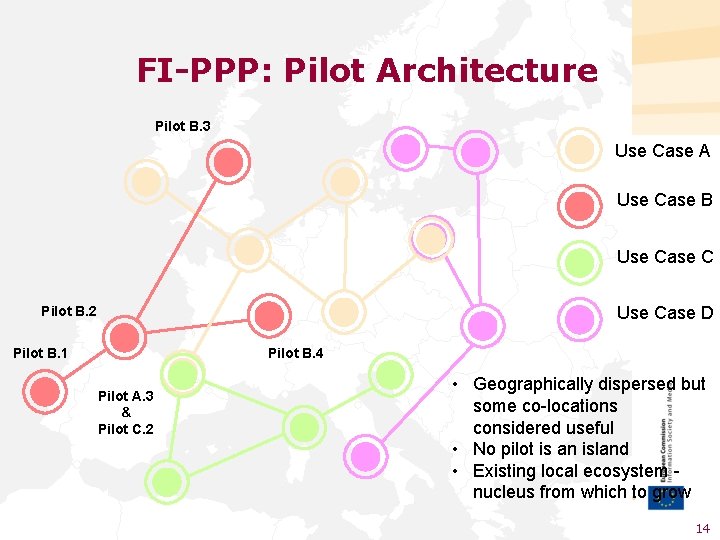
FI-PPP: Pilot Architecture Pilot B. 3 Use Case A Use Case B Use Case C Pilot B. 2 Use Case D Pilot B. 1 Pilot B. 4 Pilot A. 3 & Pilot C. 2 • Geographically dispersed but some co-locations considered useful • No pilot is an island • Existing local ecosystem nucleus from which to grow 14
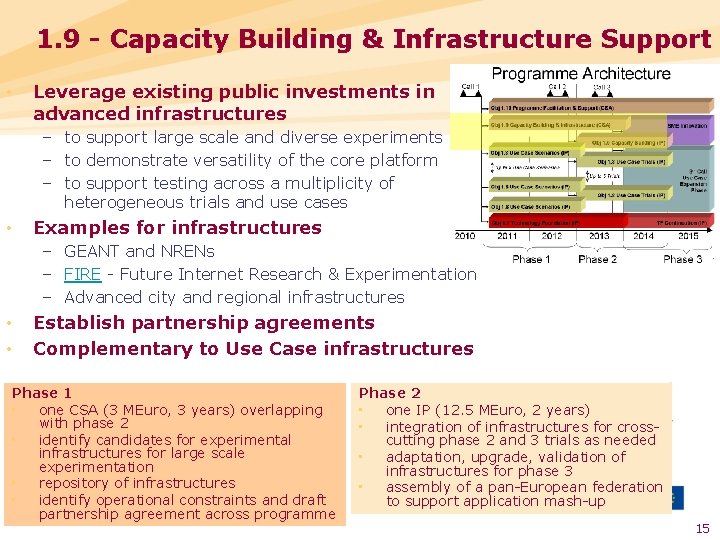
1. 9 - Capacity Building & Infrastructure Support • Leverage existing public investments in advanced infrastructures – to support large scale and diverse experiments – to demonstrate versatility of the core platform – to support testing across a multiplicity of heterogeneous trials and use cases • Examples for infrastructures – GEANT and NRENs – FIRE - Future Internet Research & Experimentation – Advanced city and regional infrastructures • • Establish partnership agreements Complementary to Use Case infrastructures Phase 1 • one CSA (3 MEuro, 3 years) overlapping with phase 2 • identify candidates for experimental infrastructures for large scale experimentation • repository of infrastructures • identify operational constraints and draft partnership agreement across programme Phase 2 • one IP (12. 5 MEuro, 2 years) • integration of infrastructures for crosscutting phase 2 and 3 trials as needed • adaptation, upgrade, validation of infrastructures for phase 3 • assembly of a pan-European federation to support application mash-up 15
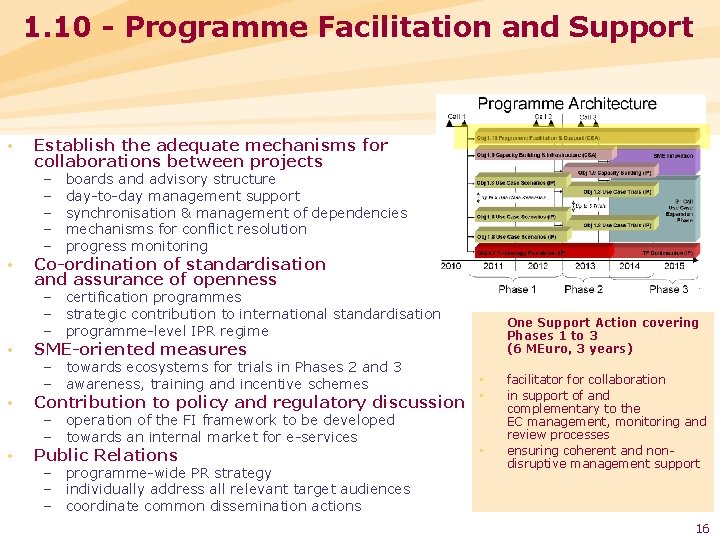
1. 10 - Programme Facilitation and Support • Establish the adequate mechanisms for collaborations between projects – – – • boards and advisory structure day-to-day management support synchronisation & management of dependencies mechanisms for conflict resolution progress monitoring Co-ordination of standardisation and assurance of openness – certification programmes – strategic contribution to international standardisation – programme-level IPR regime • One Support Action covering Phases 1 to 3 (6 MEuro, 3 years) SME-oriented measures – towards ecosystems for trials in Phases 2 and 3 – awareness, training and incentive schemes • Contribution to policy and regulatory discussion • Public Relations – operation of the FI framework to be developed – towards an internal market for e-services – programme-wide PR strategy – individually address all relevant target audiences – coordinate common dissemination actions • • • facilitator for collaboration in support of and complementary to the EC management, monitoring and review processes ensuring coherent and nondisruptive management support 16
Draft Implementation Roadmap* § Call 1: FP 7 -2011 -ICT-FI (30 July – 2 December 2010) – budget 90 MEuro § § Technology Foundation (one IP, 41 MEuro, 3 years, 30% flexible) Use Case Scenarios – Phase 1 (7 -8 areas, IP, 5 MEuro, 2 years) Capacity Building (one CSA, 3 MEuro, 3 years) Programme support (one CSA, 6 MEuro, 5 years) § Call 2: FP 7 -2012 -ICT-FI (18 May – 29 October 2012) – budget 80 MEuro § Use Case Scenarios Pilots – Phase 2 (5 areas, 13. 5 MEuro, 2 years) § Capacity Building (one IP, 12. 5 MEuro, 2 years) § Call 3: Planned under WP 2013 (later 2013) – budget 130 MEuro (tentative) § Devoted to the expansion and enlargement of many testbeds and pilots (several areas, ~100 MEuro, 2 years) *Subject to Member States and Commission approval in June/July ‘ 10 17
Further Information Next Key Events 2010/11: Sites to drill further: • • 21 -22 June – Brussels, 2 nd Usage Area Workshop • 8 July – Brussels, FI-PPP European Information Day • 27 -29 September – Brussels, ICT Event 2010 • • 20 -22 October – Tampere, 3 rd EU- • Japan Symposium on Future Internet • 29 Nov – 1 December - Tokyo, Io. T 2010 • 16 -17 December – Ghent, Future Internet Week, 6 th FIA Conference • 17 -19 May – Budapest, 7 th FIA Conference ec. europa. eu/foi – read about the many activities the EC undertakes on Future Internet www. future-internet. eu – The European Future Internet Portal – the community site cordis. europa. eu/ict/ch 1 – Ongoing European FI research & development activities 18
- Slides: 18