
The Future in Data Storage Holographic Optical Data
- Slides: 25
The Future in Data Storage
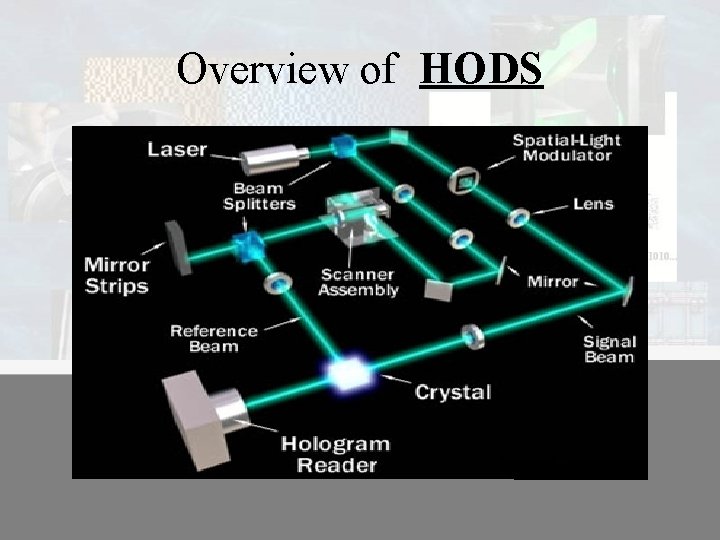
Ø Holographic Optical Data Storage (HODS) or Holographic Data Storage System (HDDS) – – The Revolutionary data storage technology Uses images (holograms) rather than bits to store data Images imposed in material Uses a combination of Lasers & Optical materials to achieve this. – This is a Volumetric approach.
ØPieter J. van Heerden first proposed the idea of holographic (three-dimensional) storage in the early 1960 s. Ø A decade later, scientists at RCA Laboratories demonstrated the technology by recording 500 holograms in an iron-doped lithium-niobate crystal. ØThe advent of Semiconductor & magnetic memories stalled its research for much time but it is now picking up momentum.
Why Do We Need This? Ø “For Internet applications alone, industry estimates are that storage needs are doubling every 100 days” -Nelson Diaz, Lucent Technologies Ø “Optoelectronics Industry and Technology Development Association projects that by the year 2010, a storage system serving an average LAN will need … 10 TB and a WAN server will require 100 TB to 1 petabyte …of storage” - Red Herring
Overview of HODS
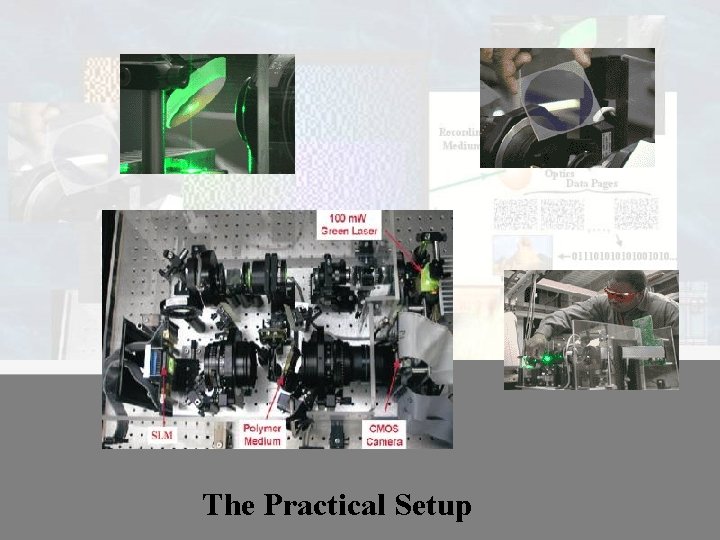
The Practical Setup
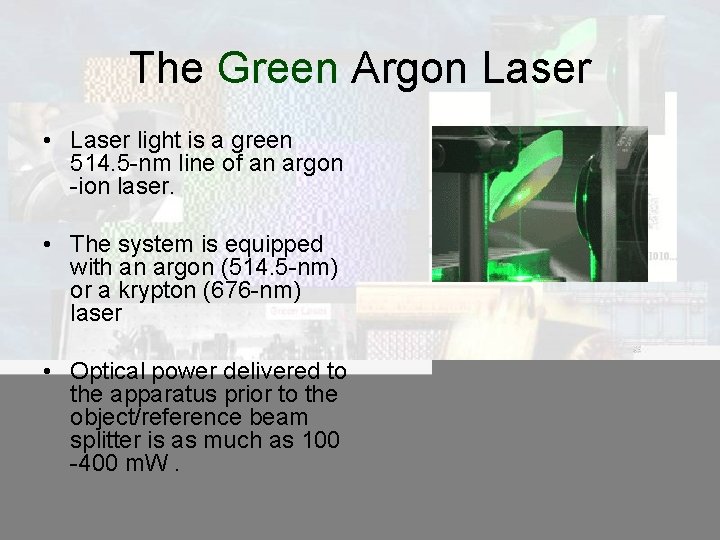
The Green Argon Laser • Laser light is a green 514. 5 -nm line of an argon -ion laser. • The system is equipped with an argon (514. 5 -nm) or a krypton (676 -nm) laser • Optical power delivered to the apparatus prior to the object/reference beam splitter is as much as 100 -400 m. W.
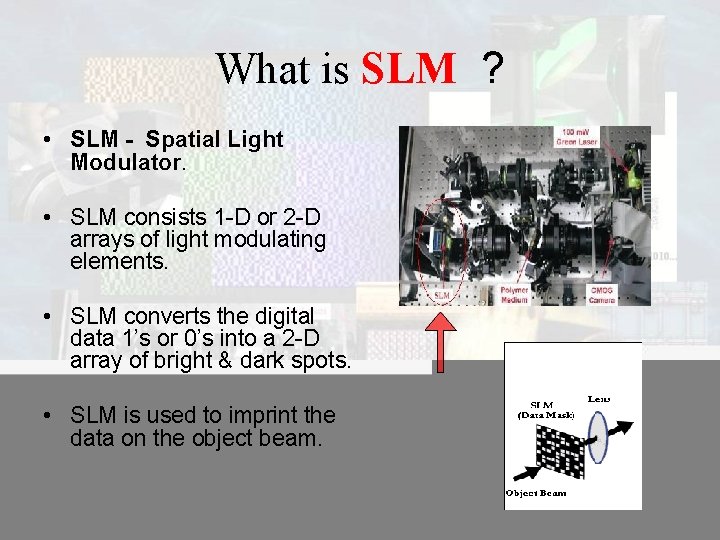
What is SLM ? • SLM - Spatial Light Modulator. • SLM consists 1 -D or 2 -D arrays of light modulating elements. • SLM converts the digital data 1’s or 0’s into a 2 -D array of bright & dark spots. • SLM is used to imprint the data on the object beam.
About Lithium Niobate Crystal • Chemical Formula- Li. Nb. O 3. • It has high photorefractive sensitivity & stability. • It has trigonal structure. • Molecular weight - 147. 9. • Band gap - 4 e. V
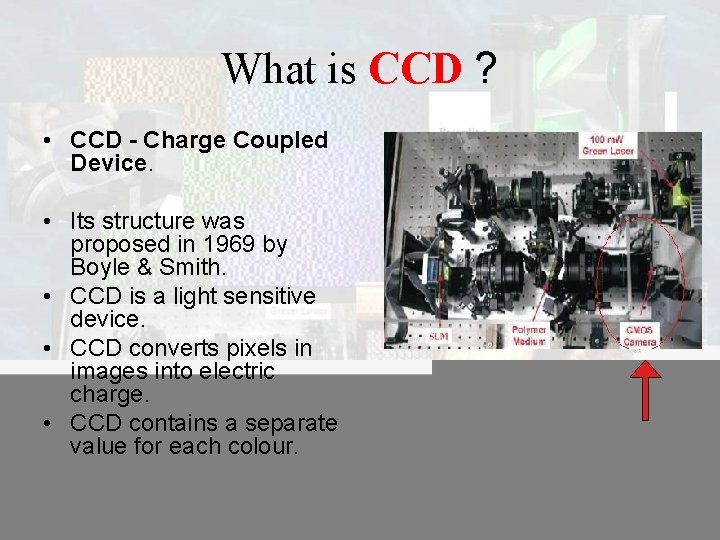
What is CCD ? • CCD - Charge Coupled Device. • Its structure was proposed in 1969 by Boyle & Smith. • CCD is a light sensitive device. • CCD converts pixels in images into electric charge. • CCD contains a separate value for each colour.
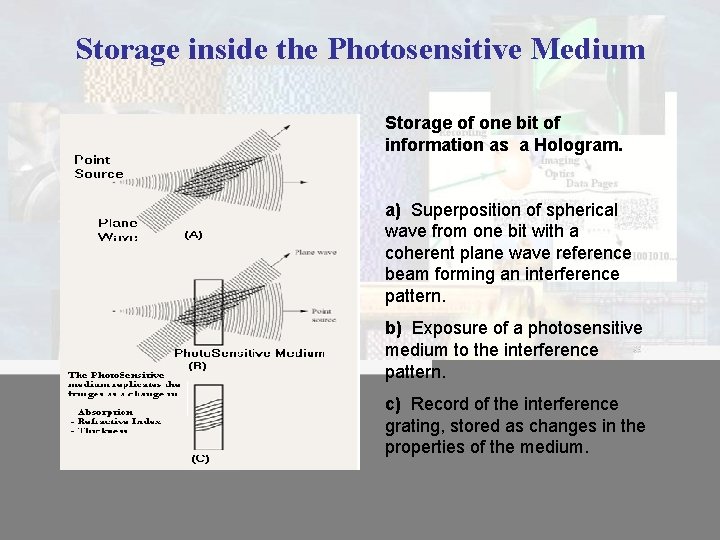
Storage inside the Photosensitive Medium Storage of one bit of information as a Hologram. a) Superposition of spherical wave from one bit with a coherent plane wave reference beam forming an interference pattern. b) Exposure of a photosensitive medium to the interference pattern. c) Record of the interference grating, stored as changes in the properties of the medium.
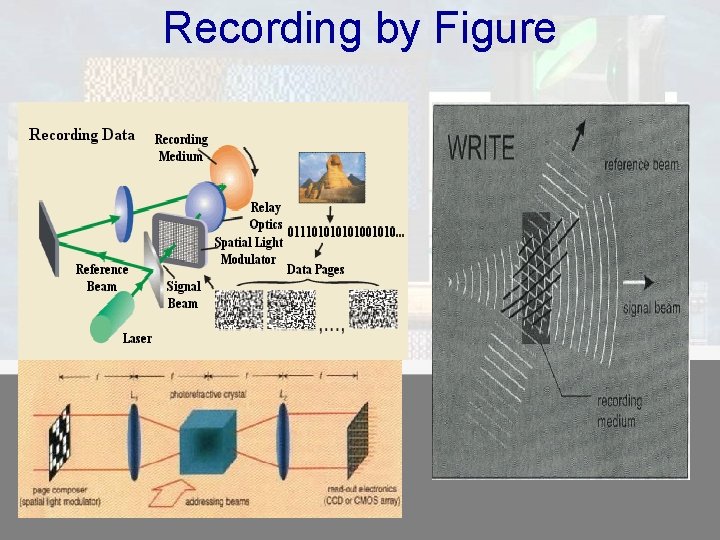
Recording • Data stream is sent to the SLM as 0’s and 1’s. – Forms a “checkerboard” pattern – 1’s transmit light, 0’s block light • Beam is split –Light passing through SLM is the signal (object) beam –Reflected beam is the reference beam • Beams interfere in the medium to produce hologram much like before
Recording by Figure
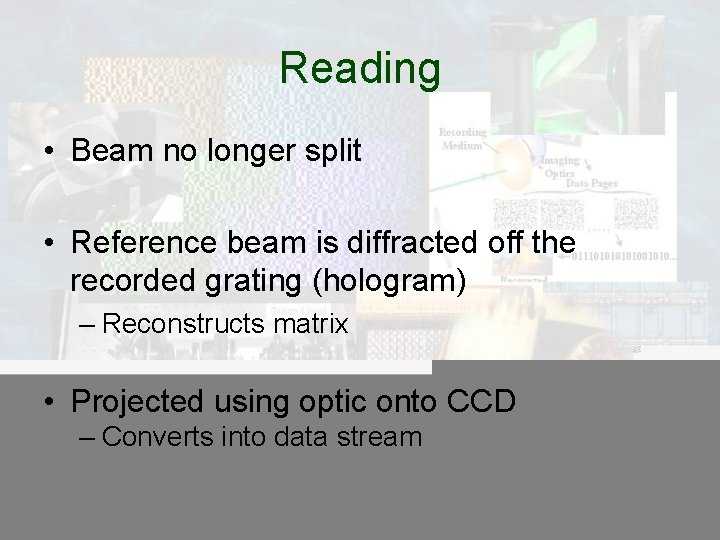
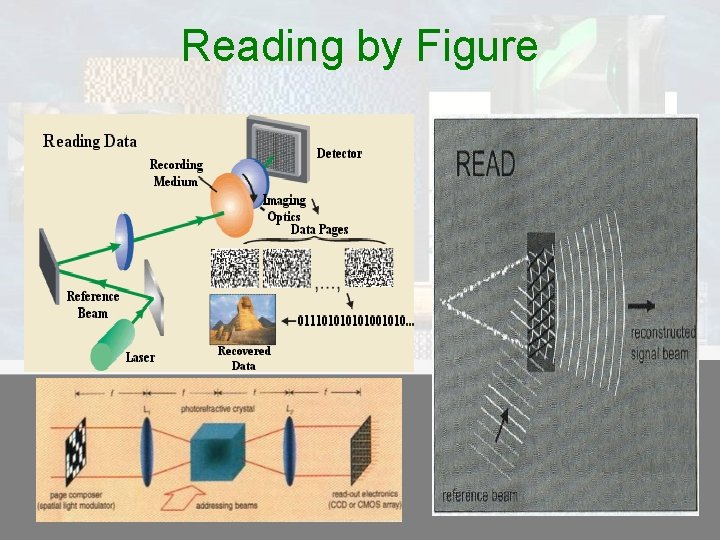
Reading • Beam no longer split • Reference beam is diffracted off the recorded grating (hologram) – Reconstructs matrix • Projected using optic onto CCD – Converts into data stream
Reading by Figure
Impacts • The everyday user might notice the impact other than more space on his/her computer. • Big benefactors are big business and internet – Parallel data storage and retrieval allows for very fast data excess for number crunching and experiments (much faster computation times). – Much faster data access for internet servers as well as much larger storage densities. – Cheaper cost per Megabyte once mainstream. • Data storage for libraries, documents and so forth will be cheaper and take up less space and access will be much faster.
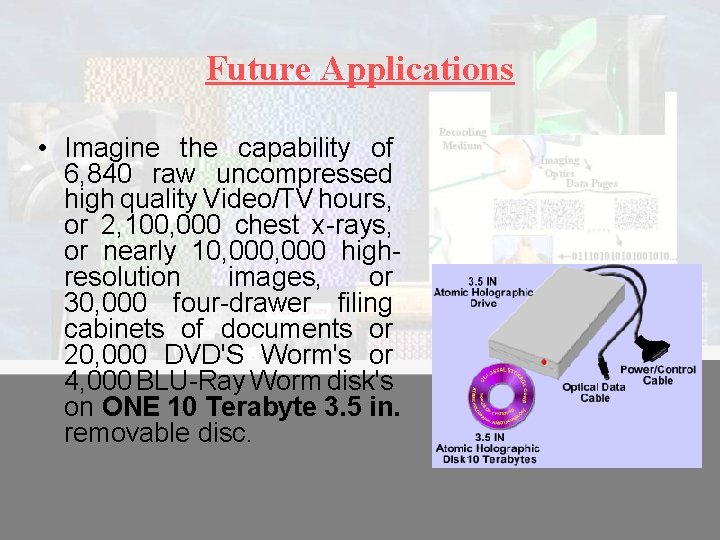
Future Applications • Imagine the capability of 6, 840 raw uncompressed high quality Video/TV hours, or 2, 100, 000 chest x-rays, or nearly 10, 000 highresolution images, or 30, 000 four-drawer filing cabinets of documents or 20, 000 DVD'S Worm's or 4, 000 BLU-Ray Worm disk's on ONE 10 Terabyte 3. 5 in. removable disc.
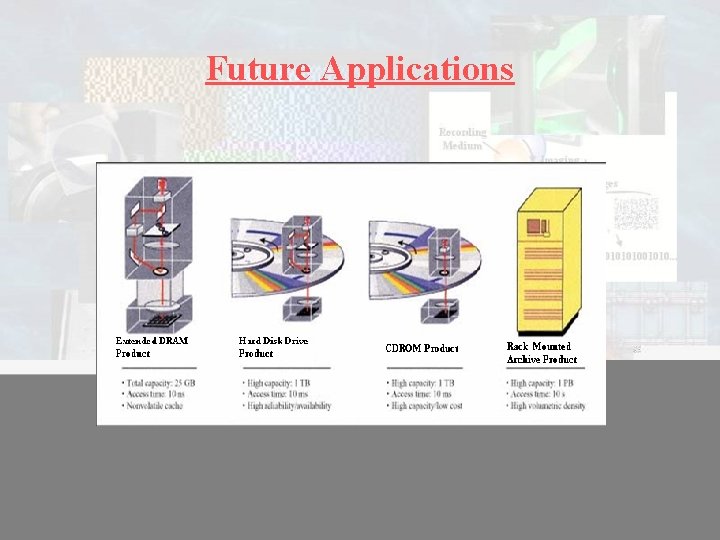
Future Applications
Long Term ! • Eventually HODS’s may take over magnetic and optical devices all together – DVD’s with 10 terabytes on them ! – Less need for compression techniques (depending on internet communications) – Even smaller computers (hard drive one of the largest components) – Less power to drive = longer lasting laptops
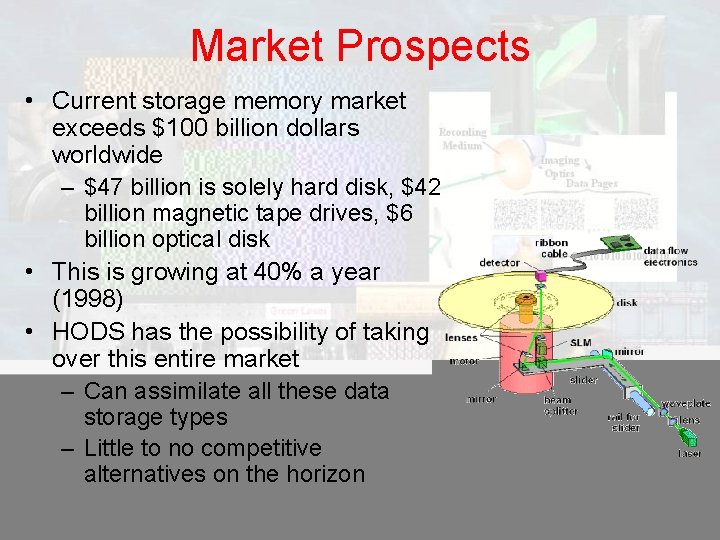
Market Prospects • Current storage memory market exceeds $100 billion dollars worldwide – $47 billion is solely hard disk, $42 billion magnetic tape drives, $6 billion optical disk • This is growing at 40% a year (1998) • HODS has the possibility of taking over this entire market – Can assimilate all these data storage types – Little to no competitive alternatives on the horizon
Who is Involved… • In. Phase Technologies, venture of Lucent Technologies – Exclusive purpose is to develop high-performance holographic data storage media – Seem to be leaders in viable product, near useable solution • Government and other participants donate $32 million for research – Large majority of research focused at Standford and IBM’s Almaden Research Facility
Interesting Facts • With predicted technology a 1 cm 3 laser cube is equal to: - 6, 944, 440 1. 44 MB floppy discs - 14, 286 700 MB CD-ROM’s - 40 250 GB hard drives - 25 million books of the Library of Congress(US)
Conclusion • Built on technology that’s around for 40+ years • HODS may be the future of data storage – HUGE capacity, Very fast, Smaller – Parallel processing • Current storage methods nearing their fundamental limits of storage density • Stationary parts for some techniques • Meets the demand for a capacity hungry society • Large market and little new competition
Further Research/Bibliography • www. lucent. com/press/010130. bla. html • http: //www. research. ibm. com/research/press/holographic. html • http: //www. research. ibm. com/journal/rd/443/ashley. pdf • http: //www. imation. com/about/newsitem/0%2 C 1233%2 C 2 98%2 C 00. html • http: //www. pitt. edu/~drew 1/2089/holo. htm • http: //www. sciam. com/2000/0500 issue/0500 toigbox 5. html
Thank you for listening to my presentation! The future is is here !