
The Future FY 16 FY 15 Budget Update
The Future: FY 16 FY 15 Budget Update
Brief FY 15/FY 16 update • Anchorage Campus distributed $19. 5 M two yr decrement – To protect academic core, cut distributed 1/3 to Academic College Units, 2/3 to Administrative units – Includes internally funding fixed cost increases for compensation (50%), utility rate increases, new facility operating costs • Community Campus -$2 M reductions (FY 15/FY 16 state cuts) • Program prioritization actions in process- 47 academic degree eliminations, administrative efficiencies – https: //www. uaa. alaska. edu/program-prioritization/index. cfm • Detailed Report of FY 15/FY 16 budget reduction actions taken by units impact students, employees (200), and the state – http: //www. uaa. alaska. edu/chancellor/budget. cfm • Many units are using their carryforward to minimize the impacts of cuts in FY 16.
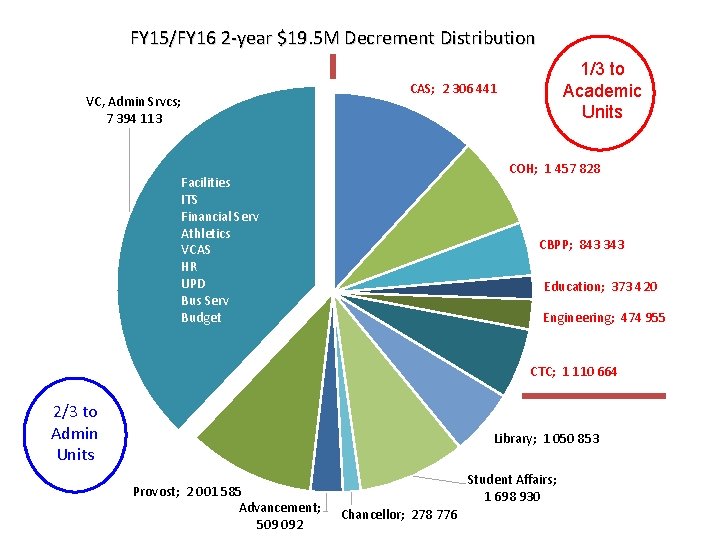
FY 15/FY 16 2 -year $19. 5 M Decrement Distribution VC, Admin Srvcs; 7 394 113 1/3 to Academic Units CAS; 2 306 441 COH; 1 457 828 Facilities ITS Financial Serv Athletics VCAS HR UPD Bus Serv Budget CBPP; 843 343 Education; 373 420 Engineering; 474 955 CTC; 1 110 664 2/3 to Admin Units Library; 1 050 853 Provost; 2 001 585 Advancement; 509 092 Student Affairs; 1 698 930 Chancellor; 278 776
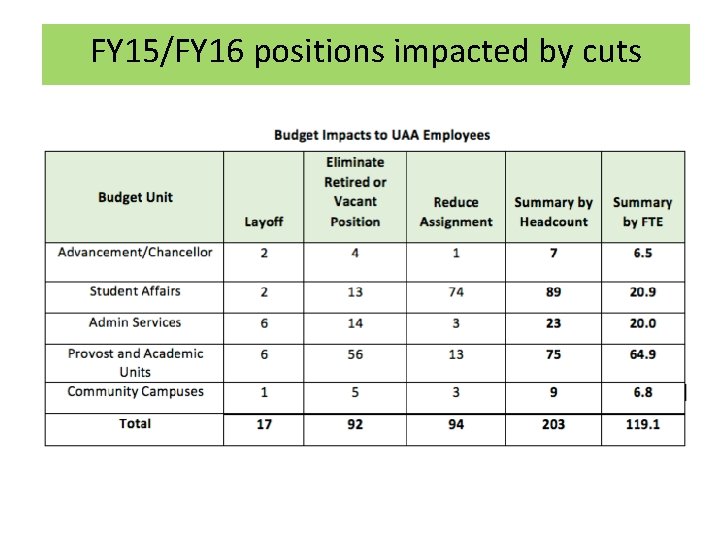
FY 15/FY 16 positions impacted by cuts
FY 15/FY 16 Budget Impacts Leadership furloughs 5 -10 days Hiring freezes Some depts. reduced staff assignments rather than layoffs Vacant positions across the system remain unfilled Reduced student employment Reduced facilities support of preventive maintenance Reduced off campus leases (Diplomacy to BOB) Reduced information technology, library, and student support services • Suspended admission or deleted various low enrollment programs: AAS in CIOS, BA in Dual Languages, 24 certificate, 17 minors, 4 Masters • Reduced course sections, offerings, review course caps • •
FY 16 collaborations, reorganizationsstarting to rethink alignments • • • Office of Health Programs moved to College of Health (from Provost) Dietetics and Nutrition moved to College of Health (from CTC) Business Services merged under Financial Services Management of recycling moved under GSS Sustainability moved to Facilities Student Affairs eliminated Student Engagement and Inclusion Division (Realigning Native Student Services, Multicultural Center and Student Life) ITS eliminated the Network and Systems Operations Center UAA sold the partially leased Diplomacy building and moved into fully owned facility at 1901 Bragaw Administrative reorganizations and/or shared services explored in several units
Budget Planning for FY 17
FY 17 budget planning- three of the biggest components • What are the factors influencing our two major revenue sources? two – Will State general fund increase or decrease? • How much the State will need to cut agency budgets to move toward a sustainable budget • Will the State continue to fund 50% of compensation? – What is the tuition rate increase? SCHRS up? • What are the factors influencing our major expense group? – What are the compensation increases for each employee group? Salary rates? staff benefit rates?
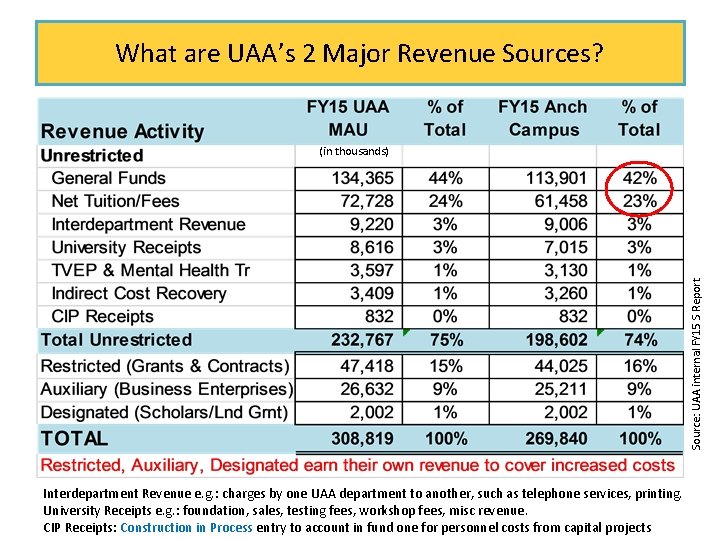
What are UAA’s 2 Major Revenue Sources? Source: UAA internal FY 15 S Report (in thousands) Interdepartment Revenue e. g. : charges by one UAA department to another, such as telephone services, printing. University Receipts e. g. : foundation, sales, testing fees, workshop fees, misc revenue. CIP Receipts: Construction in Process entry to account in fund one for personnel costs from capital projects
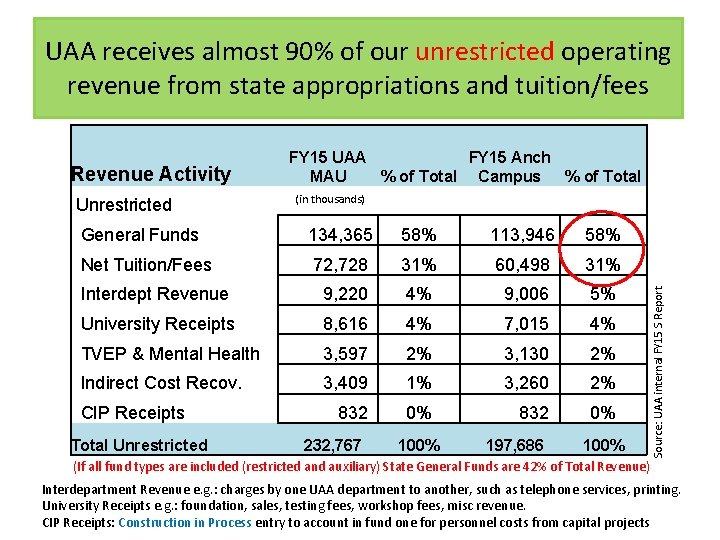
UAA receives almost 90% of our unrestricted operating revenue from state appropriations and tuition/fees Unrestricted (in thousands) General Funds 134, 365 58% 113, 946 58% Net Tuition/Fees 72, 728 31% 60, 498 31% Interdept Revenue 9, 220 4% 9, 006 5% University Receipts 8, 616 4% 7, 015 4% TVEP & Mental Health 3, 597 2% 3, 130 2% Indirect Cost Recov. 3, 409 1% 3, 260 2% 832 0% CIP Receipts Total Unrestricted 232, 767 100% 197, 686 100% Source: UAA internal FY 15 S Report Revenue Activity FY 15 UAA FY 15 Anch MAU % of Total Campus % of Total (If all fund types are included (restricted and auxiliary) State General Funds are 42% of Total Revenue) Interdepartment Revenue e. g. : charges by one UAA department to another, such as telephone services, printing. University Receipts e. g. : foundation, sales, testing fees, workshop fees, misc revenue. CIP Receipts: Construction in Process entry to account in fund one for personnel costs from capital projects
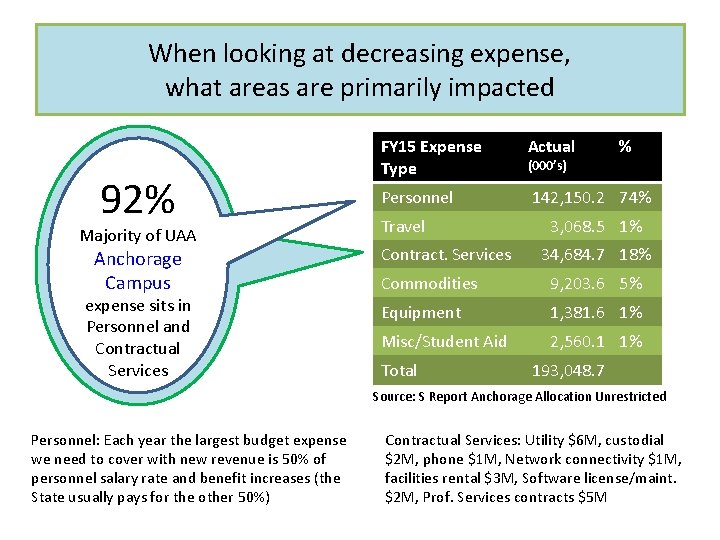
When looking at decreasing expense, what areas are primarily impacted 92% 6060% Majority of UAA Anchorage Campus expense sits in Personnel and Contractual Services FY 15 Expense Type Actual Personnel 142, 150. 2 74% Travel Contract. Services (000’s) % 3, 068. 5 1% 34, 684. 7 18% Commodities 9, 203. 6 5% Equipment 1, 381. 6 1% Misc/Student Aid 2, 560. 1 1% Total 193, 048. 7 Source: S Report Anchorage Allocation Unrestricted Personnel: Each year the largest budget expense we need to cover with new revenue is 50% of personnel salary rate and benefit increases (the State usually pays for the other 50%) Contractual Services: Utility $6 M, custodial $2 M, phone $1 M, Network connectivity $1 M, facilities rental $3 M, Software license/maint. $2 M, Prof. Services contracts $5 M
The State of the State
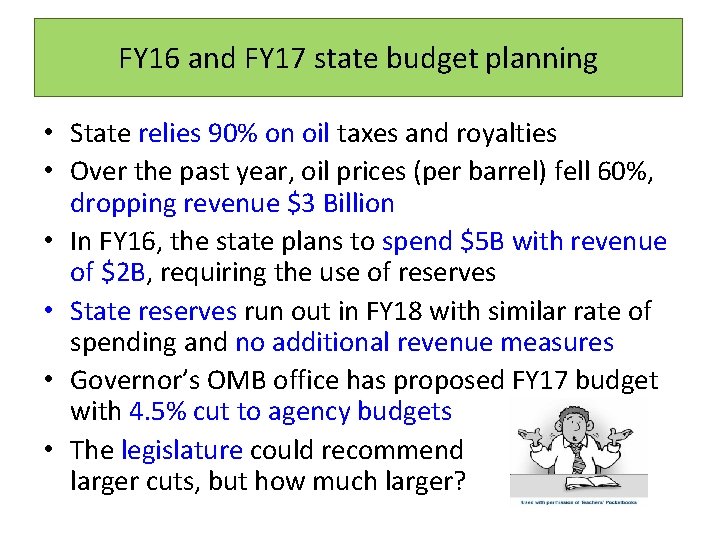
FY 16 and FY 17 state budget planning • State relies 90% on oil taxes and royalties • Over the past year, oil prices (per barrel) fell 60%, dropping revenue $3 Billion • In FY 16, the state plans to spend $5 B with revenue of $2 B, requiring the use of reserves • State reserves run out in FY 18 with similar rate of spending and no additional revenue measures • Governor’s OMB office has proposed FY 17 budget with 4. 5% cut to agency budgets • The legislature could recommend larger cuts, but how much larger?
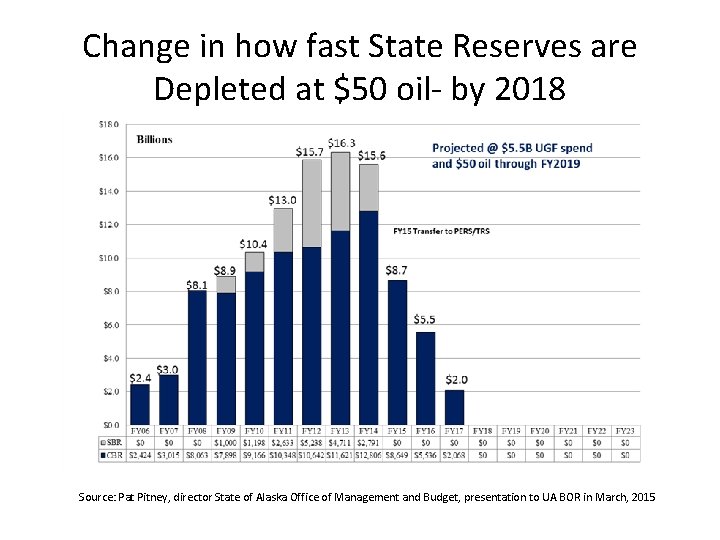
Change in how fast State Reserves are Depleted at $50 oil- by 2018 Source: Pat Pitney, director State of Alaska Office of Management and Budget, presentation to UA BOR in March, 2015
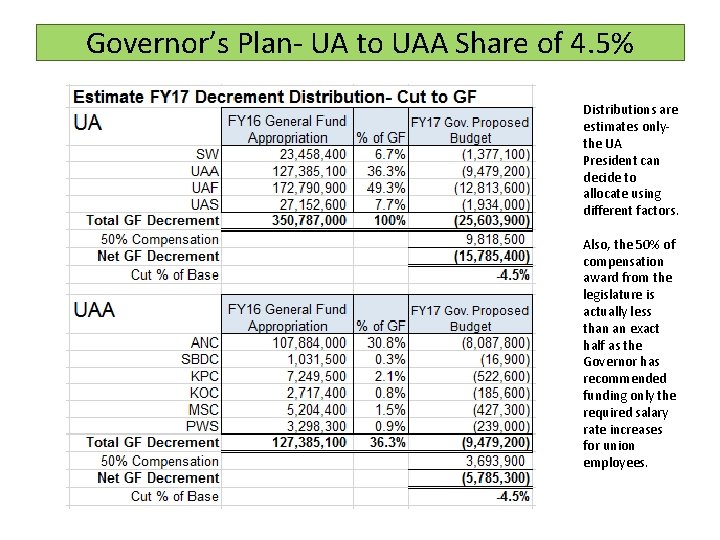
Governor’s Plan- UA to UAA Share of 4. 5% Distributions are estimates onlythe UA President can decide to allocate using different factors. Also, the 50% of compensation award from the legislature is actually less than an exact half as the Governor has recommended funding only the required salary rate increases for union employees.

The Governor and the Legislature have a big job ahead of them to balance the budget • Governor Plan’s to fund $4. 8 B FY 17 Operating Budget – $1. 6 B in Taxes and $3. 2 B in Permanent Fund Earnings Reserve – Cut State agency spending $100 M • Cut $300 M over three years • But the legislature has discussed cutting $500 M in ONE year • New revenue generating ideas are unpopular during an election year and complex to pursue* – New taxes or fees (alcohol, cigarette, mining, fishing, tourism, fuel ) – Income Tax – Use of permanent fund earnings – Modify oil and gas tax and credit structures ($500 M) • Many advocate for revenue options saying we can’t cut our way out: UAA ISER Gunnar Knapp, OMB Pat Pitney, Dept of Rev. Randy Hoffback and a Rasmuson Foundation study *Source: Christensen comments at Aug. 21 FY 17 UA budget presentation mtg
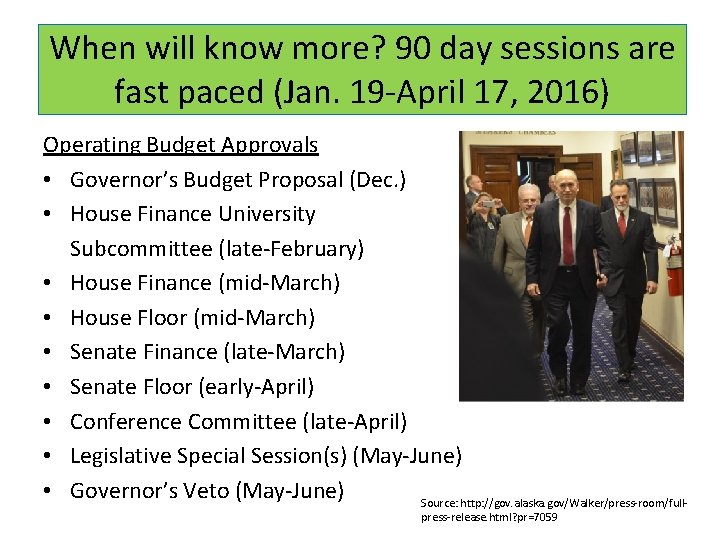
When will know more? 90 day sessions are fast paced (Jan. 19 -April 17, 2016) Operating Budget Approvals • Governor’s Budget Proposal (Dec. ) • House Finance University Subcommittee (late-February) • House Finance (mid-March) • House Floor (mid-March) • Senate Finance (late-March) • Senate Floor (early-April) • Conference Committee (late-April) • Legislative Special Session(s) (May-June) • Governor’s Veto (May-June) Source: http: //gov. alaska. gov/Walker/press-room/fullpress-release. html? pr=7059
FY 17 Budget Request to Legislature
FY 17 operating budget request to legislature: UAA asked for $14 M in fixed cost considerations • However, the Governor’s proposed budget does not recommend funding fixed-cost increases – What will we decide to fund internally? – $9. 4 M Compensation base funding – $450 K Regulatory/compliance request • $350 K-- Title IX/Health Compliance Coord. (2 positions) • $100 K Disability support (ASL interpreters) – $4. 3 M--M&R and Utilities (need to maintain the physical plant and keep the lights on) – $180 K-- Library electronic subscriptions inflation
FY 17 capital request to the legislature • Capital Request – No new buildings for UAA, asking for UAF Engineering Completion – UA asking for $50 M in Deferred Maintenance funding (UAA $16 M) • In the past: for 5 years Governor provided $37 M a year for 5 years • UAA received $450 K in FY 16 – UA asking for $50 M in Renewal and Repurposing sustainment • Governor recommended $10 M in his proposed budget 20
What’s FY 17 Tuition Look Like?
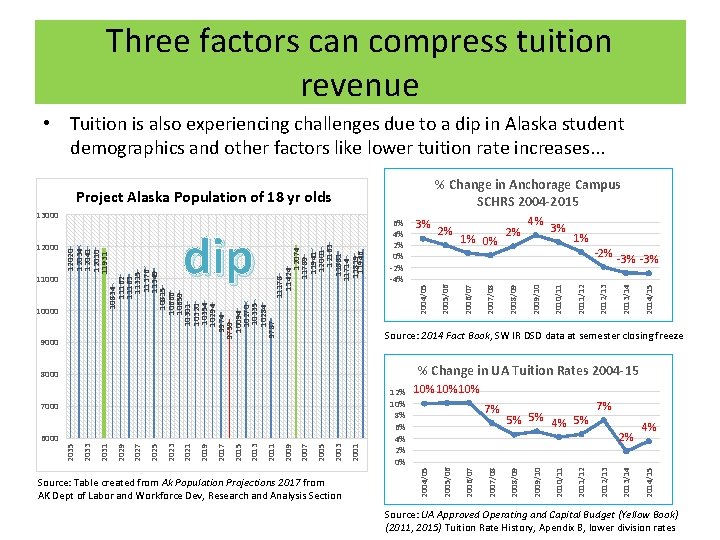
Three factors can compress tuition revenue • Tuition is also experiencing challenges due to a dip in Alaska student demographics and other factors like lower tuition rate increases. . . % Change in Anchorage Campus SCHRS 2004 -2015 9000 4% 3% 1% 2014/15 2013/14 2012/13 2011/12 2010/11 2009/10 -2% -3% 2008/09 1% 0% 2% Source: 2014 Fact Book, SW IR DSD data at semester closing freeze % Change in UA Tuition Rates 2004 -15 10% 10% 7% 4% 2014/15 2013/14 2% 2012/13 2011/12 2010/11 2009/10 5% 5% 4% 5% 2008/09 2007/08 2006/07 7% 2005/06 Source: Table created from Ak Population Projections 2017 from AK Dept of Labor and Workforce Dev, Research and Analysis Section 2001 2003 2005 2007 2009 2011 2013 2015 2017 2019 2021 2023 2025 2027 2029 2031 2033 2035 7000 12% 10% 8% 6% 4% 2% 0% 2004/05 8000 6000 2% 2007/08 10000 3% 2006/07 dip 10834 11162 11163 11315 11376 11349 10815 10666 10659 10301 10320 10354 10294 9974 9759 10094 10270 10335 10284 9787 11178 11424 12074 11789 11941 12001 12163 11881 11714 11819 11946 11000 12020 12034 12041 12010 11931 12000 6% 4% 2% 0% -2% -4% 2004/05 13000 2005/06 Project Alaska Population of 18 yr olds Source: UA Approved Operating and Capital Budget (Yellow Book) (2011, 2015) Tuition Rate History, Apendix B, lower division rates
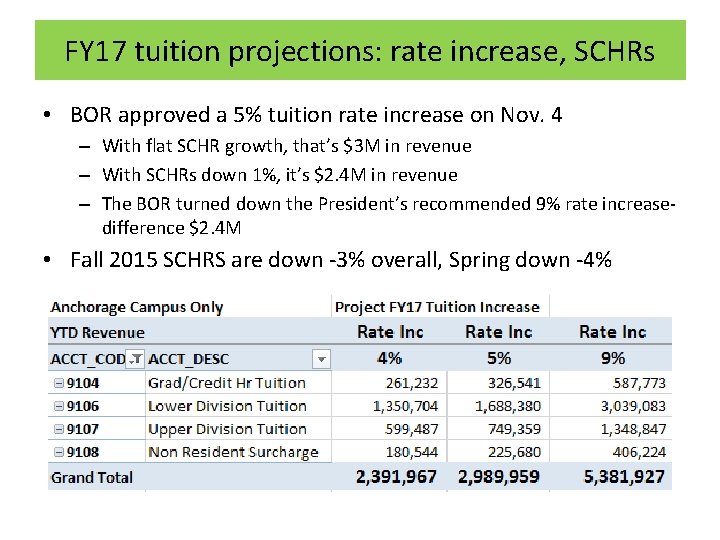
FY 17 tuition projections: rate increase, SCHRs • BOR approved a 5% tuition rate increase on Nov. 4 – With flat SCHR growth, that’s $3 M in revenue – With SCHRs down 1%, it’s $2. 4 M in revenue – The BOR turned down the President’s recommended 9% rate increasedifference $2. 4 M • Fall 2015 SCHRS are down -3% overall, Spring down -4%
FY 17 Personnel Increases? Yes Please?
FY 17 Salary Rate Increases-Projected • Classified staff- 2. 5% • Regular Faculty (per CBA) – UNAC 2% plus $750 lump sum (to base) no market – UAFT 2% plus $900 lump sum (not to base) plus market pool • AHECTE/6070 (per CBA) 1. 9% plus 1 step Nov. 1 • Adjunct Faculty (per CBA) depends on step, 1 -3% • Executive/Officers- Furlough or Increase from pool? (FY 16 5 -10 days furlough) • Students/Temps? decisions made later
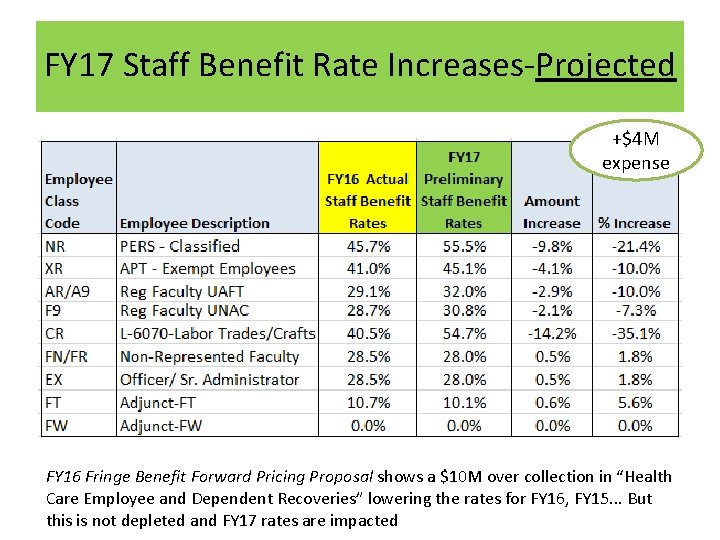
FY 17 Staff Benefit Rate Increases-Projected +$4 M expense FY 16 Fringe Benefit Forward Pricing Proposal shows a $10 M over collection in “Health Care Employee and Dependent Recoveries” lowering the rates for FY 16, FY 15. . . But this is not depleted and FY 17 rates are impacted
FY 17 Budget Plan Scenarios What are the preliminary numbers after analyzing all these factors?
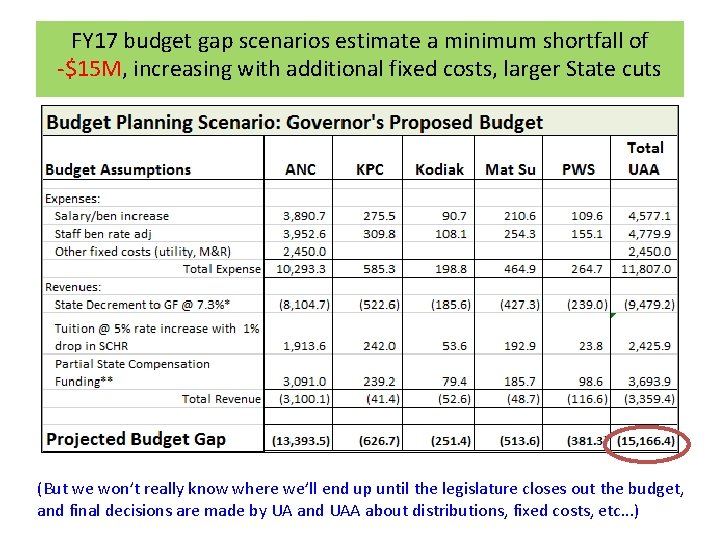
FY 17 budget gap scenarios estimate a minimum shortfall of -$15 M, increasing with additional fixed costs, larger State cuts (But we won’t really know where we’ll end up until the legislature closes out the budget, and final decisions are made by UA and UAA about distributions, fixed costs, etc. . . )
FY 17 Budget Planning: How do we move forward?
How do we get there? Administrative Efficiency • Continued program and function alignment, process improvement, simplification, and effectiveness • Informed by Prioritization • LEAN Team working to develop policy, structure for implementation • IT – already using LEAN to reorganize work flow • Project management consultant (Luann Picard) will advise on cultural and training needs • Selecting first processes to be improved • Employee training on LEAN, train the trainers • Explore out-sourcing of services • Explore partnerships for shared delivery of common services • Continued collaboration with SW, UAF and UAS • Statewide contraction, report available: • http: //www. alaska. edu/swbir/transformation-team/ • Cross campus teams evaluate specific functional areas 30
How do we get there? Focused Academic Planning • Coherent rationale for difficult resource decisions • Provost engaged in long term planning with colleges • Proper course design balance between brick and mortar and online • More efficient use of assets • Faculty productivity • Classroom use • Growth in tuition • Differential – perhaps explore for programs like Business and Engineering • Focus on high-demand programs 31
How do we get there? Emphasis on Student Success • Entry • Competency focused (e. g. Math Emporium) • Strategic recruitment • In-state • International and Lower 48 • Efficient processes • Retention- attention to student needs • Mandatory and targeted advising • Mapworks, Degreeworks, new Schedule Planner • Graduation and Jobs • Clearer pathways • Focused relationships with employers 32
Fresh and Focused Look at UAA Strengths • Geographic location- state population and business center • Quality academic programs • Expertise in economic development (ISER, BEI) • Applied research- patents, Arctic Security COE • Community engagement- ANSEP, Athletics, AAC • Engaged governance groups resource • Experienced and dedicated staff • Planning and Budget Advisory Council (PBAC) 33
In Conclusion • UAA remains a vibrant and resilient university. • UAA will continue to transform and adapt as is prudent and necessary in these times. • Student success is at the core of ALL we do and preserving the faculty, staff and services that help ensure success is critical. • The confidence our students place in UAA to provide their education and the student life experiences that help prepare them for successful careers and lives in Alaska is a GIFT. • We take our service to these students and to our State seriously and intend to continue to strive for better ways to provide that service. • No matter what the budget strife, that is our obligation. 34
- Slides: 34