
The Fundamentals of Spectroscopy Theory BUILDING BETTER SCIENCE
The Fundamentals of Spectroscopy: Theory BUILDING BETTER SCIENCE AGILENT AND YOU For teaching purpose only June 17, 2021 © Agilent Technologies, Inc. 2016 1

Agilent Technologies is committed to the educational community and is willing to provide access to company-owned material contained herein. This slide set is created by Agilent Technologies. The usage of the slides is limited to teaching purpose only. These materials and the information contained herein are accepted “as is” and Agilent makes no representations or warranties of any kind with respect to the materials and disclaims any responsibility for them as may be used or reproduced by you. Agilent will not be liable for any damages resulting from or in connection with your use, copying or disclosure of the materials contained herein. You agree to indemnify and hold Agilent harmless for any claims incurred by Agilent as a result of your use or reproduction of these materials. In case pictures, sketches or drawings should be used for any other purpose please contact Agilent Technologies a priori. For teaching purpose only June 17, 2021 © Agilent Technologies, Inc. 2016 2
Introduction Spectroscopy is the study of the interaction between matter and electromagnetic radiation. Historically, spectroscopy originated through the study of visible light dispersed according to its wavelength, by a prism. Later the concept was expanded greatly to comprise any interaction with radiative energy as a function of its wavelength or frequency. Spectroscopic data is often represented by a spectrum, a plot of the response of interest as a function of wavelength or frequency. • Spectrum (Latin): ghost • Skopos (Greek): watcher • Spectroscopist = ghost watcher For teaching purpose only June 17, 2021 © Agilent Technologies, Inc. 2016 3

Table of Contents Historical Background • Early History of Optical Spectra • 1666 Observation of Visible Spectrum • 1802 Fraunhofer Absorption Lines • Kirchhoff & Bunsen’s Emission Experiment • Kirchhoff & Bunsen’s Absorption Experiment Definitions • Spectroscopy and Spectrometer • Electromagnetic Spectrum • Light For teaching purpose only June 17, 2021 © Agilent Technologies, Inc. 2016 4 Key Parameters • Wavelength and Frequency • Absorption and Emission • Light Absorbed vs. Energy Levels • Characteristics of Atomic Spectra • Absorbance and Transmittance • Absorbance: Concentration Relationship • Beer-Bouguer-Lambert Law
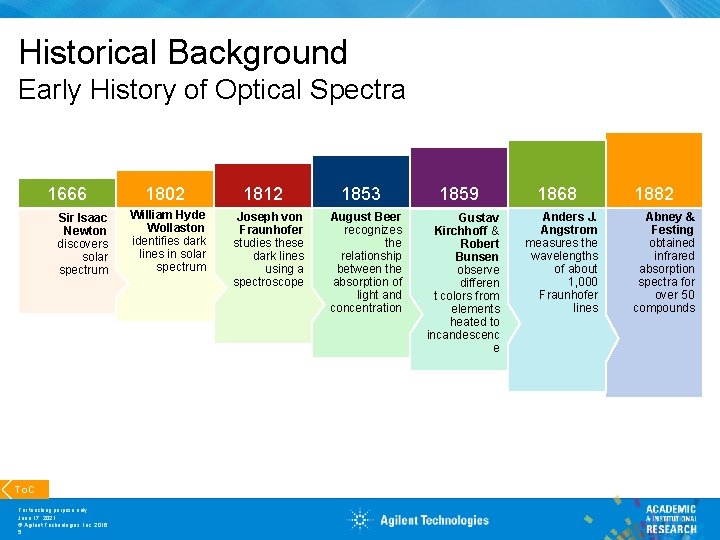
Historical Background Early History of Optical Spectra 1666 Sir Isaac Newton discovers solar spectrum To. C For teaching purpose only June 17, 2021 © Agilent Technologies, Inc. 2016 5 1802 William Hyde Wollaston identifies dark lines in solar spectrum 1812 Joseph von Fraunhofer studies these dark lines using a spectroscope 1853 August Beer recognizes the relationship between the absorption of light and concentration 1859 Gustav Kirchhoff & Robert Bunsen observe differen t colors from elements heated to incandescenc e 1868 Anders J. Angstrom measures the wavelengths of about 1, 000 Fraunhofer lines 1882 Abney & Festing obtained infrared absorption spectra for over 50 compounds
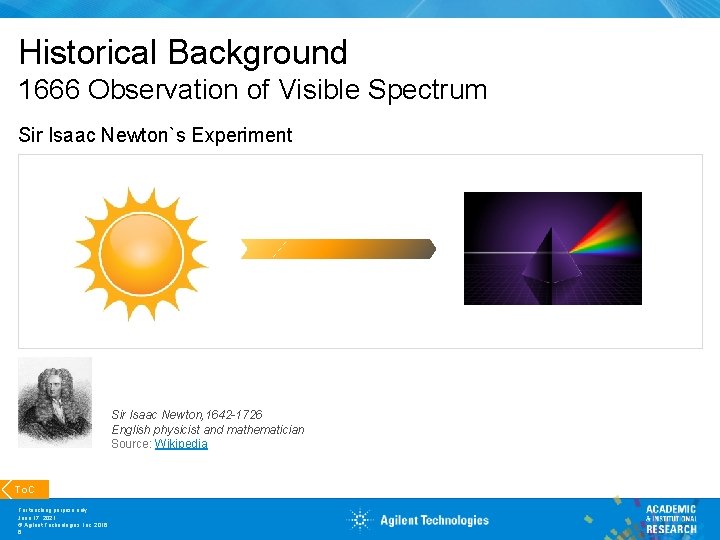
Historical Background 1666 Observation of Visible Spectrum Sir Isaac Newton`s Experiment Sir Isaac Newton, 1642 -1726 English physicist and mathematician Source: Wikipedia To. C For teaching purpose only June 17, 2021 © Agilent Technologies, Inc. 2016 6

Historical Background 1802 Fraunhofer Absorption Lines Wollaston and Fraunhofer, working independently, discover dark lines in the solar spectrum. Fraunhofer introduces diffraction grating which obtains better spectral resolution. Fraunhofer proposes that dark lines are due to the sun’s own atmosphere absorbing light. To. C For teaching purpose only June 17, 2021 © Agilent Technologies, Inc. 2016 7 Img. 1: Joseph von Fraunhofer, 1787 -1826, German Optican. Source: Wikipedia, Img. 2: William Hyde Wollaston, 1766 -1828, English Chemist. Source: Wikipedia see notes for details
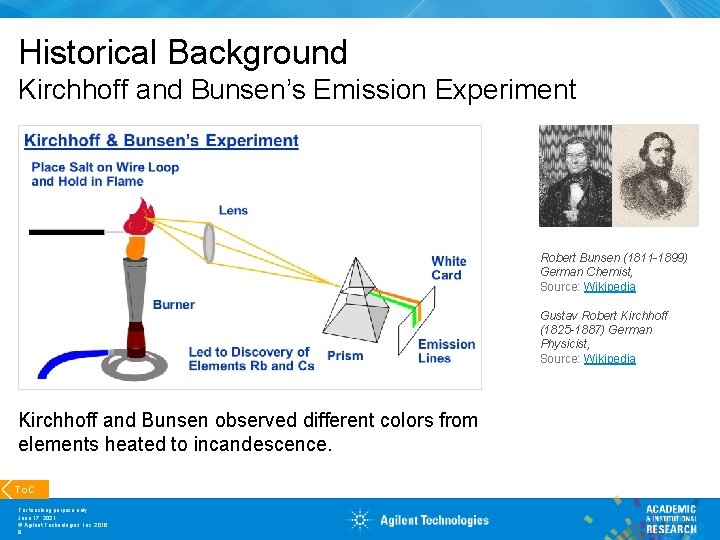
Historical Background Kirchhoff and Bunsen’s Emission Experiment Robert Bunsen (1811 -1899) German Chemist, Source: Wikipedia Gustav Robert Kirchhoff (1825 -1887) German Physicist, Source: Wikipedia Kirchhoff and Bunsen observed different colors from elements heated to incandescence. To. C For teaching purpose only June 17, 2021 © Agilent Technologies, Inc. 2016 8

Historical Background Kirchhoff and Bunsen’s Absorption Experiment Kirchhoff and Bunsen passed a light beam through the heated metallic salt and obtained Fraunhofer absorption lines. To. C For teaching purpose only June 17, 2021 © Agilent Technologies, Inc. 2016 9
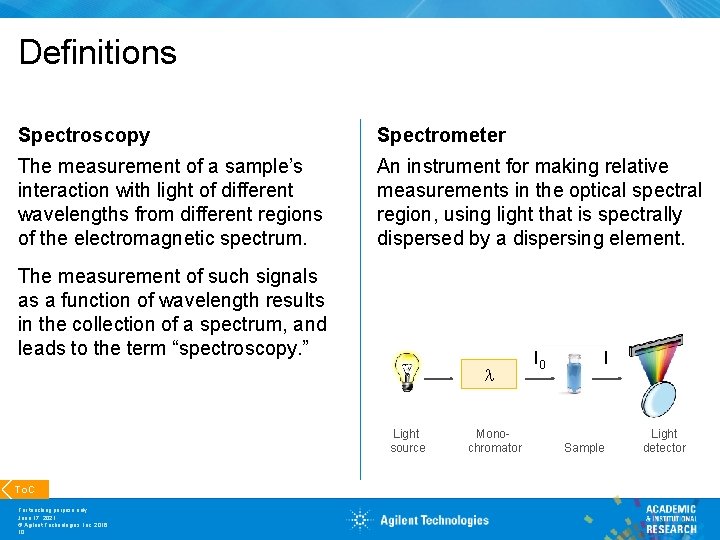
Definitions Spectroscopy Spectrometer The measurement of a sample’s interaction with light of different wavelengths from different regions of the electromagnetic spectrum. An instrument for making relative measurements in the optical spectral region, using light that is spectrally dispersed by a dispersing element. The measurement of such signals as a function of wavelength results in the collection of a spectrum, and leads to the term “spectroscopy. ” Light source To. C For teaching purpose only June 17, 2021 © Agilent Technologies, Inc. 2016 10 Monochromator I 0 I Sample Light detector
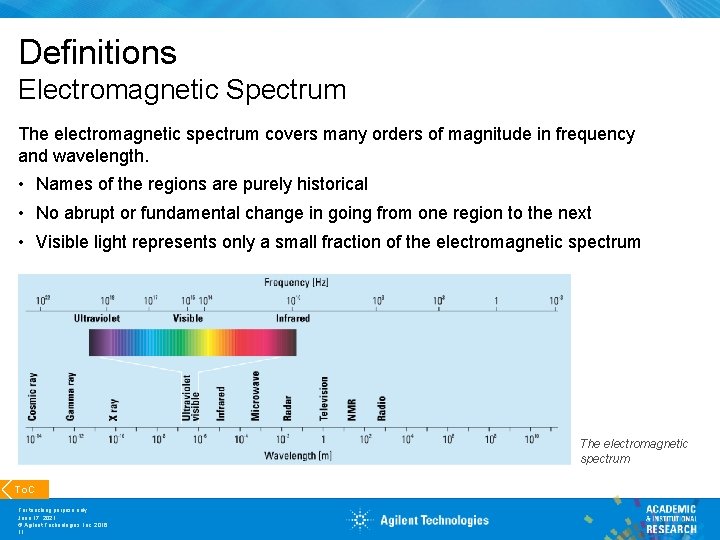
Definitions Electromagnetic Spectrum The electromagnetic spectrum covers many orders of magnitude in frequency and wavelength. • Names of the regions are purely historical • No abrupt or fundamental change in going from one region to the next • Visible light represents only a small fraction of the electromagnetic spectrum To. C For teaching purpose only June 17, 2021 © Agilent Technologies, Inc. 2016 11
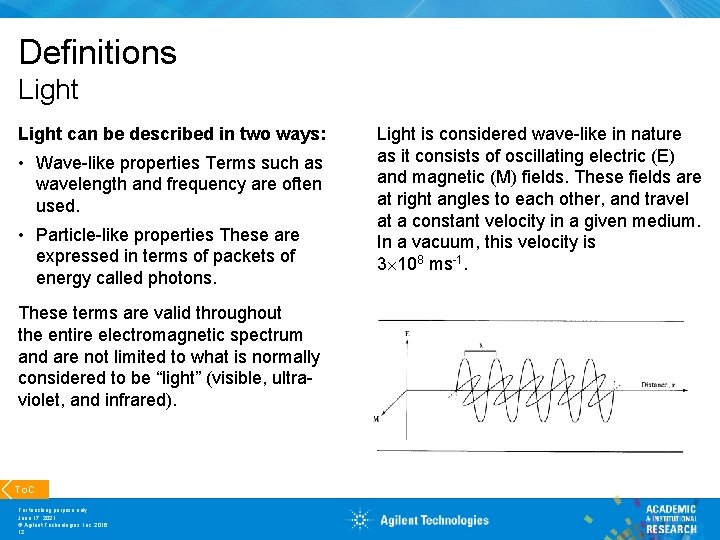
Definitions Light can be described in two ways: • Wave-like properties Terms such as wavelength and frequency are often used. • Particle-like properties These are expressed in terms of packets of energy called photons. These terms are valid throughout the entire electromagnetic spectrum and are not limited to what is normally considered to be “light” (visible, ultraviolet, and infrared). To. C For teaching purpose only June 17, 2021 © Agilent Technologies, Inc. 2016 12 Light is considered wave-like in nature as it consists of oscillating electric (E) and magnetic (M) fields. These fields are at right angles to each other, and travel at a constant velocity in a given medium. In a vacuum, this velocity is 3 108 ms-1.
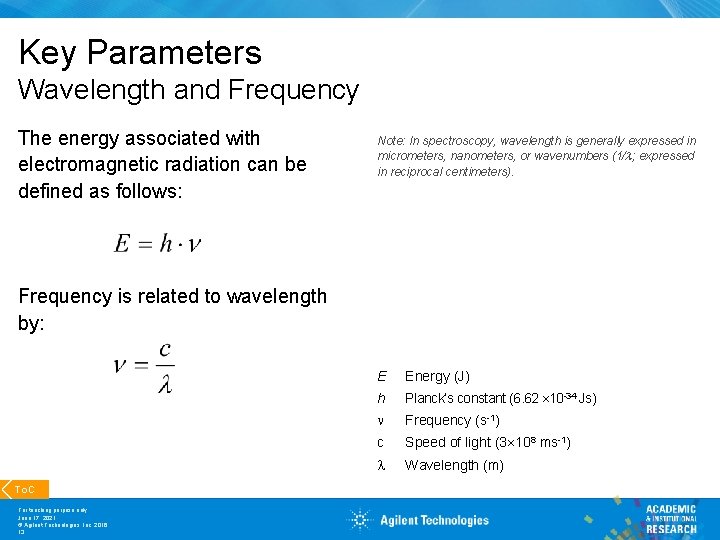
Key Parameters Wavelength and Frequency The energy associated with electromagnetic radiation can be defined as follows: Note: In spectroscopy, wavelength is generally expressed in micrometers, nanometers, or wavenumbers (1/ ; expressed in reciprocal centimeters). Frequency is related to wavelength by: To. C For teaching purpose only June 17, 2021 © Agilent Technologies, Inc. 2016 13 E Energy (J) h Planck’s constant (6. 62 10 -34 Js) n Frequency (s-1) c Speed of light (3 108 ms-1) Wavelength (m)
Key Parameters Absorption and Emission Interactions of electromagnetic radiation with matter may be broadly classified into: • Absorption processes: Electromagnetic radiation from a source is absorbed by the sample and results in a decrease in the radiant power reaching a detector • Emission processes: Electromagnetic radiation emanates from the sample, resulting in an increase in the radiant power that reaches a detector To. C For teaching purpose only June 17, 2021 © Agilent Technologies, Inc. 2016 14
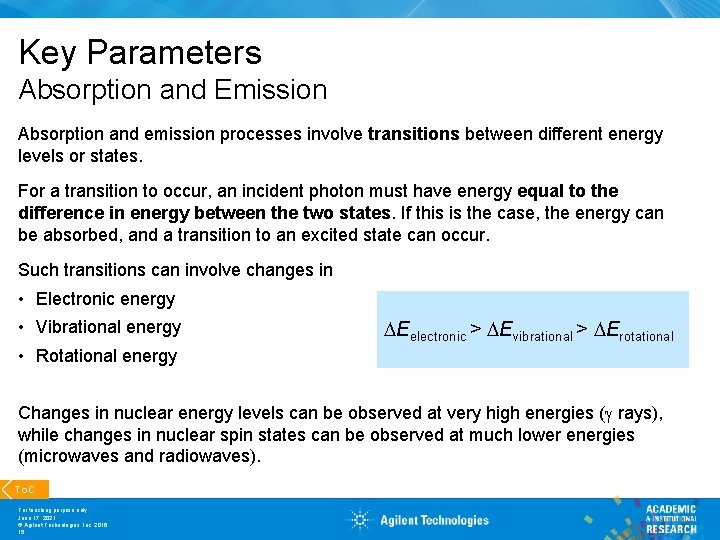
Key Parameters Absorption and Emission Absorption and emission processes involve transitions between different energy levels or states. For a transition to occur, an incident photon must have energy equal to the difference in energy between the two states. If this is the case, the energy can be absorbed, and a transition to an excited state can occur. Such transitions can involve changes in • Electronic energy • Vibrational energy Eelectronic > Evibrational > Erotational • Rotational energy Changes in nuclear energy levels can be observed at very high energies ( rays), while changes in nuclear spin states can be observed at much lower energies (microwaves and radiowaves). To. C For teaching purpose only June 17, 2021 © Agilent Technologies, Inc. 2016 15
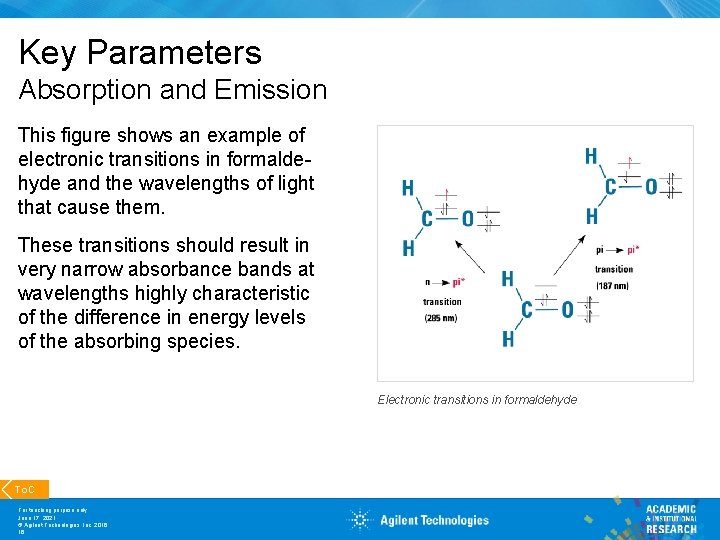
Key Parameters Absorption and Emission This figure shows an example of electronic transitions in formaldehyde and the wavelengths of light that cause them. These transitions should result in very narrow absorbance bands at wavelengths highly characteristic of the difference in energy levels of the absorbing species. Electronic transitions in formaldehyde To. C For teaching purpose only June 17, 2021 © Agilent Technologies, Inc. 2016 16
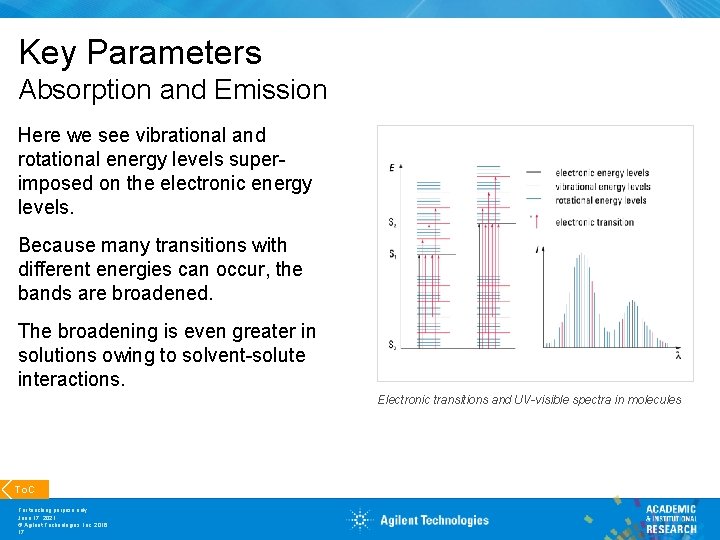
Key Parameters Absorption and Emission Here we see vibrational and rotational energy levels superimposed on the electronic energy levels. Because many transitions with different energies can occur, the bands are broadened. The broadening is even greater in solutions owing to solvent-solute interactions. Electronic transitions and UV-visible spectra in molecules To. C For teaching purpose only June 17, 2021 © Agilent Technologies, Inc. 2016 17
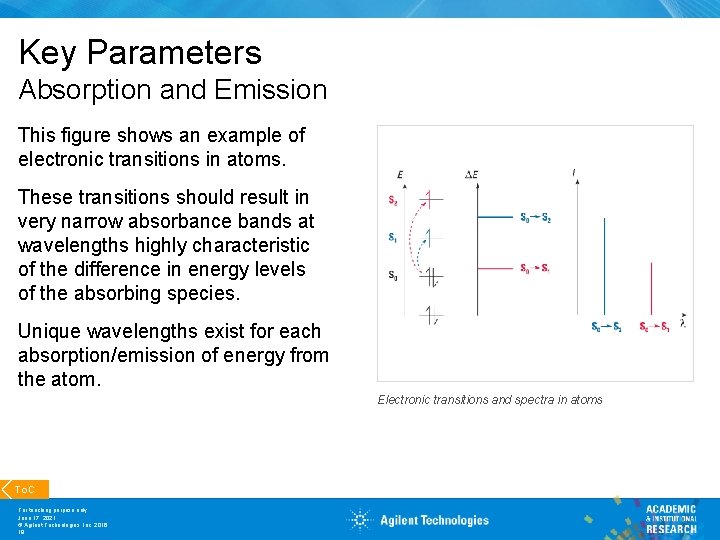
Key Parameters Absorption and Emission This figure shows an example of electronic transitions in atoms. These transitions should result in very narrow absorbance bands at wavelengths highly characteristic of the difference in energy levels of the absorbing species. Unique wavelengths exist for each absorption/emission of energy from the atom. Electronic transitions and spectra in atoms To. C For teaching purpose only June 17, 2021 © Agilent Technologies, Inc. 2016 18
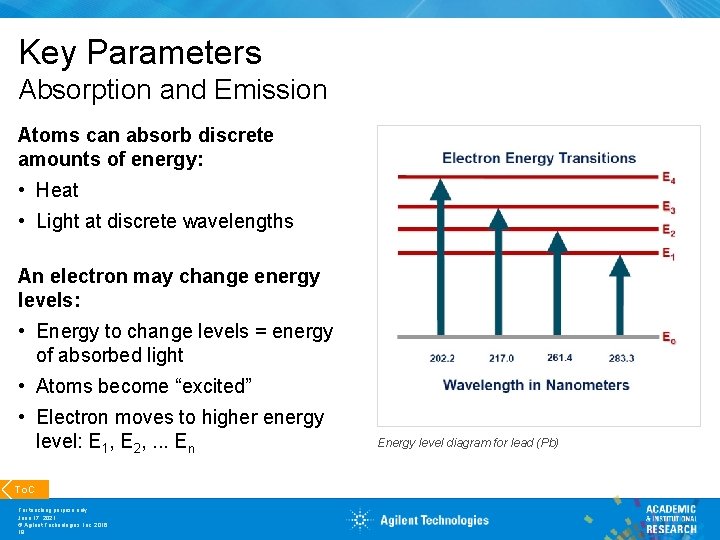
Key Parameters Absorption and Emission Atoms can absorb discrete amounts of energy: • Heat • Light at discrete wavelengths An electron may change energy levels: • Energy to change levels = energy of absorbed light • Atoms become “excited” • Electron moves to higher energy level: E 1, E 2, . . . En To. C For teaching purpose only June 17, 2021 © Agilent Technologies, Inc. 2016 19 Energy level diagram for lead (Pb)
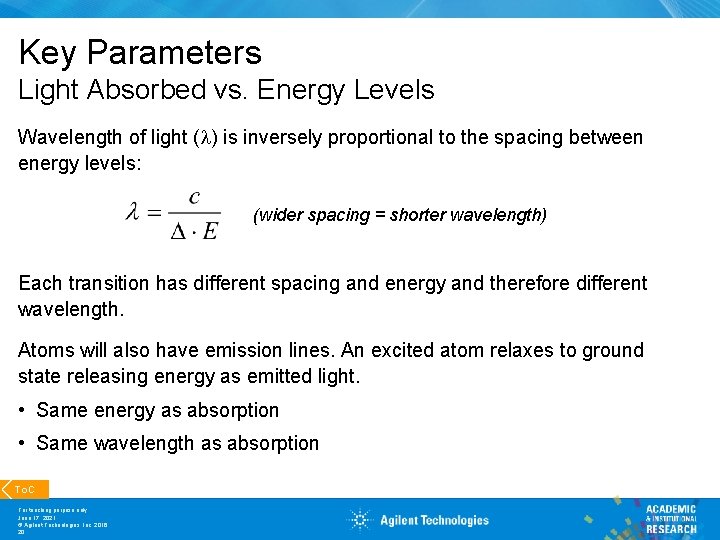
Key Parameters Light Absorbed vs. Energy Levels Wavelength of light ( ) is inversely proportional to the spacing between energy levels: (wider spacing = shorter wavelength) Each transition has different spacing and energy and therefore different wavelength. Atoms will also have emission lines. An excited atom relaxes to ground state releasing energy as emitted light. • Same energy as absorption • Same wavelength as absorption To. C For teaching purpose only June 17, 2021 © Agilent Technologies, Inc. 2016 20
Key Parameters Characteristics of Atomic Spectra Sharp peaks (compared to broad peaks in UV-Vis) Most significant lines originate from ground state • Resonance lines: – Most intense lines – Most interest in atomic absorption They can occur from one excited state to another • Non-resonance lines: – Weaker lines – Generally not useful for atomic absorption To. C For teaching purpose only June 17, 2021 © Agilent Technologies, Inc. 2016 21
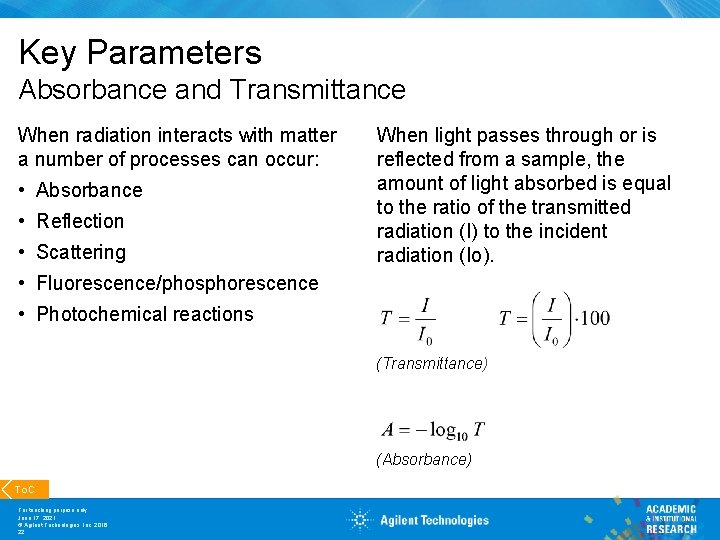
Key Parameters Absorbance and Transmittance When radiation interacts with matter a number of processes can occur: • Absorbance • Reflection • Scattering When light passes through or is reflected from a sample, the amount of light absorbed is equal to the ratio of the transmitted radiation (I) to the incident radiation (Io). • Fluorescence/phosphorescence • Photochemical reactions (Transmittance) (Absorbance) To. C For teaching purpose only June 17, 2021 © Agilent Technologies, Inc. 2016 22
Key Parameter Absorbance/Concentration Relationship Lambert’s law • The portion of light absorbed by a transparent medium is independent of the intensity of the incident light • Each successive unit of thickness of the medium absorbs an equal fraction of the light passing though it Beer’s law • Light absorption is proportional to the number of absorbing species in the sample To. C For teaching purpose only June 17, 2021 © Agilent Technologies, Inc. 2016 23
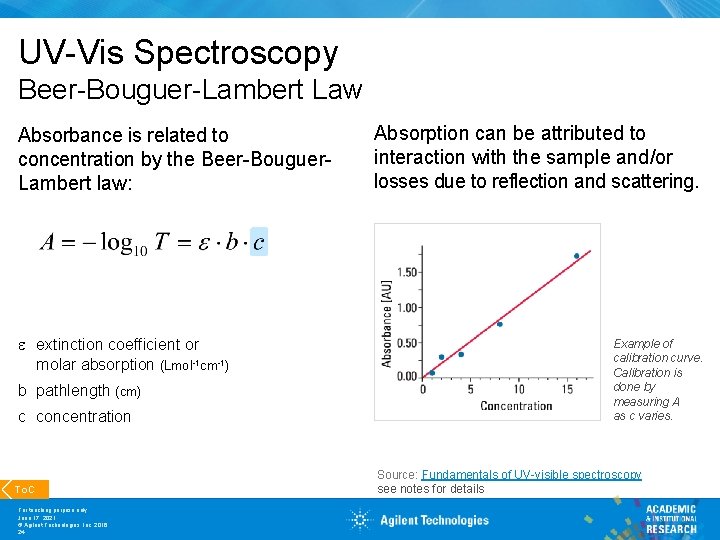
UV-Vis Spectroscopy Beer-Bouguer-Lambert Law Absorbance is related to concentration by the Beer-Bouguer. Lambert law: e extinction coefficient or molar absorption (Lmol-1 cm-1) b pathlength (cm) c concentration To. C For teaching purpose only June 17, 2021 © Agilent Technologies, Inc. 2016 24 Absorption can be attributed to interaction with the sample and/or losses due to reflection and scattering. Example of calibration curve. Calibration is done by measuring A as c varies. Source: Fundamentals of UV-visible spectroscopy see notes for details
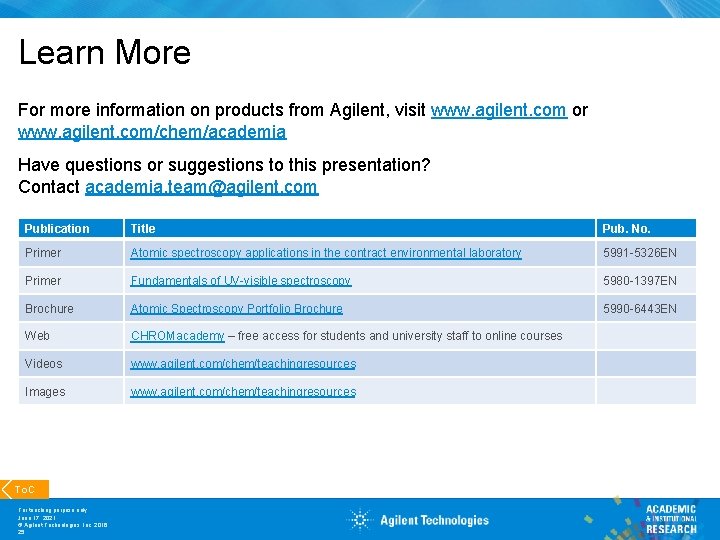
Learn More For more information on products from Agilent, visit www. agilent. com or www. agilent. com/chem/academia Have questions or suggestions to this presentation? Contact academia. team@agilent. com Publication Title Pub. No. Primer Atomic spectroscopy applications in the contract environmental laboratory 5991 -5326 EN Primer Fundamentals of UV-visible spectroscopy 5980 -1397 EN Brochure Atomic Spectroscopy Portfolio Brochure 5990 -6443 EN Web CHROMacademy – free access for students and university staff to online courses Videos www. agilent. com/chem/teachingresources Images www. agilent. com/chem/teachingresources To. C For teaching purpose only June 17, 2021 © Agilent Technologies, Inc. 2016 25
THANK YOU Publication Number: 5991 -6694 EN To. C For teaching purpose only June 17, 2021 © Agilent Technologies, Inc. 2016 26
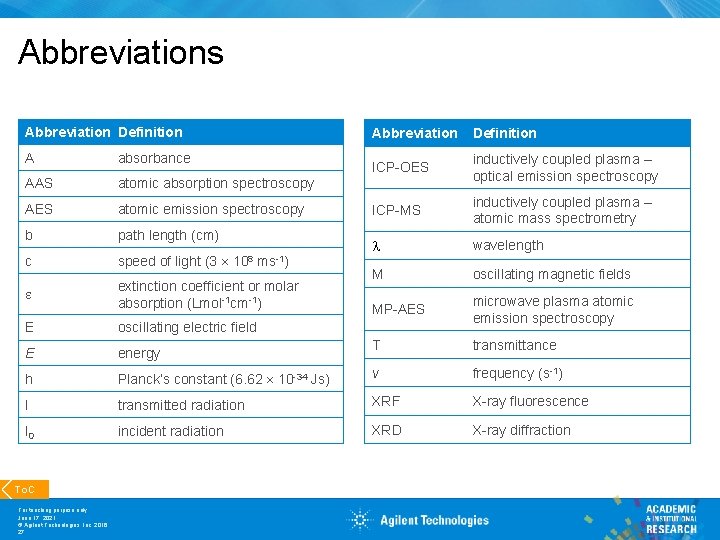
Abbreviations Abbreviation Definition ICP-OES inductively coupled plasma – optical emission spectroscopy ICP-MS inductively coupled plasma – atomic mass spectrometry wavelength M oscillating magnetic fields MP-AES microwave plasma atomic emission spectroscopy T transmittance A absorbance AAS atomic absorption spectroscopy AES atomic emission spectroscopy b path length (cm) c speed of light (3 e extinction coefficient or molar absorption (Lmol-1 cm-1) E oscillating electric field E energy h Planck’s constant (6. 62 10 -34 Js) v frequency (s-1) I transmitted radiation XRF X-ray fluorescence I 0 incident radiation XRD X-ray diffraction To. C For teaching purpose only June 17, 2021 © Agilent Technologies, Inc. 2016 27 108 ms-1)
- Slides: 27