
The FUNDAMENTALS OF ENGINEERING EXAM for Nuclear Engineers

- Slides: 12
The FUNDAMENTALS OF ENGINEERING EXAM for Nuclear Engineers Start your Journey to become a Licensed Nuclear Professional Engineer (P. E. )
Become a Licensed Nuclear Professional Engineer (P. E. ) The Nuclear Professional Engineer (P. E. ) licensure establishes you as one who is dedicated to solving problems with integrity, with creativity, and ethically. It demonstrates your proficiency, professionalism and responsibility to public health and safety. It sets you apart even when licensure is not required for your position. Your path to obtaining this valuable credential begins with successfully passing the Fundamentals of Engineering exam. 2
Become a Licensed Nuclear Professional Engineer What is Professional Licensure? • Authority granted by a state to practice a particular profession that affects public safety, health and welfare • Recognized professions: Engineering, Medicine, Law, Accounting, Nursing • Professions subject to licensure share common elements: – Code of Ethics – Rules for Professional Conduct – Minimum Standards of Professional Competency – Strong desire to be worthy of the Public’s Trust – Continuing Professional Competency – Protect public interests by enforcing standards and imposing disciplinary action when necessary 3
Become a Licensed Nuclear Professional Engineer Why become a licensed Professional Engineer (P. E. ) in Nuclear? • Licensed nuclear engineers: – Command higher salaries – Experience faster career advancement – Are qualified to work independently as consultants or business owners – Demonstrate a level of proficiency, education and experience 4
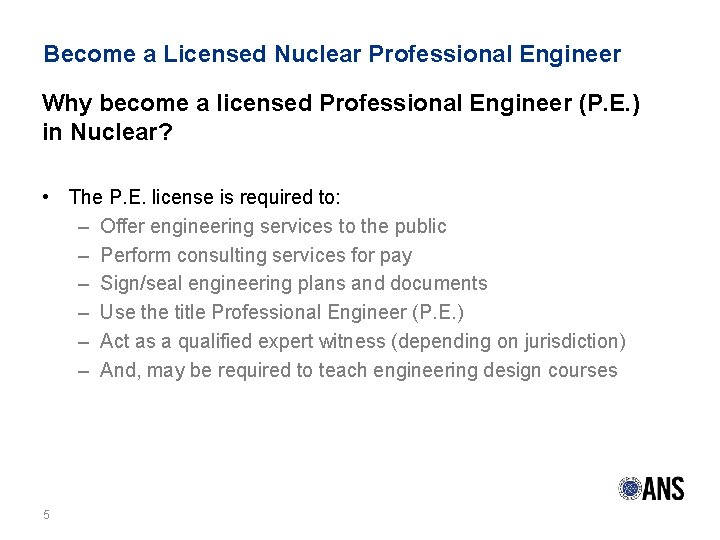
Become a Licensed Nuclear Professional Engineer Why become a licensed Professional Engineer (P. E. ) in Nuclear? • The P. E. license is required to: – Offer engineering services to the public – Perform consulting services for pay – Sign/seal engineering plans and documents – Use the title Professional Engineer (P. E. ) – Act as a qualified expert witness (depending on jurisdiction) – And, may be required to teach engineering design courses 5
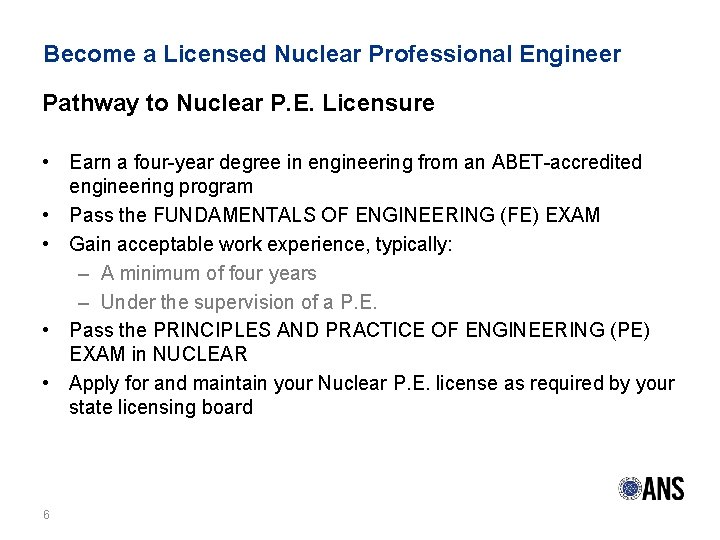
Become a Licensed Nuclear Professional Engineer Pathway to Nuclear P. E. Licensure • Earn a four-year degree in engineering from an ABET-accredited engineering program • Pass the FUNDAMENTALS OF ENGINEERING (FE) EXAM • Gain acceptable work experience, typically: – A minimum of four years – Under the supervision of a P. E. • Pass the PRINCIPLES AND PRACTICE OF ENGINEERING (PE) EXAM in NUCLEAR • Apply for and maintain your Nuclear P. E. license as required by your state licensing board 6
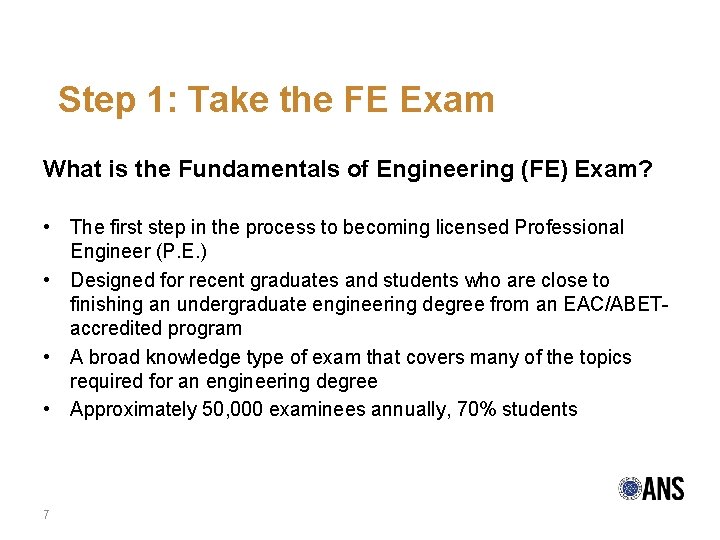
Step 1: Take the FE Exam What is the Fundamentals of Engineering (FE) Exam? • The first step in the process to becoming licensed Professional Engineer (P. E. ) • Designed for recent graduates and students who are close to finishing an undergraduate engineering degree from an EAC/ABETaccredited program • A broad knowledge type of exam that covers many of the topics required for an engineering degree • Approximately 50, 000 examinees annually, 70% students 7
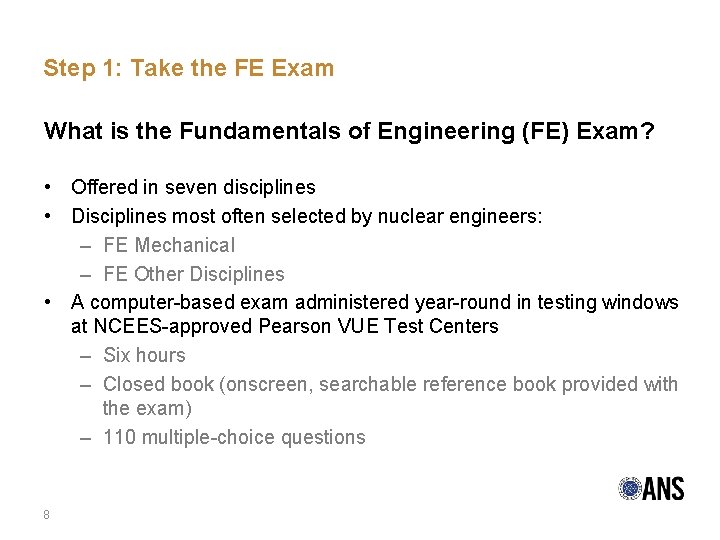
Step 1: Take the FE Exam What is the Fundamentals of Engineering (FE) Exam? • Offered in seven disciplines • Disciplines most often selected by nuclear engineers: – FE Mechanical – FE Other Disciplines • A computer-based exam administered year-round in testing windows at NCEES-approved Pearson VUE Test Centers – Six hours – Closed book (onscreen, searchable reference book provided with the exam) – 110 multiple-choice questions 8
Step 1: Take the FE Exam Who develops and administers the Fundamentals of Engineering (FE) Exam? • National Council of Examiners for Engineering and Surveying – NCEES – ncees. org – Coalition of member licensing boards in 50 states and 5 U. S. jurisdictions – Located in Clemson, South Carolina – Developed “Model Law” based on best practices – Promotes uniform requirements for licensure – Develops and administers FE and PE examinations 9
Step 1: Take the FE Exam Pass Rates • Among examinees who attended EAC/ABET-accredited engineering programs and took the FE exam within 12 months of graduation • Pass rates ranged from 68% to 80% depending upon exam discipline • Among those in a nuclear program, 90% passed the “Other Disciplines” exam • Pass rates decrease with time since being enrolled in college: –Still enrolled: 75% (Average) –Graduated within 2 years: 52% –Graduated last 3 -5 years: 40% 10
Step 1: Take the FE Exam For more information: • ncees. org/engineering/fe • Printed exam reference book available from NCEES for $14, or download PDF for free • Specifications for FE exams available as PDFs • Registration process • Fees 11
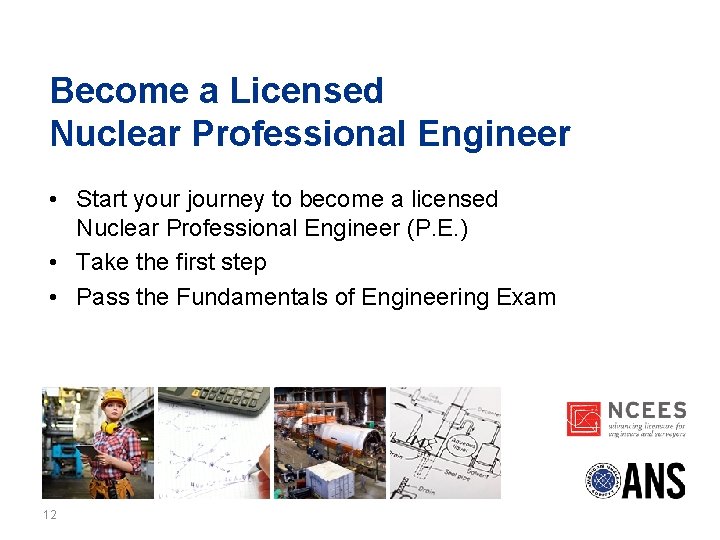
Become a Licensed Nuclear Professional Engineer • Start your journey to become a licensed Nuclear Professional Engineer (P. E. ) • Take the first step • Pass the Fundamentals of Engineering Exam 12