
The Fundamentals of Embryology FERTILIZATION IMPLANTATION AND TWINNING
The Fundamentals of Embryology FERTILIZATION & IMPLANTATION AND TWINNING @Embryology 436@gmail. com
OBJECTIVES: By the end of the lecture, you should be able to: Identify fertilization and its sites List the phases of fertilization Describe the results of fertilization Describe formation of blastocysts Identify implantation and its sites Describe the mechanism of the implantation List the common sites of ectopic pregnancies

Fertilization: a male gamete (sperm) + a female gamete (oocyte) =a single cell called the (ZYGOTE). It is a complex process which begins with a contact between the sperm & ovum and it ends up with intermingling (mixing) of the maternal and paternal chromosomes. *Chemical signals from the oocyte attracts the sperms. Where Does Fertilization Normally Occur? Usually in the ampulla (the widest part of the tube) of uterine tube. Fertilization may occur in any other part of tube. But it never occurs in the uterine cavity.
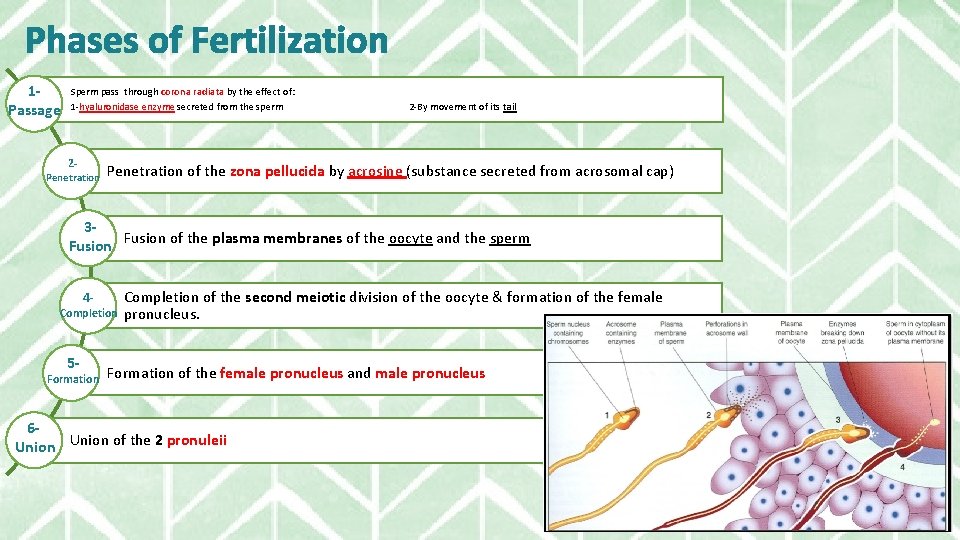
Phases of Fertilization 1 Passage Sperm pass through corona radiata by the effect of: 1 -hyaluronidase enzyme secreted from the sperm 2 - Penetration 2 -By movement of its tail Penetration of the zona pellucida by acrosine (substance secreted from acrosomal cap) 3 Fusion of the plasma membranes of the oocyte and the sperm 4 - Completion 5 - Formation Completion of the second meiotic division of the oocyte & formation of the female pronucleus. Formation of the female pronucleus and male pronucleus 6 Union of the 2 pronuleii
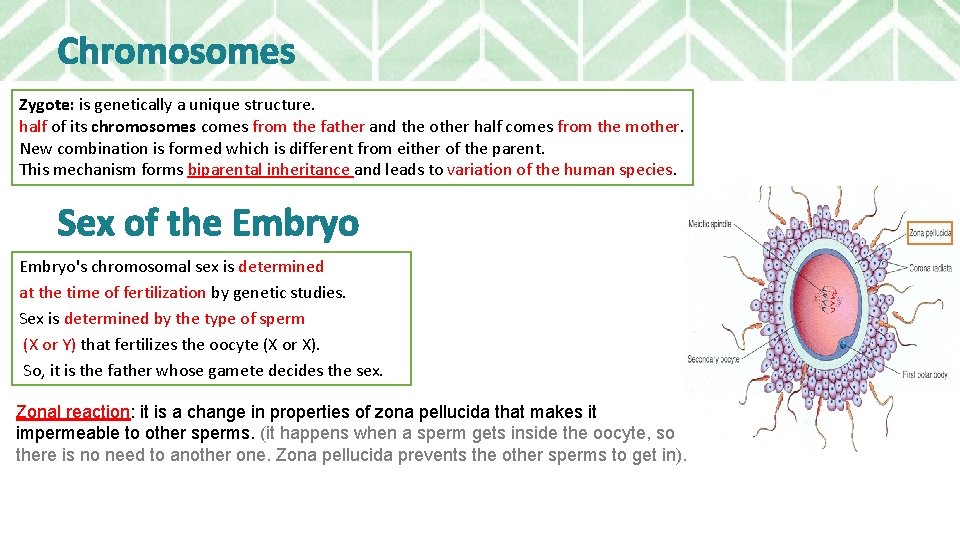
Chromosomes Zygote: is genetically a unique structure. half of its chromosomes comes from the father and the other half comes from the mother. New combination is formed which is different from either of the parent. This mechanism forms biparental inheritance and leads to variation of the human species. Sex of the Embryo's chromosomal sex is determined at the time of fertilization by genetic studies. Sex is determined by the type of sperm (X or Y) that fertilizes the oocyte (X or X). So, it is the father whose gamete decides the sex. Zonal reaction: it is a change in properties of zona pellucida that makes it impermeable to other sperms. (it happens when a sperm gets inside the oocyte, so there is no need to another one. Zona pellucida prevents the other sperms to get in).

Results of fertilization: 1. Stimulates the penetrated oocyte to complete its 2 nd meiotic division which was arrested at metaphase. 2. Restores the normal diploid number of chromosomes. (23 of the sperm and the same of the oocyte = 46) 3. Determines the sex of the embryo. 4. Initiates cleavage of the zygote (cell division).
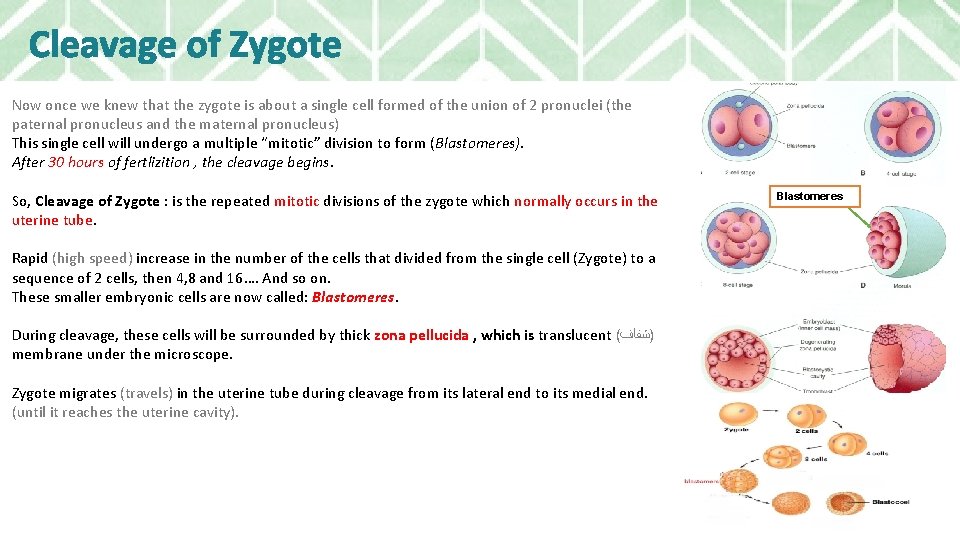
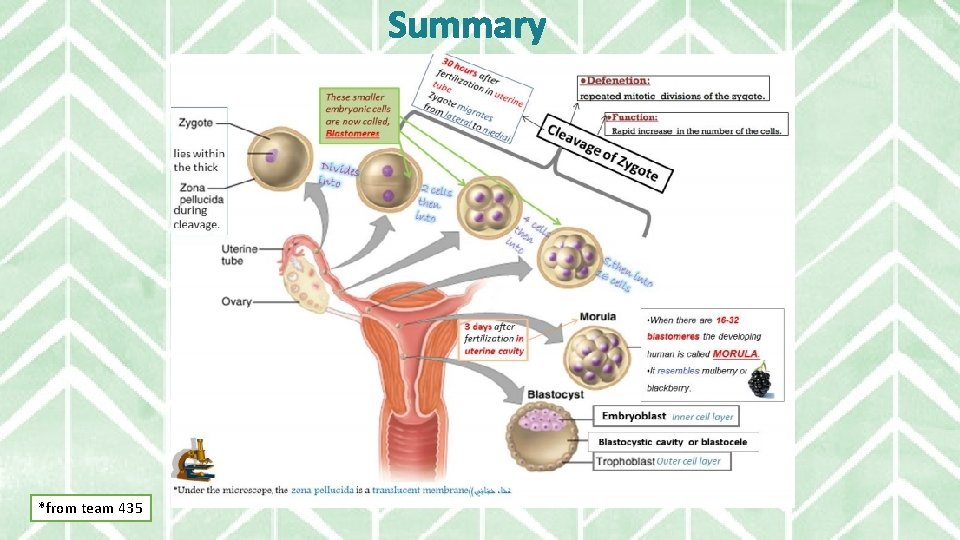
Cleavage of Zygote Now once we knew that the zygote is about a single cell formed of the union of 2 pronuclei (the paternal pronucleus and the maternal pronucleus) This single cell will undergo a multiple “mitotic” division to form (Blastomeres). After 30 hours of fertlizition , the cleavage begins. So, Cleavage of Zygote : is the repeated mitotic divisions of the zygote which normally occurs in the uterine tube. Rapid (high speed) increase in the number of the cells that divided from the single cell (Zygote) to a sequence of 2 cells, then 4, 8 and 16…. And so on. These smaller embryonic cells are now called: Blastomeres. During cleavage, these cells will be surrounded by thick zona pellucida , which is translucent ( )ﺷﻔﺎﻑ membrane under the microscope. Zygote migrates (travels) in the uterine tube during cleavage from its lateral end to its medial end. (until it reaches the uterine cavity). Blastomeres
Summary *from team 435
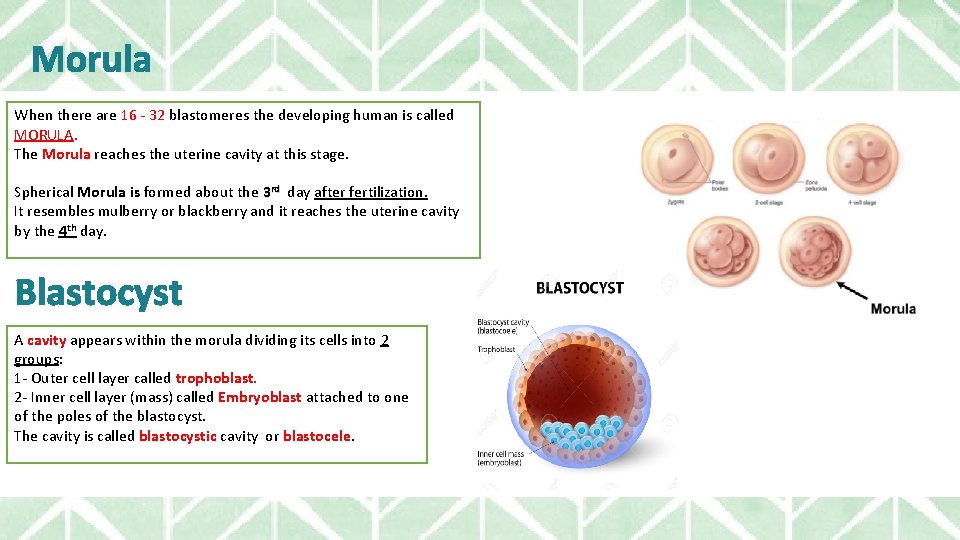
Morula When there are 16 - 32 blastomeres the developing human is called MORULA. The Morula reaches the uterine cavity at this stage. Spherical Morula is formed about the 3 rd day after fertilization. It resembles mulberry or blackberry and it reaches the uterine cavity by the 4 th day. Blastocyst A cavity appears within the morula dividing its cells into 2 groups: 1 - Outer cell layer called trophoblast. 2 - Inner cell layer (mass) called Embryoblast attached to one of the poles of the blastocyst. The cavity is called blastocystic cavity or blastocele.

IMPLANTATION Definition: It is the process by which the Blastocyst penetrates the superficial (compact) layer of the endometrium of the uterus. Site : The normal site of implantation is the posterior wall of the body of the uterus near the fundus. Time: It begins about the 6 th day after fertilization. It is completed by the 11 th or 12 th day Mechanism: *The Morula reaches the uterine cavity by the 4 th day after fertilization and it remains free within the uterine cavity for one or two days. *Fluid passes from uterine cavity to the Morula. *Now the Morula is called Blastocyst, its cavity is called blastocystic cavity or blastocele, and its cells divided into Embryoblast & Trophoblast.
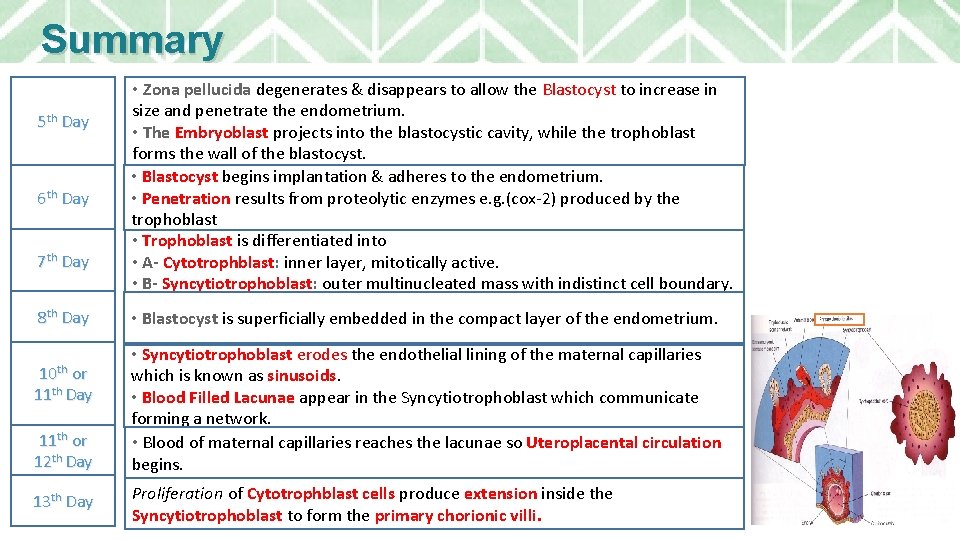
Summary 5 th Day 6 th Day 7 th Day 8 th Day 10 th or 11 th Day 11 th or 12 th Day 13 th Day • Zona pellucida degenerates & disappears to allow the Blastocyst to increase in size and penetrate the endometrium. • The Embryoblast projects into the blastocystic cavity, while the trophoblast forms the wall of the blastocyst. • Blastocyst begins implantation & adheres to the endometrium. • Penetration results from proteolytic enzymes e. g. (cox-2) produced by the trophoblast • Trophoblast is differentiated into • A- Cytotrophblast: inner layer, mitotically active. • B- Syncytiotrophoblast: outer multinucleated mass with indistinct cell boundary. • Blastocyst is superficially embedded in the compact layer of the endometrium. • Syncytiotrophoblast erodes the endothelial lining of the maternal capillaries which is known as sinusoids. • Blood Filled Lacunae appear in the Syncytiotrophoblast which communicate forming a network. • Blood of maternal capillaries reaches the lacunae so Uteroplacental circulation begins. Proliferation of Cytotrophblast cells produce extension inside the Syncytiotrophoblast to form the primary chorionic villi.
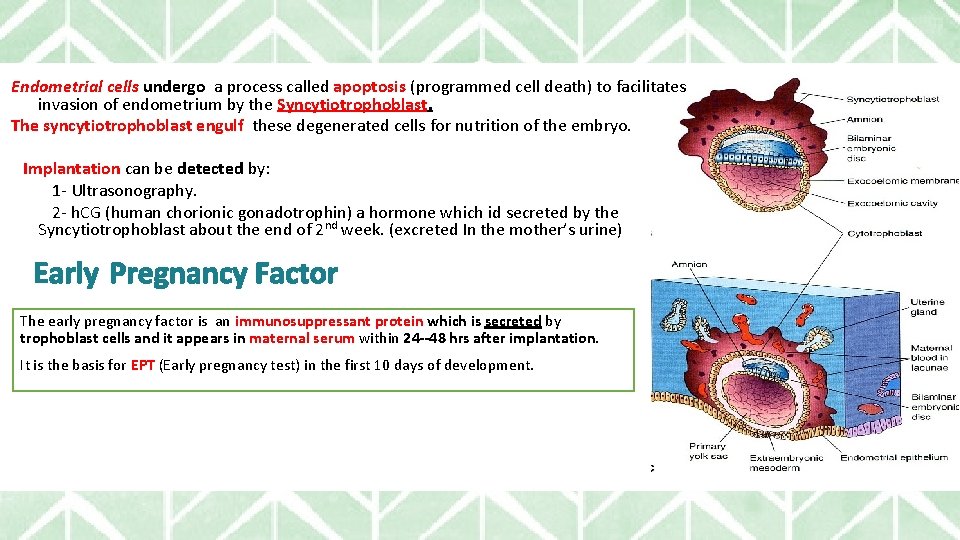
Endometrial cells undergo a process called apoptosis (programmed cell death) to facilitates invasion of endometrium by the Syncytiotrophoblast. The syncytiotrophoblast engulf these degenerated cells for nutrition of the embryo. Implantation can be detected by: 1 - Ultrasonography. 2 - h. CG (human chorionic gonadotrophin) a hormone which id secreted by the Syncytiotrophoblast about the end of 2 nd week. (excreted In the mother’s urine) Early Pregnancy Factor The early pregnancy factor is an immunosuppressant protein which is secreted by trophoblast cells and it appears in maternal serum within 24 --48 hrs after implantation. It is the basis for EPT (Early pregnancy test) in the first 10 days of development.
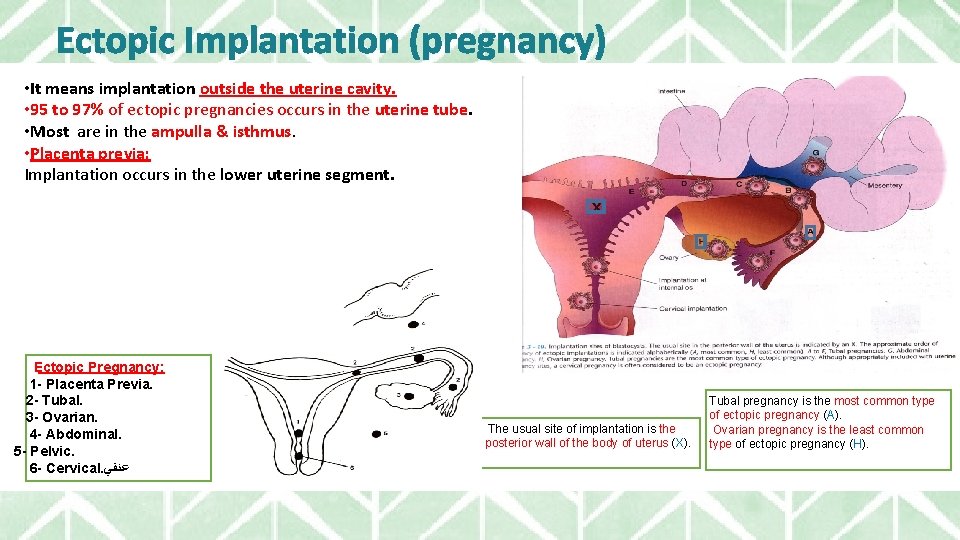
Ectopic Implantation (pregnancy) • It means implantation outside the uterine cavity. • 95 to 97% of ectopic pregnancies occurs in the uterine tube. • Most are in the ampulla & isthmus. • Placenta previa: Implantation occurs in the lower uterine segment. Ectopic Pregnancy: 1 - Placenta Previa. 2 - Tubal. 3 - Ovarian. 4 - Abdominal. 5 - Pelvic. 6 - Cervical. ﻋﻨﻘﻲ The usual site of implantation is the posterior wall of the body of uterus (X). Tubal pregnancy is the most common type of ectopic pregnancy (A). Ovarian pregnancy is the least common type of ectopic pregnancy (H).
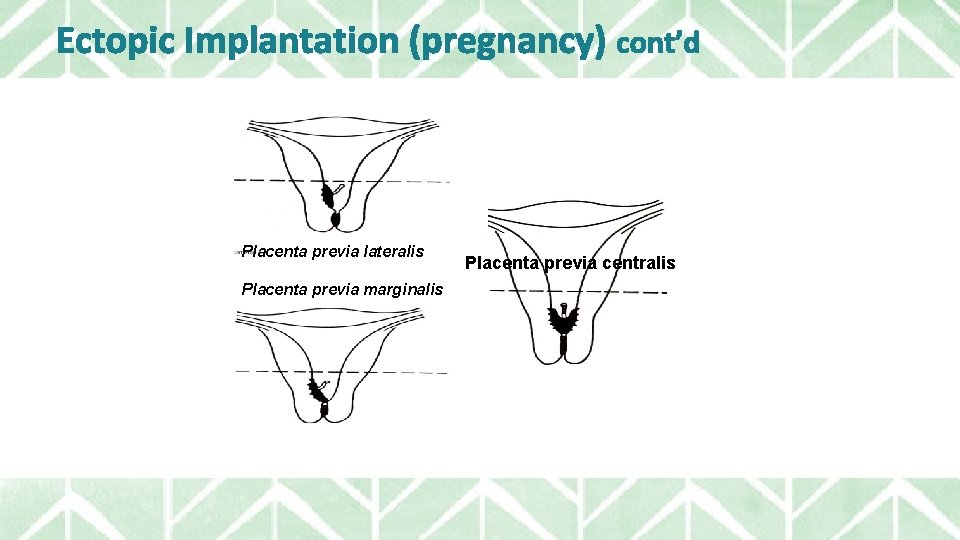
Ectopic Implantation (pregnancy) cont’d Placenta previa lateralis Placenta previa marginalis Placenta previa centralis

Credits Team members: Khalid Alhusainan Maha Al. Ghamdi Laila Mathkour Ghadah Almazrou Rana Almanaa Haneen Alsubki Nada Alyousef Ghadah Alothaim Abdulrahman Alrasheed Jehad Alsadhan Abdulrahman Alharbi Abdulkarim Alharbi Faris Alrajhi Abdulrahman Alarifi Team leaders: Mosea Alnowaiser Sumaya Al. Ghamdi Rayan Al. Qarni Saad Alrushud @Embryology 436@gmail. com
- Slides: 15