
THE FUNDAMENTAL THEOREM OF CALCULUS There are TWO
- Slides: 13
THE FUNDAMENTAL THEOREM OF CALCULUS. There are TWO different types of CALCULUS. 1. DIFFERENTIATION: finding gradients of curves. 2. INTEGRATION: finding areas under curves. These concepts seem to be totally different, but there is a connection!
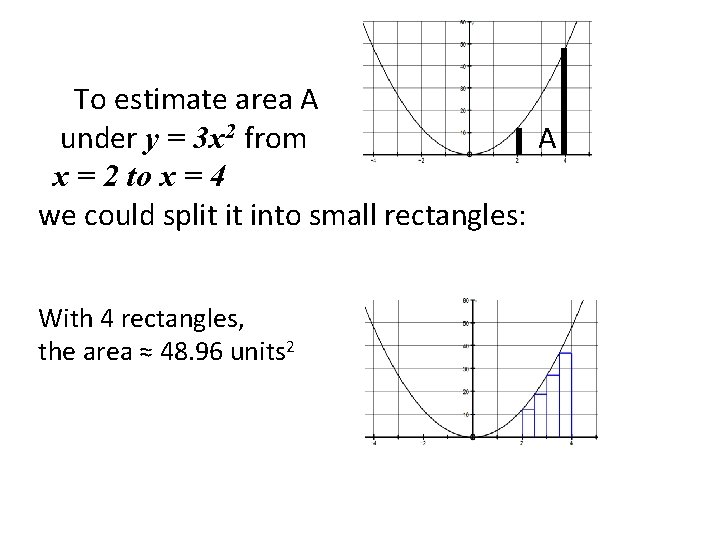
To estimate area A under y = 3 x 2 from A x = 2 to x = 4 we could split it into small rectangles: With 4 rectangles, the area ≈ 48. 96 units 2
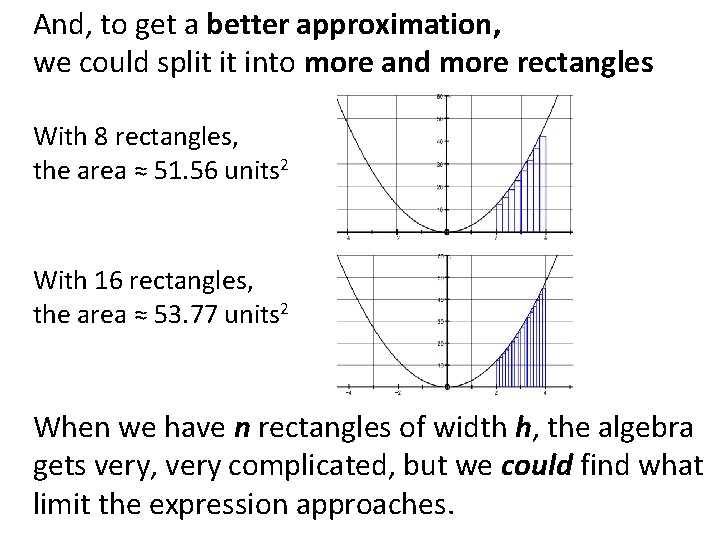
And, to get a better approximation, we could split it into more and more rectangles With 8 rectangles, the area ≈ 51. 56 units 2 With 16 rectangles, the area ≈ 53. 77 units 2 When we have n rectangles of width h, the algebra gets very, very complicated, but we could find what limit the expression approaches.
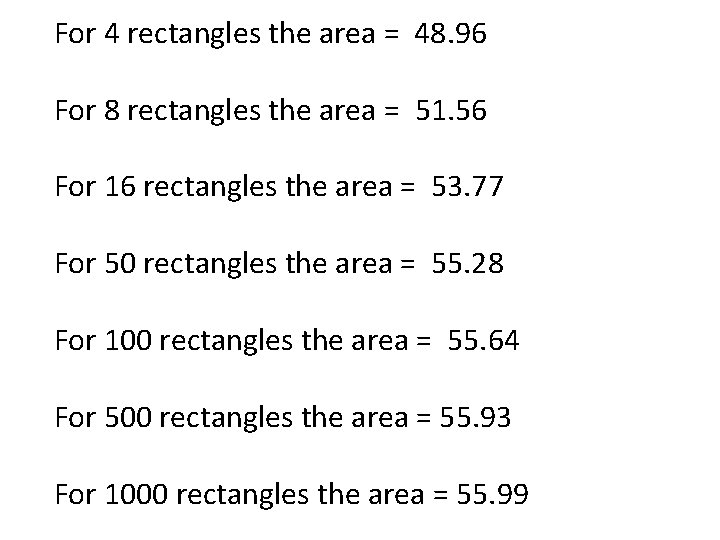
For 4 rectangles the area = 48. 96 For 8 rectangles the area = 51. 56 For 16 rectangles the area = 53. 77 For 50 rectangles the area = 55. 28 For 100 rectangles the area = 55. 64 For 500 rectangles the area = 55. 93 For 1000 rectangles the area = 55. 99
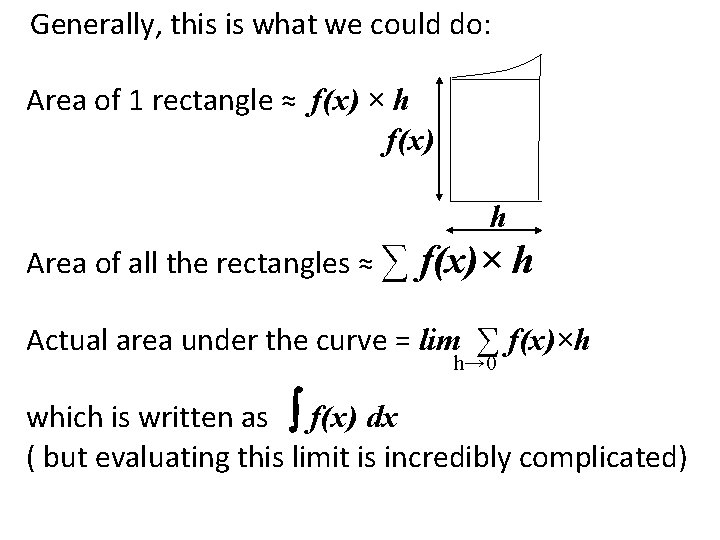
Generally, this is what we could do: Area of 1 rectangle ≈ f(x) × h f(x) h Area of all the rectangles ≈ ∑ f(x)× h Actual area under the curve = lim ∑ f(x)×h h→ 0 which is written as f(x) dx ( but evaluating this limit is incredibly complicated)
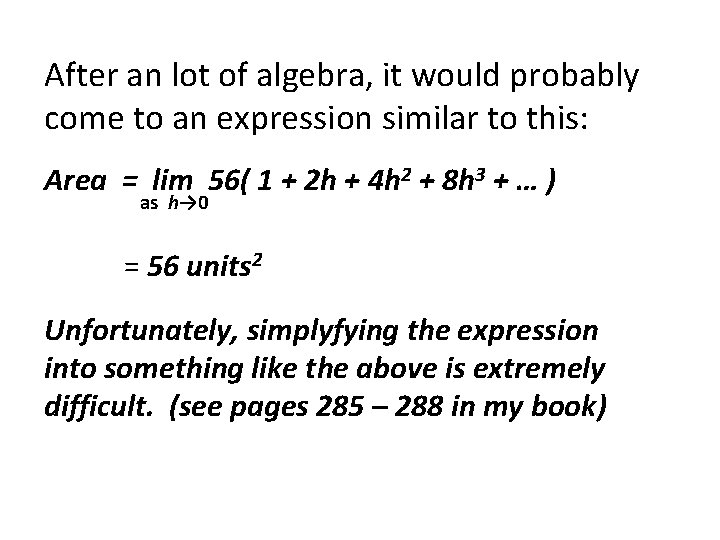
After an lot of algebra, it would probably come to an expression similar to this: Area = lim 56( 1 + 2 h + 4 h 2 + 8 h 3 + … ) as h→ 0 = 56 units 2 Unfortunately, simplyfying the expression into something like the above is extremely difficult. (see pages 285 – 288 in my book)
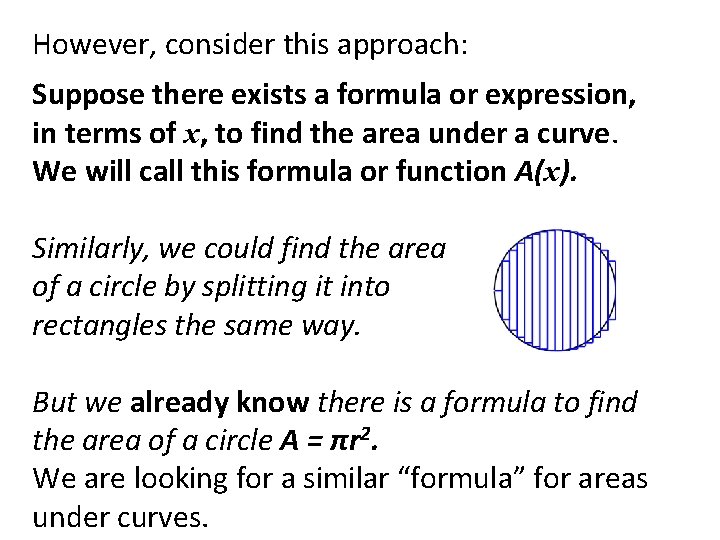
However, consider this approach: Suppose there exists a formula or expression, in terms of x, to find the area under a curve. We will call this formula or function A(x). Similarly, we could find the area of a circle by splitting it into rectangles the same way. But we already know there is a formula to find the area of a circle A = πr 2. We are looking for a similar “formula” for areas under curves.
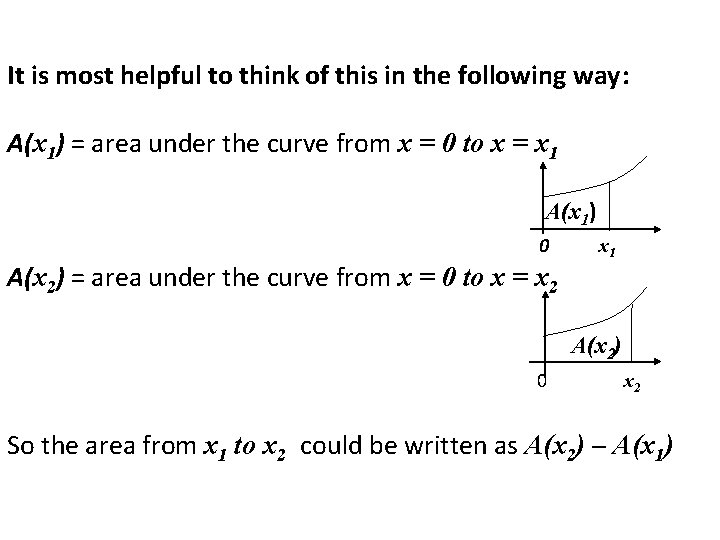
It is most helpful to think of this in the following way: A(x 1) = area under the curve from x = 0 to x = x 1 A(x 1) 0 A(x 2) = area under the curve from x = 0 to x = x 2 x 1 A(x 2) 0 x 2 So the area from x 1 to x 2 could be written as A(x 2) – A(x 1)
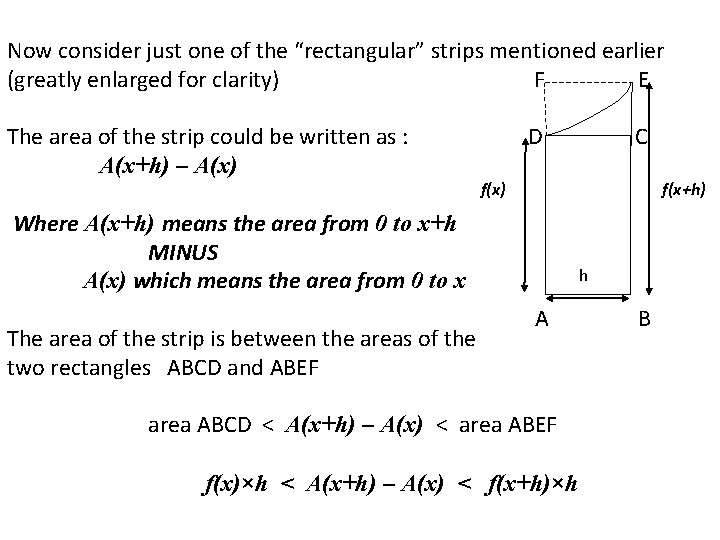
Now consider just one of the “rectangular” strips mentioned earlier (greatly enlarged for clarity) F E The area of the strip could be written as : A(x+h) – A(x) D f(x+h) f(x) Where A(x+h) means the area from 0 to x+h MINUS A(x) which means the area from 0 to x The area of the strip is between the areas of the two rectangles ABCD and ABEF C h A area ABCD < A(x+h) – A(x) < area ABEF f(x)×h < A(x+h) – A(x) < f(x+h)×h B
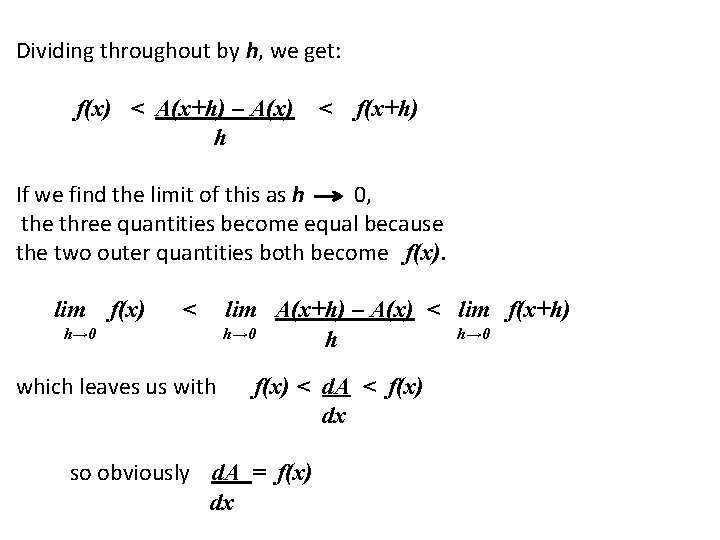
Dividing throughout by h, we get: f(x) < A(x+h) – A(x) h < f(x+h) If we find the limit of this as h 0, the three quantities become equal because the two outer quantities both become f(x). lim f(x) < h→ 0 which leaves us with lim A(x+h) – A(x) < lim f(x+h) h→ 0 h f(x) < d. A < f(x) dx so obviously d. A = f(x) dx
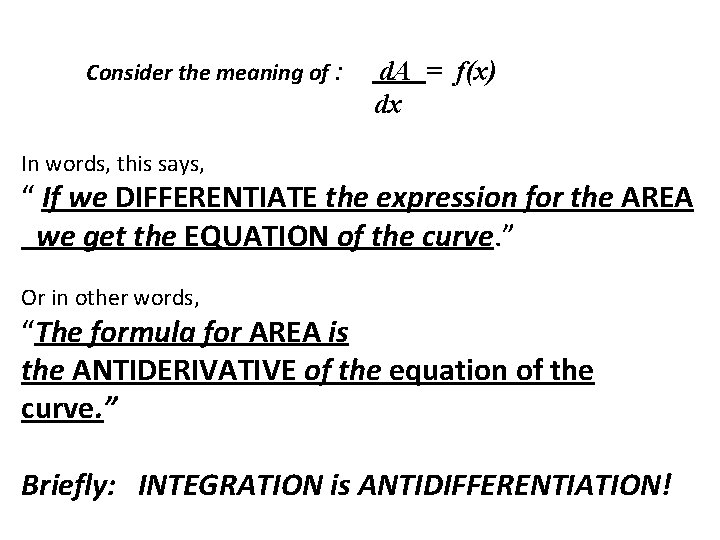
Consider the meaning of : d. A = f(x) dx In words, this says, “ If we DIFFERENTIATE the expression for the AREA we get the EQUATION of the curve. ” Or in other words, “The formula for AREA is the ANTIDERIVATIVE of the equation of the curve. ” Briefly: INTEGRATION is ANTIDIFFERENTIATION!
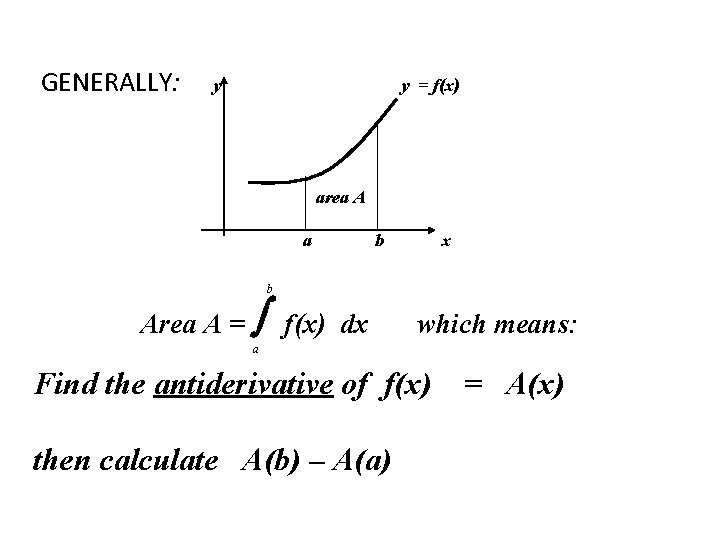
GENERALLY: y y = f(x) area A a b x b Area A = f(x) dx which means: a Find the antiderivative of f(x) then calculate A(b) – A(a) = A(x)
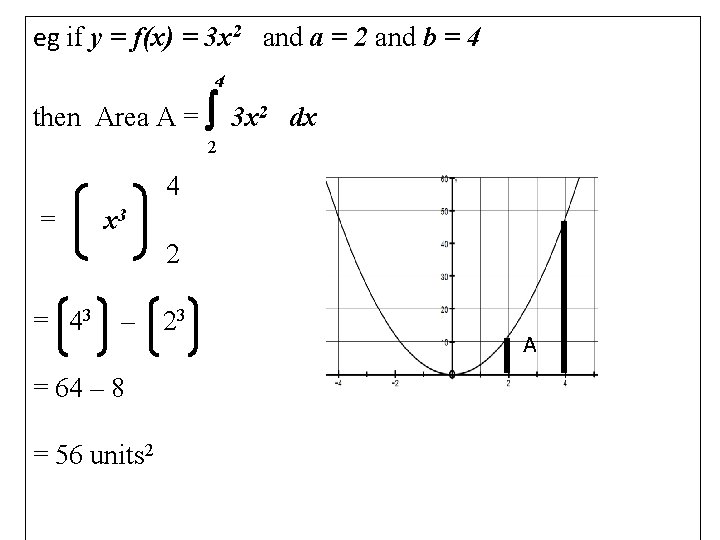
eg if y = f(x) = 3 x 2 and a = 2 and b = 4 4 then Area A = 3 x 2 dx 2 4 = x 3 2 = 43 – = 64 – 8 = 56 units 2 23 A