
The Fundamental Theorem of Algebra Skill 13 Objectives
The Fundamental Theorem of Algebra Skill #13

Objectives… �Use the Fundamental Theorem of Algebra to determine the number of zeros of a polynomial function. �Find all zeros of polynomial functions, including complex zeros. �Find conjugate pairs of complex zeros. �Find zeros of polynomials by factoring.
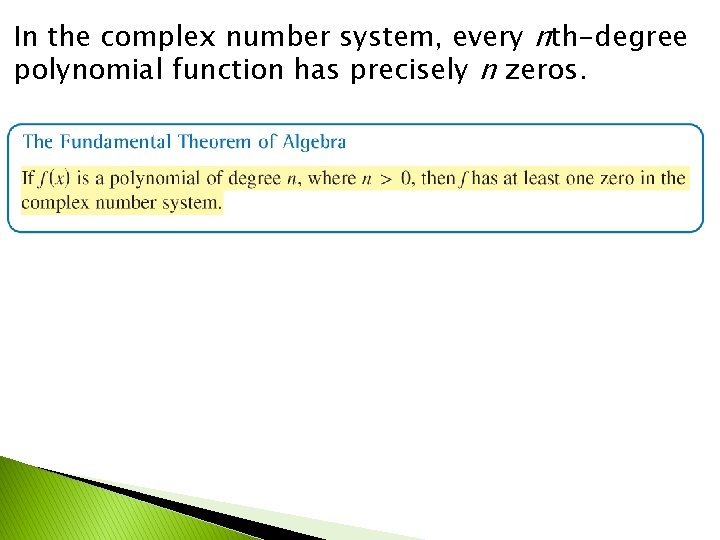
In the complex number system, every nth-degree polynomial function has precisely n zeros.
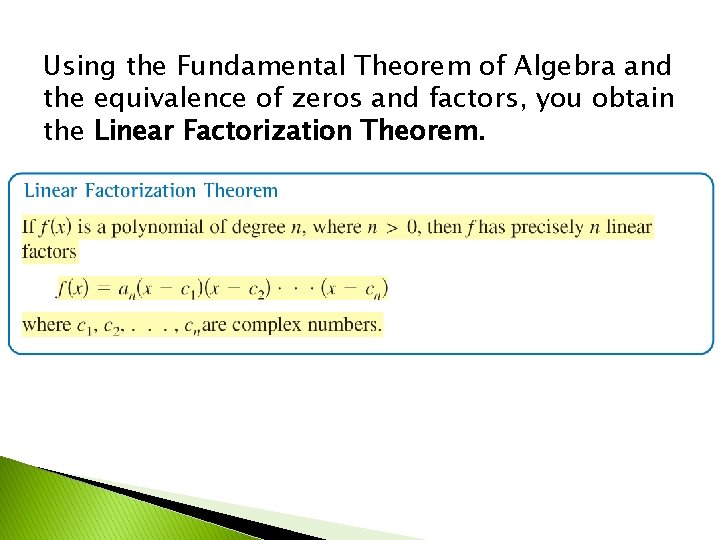
Using the Fundamental Theorem of Algebra and the equivalence of zeros and factors, you obtain the Linear Factorization Theorem.
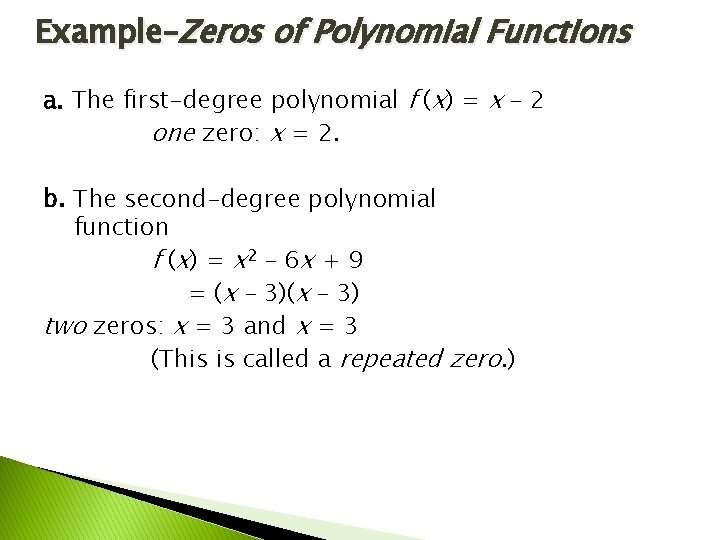
Example–Zeros of Polynomial Functions a. The first-degree polynomial f (x) = x – 2 one zero: x = 2. b. The second-degree polynomial function f ( x) = x 2 – 6 x + 9 = (x – 3) two zeros: x = 3 and x = 3 (This is called a repeated zero. )
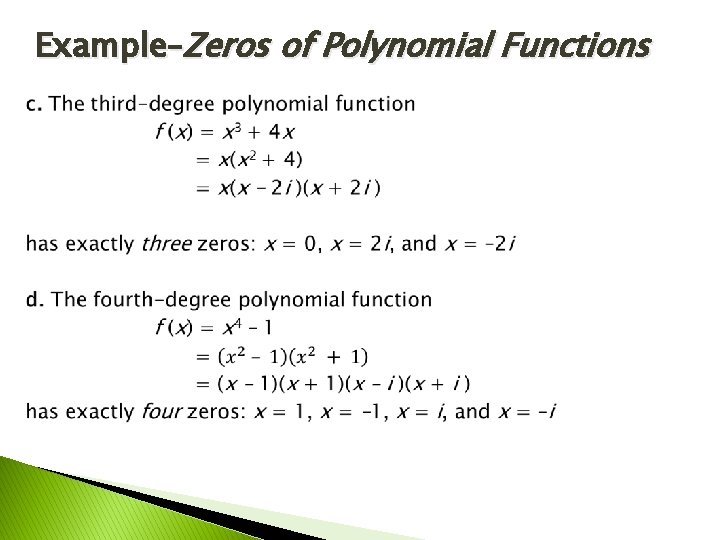
Example–Zeros of Polynomial Functions
Remember that the n zeros of a polynomial function can be real or complex, and they may be repeated.

Example–Real and Complex Zeros of a Polynomial Function Find the zeros of the third-degree polynomial function f (x ) = x 3 + 4 x Solution: x(x – 2 i )(x + 2 i ) = 0 x=0 x – 2 i = 0 x + 2 i = 0 x = 2 i x = – 2 i
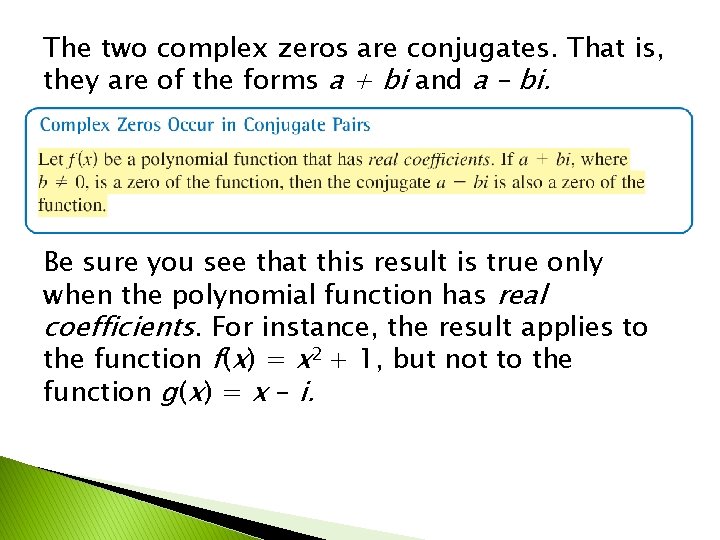
The two complex zeros are conjugates. That is, they are of the forms a + bi and a – bi. Be sure you see that this result is true only when the polynomial function has real coefficients. For instance, the result applies to the function f (x) = x 2 + 1, but not to the function g (x) = x – i.
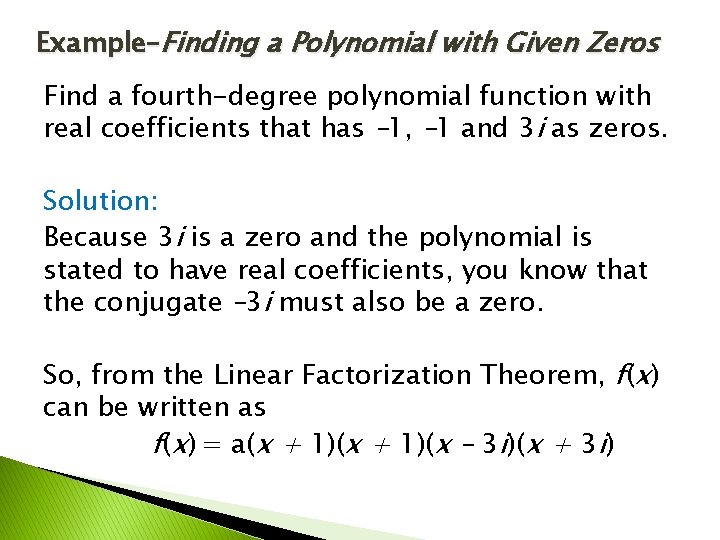
Example–Finding a Polynomial with Given Zeros Find a fourth-degree polynomial function with real coefficients that has – 1, – 1 and 3 i as zeros. Solution: Because 3 i is a zero and the polynomial is stated to have real coefficients, you know that the conjugate – 3 i must also be a zero. So, from the Linear Factorization Theorem, f (x) can be written as f (x) = a(x + 1)(x – 3 i )(x + 3 i )
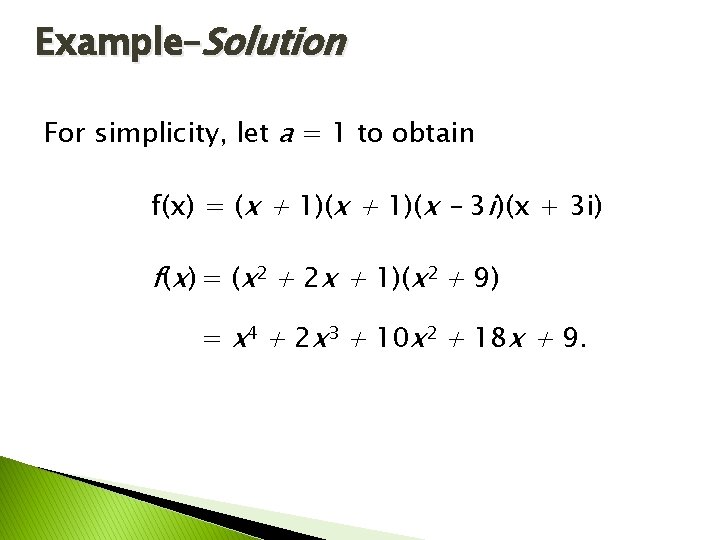
Example–Solution For simplicity, let a = 1 to obtain f(x) = (x + 1)(x – 3 i )(x + 3 i) f (x) = (x 2 + 2 x + 1)(x 2 + 9) = x 4 + 2 x 3 + 10 x 2 + 18 x + 9.

Factoring a Polynomial The Linear Factorization Theorem states that you can write any nth-degree polynomial as the product of n linear factors. f (x) = an(x – c 1)(x – c 2)(x – c 3). . (x – cn)
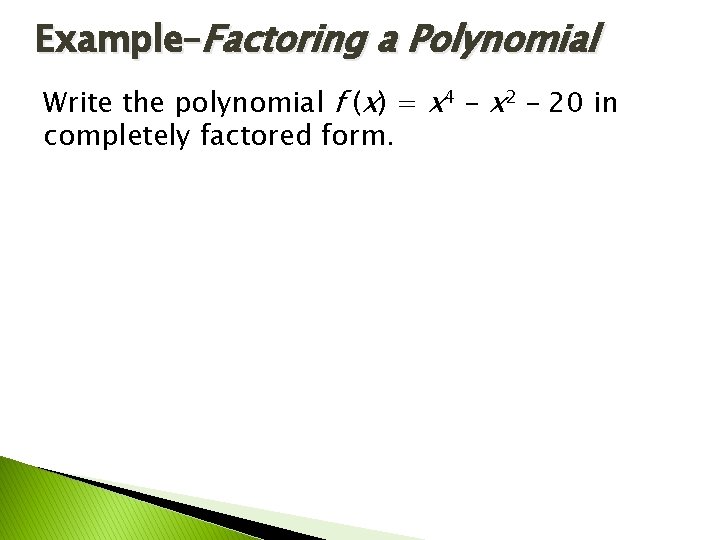
Example–Factoring a Polynomial Write the polynomial f (x) = x 4 – x 2 – 20 in completely factored form.
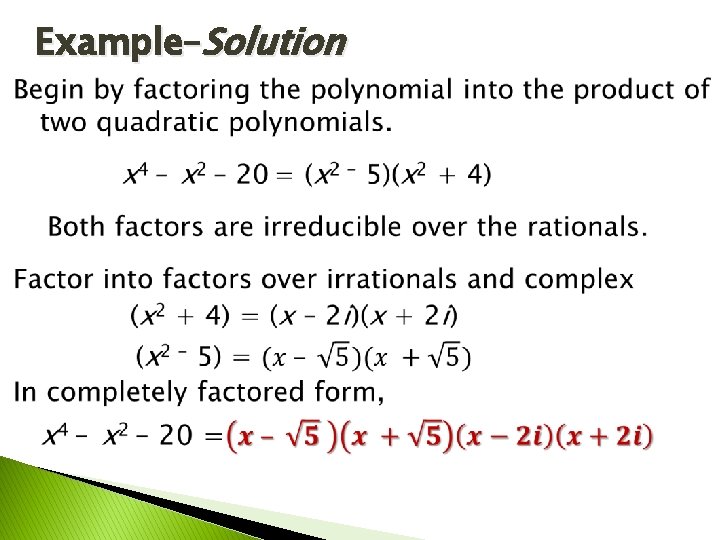
Example–Solution
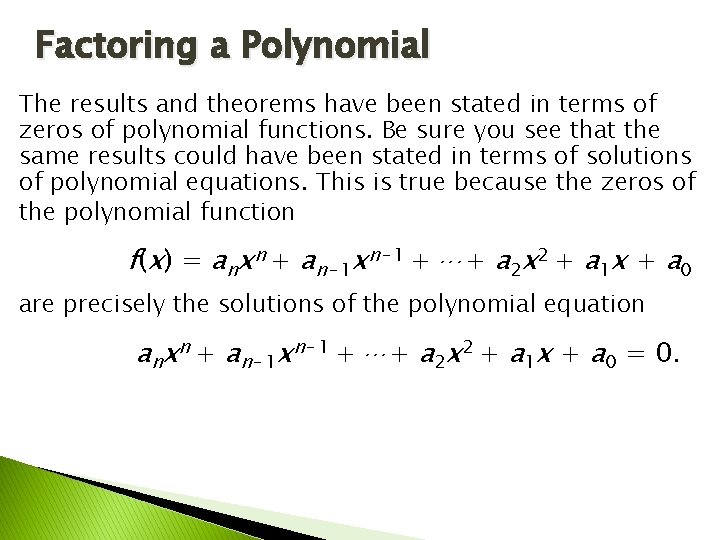
Factoring a Polynomial The results and theorems have been stated in terms of zeros of polynomial functions. Be sure you see that the same results could have been stated in terms of solutions of polynomial equations. This is true because the zeros of the polynomial function f (x ) = an x n + an – 1 x n – 1 +. . . + a 2 x 2 + a 1 x + a 0 are precisely the solutions of the polynomial equation anxn + an – 1 xn – 1 +. . . + a 2 x 2 + a 1 x + a 0 = 0.
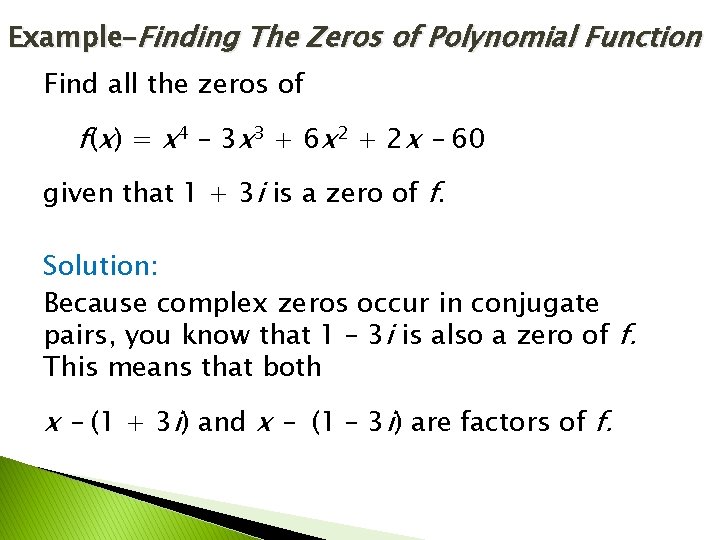
Example–Finding The Zeros of Polynomial Function Find all the zeros of f (x) = x 4 – 3 x 3 + 6 x 2 + 2 x – 60 given that 1 + 3 i is a zero of f. Solution: Because complex zeros occur in conjugate pairs, you know that 1 – 3 i is also a zero of f. This means that both x – (1 + 3 i ) and x – (1 – 3 i ) are factors of f.
![Example–Solution Multiplying these two factors produces [x – (1 + 3 i )][x –](http://slidetodoc.com/presentation_image_h2/16c98772f8dc5c6c4e2c012f9760f100/image-17.jpg "Example–Solution Multiplying these two factors produces [x – (1 + 3 i )][x –")
Example–Solution Multiplying these two factors produces [x – (1 + 3 i )][x – (1 – 3 i ) = [(x – 1) – 3 i ][(x – 1) + 3 i ] = (x – 1)2 – 9 i 2 = x 2 – 2 x + 10. Using long division, you can divide x 2 – 2 x + 10 into f to obtain the following.
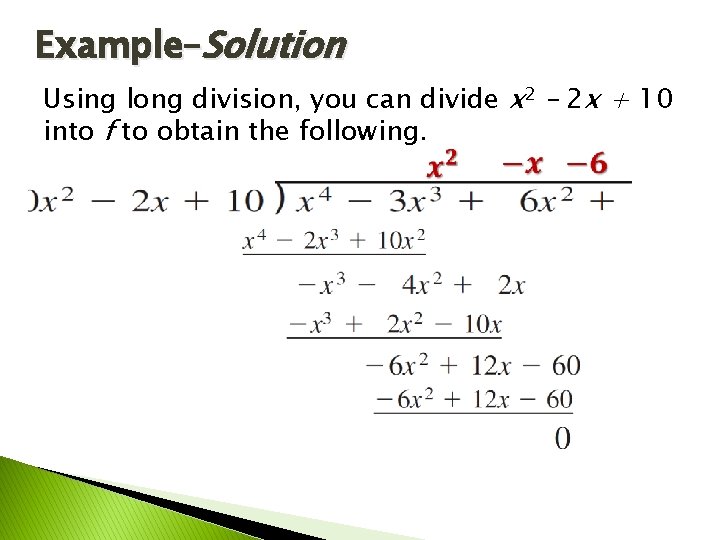
Example–Solution Using long division, you can divide x 2 – 2 x + 10 into f to obtain the following.
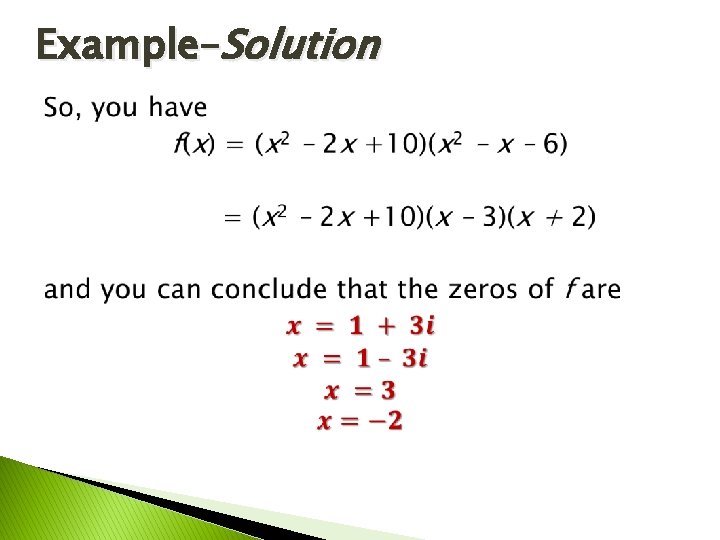
Example–Solution
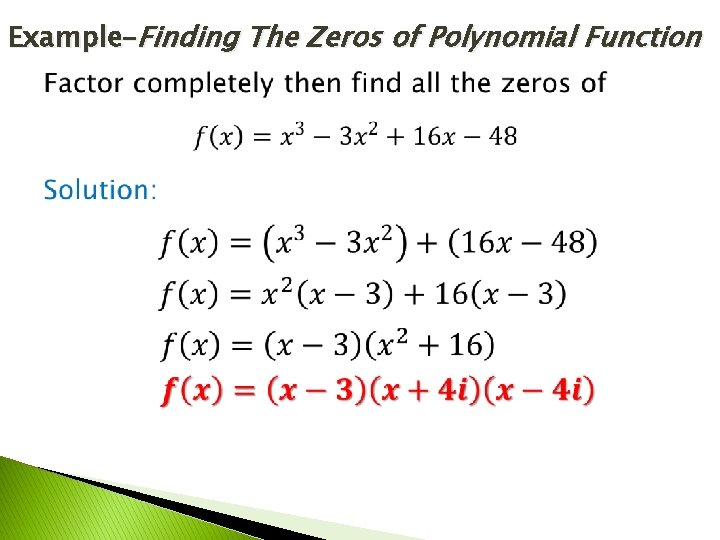
Example–Finding The Zeros of Polynomial Function
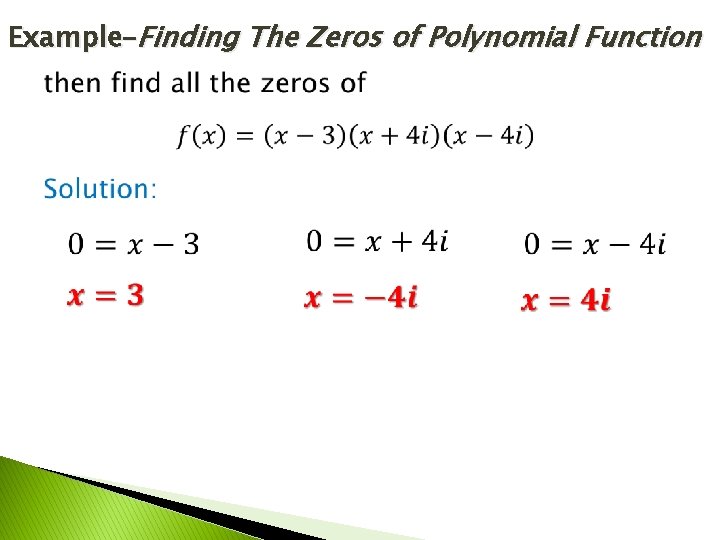
Example–Finding The Zeros of Polynomial Function

Skill #13: The Fundamental Theorem of Algebra � Summarize � Questions? � Homework ◦ Worksheet � Quiz Notes
- Slides: 22