
The Functional Vision Evaluation Made just a bit
The Functional Vision Evaluation Made just a bit easier 1 By Debbie (Cricket) Cady
APPEARANCE OF EYES TEST ITEM MATERIAL SUGGESTIONS PROCEDURES � May indicate a visual impairment. Note how the student's eyes appear, and whether or not glasses are worn. � 2

BLINK REFLEX TEST ITEM & Indications � Possible light to gross object perception. � Blinking occurs in response to movement toward face. � Hand, object, bright light. � Quickly move object toward child's face, making sure it doesn't make a sound or produce a breeze that would be reacted to. MATERIALS SUGGESTION S PROCEDURES 3
PUPILLARY RESPONSE TEST ITEM & Indications MATERIALS SUGGESTION S Neurological response to light. Light perception. Sensitivity to light. May not be able to see things clearly if there's a sudden shift in distance. � Pupils of the eye constrict when light is presented and readjust when light is removed. � � � � � PROCEDURES � Penlight, bandana or cloth. 1 a. Observe pupils without light stimulation. 1 b. Shine light indirectly into eyes from 12". 1 c. Remove light. 2. Play "Peek-a-Boo", noting the pupils' response to more/less light. 3. Observe whether response is brisk, sluggish, absent. 4
AWARENESS & LOCALIZATION TEST ITEM & Indications MATERIALS SUGGESTION S PROCEDURES Awareness of visual stimuli. First indication of degree of visual loss. Light perception, light projection, shadow and form perception. � Detection of motion. � Will visually and/or physically react to objects. � � � A familiar face, flashlight/penlight with color caps or finger puppets, black & white or fluorescent patterned cards, checkerboard, pinwheel. � Note reactions to various stimuli, such as light, objects blocking light, fixation to objects, eye orientation, head turn to movement. � 5
EYE CONTACT TEST ITEM & Indications Important part of the development of integration of visual-motor & cognitive behavior. � Will make eye contact. � MATERIALS You or others in the environment. � Observe child during social interactions to determine signs of established eye contact. � SUGGESTION S PROCEDURES 6
FIXATION TEST ITEM & Indications MATERIALS SUGGESTION S PROCEDURES Ability to establish and maintain gaze. � Roving eye movements usually mean very low visual acuity. � Looks at object for minimum of 3 seconds. � Flashlight/penlight with color caps/finger puppets, object, bottle, cup, hands, feet. � Attract attention in various fields, at various distances. � Note if fixation doesn't occur in certain area, if there is a head turn, or eccentric viewing. � 7
MUSCLE BALANCE TEST ITEM & Indications MATERIALS SUGGESTION S PROCEDURES Muscle imbalance. Using the eyes separately. Possible double vision. Eye muscles affect acuity, tracking ability, and peripheral vision. � Both eyes should move in the same direction at the same time. � � Pen light, plastic occluder. Hirschberg Test: Shine penlight to the bridge of the nose and note the reflection, which should be symmetrical in both eyes. � Cover/Uncover at Near: Have child continuously focus on object, while covering/uncovering one eye at a time with occluder or hand. � There should be no movement in the eye that is being covered and uncovered. � Cover/Uncover at Distance: Repeat procedure having child focus on object further away. � � 8
TRACKING *1 mo. - horizontally to midline *2 mo. - vertically *4 mo. - across midline TEST ITEM & Indications � � � � � MATERIALS � � SUGGESTION S � � � PROCEDURES � Ability to keep eyes on a moving target. Ability to move eyes in certain quadrants. The extent of the visual field. Muscle balance. Difficulty tracking across midline. Will visually follow a moving light or object. Tracking with eyes only is a higher level of skill than tracking with eyes and head, or with eyes and finger or other guide. May easily lose place on page when reading. May have a slow reaction to fast-moving objects. Flashlight/penlight with color caps/finger puppets, object, toy, puppet, balloon, ball. For academic student: add reading material. Hold object of attention about 8 -12" from child. Move it slowly in a large H and O pattern, to cover right and left, up and down, diagonal, and circular lines of movement. Note whether tracking is smooth or jerky; with one or both eyes. For checking distance tracking - roll a ball 2 -5' away. For academic student - note whether the student loses his place within a line, skips a line, uses finger as a pointer, or needs a typoscope or guide. 9
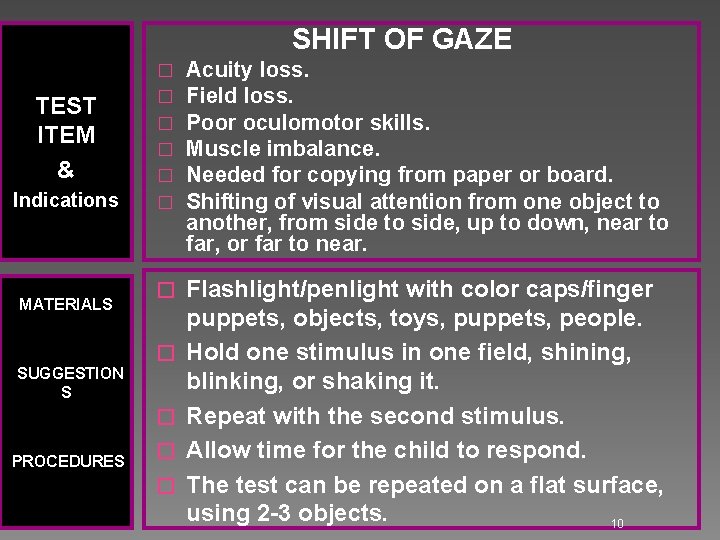
SHIFT OF GAZE TEST ITEM & Indications MATERIALS � � � Acuity loss. Field loss. Poor oculomotor skills. Muscle imbalance. Needed for copying from paper or board. Shifting of visual attention from one object to another, from side to side, up to down, near to far, or far to near. � Flashlight/penlight with color caps/finger puppets, objects, toys, puppets, people. Hold one stimulus in one field, shining, blinking, or shaking it. Repeat with the second stimulus. Allow time for the child to respond. The test can be repeated on a flat surface, using 2 -3 objects. 10 � SUGGESTION S � PROCEDURES � �
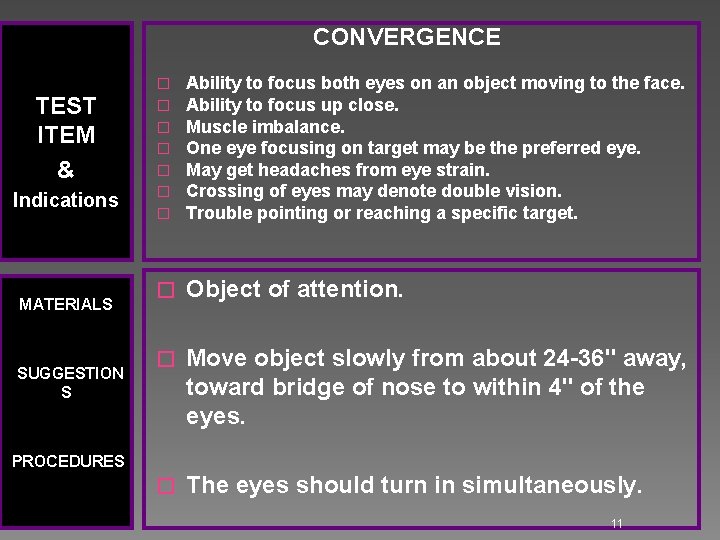
CONVERGENCE TEST ITEM & Indications MATERIALS SUGGESTION S � � � � Ability to focus both eyes on an object moving to the face. Ability to focus up close. Muscle imbalance. One eye focusing on target may be the preferred eye. May get headaches from eye strain. Crossing of eyes may denote double vision. Trouble pointing or reaching a specific target. � Object of attention. � Move object slowly from about 24 -36" away, toward bridge of nose to within 4" of the eyes. � The eyes should turn in simultaneously. PROCEDURES 11
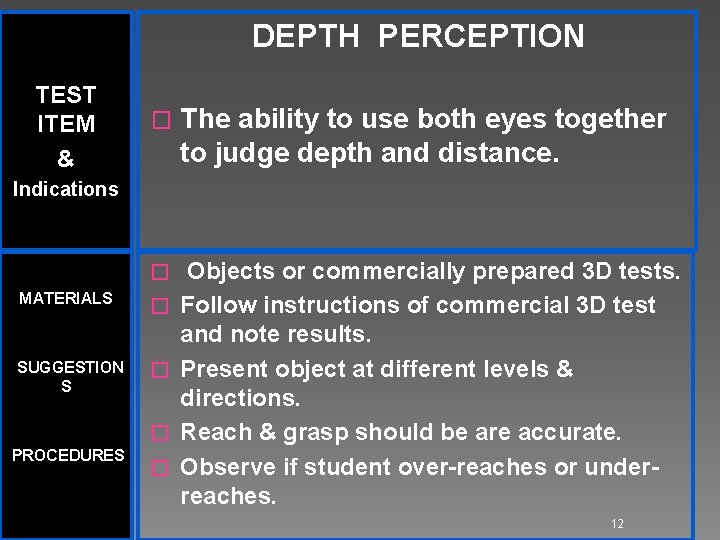
DEPTH PERCEPTION TEST ITEM & � The ability to use both eyes together to judge depth and distance. � Objects or commercially prepared 3 D tests. Follow instructions of commercial 3 D test and note results. Present object at different levels & directions. Reach & grasp should be are accurate. Observe if student over-reaches or underreaches. Indications MATERIALS SUGGESTION S � � � PROCEDURES � 12
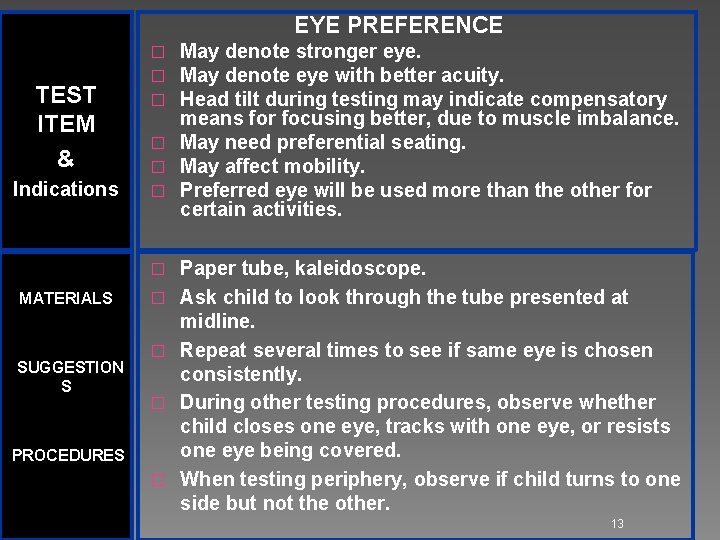
EYE PREFERENCE TEST ITEM & Indications May denote stronger eye. May denote eye with better acuity. Head tilt during testing may indicate compensatory means for focusing better, due to muscle imbalance. � May need preferential seating. � May affect mobility. � Preferred eye will be used more than the other for certain activities. � � MATERIALS SUGGESTION S � � � PROCEDURES � Paper tube, kaleidoscope. Ask child to look through the tube presented at midline. Repeat several times to see if same eye is chosen consistently. During other testing procedures, observe whether child closes one eye, tracks with one eye, or resists one eye being covered. When testing periphery, observe if child turns to one side but not the other. 13
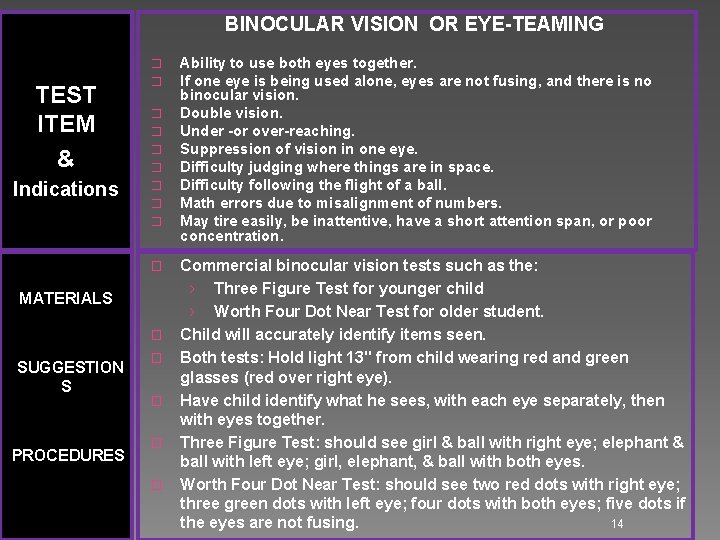
BINOCULAR VISION OR EYE-TEAMING TEST ITEM & Indications � � � � � MATERIALS � SUGGESTION S PROCEDURES � � Ability to use both eyes together. If one eye is being used alone, eyes are not fusing, and there is no binocular vision. Double vision. Under -or over-reaching. Suppression of vision in one eye. Difficulty judging where things are in space. Difficulty following the flight of a ball. Math errors due to misalignment of numbers. May tire easily, be inattentive, have a short attention span, or poor concentration. Commercial binocular vision tests such as the: › Three Figure Test for younger child › Worth Four Dot Near Test for older student. Child will accurately identify items seen. Both tests: Hold light 13" from child wearing red and green glasses (red over right eye). Have child identify what he sees, with each eye separately, then with eyes together. Three Figure Test: should see girl & ball with right eye; elephant & ball with left eye; girl, elephant, & ball with both eyes. Worth Four Dot Near Test: should see two red dots with right eye; three green dots with left eye; four dots with both eyes; five dots if 14 the eyes are not fusing.
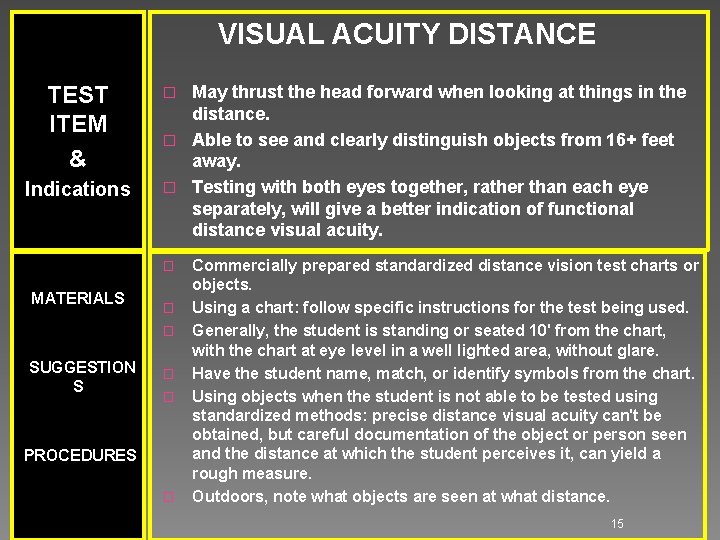
VISUAL ACUITY DISTANCE TEST ITEM & Indications � May thrust the head forward when looking at things in the distance. � Able to see and clearly distinguish objects from 16+ feet away. � Testing with both eyes together, rather than each eye separately, will give a better indication of functional distance visual acuity. � MATERIALS � � SUGGESTION S � � PROCEDURES � Commercially prepared standardized distance vision test charts or objects. Using a chart: follow specific instructions for the test being used. Generally, the student is standing or seated 10' from the chart, with the chart at eye level in a well lighted area, without glare. Have the student name, match, or identify symbols from the chart. Using objects when the student is not able to be tested using standardized methods: precise distance visual acuity can't be obtained, but careful documentation of the object or person seen and the distance at which the student perceives it, can yield a rough measure. Outdoors, note what objects are seen at what distance. 15
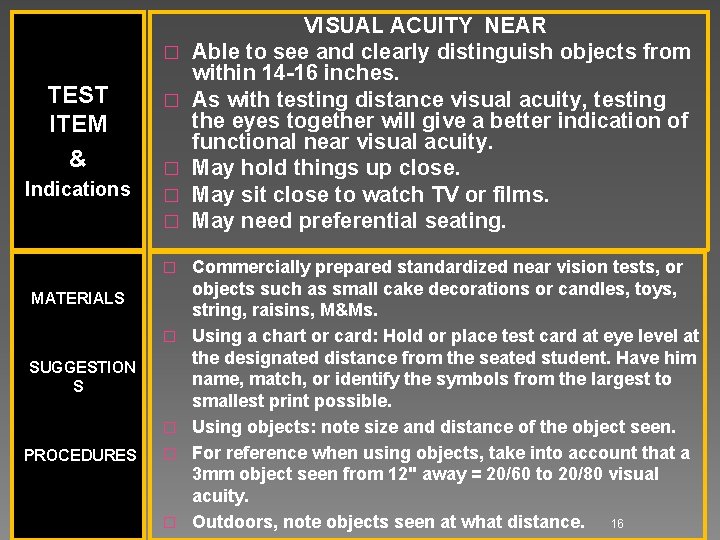
� TEST ITEM & Indications � � � MATERIALS � SUGGESTION S � PROCEDURES � � VISUAL ACUITY NEAR Able to see and clearly distinguish objects from within 14 -16 inches. As with testing distance visual acuity, testing the eyes together will give a better indication of functional near visual acuity. May hold things up close. May sit close to watch TV or films. May need preferential seating. Commercially prepared standardized near vision tests, or objects such as small cake decorations or candles, toys, string, raisins, M&Ms. Using a chart or card: Hold or place test card at eye level at the designated distance from the seated student. Have him name, match, or identify the symbols from the largest to smallest print possible. Using objects: note size and distance of the object seen. For reference when using objects, take into account that a 3 mm object seen from 12" away = 20/60 to 20/80 visual acuity. Outdoors, note objects seen at what distance. 16
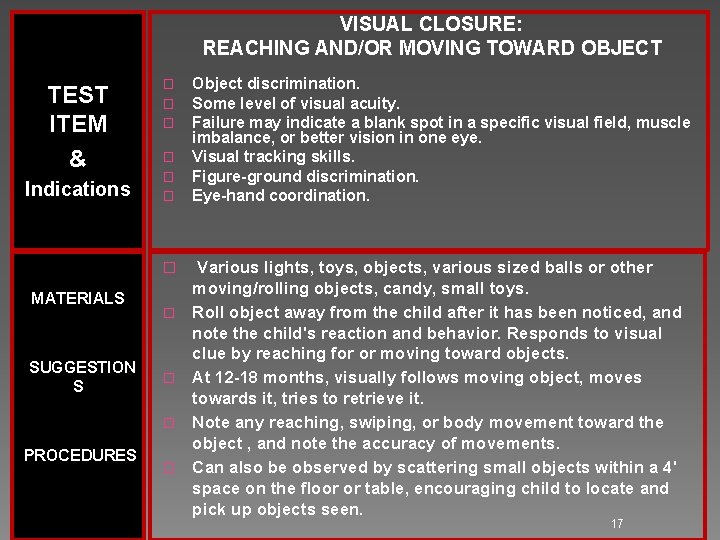
VISUAL CLOSURE: REACHING AND/OR MOVING TOWARD OBJECT TEST ITEM & Indications � Various lights, toys, objects, various sized balls or other � MATERIALS � � � Object discrimination. Some level of visual acuity. Failure may indicate a blank spot in a specific visual field, muscle imbalance, or better vision in one eye. Visual tracking skills. Figure-ground discrimination. Eye-hand coordination. � � � SUGGESTION S � � PROCEDURES � moving/rolling objects, candy, small toys. Roll object away from the child after it has been noticed, and note the child's reaction and behavior. Responds to visual clue by reaching for or moving toward objects. At 12 -18 months, visually follows moving object, moves towards it, tries to retrieve it. Note any reaching, swiping, or body movement toward the object , and note the accuracy of movements. Can also be observed by scattering small objects within a 4' space on the floor or table, encouraging child to locate and pick up objects seen. 17
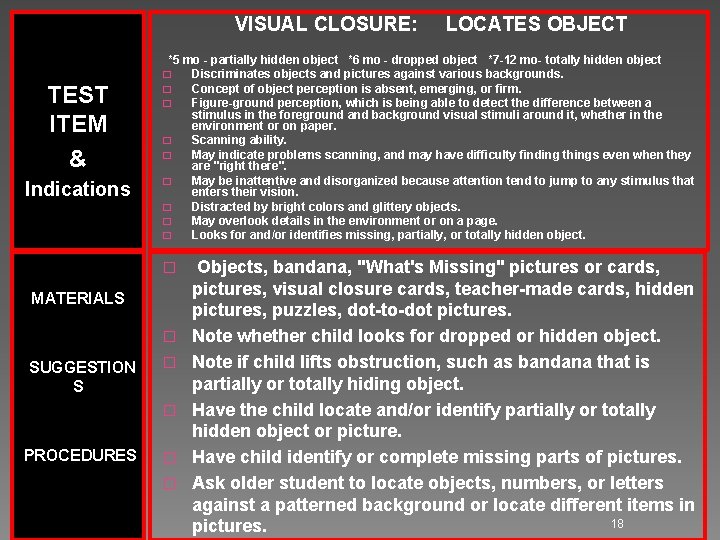
VISUAL CLOSURE: LOCATES OBJECT *5 mo - partially hidden object *6 mo - dropped object *7 -12 mo- totally hidden object TEST ITEM & Indications � � � � � MATERIALS � SUGGESTION S � � PROCEDURES � � Discriminates objects and pictures against various backgrounds. Concept of object perception is absent, emerging, or firm. Figure-ground perception, which is being able to detect the difference between a stimulus in the foreground and background visual stimuli around it, whether in the environment or on paper. Scanning ability. May indicate problems scanning, and may have difficulty finding things even when they are "right there". May be inattentive and disorganized because attention tend to jump to any stimulus that enters their vision. Distracted by bright colors and glittery objects. May overlook details in the environment or on a page. Looks for and/or identifies missing, partially, or totally hidden object. Objects, bandana, "What's Missing" pictures or cards, pictures, visual closure cards, teacher-made cards, hidden pictures, puzzles, dot-to-dot pictures. Note whether child looks for dropped or hidden object. Note if child lifts obstruction, such as bandana that is partially or totally hiding object. Have the child locate and/or identify partially or totally hidden object or picture. Have child identify or complete missing parts of pictures. Ask older student to locate objects, numbers, or letters against a patterned background or locate different items in 18 pictures.
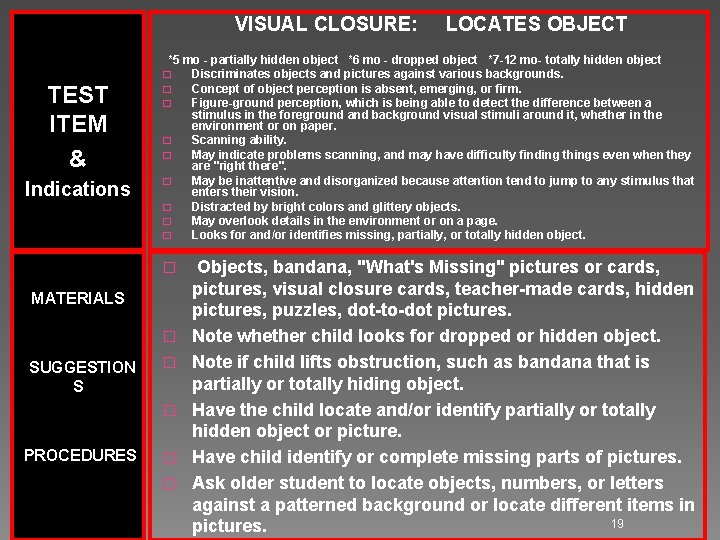
VISUAL CLOSURE: LOCATES OBJECT *5 mo - partially hidden object *6 mo - dropped object *7 -12 mo- totally hidden object TEST ITEM & Indications � � � � � MATERIALS � SUGGESTION S � � PROCEDURES � � Discriminates objects and pictures against various backgrounds. Concept of object perception is absent, emerging, or firm. Figure-ground perception, which is being able to detect the difference between a stimulus in the foreground and background visual stimuli around it, whether in the environment or on paper. Scanning ability. May indicate problems scanning, and may have difficulty finding things even when they are "right there". May be inattentive and disorganized because attention tend to jump to any stimulus that enters their vision. Distracted by bright colors and glittery objects. May overlook details in the environment or on a page. Looks for and/or identifies missing, partially, or totally hidden object. Objects, bandana, "What's Missing" pictures or cards, pictures, visual closure cards, teacher-made cards, hidden pictures, puzzles, dot-to-dot pictures. Note whether child looks for dropped or hidden object. Note if child lifts obstruction, such as bandana that is partially or totally hiding object. Have the child locate and/or identify partially or totally hidden object or picture. Have child identify or complete missing parts of pictures. Ask older student to locate objects, numbers, or letters against a patterned background or locate different items in 19 pictures.
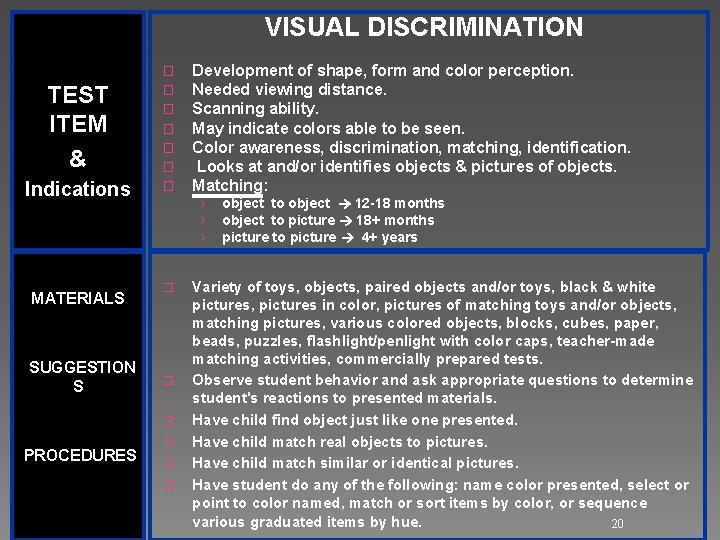
VISUAL DISCRIMINATION TEST ITEM & Indications SUGGESTION S � � � PROCEDURES Development of shape, form and color perception. Needed viewing distance. Scanning ability. May indicate colors able to be seen. Color awareness, discrimination, matching, identification. Looks at and/or identifies objects & pictures of objects. Matching: › › › MATERIALS � � � � � object to object 12 -18 months object to picture 18+ months picture to picture 4+ years Variety of toys, objects, paired objects and/or toys, black & white pictures, pictures in color, pictures of matching toys and/or objects, matching pictures, various colored objects, blocks, cubes, paper, beads, puzzles, flashlight/penlight with color caps, teacher-made matching activities, commercially prepared tests. Observe student behavior and ask appropriate questions to determine student's reactions to presented materials. Have child find object just like one presented. Have child match real objects to pictures. Have child match similar or identical pictures. Have student do any of the following: name color presented, select or point to color named, match or sort items by color, or sequence various graduated items by hue. 20
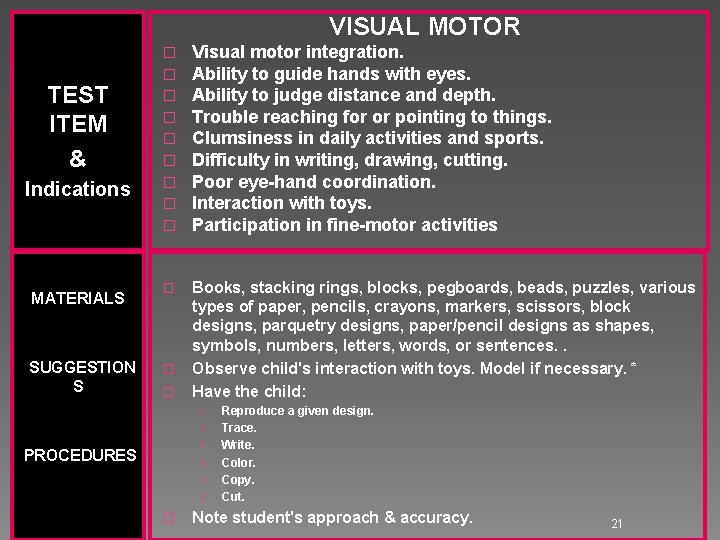
VISUAL MOTOR TEST ITEM & Indications MATERIALS SUGGESTION S � � � � � Visual motor integration. Ability to guide hands with eyes. Ability to judge distance and depth. Trouble reaching for or pointing to things. Clumsiness in daily activities and sports. Difficulty in writing, drawing, cutting. Poor eye-hand coordination. Interaction with toys. Participation in fine-motor activities Books, stacking rings, blocks, pegboards, beads, puzzles, various types of paper, pencils, crayons, markers, scissors, block designs, parquetry designs, paper/pencil designs as shapes, symbols, numbers, letters, words, or sentences. . � Observe child's interaction with toys. Model if necessary. * � Have the child: � › › › PROCEDURES � Reproduce a given design. Trace. Write. Color. Copy. Cut. Note student's approach & accuracy. 21
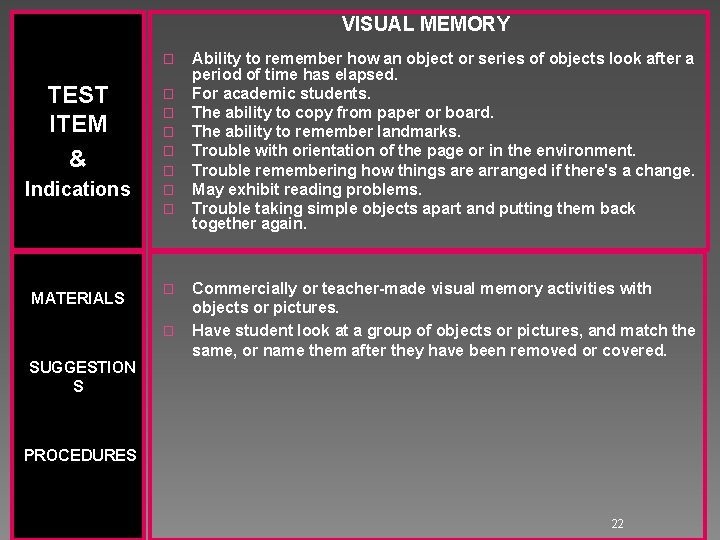
VISUAL MEMORY � TEST ITEM & Indications MATERIALS SUGGESTION S � � � � Ability to remember how an object or series of objects look after a period of time has elapsed. For academic students. The ability to copy from paper or board. The ability to remember landmarks. Trouble with orientation of the page or in the environment. Trouble remembering how things are arranged if there's a change. May exhibit reading problems. Trouble taking simple objects apart and putting them back together again. Commercially or teacher-made visual memory activities with objects or pictures. � Have student look at a group of objects or pictures, and match the same, or name them after they have been removed or covered. � PROCEDURES 22
- Slides: 22