
The Functional Mockup Interface for Tool independent Exchange



- Slides: 24
The Functional Mockup Interface for Tool independent Exchange of Simulation Models Torsten Blochwitz (ITI), Martin Otter (DLR-RM) M. Arnold University of Halle C. Bausch, M. Monteiro C. Clauß, S. Wolf H. Elmqvist, H. Olsson A. Junghanns, J. Mauss T. Neidhold D. Neumerkel J. -V. Peetz Atego Systems Gmb. H Fraunhofer IIS EAS, Dresden Dassault Systèmes, Lund QTronic, Berlin ITI, Dresden, Daimler AG, Stuttgart Fraunhofer SCAI, St. Augustin Modelica 2011, 21 st, 22 nd March
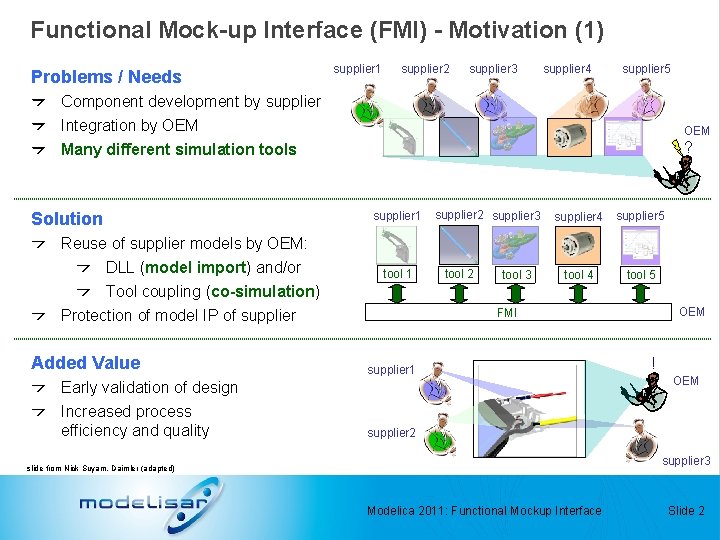
Functional Mock-up Interface (FMI) - Motivation (1) Problems / Needs supplier 1 supplier 2 supplier 3 supplier 4 supplier 5 Component development by supplier Integration by OEM Many different simulation tools ? Solution supplier 1 supplier 2 supplier 3 supplier 4 supplier 5 tool 4 tool 5 Reuse of supplier models by OEM: DLL (model import) and/or tool 1 tool 2 tool 3 Tool coupling (co-simulation) Added Value supplier 1 Early validation of design Increased process efficiency and quality OEM FMI Protection of model IP of supplier ! OEM supplier 2 supplier 3 slide from Nick Suyam, Daimler (adapted) Modelica 2011: Functional Mockup Interface Slide 2
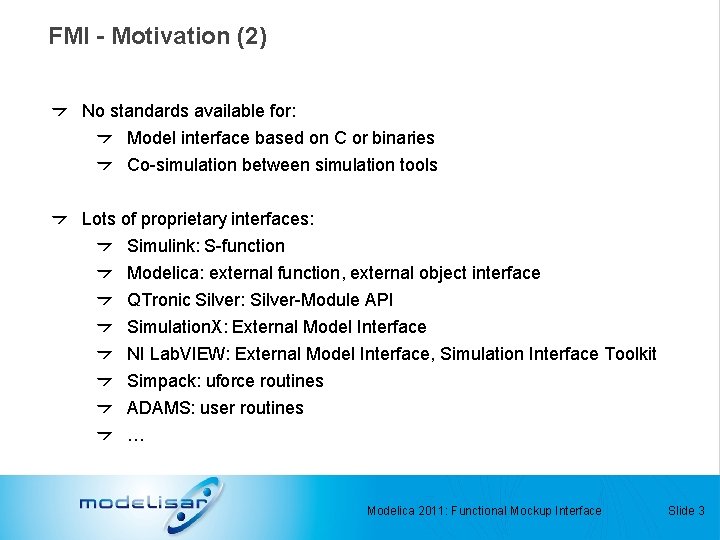
FMI - Motivation (2) No standards available for: Model interface based on C or binaries Co-simulation between simulation tools Lots of proprietary interfaces: Simulink: S-function Modelica: external function, external object interface QTronic Silver: Silver-Module API Simulation. X: External Model Interface NI Lab. VIEW: External Model Interface, Simulation Interface Toolkit Simpack: uforce routines ADAMS: user routines … Modelica 2011: Functional Mockup Interface Slide 3
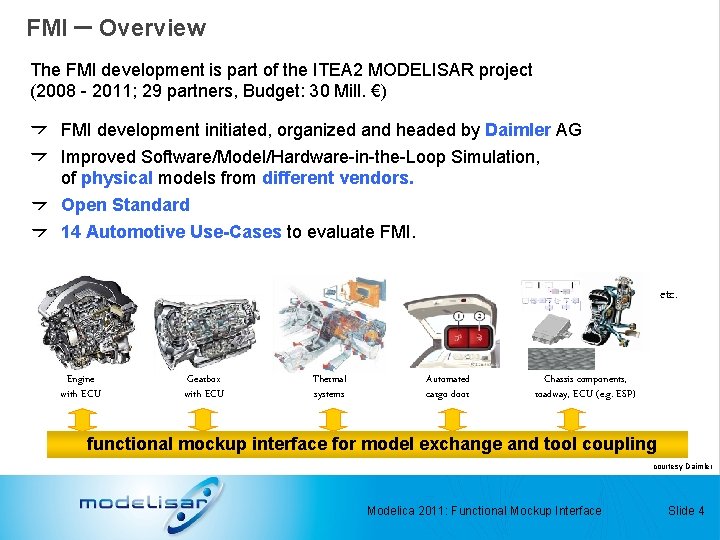
FMI – Overview The FMI development is part of the ITEA 2 MODELISAR project (2008 - 2011; 29 partners, Budget: 30 Mill. €) FMI development initiated, organized and headed by Daimler AG Improved Software/Model/Hardware-in-the-Loop Simulation, of physical models from different vendors. Open Standard 14 Automotive Use-Cases to evaluate FMI. etc. Engine with ECU Gearbox with ECU Thermal systems Automated cargo door Chassis components, roadway, ECU (e. g. ESP) functional mockup interface for model exchange and tool coupling courtesy Daimler Modelica 2011: Functional Mockup Interface Slide 4
FMI - Main Design Idea (1) FMI for Model Exchange: Tool FMU Solver Model Version 1. 0 released in January 2010 FMI for Co-Simulation: Reuses as much as possible from FMI for Model Exchange standard Tool FMU Model Solver Version 1. 0 released in October 2010 Modelica 2011: Functional Mockup Interface Slide 5
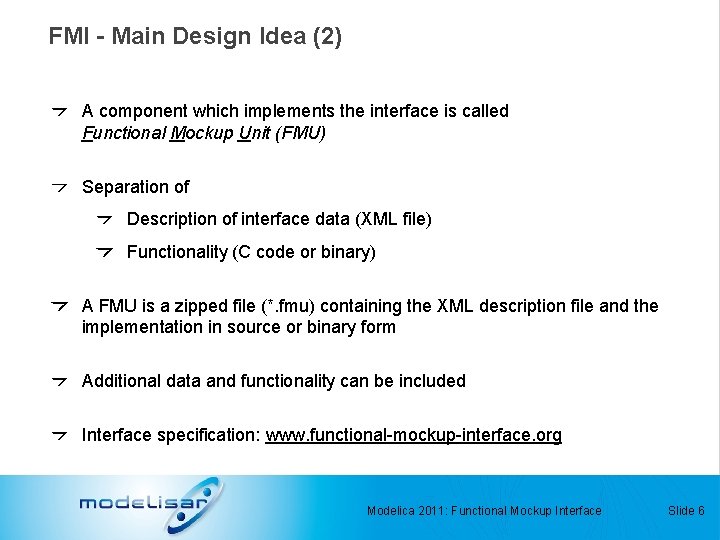
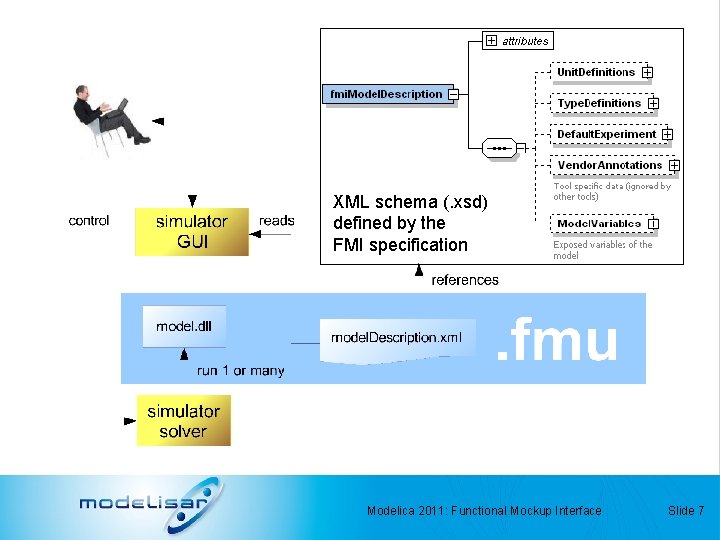
FMI - Main Design Idea (2) A component which implements the interface is called Functional Mockup Unit (FMU) Separation of Description of interface data (XML file) Functionality (C code or binary) A FMU is a zipped file (*. fmu) containing the XML description file and the implementation in source or binary form Additional data and functionality can be included Interface specification: www. functional-mockup-interface. org Modelica 2011: Functional Mockup Interface Slide 6
XML schema (. xsd) defined by the FMI specification Modelica 2011: Functional Mockup Interface Slide 7
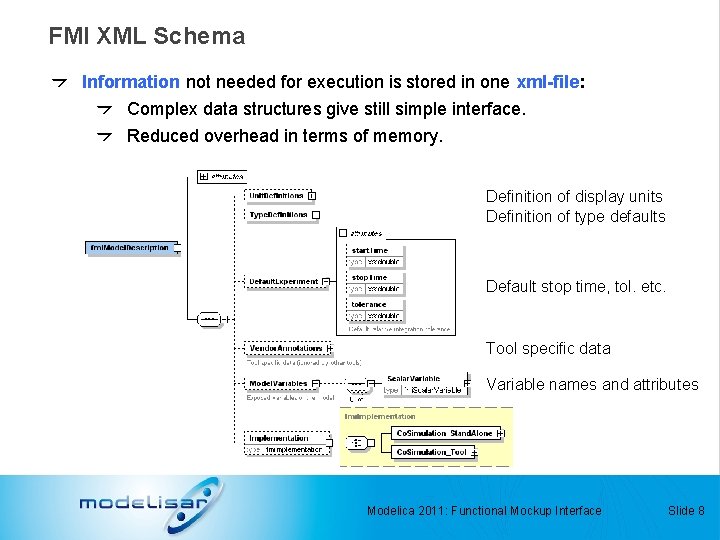
FMI XML Schema Information not needed for execution is stored in one xml-file: Complex data structures give still simple interface. Reduced overhead in terms of memory. Definition of display units Definition of type defaults Default stop time, tol. etc. Tool specific data Variable names and attributes Modelica 2011: Functional Mockup Interface Slide 8
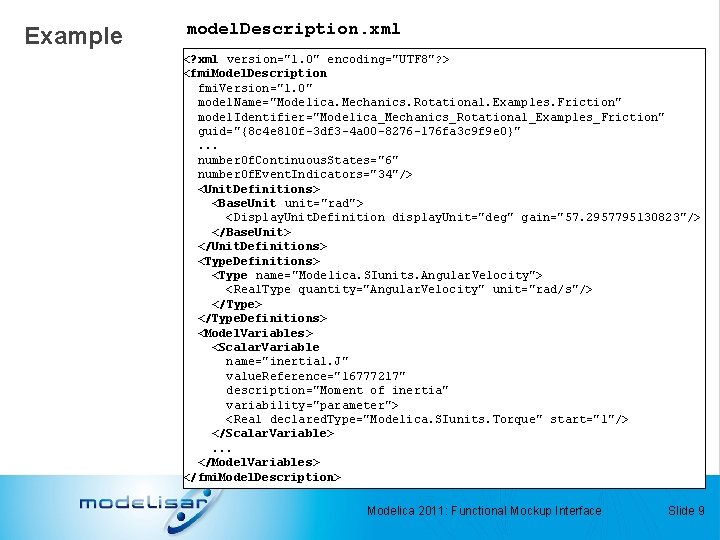
Example model. Description. xml <? xml version="1. 0" encoding="UTF 8"? > <fmi. Model. Description fmi. Version="1. 0" model. Name="Modelica. Mechanics. Rotational. Examples. Friction" model. Identifier="Modelica_Mechanics_Rotational_Examples_Friction" guid="{8 c 4 e 810 f-3 df 3 -4 a 00 -8276 -176 fa 3 c 9 f 9 e 0}". . . number. Of. Continuous. States="6" number. Of. Event. Indicators="34"/> <Unit. Definitions> <Base. Unit unit="rad"> <Display. Unit. Definition display. Unit="deg" gain="57. 2957795130823"/> </Base. Unit> </Unit. Definitions> <Type name="Modelica. SIunits. Angular. Velocity"> <Real. Type quantity="Angular. Velocity" unit="rad/s"/> </Type. Definitions> <Model. Variables> <Scalar. Variable name="inertia 1. J" value. Reference="16777217" description="Moment of inertia" variability="parameter"> <Real declared. Type="Modelica. SIunits. Torque" start="1"/> </Scalar. Variable>. . . </Model. Variables> </fmi. Model. Description> Modelica 2011: Functional Mockup Interface Slide 9
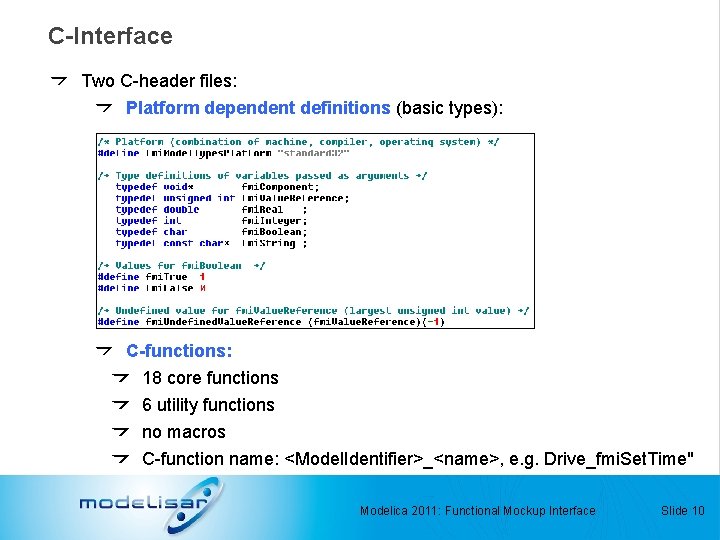
C-Interface Two C-header files: Platform dependent definitions (basic types): C-functions: 18 core functions 6 utility functions no macros C-function name: <Model. Identifier>_<name>, e. g. Drive_fmi. Set. Time" Modelica 2011: Functional Mockup Interface Slide 10
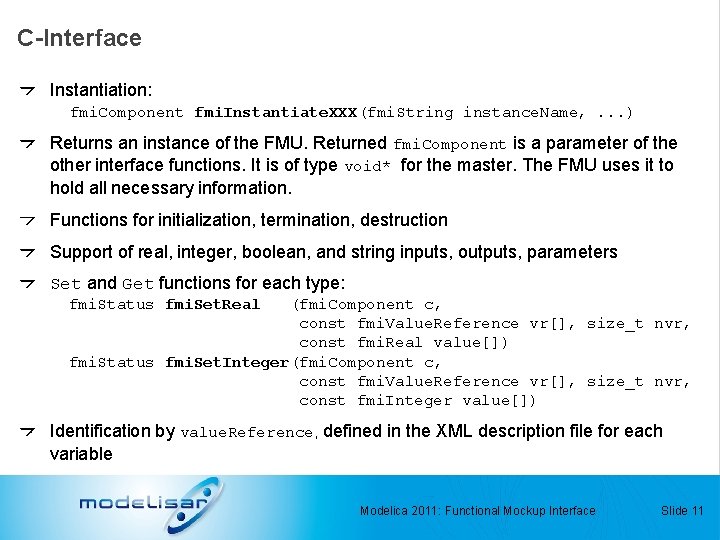
C-Interface Instantiation: fmi. Component fmi. Instantiate. XXX(fmi. String instance. Name, . . . ) Returns an instance of the FMU. Returned fmi. Component is a parameter of the other interface functions. It is of type void* for the master. The FMU uses it to hold all necessary information. Functions for initialization, termination, destruction Support of real, integer, boolean, and string inputs, outputs, parameters Set and Get functions for each type: fmi. Status fmi. Set. Real (fmi. Component c, const fmi. Value. Reference vr[], size_t nvr, const fmi. Real value[]) fmi. Status fmi. Set. Integer(fmi. Component c, const fmi. Value. Reference vr[], size_t nvr, const fmi. Integer value[]) Identification by value. Reference, defined in the XML description file for each variable Modelica 2011: Functional Mockup Interface Slide 11
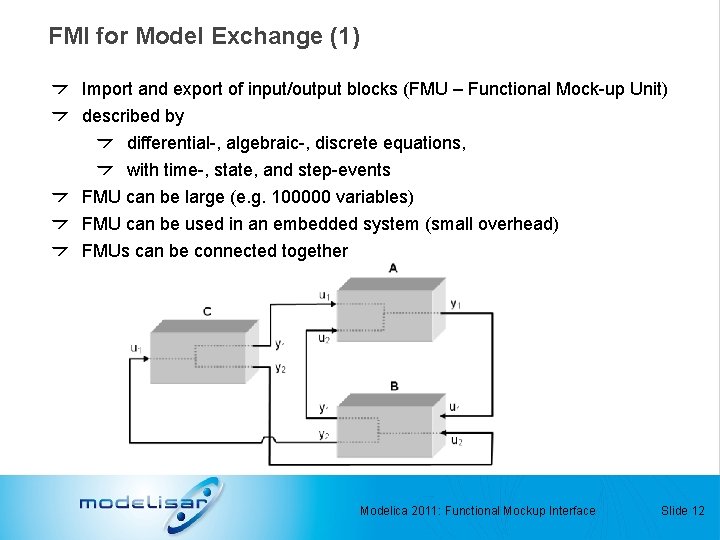
FMI for Model Exchange (1) Import and export of input/output blocks (FMU – Functional Mock-up Unit) described by differential-, algebraic-, discrete equations, with time-, state, and step-events FMU can be large (e. g. 100000 variables) FMU can be used in an embedded system (small overhead) FMUs can be connected together Modelica 2011: Functional Mockup Interface Slide 12
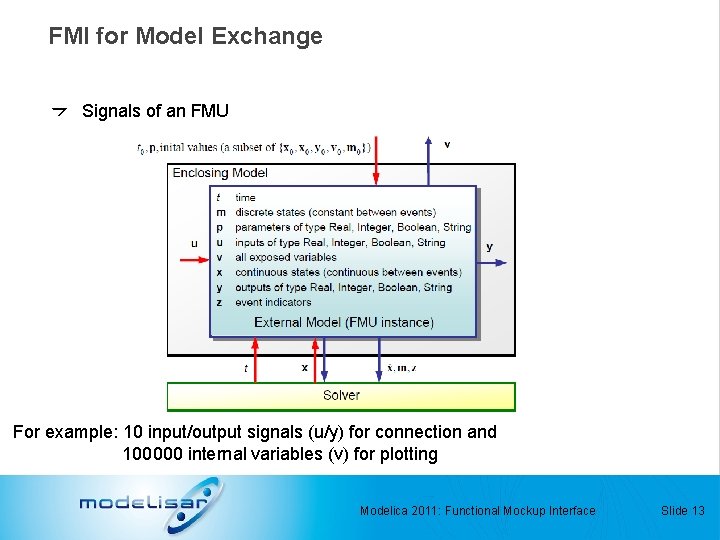
FMI for Model Exchange Signals of an FMU For example: 10 input/output signals (u/y) for connection and 100000 internal variables (v) for plotting Modelica 2011: Functional Mockup Interface Slide 13
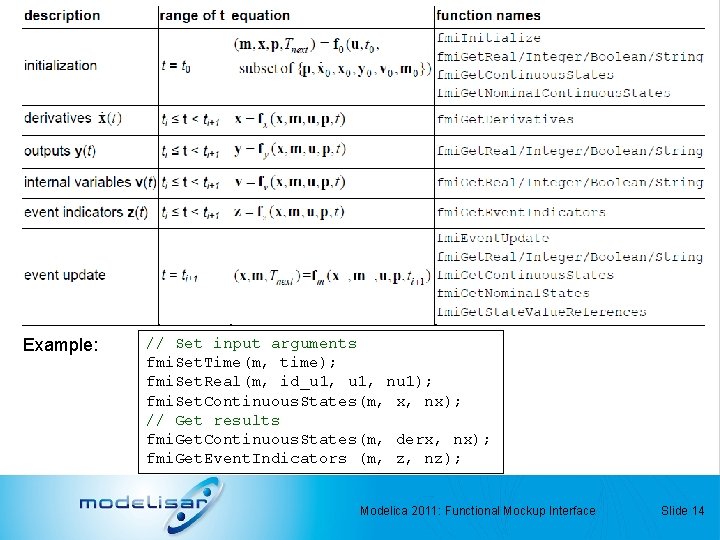
Example: // Set input arguments fmi. Set. Time(m, time); fmi. Set. Real(m, id_u 1, nu 1); fmi. Set. Continuous. States(m, x, nx); // Get results fmi. Get. Continuous. States(m, derx, nx); fmi. Get. Event. Indicators (m, z, nz); Modelica 2011: Functional Mockup Interface Slide 14
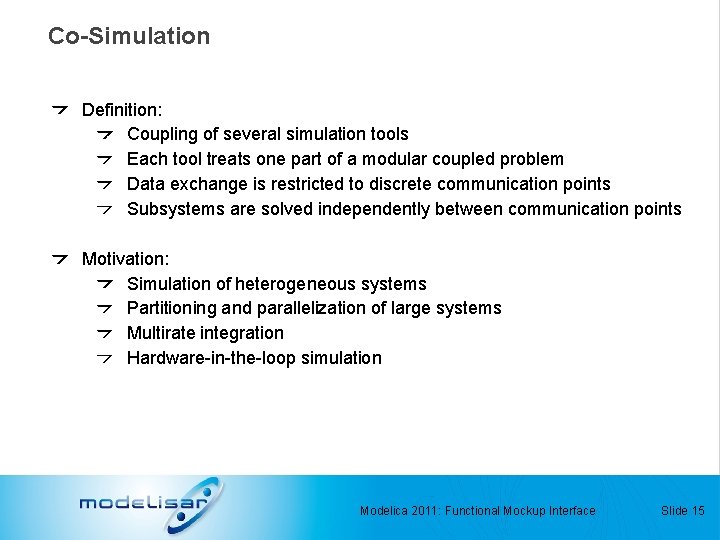
Co-Simulation Definition: Coupling of several simulation tools Each tool treats one part of a modular coupled problem Data exchange is restricted to discrete communication points Subsystems are solved independently between communication points Motivation: Simulation of heterogeneous systems Partitioning and parallelization of large systems Multirate integration Hardware-in-the-loop simulation Modelica 2011: Functional Mockup Interface Slide 15
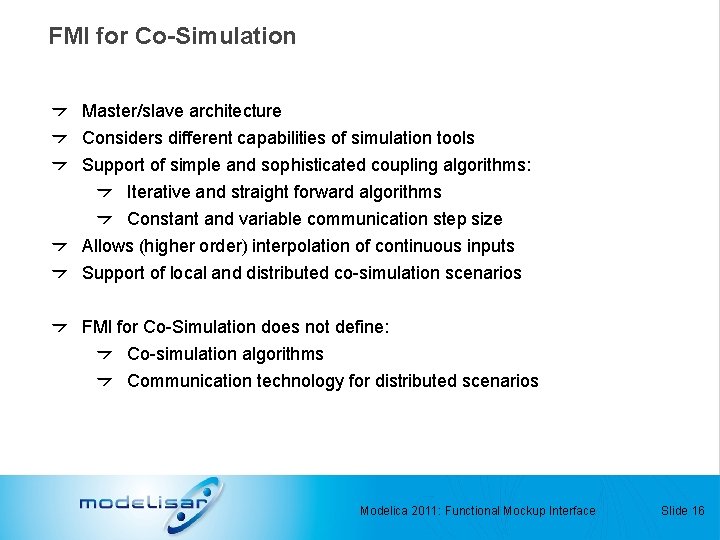
FMI for Co-Simulation Master/slave architecture Considers different capabilities of simulation tools Support of simple and sophisticated coupling algorithms: Iterative and straight forward algorithms Constant and variable communication step size Allows (higher order) interpolation of continuous inputs Support of local and distributed co-simulation scenarios FMI for Co-Simulation does not define: Co-simulation algorithms Communication technology for distributed scenarios Modelica 2011: Functional Mockup Interface Slide 16
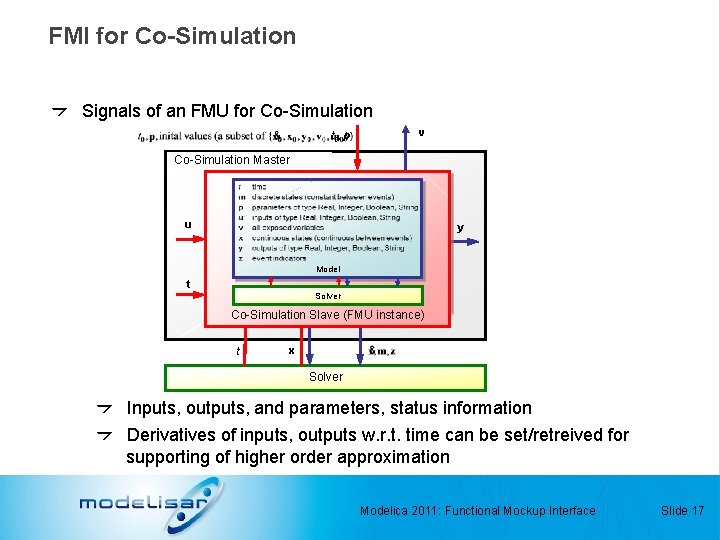
FMI for Co-Simulation Signals of an FMU for Co-Simulation t 0, p v Enclosing Model. Master Co-Simulation u y Model t Solver External Model (FMU instance) Co-Simulation Slave (FMU instance) t x Solver Inputs, outputs, and parameters, status information Derivatives of inputs, outputs w. r. t. time can be set/retreived for supporting of higher order approximation Modelica 2011: Functional Mockup Interface Slide 17
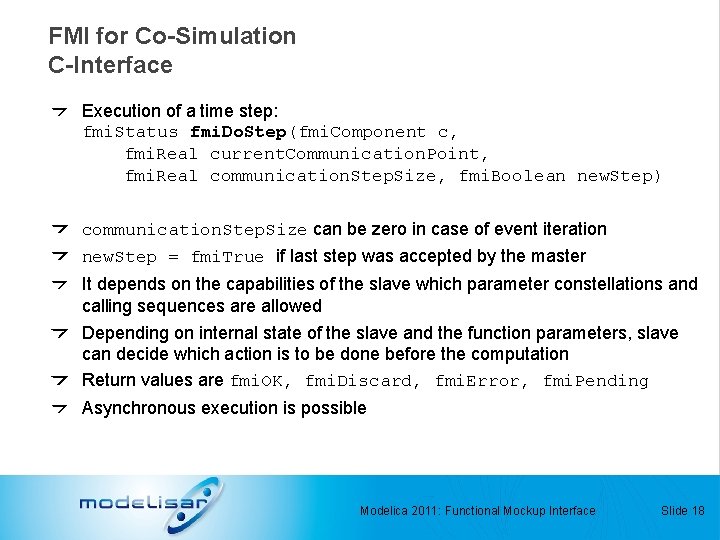
FMI for Co-Simulation C-Interface Execution of a time step: fmi. Status fmi. Do. Step(fmi. Component c, fmi. Real current. Communication. Point, fmi. Real communication. Step. Size, fmi. Boolean new. Step) communication. Step. Size can be zero in case of event iteration new. Step = fmi. True if last step was accepted by the master It depends on the capabilities of the slave which parameter constellations and calling sequences are allowed Depending on internal state of the slave and the function parameters, slave can decide which action is to be done before the computation Return values are fmi. OK, fmi. Discard, fmi. Error, fmi. Pending Asynchronous execution is possible Modelica 2011: Functional Mockup Interface Slide 18
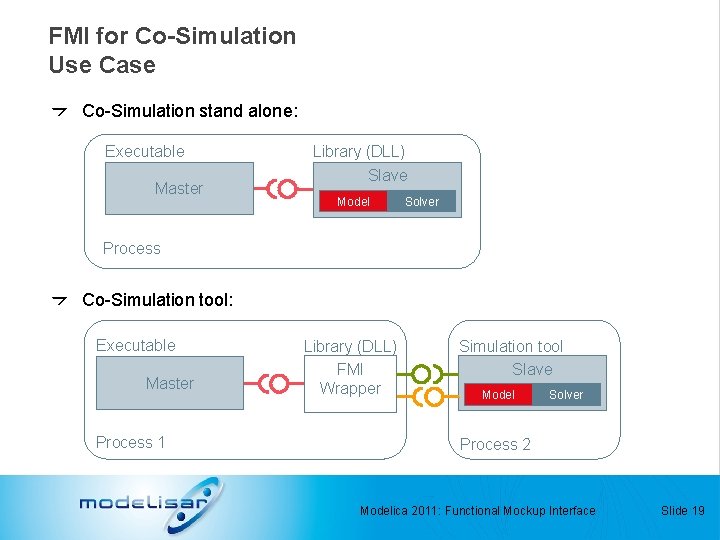
FMI for Co-Simulation Use Case Co-Simulation stand alone: Executable Master Library (DLL) Slave Model Solver Process Co-Simulation tool: Executable Master Process 1 Library (DLL) FMI Wrapper Simulation tool Slave Model Solver Process 2 Modelica 2011: Functional Mockup Interface Slide 19
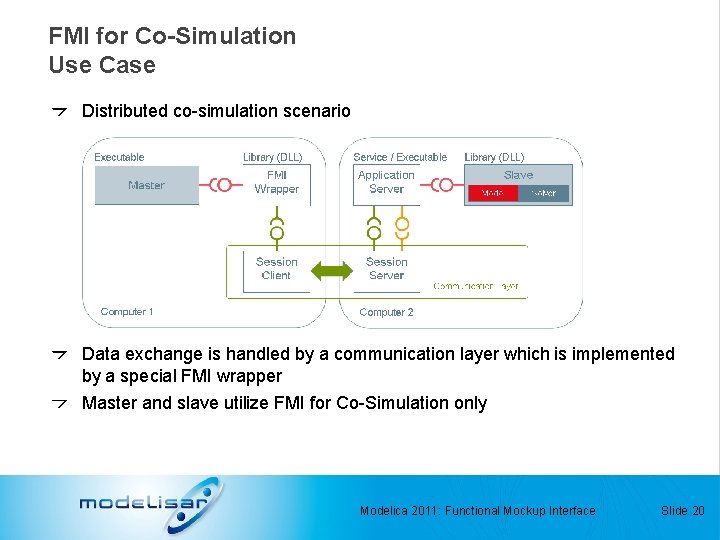
FMI for Co-Simulation Use Case Distributed co-simulation scenario Data exchange is handled by a communication layer which is implemented by a special FMI wrapper Master and slave utilize FMI for Co-Simulation only Modelica 2011: Functional Mockup Interface Slide 20
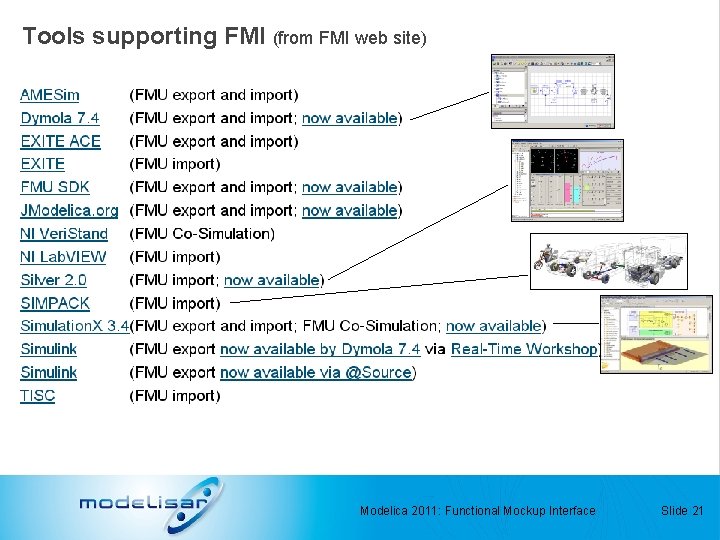
Tools supporting FMI (from FMI web site) Modelica 2011: Functional Mockup Interface Slide 21
Conclusions and Outlook FMI has a high potential being widely accepted in the CAE world: Initiated, organized and pushed by Daimler to significantly improve the exchange of simulation models between suppliers and OEMs. Defined in close collaboration of different tool vendors. Industrial users were involved in the proof of concept. FMI can already be used with several Modelica tools, Simulink, multibody and other tools. FMI is maintained and further developed: Unification and harmonization of FMI for Model Exchange and Co‑Simulation (FMI 2. 0) within Modelisar. Improved handling of time events. Clean handling of changeable parameters. Efficient interface to Jacobian matrices. Modelica 2011: Functional Mockup Interface Slide 22
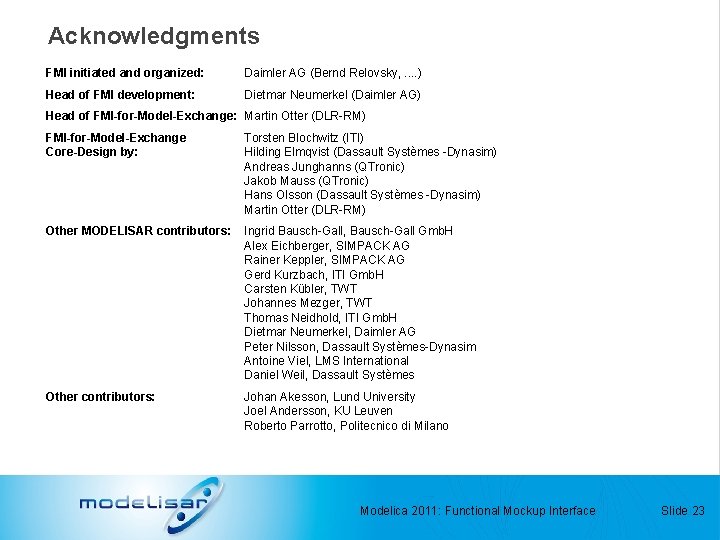
Acknowledgments FMI initiated and organized: Daimler AG (Bernd Relovsky, . . ) Head of FMI development: Dietmar Neumerkel (Daimler AG) Head of FMI-for-Model-Exchange: Martin Otter (DLR-RM) FMI-for-Model-Exchange Core-Design by: Torsten Blochwitz (ITI) Hilding Elmqvist (Dassault Systèmes -Dynasim) Andreas Junghanns (QTronic) Jakob Mauss (QTronic) Hans Olsson (Dassault Systèmes -Dynasim) Martin Otter (DLR-RM) Other MODELISAR contributors: Ingrid Bausch-Gall, Bausch-Gall Gmb. H Alex Eichberger, SIMPACK AG Rainer Keppler, SIMPACK AG Gerd Kurzbach, ITI Gmb. H Carsten Kübler, TWT Johannes Mezger, TWT Thomas Neidhold, ITI Gmb. H Dietmar Neumerkel, Daimler AG Peter Nilsson, Dassault Systèmes-Dynasim Antoine Viel, LMS International Daniel Weil, Dassault Systèmes Other contributors: Johan Akesson, Lund University Joel Andersson, KU Leuven Roberto Parrotto, Politecnico di Milano Modelica 2011: Functional Mockup Interface Slide 23
Acknowledgments FMI for Co-Simulation Martin Arnold, University Halle, Germany Core-Design by: Constanze Bausch, Atego Systems Gmb. H, Wolfsburg, Germany Torsten Blochwitz, ITI Gmb. H, Dresden, Germany Christoph Clauß, Fraunhofer IIS EAS, Dresden, Germany Manuel Monteiro, Atego Systems Gmb. H, Wolfsburg, Germany Thomas Neidhold, ITI Gmb. H, Dresden, Germany Jörg-Volker Peetz, Fraunhofer SCAI, St. Augustin, Germany Susann Wolf, Fraunhofer IIS EAS, Dresden, Germany Contributors: Jens Bastian, Fraunhofer IIS EAS, Dresden, Germany Christoph Clauß, Fraunhofer IIS EAS, Dresden, Germany Dietmar Neumerkel, Daimler AG, Böblingen, Germany Martin Otter, DLR, Oberpfaffenhofen, Germany Tom Schierz, University Halle, Germany Wolfgang Trautenberg, Simpack AG, Germany Klaus Wolf, Fraunhofer SCAI, St. Augustin, Germany Partially funded by: BMBF, VINNOVA, DGCIS, organized by ITEA 2 Modelica 2011: Functional Mockup Interface Slide 24