
THE FUNCTION OF CAPILLARIES BY BRYANT FROM 5

THE FUNCTION OF CAPILLARIES BY BRYANT FROM: 5 E
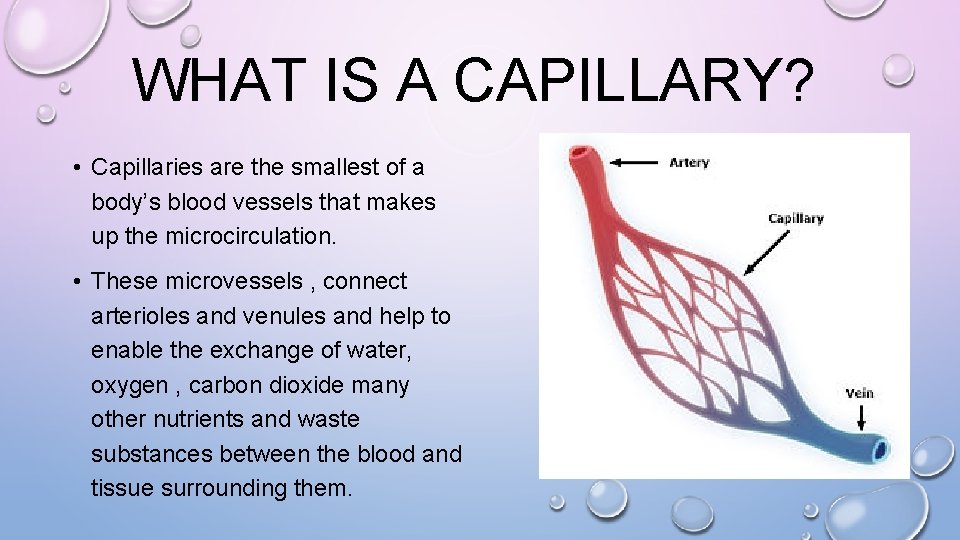
WHAT IS A CAPILLARY? • Capillaries are the smallest of a body’s blood vessels that makes up the microcirculation. • These microvessels , connect arterioles and venules and help to enable the exchange of water, oxygen , carbon dioxide many other nutrients and waste substances between the blood and tissue surrounding them.
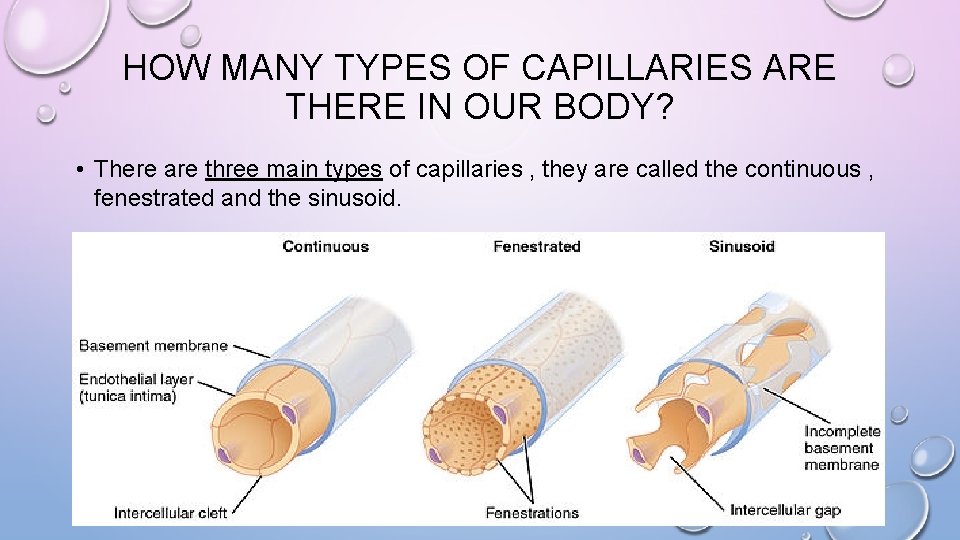
HOW MANY TYPES OF CAPILLARIES ARE THERE IN OUR BODY? • There are three main types of capillaries , they are called the continuous , fenestrated and the sinusoid.
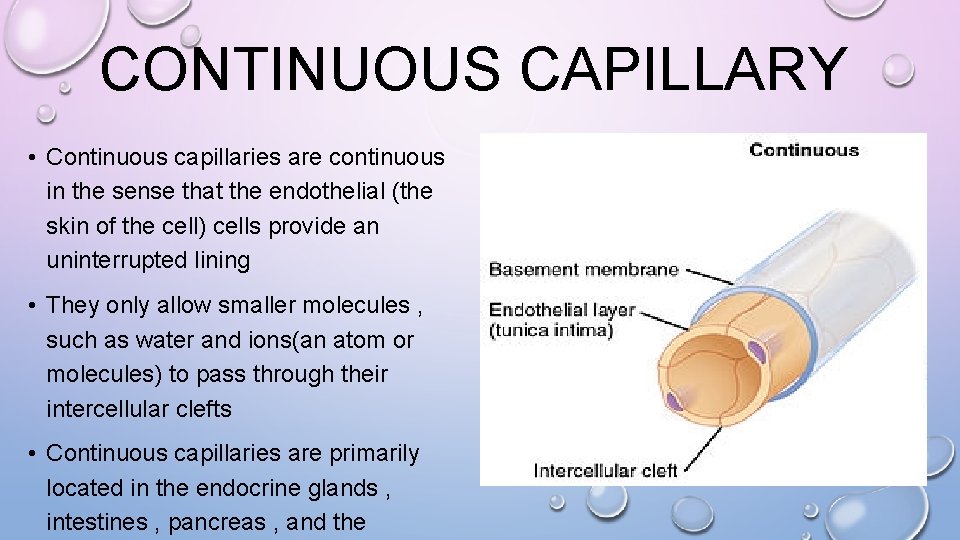
CONTINUOUS CAPILLARY • Continuous capillaries are continuous in the sense that the endothelial (the skin of the cell) cells provide an uninterrupted lining • They only allow smaller molecules , such as water and ions(an atom or molecules) to pass through their intercellular clefts • Continuous capillaries are primarily located in the endocrine glands , intestines , pancreas , and the

FENESTRATED CAPILLARY • Fenestrated capillary have pores in the endothelial cells that are spanned by a diaphragm of radially oriented (position) fibrils and • Allow small molecules and limited amounts of protein to diffuse. • The fenestrated capillaries (same as the continuous capillaries) are primarily located in the endocrine glands, intestines, pancreas, and the glomeruli of the kidney
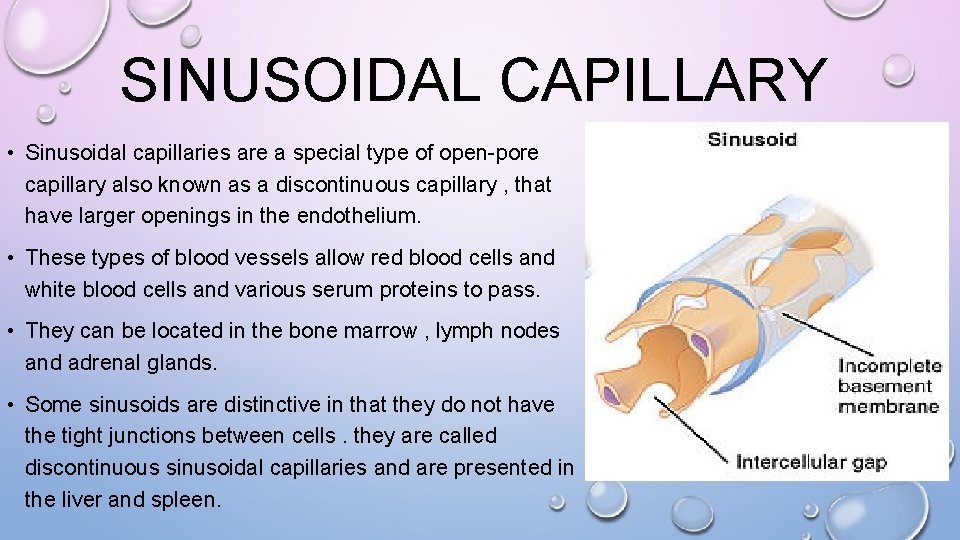
SINUSOIDAL CAPILLARY • Sinusoidal capillaries are a special type of open-pore capillary also known as a discontinuous capillary , that have larger openings in the endothelium. • These types of blood vessels allow red blood cells and white blood cells and various serum proteins to pass. • They can be located in the bone marrow , lymph nodes and adrenal glands. • Some sinusoids are distinctive in that they do not have the tight junctions between cells. they are called discontinuous sinusoidal capillaries and are presented in the liver and spleen.

SIMPLIFIED IMAGE SHOWING BLOOD-FLOW THROUGH THE BODY, PASSING THROUGH CAPILLARY NETWORKS IN ITS PATH
CAPILLARY WALL • A capillary wall is only 1 cell thick and is simple squamous epithelium • The capillary wall performs an important function by allowing nutrients and waste substances to pass across it.

EXPERIMENT TO SHOW CAPILLARIES IN ACTION. What You Need: Celery stalk with leaves on it • Butter knife • Food coloring • Water • Two glasses
STEPS TO CARRY OUT THE EXPERIMENT. 1. First, use the butter knife to carefully trim the end of the celery stalk. 2. Then, fill a glass with water and add a few drops of food coloring. 3. Now put the celery stalk into the glass of colored water. 4. You'll soon see the water travel up the veins of the celery stalk. 5. Water can defy gravity and travel up the stalk because of adhesion. Adhesion is the force that attracts water to other surfaces. In this case, the water adheres to the inside surface of the veins. Adhesion is what pulls the water up into the celery stalk. When water travels in this way it is known as capillary action.
A SCIENTIFIC EXPLANATION A celery vein is a simple way to think of the human blood system. Celery veins transport, or carry, water and nutrients in the plant. Blood is transported in a similar manner in the human body. But instead of using capillary action, we have a heart that pumps the blood through our veins and arteries.

THANK YOU CREDITS TO • WIKIPEDIA , THE FREE ENCYCLOPEDIA • THE MAGIC SCHOOL BUS SCIENCE EXPERIMENT
- Slides: 12