
The Freshman Shock Your Childs New Academic Responsibilities

The Freshman Shock: Your Child’s New Academic Responsibilities in Upper School Thursday, May 1 st, 2014 This presentation will be posted on the Upper School Counseling Services page
“Parenting a teenager means thinking more in terms of influence than control - easy to say, tough to do. ” ~Dr. Mike Riera, author of: Staying Connected to Your Teenager, (Perseus, 2003) and Uncommon Sense for Parents with Teenagers, (Ten Speed Press, 2004)
COLLEGE-PREP RIGOR ● PLP offers only ONE diploma type and it is the most academically rigorous of the nine NC diplomas that are available at most traditional high schools ● ALL courses in the PLP Upper School are college prep courses and highly rigorous o Standard-level college prep o Honors-level college prep o Advanced Placement ("AP") college-level courses o Dual enrollment college courses (CPCC/Mitchell)
COLLEGE-PREP RIGOR ● It is expected that ALL students will struggle with the material at some point while in the Upper School - this is ok and is the nature of a rigorous course of study. The level of rigor at PLP prepares students to be successful in college no matter which institution they choose to attend. ● When students struggle, they learn coping skills that they can apply to similar situations in the future. If students do not struggle now, they WILL in college - a more costly environment with less support and resources. ● Colleges will only see the final grade in each course. They will NOT see term grades.
It is our ultimate goal, passion and deepest desire to ensure that all PLP students are thoroughly prepared for a four-year university environment, from the first day that they step foot on a college campus.

What to Expect. . .
SUMMER READING ASSIGNMENTS ● Mandatory - comprises a large percentage of the Term 1 grade ● Students will be tested on the material and will engage in projects and activities for which the reading is a prerequisite ● No make-up opportunities or extensions will be available to students who do not complete the summer reading assignments ● Summer 2014 Standard level: Tuesdays with Morrie by Mitch Albom; The ● Book Thief by Markus Zusak Summer 2014 Honors level: Narrative of the Life of Frederick Douglass by Frederick Douglass; Tuesdays with Morrie by Mitch Albom; The Book Thief by Markus Zusak
HOMEWORK ● As students age, the amount of responsibility increases ● PLP students have reported experiencing a large jump in the amount and difficulty level of homework from 8 th to 9 th grade ● The average student at PLP can expect about 2 hours of homework, on average, per night in the upper school ● This workload will likely be heavier if your child is enrolled in all honors courses (NOTE: Students wishing to take all honors courses must be willing to put in the necessary time and work that accompanies an honors schedule - for some students this may mean a sacrifice of cutting back on athletics, clubs, jobs, or other extracurricular activities in order to maintain A's and B's)
HOMEWORK ● Homework may or may not be graded/monitored, but it is still essential to the learning process ● Busy work is not assigned - every assignment facilitates learning and is expected to be completed, whether or not it is graded ● If HW is not graded, students must become self-accountable and continue doing it anyway. This can be a very challenging skill for students to learn. It cannot be taught; they must develop this essential skill through repeated practice. ● On any given night, "if they aren’t doing something, they’re doing something wrong. " Homework and studying should occur EVERY night. Some nights may have a lighter workload than other nights, but it is extremely rare for a student to not have homework in any class on a given night.
HOMEWORK - how parents can help ● Help your child set up a daily homework plan/schedule, write it down and post in a central location. Discuss the following: o Time homework/studying should occur o Location it should occur o Materials needed o Potential challenges and solutions (motivation, laziness, distractions) ● May need different schedules for different days (for games, matches, practices, extracurriculars)
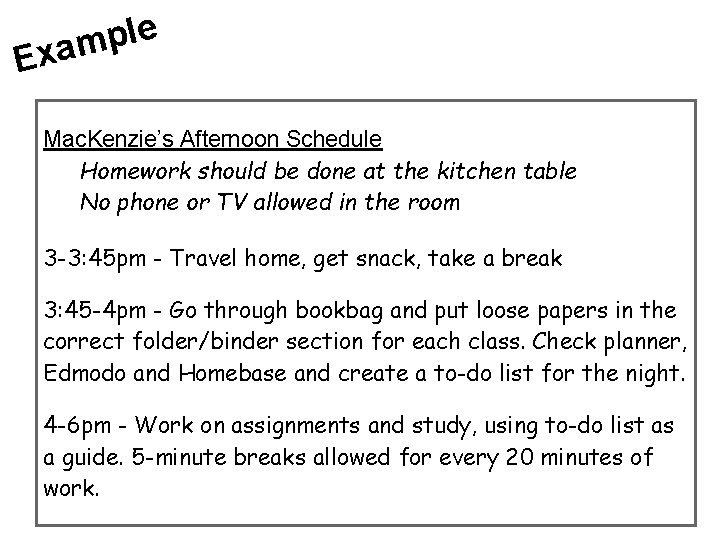
e l p xam E Mac. Kenzie’s Afternoon Schedule Homework should be done at the kitchen table No phone or TV allowed in the room 3 -3: 45 pm - Travel home, get snack, take a break 3: 45 -4 pm - Go through bookbag and put loose papers in the correct folder/binder section for each class. Check planner, Edmodo and Homebase and create a to-do list for the night. 4 -6 pm - Work on assignments and study, using to-do list as a guide. 5 -minute breaks allowed for every 20 minutes of work.
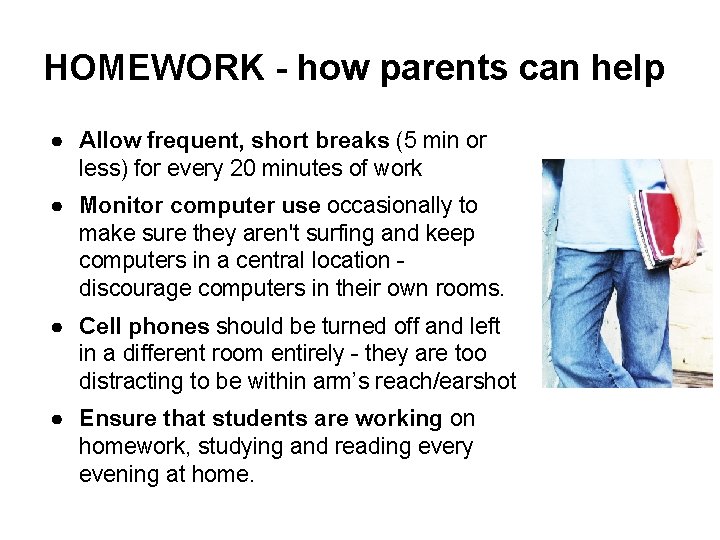
HOMEWORK - how parents can help ● Allow frequent, short breaks (5 min or less) for every 20 minutes of work ● Monitor computer use occasionally to make sure they aren't surfing and keep computers in a central location discourage computers in their own rooms. ● Cell phones should be turned off and left in a different room entirely - they are too distracting to be within arm’s reach/earshot ● Ensure that students are working on homework, studying and reading every evening at home.
HOMEWORK - how parents can help ● Although it may be a change from 8 th grade, try to avoid monitoring every assignment ● Now that students are in high school, we expect them to be responsible for assignment completion, making up work, and appropriate behavior ● These are skills that must be learned through practice, trial-and-error, and self-correcting after mistakes are made
STUDYING ● Homework and studying are two different things o Homework is an actual assignment that a student is expected to complete, usually by a certain deadline. o Studying is the purposeful review of material with the intent of reinforcing material that has already been learned. It is often not graded nor assigned, thus it is student-directed instead of teacher-directed. ● It is common for students not to have had to study in middle school or to have had to study minimally, but most students cannot maintain the grades they earned in middle school without studying in upper school
STUDYING Lack of effective studying is the #1 reason grades drop during freshman year. While some study skills are taught in class, learning to study is largely a self-directed activity that students must learn through trial-and-error. ● Examples of INEFFECTIVE studying: o Re-reading studying guides, looking over notes ● Examples of EFFECTIVE studying: o Re-writing or re-stating study guide material in your own words, then quizzing yourself or a friend o Working problems in math, then checking your answer o Teaching the material to someone else (real or imaginary)
STUDYING - how parents can help ● Encourage your child to try different strategies, then stick with whatever works for them ● Point your child to studying resources (i. e. Counseling Services webpage) ● Give your child the benefit of the doubt to study how/where they want to, at least initially. If grades do not reflect their best work, then they lose the freedom to study how/where they want to, with the opportunity to earn back that freedom. Set a clear deadline with clear expectations for grades and a clear reward (i. e. earn all A’s and B’s on the 2 nd term report card and you will be able to study in your room again).
STUDYING - how parents can help ● Developmentally appropriate limits should be set (i. e. more frequent, but shorter breaks for teens who have a harder time staying focused) ● Buy a planner for your child and show them how to use it or help them figure out an alternative way to track assignments (i. e. Google Docs, Evernote, i. Phone notepad, My. Homework. App, Spaaze, Shoshiku) ● Ensure that technology is not getting in the way of your child’s study time
Keeping Track of Daily Assignments ● It is the student’s responsibility to be present to class and pay attention so they can get daily assignments ● Some daily assignments cannot be made-up, due to the nature of the assignment and the pacing of the course. ● Missing an assignment teaches a student to self-correct next time - this is one of the most effective ways to teach self-accountability skills. ● Encourage your child to keep a planner or agenda, so they can write these assignments down immediately so they don’t forget to complete them later. For the first month of school, ask your freshman each day to show you their planner (or other method of tracking assignments) to help them get into the habit of using it.
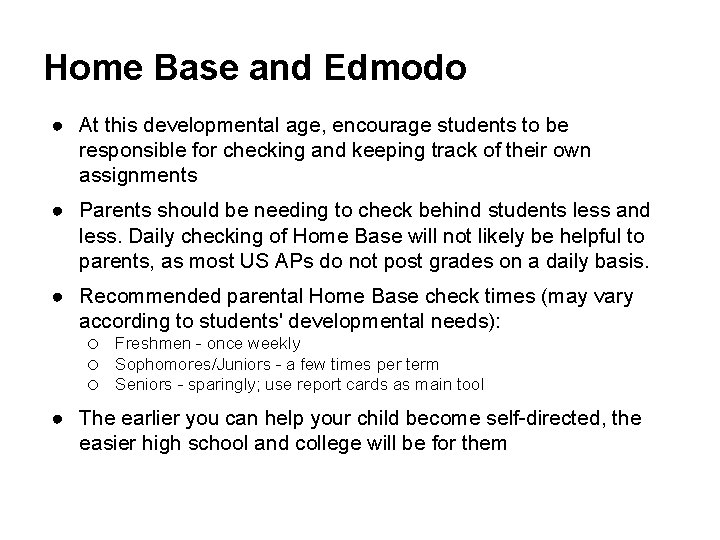
Home Base and Edmodo ● At this developmental age, encourage students to be responsible for checking and keeping track of their own assignments ● Parents should be needing to check behind students less and less. Daily checking of Home Base will not likely be helpful to parents, as most US APs do not post grades on a daily basis. ● Recommended parental Home Base check times (may vary according to students' developmental needs): o Freshmen - once weekly o Sophomores/Juniors - a few times per term o Seniors - sparingly; use report cards as main tool ● The earlier you can help your child become self-directed, the easier high school and college will be for them
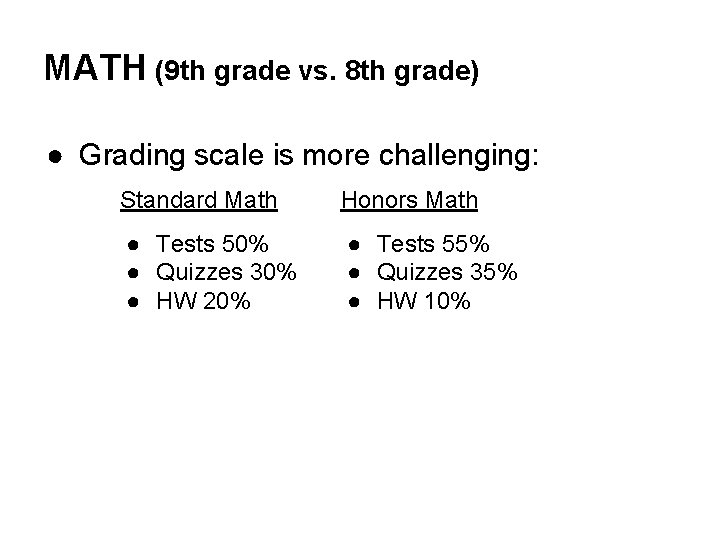
MATH (9 th grade vs. 8 th grade) ● Grading scale is more challenging: Standard Math Honors Math ● Tests 50% ● Quizzes 30% ● HW 20% ● Tests 55% ● Quizzes 35% ● HW 10%
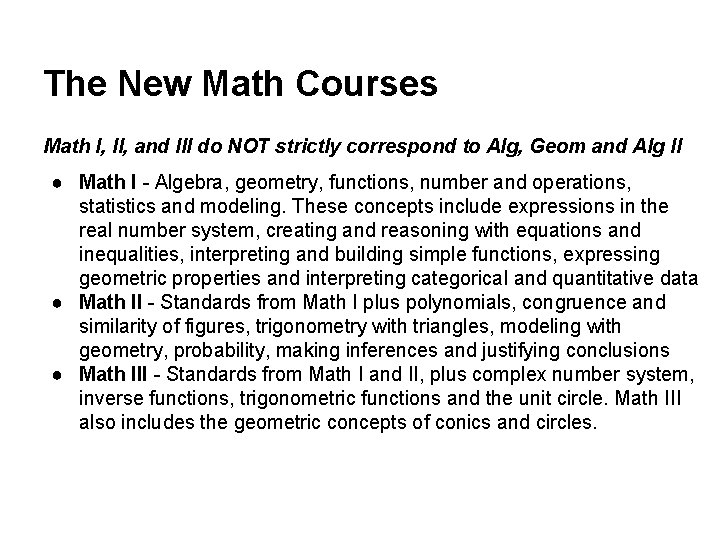
The New Math Courses Math I, II, and III do NOT strictly correspond to Alg, Geom and Alg II ● Math I - Algebra, geometry, functions, number and operations, statistics and modeling. These concepts include expressions in the real number system, creating and reasoning with equations and inequalities, interpreting and building simple functions, expressing geometric properties and interpreting categorical and quantitative data ● Math II - Standards from Math I plus polynomials, congruence and similarity of figures, trigonometry with triangles, modeling with geometry, probability, making inferences and justifying conclusions ● Math III - Standards from Math I and II, plus complex number system, inverse functions, trigonometric functions and the unit circle. Math III also includes the geometric concepts of conics and circles.
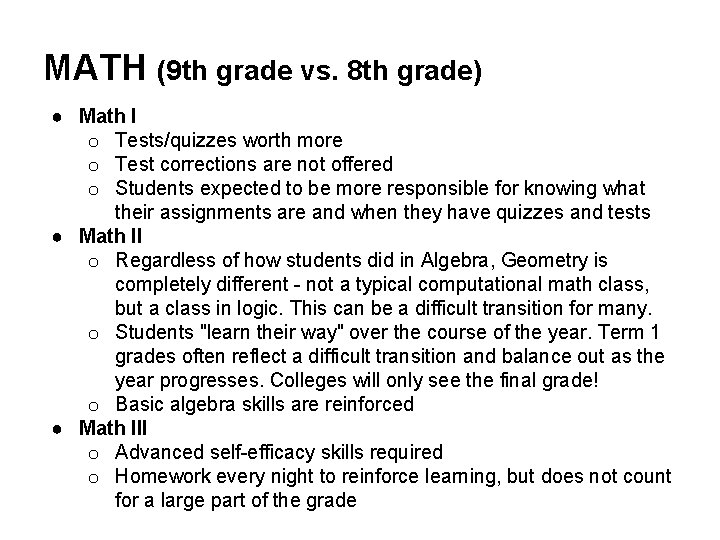
MATH (9 th grade vs. 8 th grade) ● Math I o Tests/quizzes worth more o Test corrections are not offered o Students expected to be more responsible for knowing what their assignments are and when they have quizzes and tests ● Math II o Regardless of how students did in Algebra, Geometry is completely different - not a typical computational math class, but a class in logic. This can be a difficult transition for many. o Students "learn their way" over the course of the year. Term 1 grades often reflect a difficult transition and balance out as the year progresses. Colleges will only see the final grade! o Basic algebra skills are reinforced ● Math III o Advanced self-efficacy skills required o Homework every night to reinforce learning, but does not count for a large part of the grade
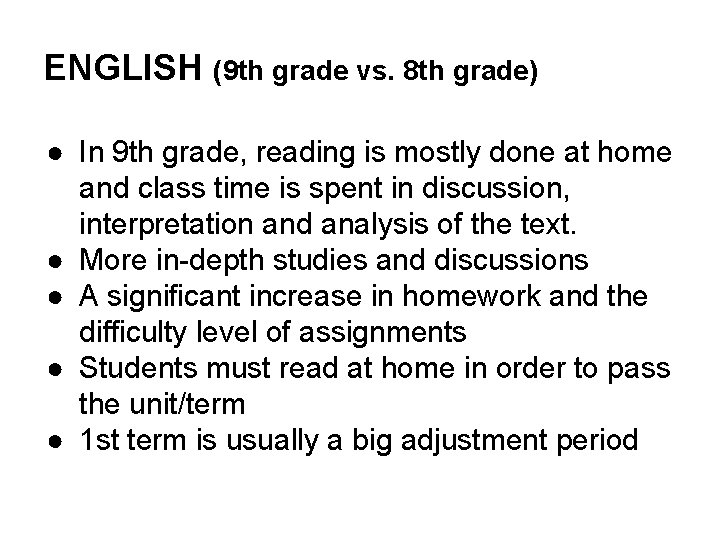
ENGLISH (9 th grade vs. 8 th grade) ● In 9 th grade, reading is mostly done at home and class time is spent in discussion, interpretation and analysis of the text. ● More in-depth studies and discussions ● A significant increase in homework and the difficulty level of assignments ● Students must read at home in order to pass the unit/term ● 1 st term is usually a big adjustment period
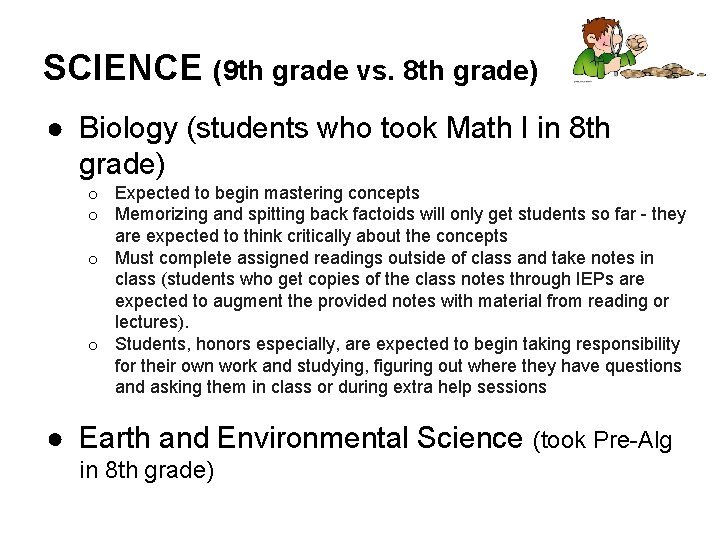
SCIENCE (9 th grade vs. 8 th grade) ● Biology (students who took Math I in 8 th grade) o Expected to begin mastering concepts o Memorizing and spitting back factoids will only get students so far - they are expected to think critically about the concepts o Must complete assigned readings outside of class and take notes in class (students who get copies of the class notes through IEPs are expected to augment the provided notes with material from reading or lectures). o Students, honors especially, are expected to begin taking responsibility for their own work and studying, figuring out where they have questions and asking them in class or during extra help sessions ● Earth and Environmental Science (took Pre-Alg in 8 th grade)
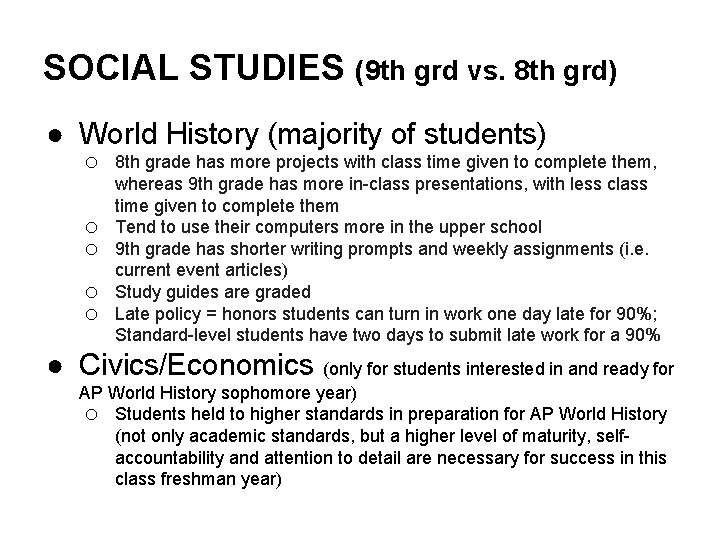
SOCIAL STUDIES (9 th grd vs. 8 th grd) ● World History (majority of students) o o o 8 th grade has more projects with class time given to complete them, whereas 9 th grade has more in-class presentations, with less class time given to complete them Tend to use their computers more in the upper school 9 th grade has shorter writing prompts and weekly assignments (i. e. current event articles) Study guides are graded Late policy = honors students can turn in work one day late for 90%; Standard-level students have two days to submit late work for a 90% ● Civics/Economics (only for students interested in and ready for AP World History sophomore year) o Students held to higher standards in preparation for AP World History (not only academic standards, but a higher level of maturity, selfaccountability and attention to detail are necessary for success in this class freshman year)
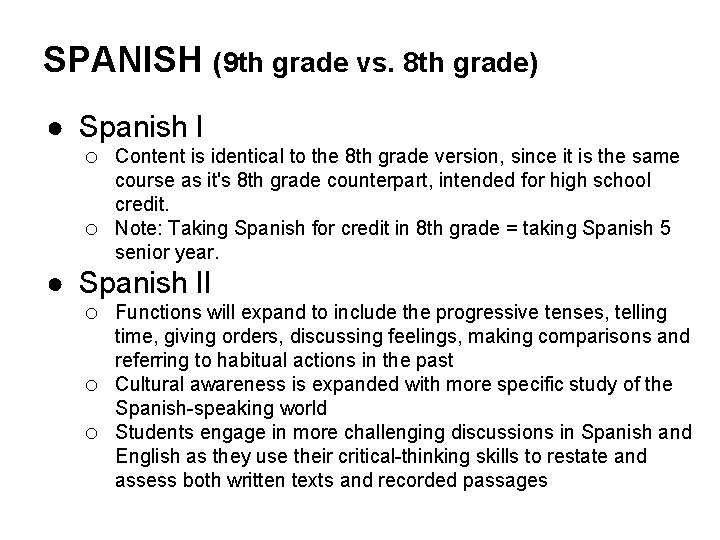
SPANISH (9 th grade vs. 8 th grade) ● Spanish I o Content is identical to the 8 th grade version, since it is the same o course as it's 8 th grade counterpart, intended for high school credit. Note: Taking Spanish for credit in 8 th grade = taking Spanish 5 senior year. ● Spanish II o Functions will expand to include the progressive tenses, telling o o time, giving orders, discussing feelings, making comparisons and referring to habitual actions in the past Cultural awareness is expanded with more specific study of the Spanish-speaking world Students engage in more challenging discussions in Spanish and English as they use their critical-thinking skills to restate and assess both written texts and recorded passages
FINE ARTS (9 th grade vs. 8 th grade) ● Visual Arts 1 o Projects become more open-ended. Guidelines are given, but students must come up with their own unique subjects and ideas. o Students complete a much larger painting unit o Grade determined by growth in the content area, consistent work habits/self-efficacy, effective use of class time ● Chorus 1 o Extra performance during the year o Great deal of emphasis is placed on the students' individual responsibility to uphold the integrity of the ensemble, the music, and the sound that is made
FINE ARTS (9 th grade vs. 8 th grade) ● Band 1 o Music literature is more challenging o Students learn more scales o Upper School band will attend the North Carolina Bandmaster’s Association Music Performance Assessment (MPA) for concert bands in March ● Theater 1 o More academically driven o Students are expected to perform in front of their peers in monologues and duet scenes o Begin writing monologues and short scenes o Before sophomore year, theatre students have the option of auditioning into the acting track if they enjoy acting. All acting classes are strictly performance-based. Theatre classes are history, tech, and performance.
A Parent's Role in Ensuring Assignment Completion ● In US, completion of homework and assignments is the student's responsibility ● As a parent, it’s easy to fall into the trap of unintentionally making it your responsibility ● Allow your child to make mistakes and deal with the natural consequences - even multiple times if necessary. Examples: o If they forget to turn in homework or a project by the due date, do not email the teacher asking for an extension. Instead, allow the student to experience the grade drop. o If they forget their homework on the kitchen table, do not bring it by the school for them or email it to them.
A Parent's Role in Ensuring Assignment Completion ● Dealing with natural consequences is the most effective way for teenagers to learn from their mistakes. Inform them of this rule at the beginning of the year, so it is not a surprise to them later on. ● Parents worry about the effect these mistakes and subsequent grade drops will have on GPAs and college admission ● Bottom line = if students don’t learn these lessons now, they will get into and go off to a great college lacking necessary skills. This is a much worse scenario with sometimes severe consequences. ● Better they learn the lessons in this more supportive and less costly environment
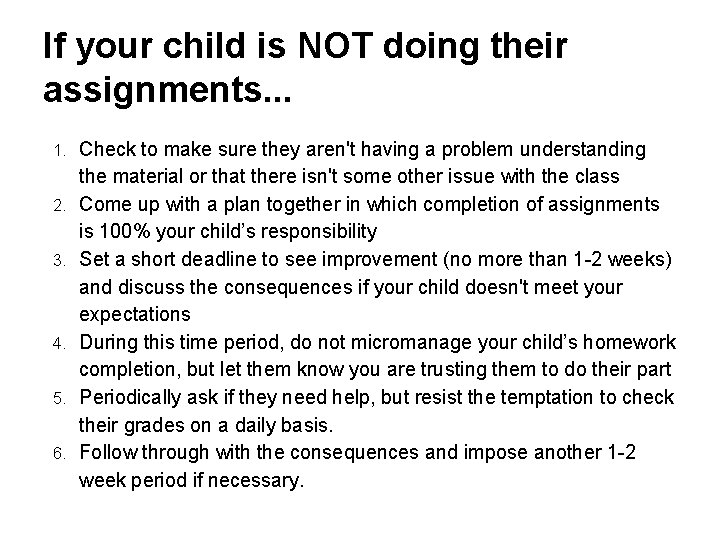
If your child is NOT doing their assignments. . . 1. Check to make sure they aren't having a problem understanding 2. 3. 4. 5. 6. the material or that there isn't some other issue with the class Come up with a plan together in which completion of assignments is 100% your child’s responsibility Set a short deadline to see improvement (no more than 1 -2 weeks) and discuss the consequences if your child doesn't meet your expectations During this time period, do not micromanage your child’s homework completion, but let them know you are trusting them to do their part Periodically ask if they need help, but resist the temptation to check their grades on a daily basis. Follow through with the consequences and impose another 1 -2 week period if necessary.
Assessing Your Child's Readiness for US
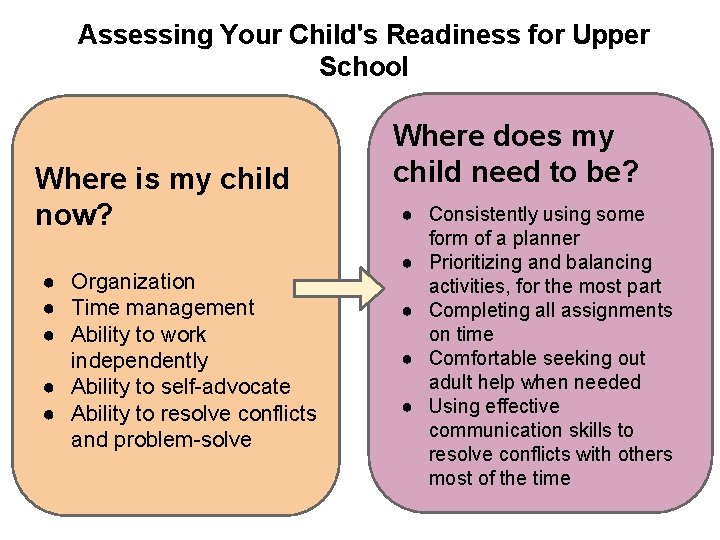
Assessing Your Child's Readiness for Upper School Where is my child now? ● Organization ● Time management ● Ability to work independently ● Ability to self-advocate ● Ability to resolve conflicts and problem-solve Where does my child need to be? ● Consistently using some form of a planner ● Prioritizing and balancing activities, for the most part ● Completing all assignments on time ● Comfortable seeking out adult help when needed ● Using effective communication skills to resolve conflicts with others most of the time
So how can I help my child get there?
So how can I help my child get there? ● Start now! Begin implementing new strategies to help your child practice these new skills prior to starting 9 th grade ● Insist your child use some form of planner (i. e. day planner, calendar, Google Docs, phone notes, post-its, Evernote) - help them find what works for THEM ● Help your child determine how many extracurricular activities are possible while still maintaining target grades. Time management only gets harder from here on out - if they are already struggling this year, discuss cutting back or trying new time management strategies. ● Help your child choose the RIGHT extracurricular activities for them - things they are passionate about, enjoy and are excited to be involved in
So how can I help my child get there? ● Have an open, continuous conversation about your child's expectations for success and their target grades ● Help your child set short term goals (daily, weekly, term) and long-term goals (overall year grades, passions, interests, values, college/career life) ● Encouraging your child to speak with APs before you get involved ● When your child experiences setbacks, failures, or conflicts: o Validate your child's feelings and try not to get emotionally involved - remain as objective as possible o Ask open-ended questions to help them think through the problem o Allow them to experience natural consequences o Try alternatives to punishment that allow your child to learn from their mistakes (this tends to work well with teenagers)
College Planning Essentials ● Taking your freshman on a few college tours is one of the best ways to increase their engagement in school ● College still seems like a long way off for freshmen college tours help to make it more "real" and help them to connect what they are doing NOW to the END-GOAL. ● Help your child explore colleges they may be interested in and look up the average GPAs for admitted students. Compare that GPA with your child's GPA. Discuss with your child how he/she "stacks up" and what your child must do to be competitive in the admissions process. ● Discuss your child's interests, abilities, and values and help them explore possible majors and careers. ● Keep the conversation going throughout the year!
Thank you for working with PLP as partners in your child's education! Questions? Contact Whitney Triplett, Upper School Counselor, at wtriplett@pinelakeprep. org
- Slides: 38