
The Frequency of Difficult Intubation in Obstetric Patients
The Frequency of Difficult Intubation in Obstetric Patients: A Report from the Multicenter Perioperative Outcomes Group Research Consortium Sharon Chang Reale, MD Attending Anesthesiologist | Brigham and Women’s Hospital Instructor in Anesthesia | Harvard Medical School
Background • Estimates for the incidence of difficult and failed intubation in the obstetric population vary widely • Studies largely from countries outside the US or smaller centers or are dated
Aims ● Estimate the frequency of difficult intubation in obstetrics ● Describe management of difficult intubations ● Determine risk factors for difficult intubation ● Determine if frequency of difficult intubation is higher in obstetric patients
Methods ● Multicenter, retrospective, observational study ● Women aged 15 -44 undergoing general anesthesia for cesarean delivery at 47 centers ● 2004 -2018

Methods Difficult Intubation Failed Intubation Cormack-Lehane view ≥ 3 Attempt at intubation without successful endotracheal tube placement Intubation attempts ≥ 3 FOI after failed laryngoscopy SGA followed by successful intubation Failed intubation

Methods ● Identified predictors of difficult intubation in cesarean delivery cohort ● Compared rate of difficult intubation in obstetrics to non- obstetric surgical patients ○ Age and gender matched
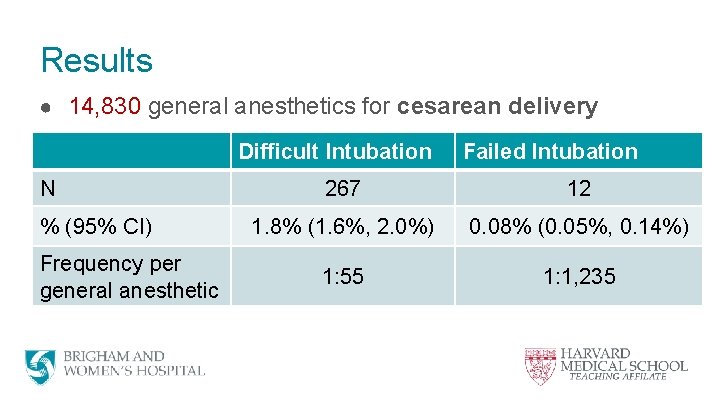
Results ● 14, 830 general anesthetics for cesarean delivery Difficult Intubation N % (95% CI) Frequency per general anesthetic Failed Intubation 267 12 1. 8% (1. 6%, 2. 0%) 0. 08% (0. 05%, 0. 14%) 1: 55 1: 1, 235
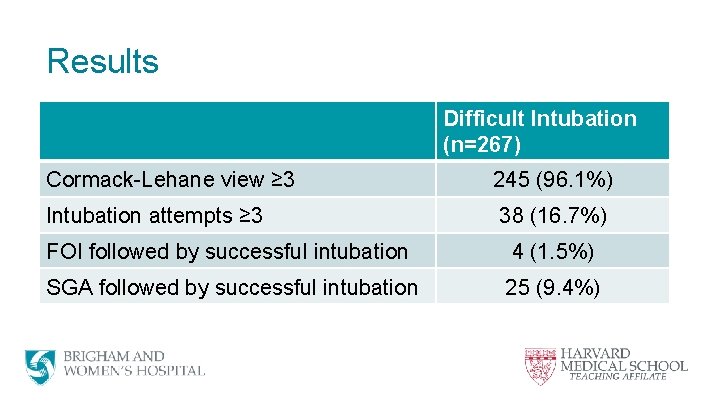
Results Difficult Intubation (n=267) Cormack-Lehane view ≥ 3 245 (96. 1%) Intubation attempts ≥ 3 38 (16. 7%) FOI followed by successful intubation 4 (1. 5%) SGA followed by successful intubation 25 (9. 4%)
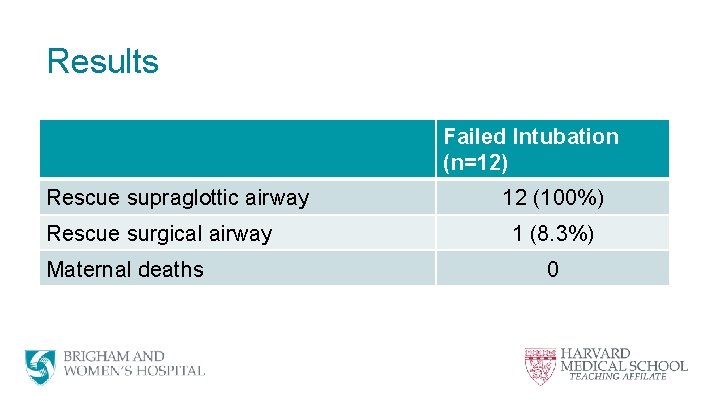
Results Failed Intubation (n=12) Rescue supraglottic airway Rescue surgical airway Maternal deaths 12 (100%) 1 (8. 3%) 0
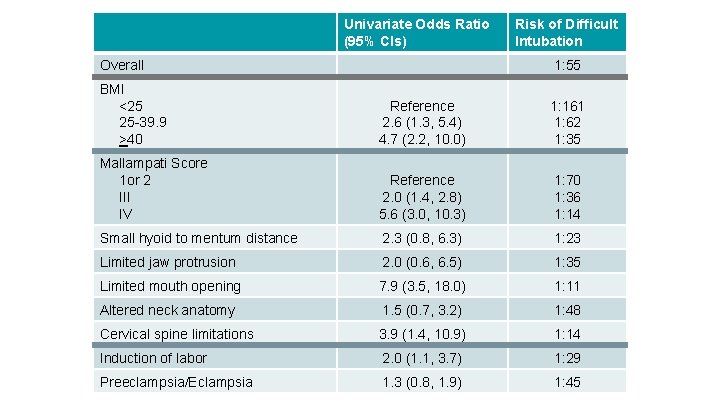
Univariate Odds Ratio (95% CIs) Overall Risk of Difficult Intubation 1: 55 BMI <25 25 -39. 9 >40 Reference 2. 6 (1. 3, 5. 4) 4. 7 (2. 2, 10. 0) 1: 161 1: 62 1: 35 Mallampati Score 1 or 2 III IV Reference 2. 0 (1. 4, 2. 8) 5. 6 (3. 0, 10. 3) 1: 70 1: 36 1: 14 Small hyoid to mentum distance 2. 3 (0. 8, 6. 3) 1: 23 Limited jaw protrusion 2. 0 (0. 6, 6. 5) 1: 35 Limited mouth opening 7. 9 (3. 5, 18. 0) 1: 11 Altered neck anatomy 1. 5 (0. 7, 3. 2) 1: 48 Cervical spine limitations 3. 9 (1. 4, 10. 9) 1: 14 Induction of labor 2. 0 (1. 1, 3. 7) 1: 29 Preeclampsia/Eclampsia 1. 3 (0. 8, 1. 9) 1: 45
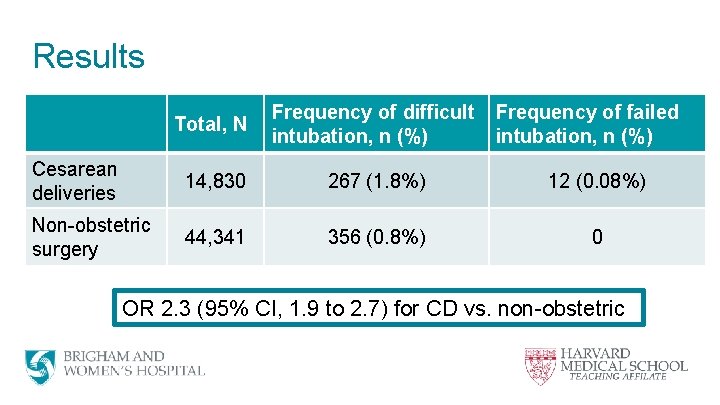
Results Total, N Frequency of difficult intubation, n (%) Frequency of failed intubation, n (%) Cesarean deliveries 14, 830 267 (1. 8%) 12 (0. 08%) Non-obstetric surgery 44, 341 356 (0. 8%) 0 OR 2. 3 (95% CI, 1. 9 to 2. 7) for CD vs. non-obstetric
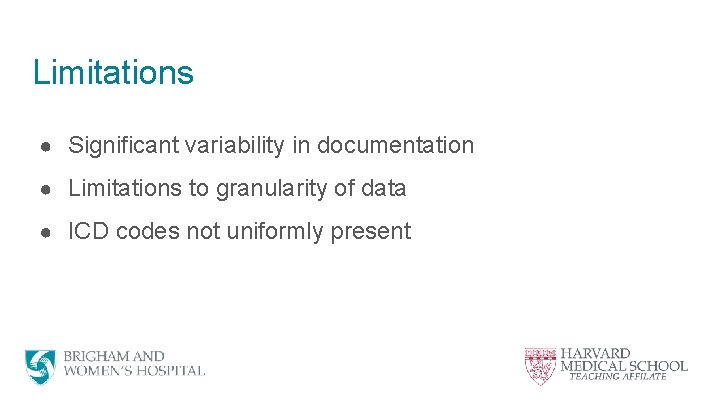
Limitations ● Significant variability in documentation ● Limitations to granularity of data ● ICD codes not uniformly present
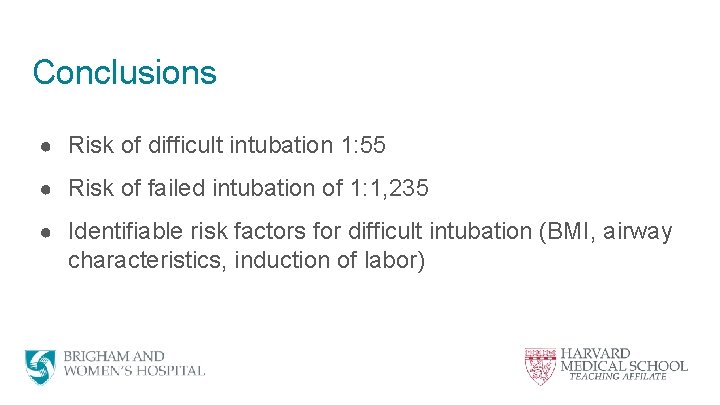
Conclusions ● Risk of difficult intubation 1: 55 ● Risk of failed intubation of 1: 1, 235 ● Identifiable risk factors for difficult intubation (BMI, airway characteristics, induction of labor)

Questions?
- Slides: 14