
The French Revolution The French Revolution Phase 1



- Slides: 30
The French Revolution
The French Revolution: Phase 1 The Moderate Stage
The Great Fear - After the fall of the Bastille peasants attacked other centers of government - Many peasants believed the aristocrats were trying to create a famine to starve them out - Peasants formed into brigades to protect the crops and spread fear throughout the countryside - In response the National Assembly abolished the remaining parts of feudalism - This included all forms of privilege, gave freedom of worship, and abolished sales of office
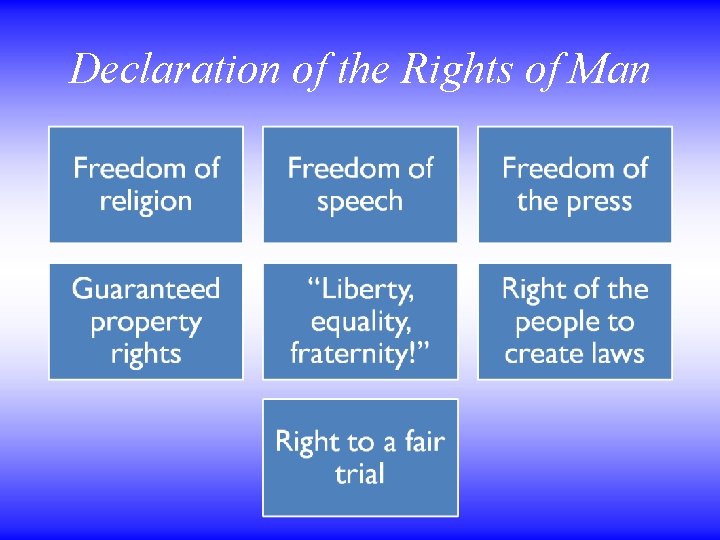
Declaration of the Rights of Man and Citizen • August 1789 • Promulgates the ideas of the enlightenment including civil involvement, the struggle against corporate power and unjust privilege, individual freedom, and anti absolutism • “All men are born free and equal” • Natural rights: liberty, property, security freedom from oppression, innocent until proven guilty • Didn’t guarantee economic equality • Laws should be passed in response to the “general will” • Excludes women
Declaration of the Rights of Man
Reaction to the Declaration - The King rejects any constitutional arrangement that limits his power - October 1789 7, 000 women marched to Versailles to protest the price of bread. - King, Queen, and the National Assembly are taken to Paris “The baker, the baker's wife, and the baker's little boy”
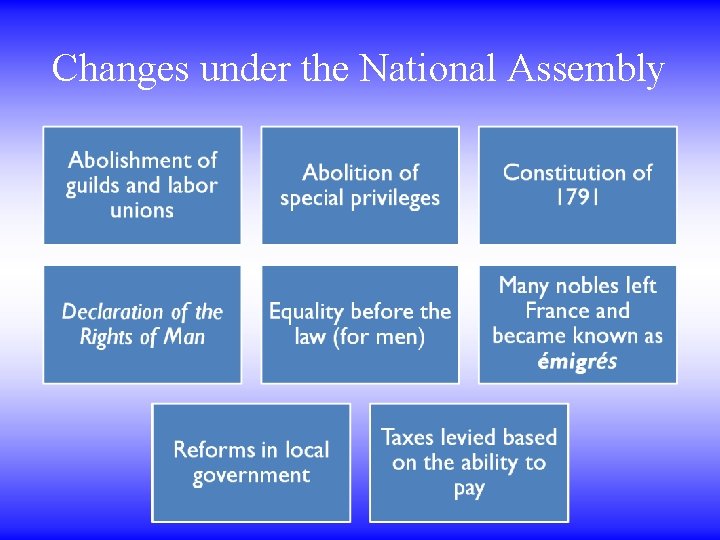
Reforms of the Assembly • Louis proclaimed “King of the French” • Talleyrand will convince the Assembly to confiscate church land sell it • July 1790, Louis agreed to a constitutional monarchy. • New laws increased opportunities for women, but still no vote. • Reorganized the provinces into 83 departments • Weights and measures were standardized (metric), guild restrictions lifted. • Paper currency was issued creating inflation and helping the peasants • A difference is made between active and passive citizens
Other Reforms of the Assembly • Customs tax on internally transported goods was lifted • The clergy was required to take an oath of loyalty to the state. This suborned the church to the state • The Assembly declared the Revolution over! • Louis made several concessions to the Assembly but he never intended to keep them • Abolition of special privileges for the nobility • Wrote a constitution which limited the monarchy • Torture was abolished, citizen juries introduced, sale of offices was abolished
Reaction to Changes - The King's brother and about 20, 000 emigres flee France - Half the clergy will not take the oath - A counter revolutionary movement begins due to the clerical reforms - Slavery is abolished, but not in the colonies, so colonial slaves rebel establishing the country of Haiti - Danton protests “active citizens” believing there should not be a property limit to vote - Many Europeans at first look favorably on the development of a constitutional monarchy along enlightenment principles - The Pope rejects the Declaration and the changes - Olympe de Gouges published The Rights of Women demanding natural rights for women as well
Changes under the National Assembly
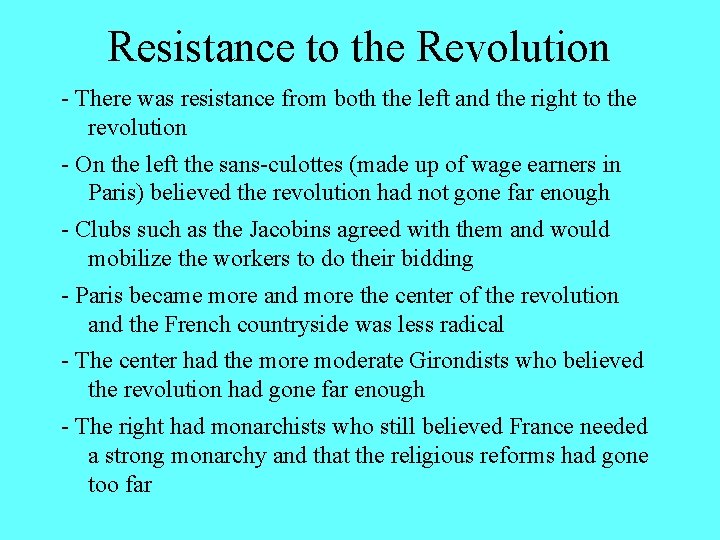
Resistance to the Revolution - There was resistance from both the left and the right to the revolution - On the left the sans-culottes (made up of wage earners in Paris) believed the revolution had not gone far enough - Clubs such as the Jacobins agreed with them and would mobilize the workers to do their bidding - Paris became more and more the center of the revolution and the French countryside was less radical - The center had the more moderate Girondists who believed the revolution had gone far enough - The right had monarchists who still believed France needed a strong monarchy and that the religious reforms had gone too far
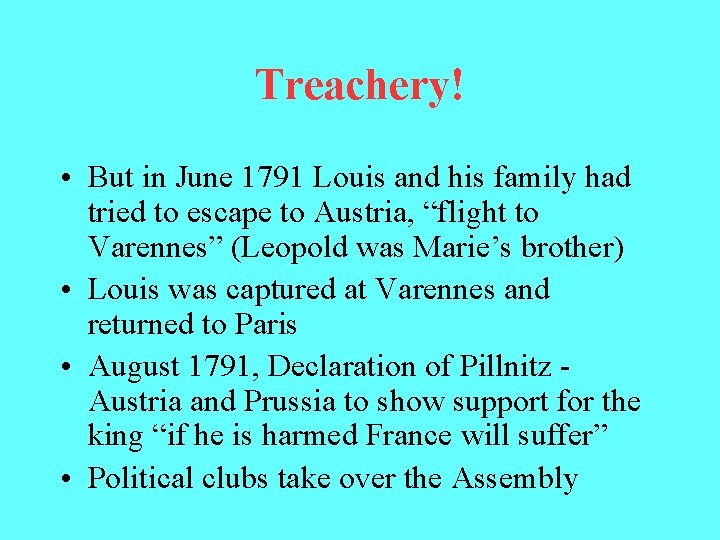
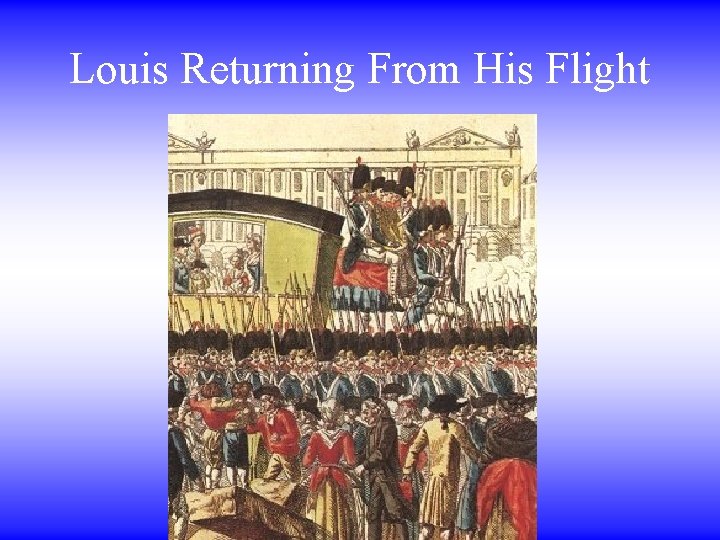
Treachery! • But in June 1791 Louis and his family had tried to escape to Austria, “flight to Varennes” (Leopold was Marie’s brother) • Louis was captured at Varennes and returned to Paris • August 1791, Declaration of Pillnitz Austria and Prussia to show support for the king “if he is harmed France will suffer” • Political clubs take over the Assembly
Louis Returning From His Flight
The French Revolution: Phase 2 The Radical Stage
The Revolution Turns Radical • By September 1791 the National Assembly announced its work completed, Louis accepted the constitution. • By 1792 the Revolution had turned radical because of: a) a counter revolution led by the king, church, and Catholic peasants b) economic, social, and political discontent among the peasants, artisans, and wage earners (sans-culottes) c) The wars of the Revolution created fear of internal sabotage
First Revolutionary Wars • The Girondists were able to take over the assembly and had a much more aggressive stance, wanting to spread the revolution to the rest of Europe • In April 1792 France declared war on Austria • July 25: The Brunswick Manifesto: Austria and Prussia promise revenge if the monarch is hurt • Prussia joined Austria to create the First Coalition (which will eventually be joined by Great Britain and the Dutch Netherlands • The French suffered defeats early in the war
The Second Revolution • The sans-culottes insisted it was the duty of the government to protect them • They wanted the government to increase wages, fix prices, and end shortages • They wanted to prevent extremes of wealth • Wanted a democratic republic such as Thomas Paine suggested • In August 1792 sans-culottes attacked the palace and killed several hundred Swiss Guards • By September Paris was in turmoil • “September Massacres” a civil war in France breaks out with both sides slaughtering each other, some areas loosing 25% of the population • On September 1 st, 1792 France was declared a Republic
The Second Revolution • The sans-culottes insisted it was the duty of the government to protect them • They wanted the government to increase wages, fix prices, and end shortages • They wanted to prevent extremes of wealth • Wanted a democratic republic such as Thomas Paine suggested • In August 1792 sans-culottes attacked the palace and killed several hundred Swiss Guards • By September Paris was in turmoil • “September Massacres” a civil war in France breaks out with both sides slaughtering each other, some areas loosing 25% of the population • On September 1 st, 1792 France was declared a Republic
Internal Divisions • With a civil war raging the King was discovered to be attempting to get help from the powers fighting France • The king was imprisoned and tried in December 1792 • He was convicted and will be sentenced to execution by one vote • After the execution the Assembly became the National Convention
More War • British Prime Minister Pitt said France had to leave Belgium • France is pushed out of Belgium • February 1, 1793 France declares war on Britain, Holland, Spain Austria, and Prussia • The Assembly divided into two groups: Girondists from western France, and the Jacobins led by Robespierre and Danton • Both advocated war • In the spring France was pushed from Belgium • In response to the war France decreed “Levee en Masse” a national conscription • Heavily opposed and stoked the growing civil war which became a mass insurrection by 1793
The French Revolution The Terror
Split in the Convention • Republican armies captured Nice, invaded the Rhineland occupied Austrian Netherlands • Girondists and Jacobins became very suspicious of each other • May 31 1793, the Commune, under sans-culottes pressure, has the Girondists arrested • Sans-culotte emerge as the most powerful group in Paris
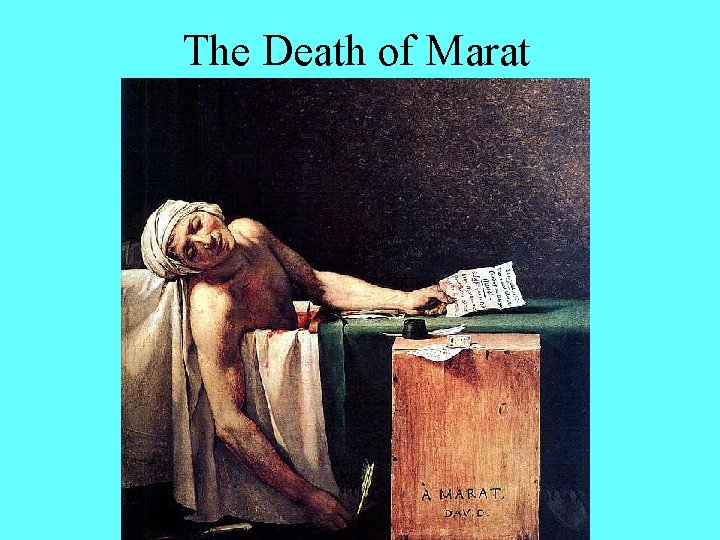
The Convention • Maximilian Robespierre (a disciple of Rousseau) formed the Committee of Public Safety to ensure success of the revolution • Mandated economic controls, but too weak to enforce, except the price of bread • Nationalized the war effort • Arrested thousands of suspected counter-revolutionaries • Robespierre wanted to create a Republic of Virtue • To ensure his ideals he implemented the Reign of Terror (1793 -4) • At the same time Marat, leader of the Girondists was killed by a noblewoman at his home
The Death of Marat
Reign of Terror • Leaders of the Girondists were executed including Danton • Revolutionary courts tried enemies of the state • Dictatorship • 40, 000 executed, 300, 000 imprisoned • Robespierre tried to De-Christianize the country • New calendar with no Christian holidays or Sundays - Sept. 1, 1792 was day one, year one. • Each month had 30 days, with 10 day weeks • June 1794 Robespierre introduced the cult of the Supreme Being in which the Republic acknowledged the existence of God • Alienated Catholics
Marie Antoinette • • • Beheaded Oct. 16 “Terror is the order of the day” 1794 French armies successful on all fronts 1795 Spain and Prussia quit 1796 Austria quit leaving only Britain
The French Revolution Phase 3: Decent Into Dictatorship
Thermidorean Reaction • Robespierre wanted an ideal democratic republic without rich or poor • Through despotism and the guillotine he eliminated all opposition • Robespierre was arrested by the Convention and executed (July 28, 1794) by fearful middle class who really benefited from his removal • Inflation increased, self-indulgence increased, people turned to religion • National Convention abolished economic controls and wrote a new constitution
The Directory • 1795 leadership passed to five Directors, but same old leaders people who had survived - dominated by bourgeoisie • Lowered prices; alleviated hunger; reorganized the tax system; won military victories; wrote a constitution which incorporated Belgium • Faced revolts from the left - “Gracchus” Babeuf and the “conspiracy of equals” • And from the monarchists - Barthelemy and Carnot • 1795 Louis “XVII” died, the Count de Provance claimed to be Louis “XVIII” • Louis XVIII made the Declaration of Verona: a) restore the Old Regime b) return all confiscated land c) restore old privileges, taxes, and dues
The Coup • 18 Fructidor (Sept 4, 1797) three Directors occupy Paris and stage a coup • They annulled the elections, imposed censorship, and exiled troublemakers • Napoleon sent deputy to Paris to ensure the success of the coup