
The French Revolution Revolts and Reforms Overview 1
- Slides: 45
The French Revolution Revolts and Reforms
Overview 1. The old regime “Ancien Regime” 2. Economic troubles for Louis XVI! 3. Louis XVI calls the Estate General 4. The Storming of the Bastille
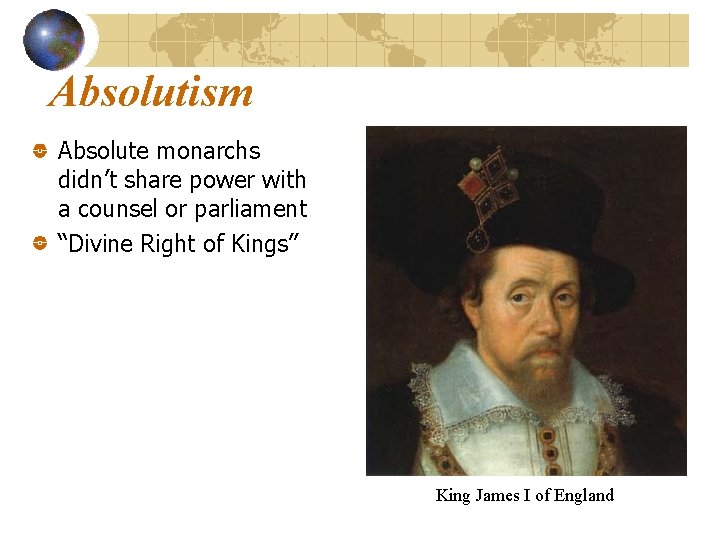
Absolutism Absolute monarchs didn’t share power with a counsel or parliament “Divine Right of Kings” King James I of England
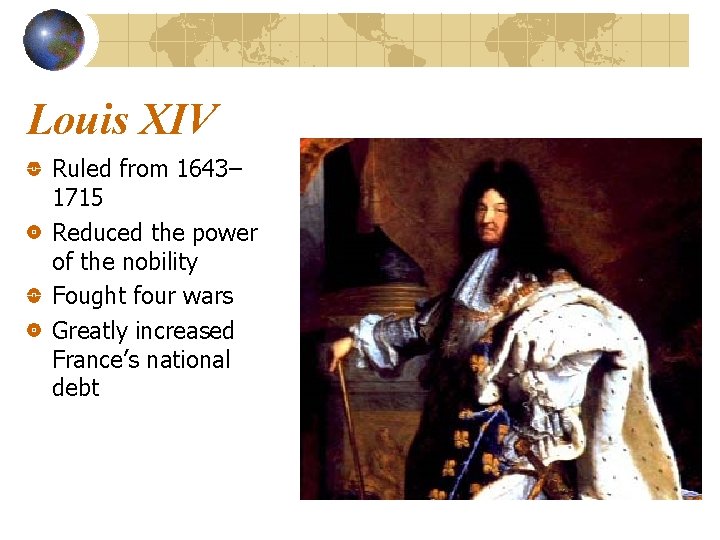
Louis XIV Ruled from 1643– 1715 Reduced the power of the nobility Fought four wars Greatly increased France’s national debt
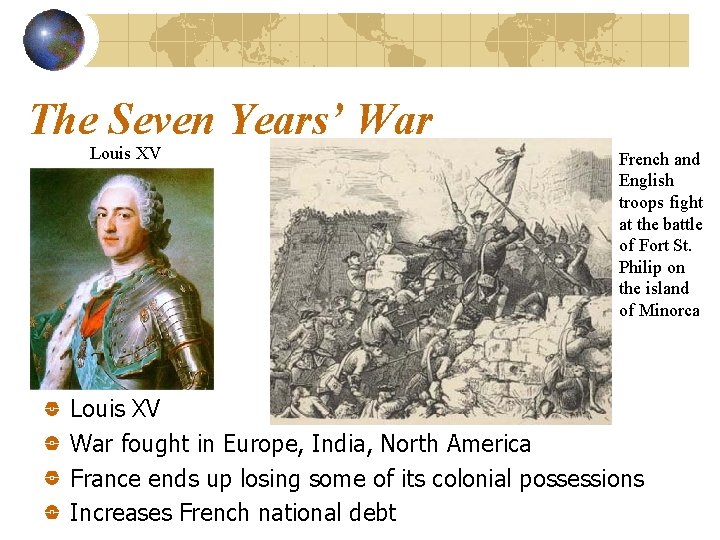
The Seven Years’ War Louis XV French and English troops fight at the battle of Fort St. Philip on the island of Minorca Louis XV War fought in Europe, India, North America France ends up losing some of its colonial possessions Increases French national debt
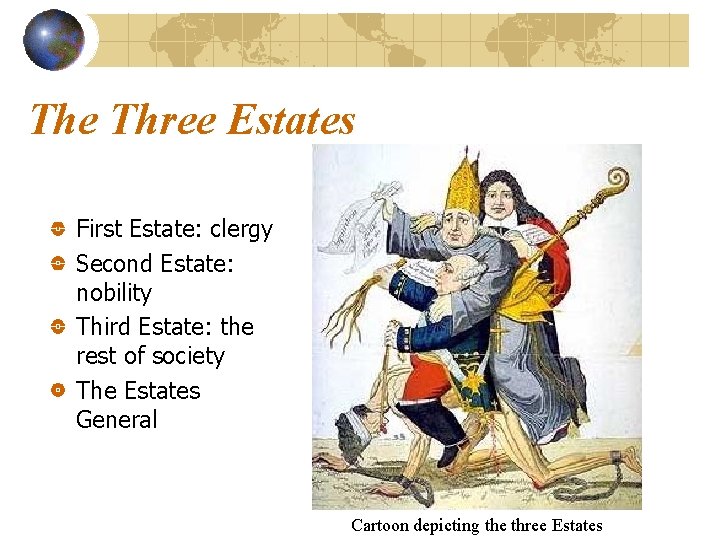
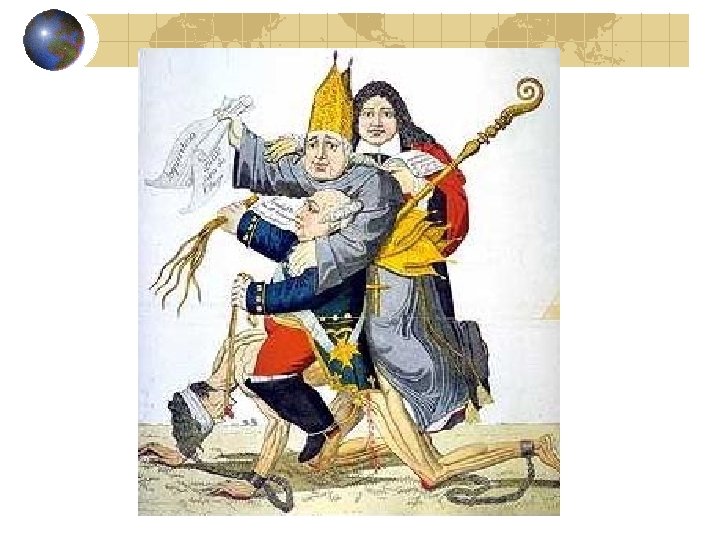
The Three Estates First Estate: clergy Second Estate: nobility Third Estate: the rest of society The Estates General Cartoon depicting the three Estates
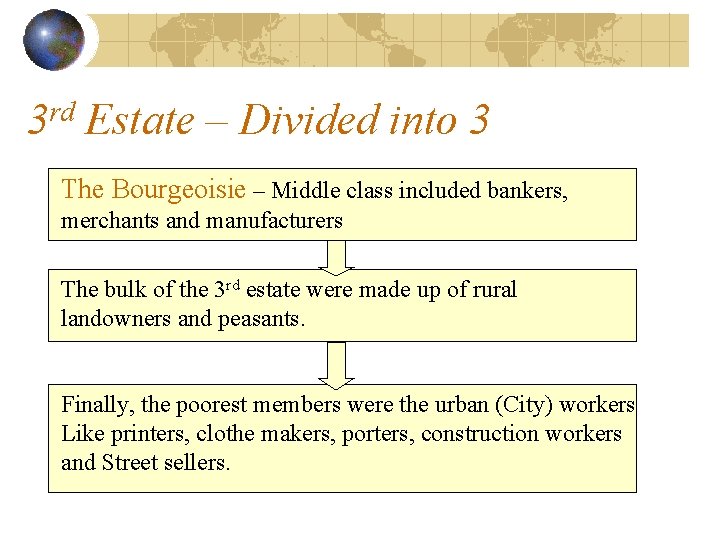
3 rd Estate – Divided into 3 The Bourgeoisie – Middle class included bankers, merchants and manufacturers The bulk of the 3 rd estate were made up of rural landowners and peasants. Finally, the poorest members were the urban (City) workers Like printers, clothe makers, porters, construction workers and Street sellers.
Causes of the French Revolution
The 3 rd Estate - Discontent 1. Discontent starts to increase amongst the poor. 2. Urban workers suffered every time prices went up for food, especially bread 3. Peasants were taxed on everything, land, soap, salt. 4. Peasants were forced to pay Corvee which was unpaid labor to repair roads and bridges. 5. The ideas of Enlightenment started to lead people to question why they were made to suffer when the nobles and clergy had so much!
Economic Troubles for Louis XVI The French and Indian War has nearly broken the Treasury and increased the national debt. Poor Harvests meant raised food prices, the poor get even less. Failure to reform: Louis hires Jaques Necker to solve the economic crisis. Necker tries to get the King to reduce court spending and reform the government. Necker was only allowed to tax the poor, but not the nobles, making the situation even worse!
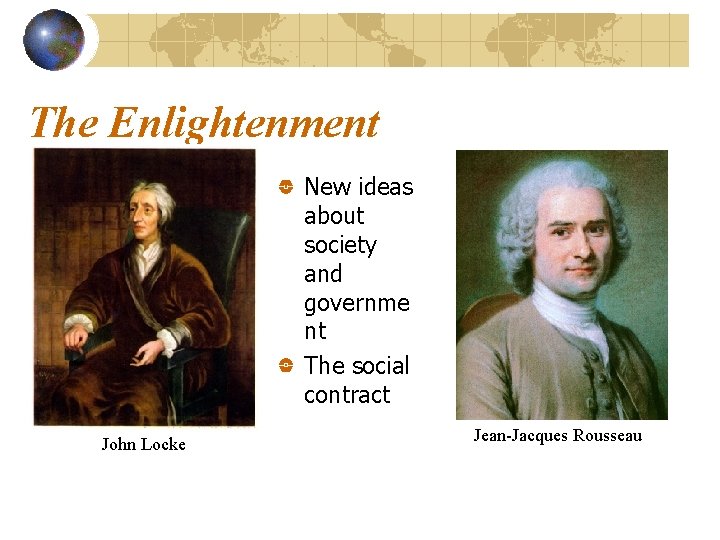
The Enlightenment New ideas about society and governme nt The social contract John Locke Jean-Jacques Rousseau
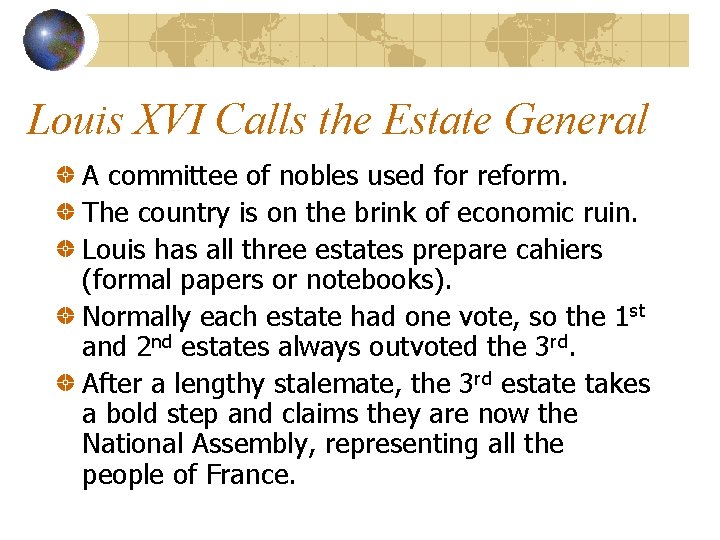
Louis XVI Calls the Estate General A committee of nobles used for reform. The country is on the brink of economic ruin. Louis has all three estates prepare cahiers (formal papers or notebooks). Normally each estate had one vote, so the 1 st and 2 nd estates always outvoted the 3 rd. After a lengthy stalemate, the 3 rd estate takes a bold step and claims they are now the National Assembly, representing all the people of France.
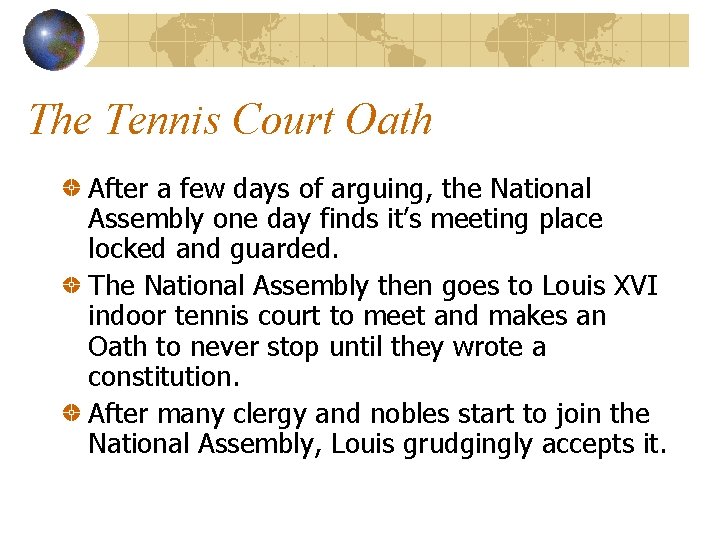
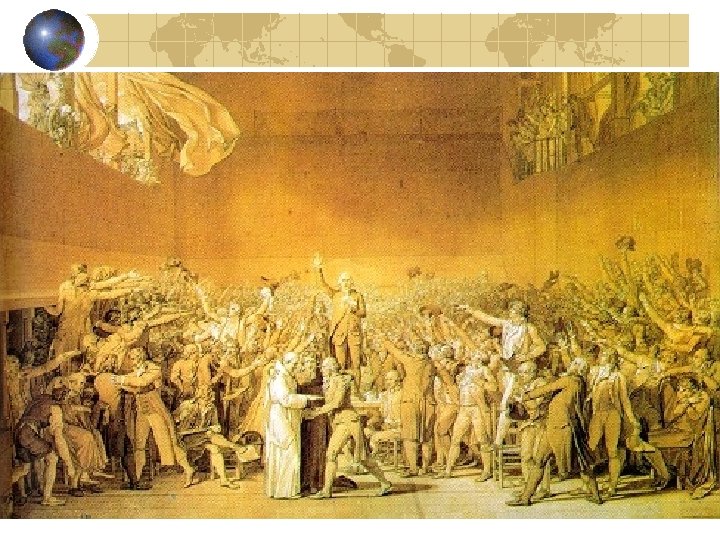
The Tennis Court Oath After a few days of arguing, the National Assembly one day finds it’s meeting place locked and guarded. The National Assembly then goes to Louis XVI indoor tennis court to meet and makes an Oath to never stop until they wrote a constitution. After many clergy and nobles start to join the National Assembly, Louis grudgingly accepts it.
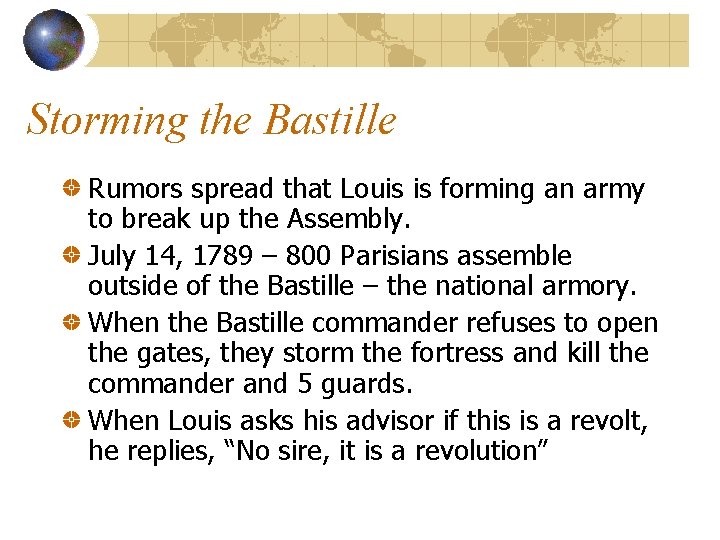
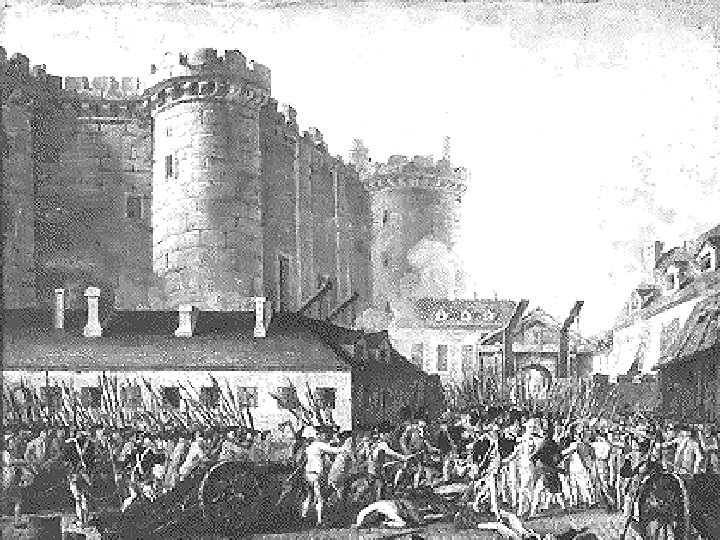
Storming the Bastille Rumors spread that Louis is forming an army to break up the Assembly. July 14, 1789 – 800 Parisians assemble outside of the Bastille – the national armory. When the Bastille commander refuses to open the gates, they storm the fortress and kill the commander and 5 guards. When Louis asks his advisor if this is a revolt, he replies, “No sire, it is a revolution”
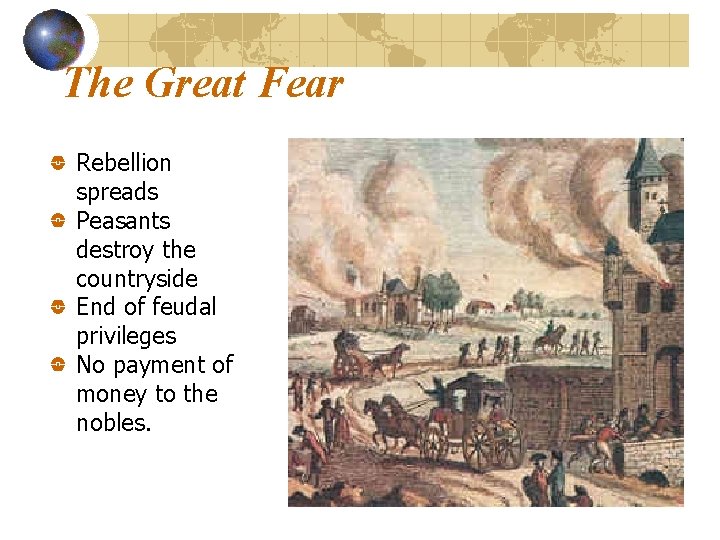
The Great Fear Rebellion spreads Peasants destroy the countryside End of feudal privileges No payment of money to the nobles.
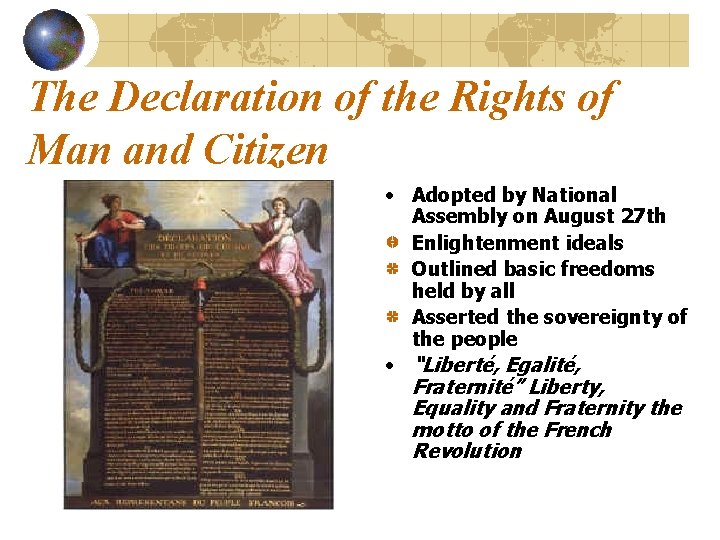
The Declaration of the Rights of Man and Citizen • Adopted by National Assembly on August 27 th Enlightenment ideals Outlined basic freedoms held by all Asserted the sovereignty of the people • “Liberté, Egalité, Fraternité” Liberty, Equality and Fraternity the motto of the French Revolution
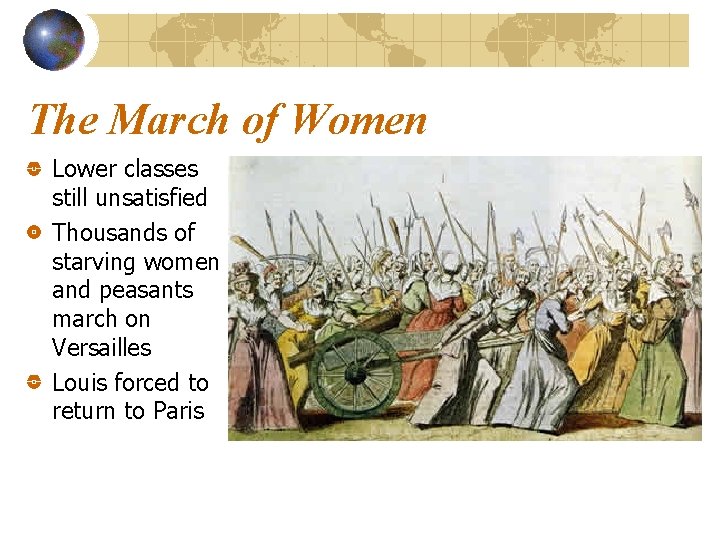
The March of Women Lower classes still unsatisfied Thousands of starving women and peasants march on Versailles Louis forced to return to Paris
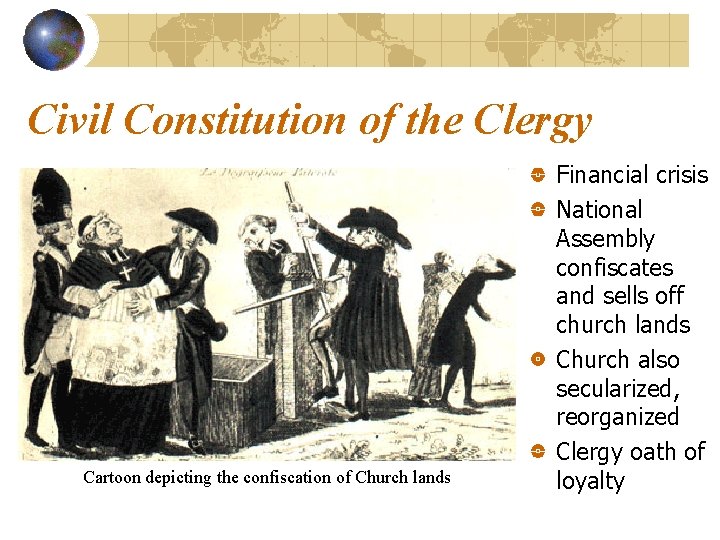
Civil Constitution of the Clergy Cartoon depicting the confiscation of Church lands Financial crisis National Assembly confiscates and sells off church lands Church also secularized, reorganized Clergy oath of loyalty
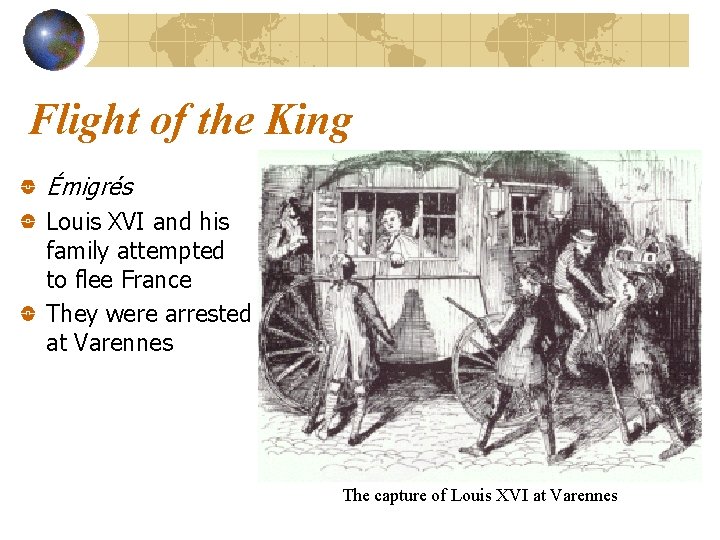
Flight of the King Émigrés Louis XVI and his family attempted to flee France They were arrested at Varennes The capture of Louis XVI at Varennes
Reforms of the National Assembly Abolish feudal dues, set up a fair tax system, education system, abolish privileges of 1 st and 2 nd estates ( job opportunities and hunting rights) Abolish all titles of nobility Declaration of the Rights of Man and Citizen gives the men natural rights denied by the monarchy. Civil Constitution of the Clergy Ancient Regime is going to be abolished/ no more estates
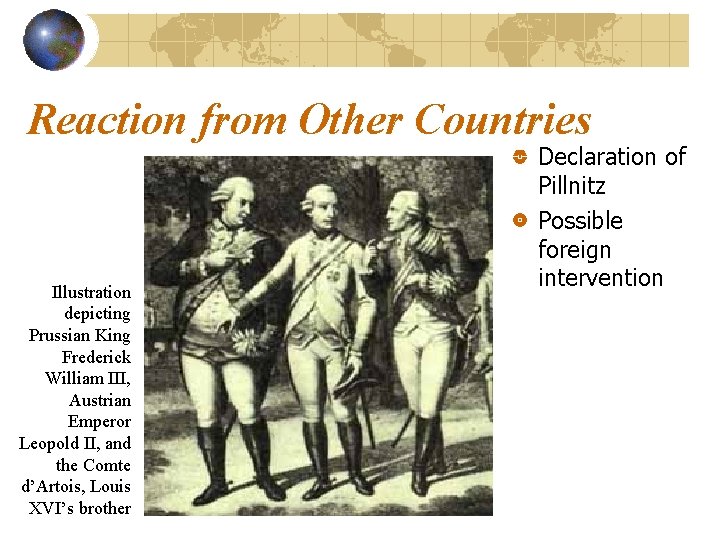
Reaction from Other Countries Illustration depicting Prussian King Frederick William III, Austrian Emperor Leopold II, and the Comte d’Artois, Louis XVI’s brother Declaration of Pillnitz Possible foreign intervention
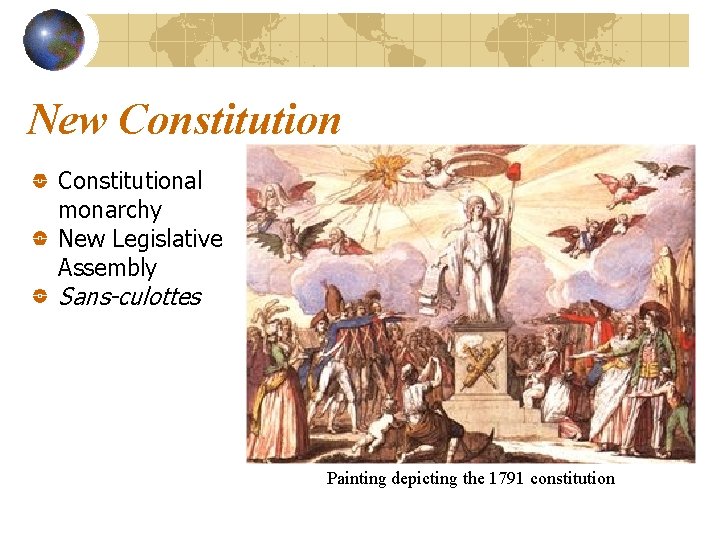
New Constitutional monarchy New Legislative Assembly Sans-culottes Painting depicting the 1791 constitution
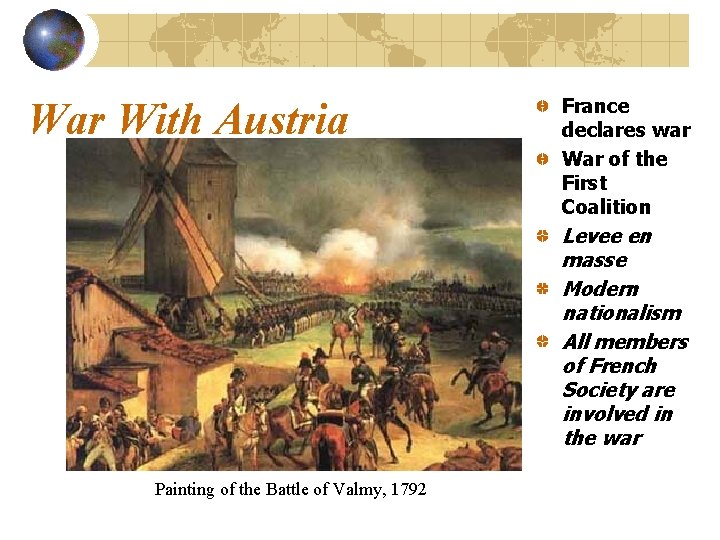
War With Austria France declares war War of the First Coalition Levee en masse Modern nationalism All members of French Society are involved in the war Painting of the Battle of Valmy, 1792
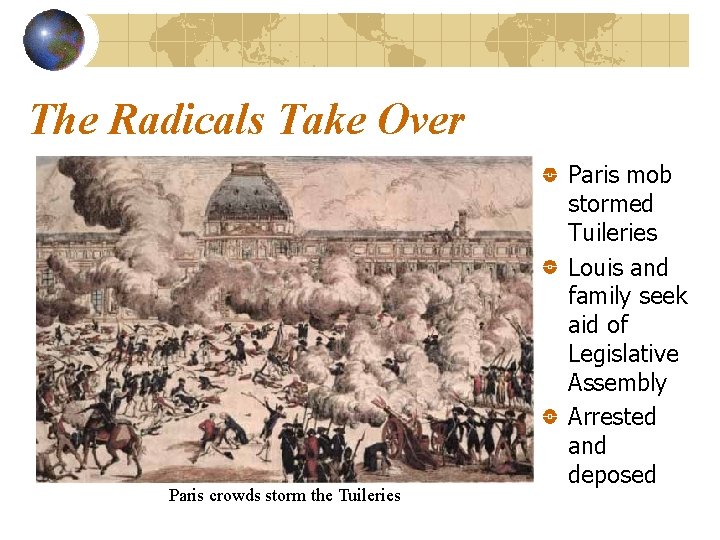
The Radicals Take Over Paris crowds storm the Tuileries Paris mob stormed Tuileries Louis and family seek aid of Legislative Assembly Arrested and deposed
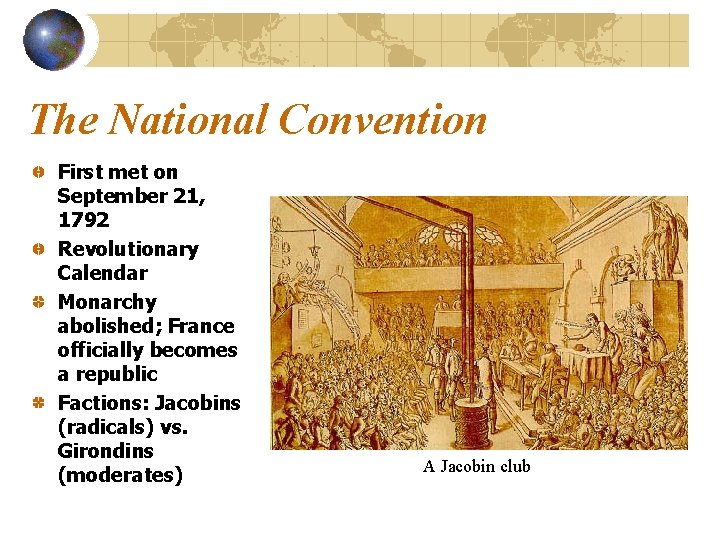
The National Convention First met on September 21, 1792 Revolutionary Calendar Monarchy abolished; France officially becomes a republic Factions: Jacobins (radicals) vs. Girondins (moderates) A Jacobin club
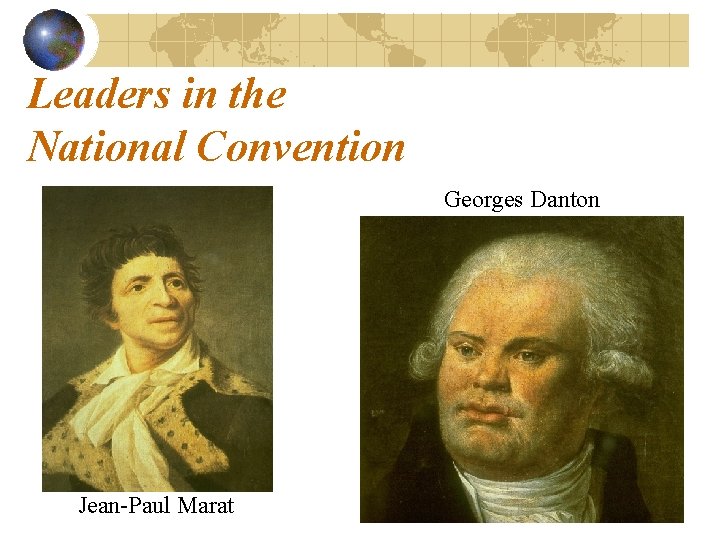
Leaders in the National Convention Georges Danton Jean-Paul Marat
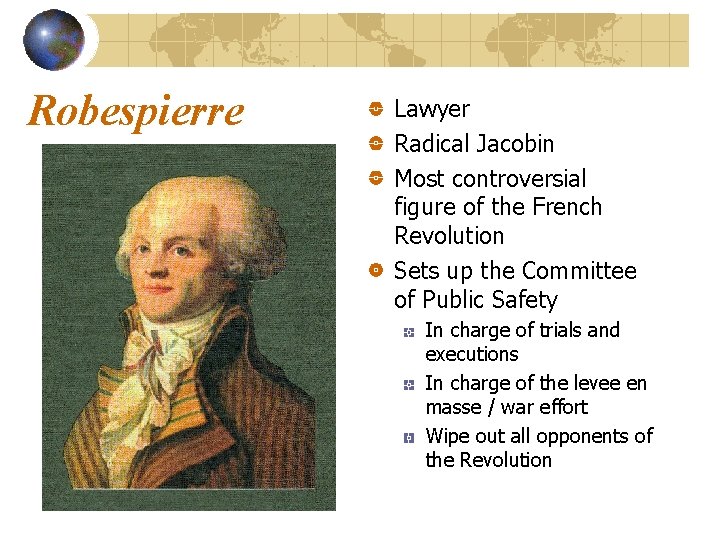
Robespierre Lawyer Radical Jacobin Most controversial figure of the French Revolution Sets up the Committee of Public Safety In charge of trials and executions In charge of the levee en masse / war effort Wipe out all opponents of the Revolution
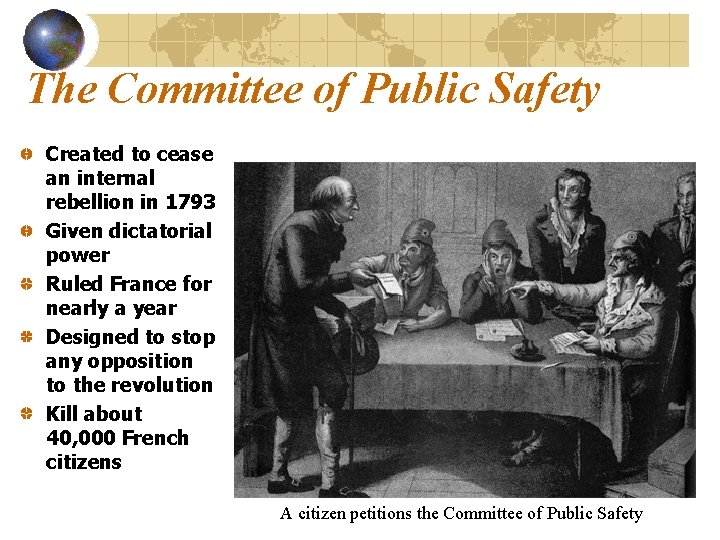
The Committee of Public Safety Created to cease an internal rebellion in 1793 Given dictatorial power Ruled France for nearly a year Designed to stop any opposition to the revolution Kill about 40, 000 French citizens A citizen petitions the Committee of Public Safety
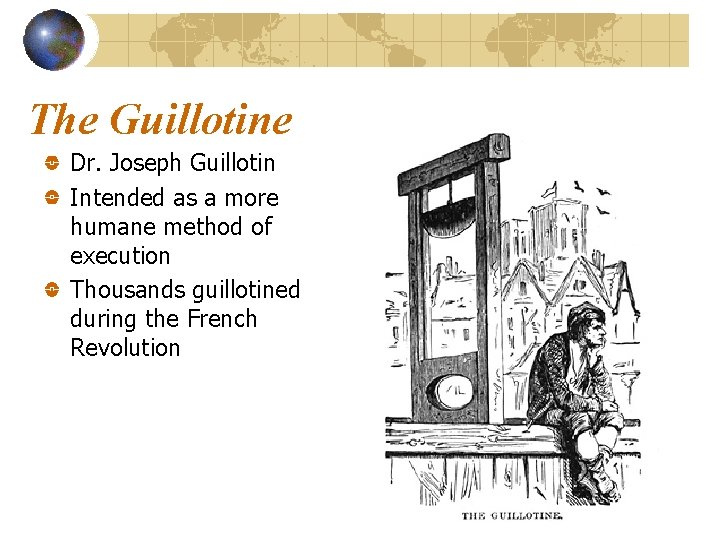
The Guillotine Dr. Joseph Guillotin Intended as a more humane method of execution Thousands guillotined during the French Revolution
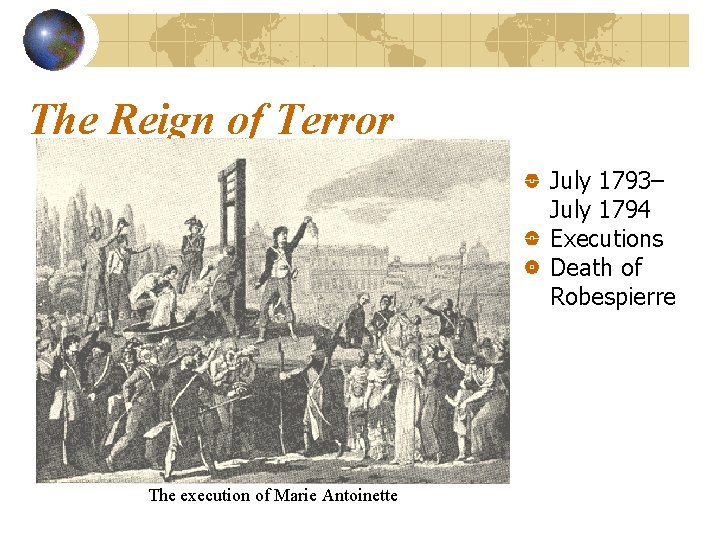
The Reign of Terror July 1793– July 1794 Executions Death of Robespierre The execution of Marie Antoinette
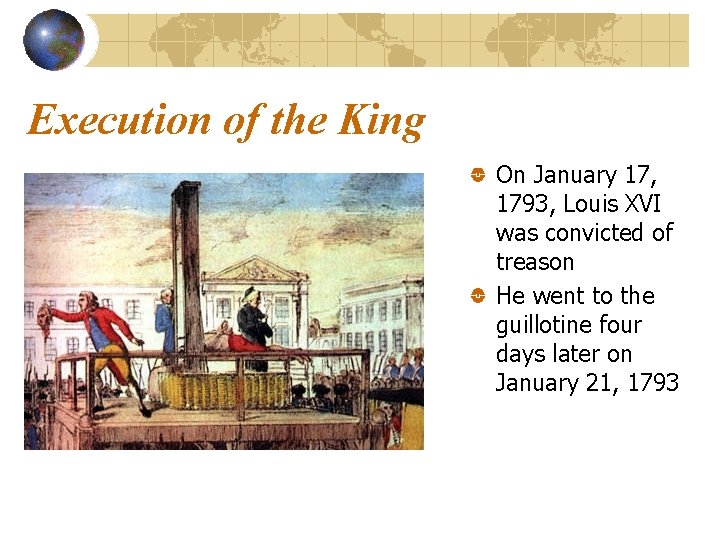
Execution of the King On January 17, 1793, Louis XVI was convicted of treason He went to the guillotine four days later on January 21, 1793
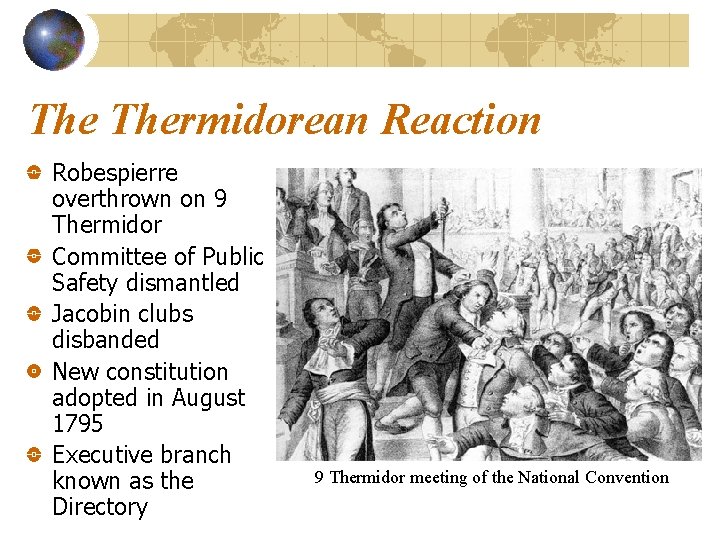
The Thermidorean Reaction Robespierre overthrown on 9 Thermidor Committee of Public Safety dismantled Jacobin clubs disbanded New constitution adopted in August 1795 Executive branch known as the Directory 9 Thermidor meeting of the National Convention
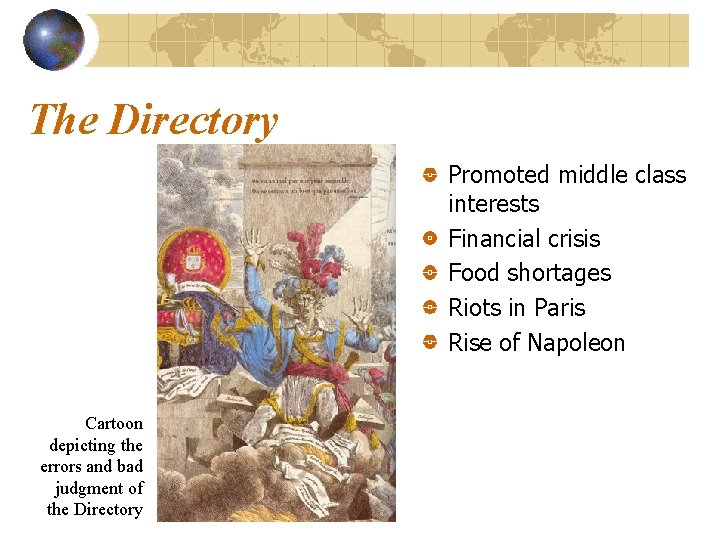
The Directory Promoted middle class interests Financial crisis Food shortages Riots in Paris Rise of Napoleon Cartoon depicting the errors and bad judgment of the Directory
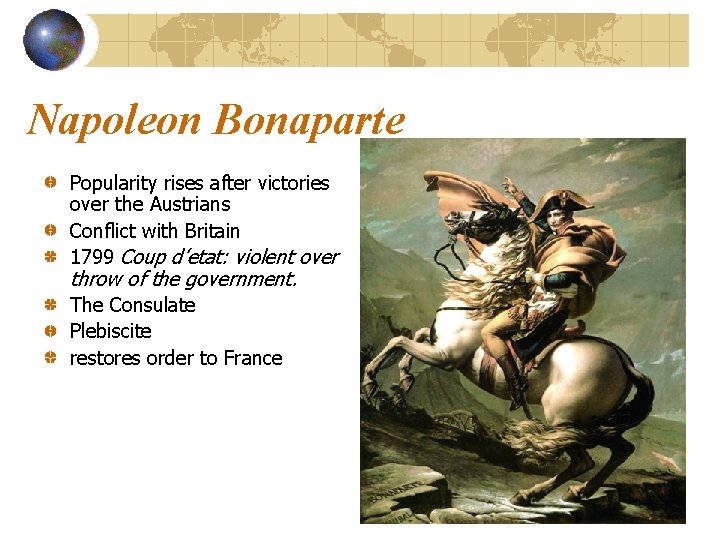
Napoleon Bonaparte Popularity rises after victories over the Austrians Conflict with Britain 1799 Coup d’etat: violent over throw of the government. The Consulate Plebiscite restores order to France
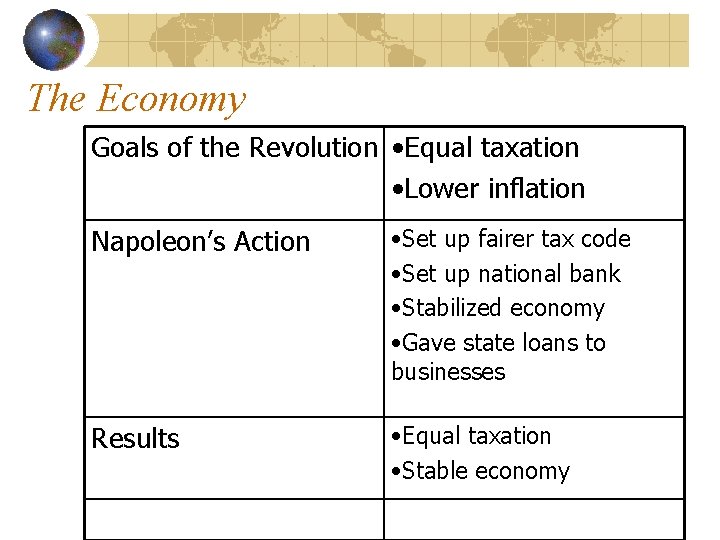
The Economy Goals of the Revolution • Equal taxation • Lower inflation Napoleon’s Action • Set up fairer tax code • Set up national bank • Stabilized economy • Gave state loans to businesses Results • Equal taxation • Stable economy
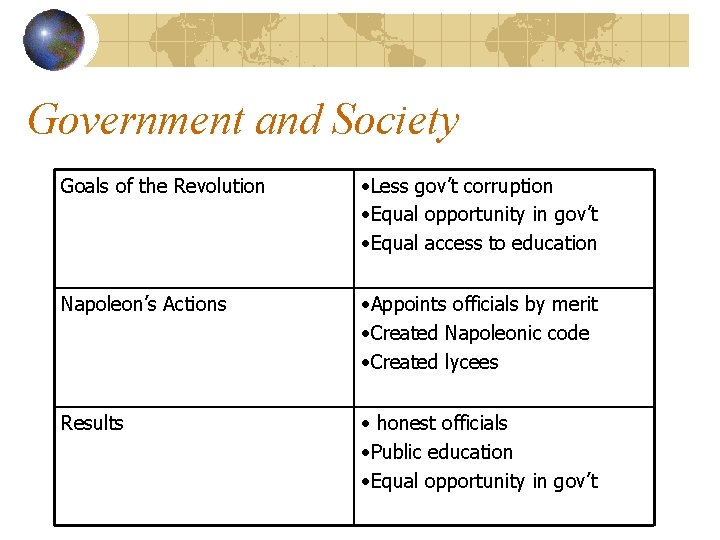
Government and Society Goals of the Revolution • Less gov’t corruption • Equal opportunity in gov’t • Equal access to education Napoleon’s Actions • Appoints officials by merit • Created Napoleonic code • Created lycees Results • honest officials • Public education • Equal opportunity in gov’t
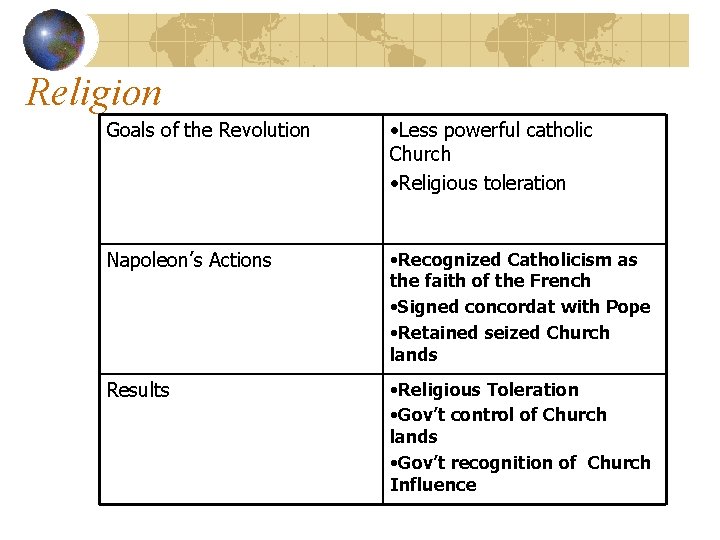
Religion Goals of the Revolution • Less powerful catholic Church • Religious toleration Napoleon’s Actions • Recognized Catholicism as the faith of the French • Signed concordat with Pope • Retained seized Church lands Results • Religious Toleration • Gov’t control of Church lands • Gov’t recognition of Church Influence
Napoleon Builds an Empire Conquered most of Europe except for Britain and Russia Loses Battle of Trafalgar to coalition of European Countries
Napoleon’s Three Costly Mistakes The Continental System The Peninsular War Against Spain and Portugal The Invasion of Russia Scorched earth policy Loss of about 300, 000 to 400, 000 men
Napoleon’s Downfall Coalition against Napoleon Battle of Leipzig 1813 Banished to Elba Returns for 100 Days Battle of Waterloo in Belgium Island of St. Helena
The Congress of Vienna Prince Klemens von Metternich Restore Balance of Power Based on Legitimacy: under the principle of legitimacy, rulers disposed by Napoleon are returned to power Makes fair settlements and produces a lasting peace. Redraw the borders of France to the pre revolution borders.
Napoleon’s Contributions to Europe Napoleonic code Spread the ideals of the French Revolution: equality Nationalism