
The French Revolution History1028 Separation of Powers Direct

- Slides: 12
The French Revolution
History-10/28 Separation of Powers Direct Democracy 1 st Amendment Rights Natural Rights/Consent of the Governed • Rights of the Accused • Women’s Equality • • • A-Locke B-Wollstonecraft C-Montesquieu D-Rousseau E-Beccaria F-Voltaire
History-2/3 • Who made up each of the 3 Estates in France during the 18 th Century (1700 s)? – 1 st Estate: – 2 nd Estate: – 3 rd Estate: • Why did the 3 rd Estate have a problem with King Louis XVI and the 1 st and 2 nd Estates? • What was considered the 1 st verbal revolutionary act of the French Revolution? • What was considered the 1 st physical revolutionary act of the French Revolution?
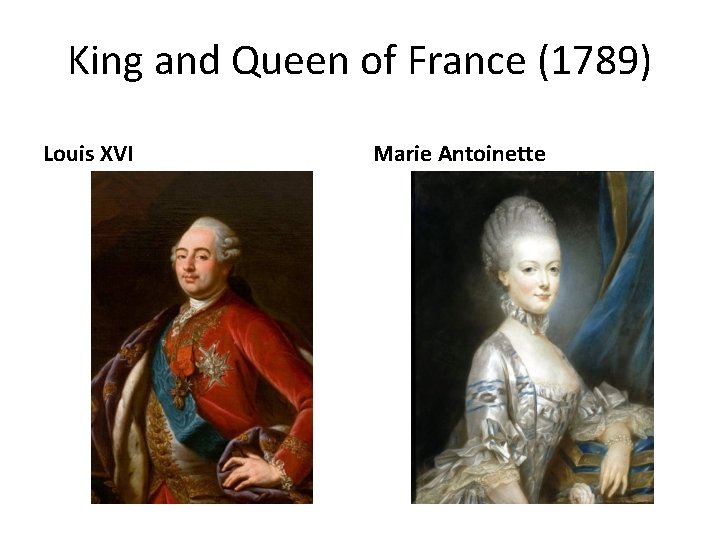
King and Queen of France (1789) Louis XVI Marie Antoinette
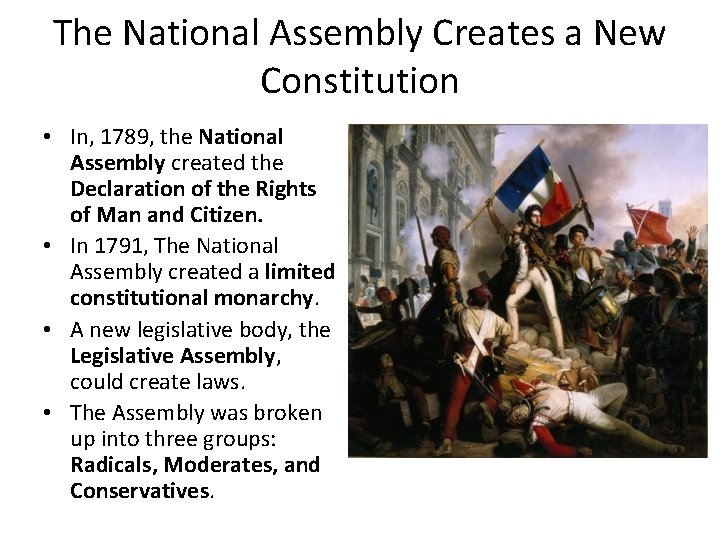
The National Assembly Creates a New Constitution • In, 1789, the National Assembly created the Declaration of the Rights of Man and Citizen. • In 1791, The National Assembly created a limited constitutional monarchy. • A new legislative body, the Legislative Assembly, could create laws. • The Assembly was broken up into three groups: Radicals, Moderates, and Conservatives.
History-2/4 • What type of government did the new Constitution in France create? • What important document did the National Assembly create with the Constitution? • What was the purpose of the Legislative Assembly? • What were the 3 political factions of the Assembly?
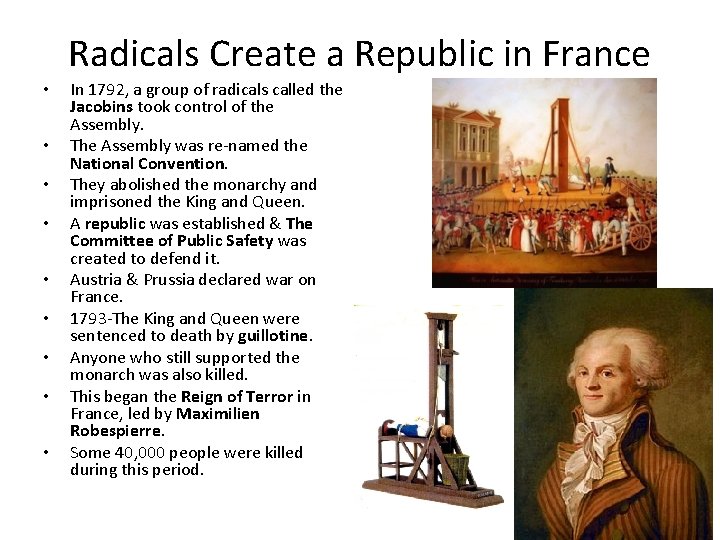
Radicals Create a Republic in France • • • In 1792, a group of radicals called the Jacobins took control of the Assembly. The Assembly was re-named the National Convention. They abolished the monarchy and imprisoned the King and Queen. A republic was established & The Committee of Public Safety was created to defend it. Austria & Prussia declared war on France. 1793 -The King and Queen were sentenced to death by guillotine. Anyone who still supported the monarch was also killed. This began the Reign of Terror in France, led by Maximilien Robespierre. Some 40, 000 people were killed during this period.
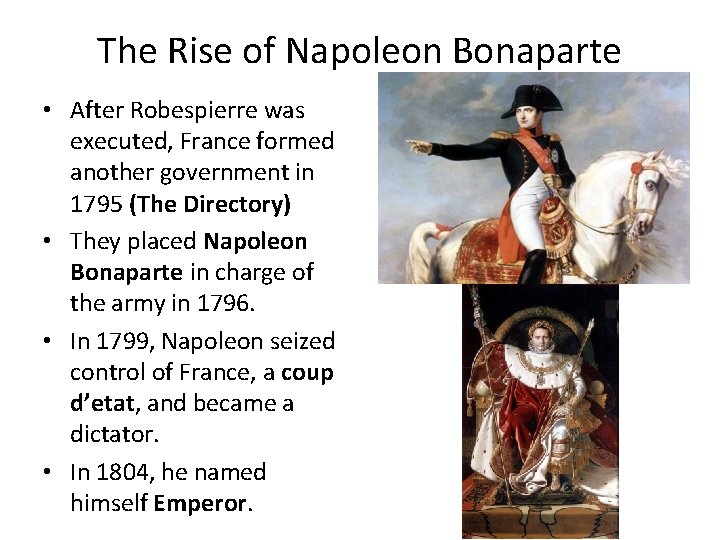
The Rise of Napoleon Bonaparte • After Robespierre was executed, France formed another government in 1795 (The Directory) • They placed Napoleon Bonaparte in charge of the army in 1796. • In 1799, Napoleon seized control of France, a coup d’etat, and became a dictator. • In 1804, he named himself Emperor.
History-11/1 It is necessary to stifle the domestic and foreign enemies of the Republic or perish with them. Now in these circumstances, the first maxim of our politics ought to be to lead the people by means of reason and the enemies of the people by terror. If the basis of popular government in time of peace is virtue, the basis of popular government in time of revolution is both virtue and terror: virtue without which terror is murderous, terror without which virtue is powerless. Terror is nothing else than swift, severe, indomitable justice; it flows, then, from virtue. • Who is likely to have said this from the French Revolution? • Do you agree that terror is necessary in a time of revolution? • What does he mean by terror flows from virtue?
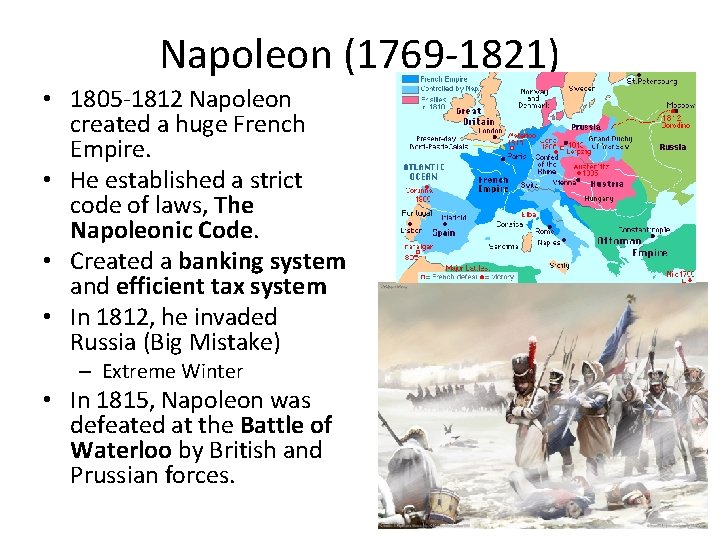
Napoleon (1769 -1821) • 1805 -1812 Napoleon created a huge French Empire. • He established a strict code of laws, The Napoleonic Code. • Created a banking system and efficient tax system • In 1812, he invaded Russia (Big Mistake) – Extreme Winter • In 1815, Napoleon was defeated at the Battle of Waterloo by British and Prussian forces.
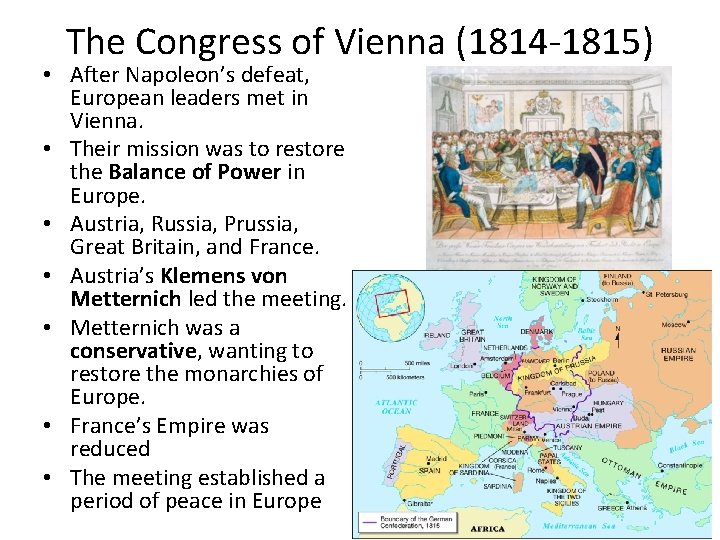
The Congress of Vienna (1814 -1815) • After Napoleon’s defeat, European leaders met in Vienna. • Their mission was to restore the Balance of Power in Europe. • Austria, Russia, Prussia, Great Britain, and France. • Austria’s Klemens von Metternich led the meeting. • Metternich was a conservative, wanting to restore the monarchies of Europe. • France’s Empire was reduced • The meeting established a period of peace in Europe
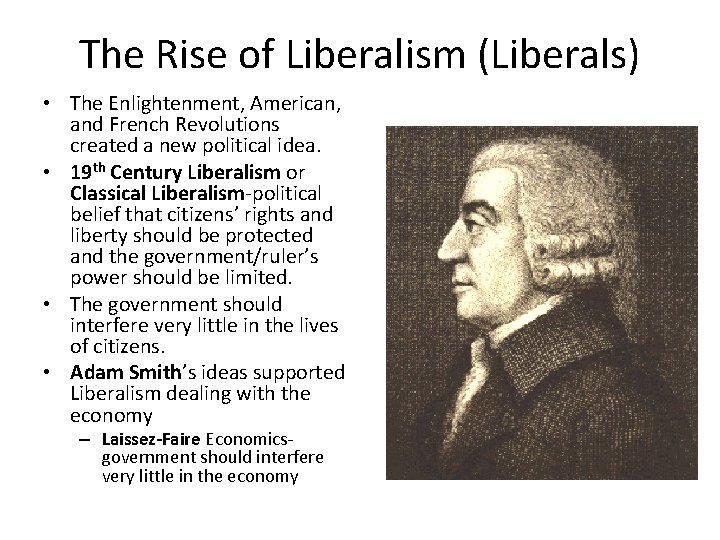
The Rise of Liberalism (Liberals) • The Enlightenment, American, and French Revolutions created a new political idea. • 19 th Century Liberalism or Classical Liberalism-political belief that citizens’ rights and liberty should be protected and the government/ruler’s power should be limited. • The government should interfere very little in the lives of citizens. • Adam Smith’s ideas supported Liberalism dealing with the economy – Laissez-Faire Economicsgovernment should interfere very little in the economy