
THE FRENCH REVOLUTION Grade 8 Meaning of the

- Slides: 38
THE FRENCH REVOLUTION Grade 8
Meaning of the term ‘REVOLUTION’ �The word ‘revolution’ describes a time of dramatic and sudden change in history. �The word is also used to describe changes in other aspects such as transport, agriculture and industry which take place over many years.
Introduction �Between 1789 and 1794 a revolution took place in France and the ideas of the revolution spread to other countries in Europe. �To understand how and why the French Revolution occurred, we need to understand the French society of that time. �It was made up of autocratic (absolute), extravagant rulers, privileged nobles and clergy, landless peasants, jobless workers and unequal taxation.
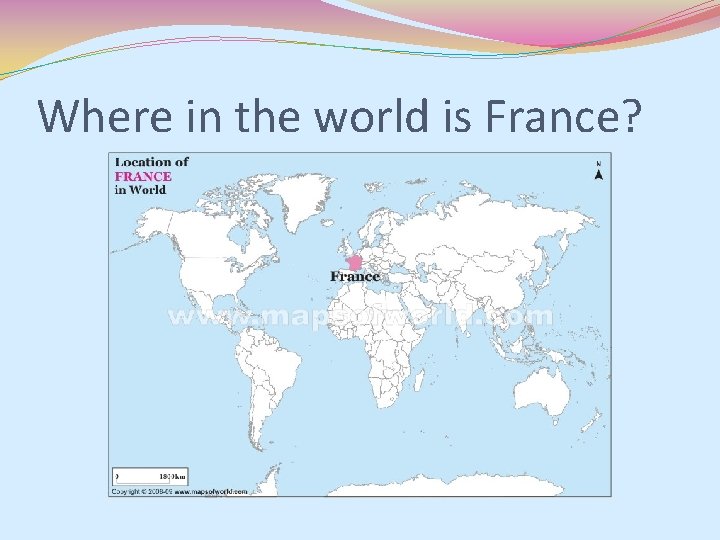
Where in the world is France?
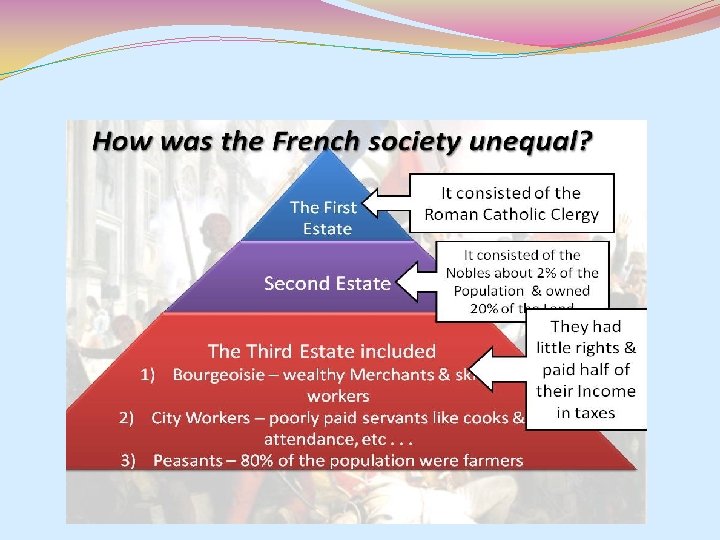
The French Society �The French society was divided into classes or estates. �There were two privileged classes – the clergy and the nobility �They were known as the First Estate and the Second Estate �Their lives were characterized by extravagance and luxury.
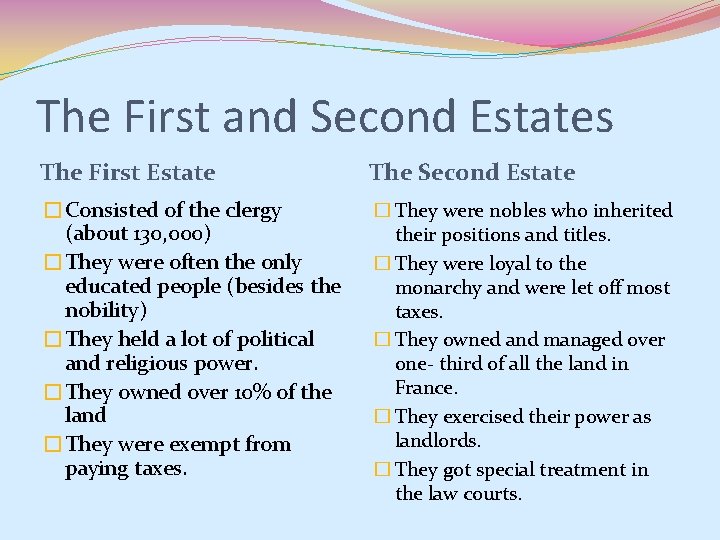
The First and Second Estates The First Estate The Second Estate �Consisted of the clergy (about 130, 000) �They were often the only educated people (besides the nobility) �They held a lot of political and religious power. �They owned over 10% of the land �They were exempt from paying taxes. � They were nobles who inherited their positions and titles. � They were loyal to the monarchy and were let off most taxes. � They owned and managed over one- third of all the land in France. � They exercised their power as landlords. � They got special treatment in the law courts.
The Third Estate �The rest of the people of France were called the Third Estate. �They were common people and made up about 95% of the total population. �They were the underprivileged people, who were part of three different sections. �However, there were many differences in their wealth and style of living
The Bourgeoisie (Middle class) bour·geoi·sie �This class consisted of the educated people- writers, doctors, lawyers, teachers and the richer people who were merchants, bankers and manufacturers. �Economically, this class was the most important one. �However, they had no political rights, social status and its members had to suffer many humiliations.
Artisans and City workers �They were looked upon as inferior creatures without any rights. �They toiled for long hours and paid heavy taxes. �No worker could leave his job for another without the employer’s consent. �Paris had more than 500, 000 of them. �This group was to become the mainstay of the French Revolution.
The Peasants �The largest section of the Third Estate consisted of the peasants. (almost 80% of the population) �A large majority were landless or had very small holdings. �They could earn hardly enough for subsistence. �The burden of taxation was unbearable. �They had to pay taxes for local roads and bridges. �A bad harvest under these conditions led to starvation and unrest.
Bad Harvest � Most people in France depended heavily on agriculture and farming in the 1700 s. � In the years 1787 – 1789, terrible weather, heavy rain, hard winters and too hot summers led to three very bad harvests in France. � This led to peasants and farmers having smaller incomes, while food prices rose sharply. � The poor harvests also meant that many French farmers became unemployed. � Many poorer people were starving, but could not afford food and could not find a job. � Meanwhile, the nobility, the clergy and King Louis and his family continued to live in the lap of luxury, in their palaces and chateaux.
The Monarchy �At the head of the French State stood the king, an absolute monarch, Louis XVI. �He was a man of mediocre intelligence, stubborn and indifferent to the work of the government. �His wife Marie Antoinette (Ma·rie An·toi·nette) squandered money and influenced the king’s decisions. �The king showered favours and pensions upon his friends. �He kept huge armies and waging wars made matters worse.
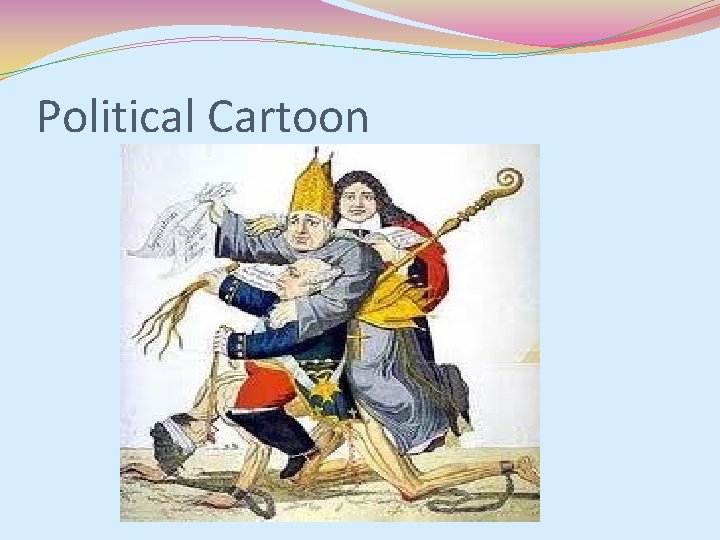
The Monarchy �King Louis XVI was completely ignorant of and indifferent to the sufferings of the common people. �He squandered money on festivities and pleasures and emptied the royal treasury. �The economic bankruptcy was further aggravated by French involvement in useless wars against England. �The rich who could afford to pay taxes continued to be exempted from it and the poor were crushed under heavier taxation.
Political Cartoon
New Ideas of Enlightenment In Europe: �New ideas were becoming fashionable during this period. �Philosophers and scientists began to question old ideas. �They believed in reason and the use of scientific methods to test new ideas. �All over Europe, people were talking about the different ways of ruling and questioned monarchy and the Catholic Church. �Some criticized the way society worked.
New Ideas of Enlightenment In America: �The American Revolution took place in 1776. �North American colonies wanted their freedom and were prepared to fight for it. �When they won, they declared their independence from Britain. �They organized a constitution(list of rules) that their government had to follow. �France supported America in their war and these ideas quickly spread through France.
New ideas of Enlightenment �The French generals and soldiers who had fought in the American Revolution, returned to France with revolutionary ideas and inspired the people to fight against their unjust, despotic(authoritarian) government. �The success of the American revolutionaries enthused the French people and encouraged them to rebel.
New Ideas of Enlightenment In France: �Discontent is not enough to make a successful revolution. �Someone must help the discontented to focus on the ‘enemy’ and provide ideals to fight for. �Revolutionary thinking and ideas must precede revolutionary action. �In the 18 th century, France had many revolutionary thinkers. �Without the spread of their ideas, the French Revolution would simply have been an outbreak of violence.
New Ideas of Enlightenment In France: �People soon began to challenge the ancien regime. �Philosophers and thinkers criticized the way the king ruled. �They argued that the Catholic Church had too much power over ordinary people. �Most people in France did not think of any violent changes but they had begun to think that their lives could be different.
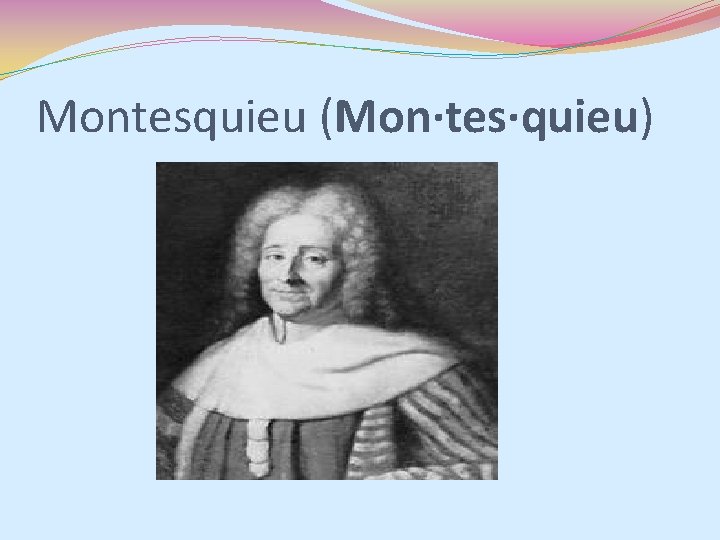
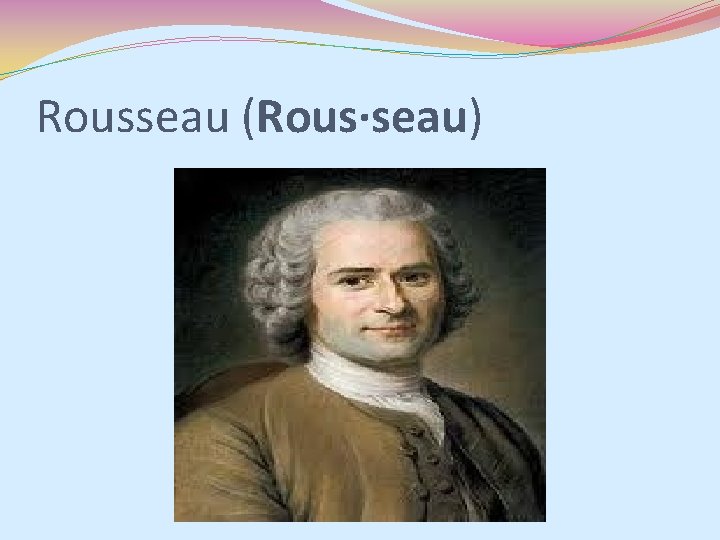
The Age of Reason �Because of the ideas expressed by the French Intellectuals, the 18 th century has been called the Age of Reason. �The philosopher- writer, Montesquieu, thought that constitutional monarchy was the most suitable form of government and outlined the principles for this form of government. �Rousseau asserted sovereignty and democracy.
Montesquieu (Mon·tes·quieu)
Rousseau (Rous·seau)
Influence of New Ideas �The revolutionary writings and ideals of great political philosophers created an intellectual agitation and excitement in France. �The middle class was greatly impressed by the revolutionary ideas of liberty, equality, fraternity and sovereignty. �Through their writings, the philosophers exposed the evils of the French Society and government and inspired the people to revolt and fight for their rights.
Outbreak of the Revolution � In August 1788, King Louis XVI called the Estates General (a gathering of representatives from all three estates) for the first time since 1614. � The Estates General met at the palace of Versailles, just outside Paris, in May 1789. � The king hoped the Estates General would approve new taxes. � The nobles and the clergy hoped they would control the affairs to continue their privileged lifestyles. � The middle classes hoped for an English style democracy. � The peasants hoped for solutions to their problems and were asked by their representatives to draw up lists of complaints. (cahiers)
�The King summoned the Estates General to Versailles, where he had a body of troops. �Some saw this as an attempt to frighten the representatives. �He did not present them with any proposals for discussion, so they were left to think up their own ideas. � This meant that Louis did not have control of the meeting.
The National Assembly � On 17 th June, 1789, members of the Third Estate, representing 96% of the population, declared themselves the National Assembly. � This would replace the Estates General and make decisions about ruling France from now on. � They wanted to draw up a constitution showing how France was to be governed. � On 20 th June, they found their meeting hall occupied by royal guards. � Determined to meet, they moved to the nearby tennis court to work out a constitution. � They pledged an oath (The Tennis Court Oath) not to leave until the King agreed to meet their demands. � The Third Estate was now joined by some dissatisfied clergy and noblemen.
�Louis then made preparations to break up the Assembly. �Troops were called. �Rumors spread that leading members of the Assembly would soon be arrested. �This enraged the people, who began to gather in their thousands. �They were soon joined by the guards.
Storming of the Bastille �On July 14 th, 1789, the mob rioted and attacked the royal fortress prison called the Bastille. � They saw the Bastille as a symbol of everything that was wrong with France. �It was a symbol of the King and his government and the Paris mob wanted it destroyed. �The y released some prisoners, killing anyone who stood in their way. � News of the event soon spread all over France and abroad, appearing in newspapers, pictures and stories.
Fall of the Bastille �After a four-hour siege, the mob broke open the doors. �The fall of the Bastille symbolized the fall of autocracy. �Every year, July 14 th is celebrated as a national holiday in France. �After July 14 th 1789, Louis XVI was king only in name. �The National Assembly began to enact laws. �The revolt soon spread to other towns and cities and finally into the countryside.
Declaration of the Rights of Man �Soon after the fall of the Bastille, the National Assembly adopted the famous Declaration of the Rights of Man. �It specified – - the equality of all men before the law - eligibility of all citizens for all public offices - freedom from arrest or punishment without proven causes - freedom of speech and freedom of press - Equal distribution of the burden of taxation and rights of private property
The Legislative Assembly �The old National Assembly was replaced by the Legislative Assembly. �This Assembly took over the property of the people that had fled. �In June 1791, the king and the queen try to escape to Austria, but are arrested and brought back to Paris. �In April 1792, the revolutionaries declares war on Austria as rumours of an Austrian invasion become strong. �Soon, France was fighting Austria and Prussia.
Contd �Anyone opposed to the Constitution or in favour of the monarchy is killed. �This includes priests, who are thought to be traitors. �The king and queen are imprisoned as, their power is removed and France is declared a Republic.
The National Convention �In September 1792, a group called the National Convention is set up, replacing the National Assembly. �The king and queen, seen as a threat to the Republic, were put on trial and found guilty. They were executed by guillotine in 1793.
The Reign of Terror �A radical group known as the Jacobins, who believed in direct democracy, came to power. �Fearing that the revolution was in danger, this group took strong measures to crush forces who were a potential threat to the Revolution. �In 14 months, about 17, 000 people, including those who were innocent, were tried and executed. �Some people have called it the ‘Reign of Terror’.
The Directory �The Directory or Directorate was a body of 5 directors that held executive powers in France following the ‘reign of terror’. �This period was marked by corruption and financial difficulties. �Soon there was conflict among the Directors. �The army had become increasingly powerful and this led to the rise of Napoleon Bonaparte.
Consequences of the French Revolution �A major result was the destruction of feudalism in France. �Church lands were bought by the middle classes. �The lands of the nobles were confiscated. �Privileged classes were abolished. �The French Revolution gave the term ‘nation’ its modern meaning- it is not the territory that people belonging to it occupy, but the people themselves.
�From this followed the idea of sovereignty- the people are the source of all power and authority. The nation recognizes no law above its own. �In 1792, for the first time in history, peasants and workers were given equal political rights. �France soon became one of the first countries where ideas of social equality gave rise to a new kind of political movement.