
The French Revolution Equalit Liberty y Fraternity 1
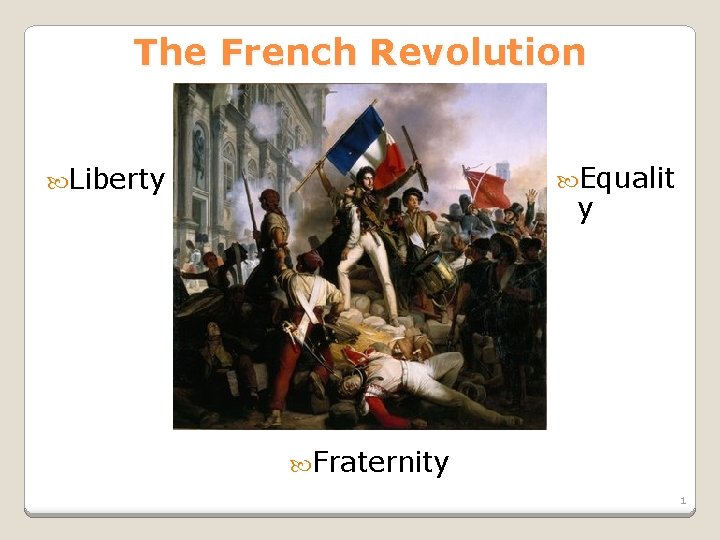
The French Revolution Equalit Liberty y Fraternity 1
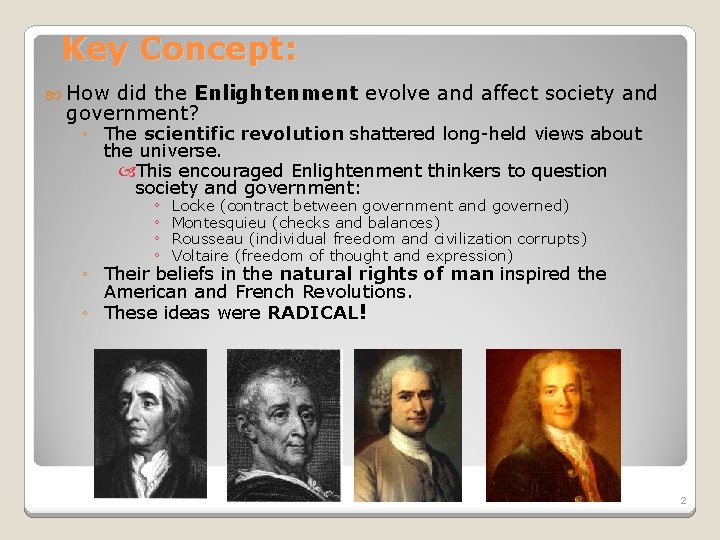
Key Concept: How did the Enlightenment evolve and affect society and government? ◦ The scientific revolution shattered long-held views about the universe. This encouraged Enlightenment thinkers to question society and government: ◦ Locke (contract between government and governed) ◦ Montesquieu (checks and balances) ◦ Rousseau (individual freedom and civilization corrupts) ◦ Voltaire (freedom of thought and expression) ◦ Their beliefs in the natural rights of man inspired the American and French Revolutions. ◦ These ideas were RADICAL! 2
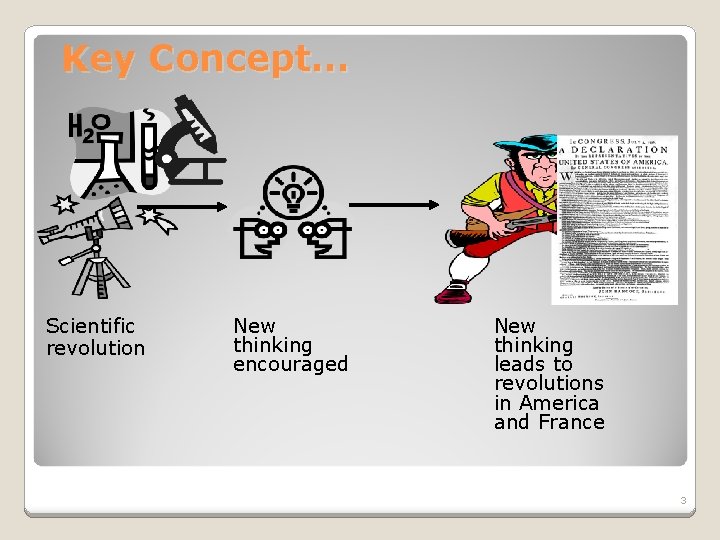
Key Concept… Scientific revolution New thinking encouraged New thinking leads to revolutions in America and France 3
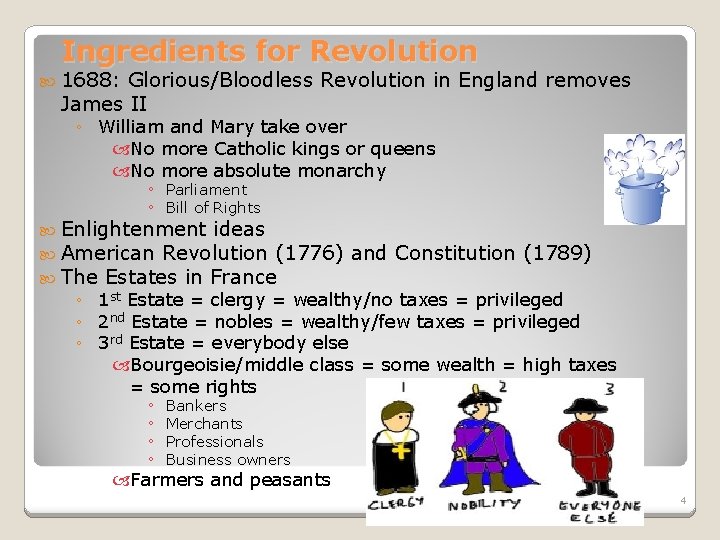
Ingredients for Revolution 1688: Glorious/Bloodless Revolution in England removes James II ◦ William and Mary take over No more Catholic kings or queens No more absolute monarchy ◦ Parliament ◦ Bill of Rights Enlightenment ideas American Revolution (1776) The Estates in France and Constitution (1789) ◦ 1 st Estate = clergy = wealthy/no taxes = privileged ◦ 2 nd Estate = nobles = wealthy/few taxes = privileged ◦ 3 rd Estate = everybody else Bourgeoisie/middle class = some wealth = high taxes = some rights ◦ Bankers ◦ Merchants ◦ Professionals ◦ Business owners Farmers and peasants 4
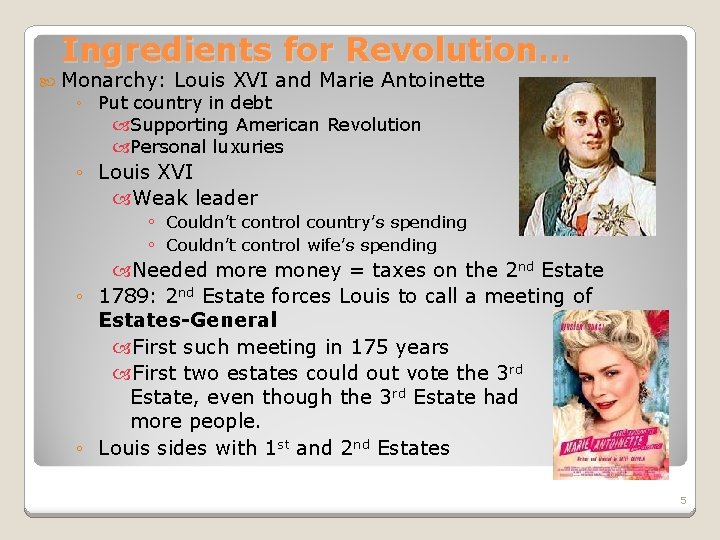
Ingredients for Revolution… Monarchy: Louis XVI and Marie Antoinette ◦ Put country in debt Supporting American Revolution Personal luxuries ◦ Louis XVI Weak leader ◦ Couldn’t control country’s spending ◦ Couldn’t control wife’s spending Needed more money = taxes on the 2 nd Estate ◦ 1789: 2 nd Estate forces Louis to call a meeting of Estates-General First such meeting in 175 years First two estates could out vote the 3 rd Estate, even though the 3 rd Estate had more people. ◦ Louis sides with 1 st and 2 nd Estates 5
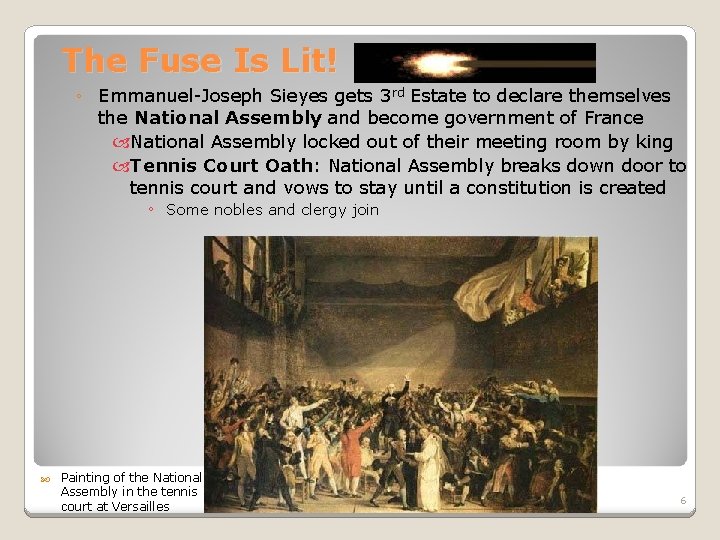
The Fuse Is Lit! ◦ Emmanuel-Joseph Sieyes gets 3 rd Estate to declare themselves the National Assembly and become government of France National Assembly locked out of their meeting room by king Tennis Court Oath: National Assembly breaks down door to tennis court and vows to stay until a constitution is created ◦ Some nobles and clergy join Painting of the National Assembly in the tennis court at Versailles 6
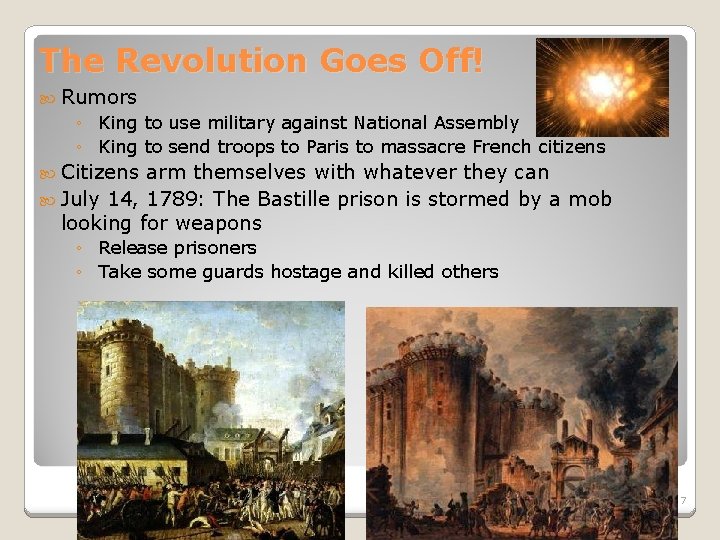
The Revolution Goes Off! Rumors ◦ King to use military against National Assembly ◦ King to send troops to Paris to massacre French citizens Citizens arm themselves with whatever they can July 14, 1789: The Bastille prison is stormed by a mob looking for weapons ◦ Release prisoners ◦ Take some guards hostage and killed others 7
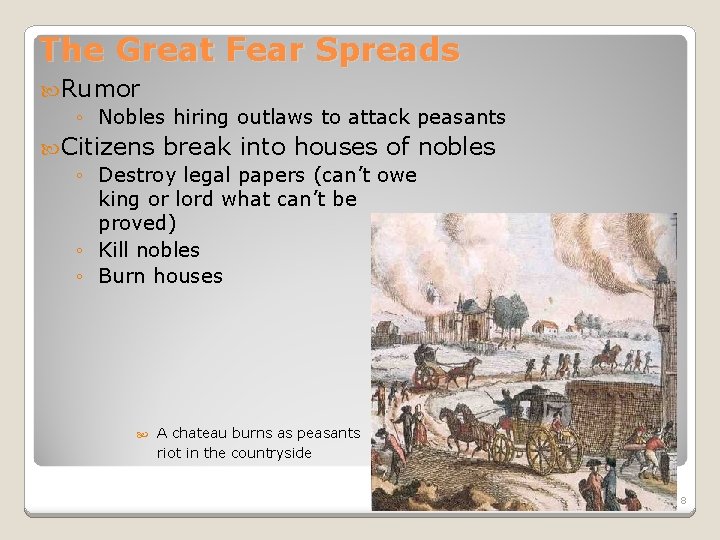
The Great Fear Spreads Rumor ◦ Nobles hiring outlaws to attack peasants Citizens break into houses of nobles ◦ Destroy legal papers (can’t owe king or lord what can’t be proved) ◦ Kill nobles ◦ Burn houses A chateau burns as peasants riot in the countryside 8
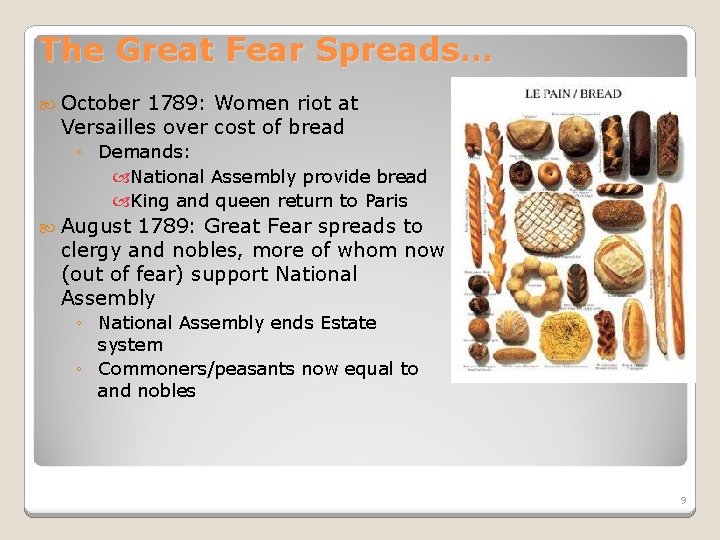
The Great Fear Spreads… October 1789: Women riot at Versailles over cost of bread ◦ Demands: National Assembly provide bread King and queen return to Paris August 1789: Great Fear spreads to clergy and nobles, more of whom now (out of fear) support National Assembly ◦ National Assembly ends Estate system ◦ Commoners/peasants now equal to and nobles clergy 9
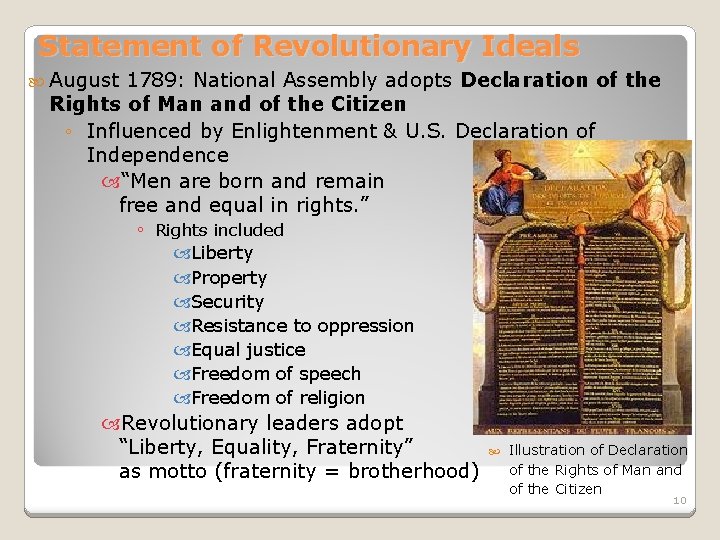
Statement of Revolutionary Ideals August 1789: National Assembly adopts Declaration of the Rights of Man and of the Citizen ◦ Influenced by Enlightenment & U. S. Declaration of Independence “Men are born and remain free and equal in rights. ” ◦ Rights included Liberty Property Security Resistance to oppression Equal justice Freedom of speech Freedom of religion Revolutionary leaders adopt “Liberty, Equality, Fraternity” as motto (fraternity = brotherhood) Illustration of Declaration of the Rights of Man and of the Citizen 10
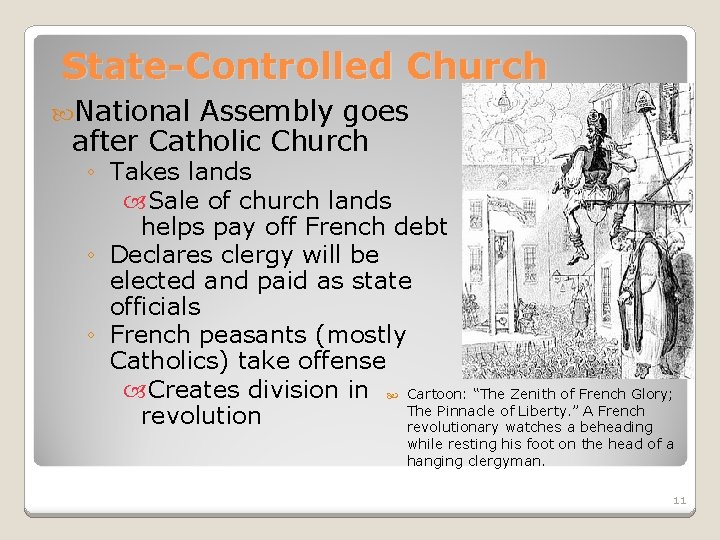
State-Controlled Church National Assembly goes after Catholic Church ◦ Takes lands Sale of church lands helps pay off French debt ◦ Declares clergy will be elected and paid as state officials ◦ French peasants (mostly Catholics) take offense Creates division in Cartoon: “The Zenith of French Glory; The Pinnacle of Liberty. ” A French revolutionary watches a beheading while resting his foot on the head of a hanging clergyman. 11
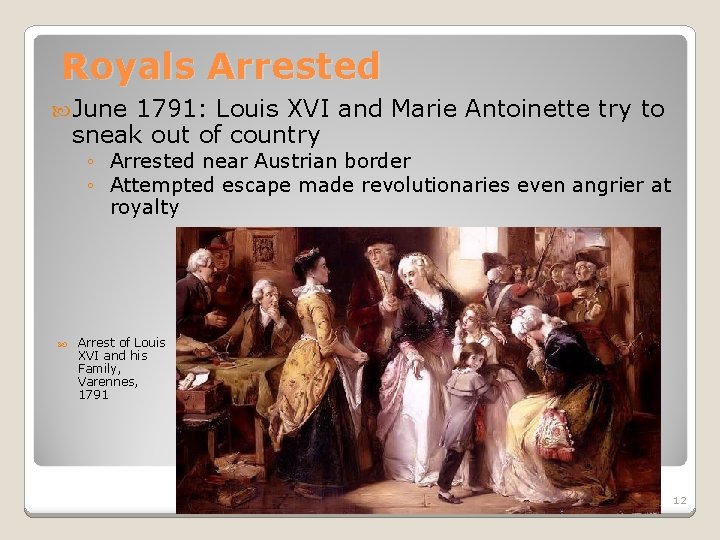
Royals Arrested June 1791: Louis XVI and Marie Antoinette try to sneak out of country ◦ Arrested near Austrian border ◦ Attempted escape made revolutionaries even angrier at royalty Arrest of Louis XVI and his Family, Varennes, 1791 12
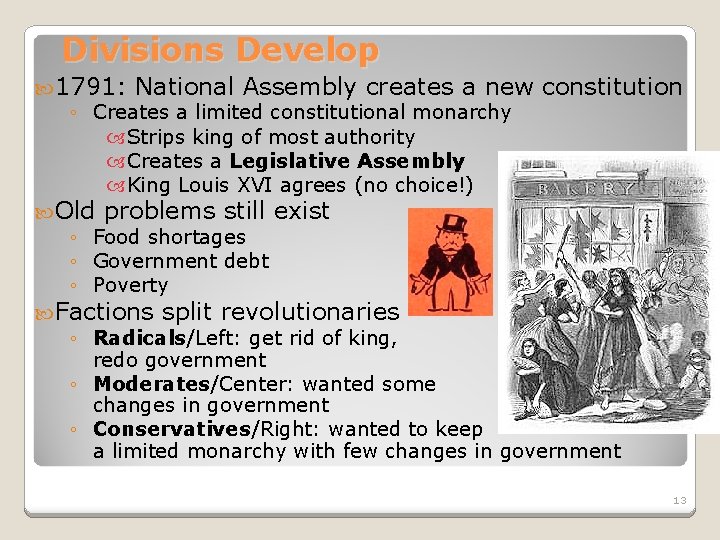
Divisions Develop 1791: National Assembly creates a new constitution ◦ Creates a limited constitutional monarchy Strips king of most authority Creates a Legislative Assembly King Louis XVI agrees (no choice!) Old problems still exist ◦ Food shortages ◦ Government debt ◦ Poverty Factions split revolutionaries ◦ Radicals/Left: get rid of king, redo government ◦ Moderates/Center: wanted some changes in government ◦ Conservatives/Right: wanted to keep a limited monarchy with few changes in government 13
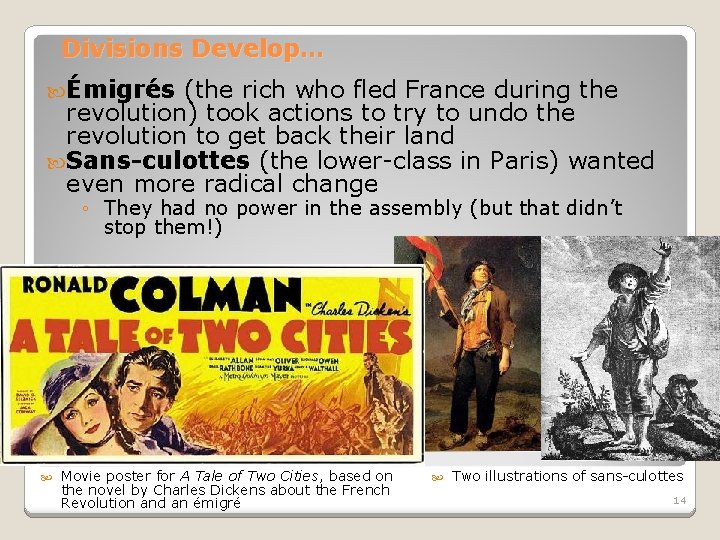
Divisions Develop… Émigrés (the rich who fled France during the revolution) took actions to try to undo the revolution to get back their land Sans-culottes (the lower-class in Paris) wanted even more radical change ◦ They had no power in the assembly (but that didn’t stop them!) Movie poster for A Tale of Two Cities, based on the novel by Charles Dickens about the French Revolution and an émigré Two illustrations of sans-culottes 14
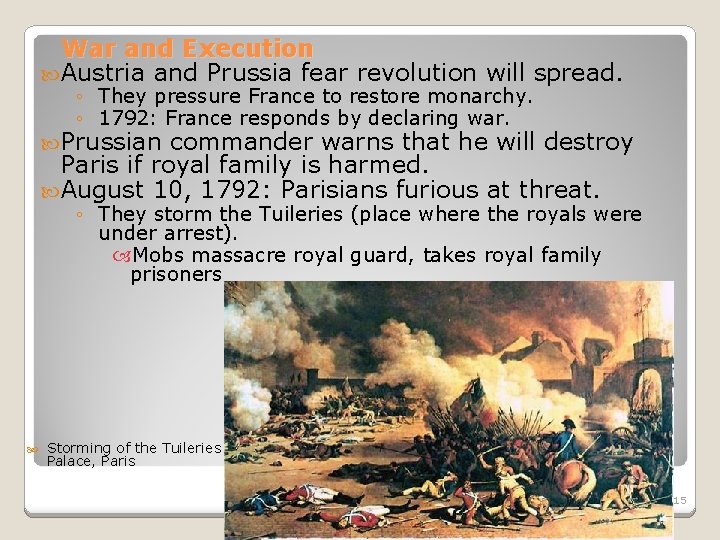
War and Execution Austria and Prussia fear revolution will spread. ◦ They pressure France to restore monarchy. ◦ 1792: France responds by declaring war. Prussian commander warns that he will destroy Paris if royal family is harmed. August 10, 1792: Parisians furious at threat. ◦ They storm the Tuileries (place where the royals were under arrest). Mobs massacre royal guard, takes royal family prisoners Storming of the Tuileries Palace, Paris 15
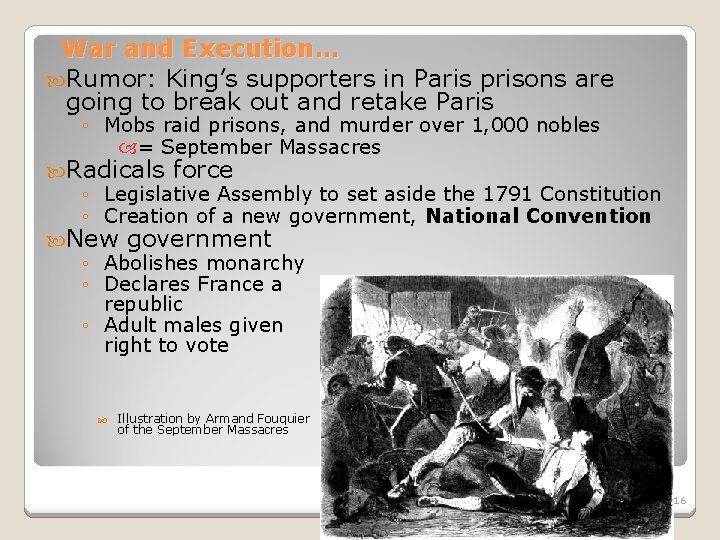
War and Execution… Rumor: King’s supporters in Paris prisons are going to break out and retake Paris ◦ Mobs raid prisons, and murder over 1, 000 nobles = September Massacres Radicals force ◦ Legislative Assembly to set aside the 1791 Constitution ◦ Creation of a new government, National Convention New government ◦ Abolishes monarchy ◦ Declares France a republic ◦ Adult males given right to vote Illustration by Armand Fouquier of the September Massacres 16
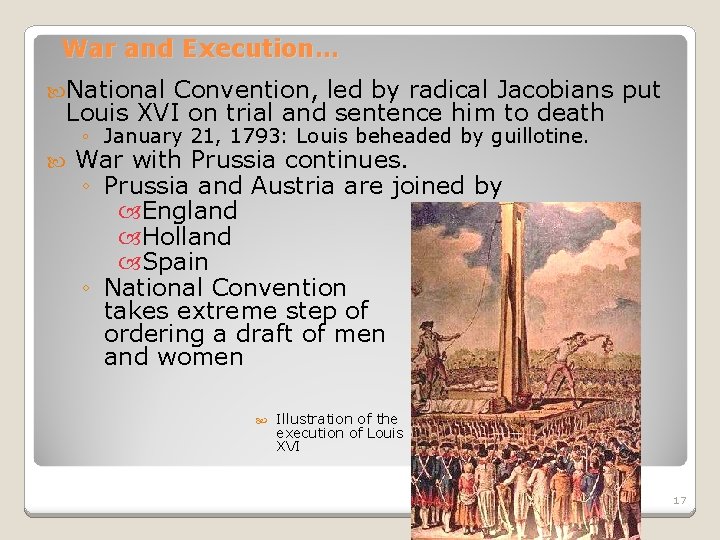
War and Execution… National Convention, led by radical Jacobians put Louis XVI on trial and sentence him to death ◦ January 21, 1793: Louis beheaded by guillotine. War with Prussia continues. ◦ Prussia and Austria are joined by England Holland Spain ◦ National Convention takes extreme step of ordering a draft of men and women Illustration of the execution of Louis XVI 17
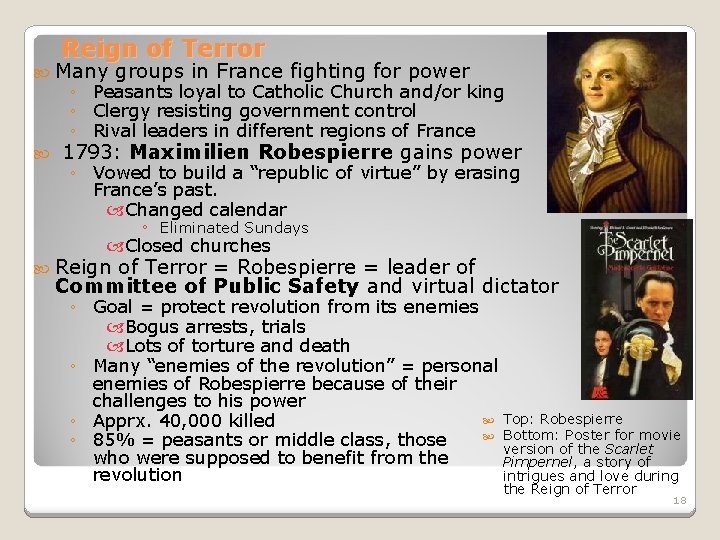
Reign of Terror Many groups in France fighting for power ◦ Peasants loyal to Catholic Church and/or king ◦ Clergy resisting government control ◦ Rival leaders in different regions of France 1793: Maximilien Robespierre gains power ◦ Vowed to build a “republic of virtue” by erasing France’s past. Changed calendar ◦ Eliminated Sundays Closed churches Reign of Terror = Robespierre = leader of Committee of Public Safety and virtual dictator ◦ Goal = protect revolution from its enemies Bogus arrests, trials Lots of torture and death ◦ Many “enemies of the revolution” = personal enemies of Robespierre because of their challenges to his power Top: Robespierre ◦ Apprx. 40, 000 killed Bottom: Poster for movie ◦ 85% = peasants or middle class, those version of the Scarlet who were supposed to benefit from the Pimpernel, a story of intrigues and love during revolution the Reign of Terror 18
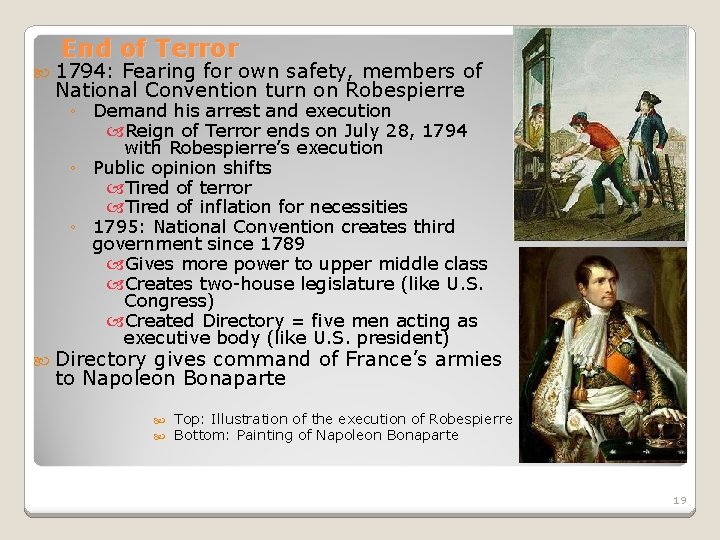
End of Terror 1794: Fearing for own safety, members of National Convention turn on Robespierre ◦ Demand his arrest and execution Reign of Terror ends on July 28, 1794 with Robespierre’s execution ◦ Public opinion shifts Tired of terror Tired of inflation for necessities ◦ 1795: National Convention creates third government since 1789 Gives more power to upper middle class Creates two-house legislature (like U. S. Congress) Created Directory = five men acting as executive body (like U. S. president) Directory gives command of France’s armies to Napoleon Bonaparte Top: Illustration of the execution of Robespierre Bottom: Painting of Napoleon Bonaparte 19
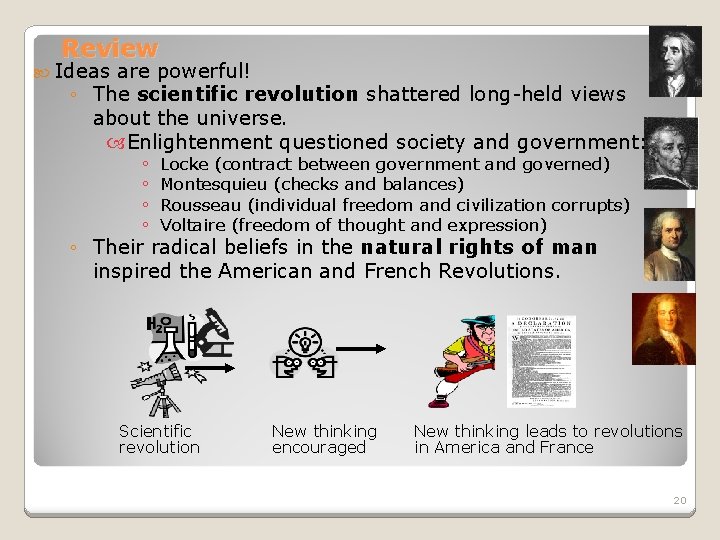
Review Ideas are powerful! ◦ The scientific revolution shattered long-held views about the universe. Enlightenment questioned society and government: ◦ Locke (contract between government and governed) ◦ Montesquieu (checks and balances) ◦ Rousseau (individual freedom and civilization corrupts) ◦ Voltaire (freedom of thought and expression) ◦ Their radical beliefs in the natural rights of man inspired the American and French Revolutions. Scientific revolution New thinking encouraged New thinking leads to revolutions in America and France 20
- Slides: 20