
The French Revolution Crane Brintons Anatomy of a

The French Revolution
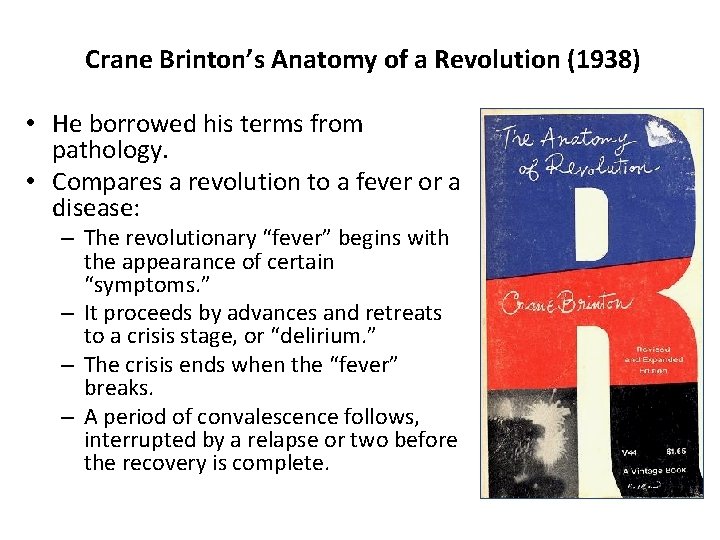
Crane Brinton’s Anatomy of a Revolution (1938) • He borrowed his terms from pathology. • Compares a revolution to a fever or a disease: – The revolutionary “fever” begins with the appearance of certain “symptoms. ” – It proceeds by advances and retreats to a crisis stage, or “delirium. ” – The crisis ends when the “fever” breaks. – A period of convalescence follows, interrupted by a relapse or two before the recovery is complete.
Conditions Present Before a Revolution Occurs 1. People from all social classes are discontented. 2. People feel restless and held down by unacceptable restrictions in society, religion, the economy or govt. 3. People are hopeful about the future, but they are being forced to accept less than they had hoped for. 4. People are beginning to think of themselves as belonging to a social class, and there is a growing bitterness between social classes. 5. The social classes closest to one another are the most hostile.
Conditions Present Before a Revolution Occurs 6. The scholars and thinkers give up on the way their society operates. 7. The government does not respond to the needs of its society. 8. The leaders of the government and the ruling class begin to doubt themselves. Some join with the opposition groups. 9. The government is unable to get enough support from any group to save itself. 10. The government cannot organize its finances correctly and is either going bankrupt or trying to tax heavily and unjustly.
Timeline of Pre-Revolutionary France • 1700’s Rampant spending by the Bourbons – unable to be curtailed by Ministers Fluery, Turgot, Necker and Calonne • 1780’s-Revloutionary wave in Europe, North America – Inspired by Enlightenment ideas • 1787 -8: Famine in France raises price of bread • 1788: King calls Assembly of Notables hoping to levy taxes • June 1789: Estates General is called – Last time it had been called was 1614
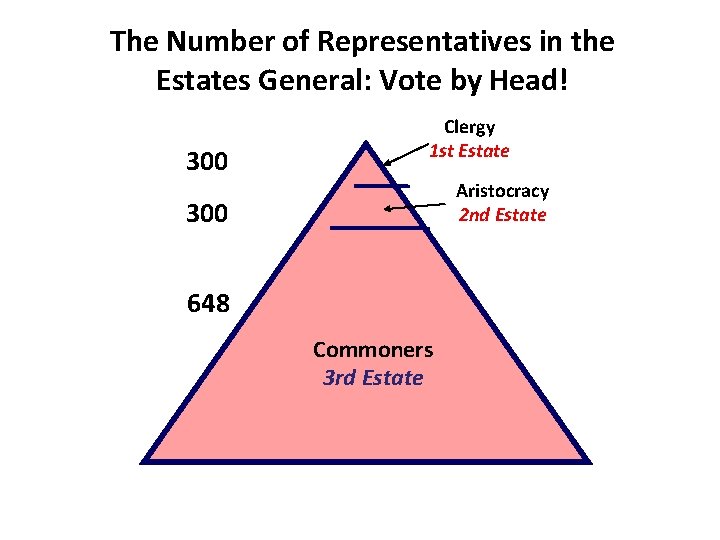
The Number of Representatives in the Estates General: Vote by Head! 300 Clergy 1 st Estate Aristocracy 2 nd Estate 300 648 Commoners 3 rd Estate
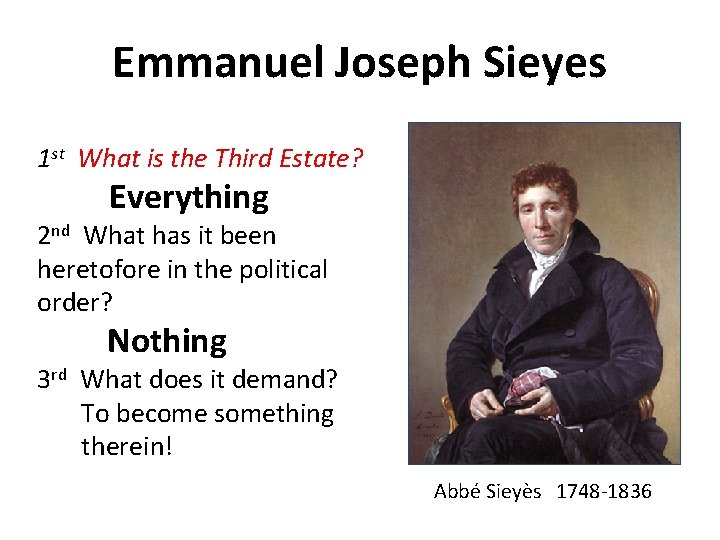
Emmanuel Joseph Sieyes 1 st What is the Third Estate? Everything 2 nd What has it been heretofore in the political order? Nothing 3 rd What does it demand? To become something therein! Abbé Sieyès 1748 -1836
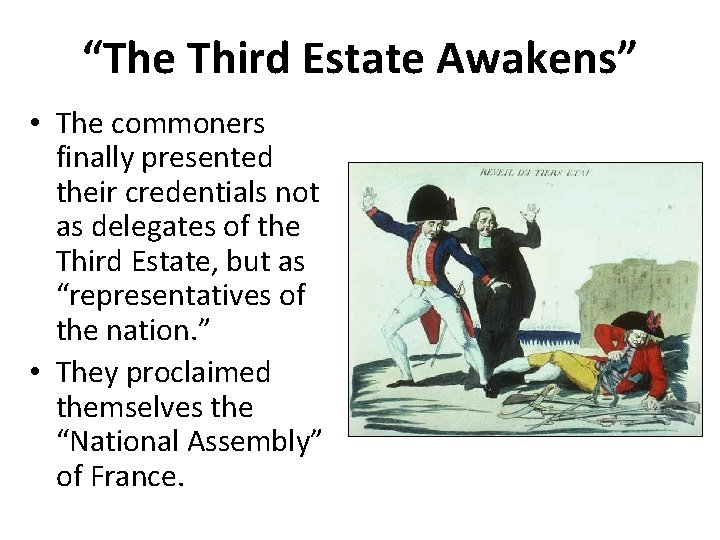
“The Third Estate Awakens” • The commoners finally presented their credentials not as delegates of the Third Estate, but as “representatives of the nation. ” • They proclaimed themselves the “National Assembly” of France.
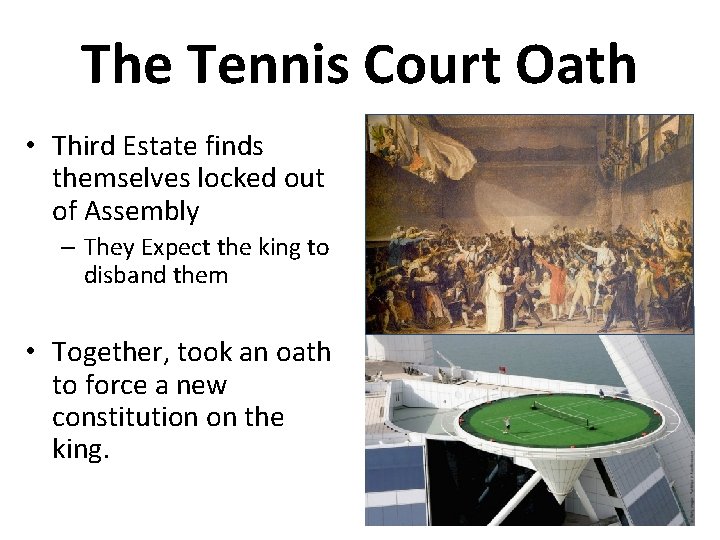
The Tennis Court Oath • Third Estate finds themselves locked out of Assembly – They Expect the king to disband them • Together, took an oath to force a new constitution on the king.
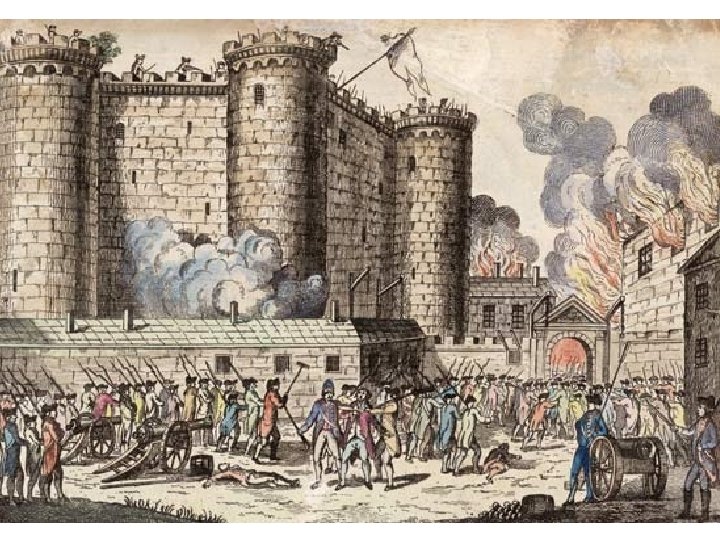
Storming the Bastille • Louis legalized the National Assembly under the Third Estate – Surrounded Versailles with troops – Dismissed Jacques Necker • popular minister of state, supported reforms. • In response, Parisians mobilized and on July 14 stormed the Bastille – State prison where they believed ammunition was stored …and the French Revolution began.
Crane Brinton: The Course that Revolutions Seem to Take 1. Impossible demands made of government which, if granted, would mean its end. 2. Unsuccessful government attempts to suppress revolutionaries. 3. Revolutionaries gain power and seem united. 4. Once in power, revolutionaries begin to quarrel among themselves, and unity begins to dissolve. 5. The moderates gain the leadership but fail to satisfy those who insist on further changes.
Crane Brinton: The Course that Revolutions Seem to Take 6. Power is gained by progressively more radical groups until finally a lunatic fringe gains almost complete control. 7. A strong man emerges and assumes great power. 8. The extremists try to create a “heaven-on-earth” by introducing their whole program and by punishing all of their opponents. 9. A period of terror [extreme violence] occurs. 10. Moderate groups regain power. THE REVOLUTION IS OVER!
• • • • National Assembly Abolishes Feudalism National Assembly Approved Declaration of the Rights of Man Women’s March to Versailles Constituent Assembly abolishes nobility Louis XVI flees Paris for Varennes Slavery abolished in France (but not colonies) Food Riots (1792) “War of the First Coalition” France declares war on Austria Louis XVI executed Austria, Britain, Holland, Prussia, Spain Committee of Public Safety formed The Terror Marie Antoinette executed Napoleon given command of French Army in Italy
The Great Fear (1789) • A period of panic/rioting by peasants amid rumors of an “aristocratic conspiracy” by the king and the privileged to overthrow the Third Estate. – The revolution quickly spread to the countryside. – Peasants, armed with pitchforks and other rudimentary weapons • overran estates and country houses • seized and destroyed records.
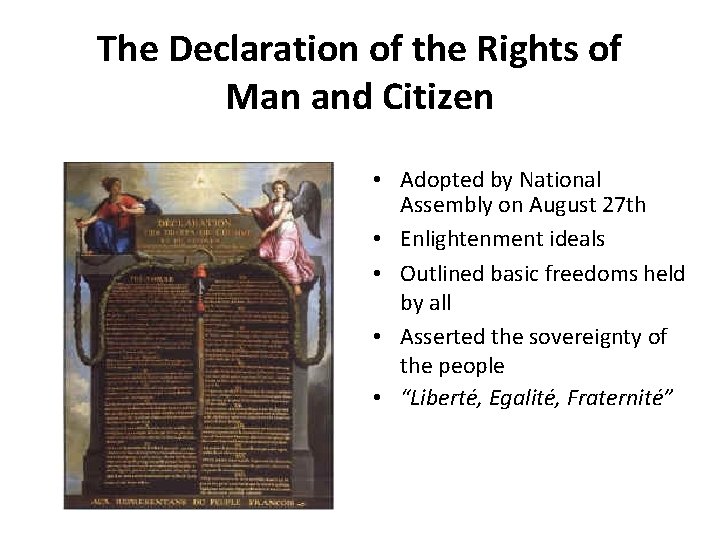
The Declaration of the Rights of Man and Citizen • Adopted by National Assembly on August 27 th • Enlightenment ideals • Outlined basic freedoms held by all • Asserted the sovereignty of the people • “Liberté, Egalité, Fraternité”
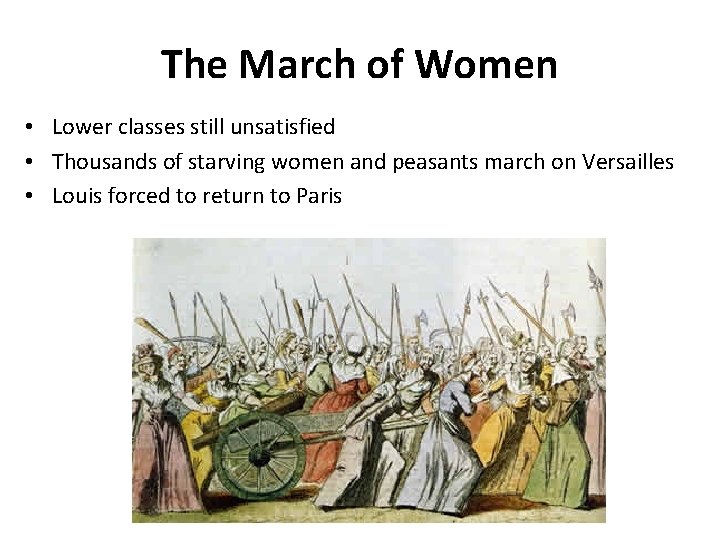
The March of Women • Lower classes still unsatisfied • Thousands of starving women and peasants march on Versailles • Louis forced to return to Paris
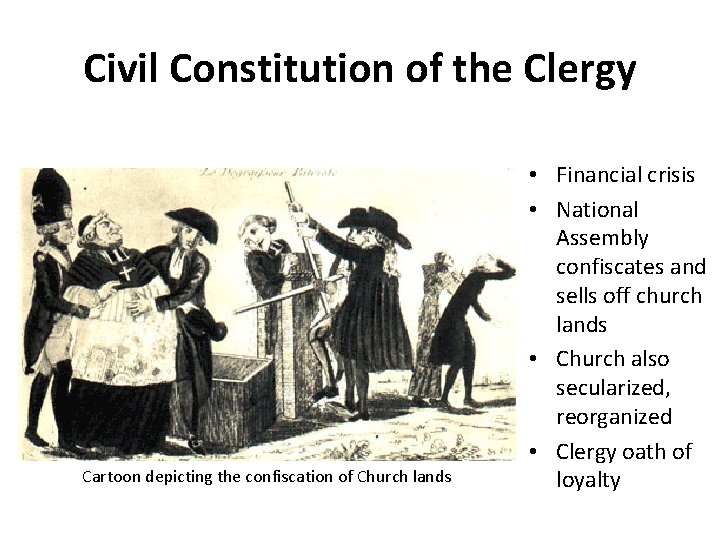
Civil Constitution of the Clergy Cartoon depicting the confiscation of Church lands • Financial crisis • National Assembly confiscates and sells off church lands • Church also secularized, reorganized • Clergy oath of loyalty

The Jacobins • October 6 th, 1789 - the Jacobin Club is formed. – Its members become some of the most radical leaders of the French Revolution. • Maximilien Robespierre • Louis de Saint-Just – Identify with extreme egalitarianism – Responsible for massive violence – Reign of Terror

Flight of the King • Louis XVI and his family attempted to flee France – Most of the nobility had already left • They were arrested at Varennes – Further discredits Louis XVI The capture of Louis XVI at Varennes
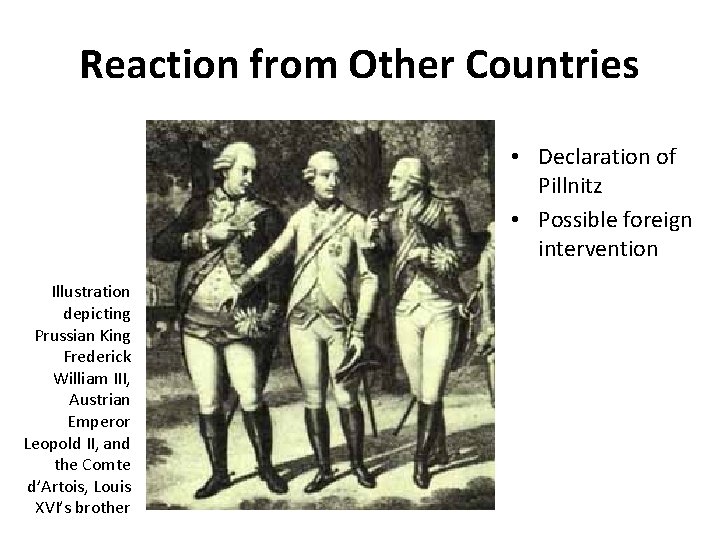
Reaction from Other Countries • Declaration of Pillnitz • Possible foreign intervention Illustration depicting Prussian King Frederick William III, Austrian Emperor Leopold II, and the Comte d’Artois, Louis XVI’s brother
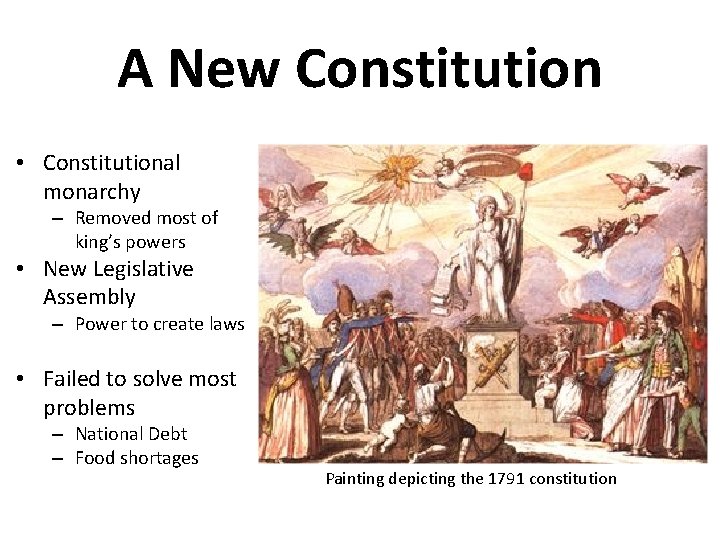
A New Constitution • Constitutional monarchy – Removed most of king’s powers • New Legislative Assembly – Power to create laws • Failed to solve most problems – National Debt – Food shortages Painting depicting the 1791 constitution
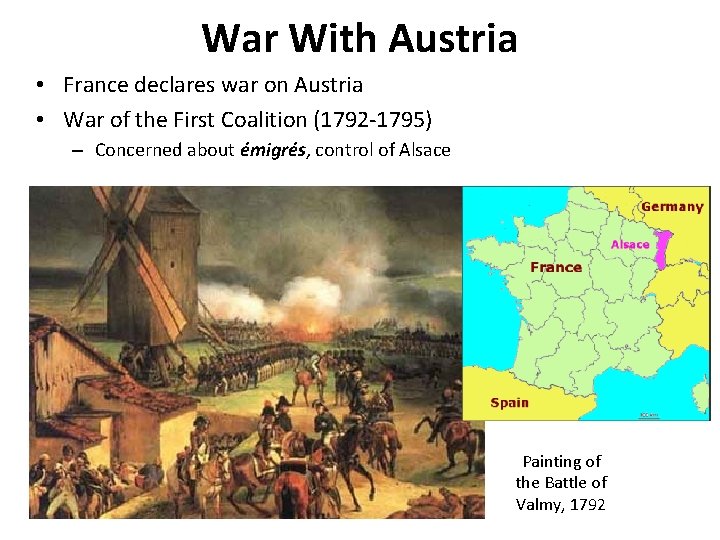
War With Austria • France declares war on Austria • War of the First Coalition (1792 -1795) – Concerned about émigrés, control of Alsace Painting of the Battle of Valmy, 1792
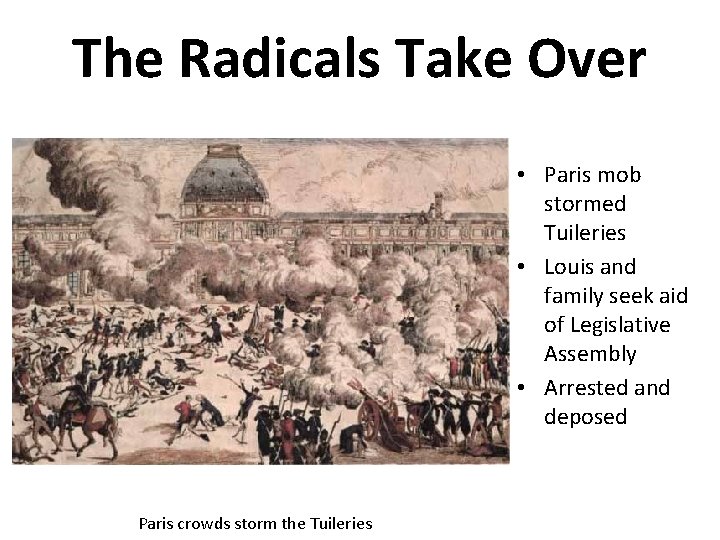
The Radicals Take Over • Paris mob stormed Tuileries • Louis and family seek aid of Legislative Assembly • Arrested and deposed Paris crowds storm the Tuileries

The National Convention • First met on September 21, 1792 • Revolutionary Calendar • Monarchy abolished; France officially becomes a republic • Factions: Jacobins vs. Girondins A Jacobin club
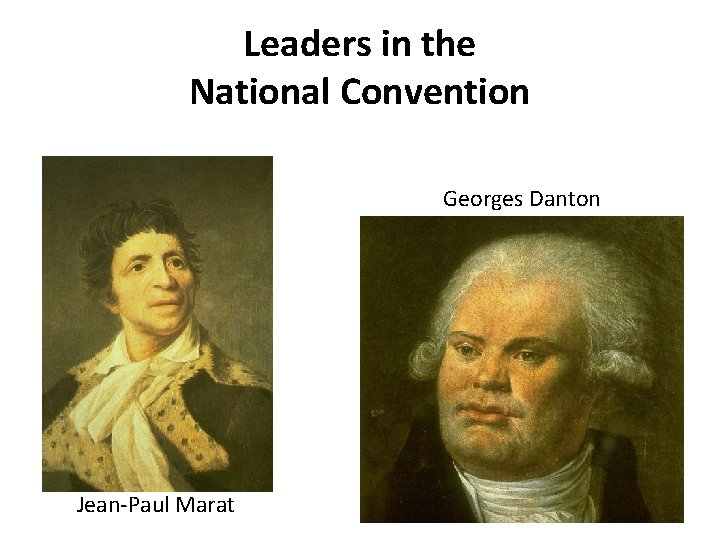
Leaders in the National Convention Georges Danton Jean-Paul Marat
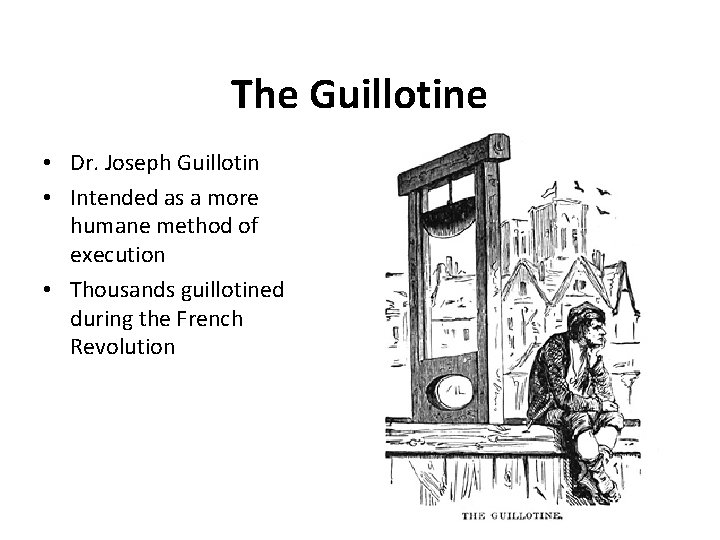
The Guillotine • Dr. Joseph Guillotin • Intended as a more humane method of execution • Thousands guillotined during the French Revolution
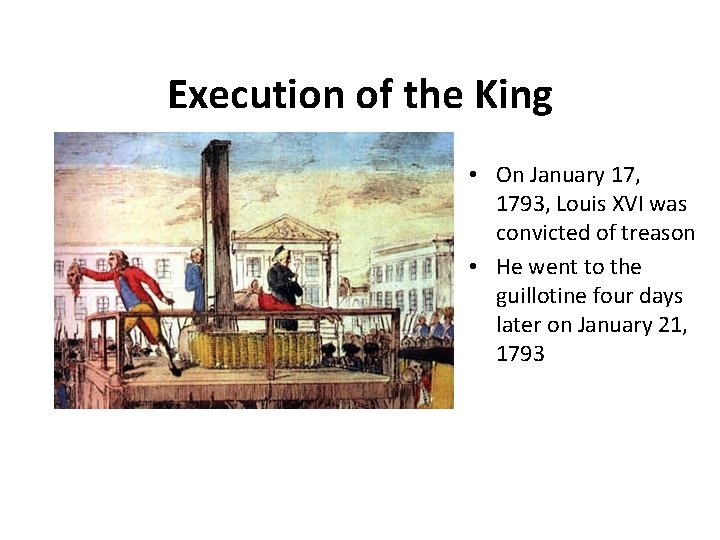
Execution of the King • On January 17, 1793, Louis XVI was convicted of treason • He went to the guillotine four days later on January 21, 1793
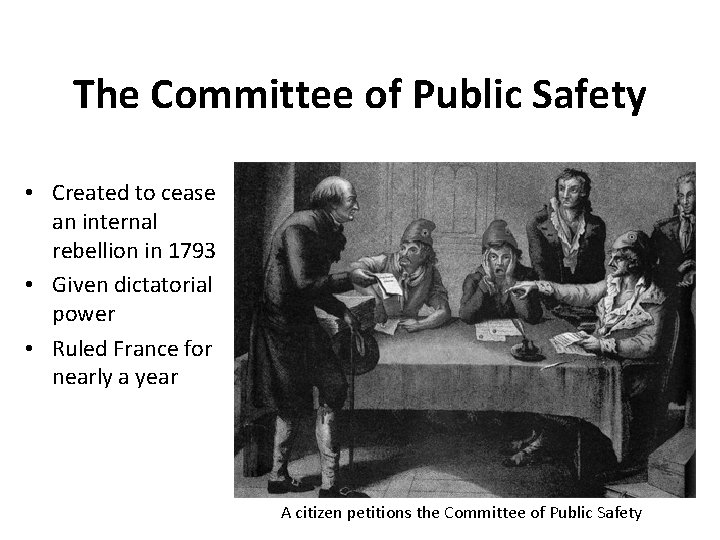
The Committee of Public Safety • Created to cease an internal rebellion in 1793 • Given dictatorial power • Ruled France for nearly a year A citizen petitions the Committee of Public Safety

The Reign of Terror • July 1793– July 1794 • Executions • Death of Robespierre The execution of Marie Antoinette
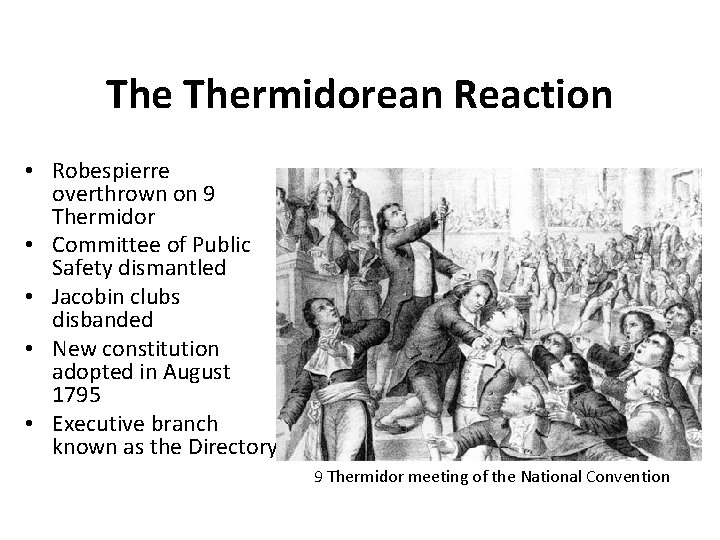
The Thermidorean Reaction • Robespierre overthrown on 9 Thermidor • Committee of Public Safety dismantled • Jacobin clubs disbanded • New constitution adopted in August 1795 • Executive branch known as the Directory 9 Thermidor meeting of the National Convention
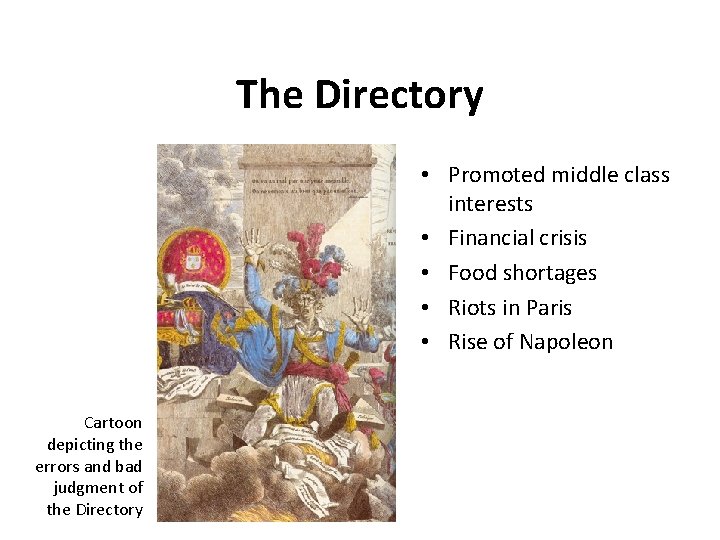
The Directory • Promoted middle class interests • Financial crisis • Food shortages • Riots in Paris • Rise of Napoleon Cartoon depicting the errors and bad judgment of the Directory
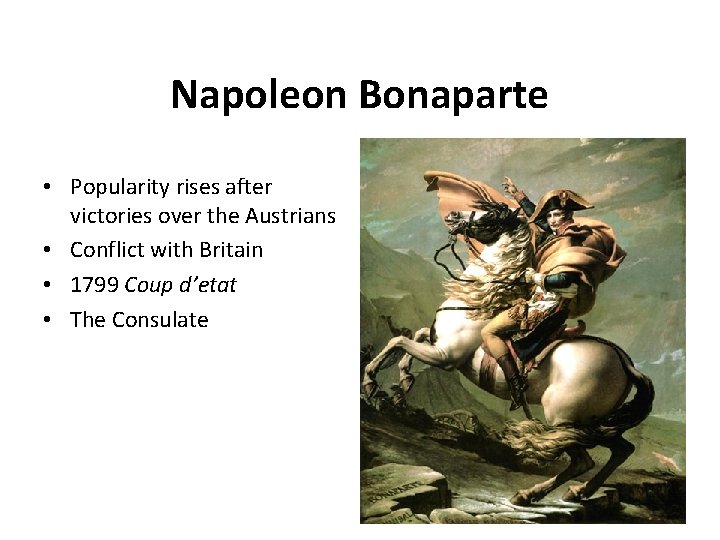
Napoleon Bonaparte • Popularity rises after victories over the Austrians • Conflict with Britain • 1799 Coup d’etat • The Consulate
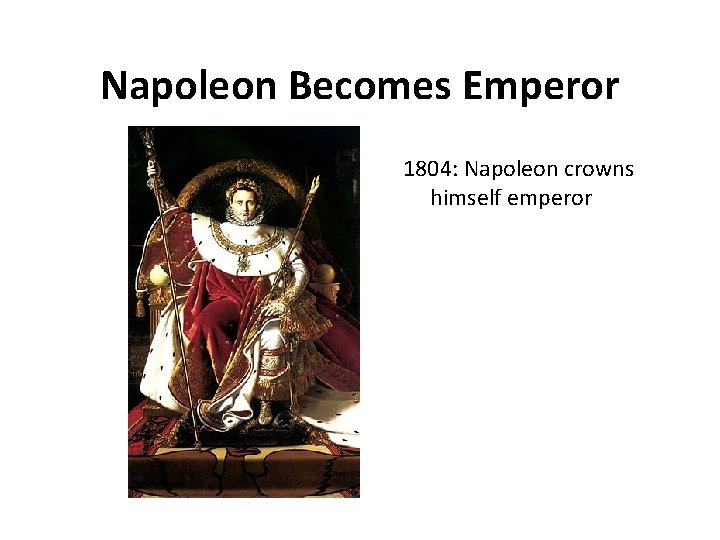
Napoleon Becomes Emperor 1804: Napoleon crowns himself emperor
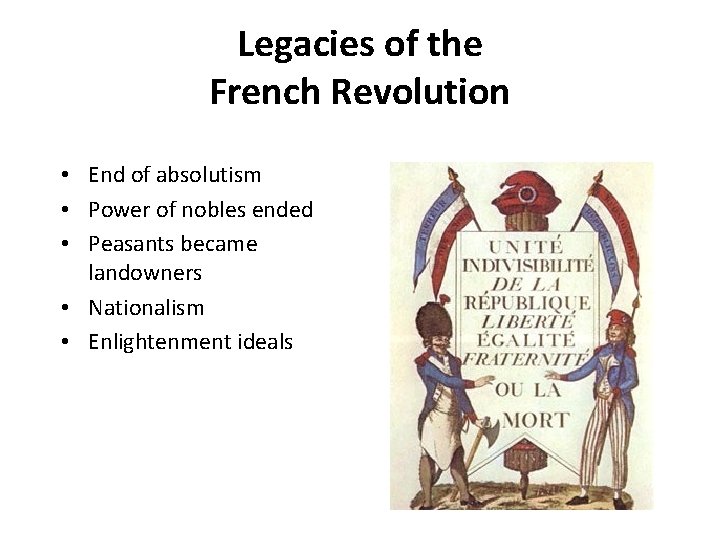
Legacies of the French Revolution • End of absolutism • Power of nobles ended • Peasants became landowners • Nationalism • Enlightenment ideals
- Slides: 35