
The French Revolution Background of the French Revolution
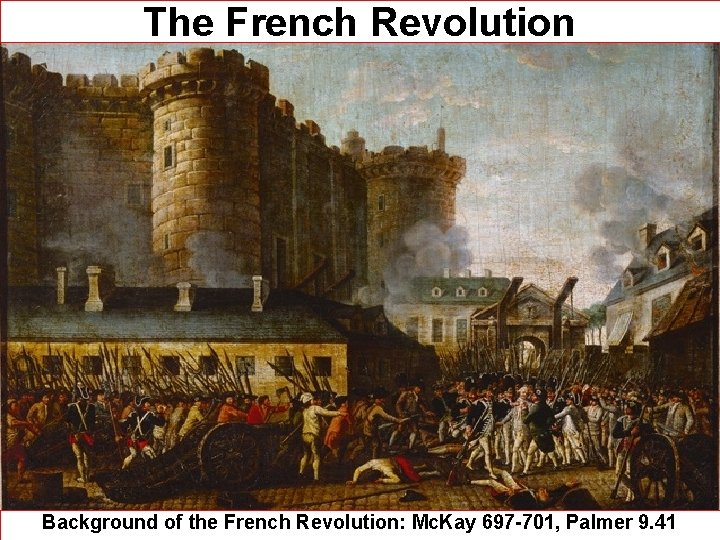
The French Revolution Background of the French Revolution: Mc. Kay 697 -701, Palmer 9. 41
Today’s Agenda • Test this Tuesday • Background to French Revolution
July 14, 1789
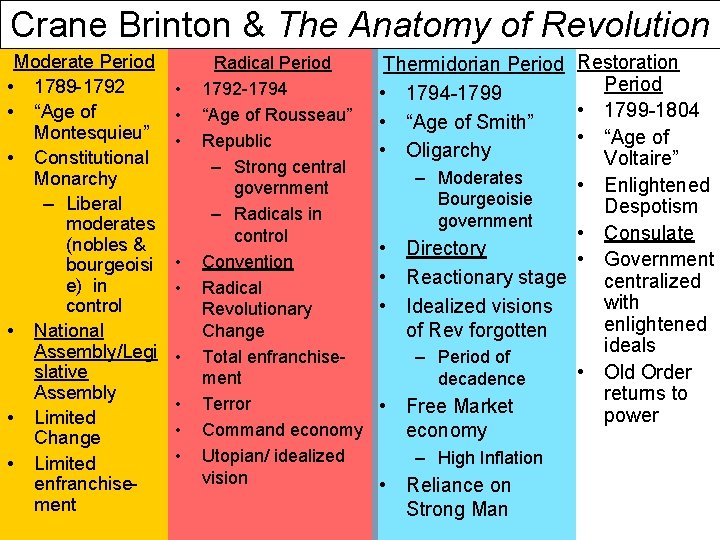
Crane Brinton & The Anatomy of Revolution Moderate Period • 1789 -1792 • “Age of Montesquieu” • Constitutional Monarchy – Liberal moderates (nobles & bourgeoisi e) in control • National Assembly/Legi slative Assembly • Limited Change • Limited enfranchisement • • • Radical Period 1792 -1794 “Age of Rousseau” Republic – Strong central government – Radicals in control Convention Radical Revolutionary Change Total enfranchisement Terror Command economy Utopian/ idealized vision Thermidorian Period Restoration Period • 1794 -1799 • 1799 -1804 • “Age of Smith” • “Age of • Oligarchy Voltaire” – Moderates • Enlightened Bourgeoisie Despotism government • Consulate • Directory • Government • Reactionary stage centralized with • Idealized visions enlightened of Rev forgotten ideals – Period of • Old Order decadence returns to • Free Market power economy – High Inflation • Reliance on Strong Man

The French Revolution Assembly of Notables call for Estates General Civil Constitution of Clergy -Louis XVI executed -Comm of Public Safety begins Terror -Marie A. executed -Cult of Reason -Flight to Varennes -Declaration of Pilnitz 1787 1789 1790 1791 -Estates General -Tennis Court Oath -National Assembly -Bastille stormed -Great Fear -Declaration of the Rights of M & C -March on Versailles 1792 1793 -September Massacres -Year One of First Republic Proclaimed -White Terror of Directory eliminates radicals -Price controls eliminated -Fructidorian Gov. suspends Con. Of 1795 1794 1795 Robespierre executed on 9 th of Thermidor -Concordat of 1801 -Code Napoleon -Napoleon crowns himself Emperor of France 1799 1804 8 th of Brumaire Napoleon leads coup
You should be able to: • Describe characteristics of 5 causes of the French Revolution – Estate System – Enlightenment – Financial Crisis – Louis XVI – Economic Crisis
Old Regime France (1789) • Population = 28 million • Cultural leader of the world – French spoken in every court across Europe (except England) – French manners copied across Europe • Wealthiest nation in world
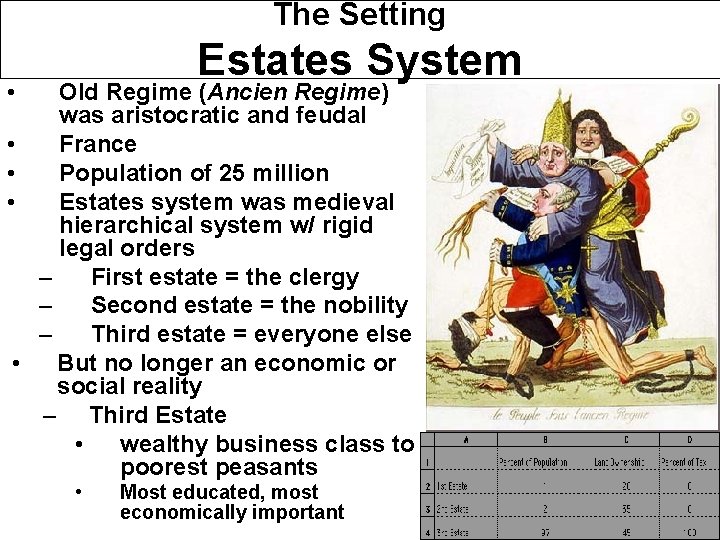
The Setting • • • Estates System Old Regime (Ancien Regime) was aristocratic and feudal France Population of 25 million Estates system was medieval hierarchical system w/ rigid legal orders – First estate = the clergy – Second estate = the nobility – Third estate = everyone else But no longer an economic or social reality – Third Estate • wealthy business class to poorest peasants • Most educated, most economically important
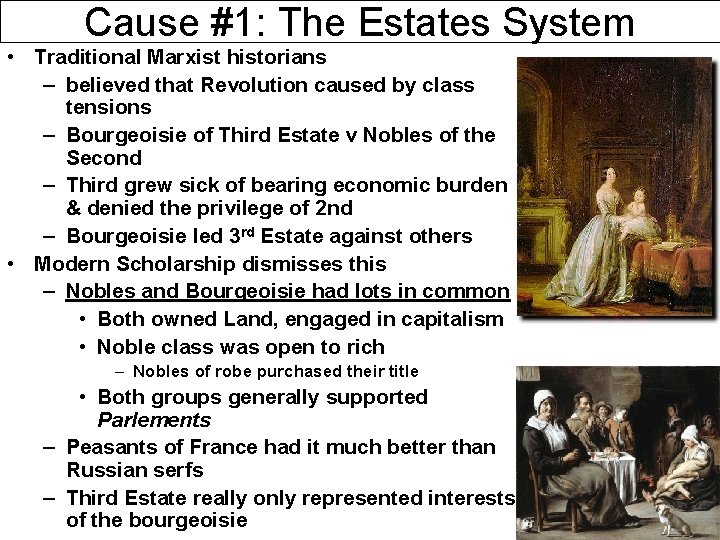
Cause #1: The Estates System • Traditional Marxist historians – believed that Revolution caused by class tensions – Bourgeoisie of Third Estate v Nobles of the Second – Third grew sick of bearing economic burden & denied the privilege of 2 nd – Bourgeoisie led 3 rd Estate against others • Modern Scholarship dismisses this – Nobles and Bourgeoisie had lots in common • Both owned Land, engaged in capitalism • Noble class was open to rich – Nobles of robe purchased their title • Both groups generally supported Parlements – Peasants of France had it much better than Russian serfs – Third Estate really only represented interests of the bourgeoisie
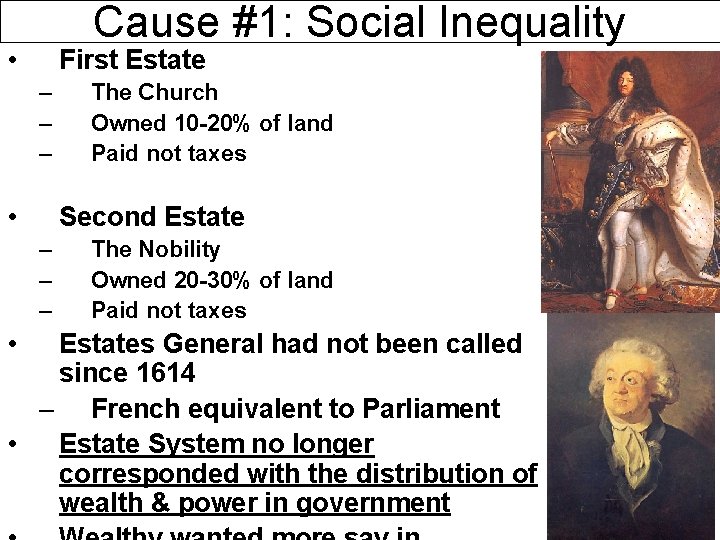
Cause #1: Social Inequality • First Estate – – – • Second Estate – – – • The Church Owned 10 -20% of land Paid not taxes The Nobility Owned 20 -30% of land Paid not taxes Estates General had not been called since 1614 – French equivalent to Parliament • Estate System no longer corresponded with the distribution of wealth & power in government
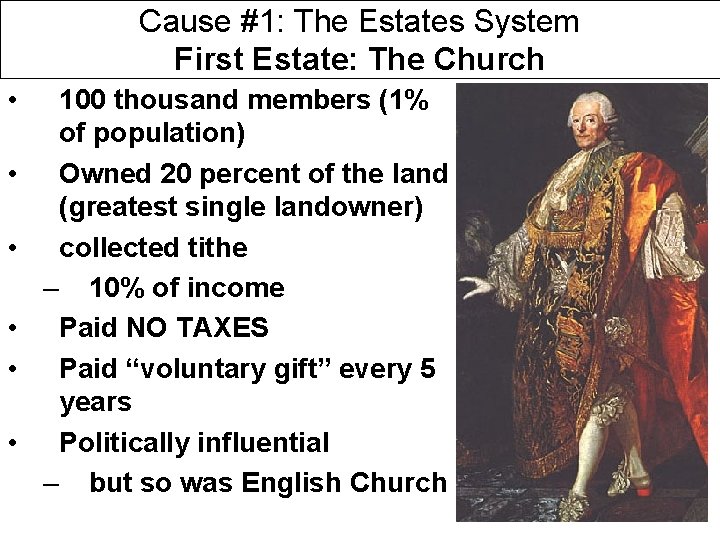
Cause #1: The Estates System First Estate: The Church • • • 100 thousand members (1% of population) Owned 20 percent of the land (greatest single landowner) collected tithe – 10% of income Paid NO TAXES Paid “voluntary gift” every 5 years Politically influential – but so was English Church

• • • Cause #1: The Estates System Second Estate: The Nobility About 400 thousand members (2 % of population) Owned 25 -35% of land Retained Medieval Manorial Rights – Banalities • Exclusive rights to hunt, fish, monopoly on bread baking, pressing grapes, etc. – Eminent property • fees paid to the noble for lands held by peasants (transfer fees, when land changed owners by sale or death) Retained Medieval Honorific Rights – Right to carry a sword, hunt game Monopolized higher offices in the military, government, and church PAID NO TAX – – • Exempt from direct tax (taille) bourgeoisie greatly resented this (even thou they got out of paying also) Divided into: – Nobles of the Sword (noblesse d’epee) more distinguished ancient – Nobles of the Robe (noblesse de robe) purchased the title of administrative of judicial (robe)
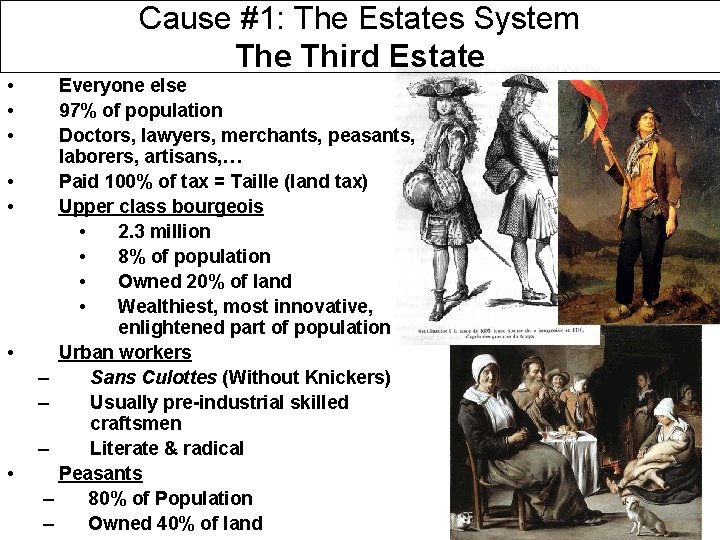
Cause #1: The Estates System The Third Estate • • Everyone else 97% of population Doctors, lawyers, merchants, peasants, laborers, artisans, … Paid 100% of tax = Taille (land tax) Upper class bourgeois • 2. 3 million • 8% of population • Owned 20% of land • Wealthiest, most innovative, enlightened part of population Urban workers – Sans Culottes (Without Knickers) – Usually pre-industrial skilled craftsmen – Literate & radical Peasants – 80% of Population – Owned 40% of land
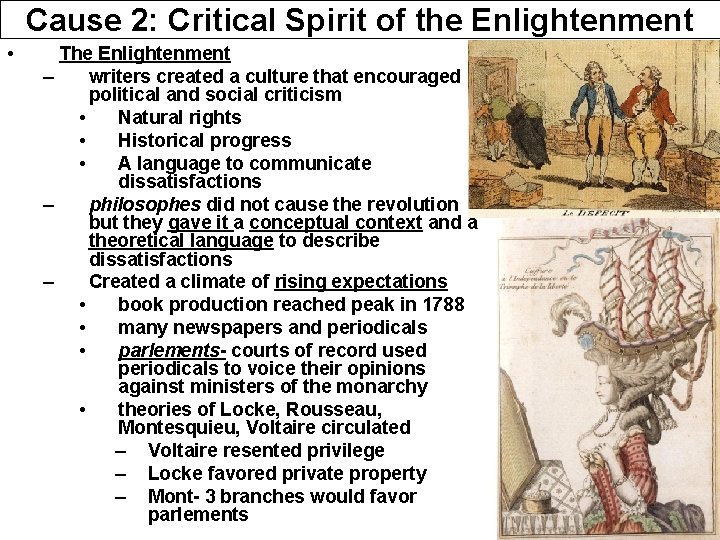
Cause 2: Critical Spirit of the Enlightenment • The Enlightenment – writers created a culture that encouraged political and social criticism • Natural rights • Historical progress • A language to communicate dissatisfactions – philosophes did not cause the revolution but they gave it a conceptual context and a theoretical language to describe dissatisfactions – Created a climate of rising expectations • book production reached peak in 1788 • many newspapers and periodicals • parlements- courts of record used periodicals to voice their opinions against ministers of the monarchy • theories of Locke, Rousseau, Montesquieu, Voltaire circulated – Voltaire resented privilege – Locke favored private property – Mont- 3 branches would favor parlements
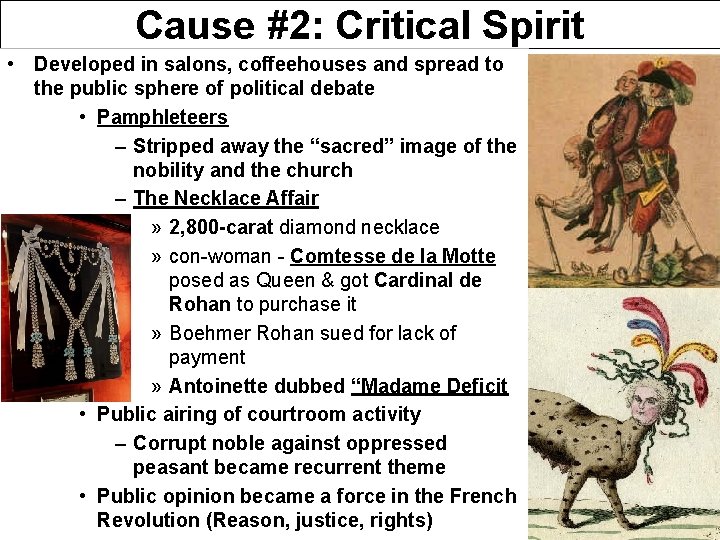
Cause #2: Critical Spirit • Developed in salons, coffeehouses and spread to the public sphere of political debate • Pamphleteers – Stripped away the “sacred” image of the nobility and the church – The Necklace Affair » 2, 800 -carat diamond necklace » con-woman - Comtesse de la Motte posed as Queen & got Cardinal de Rohan to purchase it » Boehmer Rohan sued for lack of payment » Antoinette dubbed “Madame Deficit • Public airing of courtroom activity – Corrupt noble against oppressed peasant became recurrent theme • Public opinion became a force in the French Revolution (Reason, justice, rights)
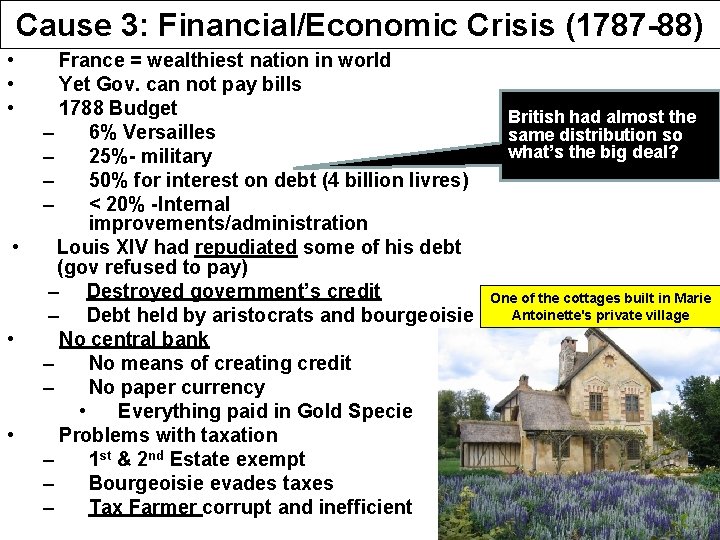
Cause 3: Financial/Economic Crisis (1787 -88) • • • France = wealthiest nation in world Yet Gov. can not pay bills 1788 Budget – 6% Versailles – 25%- military – 50% for interest on debt (4 billion livres) – < 20% -Internal improvements/administration Louis XIV had repudiated some of his debt (gov refused to pay) – Destroyed government’s credit – Debt held by aristocrats and bourgeoisie No central bank – No means of creating credit – No paper currency • Everything paid in Gold Specie Problems with taxation – 1 st & 2 nd Estate exempt – Bourgeoisie evades taxes – Tax Farmer corrupt and inefficient British had almost the same distribution so what’s the big deal? One of the cottages built in Marie Antoinette's private village
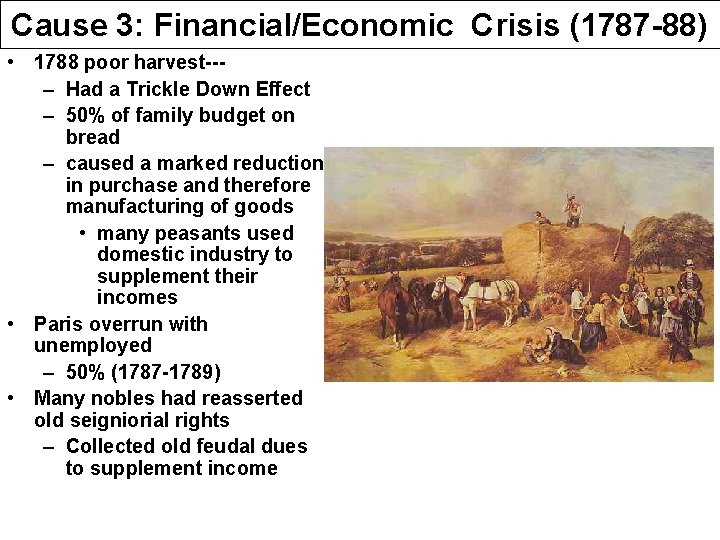
Cause 3: Financial/Economic Crisis (1787 -88) • 1788 poor harvest--– Had a Trickle Down Effect – 50% of family budget on bread – caused a marked reduction in purchase and therefore manufacturing of goods • many peasants used domestic industry to supplement their incomes • Paris overrun with unemployed – 50% (1787 -1789) • Many nobles had reasserted old seigniorial rights – Collected old feudal dues to supplement income
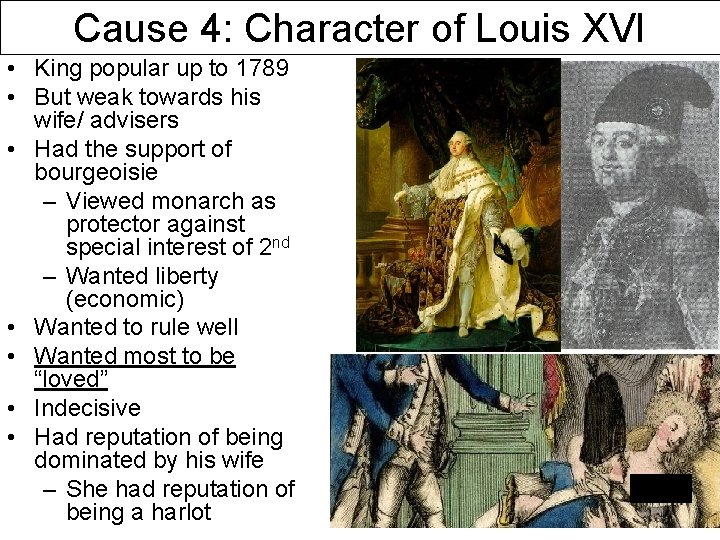
Cause 4: Character of Louis XVI • King popular up to 1789 • But weak towards his wife/ advisers • Had the support of bourgeoisie – Viewed monarch as protector against special interest of 2 nd – Wanted liberty (economic) • Wanted to rule well • Wanted most to be “loved” • Indecisive • Had reputation of being dominated by his wife – She had reputation of being a harlot
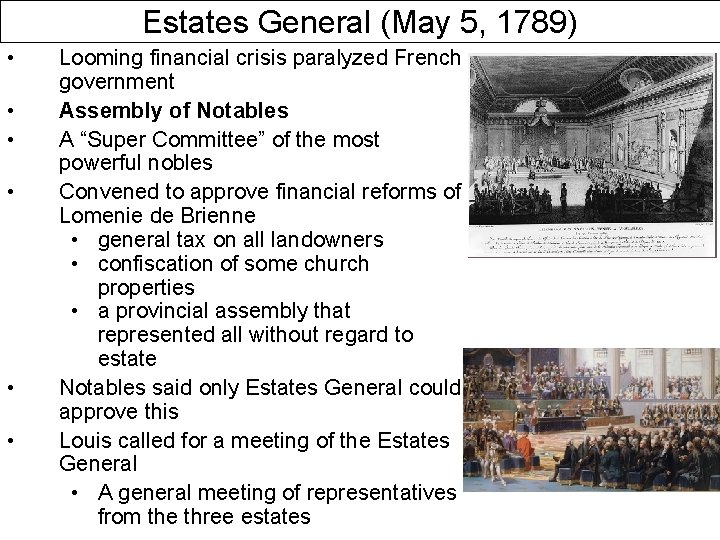
Estates General (May 5, 1789) • • • Looming financial crisis paralyzed French government Assembly of Notables A “Super Committee” of the most powerful nobles Convened to approve financial reforms of Lomenie de Brienne • general tax on all landowners • confiscation of some church properties • a provincial assembly that represented all without regard to estate Notables said only Estates General could approve this Louis called for a meeting of the Estates General • A general meeting of representatives from the three estates
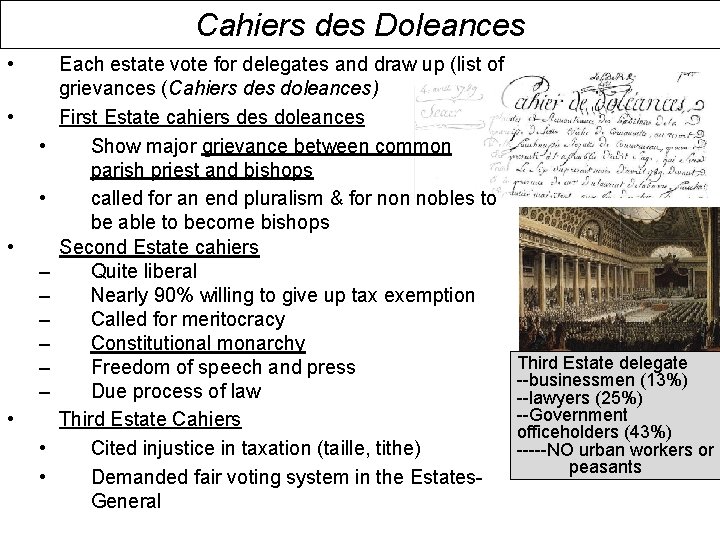
Cahiers des Doleances • • • – – – • • • Each estate vote for delegates and draw up (list of grievances (Cahiers des doleances) First Estate cahiers des doleances Show major grievance between common parish priest and bishops called for an end pluralism & for non nobles to be able to become bishops Second Estate cahiers Quite liberal Nearly 90% willing to give up tax exemption Called for meritocracy Constitutional monarchy Freedom of speech and press Due process of law Third Estate Cahiers Cited injustice in taxation (taille, tithe) Demanded fair voting system in the Estates. General Third Estate delegate --businessmen (13%) --lawyers (25%) --Government officeholders (43%) -----NO urban workers or peasants
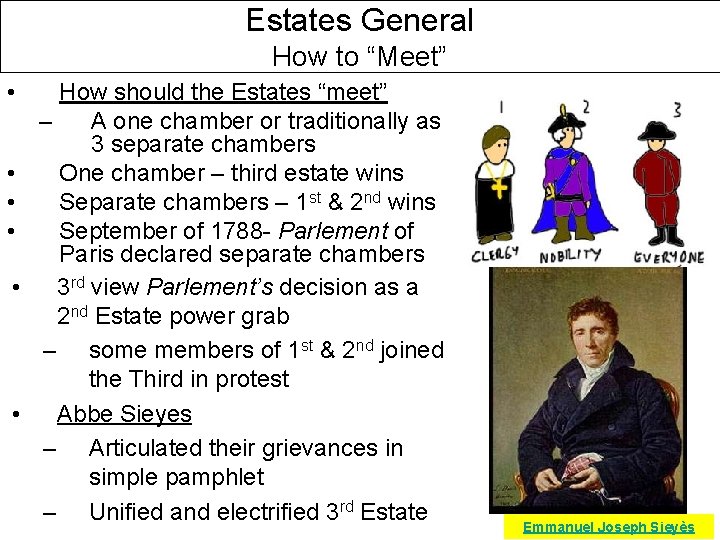
Estates General How to “Meet” • • • How should the Estates “meet” – A one chamber or traditionally as 3 separate chambers One chamber – third estate wins Separate chambers – 1 st & 2 nd wins September of 1788 - Parlement of Paris declared separate chambers 3 rd view Parlement’s decision as a 2 nd Estate power grab – some members of 1 st & 2 nd joined the Third in protest Abbe Sieyes – Articulated their grievances in simple pamphlet – Unified and electrified 3 rd Estate Emmanuel Joseph Sieyès
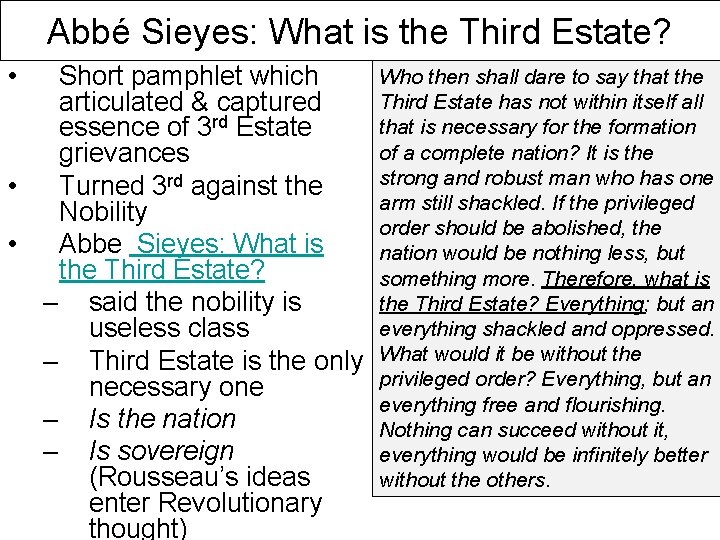
Abbé Sieyes: What is the Third Estate? • Short pamphlet which articulated & captured essence of 3 rd Estate grievances • Turned 3 rd against the Nobility • Abbe Sieyes: What is the Third Estate? – said the nobility is useless class – Third Estate is the only necessary one – Is the nation – Is sovereign (Rousseau’s ideas enter Revolutionary thought) Who then shall dare to say that the Third Estate has not within itself all that is necessary for the formation of a complete nation? It is the strong and robust man who has one arm still shackled. If the privileged order should be abolished, the nation would be nothing less, but something more. Therefore, what is the Third Estate? Everything; but an everything shackled and oppressed. What would it be without the privileged order? Everything, but an everything free and flourishing. Nothing can succeed without it, everything would be infinitely better without the others.
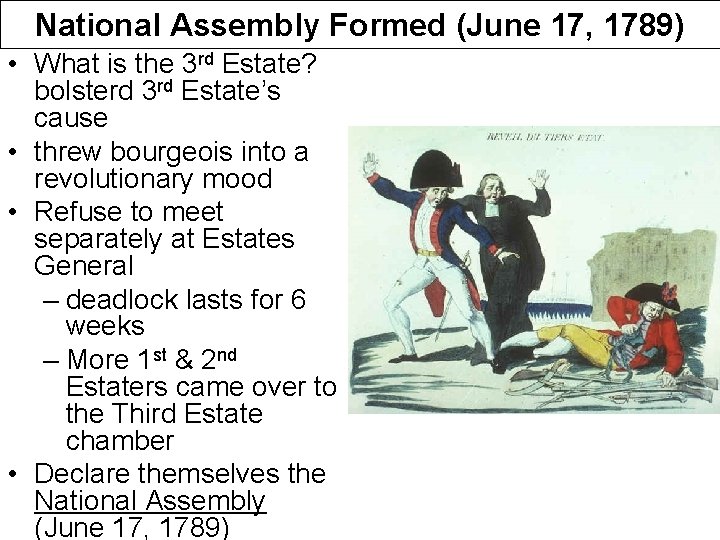
National Assembly Formed (June 17, 1789) • What is the 3 rd Estate? bolsterd 3 rd Estate’s cause • threw bourgeois into a revolutionary mood • Refuse to meet separately at Estates General – deadlock lasts for 6 weeks – More 1 st & 2 nd Estaters came over to the Third Estate chamber • Declare themselves the National Assembly (June 17, 1789)
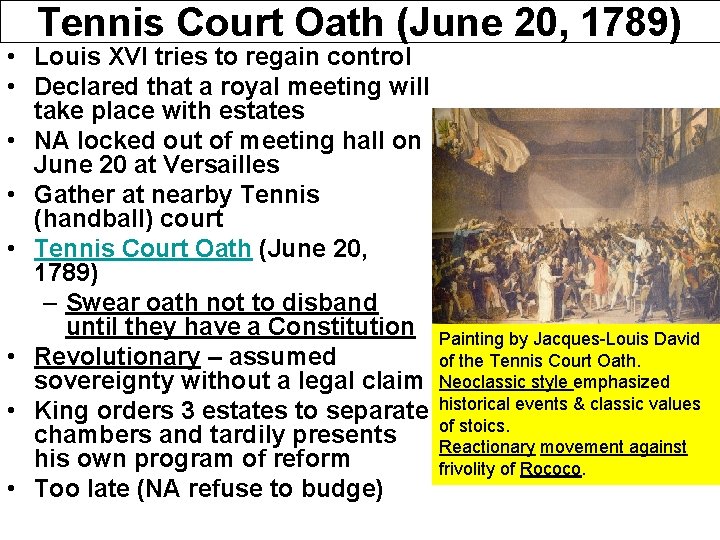
Tennis Court Oath (June 20, 1789) • Louis XVI tries to regain control • Declared that a royal meeting will take place with estates • NA locked out of meeting hall on June 20 at Versailles • Gather at nearby Tennis (handball) court • Tennis Court Oath (June 20, 1789) – Swear oath not to disband until they have a Constitution • Revolutionary – assumed sovereignty without a legal claim • King orders 3 estates to separate chambers and tardily presents his own program of reform • Too late (NA refuse to budge) Painting by Jacques-Louis David of the Tennis Court Oath. Neoclassic style emphasized historical events & classic values of stoics. Reactionary movement against frivolity of Rococo.
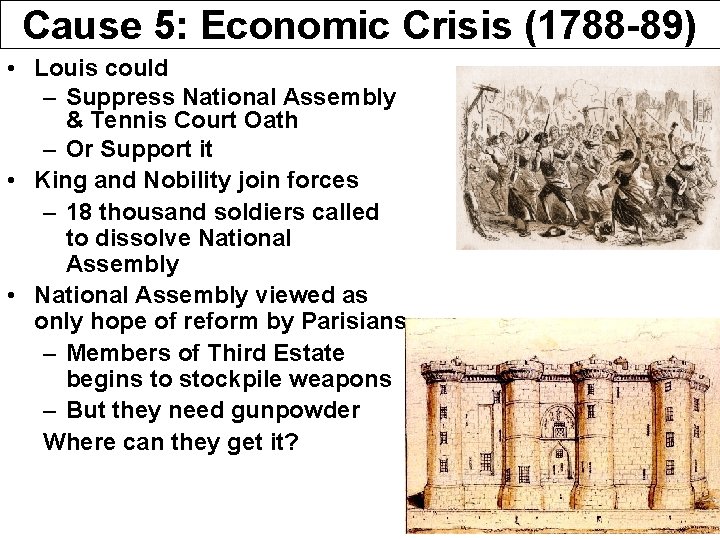
Cause 5: Economic Crisis (1788 -89) • Louis could – Suppress National Assembly & Tennis Court Oath – Or Support it • King and Nobility join forces – 18 thousand soldiers called to dissolve National Assembly • National Assembly viewed as only hope of reform by Parisians – Members of Third Estate begins to stockpile weapons – But they need gunpowder Where can they get it?
- Slides: 25