
The French Revolution and Rise of Napoleon Absolutism
The French Revolution and Rise of Napoleon
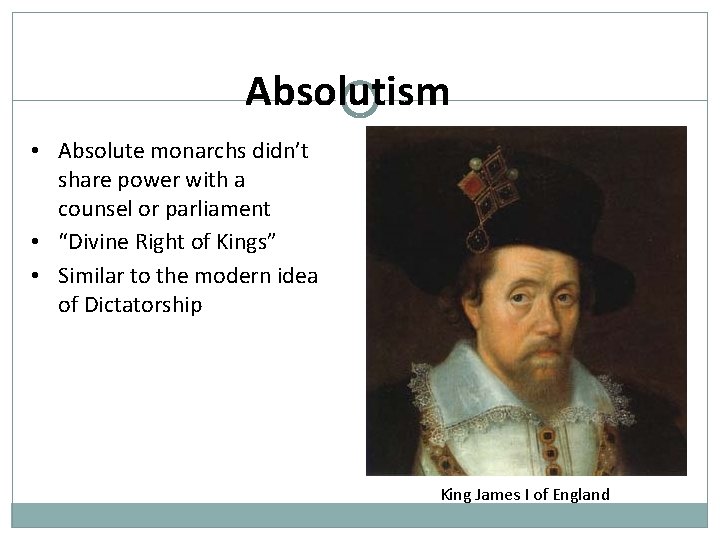
Absolutism • Absolute monarchs didn’t share power with a counsel or parliament • “Divine Right of Kings” • Similar to the modern idea of Dictatorship King James I of England
How did the French Revolution begin? �The French were inspired by the . � ideas
CAUSES of the French Revolution �In 1789, the French government was bankrupt. �The result, was increased French citizens. for
CAUSES of the French Revolution �This created a cycle of low wages, high prices and classes. among French social �Approximately 2% of the population controlled 99%
Financial Difficulties • Need for tax reform – Nobles didn’t want to pay taxes. They never had to before. – Peasants and bourgeoisie were upset because they paid all the taxes • Government had large debts with heavy interest – Extravagant spending on courts – Over ambitious wars
French Society �Three Estates: Society was divided into three classes of people; The First, Second, and Estates.
The First Estate �Made up of the Clergy, operated schools and hospitals, and helped the poor. �They paid .
The Second Estate �Made up of the , highest positions in the Church, military and government. �Also did not have to pay taxes.
The Third Estate �The which is French for “middle class. ” (Even though it was the lowest class in French society). �Made up of peasants, artisans and commoners. �Paid of the taxes in France.
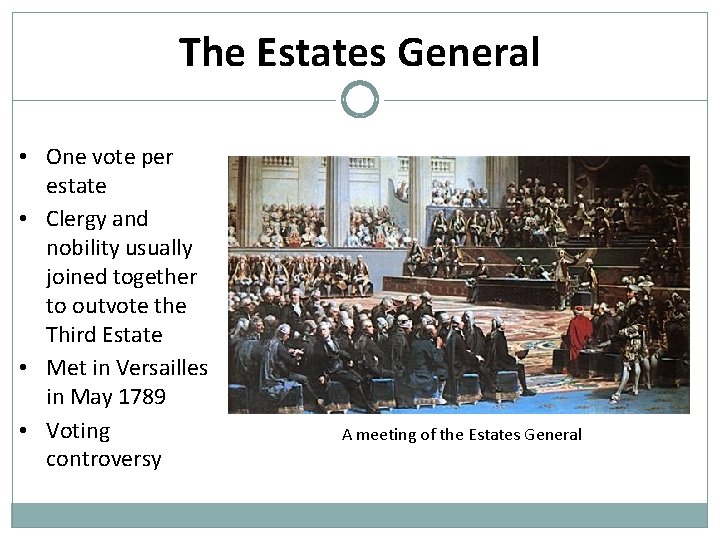
The Estates General • One vote per estate • Clergy and nobility usually joined together to outvote the Third Estate • Met in Versailles in May 1789 • Voting controversy A meeting of the Estates General
The National Assembly �Louis XVI restored the National Assembly and gave the Third Estate a say in government, but
Storming the Bastille �The people were upset with the King. �On July 14, 1789 they stormed the , which was a prison that held hundreds of political captive. �The Bastille was destroyed, and the people continued to fight against the absolute monarchy of Louis VXI. �The French Revolution had begun.
Phase I of the French Revolution : Declaration of the Rights of Man – Document that declares France a and emphasizes liberty, brotherhood, and equality for all citizens. �
Phase I of the French Revolution � 1791 – The French constitution is written. �This document includes arrangements for a and a government for the people, however does not include an “elastic clause. ” �The original constitution only lasted until 1792 because the people wanted more change.
New Political Groups �France had three political groups: Conservatives, moderates and radicals. �Conservatives favored the monarchy and wanted few changes. �Moderates wanted minor changes
New Political Groups �Radicals opposed the idea of monarchy and wanted many changes. �The
The Rise of Robespierre � 1793: Maximilien - Leader of the Jacobins. �Jacobins: Radical group who wanted to rebuild France. �Radical changes called for the of the King and Queen. �Robespierre and the Jacobins created the French Republic
The Reign of Terror �Robespierre was the chief architect of the : Radical campaign of executing all who were against the Revolution (Conservatives, Moderates). �He was referred to by the people as “the . ” �Used the and beheaded approximately 40, 000 people.
Execution of Louis XVI and Marie Antoinette �In January of 1793, Louis XVI was put on trial for being a traitor to France. �He was sentenced to death with a single vote and on a foggy morning. �His last words were drowned out by the screams from the crowd. �In the same fashion, his wife, Marie Antoinette was executed in October of that year.
The Reign of Terror �By 1795, members of Robespierre’s political party were afraid that the Reign of Terror was taken too far. They were afraid for their own lives. �Robespierre was arrested and put on trial for the Reign of Terror. He was executed by more moderate members of his own party. �In 1795, a new constitution was written. A small group made up of 5 men called “ would stabilize and rebuild France.
The Rise of Napoleon What led to the Rise of Napoleon?
France 1796 -1799 �France was ruled under the Directory (5 man government) �In 1799, Napoleon staged a (sudden takeover of the government)
Napoleon’s Achievements �Napoleon created a that encompassed Austria, Prussia, Spain, Portugal and Italy (all of which conquered by his army). �Sold the United States. to the
Napoleon’s Achievements �Napoleon was crowned in 1804 : System of Law used as a model today (Equality to men and fair tax code) � �Created National bank, common currency and public high schools. �His rule was based on
The Fall of Napoleon �Napoleon made several mistakes brought on by his thirst for power and territory: 1. Invasion of Russia: Led horses into Russia in 1812. soldiers and 50, 000 2. Russians retreated, burning all of their own crops and taking all food from their villages along the way. This is called the strategy. 1. Thousands of French soldiers starved to death and/or froze during the winter. Result- French defeat.
The Fall of Napoleon �After the French were defeated by the Russians, Napoleon was forced into Elba. on the island of �With Napoleon in captivity, Louis XVIII took the throne of France in 1814. �The government and economy under Louis , and Napoleon saw his chance to return. He escapes Elba and returns to Paris.
The Final Defeat of Napoleon �After in exile, in 1815, Napoleon returned to France to rebuild an Empire. �That same year, he led an army against the Allied Armies (Great Britain under the command of the , and Prussia)
Battle of Waterloo �The allied armies (Britain and Prussia) . Napoleon is once again exiled to island called St. Helena, where he dies in 1821. �The Battle of for France. was a defeat
The Congress of Vienna �Leaders from Austria, Russia, England France gathered in 1814 to think of ways of. �The Prince of Austria, Klemens Wenzel von Metternich, presided over the meeting.
Goals of the Congress of Vienna �Create a lasting peace; establish the �Re-draw the map of Europe and surround France with strong countries. �All land conquered by Napoleon is �Britain gains colonial territories in Africa and . �Restoring Monarchs to power in France and Spain.
Problems after the Congress �Re-drew map of Europe without concern for common cultures. �Nations split. �Increase in which eventually led to more revolutions.
- Slides: 32