
The French Revolution 4 stages n n n
- Slides: 40
The French Revolution 4 stages
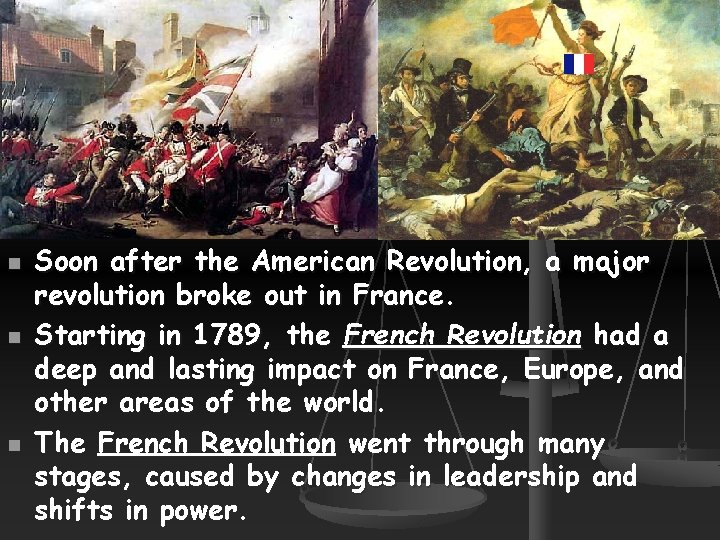
n n n Soon after the American Revolution, a major revolution broke out in France. Starting in 1789, the French Revolution had a deep and lasting impact on France, Europe, and other areas of the world. The French Revolution went through many stages, caused by changes in leadership and shifts in power.
Causes of the Revolution Political, social, and economic factors combined to bring about the French Revolution.
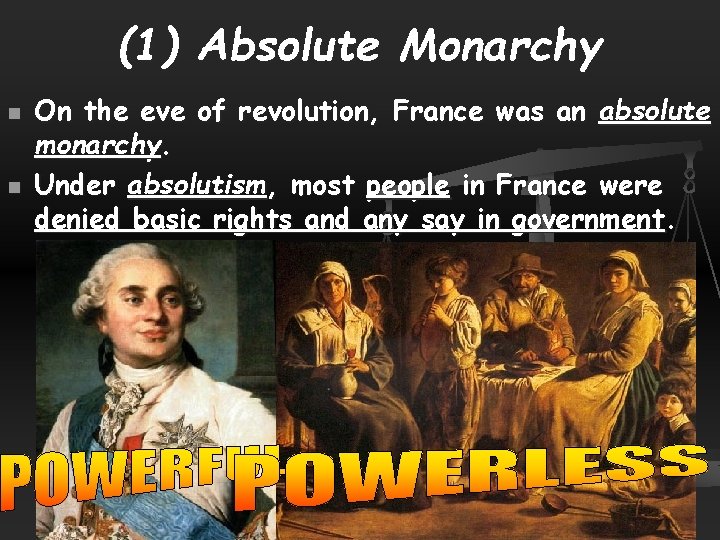
(1) Absolute Monarchy n n On the eve of revolution, France was an absolute monarchy. Under absolutism, most people in France were denied basic rights and any say in government.
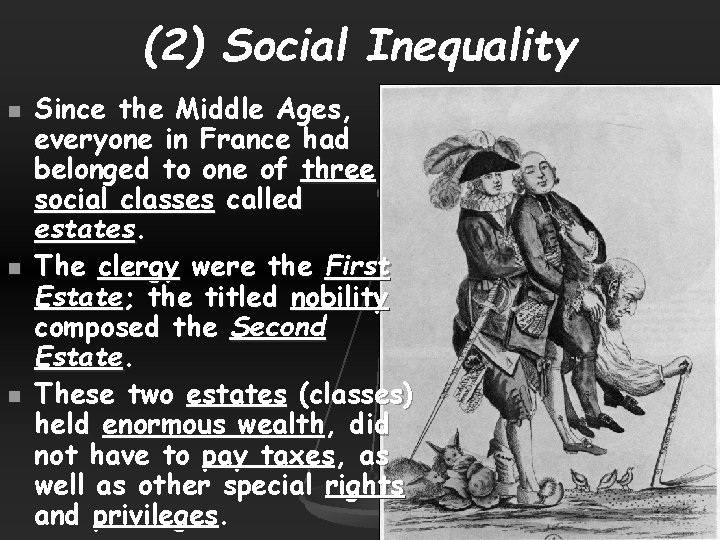
(2) Social Inequality n n n Since the Middle Ages, everyone in France had belonged to one of three social classes called estates. The clergy were the First Estate; the titled nobility composed the Second Estate. These two estates (classes) held enormous wealth, did not have to pay taxes, as well as other special rights and privileges.
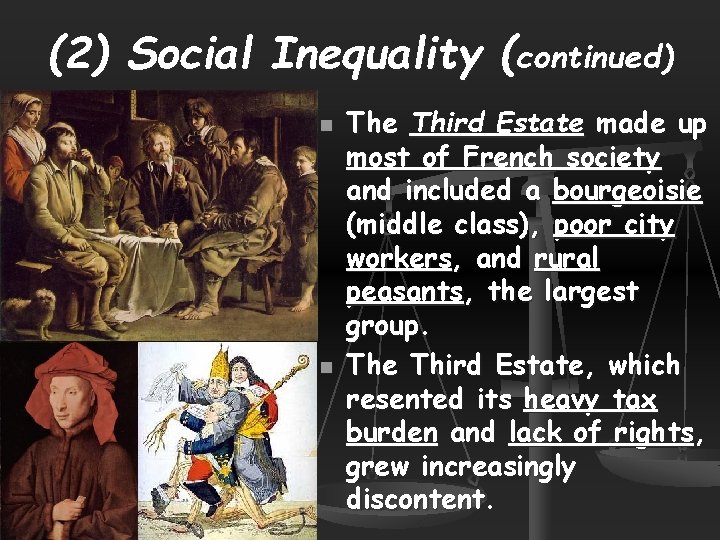
(2) Social Inequality (continued) n n The Third Estate made up most of French society and included a bourgeoisie (middle class), poor city workers, and rural peasants, the largest group. The Third Estate, which resented its heavy tax burden and lack of rights, grew increasingly discontent.
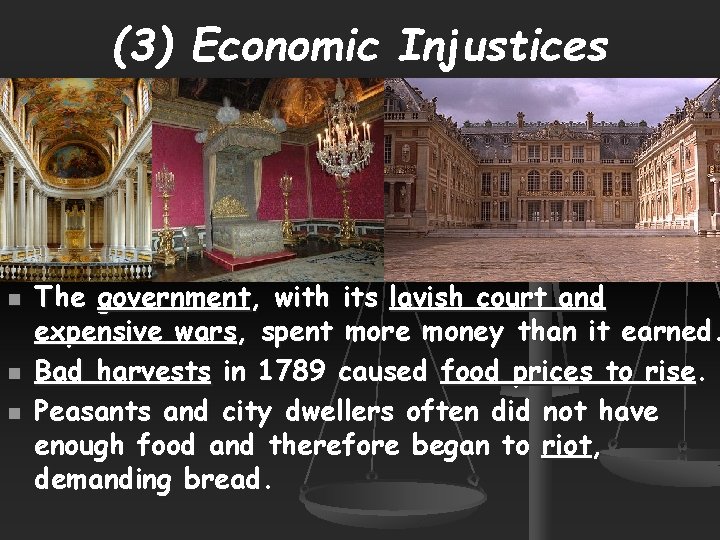
(3) Economic Injustices n n n The government, with its lavish court and expensive wars, spent more money than it earned. Bad harvests in 1789 caused food prices to rise. Peasants and city dwellers often did not have enough food and therefore began to riot, demanding bread.
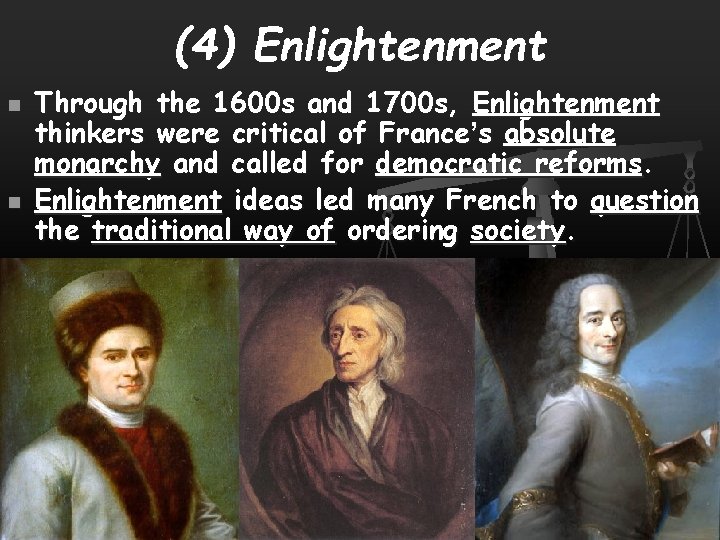
(4) Enlightenment n n Through the 1600 s and 1700 s, Enlightenment thinkers were critical of France’s absolute monarchy and called for democratic reforms. Enlightenment ideas led many French to question the traditional way of ordering society.
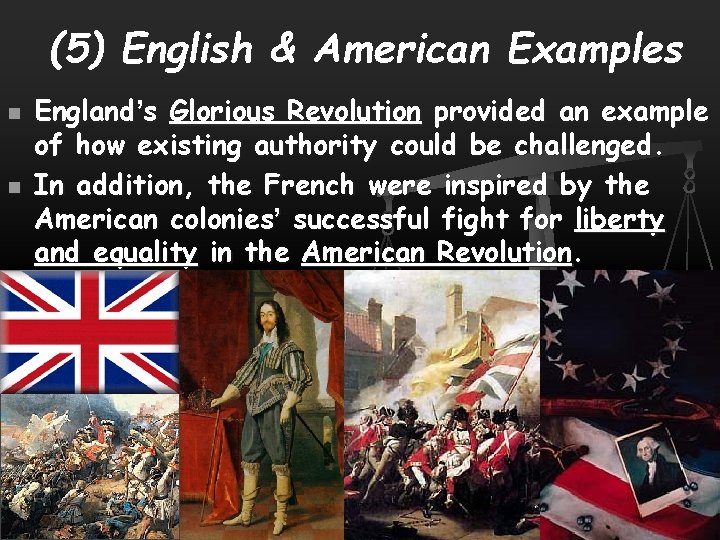
(5) English & American Examples n n England’s Glorious Revolution provided an example of how existing authority could be challenged. In addition, the French were inspired by the American colonies’ successful fight for liberty and equality in the American Revolution.
Stages of the Revolution The French Revolution
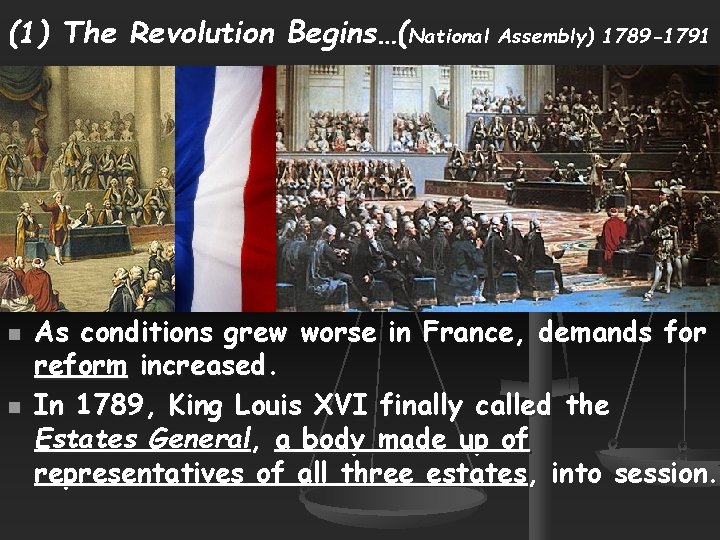
(1) The Revolution Begins…(National Assembly) 1789 -1791 n n As conditions grew worse in France, demands for reform increased. In 1789, King Louis XVI finally called the Estates General, a body made up of representatives of all three estates, into session.
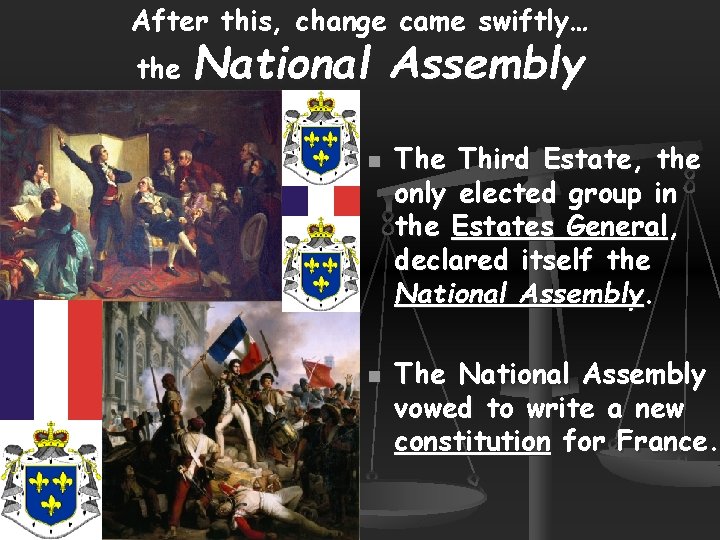
After this, change came swiftly… the National Assembly n n The Third Estate, the only elected group in the Estates General, declared itself the National Assembly. The National Assembly vowed to write a new constitution for France.
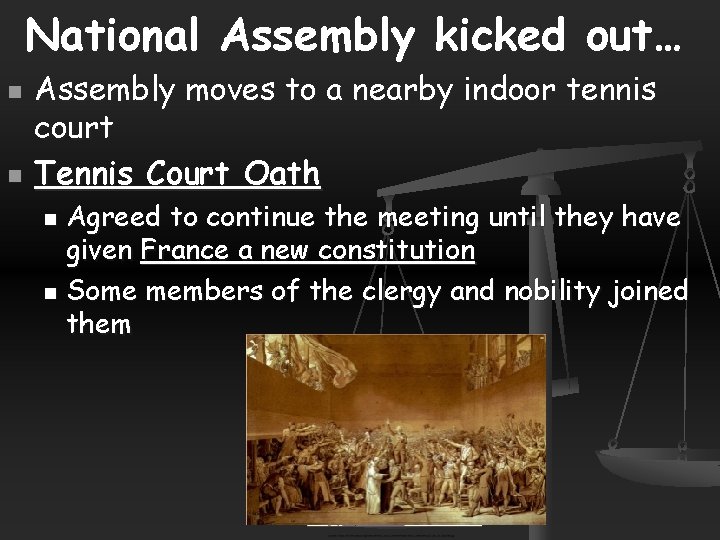
National Assembly kicked out… n n Assembly moves to a nearby indoor tennis court Tennis Court Oath Agreed to continue the meeting until they have given France a new constitution n Some members of the clergy and nobility joined them n
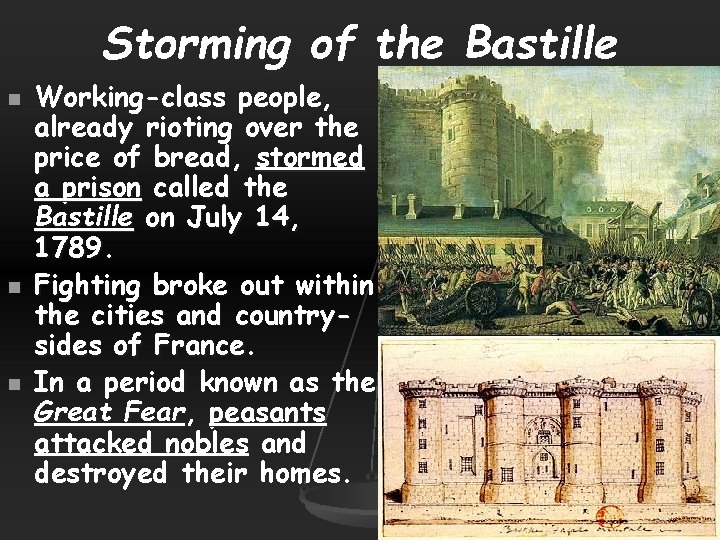
Storming of the Bastille n n n Working-class people, already rioting over the price of bread, stormed a prison called the Bastille on July 14, 1789. Fighting broke out within the cities and countrysides of France. In a period known as the Great Fear, peasants attacked nobles and destroyed their homes.
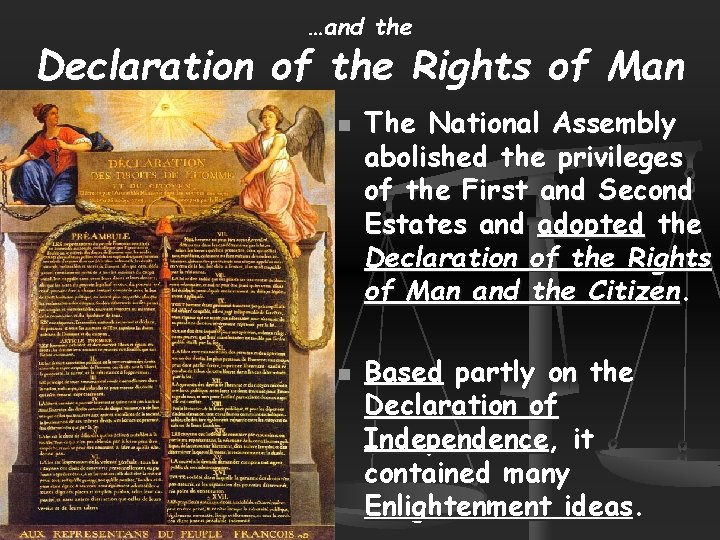
…and the Declaration of the Rights of Man n n The National Assembly abolished the privileges of the First and Second Estates and adopted the Declaration of the Rights of Man and the Citizen. Based partly on the Declaration of Independence, it contained many Enlightenment ideas.
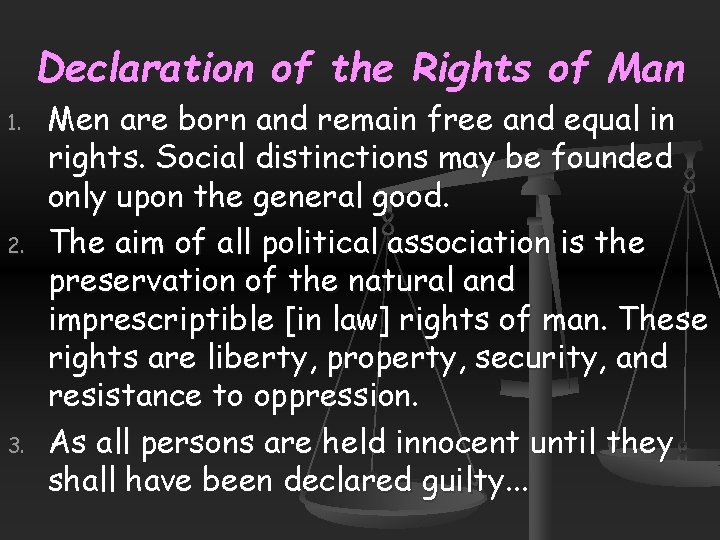
Declaration of the Rights of Man 1. 2. 3. Men are born and remain free and equal in rights. Social distinctions may be founded only upon the general good. The aim of all political association is the preservation of the natural and imprescriptible [in law] rights of man. These rights are liberty, property, security, and resistance to oppression. As all persons are held innocent until they shall have been declared guilty. . .
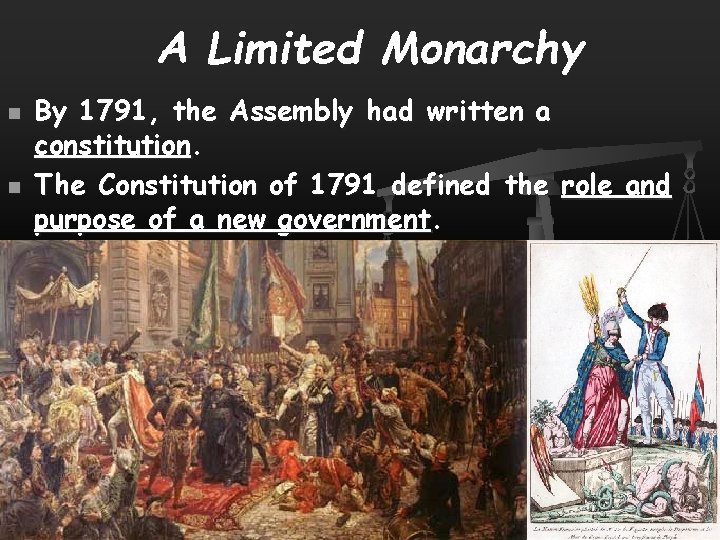
A Limited Monarchy n n By 1791, the Assembly had written a constitution. The Constitution of 1791 defined the role and purpose of a new government.
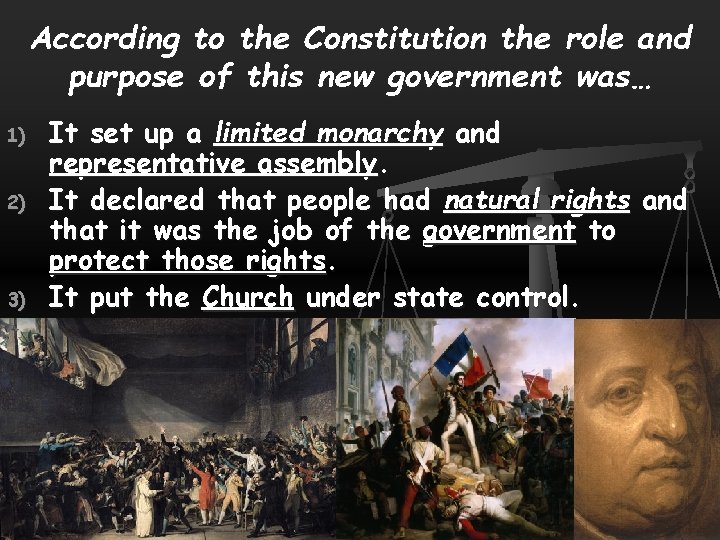
According to the Constitution the role and purpose of this new government was… 1) 2) 3) It set up a limited monarchy and representative assembly. It declared that people had natural rights and that it was the job of the government to protect those rights. It put the Church under state control.
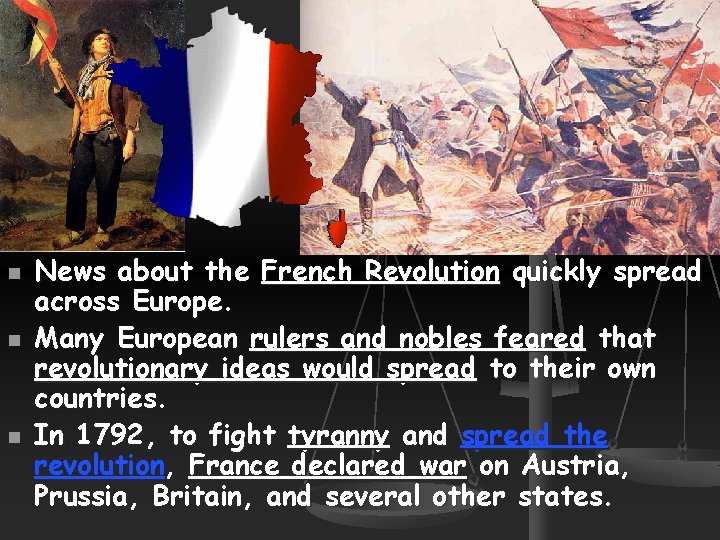
n n n News about the French Revolution quickly spread across Europe. Many European rulers and nobles feared that revolutionary ideas would spread to their own countries. In 1792, to fight tyranny and spread the revolution, France declared war on Austria, Prussia, Britain, and several other states.
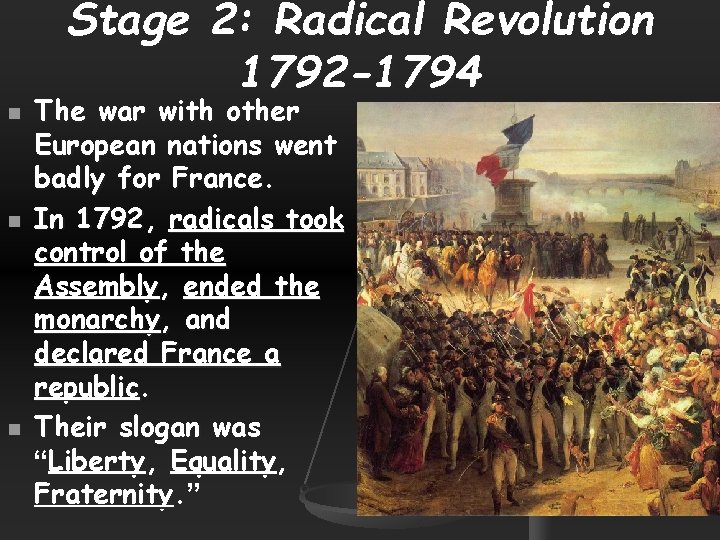
Stage 2: Radical Revolution 1792 -1794 n n n The war with other European nations went badly for France. In 1792, radicals took control of the Assembly, ended the monarchy, and declared France a republic. Their slogan was “Liberty, Equality, Fraternity. ”
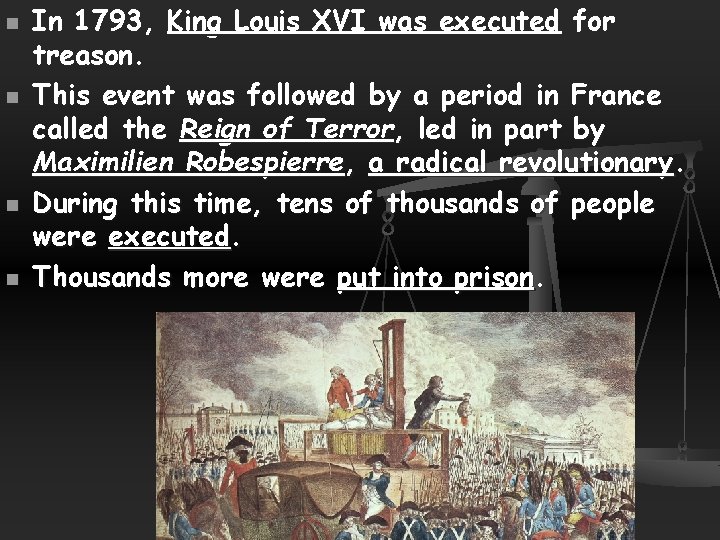
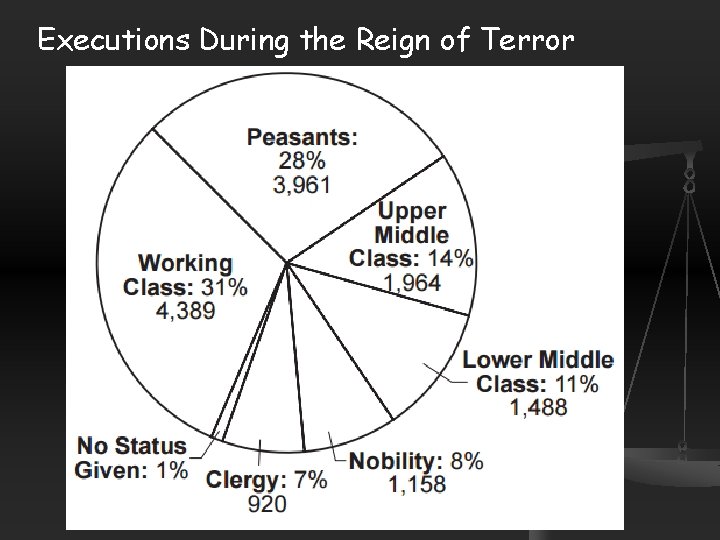
n n In 1793, King Louis XVI was executed for treason. This event was followed by a period in France called the Reign of Terror, led in part by Maximilien Robespierre, a radical revolutionary. During this time, tens of thousands of people were executed. Thousands more were put into prison.
Executions During the Reign of Terror
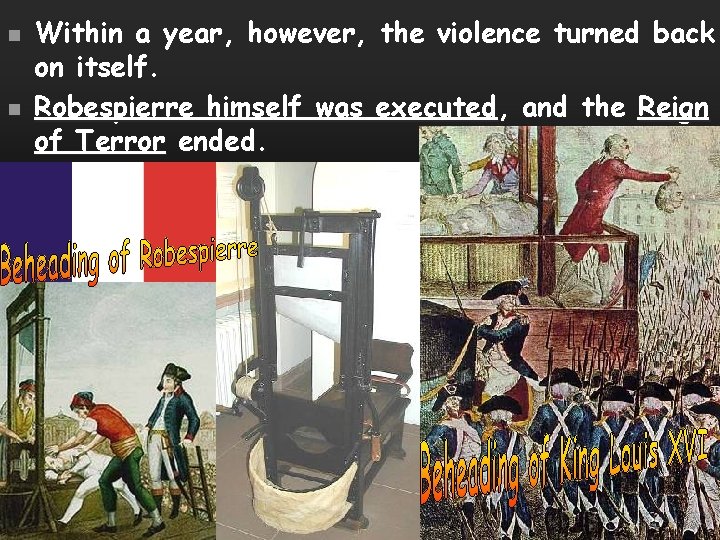
n n Within a year, however, the violence turned back on itself. Robespierre himself was executed, and the Reign of Terror ended.
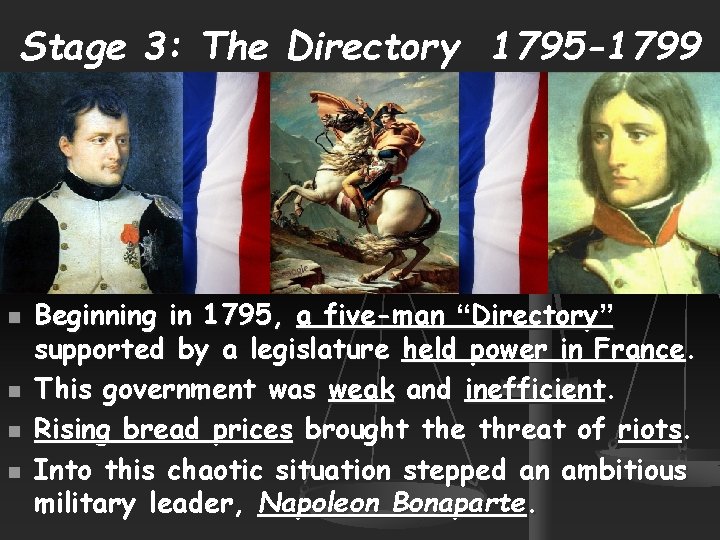
Stage 3: The Directory 1795 -1799 n n Beginning in 1795, a five-man “Directory” supported by a legislature held power in France. This government was weak and inefficient. Rising bread prices brought the threat of riots. Into this chaotic situation stepped an ambitious military leader, Napoleon Bonaparte.
Age of Napoleon Stage 4 1799 -1815
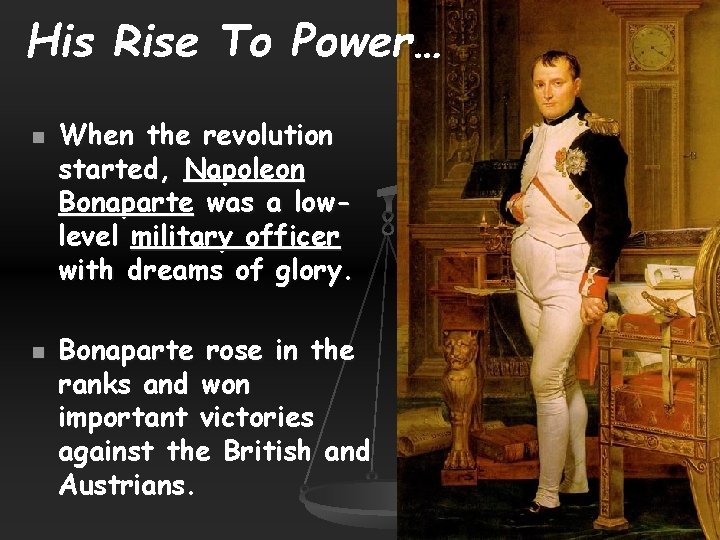
His Rise To Power… n n When the revolution started, Napoleon Bonaparte was a lowlevel military officer with dreams of glory. Bonaparte rose in the ranks and won important victories against the British and Austrians.
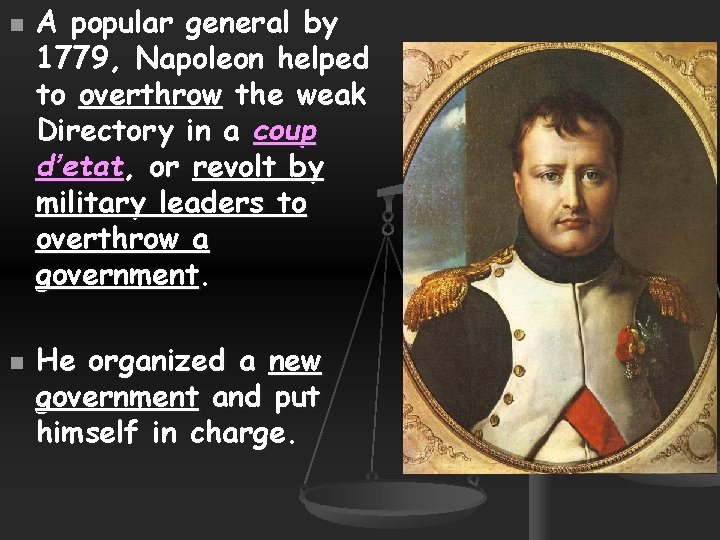
n n A popular general by 1779, Napoleon helped to overthrow the weak Directory in a coup d’etat, or revolt by military leaders to overthrow a government. He organized a new government and put himself in charge.
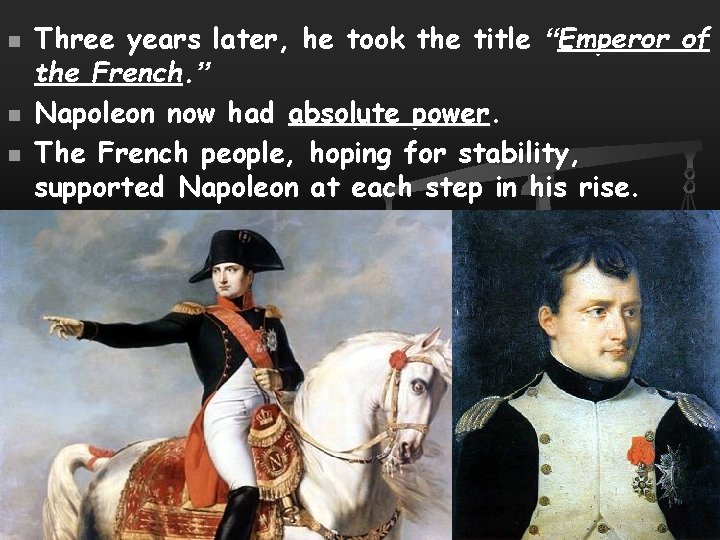
n n n Three years later, he took the title “Emperor of the French. ” Napoleon now had absolute power. The French people, hoping for stability, supported Napoleon at each step in his rise.
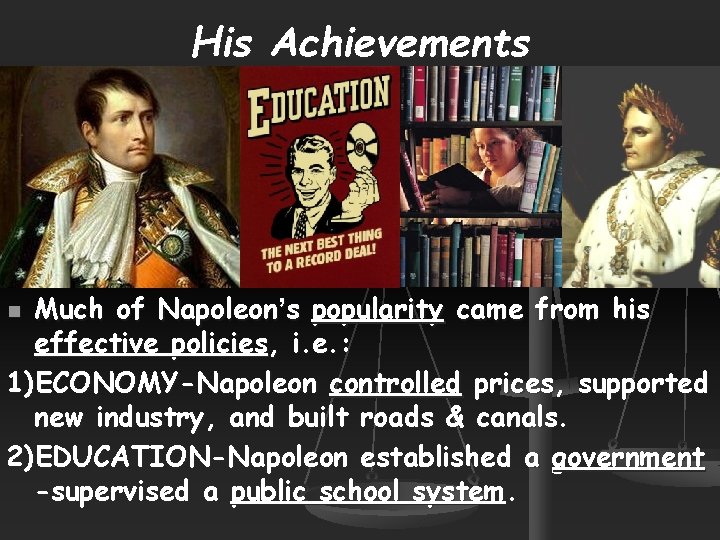
His Achievements Much of Napoleon’s popularity came from his effective policies, i. e. : 1)ECONOMY-Napoleon controlled prices, supported new industry, and built roads & canals. 2)EDUCATION-Napoleon established a government -supervised a public school system. n
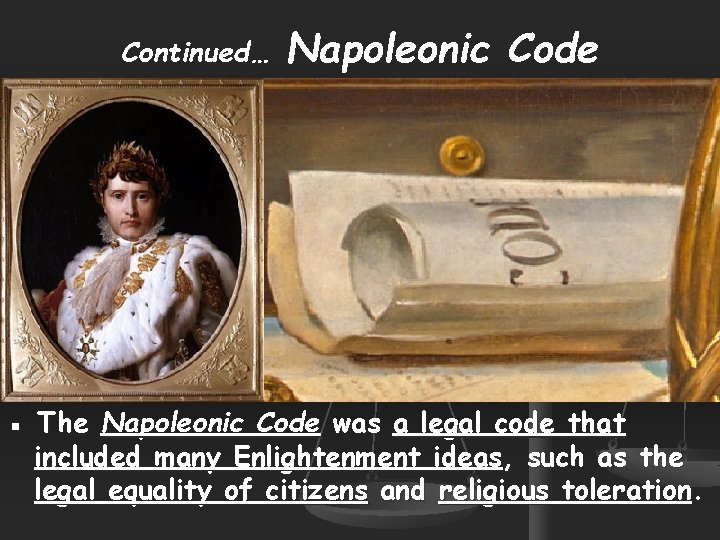
Continued… Napoleonic Code ▪ The Napoleonic Code was a legal code that included many Enlightenment ideas, such as the legal equality of citizens and religious toleration.
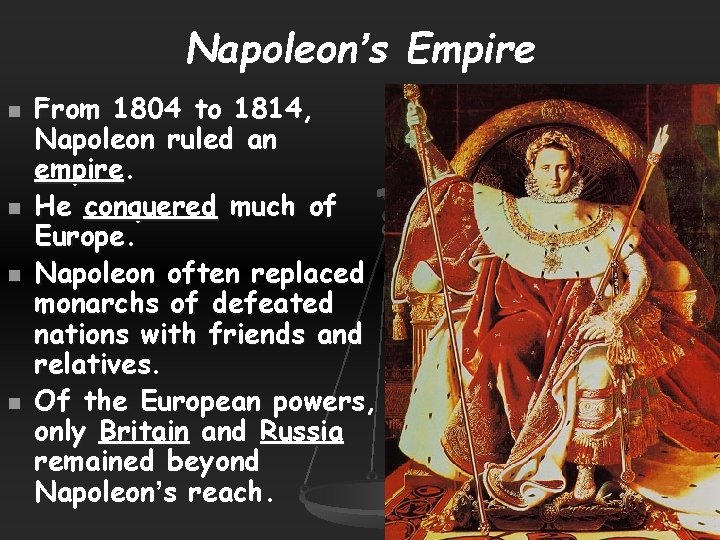
Napoleon’s Empire n n From 1804 to 1814, Napoleon ruled an empire. He conquered much of Europe. Napoleon often replaced monarchs of defeated nations with friends and relatives. Of the European powers, only Britain and Russia remained beyond Napoleon’s reach.
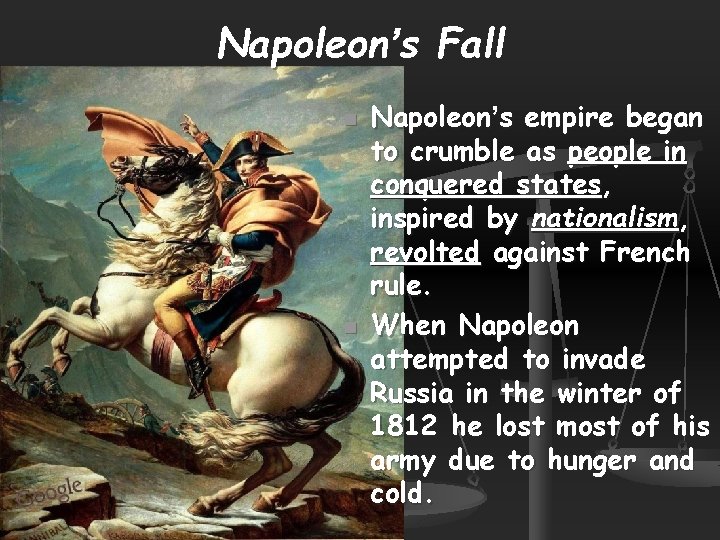
Napoleon’s Fall n n Napoleon’s empire began to crumble as people in conquered states, inspired by nationalism, revolted against French rule. When Napoleon attempted to invade Russia in the winter of 1812 he lost most of his army due to hunger and cold.
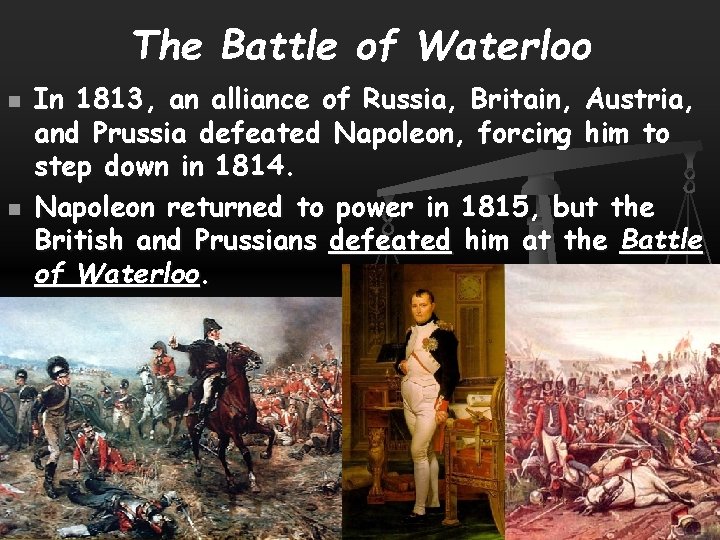
The Battle of Waterloo n n In 1813, an alliance of Russia, Britain, Austria, and Prussia defeated Napoleon, forcing him to step down in 1814. Napoleon returned to power in 1815, but the British and Prussians defeated him at the Battle of Waterloo.
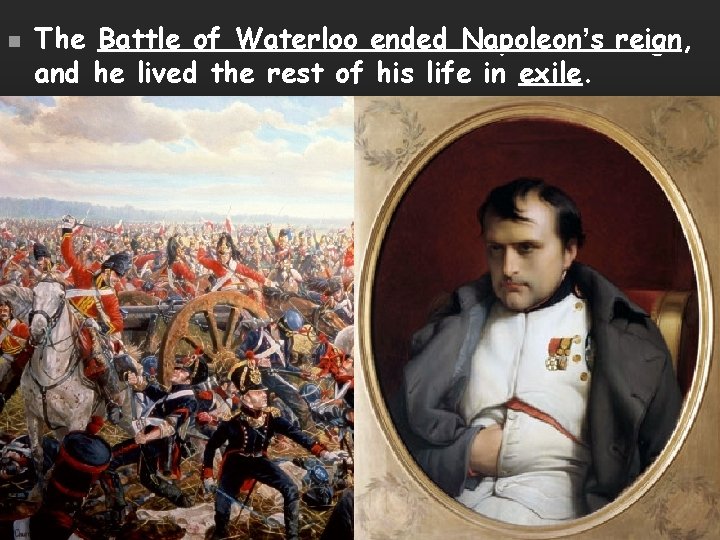
n The Battle of Waterloo ended Napoleon’s reign, and he lived the rest of his life in exile.
The Congress of Vienna Balance of Power and Restored Monarchs
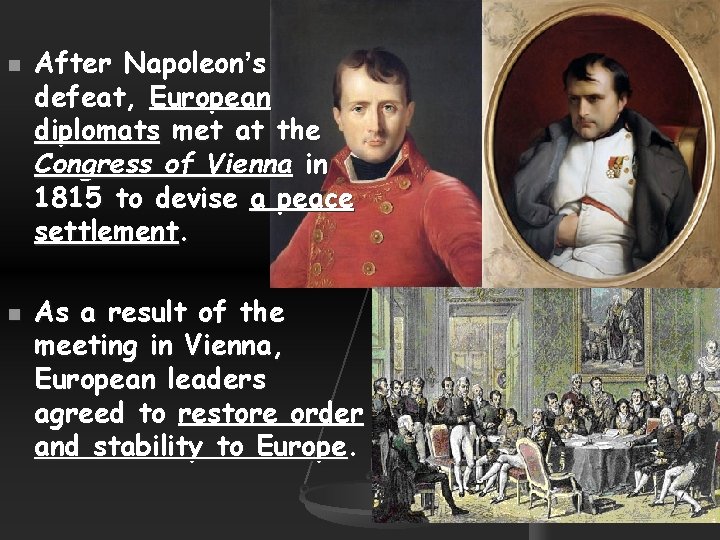
n n After Napoleon’s defeat, European diplomats met at the Congress of Vienna in 1815 to devise a peace settlement. As a result of the meeting in Vienna, European leaders agreed to restore order and stability to Europe.
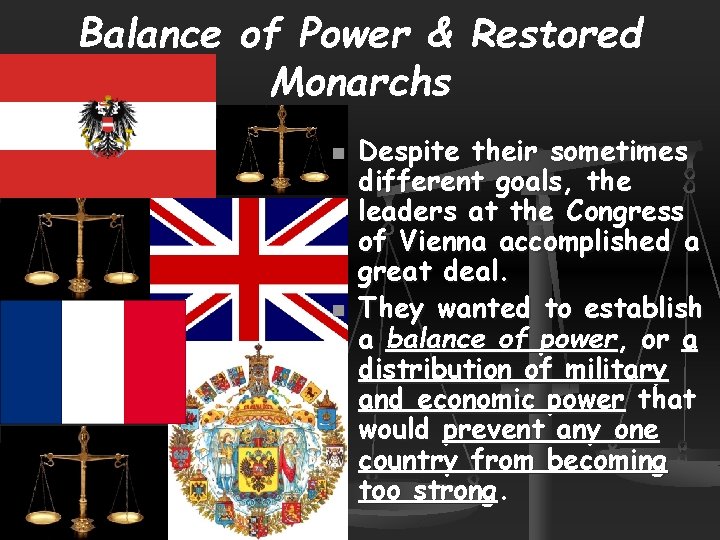
Balance of Power & Restored Monarchs n n Despite their sometimes different goals, the leaders at the Congress of Vienna accomplished a great deal. They wanted to establish a balance of power, or a distribution of military and economic power that would prevent any one country from becoming too strong.
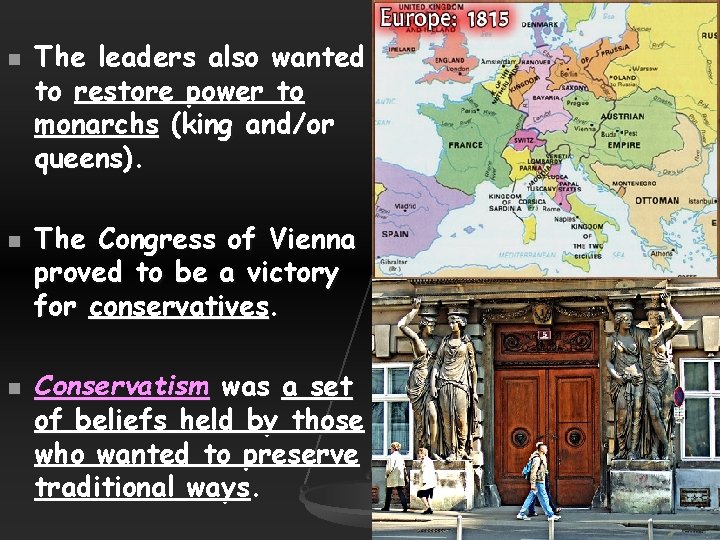
n n n The leaders also wanted to restore power to monarchs (king and/or queens). The Congress of Vienna proved to be a victory for conservatives. Conservatism was a set of beliefs held by those who wanted to preserve traditional ways.
Effects of the French Revolution n 1) 2) The French Revolution and the reign of Napoleon transformed both France and Europe in may ways: DEMOCRATIC IDEALS-Napoleon’s conquests spread the ideals of democracy throughout Europe. People struggled to achieve the goals of the French republic: “Liberty, Equality, Fraternity. ” NATIONALISM-National pride and a sense of national identity replaced earlier loyalty to local authority and the person of the monarch.
Effects of the French Revolution 3) cont. As conservatism clashed with the ideals of the French Revolution, revolutions would occur throughout Europe and Latin America.