
The Free Market What key economic questions must


- Slides: 16
The Free Market • What key economic questions must every society answer? • Why markets exist? • Analyze a circular flow model of a free market economy? • Understand the self-regulating nature of the marketplace • Identify the advantages of a free market economy. Chapter 2 Section Main Menu
Why Do Markets Exist? Markets exist because none of us produces all the goods and services we require to satisfy our needs and wants. A market is an arrangement that allows buyers and sellers to exchange goods and services. Chapter 2 Section Specialization is the concentration of the productive efforts of individuals and firms on a limited number of activities. Main Menu
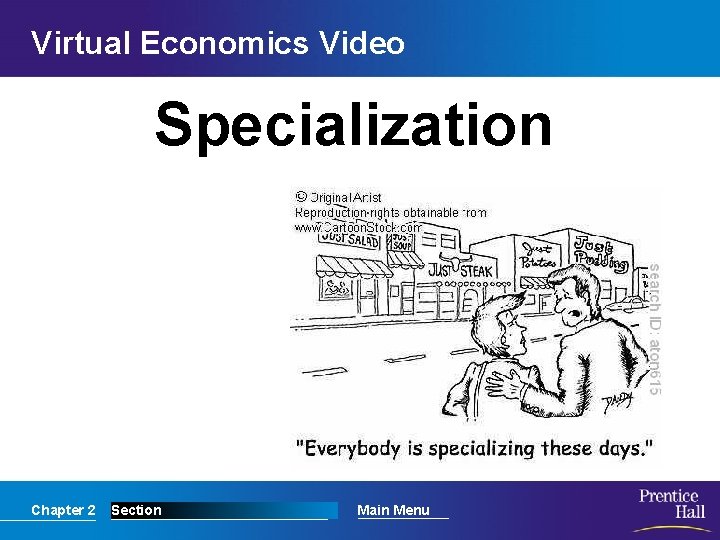
Virtual Economics Video Specialization Chapter 2 Section Main Menu
The Free Market Economy In a free market economy, households and business firms use markets to exchange money and products. Households own the factors of production and consume goods and services. Product Market – The market in which households purchase the goods and services that firms produce. Circular Flow Diagram of a Market Economy Households pay firms for goods and services. Section monetary flow physical flow Firms supply households with goods and services. Households Firms Households supply firms with land, labor, and capital. Factor Market – Market in which firms purchase the factors of production from households. (Factors of production = land, labor, and capital!) Chapter 2 Product market physical flow monetary flow Factor market Main Menu Firms pay households for land, labor, and capital.
Adam Smith Read Biography on Page 33 Be prepared to answer the following questions: – Who was Adam Smith? – What book did he write? – What is “laissez faire” – What is meant by the “invisible hand”? Chapter 2 Section Main Menu
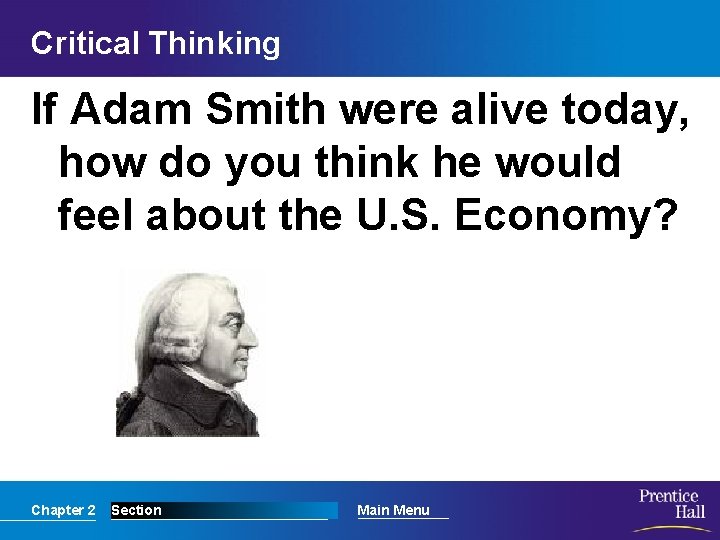
Critical Thinking If Adam Smith were alive today, how do you think he would feel about the U. S. Economy? Chapter 2 Section Main Menu
The Market’s Self-Regulating Nature • In every transaction, the buyer and seller consider their self-interest, or their own personal gain. Selfinterest is the motivating force in the free market. • Producers in a free market struggle for the dollars of consumers. This is known as competition, and is the regulating force of the free market. • The interaction of buyers and sellers, motivated by self-interest and regulated by competition, all happens without a central plan. This phenomenon is called “the invisible hand of the marketplace. ” Chapter 2 Section Main Menu
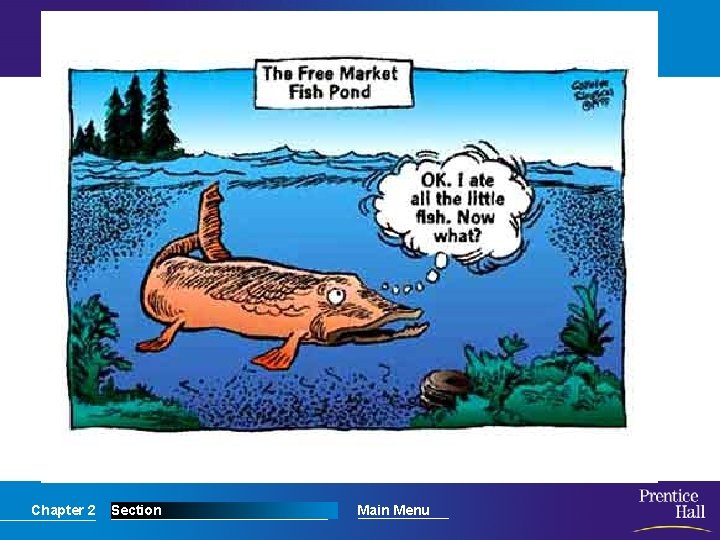
Chapter 2 Section Main Menu
The Three Economic Questions • Every society must answer three questions: – What goods and services should be produced? – How should these goods and services be produced? – Who consumes these goods and services? Chapter 2 Section Main Menu
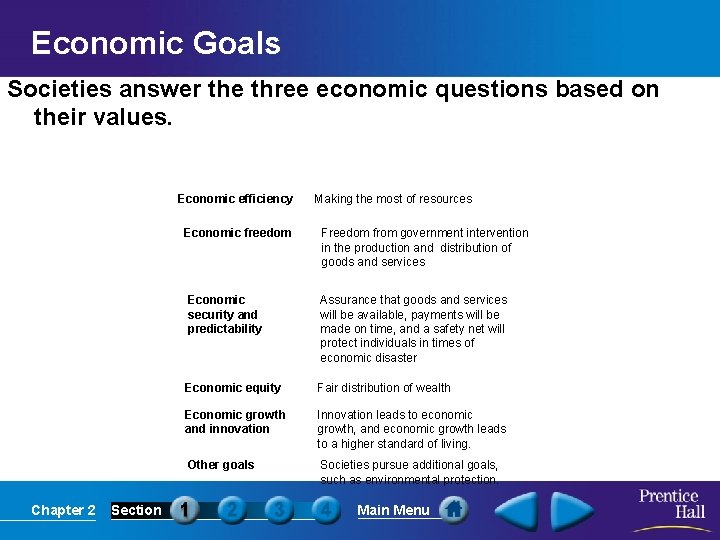
Economic Goals Societies answer the three economic questions based on their values. Economic Goals Economic efficiency Economic freedom Chapter 2 Section Making the most of resources Freedom from government intervention in the production and distribution of goods and services Economic security and predictability Assurance that goods and services will be available, payments will be made on time, and a safety net will protect individuals in times of economic disaster Economic equity Fair distribution of wealth Economic growth and innovation Innovation leads to economic growth, and economic growth leads to a higher standard of living. Other goals Societies pursue additional goals, such as environmental protection. Main Menu
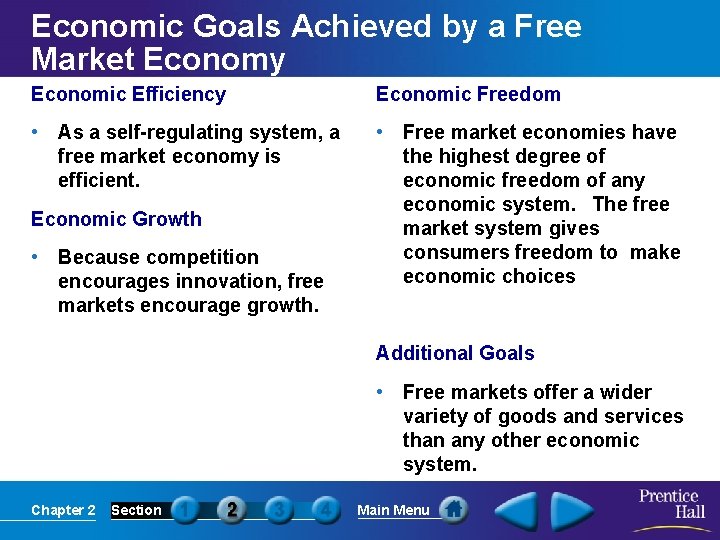
Economic Goals Achieved by a Free Market Economy Economic Efficiency Economic Freedom • As a self-regulating system, a free market economy is efficient. • Free market economies have the highest degree of economic freedom of any economic system. The free market system gives consumers freedom to make economic choices Economic Growth • Because competition encourages innovation, free markets encourage growth. Additional Goals • Free markets offer a wider variety of goods and services than any other economic system. Chapter 2 Section Main Menu
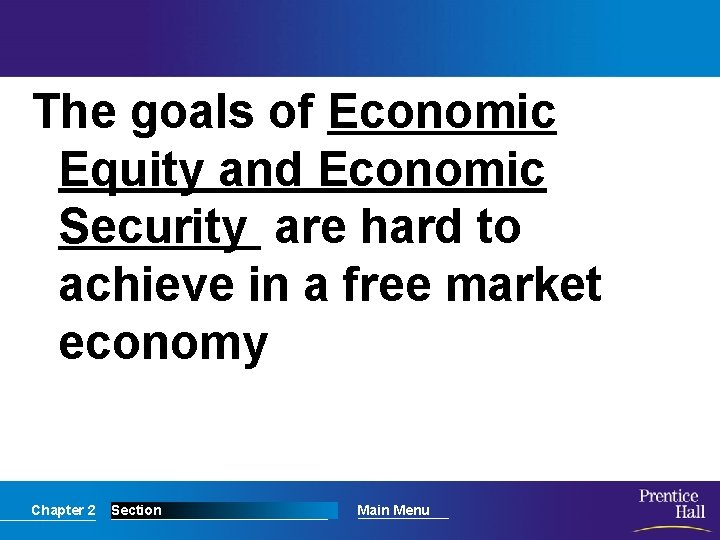
The goals of Economic Equity and Economic Security are hard to achieve in a free market economy Chapter 2 Section Main Menu
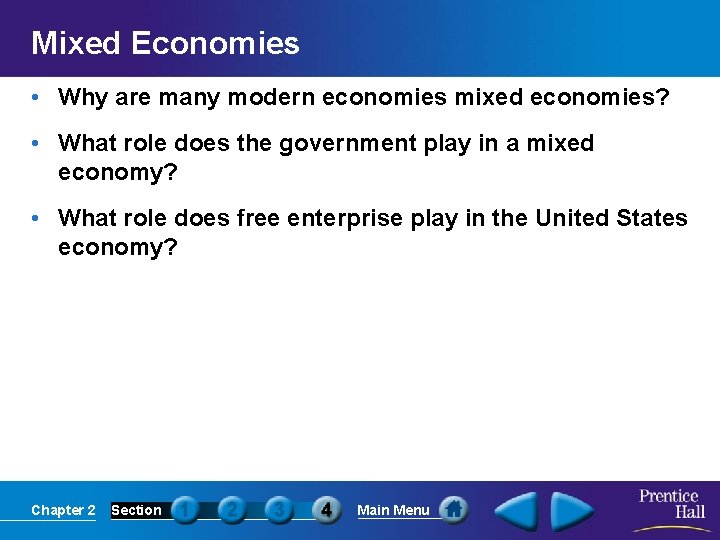
Mixed Economies • Why are many modern economies mixed economies? • What role does the government play in a mixed economy? • What role does free enterprise play in the United States economy? Chapter 2 Section Main Menu
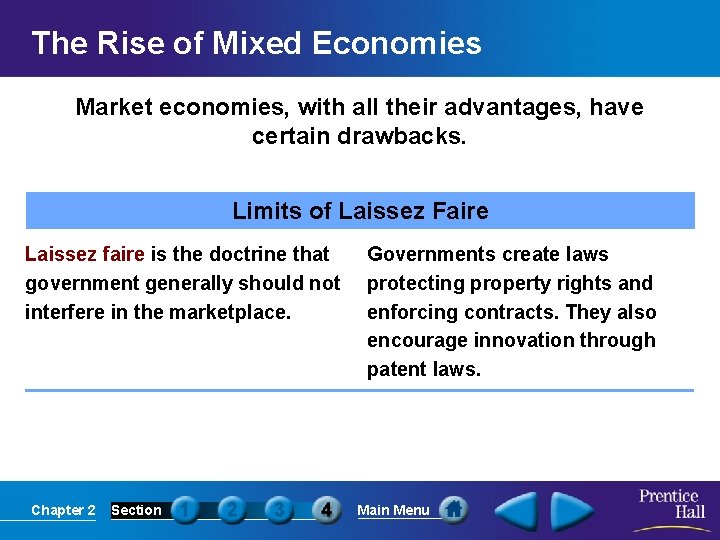
The Rise of Mixed Economies Market economies, with all their advantages, have certain drawbacks. Limits of Laissez Faire Laissez faire is the doctrine that government generally should not interfere in the marketplace. Chapter 2 Section Governments create laws protecting property rights and enforcing contracts. They also encourage innovation through patent laws. Main Menu
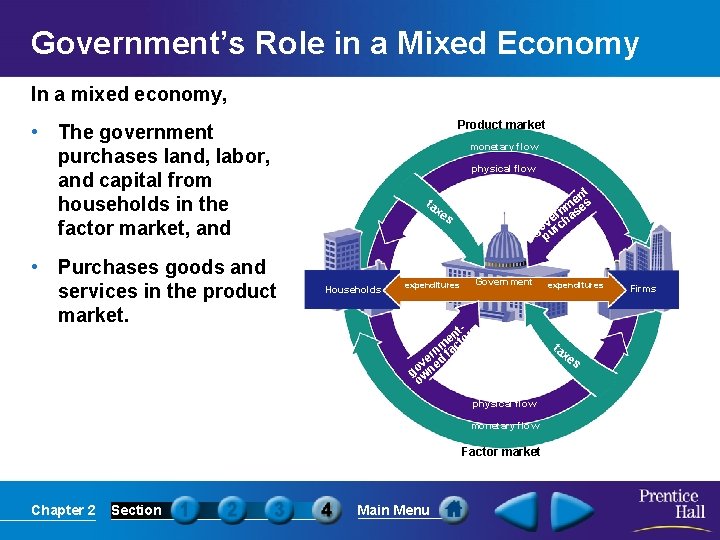
Government’s Role in a Mixed Economy In a mixed economy, Circular Flow Diagram of a Mixed Economy Product market • The government purchases land, labor, and capital from households in the factor market, and • Purchases goods and services in the product market. monetary flow physical flow t en s m e rn as e v ch gopur ta xe s Households expenditures Government t- s en tor m c rnd fa e v e go wn o physical flow monetary flow Factor market Chapter 2 Section Main Menu expenditures ta xe s Firms
Demonstration Circular Flow Model of a Mixed Economy Chapter 2 Section Main Menu