
The Framework Interpretation Of Genesis 1 and 2

- Slides: 22
The Framework Interpretation Of Genesis 1 and 2
The Framework Interpretation of Genesis 1 and 2 “At the heart of the issue… is the question of whether the modus operandi of divine providence was the same during the creation era as that of ordinary providence now. This is not to raise the question of whether Genesis 1 leaves the door open for some sort of evolutionary reconstruction. On the contrary, it is assumed here that Genesis 1 contradicts the idea that an undifferentiated worldstuff evolved into the present variegated universe by dint of intrinsic potentialities whether divinely "triggered" or otherwise. ”
The Framework Interpretation of Genesis 1 and 2 If we take the Genesis 1 record chronologically… – First event: Genesis 1: 3 -5 (Day 1) – Second event: Genesis 1: 6 -8 (Day 2) – Third event: Genesis 1: 9 -13 (Day 3) …and so on… Then we will be forced to conclude that God did not use “secondary means” and natural law like he does now.
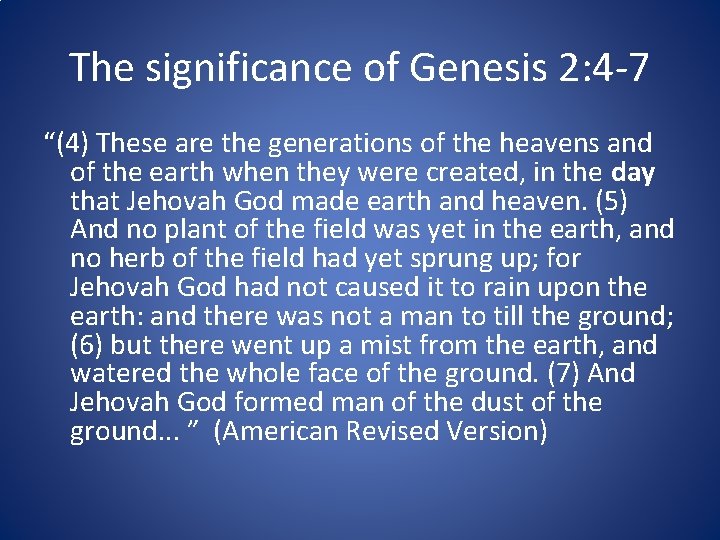
The significance of Genesis 2: 4 -7 “(4) These are the generations of the heavens and of the earth when they were created, in the day that Jehovah God made earth and heaven. (5) And no plant of the field was yet in the earth, and no herb of the field had yet sprung up; for Jehovah God had not caused it to rain upon the earth: and there was not a man to till the ground; (6) but there went up a mist from the earth, and watered the whole face of the ground. (7) And Jehovah God formed man of the dust of the ground. . . ” (American Revised Version)
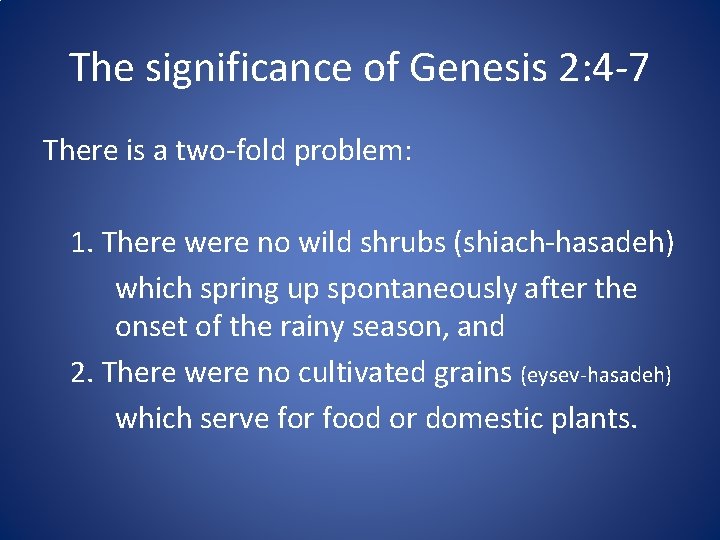
The significance of Genesis 2: 4 -7 There is a two-fold problem: 1. There were no wild shrubs (shiach-hasadeh) which spring up spontaneously after the onset of the rainy season, and 2. There were no cultivated grains (eysev-hasadeh) which serve for food or domestic plants.
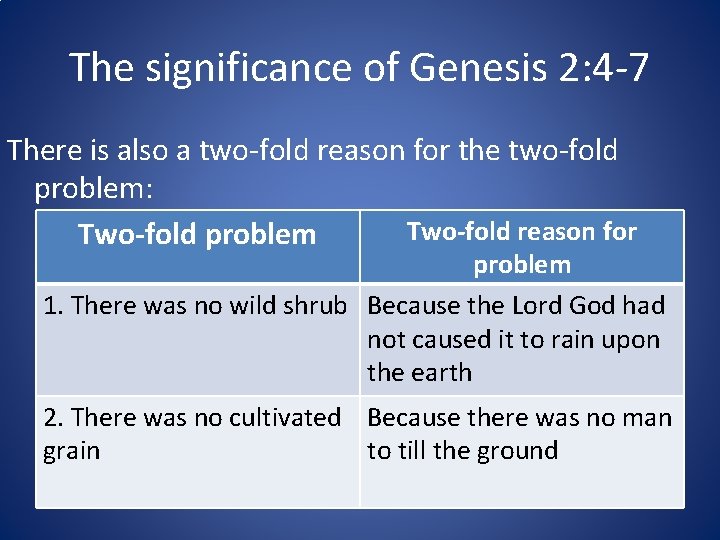
The significance of Genesis 2: 4 -7 There is also a two-fold reason for the two-fold problem: Two-fold reason for Two-fold problem 1. There was no wild shrub Because the Lord God had not caused it to rain upon the earth 2. There was no cultivated Because there was no man grain to till the ground
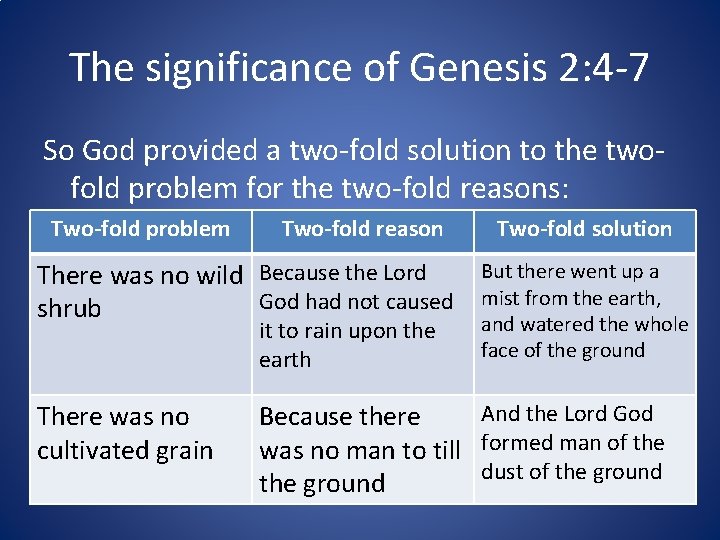
The significance of Genesis 2: 4 -7 So God provided a two-fold solution to the twofold problem for the two-fold reasons: Two-fold problem Two-fold reason There was no wild Because the Lord God had not caused shrub it to rain upon the earth There was no cultivated grain Two-fold solution But there went up a mist from the earth, and watered the whole face of the ground And the Lord God Because there was no man to till formed man of the dust of the ground
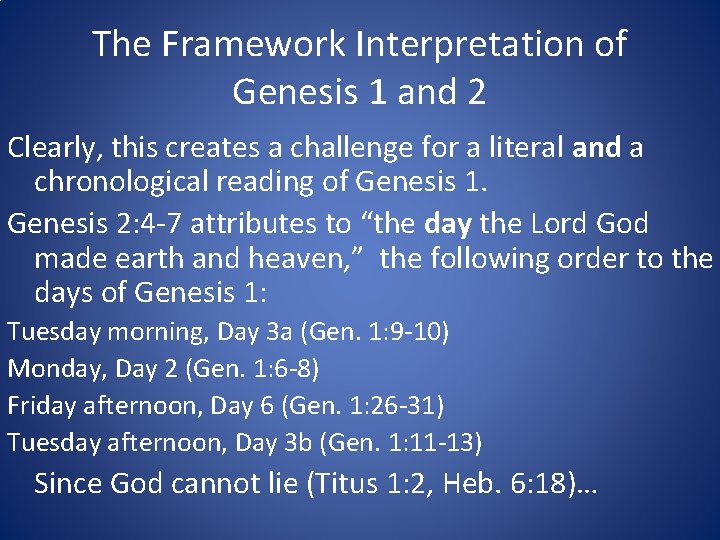
The Framework Interpretation of Genesis 1 and 2 Clearly, this creates a challenge for a literal and a chronological reading of Genesis 1. Genesis 2: 4 -7 attributes to “the day the Lord God made earth and heaven, ” the following order to the days of Genesis 1: Tuesday morning, Day 3 a (Gen. 1: 9 -10) Monday, Day 2 (Gen. 1: 6 -8) Friday afternoon, Day 6 (Gen. 1: 26 -31) Tuesday afternoon, Day 3 b (Gen. 1: 11 -13) Since God cannot lie (Titus 1: 2, Heb. 6: 18)…
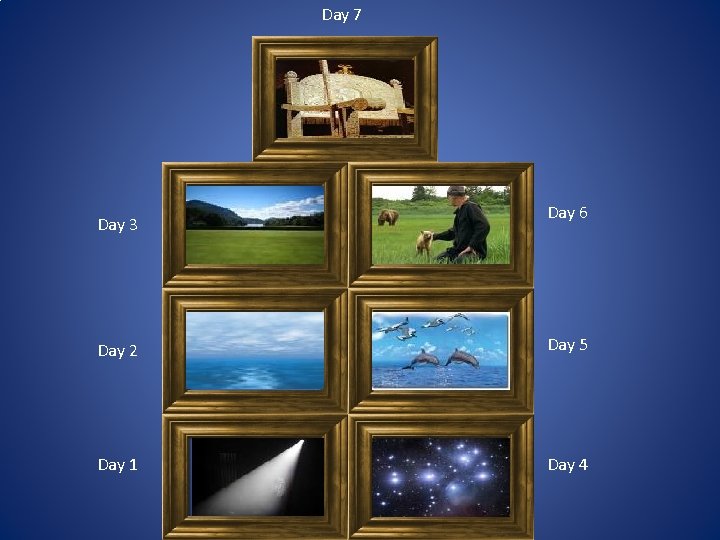
The Framework Interpretation of Genesis 1 and 2 …then we must find a non-sequential way to harmonize chapter 1 and chapter 2: 4 -7. Let’s observe some other features of Genesis 1: Days are paired together thematically.
Day 7 Day 3 Day 6 Day 2 Day 5 Day 1 Day 4
The Framework Interpretation of Genesis 1 and 2 So in light of Genesis 2: 4 -7 and the pairing of days in Genesis 1, we can see that those days are not chronologically arranged. But are they “literal” days (i. e. , 24 hr. periods)?
The Framework Interpretation of Genesis 1 and 2 Note well the use of the word “day” (yom) in Genesis 2: 4 “These are the generations of the heavens and of the earth when they were created, in the day that Jehovah God made earth and heaven. ” Literalists would have to concede that “day” here covers a 144 hour period (24 hours x 6)
The Framework Interpretation of Genesis 1 and 2 Also, note the use of “day” (yom) in Genesis 2: 2 -3 “By the seventh day God completed His work which He had done, and He rested on the seventh day from all His work which he had done. Then God blessed the seventh day and sanctified it, because in it He rested from all His work which God had created and made. ” Question: Was God literally exhausted?
The Framework Interpretation of Genesis 1 and 2 Consider how God interprets Genesis 2: 2 -3 for us in Hebrews 4: 4, 9 -10 “For He has said somewhere concerning the seventh day, ‘And God rested on the seventh day from all His works”… So there remains a Sabbath rest for the people of God. For the one who has entered His rest has himself also rested from His works, as God did from His. ”
The Framework Interpretation of Genesis 1 and 2 The author of the book of Hebrews doesn’t take the seventh day as a 24 hour period. He interprets it as beginning the “day” after God created Adam and continuing on even now. In fact, he says that we enter the exact same rest as God when we “rest from [our] works. ”
The Framework Interpretation of Genesis 1 and 2 So if the seventh day (yom) isn’t a literal 24 hour period… And if Genesis 2: 4 describes the whole creation week as the day (yom) in which God created the heavens and the earth… Then day (yom) does not refer to a literal, 24 hour period in Genesis 1 and 2.
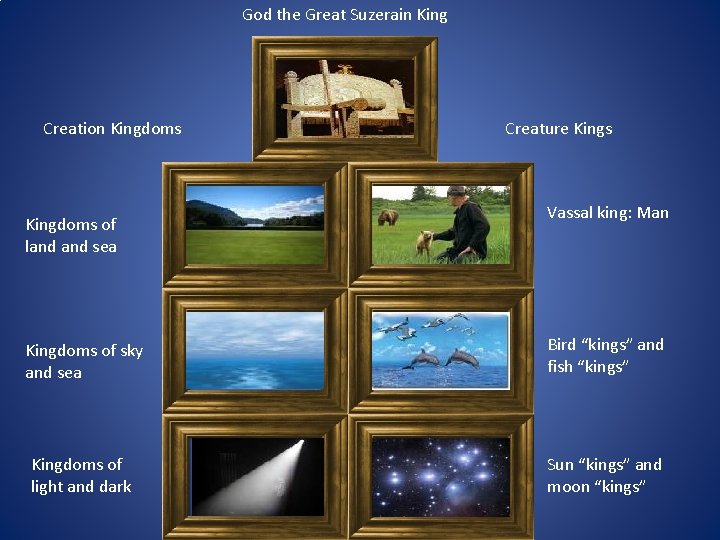
The Framework Interpretation of Genesis 1 and 2 Furthermore, consider some of the other language used in Genesis 1: God made the sun to “rule over” the day and the moon to “rule over” the night (Day 4). God gave the birds and the fish the same “dominion” mandate that he gives man (Day 5). God charged man with ruling over and subduing EVERYTHING (Day 6). So let’s return to our Framework…
God the Great Suzerain King Creation Kingdoms of land sea Creature Kings Vassal king: Man Kingdoms of sky and sea Bird “kings” and fish “kings” Kingdoms of light and dark Sun “kings” and moon “kings”
The Framework Interpretation of Genesis 1 and 2 Moses seems to have been more interested in theology The Kingdom of God, the Great Suzerain King Man, the vassal king …all setting the stage for the test involving the Tree of the Knowledge of Good and Evil… and
The Framework Interpretation of Genesis 1 and 2 Moses seems to have had literary concerns as well • Strophic (semi-poetic) refrain: “and there was evening, and there was morning, the ___ day. ” • The striking parallel between days 1 & 4: separating on each day. NB: Gen. 1: 14, 17 -18 cp. 1: 3 -5 • Chiasm in days 2 & 5: creation of Sky and Sea (Day 2), then kings of Sea and kings of Sky (Day 5). • Double creation-events on days 3 and 6. • Temporal Recapitulation: After Ch. 1, Genesis 2: 4 -7 goes back to the middle of the creation week to resume the story of Adam and the vegetation in order to set the stage for Adam and the Tree of KGE.
The Framework Interpretation of Genesis 1 and 2 Review: What does the Framework Interpretation affirm?
• God created ex nihilo in real, time-space history (Rom. 5: 12 -20 and 1 Cor. 15: 40 -50) • “While the six days of creation are presented as normal solar days, according to the framework interpretation the total picture of God’s completing His creative work in a week of days is not to be taken literally. Instead it functions as a literary structure in which the creative works of God have been narrated in a topical order. The days are like picture frames. Within each dayframe, Moses gives us a snapshot of divine creative activity. Although the creative fiat-fulfillments…refer to actual historical events that actually occurred, they are narrated in a nonsequential order within the literary structure or framework of a seven-day week. ”