
The Four Stages of Nicotine Addiction Starship Childrens



- Slides: 56
The Four Stages of Nicotine Addiction Starship Children’s Hospital Joseph R Di. Franza MD University of Massachusetts Medical School
Nicotine Addiction- Case histories n We asked smokers what does it feel like to need a cigarette?
Wanting n n “Wanting” is the first symptom of nicotine withdrawal. Wanting is a mild transient desire to smoke that is easily ignored.
Craving n n Craving is more intense than wanting and intrudes upon the person’s thoughts. It is more persistent and difficult to ignore. “I feel like someone inside of me is really telling me to smoke. ” Craving a cigarette “just, like, pops in your head, like someone is sending you a message. ”
Craving n Craving is like “being hungry, but instead of your stomach saying it, it’s your brain…it’s just hungry, except for a cigarette. ”
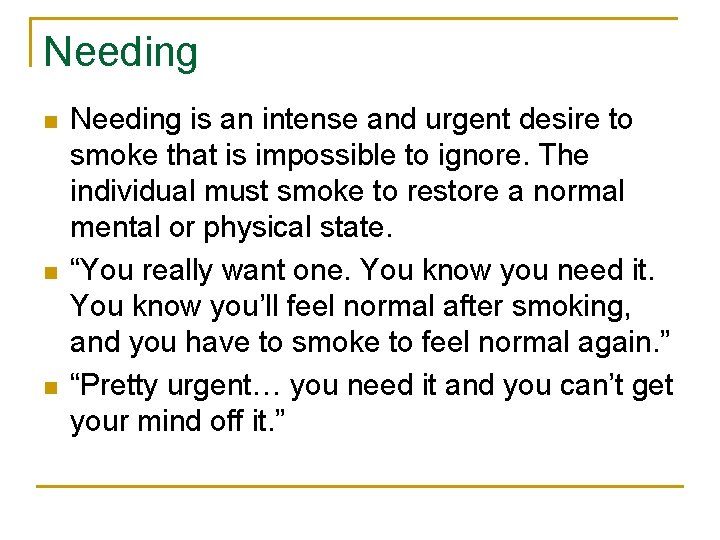
Needing n n n Needing is an intense and urgent desire to smoke that is impossible to ignore. The individual must smoke to restore a normal mental or physical state. “You really want one. You know you need it. You know you’ll feel normal after smoking, and you have to smoke to feel normal again. ” “Pretty urgent… you need it and you can’t get your mind off it. ”
Craving and Needing can be accompanied by the classic symptoms of. Restlessness nicotine withdrawal. Anxiety Irritability Anger Difficulty concentrating Disturbed sleep
Withdrawal recurs after each cigarette n n n Wanting then Craving then Needing
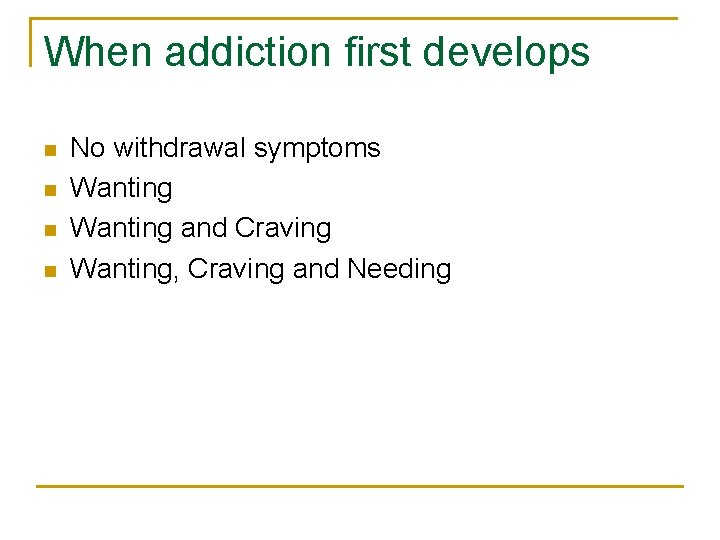
When addiction first develops n n No withdrawal symptoms Wanting and Craving Wanting, Craving and Needing
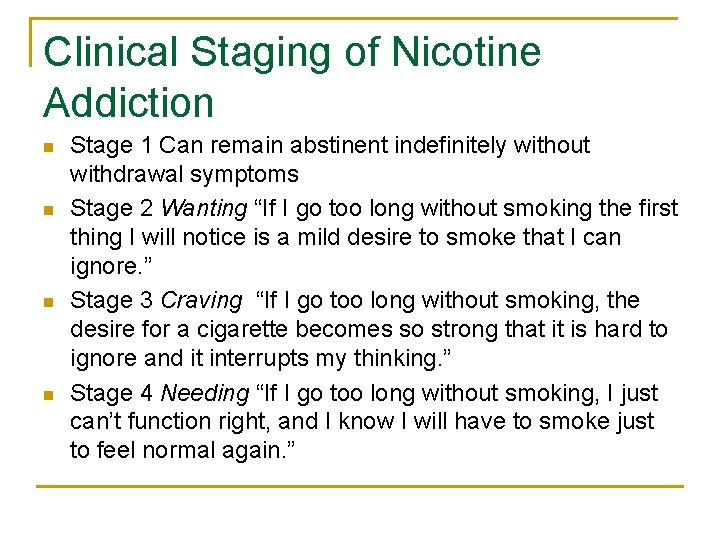
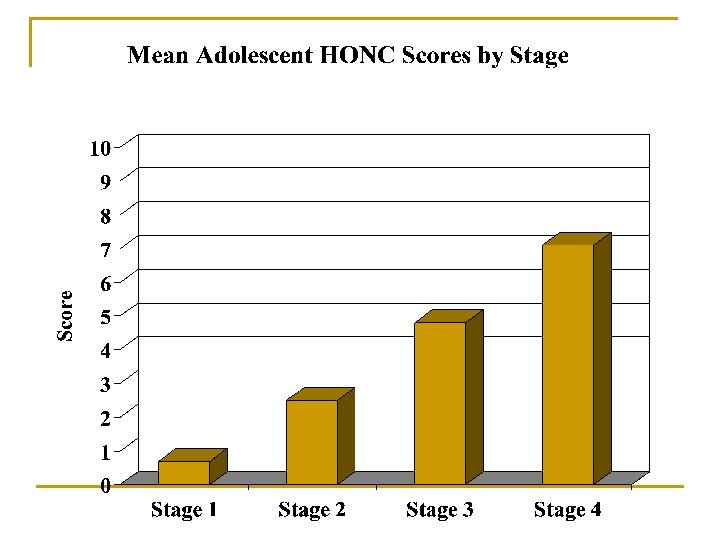
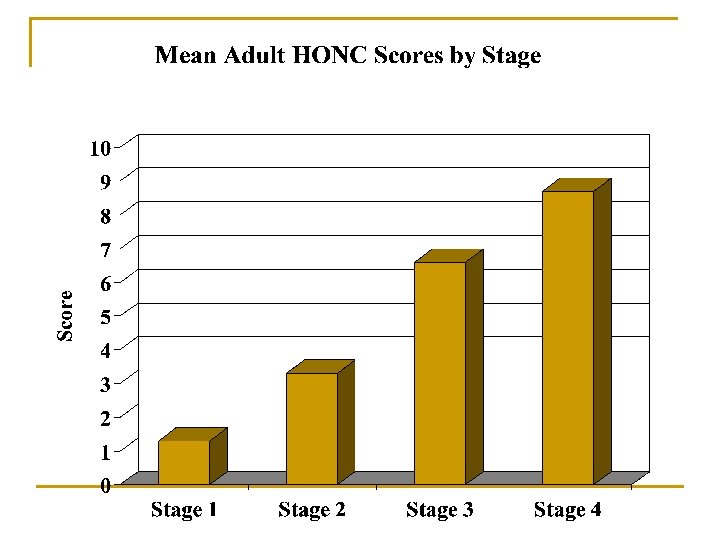
Clinical Staging of Nicotine Addiction n n Stage 1 Can remain abstinent indefinitely without withdrawal symptoms Stage 2 Wanting “If I go too long without smoking the first thing I will notice is a mild desire to smoke that I can ignore. ” Stage 3 Craving “If I go too long without smoking, the desire for a cigarette becomes so strong that it is hard to ignore and it interrupts my thinking. ” Stage 4 Needing “If I go too long without smoking, I just can’t function right, and I know I will have to smoke just to feel normal again. ”
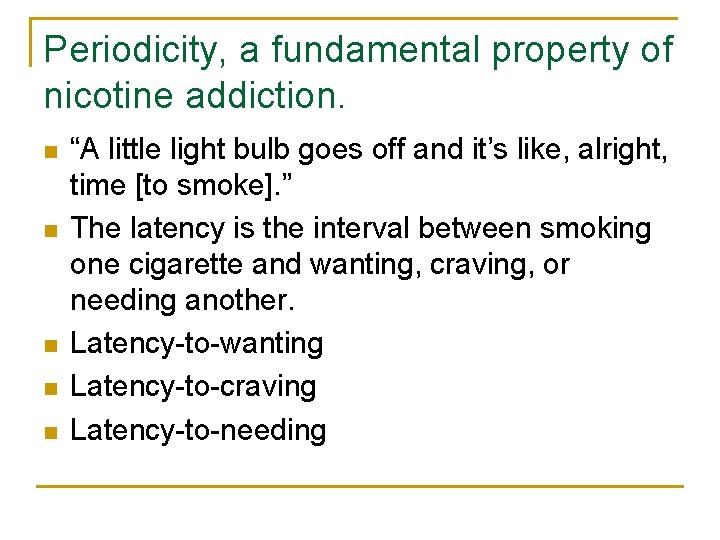
Periodicity, a fundamental property of nicotine addiction. n n n “A little light bulb goes off and it’s like, alright, time [to smoke]. ” The latency is the interval between smoking one cigarette and wanting, craving, or needing another. Latency-to-wanting Latency-to-craving Latency-to-needing
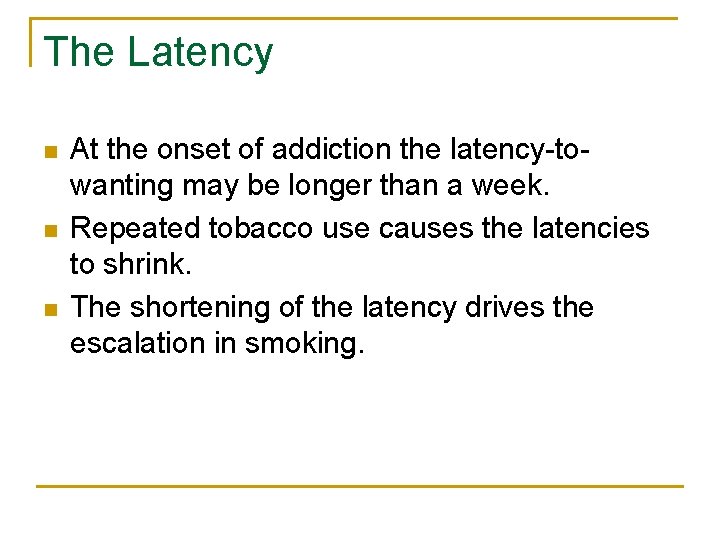
The Latency n n n At the onset of addiction the latency-towanting may be longer than a week. Repeated tobacco use causes the latencies to shrink. The shortening of the latency drives the escalation in smoking.
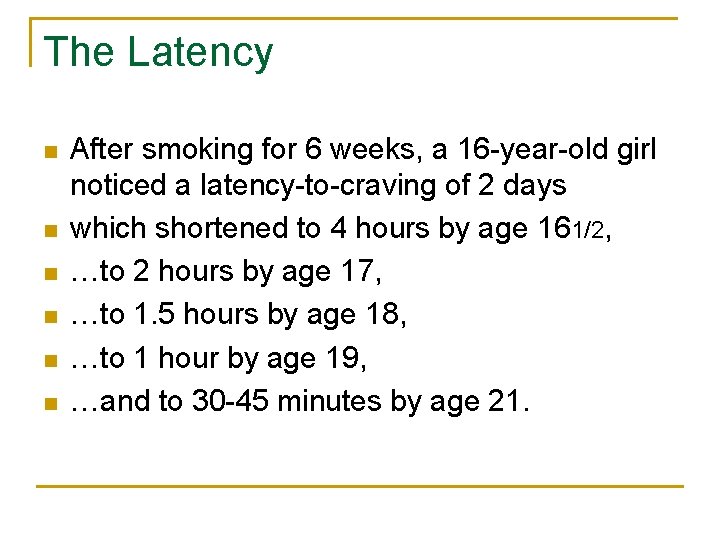
The Latency n n n After smoking for 6 weeks, a 16 -year-old girl noticed a latency-to-craving of 2 days which shortened to 4 hours by age 161/2, …to 2 hours by age 17, …to 1. 5 hours by age 18, …to 1 hour by age 19, …and to 30 -45 minutes by age 21.
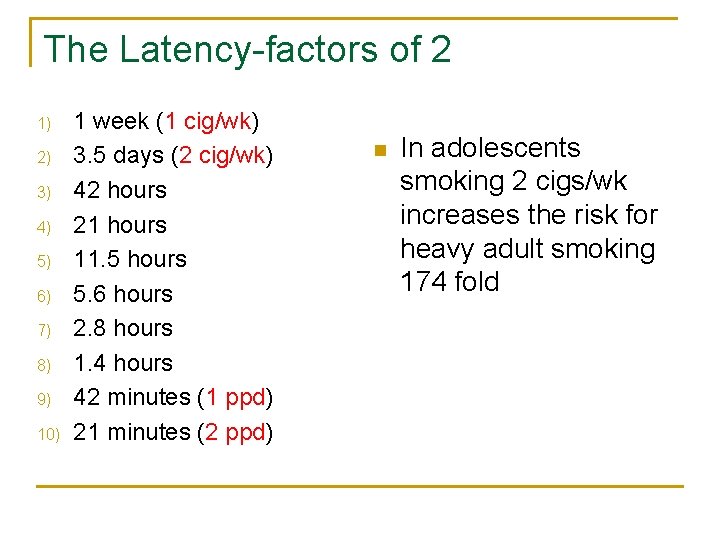
The Latency-factors of 2 1) 2) 3) 4) 5) 6) 7) 8) 9) 10) 1 week (1 cig/wk) 3. 5 days (2 cig/wk) 42 hours 21 hours 11. 5 hours 5. 6 hours 2. 8 hours 1. 4 hours 42 minutes (1 ppd) 21 minutes (2 ppd) n In adolescents smoking 2 cigs/wk increases the risk for heavy adult smoking 174 fold
Smokers have Latencies of days or weeks n With a half life of 2 hours, how can nicotine have such a prolonged impact?
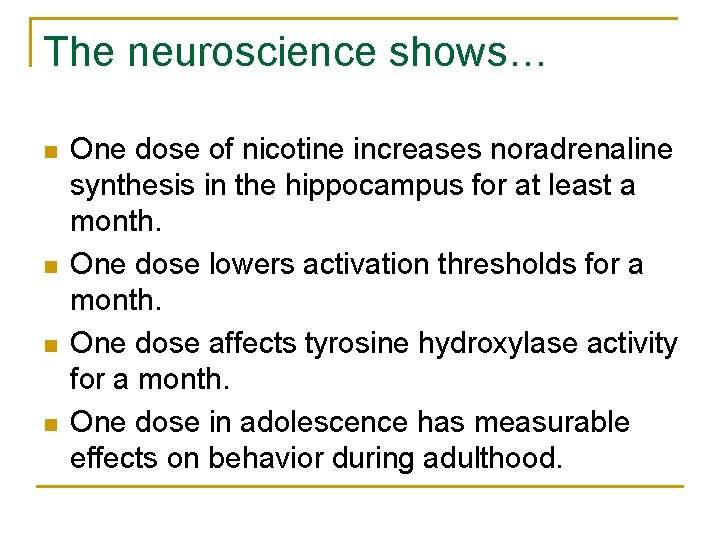
The neuroscience shows… n n One dose of nicotine increases noradrenaline synthesis in the hippocampus for at least a month. One dose lowers activation thresholds for a month. One dose affects tyrosine hydroxylase activity for a month. One dose in adolescence has measurable effects on behavior during adulthood.
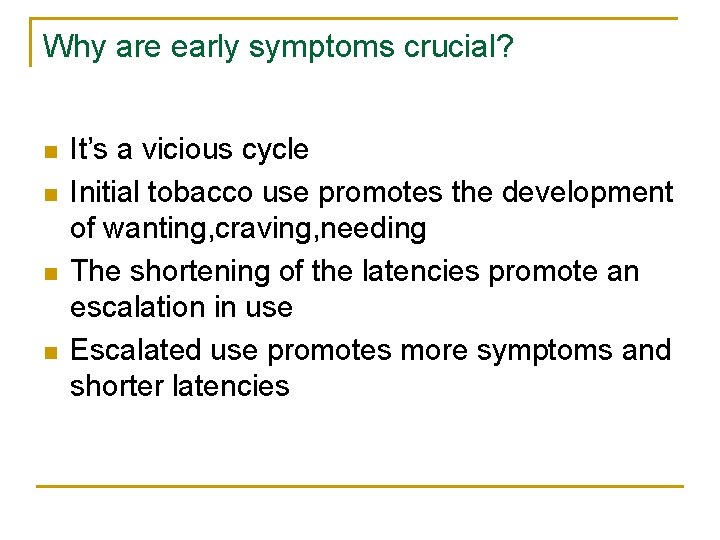
Why are early symptoms crucial? n n It’s a vicious cycle Initial tobacco use promotes the development of wanting, craving, needing The shortening of the latencies promote an escalation in use Escalated use promotes more symptoms and shorter latencies
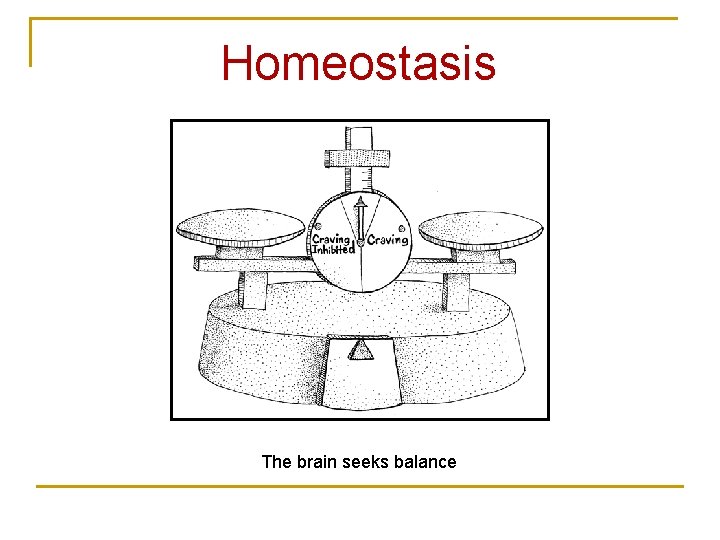
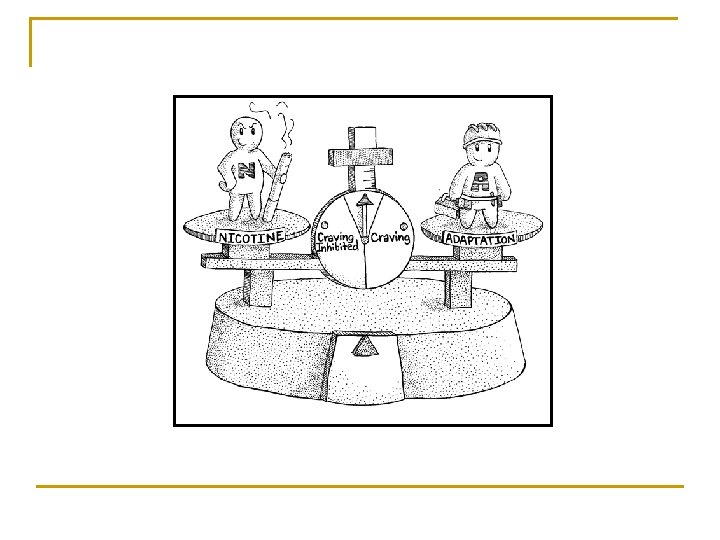
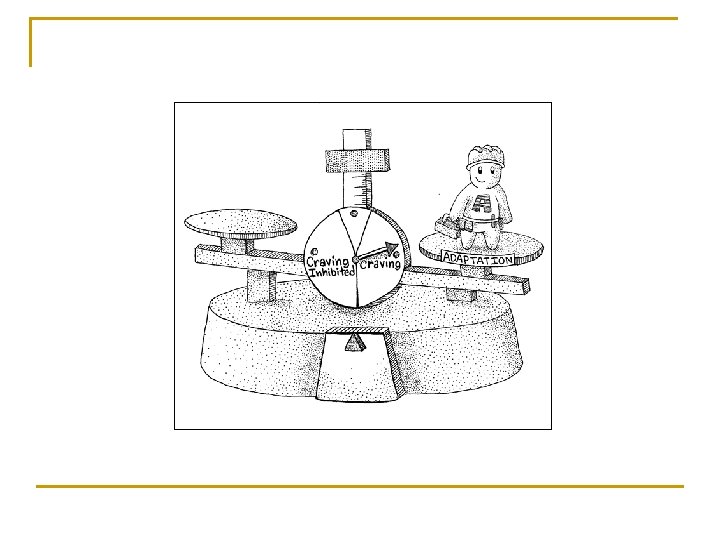
Homeostasis The brain seeks balance
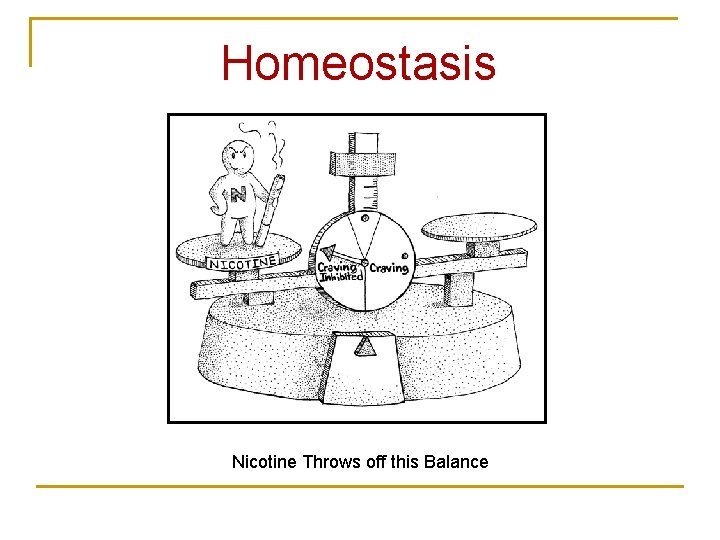
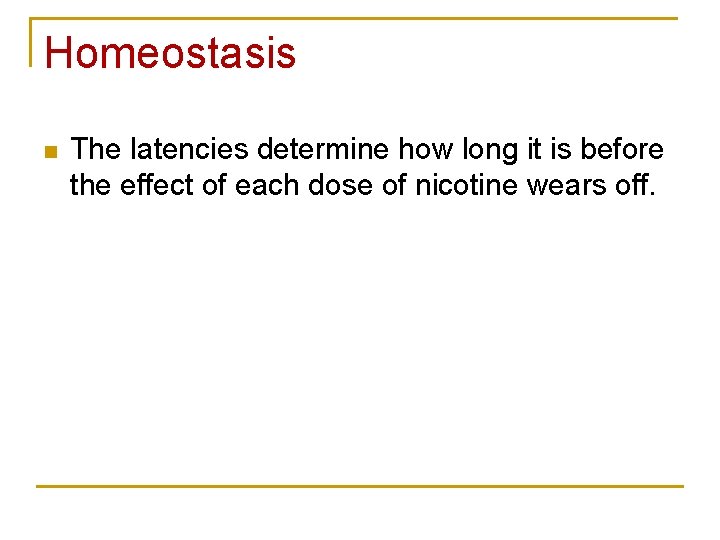
Homeostasis Nicotine Throws off this Balance
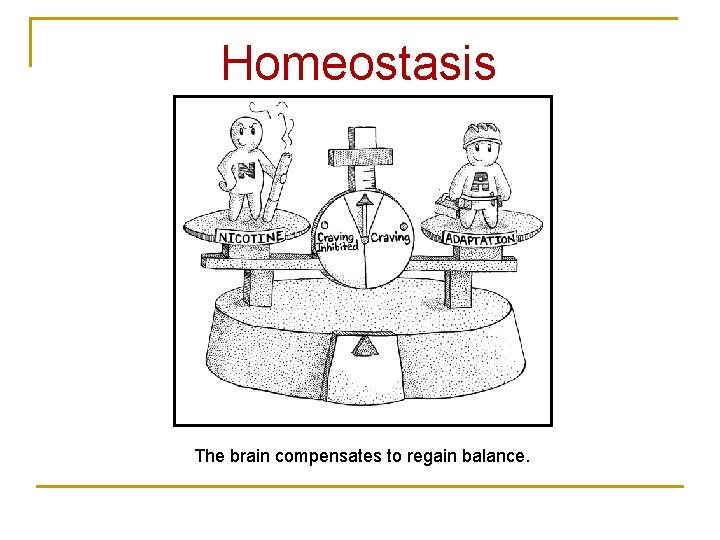
Homeostasis The brain compensates to regain balance.
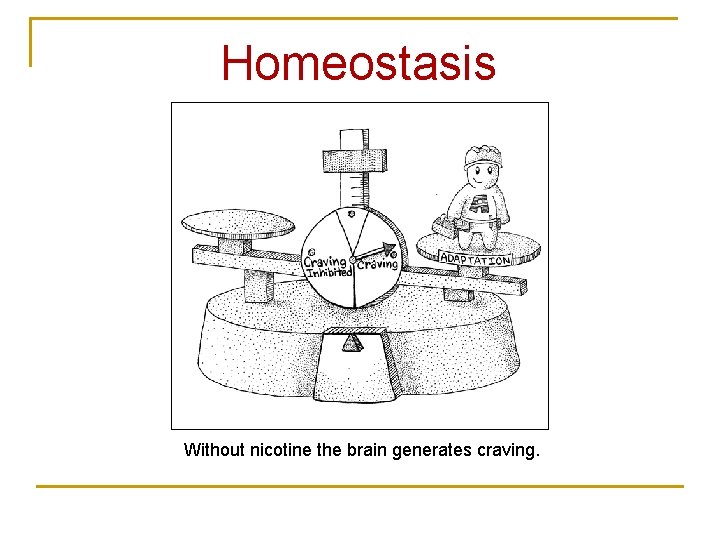
Homeostasis Without nicotine the brain generates craving.
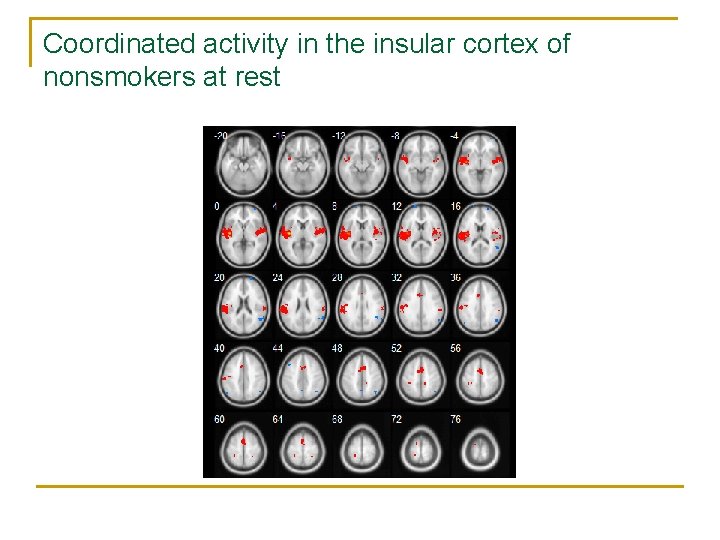
Coordinated activity in the insular cortex of nonsmokers at rest
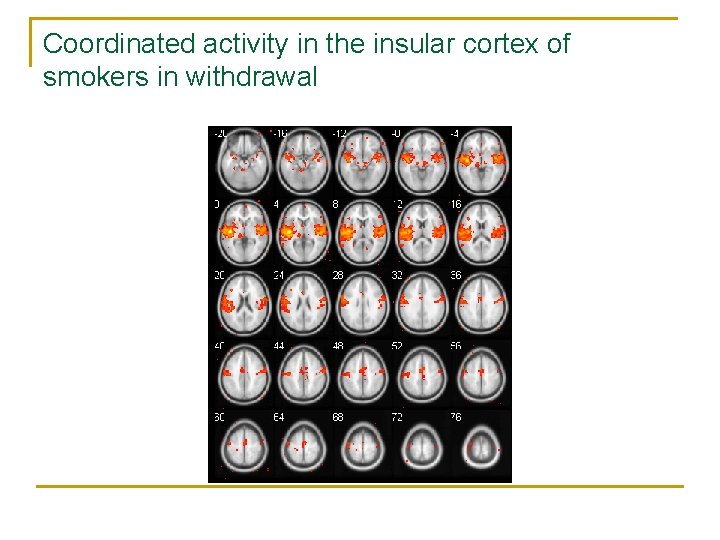
Coordinated activity in the insular cortex of smokers in withdrawal
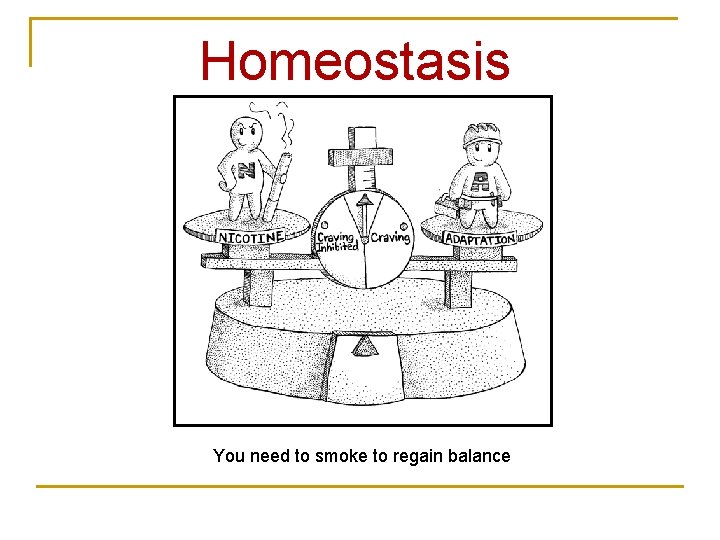
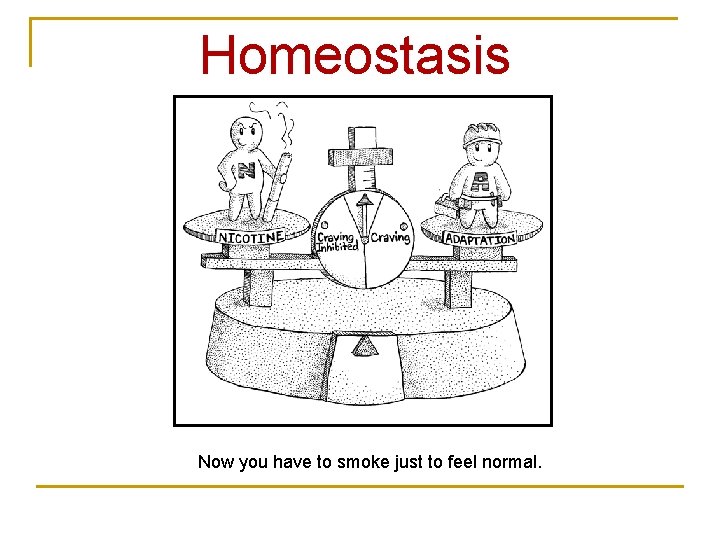
Homeostasis You need to smoke to regain balance
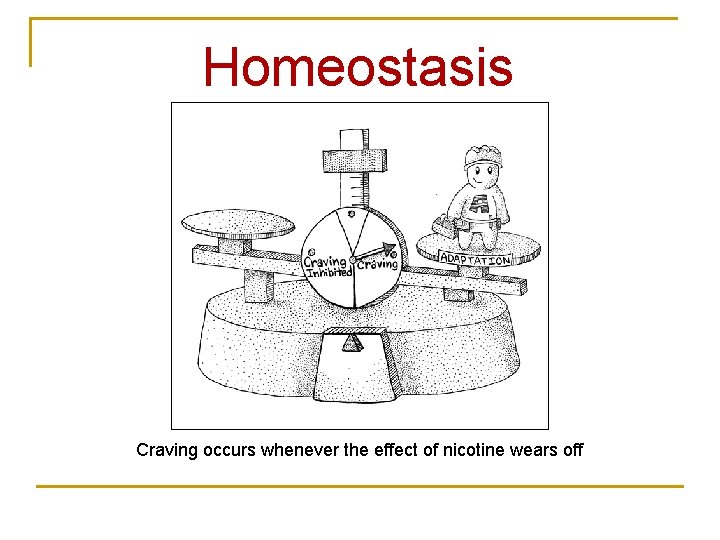
Homeostasis Craving occurs whenever the effect of nicotine wears off
Homeostasis Now you have to smoke just to feel normal.
Homeostasis n The latencies determine how long it is before the effect of each dose of nicotine wears off.
n Do the Stages of Nicotine Addiction coincide with actual physical changes in the brain?
Fractional Anisotropy n n n This technique measures the ability of water to diffuse through the white matter brain tissue. Tissue that is complexly organized has higher FA. Prior studies show that smokers generally have higher FA than nonsmokers.
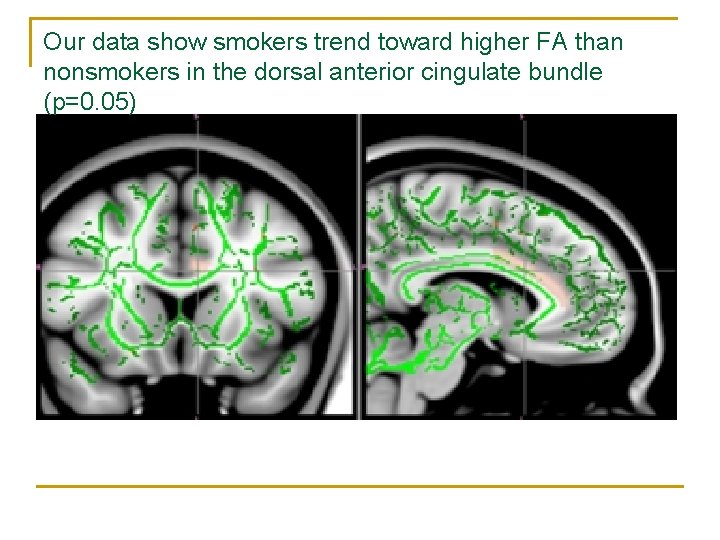
Our data show smokers trend toward higher FA than nonsmokers in the dorsal anterior cingulate bundle (p=0. 05)
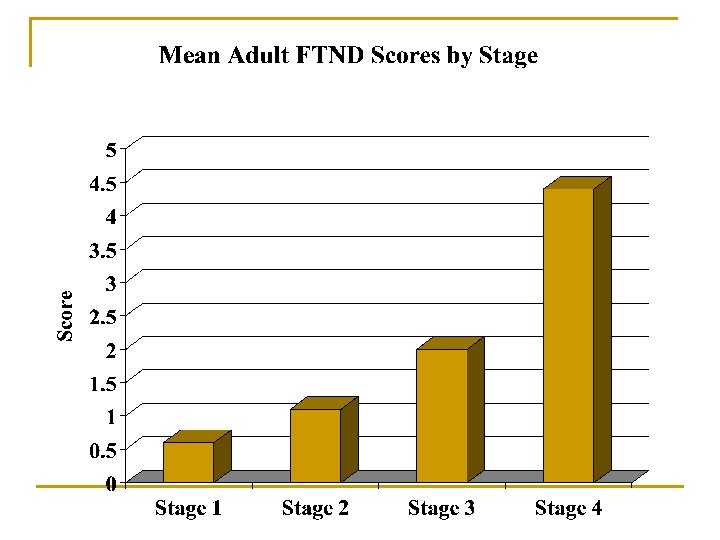
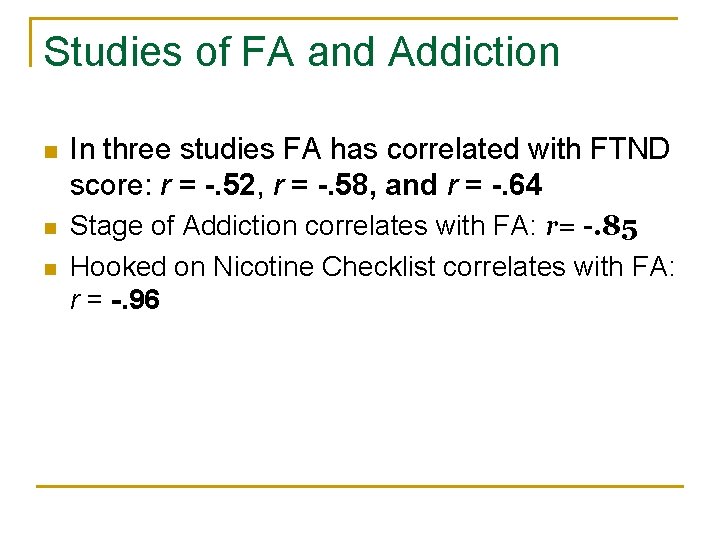
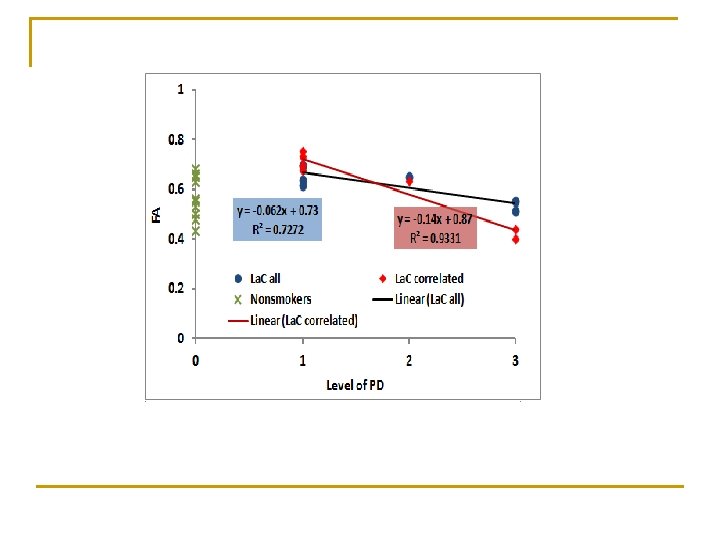
Studies of FA and Addiction n In three studies FA has correlated with FTND score: r = -. 52, r = -. 58, and r = -. 64 n Stage of Addiction correlates with FA: r= -. 85 Hooked on Nicotine Checklist correlates with FA: r = -. 96 n
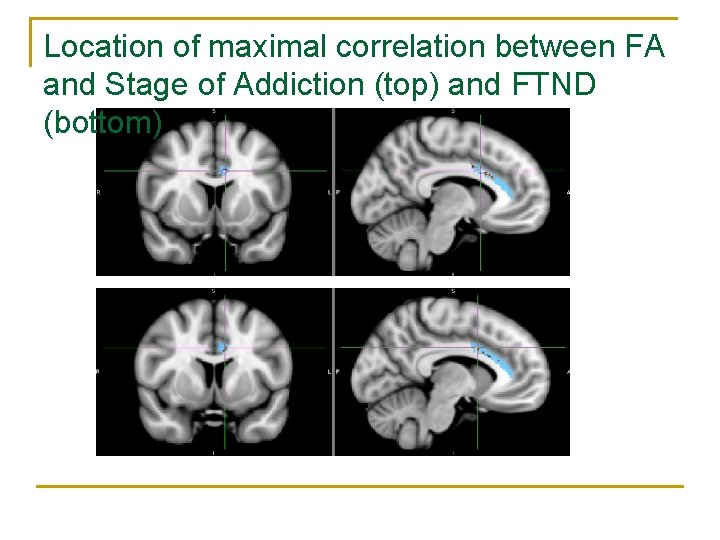
Location of maximal correlation between FA and Stage of Addiction (top) and FTND (bottom)
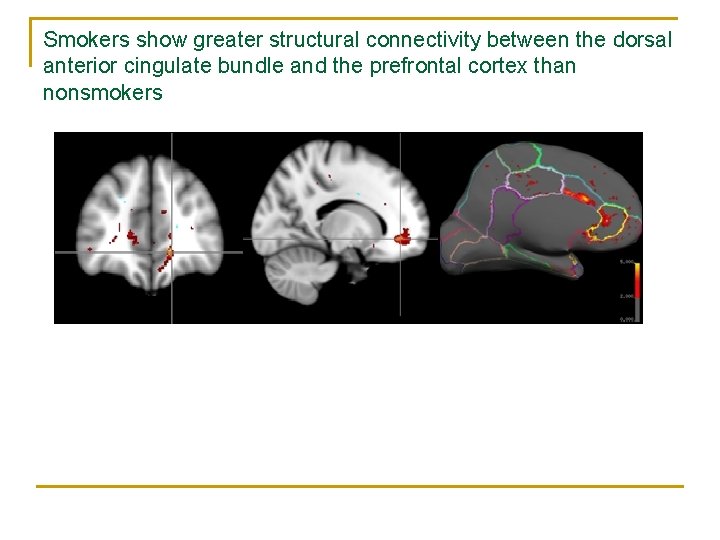
Smokers show greater structural connectivity between the dorsal anterior cingulate bundle and the prefrontal cortex than nonsmokers
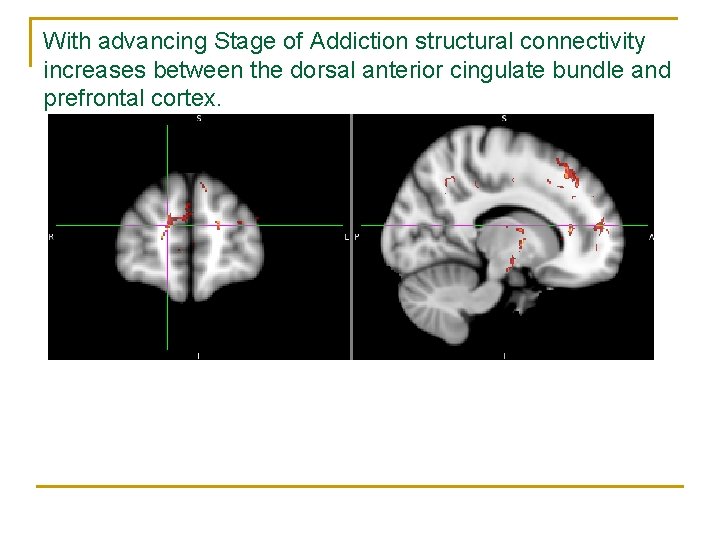
With advancing Stage of Addiction structural connectivity increases between the dorsal anterior cingulate bundle and prefrontal cortex.
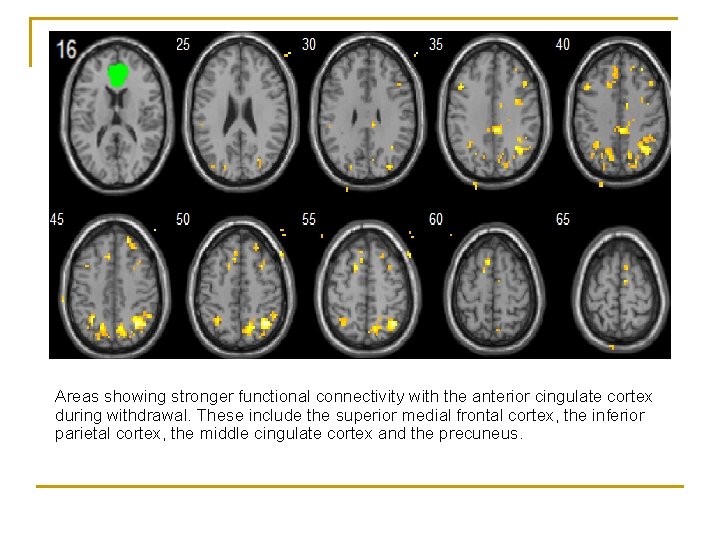
Areas showing stronger functional connectivity with the anterior cingulate cortex during withdrawal. These include the superior medial frontal cortex, the inferior parietal cortex, the middle cingulate cortex and the precuneus.
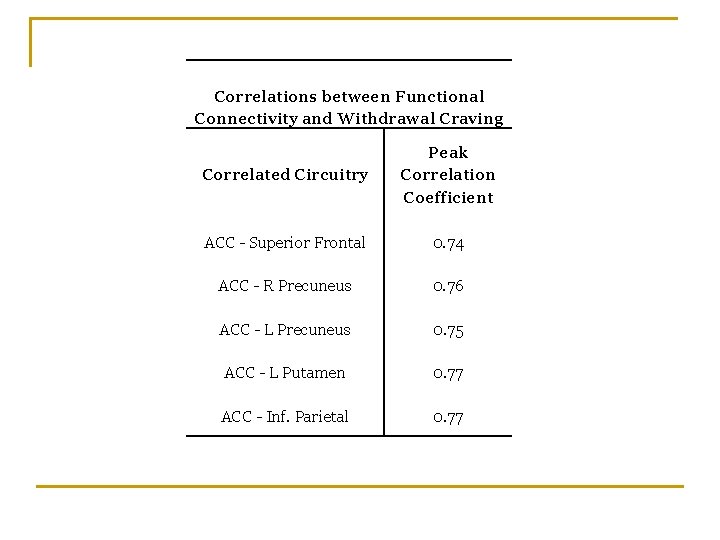
Correlations between Functional Connectivity and Withdrawal Craving Correlated Circuitry Peak Correlation Coefficient ACC - Superior Frontal 0. 74 ACC - R Precuneus 0. 76 ACC - L Precuneus 0. 75 ACC - L Putamen 0. 77 ACC - Inf. Parietal 0. 77
Summary n n n Advancing stages of addiction are associated with decreased organizational complexity in the anterior cingulate white matter and increased structural connectivity between it and the frontal cortex. Withdrawal craving correlates well with coordination of activity between the anterior cingulate and several other brain structures. Addiction is a result of structural changes in the brain.
n How quickly does addiction develop?
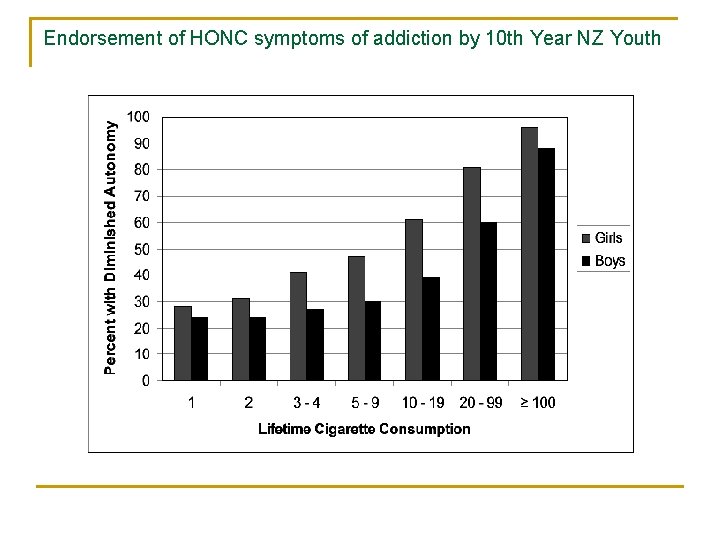
Endorsement of HONC symptoms of addiction by 10 th Year NZ Youth
The clinical data indicate that… n One cigarette must rapidly change the brain.
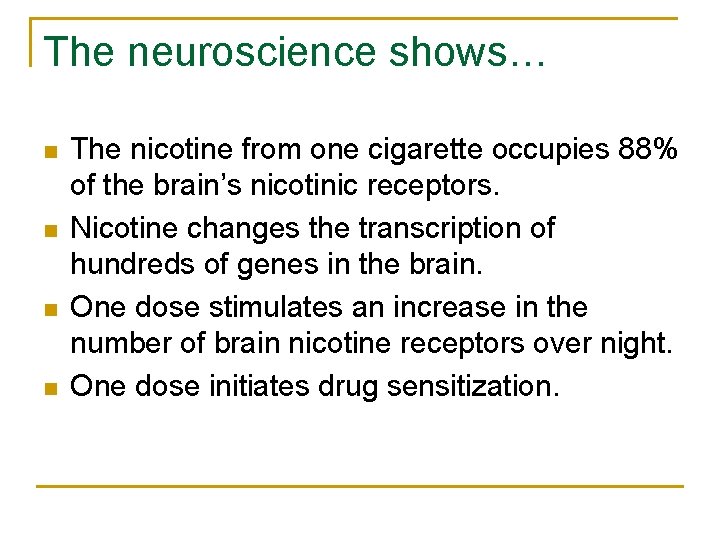
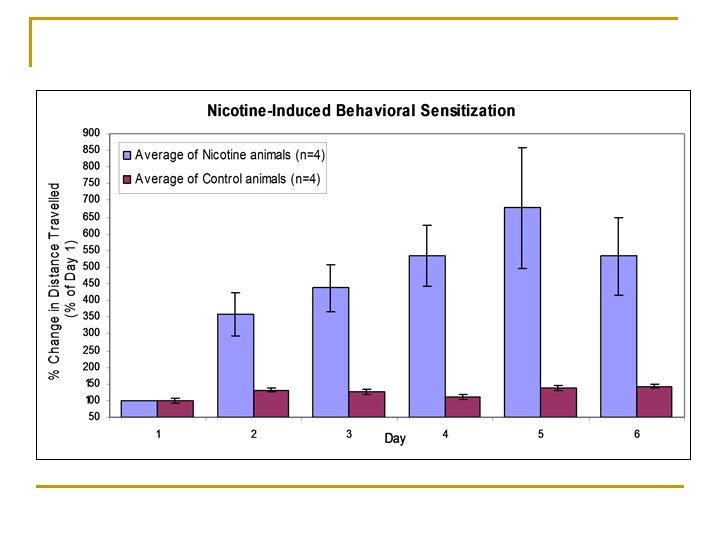
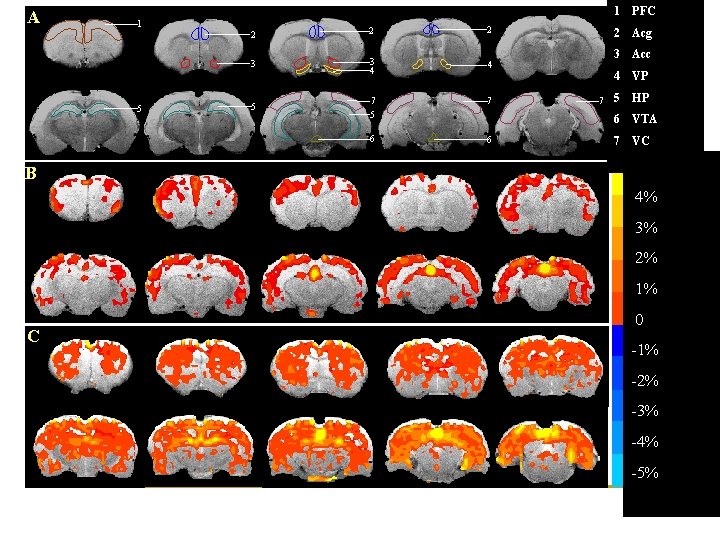
The neuroscience shows… n n The nicotine from one cigarette occupies 88% of the brain’s nicotinic receptors. Nicotine changes the transcription of hundreds of genes in the brain. One dose stimulates an increase in the number of brain nicotine receptors over night. One dose initiates drug sensitization.
A 1 5 B 2 2 2 3 3 4 4 7 5 7 6 6 5 7 1 PFC 2 Acg 3 Acc 4 VP 5 HP 6 VTA 7 VC 5% 4% 3% 2% 1% C 0 -1% -2% -3% -4% -5%
Clinical Pearls n n n Nicotine literally rewires the brain to produce addiction. Neurological changes and addiction can begin with the first dose of nicotine. Nicotine addiction is a physical brain disease, not a defect in will power.
Clinical Pearls n n n Nicotine addiction develops through 4 stages with wanting, craving and needing. The shortening of the latency to withdrawal drives the progression to daily smoking. Nondaily smokers relapse at the same rate as daily smokers.
The Four Stages of Nicotine Addiction Starship Children’s Hospital Joseph R Di. Franza MD University of Massachusetts Medical School
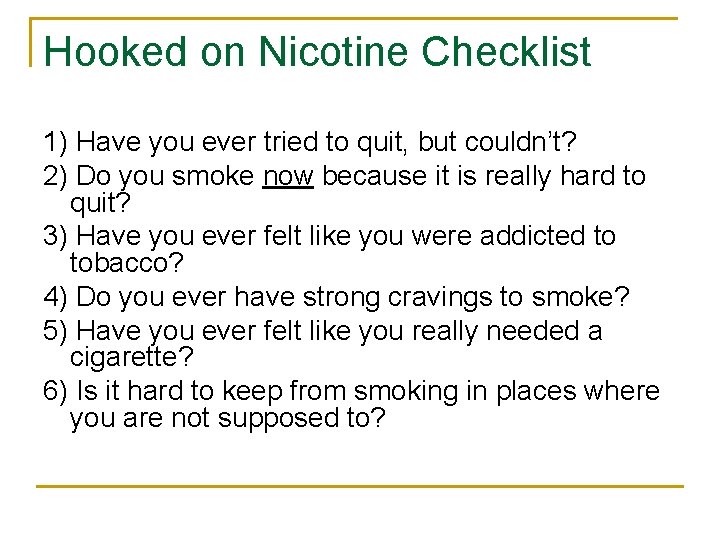
Hooked on Nicotine Checklist 1) Have you ever tried to quit, but couldn’t? 2) Do you smoke now because it is really hard to quit? 3) Have you ever felt like you were addicted to tobacco? 4) Do you ever have strong cravings to smoke? 5) Have you ever felt like you really needed a cigarette? 6) Is it hard to keep from smoking in places where you are not supposed to?
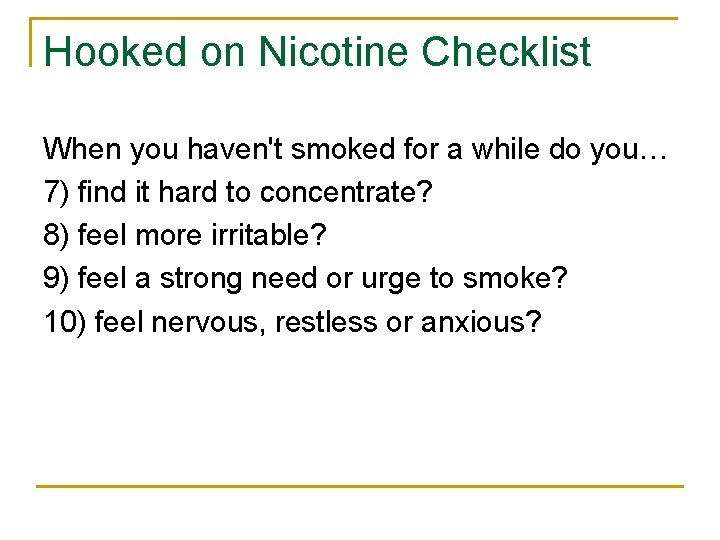
Hooked on Nicotine Checklist When you haven't smoked for a while do you… 7) find it hard to concentrate? 8) feel more irritable? 9) feel a strong need or urge to smoke? 10) feel nervous, restless or anxious?
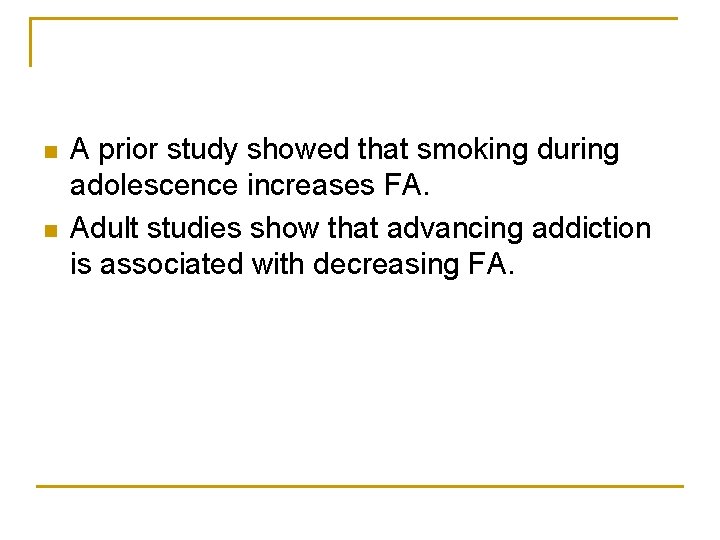
n n A prior study showed that smoking during adolescence increases FA. Adult studies show that advancing addiction is associated with decreasing FA.
Interpretation n n Increasing FA in new smokers represents the adaptations that cause wanting, craving and needing. Decreasing FA in adult smokers represents the adaptations that cause the Latency to Withdrawal to grow shorter.