
The Four Guiding Principles for determining what Partnership
- Slides: 4
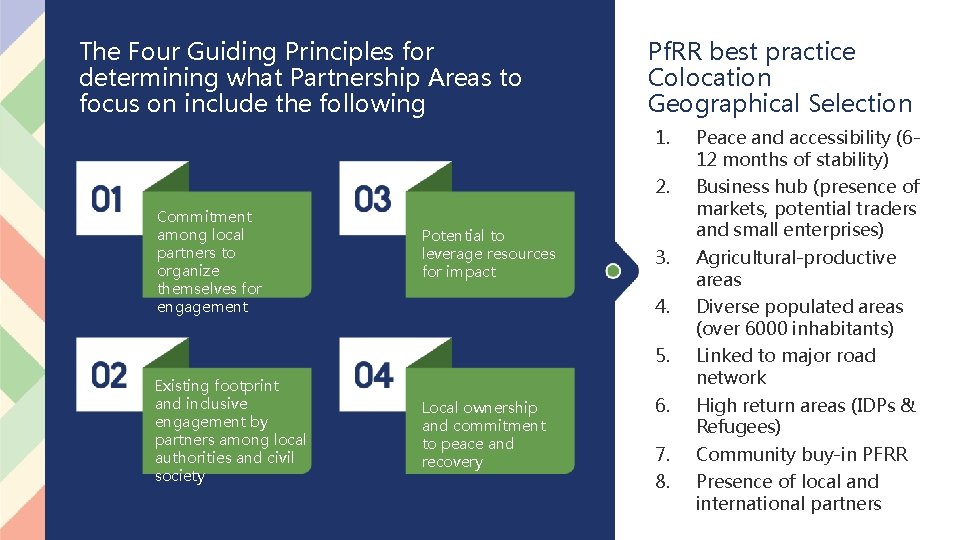
The Four Guiding Principles for determining what Partnership Areas to focus on include the following Commitment among local partners to organize themselves for engagement Existing footprint and inclusive engagement by partners among local authorities and civil society Potential to leverage resources for impact Local ownership and commitment to peace and recovery Pf. RR best practice Colocation Geographical Selection 1. Peace and accessibility (612 months of stability) 2. Business hub (presence of markets, potential traders and small enterprises) 3. Agricultural-productive areas 4. Diverse populated areas (over 6000 inhabitants) 5. Linked to major road network 6. High return areas (IDPs & Refugees) 7. 8. Community buy-in PFRR Presence of local and international partners
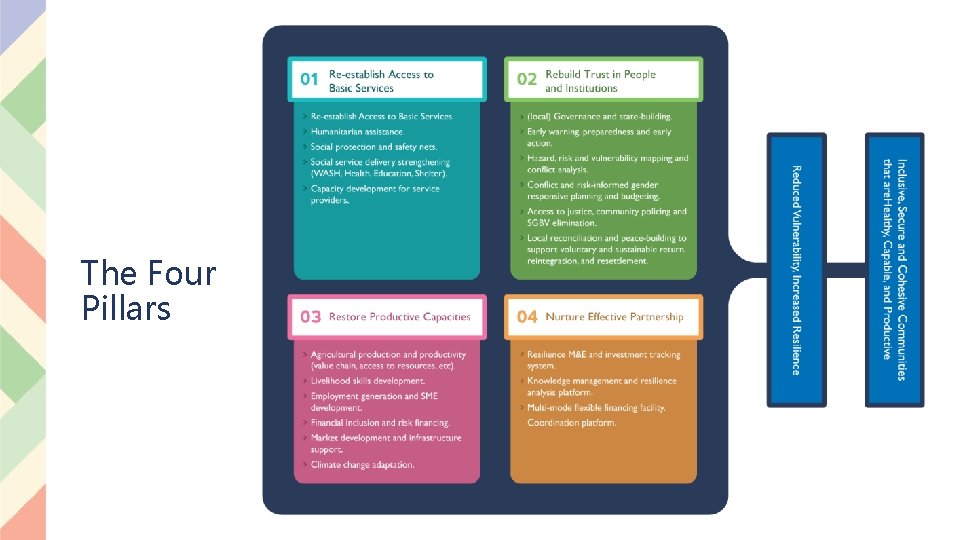
The Four Pillars
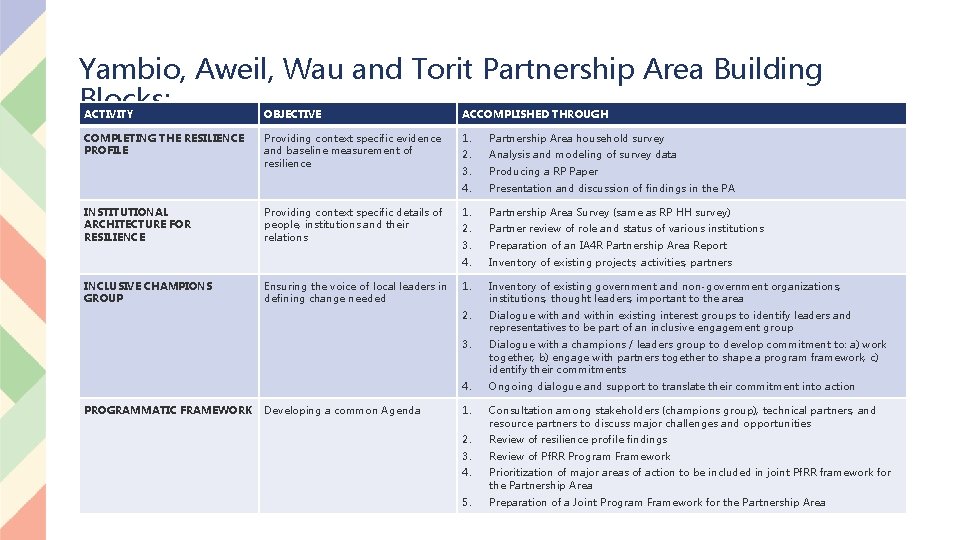
Yambio, Aweil, Wau and Torit Partnership Area Building Blocks: ACTIVITY OBJECTIVE ACCOMPLISHED THROUGH COMPLETING THE RESILIENCE PROFILE Providing context specific evidence and baseline measurement of resilience 1. Partnership Area household survey 2. Analysis and modeling of survey data 3. Producing a RP Paper 4. Presentation and discussion of findings in the PA 1. Partnership Area Survey (same as RP HH survey) 2. Partner review of role and status of various institutions 3. Preparation of an IA 4 R Partnership Area Report 4. Inventory of existing projects, activities, partners 1. Inventory of existing government and non-government organizations, institutions, thought leaders, important to the area 2. Dialogue with and within existing interest groups to identify leaders and representatives to be part of an inclusive engagement group 3. Dialogue with a champions / leaders group to develop commitment to: a) work together, b) engage with partners together to shape a program framework, c) identify their commitments 4. Ongoing dialogue and support to translate their commitment into action 1. Consultation among stakeholders (champions group), technical partners, and resource partners to discuss major challenges and opportunities 2. Review of resilience profile findings 3. Review of Pf. RR Program Framework 4. Prioritization of major areas of action to be included in joint Pf. RR framework for the Partnership Area 5. Preparation of a Joint Program Framework for the Partnership Area INSTITUTIONAL ARCHITECTURE FOR RESILIENCE INCLUSIVE CHAMPIONS GROUP PROGRAMMATIC FRAMEWORK Providing context specific details of people, institutions and their relations Ensuring the voice of local leaders in defining change needed Developing a common Agenda
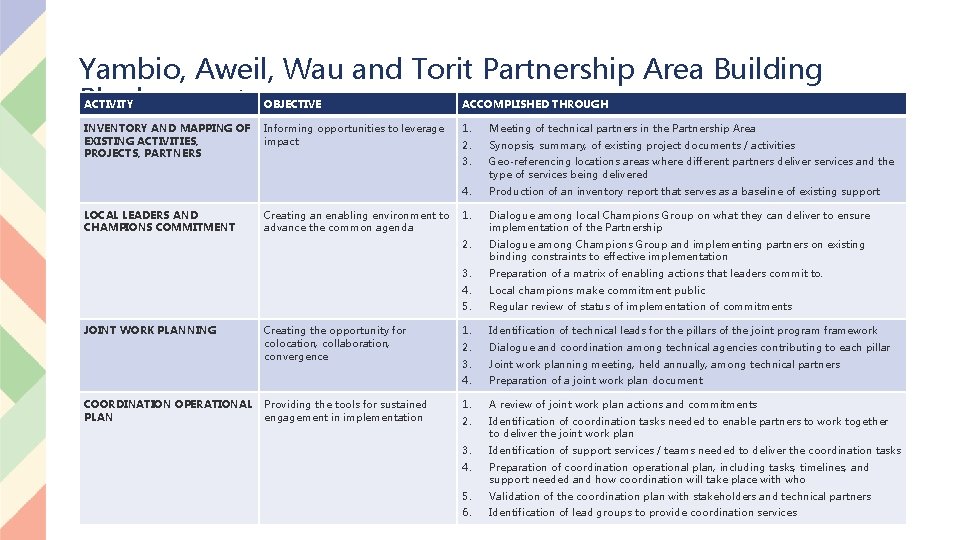
Yambio, Aweil, Wau and Torit Partnership Area Building Blocks: cont… ACTIVITY OBJECTIVE ACCOMPLISHED THROUGH INVENTORY AND MAPPING OF EXISTING ACTIVITIES, PROJECTS, PARTNERS Informing opportunities to leverage impact 1. Meeting of technical partners in the Partnership Area 2. Synopsis, summary, of existing project documents / activities 3. Geo-referencing locations areas where different partners deliver services and the type of services being delivered 4. Production of an inventory report that serves as a baseline of existing support 1. Dialogue among local Champions Group on what they can deliver to ensure implementation of the Partnership 2. Dialogue among Champions Group and implementing partners on existing binding constraints to effective implementation 3. Preparation of a matrix of enabling actions that leaders commit to. 4. Local champions make commitment public 5. Regular review of status of implementation of commitments 1. Identification of technical leads for the pillars of the joint program framework 2. Dialogue and coordination among technical agencies contributing to each pillar 3. Joint work planning meeting, held annually, among technical partners 4. Preparation of a joint work plan document 1. A review of joint work plan actions and commitments 2. Identification of coordination tasks needed to enable partners to work together to deliver the joint work plan 3. Identification of support services / teams needed to deliver the coordination tasks 4. Preparation of coordination operational plan, including tasks, timelines, and support needed and how coordination will take place with who 5. Validation of the coordination plan with stakeholders and technical partners 6. Identification of lead groups to provide coordination services LOCAL LEADERS AND CHAMPIONS COMMITMENT JOINT WORK PLANNING COORDINATION OPERATIONAL PLAN Creating an enabling environment to advance the common agenda Creating the opportunity for colocation, collaboration, convergence Providing the tools for sustained engagement in implementation