
The Founding of the European Union Historical overview
- Slides: 14
The Founding of the European Union Historical overview of the European integration project
Inter war years Preservation of peace and security ¢ An overall political authority to manage European conflicts ¢ Federalism: a liberal intellectual current ¢
War years Crisis of nation state system (balance of power) ¢ Crisis of the state (invasion / collaboration / ideological division) ¢ Anti-Nazi resistance: break with nationalism ¢ Reconstruction of politics through a European federal state ¢
Post-war Practical co-ordination of reconstruction ¢ Integration of defeated states ¢ Need security system for western Europe ¢ New emphasis on economic modernisation and living standards ¢
Solutions French-German co-operation / integration ¢ Contain Germany in an integrated Europe ¢ ¢ Federalists: promote federal ideal, a popular movement
The UK Churchill had proposed Anglo-French Union in 1940 ad suggested a United States of Europe with common institutions and military ¢ 1946 in Zurich, Churchill: European project should be based around France and Germany, not Britain ¢ Britain was ‘with Europe but not of it’ ¢
The Founding Fathers Jean MONNET – French businessman and Planning Minister ¢ Robert SCHUMANN – French Foreign Minister ¢ ¢ Committed to federal vision, but also practical politics and specific forms of integration
European Coal and Steel Community (ECSC) 1951 Treaty of Paris: unifies coal and steel industries of France and Germany. Economic integration for the prevention of conflict. ¢ Joined by Italy and the Benelux countries ¢ 4 common institutions: High Authority; Council of Ministers; Assembly; Court ¢
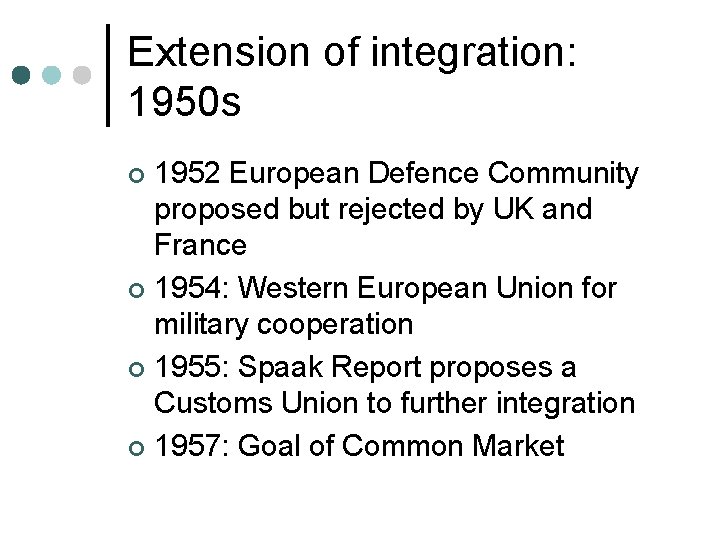
Extension of integration: 1950 s 1952 European Defence Community proposed but rejected by UK and France ¢ 1954: Western European Union for military cooperation ¢ 1955: Spaak Report proposes a Customs Union to further integration ¢ 1957: Goal of Common Market ¢
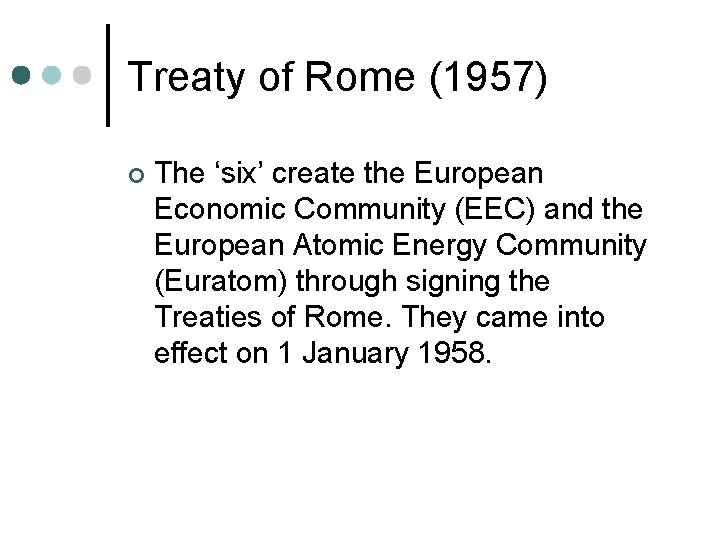
Treaty of Rome (1957) ¢ The ‘six’ create the European Economic Community (EEC) and the European Atomic Energy Community (Euratom) through signing the Treaties of Rome. They came into effect on 1 January 1958.
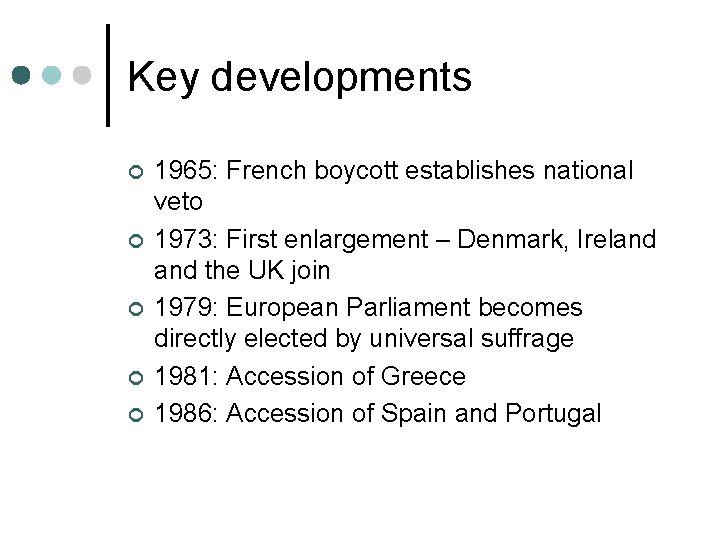
Key developments ¢ ¢ ¢ 1965: French boycott establishes national veto 1973: First enlargement – Denmark, Ireland the UK join 1979: European Parliament becomes directly elected by universal suffrage 1981: Accession of Greece 1986: Accession of Spain and Portugal
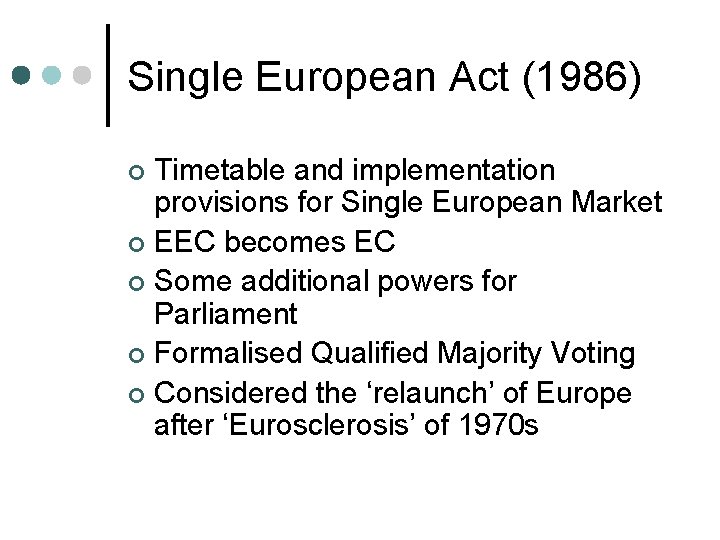
Single European Act (1986) Timetable and implementation provisions for Single European Market ¢ EEC becomes EC ¢ Some additional powers for Parliament ¢ Formalised Qualified Majority Voting ¢ Considered the ‘relaunch’ of Europe after ‘Eurosclerosis’ of 1970 s ¢
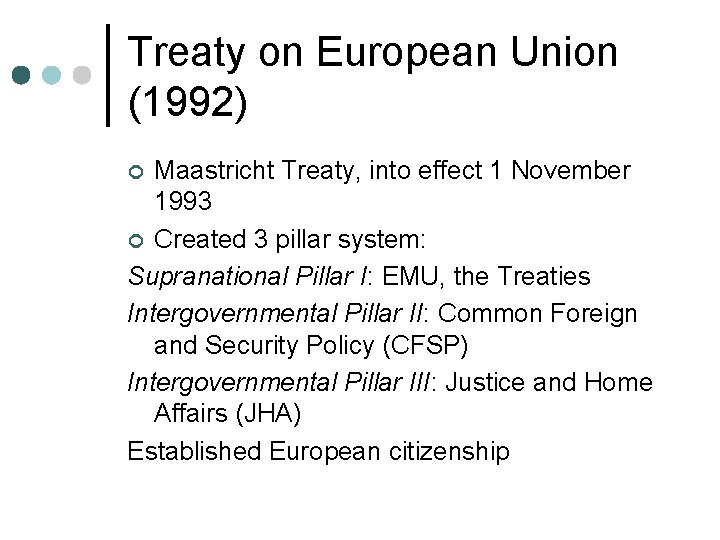
Treaty on European Union (1992) Maastricht Treaty, into effect 1 November 1993 ¢ Created 3 pillar system: Supranational Pillar I: EMU, the Treaties Intergovernmental Pillar II: Common Foreign and Security Policy (CFSP) Intergovernmental Pillar III: Justice and Home Affairs (JHA) Established European citizenship ¢
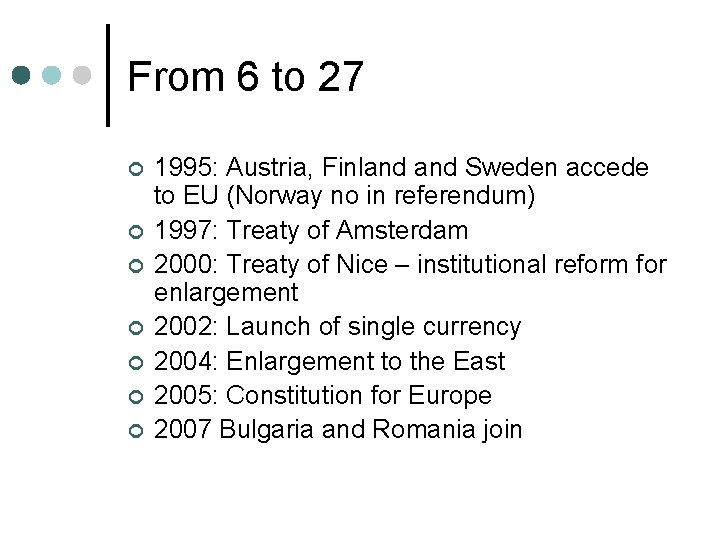
From 6 to 27 ¢ ¢ ¢ ¢ 1995: Austria, Finland Sweden accede to EU (Norway no in referendum) 1997: Treaty of Amsterdam 2000: Treaty of Nice – institutional reform for enlargement 2002: Launch of single currency 2004: Enlargement to the East 2005: Constitution for Europe 2007 Bulgaria and Romania join