
THE FOUNDING OF ROME Chapter 11 Lesson 1




- Slides: 33
THE FOUNDING OF ROME Chapter 11 Lesson 1
ANCIENT ROME ; NATIONAL GEOGRAPHIC • https: //www. youtube. com/watch? v=GXo. Ep. Njg. Kzg
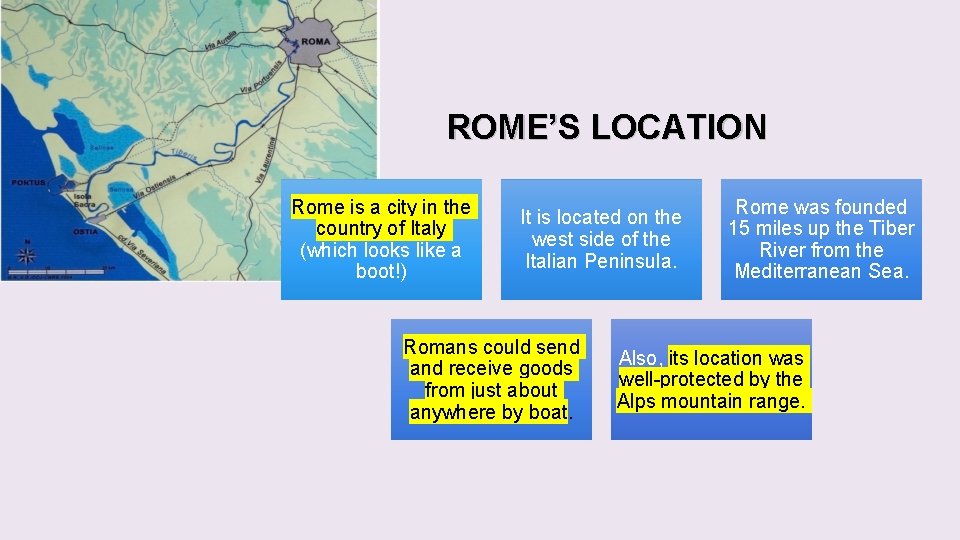
• Italy is centrally located in the Mediterranean region. • sunny, mild climate with fertile farmland. • popular settling point for many travelers. • Rome is a city in the country of Italy • Romans could send and receive goods from just about anywhere by boat. • its location was well-protected by the Alps mountain range. • Roman Origins: Legends • The. Aeneid -Epic poem written by Virgil more than 500 years after Rome is founded - According to the story the Romans are descendants of Aeneas (a Trojan) and Lavinia (a Latin) • Romulus and Remus-Twin brothers - Romulus kills Remus in an argument about the city - Romulus names the city Rome, after himself • Roman Origins: Reality • Latins - Between 2000 and 1000 BC, Latins moved to Italy - became the first Romans. • Influence of Greece - 750 BC to 500 BC, Greeks settled in southern Italy - introduced grape and olive farming, gave the Romans the Greek alphabet, & Romans would model their buildings, sculpture, and literature • Influence of Estruscans (ih-TRUHS-kuhnz) - took control of Rome in 650 BC - ruled by nobles - wealthy from trade and mining. • skilled with metals, making weapons, tools, and jewelry. • Etruscans taught the Romans how to build with bricks and how to roof their homes with tile. • Romans adopted their fashion, wearing short cloaks and togas, & the Etruscan model for their army
• Becoming a Republic - 509 BC, Rome overthrew the Etruscan king and established a republic - Over the next 200 years, Rome fought many wars against these neighbors. • Every land-owning Roman had to serve in their army. • By 267 BC, Rome controlled almost all of Italy. • Reorganized their troops into legions - Each legion had about 6, 000 soldiers and those were broken into groups of 60 to 120 soldiers. • Roman soldiers, called legionaries, armed with short, double-edged sword called a gladius and an iron spear called a pilum. • Tortoise formation - Protects against arrows and from frontal assault • Defensive Formation - Creates a“Wall of Shields” • Who Ruled Rome? • After the Romans would conquer a region, they would build a permanent military outpost to protect it - also built roads • The Romans made it a point to treat conquered people fairly. • the Roman Confederation, gives full Roman citizenship to conquered people • Most conquered regions became allies of Rome. • paid taxes and supplied Rome with soldiers, but got to manage their own local issues
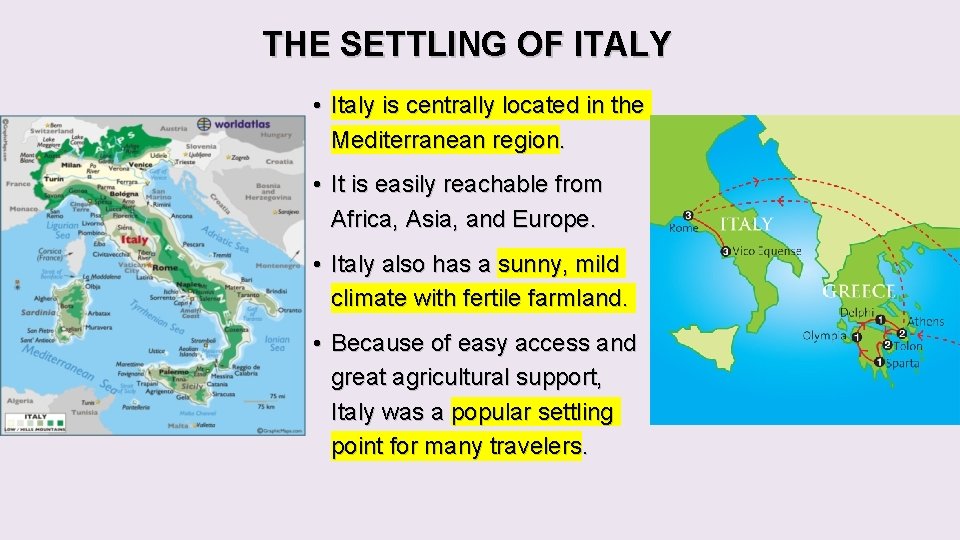
THE SETTLING OF ITALY • Italy is centrally located in the Mediterranean region. • It is easily reachable from Africa, Asia, and Europe. • Italy also has a sunny, mild climate with fertile farmland. • Because of easy access and great agricultural support, Italy was a popular settling point for many travelers.
ROME’S LOCATION Rome is a city in the country of Italy (which looks like a boot!) It is located on the west side of the Italian Peninsula. Romans could send and receive goods from just about anywhere by boat. Rome was founded 15 miles up the Tiber River from the Mediterranean Sea. Also, its location was well-protected by the Alps mountain range.
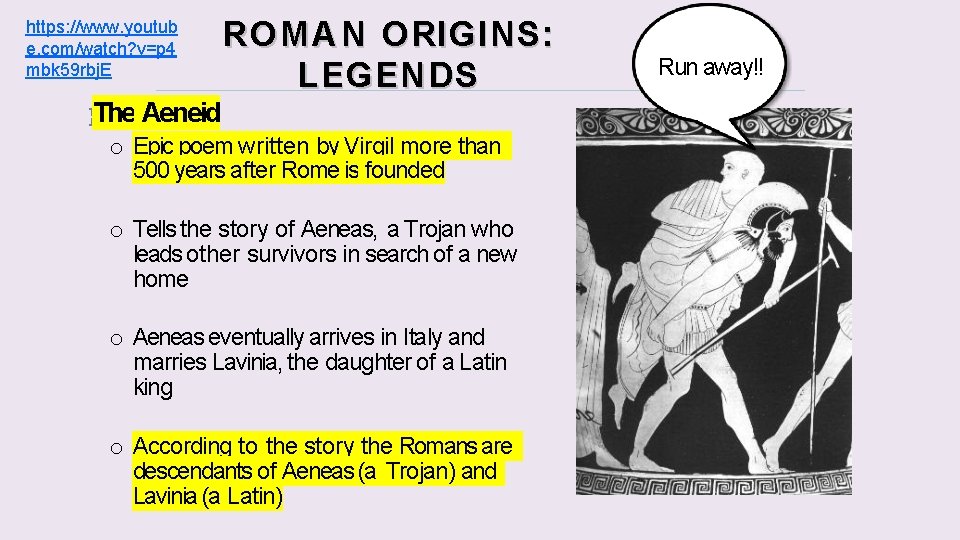
https: //www. youtub e. com/watch? v=p 4 mbk 59 rbj. E R O M A N ORIGINS: LEGENDS }� The Aeneid o Epic poem written by Virgil more than 500 years after Rome is founded o Tells the story of Aeneas, a Trojan who leads other survivors in search of a new home o Aeneas eventually arrives in Italy and marries Lavinia, the daughter of a Latin king o According to the story the Romans are descendants of Aeneas (a Trojan) and Lavinia (a Latin) Run away!!
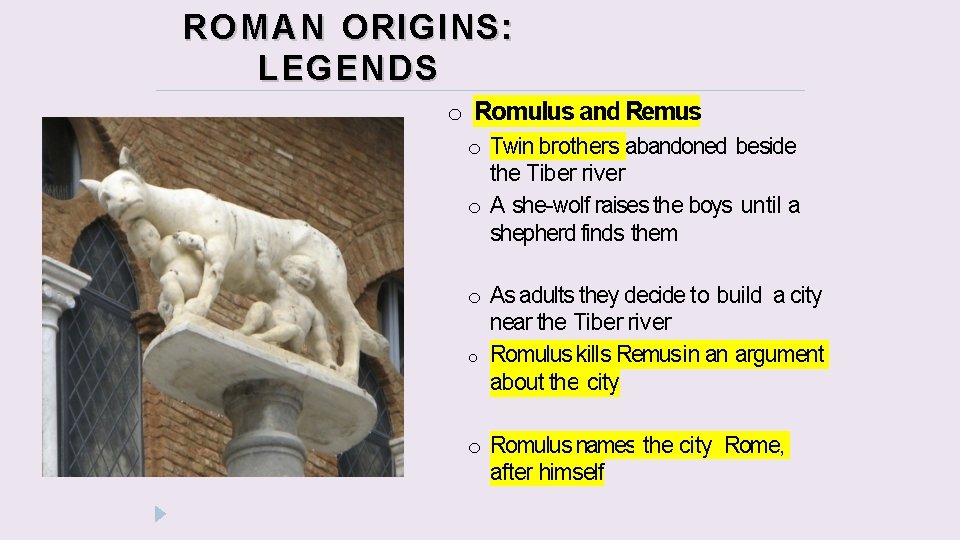
R O M A N ORIGINS: LEGENDS o Romulus and Remus o Twin brothers abandoned beside the Tiber river o A she-wolf raises the boys until a shepherd finds them o As adults they decide to build a city near the Tiber river o Romulus kills Remus in an argument about the city o Romulus names the city Rome, after himself
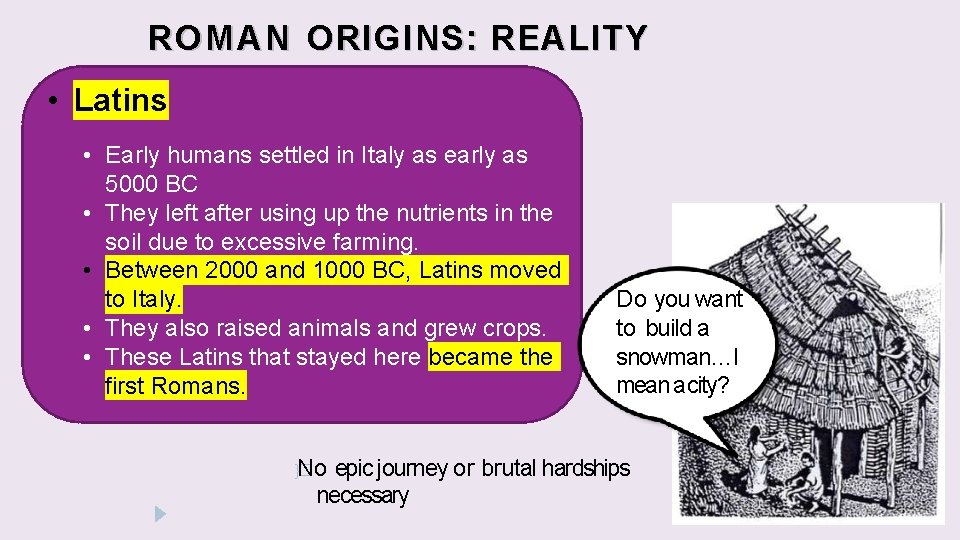
R O M A N ORIGINS: REALITY • Latins • Early humans settled in Italy as early as 5000 BC • They left after using up the nutrients in the soil due to excessive farming. • Between 2000 and 1000 BC, Latins moved to Italy. • They also raised animals and grew crops. • These Latins that stayed here became the first Romans. }� No Do you want to build a snowman…I mean acity? epic journey or brutal hardships necessary
From about 750 BC to 500 BC, Greeks settled in farming villages in southern Italy. They introduced grape and olive farming to the region. The Greeks also gave the Romans the Greek alphabet. Later, the Romans would model their buildings, sculpture, and literature after the Greeks. INFLUENCE OF GREECE
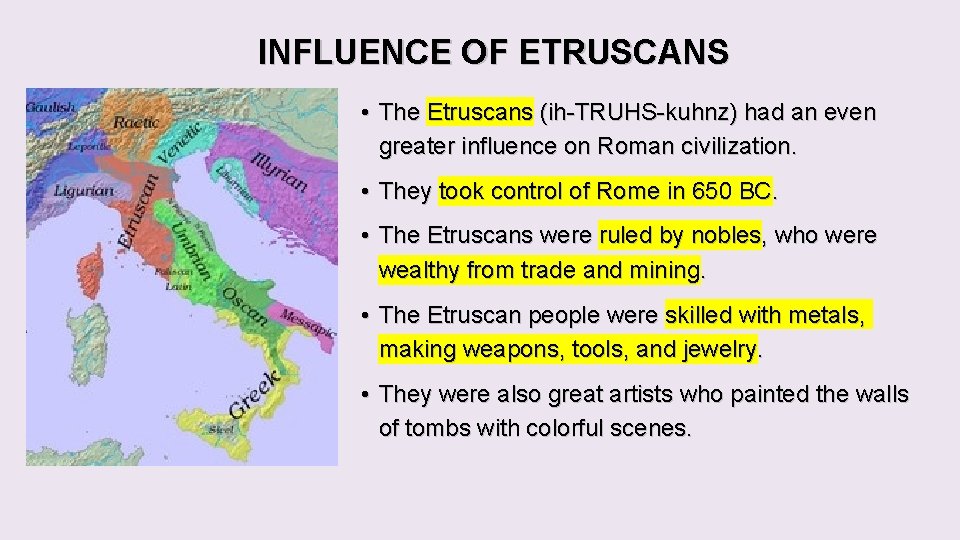
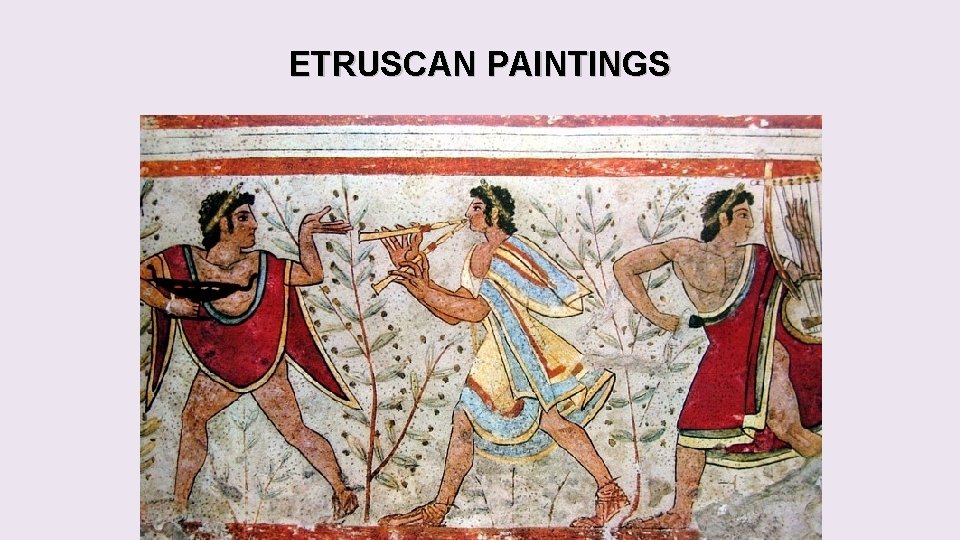
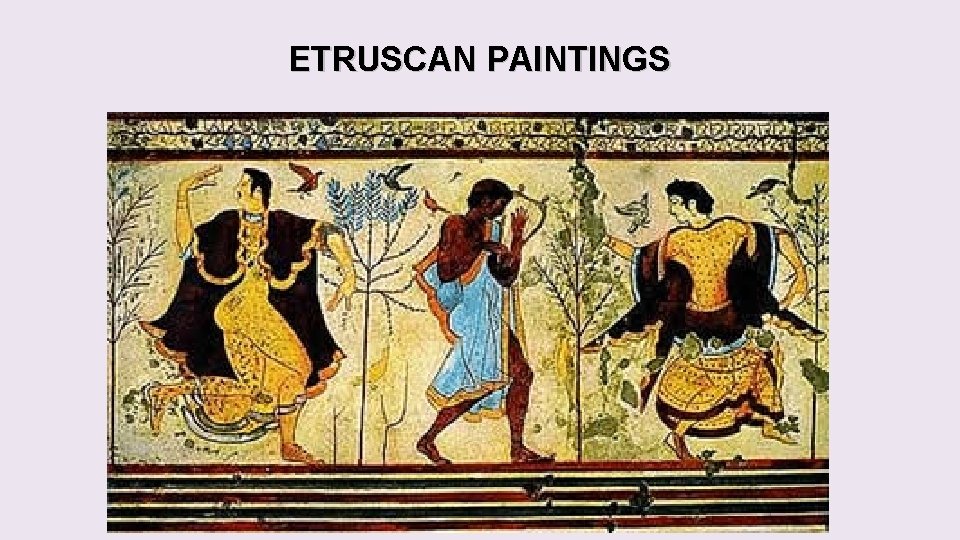
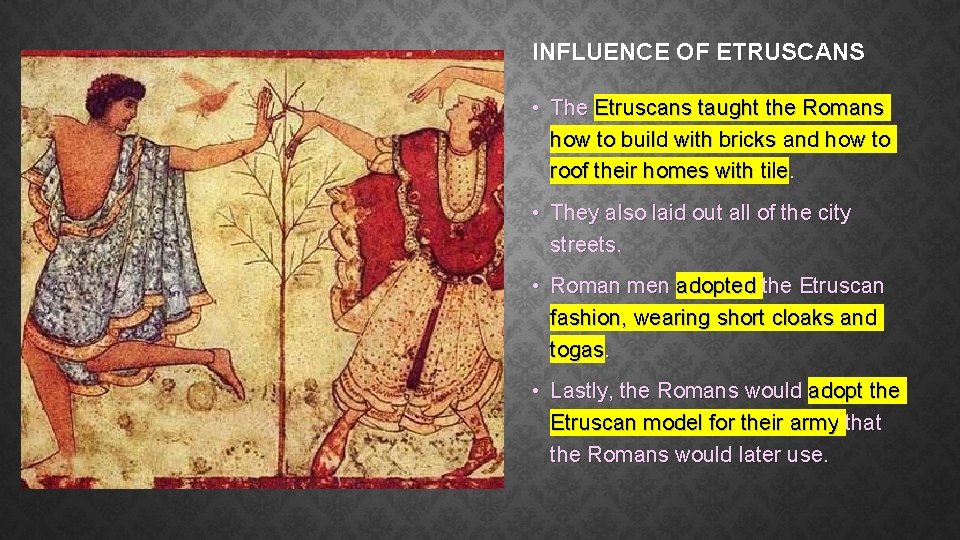
INFLUENCE OF ETRUSCANS • The Etruscans (ih-TRUHS-kuhnz) had an even greater influence on Roman civilization. • They took control of Rome in 650 BC. • The Etruscans were ruled by nobles, who were wealthy from trade and mining. • The Etruscan people were skilled with metals, making weapons, tools, and jewelry. • They were also great artists who painted the walls of tombs with colorful scenes.
ETRUSCAN PAINTINGS
ETRUSCAN PAINTINGS
INFLUENCE OF ETRUSCANS • The Etruscans taught the Romans how to build with bricks and how to roof their homes with tile. • They also laid out all of the city streets. • Roman men adopted the Etruscan fashion, wearing short cloaks and togas. • Lastly, the Romans would adopt the Etruscan model for their army that the Romans would later use.
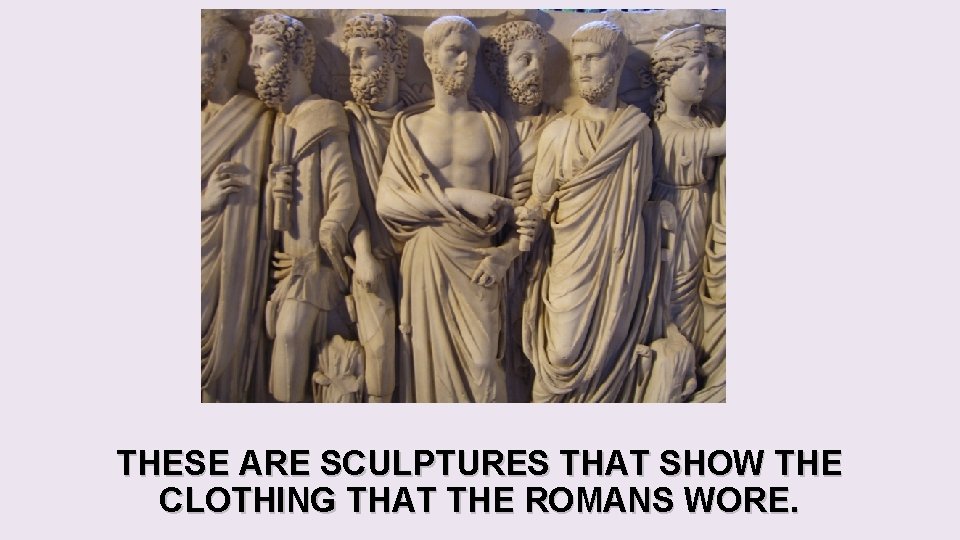
THESE ARE SCULPTURES THAT SHOW THE CLOTHING THAT THE ROMANS WORE.
BECOMING A REPUBLIC • In 509 BC, Rome overthrew the Etruscan king and established a republic, which is a form of government in which citizens elect their leaders. • This began a new era in Rome’s history. • They were still a small city, surrounded by Etruscans, Greeks, and Latins. • Over the next 200 years, Rome fought many wars against these neighbors.
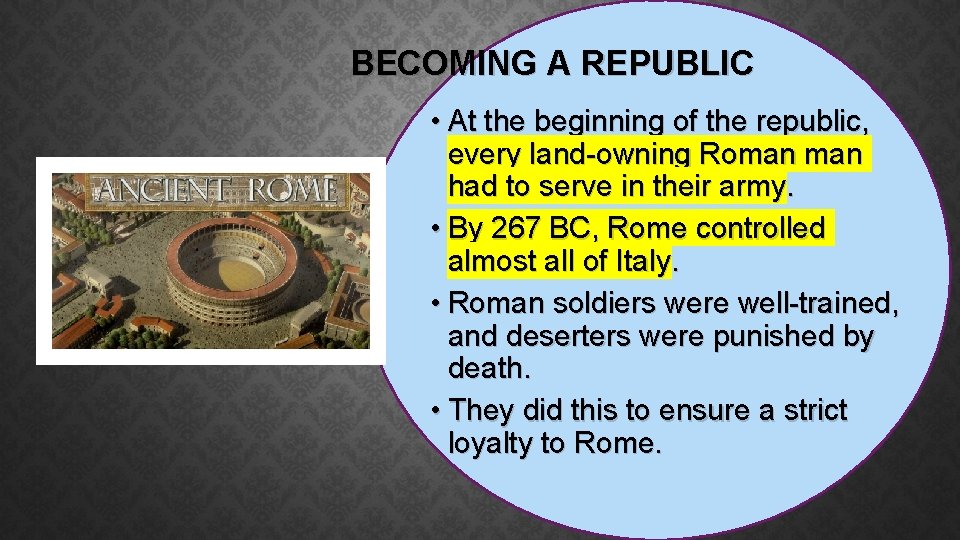
BECOMING A REPUBLIC • At the beginning of the republic, every land-owning Roman had to serve in their army. • By 267 BC, Rome controlled almost all of Italy. • Roman soldiers were well-trained, and deserters were punished by death. • They did this to ensure a strict loyalty to Rome.
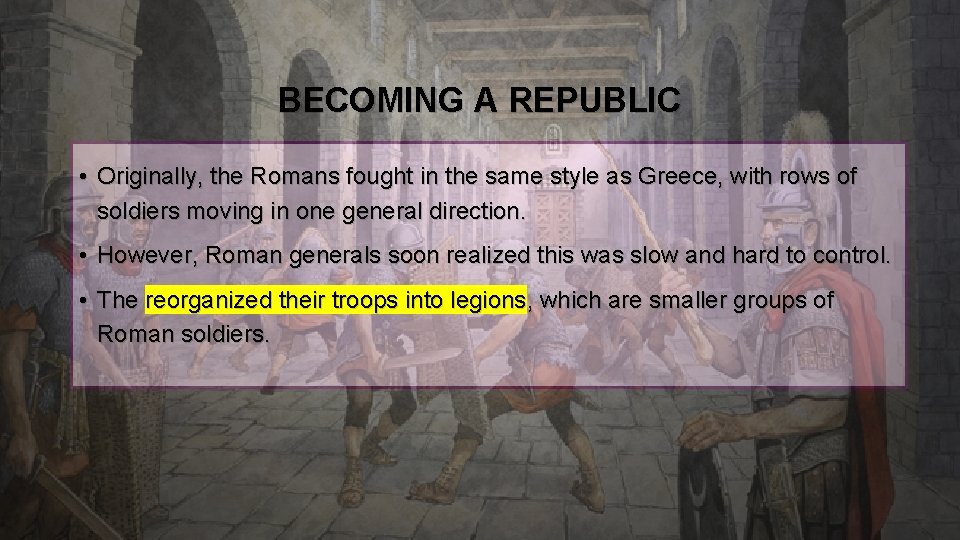
BECOMING A REPUBLIC • Originally, the Romans fought in the same style as Greece, with rows of soldiers moving in one general direction. • However, Roman generals soon realized this was slow and hard to control. • The reorganized their troops into legions, which are smaller groups of Roman soldiers.
BECOMING A REPUBLIC • Each legion had about 6, 000 soldiers and those were broken into groups of 60 to 120 soldiers. • This allowed for quick movement around the battlefield. • Roman soldiers, called legionaries, were well-armed. • Most carried a short, double-edged sword called a gladius and an iron spear called a pilum.
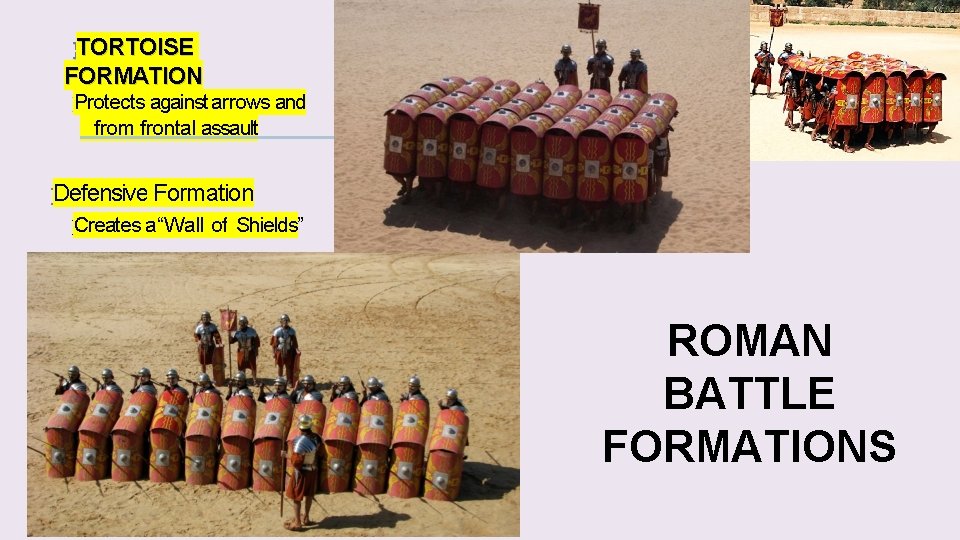
}� TORTOISE FORMATION }� Protects against arrows and from frontal assault }� Defensive Formation }� Creates a“Wall of Shields” ROMAN BATTLE FORMATIONS
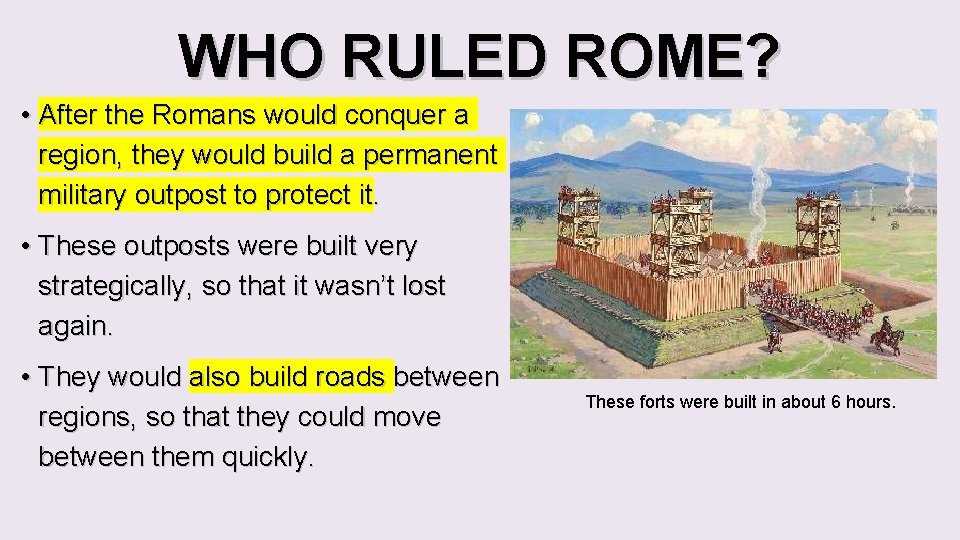
WHO RULED ROME? • After the Romans would conquer a region, they would build a permanent military outpost to protect it. • These outposts were built very strategically, so that it wasn’t lost again. • They would also build roads between regions, so that they could move between them quickly. These forts were built in about 6 hours.
The Romans made it a point to treat conquered people fairly. WHO RULED ROME? They believed that if they were treated well, they would become loyal to Rome. To encourage fair treatment, Romans created the Roman Confederation, which gives full Roman citizenship to conquered people if they submitted.
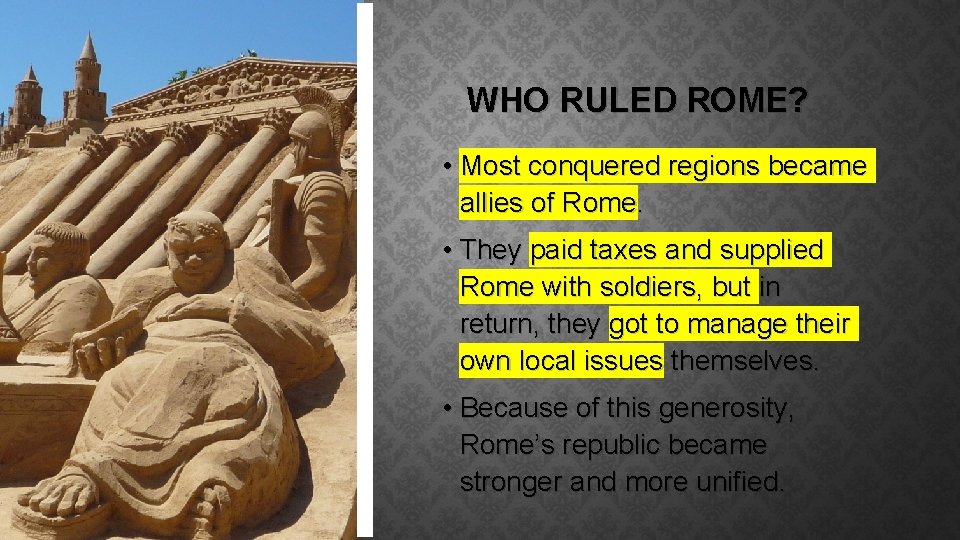
WHO RULED ROME? • Most conquered regions became allies of Rome. • They paid taxes and supplied Rome with soldiers, but in return, they got to manage their own local issues themselves. • Because of this generosity, Rome’s republic became stronger and more unified.
REVIEW QUESTIONS }� 1. What do the two origin stories of the Romans tell us about them? How did the Romans like to see themselves? }� 2. Why would formation fighting help the Romans defeat their enemies on the battlefield? }� 3. What were some advantages to being conquered by the Romans?
FROM SLAVE TO REBEL GLADIATOR – SPARTACUS – TED ED • https: //www. youtube. com/watch? v=8 l 1 Ny. R 6 Uvx. U
ROME AS A REPUBLIC Chapter 11 Lesson 2
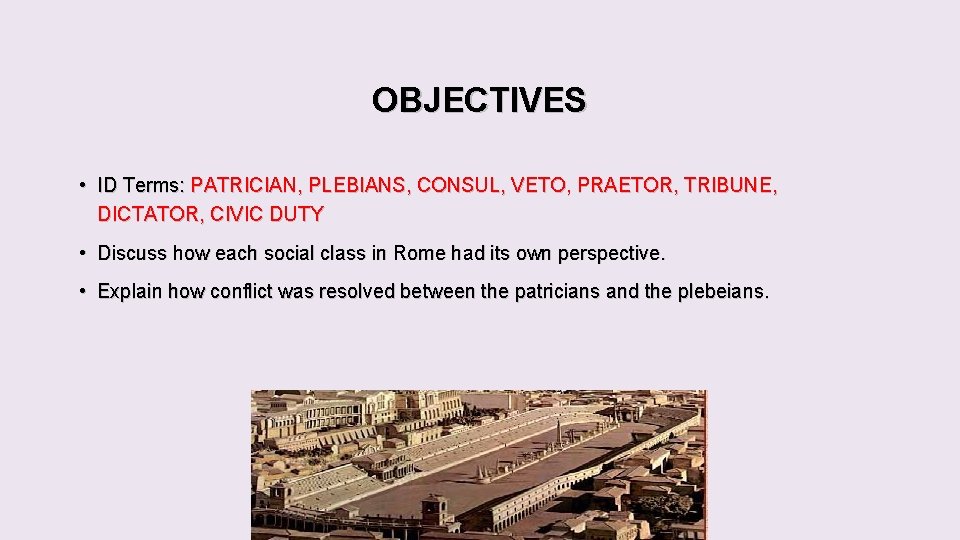
OBJECTIVES • ID Terms: PATRICIAN, PLEBIANS, CONSUL, VETO, PRAETOR, TRIBUNE, DICTATOR, CIVIC DUTY • Discuss how each social class in Rome had its own perspective. • Explain how conflict was resolved between the patricians and the plebeians.
GOVERNING ROME • Not everyone was treated fairly in the Roman Republic. • Early Romans were divided into two classes, PATRICIANS (wealthy landowners) or PLEBEIANS ( poor, smaller landowners, shopkeepers) • Both were allowed to vote and had civic responsibilities (taxes, army), but the plebeians could not hold public office.
GOVERNMENT OF THE REPUBLIC • The government of the Republic was divided into three branches. • One branch makes laws, another branch ran the daily affairs of government and the third branch was made up of judges. • There was also a system of checks and balances in place to prevent any of the branches from becoming too powerful • We have a similar system in our country TODAY…
GOVERNMENT OF THE REPUBLIC, CONTINUED • Two patricians called CONSULS, headed the government. • Each CONSUL was an administrative and military leader. They served one year in office. • Each CONSUL could VETO (reject) the other CONSUL • Rome also had PRAETORS who served as judges and army officials. • The Senate was Rome’s legislature. 300 members -they served for life.
CONFLICT BETWEEN CLASSES • As time passed, the plebeians grew frustrated. • Why? They had to serve in the army and pay taxes, but they had no government power. • There were several strikes by the plebeians. Eventually, the patricians allowed the plebeians to have their own body of representatives, The Council of the Plebs. • Plebeians elected officials called TRIBUNES. • These TRIBUNES helped to make the Roman Republic more representative, but it was not fully democratic
ROMAN SOCIETY AND POLITICAL STRUCTURE https: //www. youtube. com/watch? v=3 B 5 p. Gi. Wptb 4