
The Founding of Rome and its Republic World

The Founding of Rome and its Republic World History I Heritage High School Mr. Irwin
Main Ideas • Culture – Stories about the beginnings of Rome are a mix of legend and historical fact. • Geography – The people who settled Rome chose geographic location that was good for defense, travel, and trade. • Economics – Early Roman society was divided into two unequal classes. • Government – The Roman Republic had a government divided into three parts.
The Beginnings of Rome Essential Question: What is the early history of Rome?
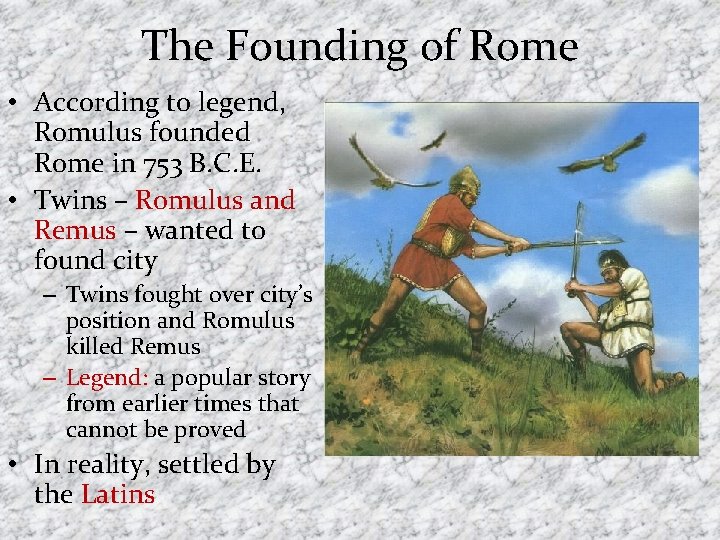
The Founding of Rome • According to legend, Romulus founded Rome in 753 B. C. E. • Twins – Romulus and Remus – wanted to found city – Twins fought over city’s position and Romulus killed Remus – Legend: a popular story from earlier times that cannot be proved • In reality, settled by the Latins
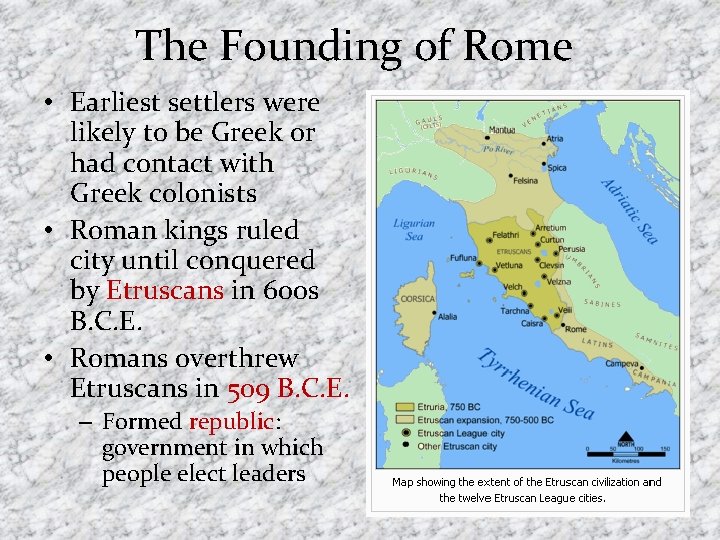
The Founding of Rome • Earliest settlers were likely to be Greek or had contact with Greek colonists • Roman kings ruled city until conquered by Etruscans in 600 s B. C. E. • Romans overthrew Etruscans in 509 B. C. E. – Formed republic: government in which people elect leaders
But why this location? • Rome had mild climate, good farmland, strategic location – Large plains made farming easier than in Greece • Built city on seven hills that could be defended – Farmed at base of hills and lived on hilltops • City was close to Mediterranean Sea and its trade routes – Helped in conquering new areas – Lay next to Tiber River, which aided in trade and provided protection • Alps, Apennines Mountains protected Rome, but didn’t isolate it
Review Question: Why was Rome’s location so favorable?
The Roman Republic Essential Questions: How was Roman society structured? How was the republican government organized?
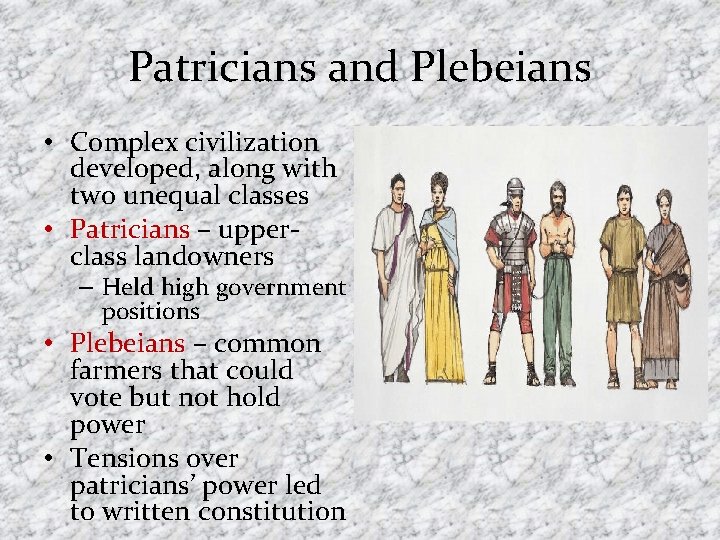
Patricians and Plebeians • Complex civilization developed, along with two unequal classes • Patricians – upperclass landowners – Held high government positions • Plebeians – common farmers that could vote but not hold power • Tensions over patricians’ power led to written constitution

Legislative and Judicial • Roman government established tripartite or three-branch government – Legislative makes law – Executive enforces law – Judicial interprets law • Legislative branch included Senate, assemblies – Senate: 300 members, mostly patricians • Advised leaders – Assemblies: mostly plebeian • Protected plebeian rights • Eight judges of judicial branch oversaw courts and governed provinces
Executive • Two consuls led executive branch – Commanded army – Ran government for a year – Each consul could veto the other • In a crisis, consuls could choose dictator to rule for limited time
Legacy of Roman Law • U. S. Government adopted Roman Republic’s tripartite system – Checks and balances keeps one branch from getting too powerful – Government based on written constitution • Citizenship is important in republican government – Citizens expected to perform civic duties – American citizens vote, pay taxes, and serve on juries
Review: Flip to the chart on the back on the questions for the reading – The Founding of Rome.
- Slides: 13