
The formation and characteristics of tropical stormscyclones Getting
- Slides: 20
The formation and characteristics of tropical storms/cyclones
Getting started You’ll need a notepad on which to make notes as you go along, or you could make notes, paste images, etc. on your device. You can view these slides: • as a slide-show for any animations and to follow links • in ‘normal’ view if you want to add call-outs or extra slides to make notes, paste images, answer questions, etc. © Geographical Association, 2020
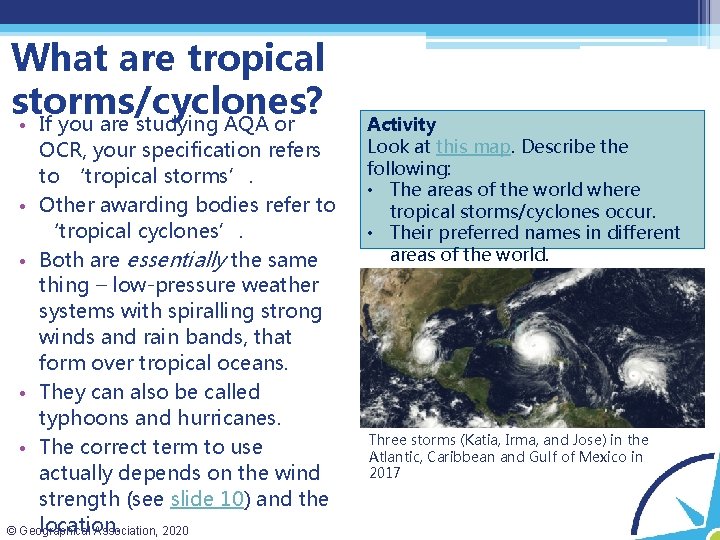
What are tropical storms/cyclones? • If you are studying AQA or OCR, your specification refers to ‘tropical storms’. • Other awarding bodies refer to ‘tropical cyclones’. • Both are essentially the same thing – low-pressure weather systems with spiralling strong winds and rain bands, that form over tropical oceans. • They can also be called typhoons and hurricanes. • The correct term to use actually depends on the wind strength (see slide 10) and the location. © Geographical Association, 2020 Activity Look at this map. Describe the following: • The areas of the world where tropical storms/cyclones occur. • Their preferred names in different areas of the world. Three storms (Katia, Irma, and Jose) in the Atlantic, Caribbean and Gulf of Mexico in 2017
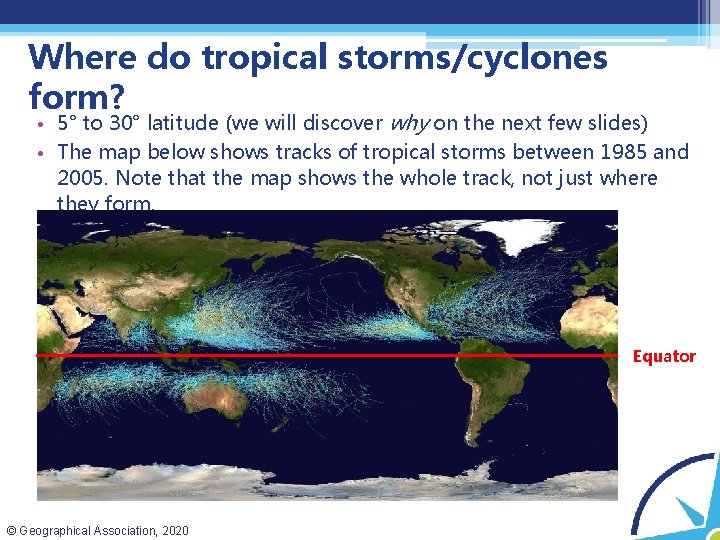
Where do tropical storms/cyclones form? • 5° to 30° latitude (we will discover why on the next few slides) • The map below shows tracks of tropical storms between 1985 and 2005. Note that the map shows the whole track, not just where they form. Equator © Geographical Association, 2020
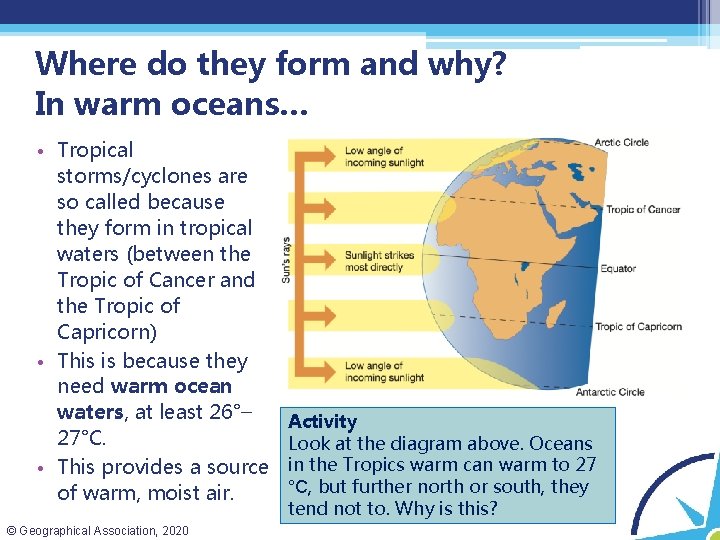
Where do they form and why? In warm oceans… • Tropical storms/cyclones are so called because they form in tropical waters (between the Tropic of Cancer and the Tropic of Capricorn) • This is because they need warm ocean waters, at least 26°– 27°C. • This provides a source of warm, moist air. © Geographical Association, 2020 Activity Look at the diagram above. Oceans in the Tropics warm can warm to 27 °C, but further north or south, they tend not to. Why is this?
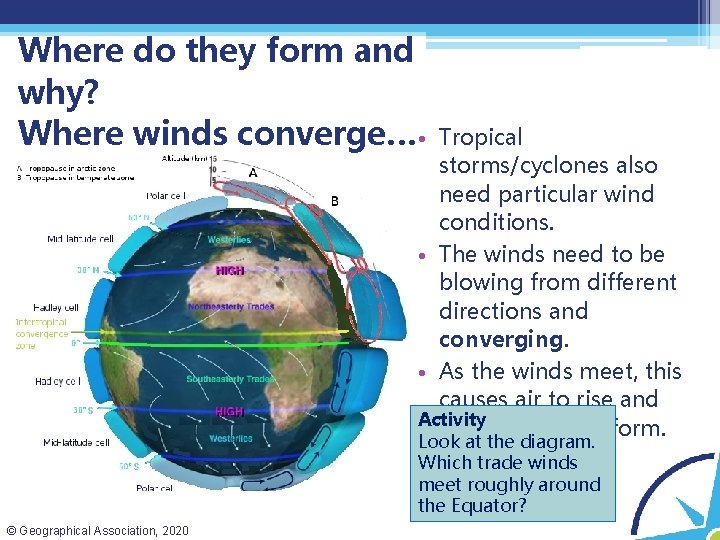
Where do they form and why? Where winds converge… • Tropical storms/cyclones also need particular wind conditions. • The winds need to be blowing from different directions and converging. • As the winds meet, this causes air to rise and Activity storm clouds to form. Look at the diagram. Which trade winds meet roughly around the Equator? © Geographical Association, 2020
Where do they form and why? Where there is low wind shear… • Tropical storms/cyclones need the wind pattern to be fairly consistent from the ground upwards. • They cannot form where winds cross (wind shear). • So they need low wind shear. • This enables the storm clouds to rise vertically to high levels into a ‘column’. Activity Watch this video clip. Explain how high wind shear can ‘tear apart’ and prevent tropical storms (hurricanes). © Geographical Association, 2020 Tip! If you are struggling to remember what wind shear is, think of a big pair of shears (like scissors) cutting across the hurricane and destroying it!
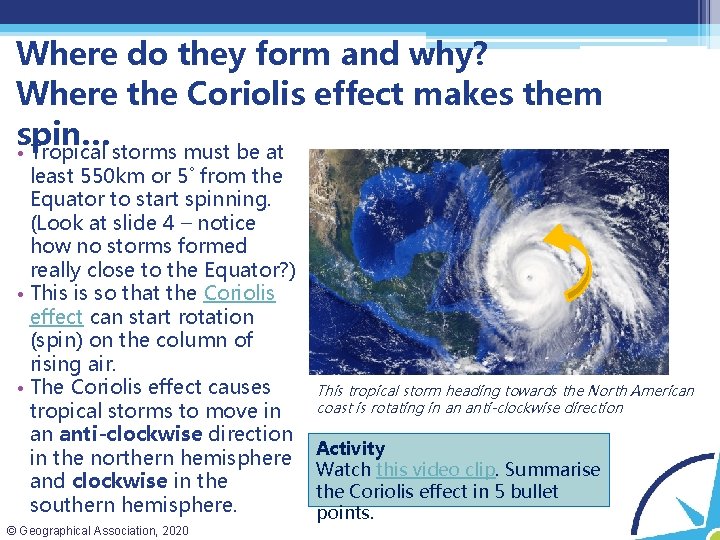
Where do they form and why? Where the Coriolis effect makes them spin… • Tropical storms must be at least 550 km or 5° from the Equator to start spinning. (Look at slide 4 – notice how no storms formed really close to the Equator? ) • This is so that the Coriolis effect can start rotation (spin) on the column of rising air. • The Coriolis effect causes tropical storms to move in an anti-clockwise direction in the northern hemisphere and clockwise in the southern hemisphere. © Geographical Association, 2020 This tropical storm heading towards the North American coast is rotating in an anti-clockwise direction Activity Watch this video clip. Summarise the Coriolis effect in 5 bullet points.
Once the conditions are right, how do they form? • In summary, tropical storms need the following conditions to form: ▫ warm ocean waters ▫ converging winds ▫ low wind shear ▫ the Coriolis effect. • So how do these combine to form the tropical cyclone? Complete the activity. © Geographical Association, 2020 Activity Watch this video clip and create a flow chart 5– 10 boxes long to explain how a hurricane forms. If you’d like to know even more, watch this video too.
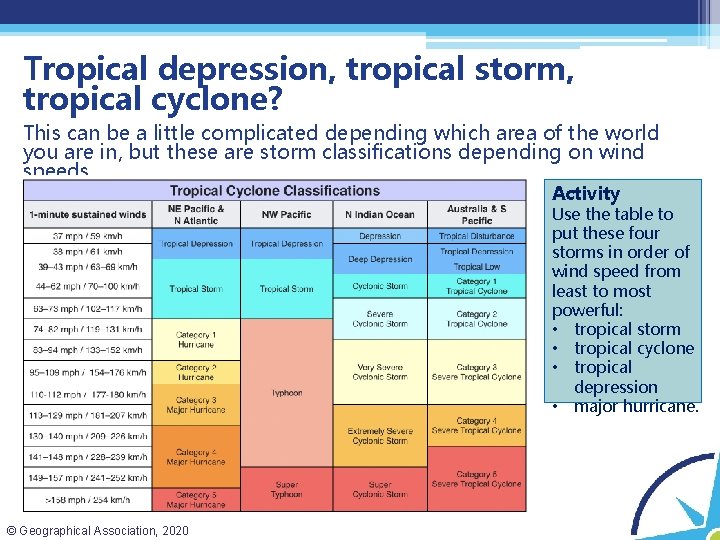
Tropical depression, tropical storm, tropical cyclone? This can be a little complicated depending which area of the world you are in, but these are storm classifications depending on wind speeds. Activity Use the table to put these four storms in order of wind speed from least to most powerful: • tropical storm • tropical cyclone • tropical depression • major hurricane. © Geographical Association, 2020
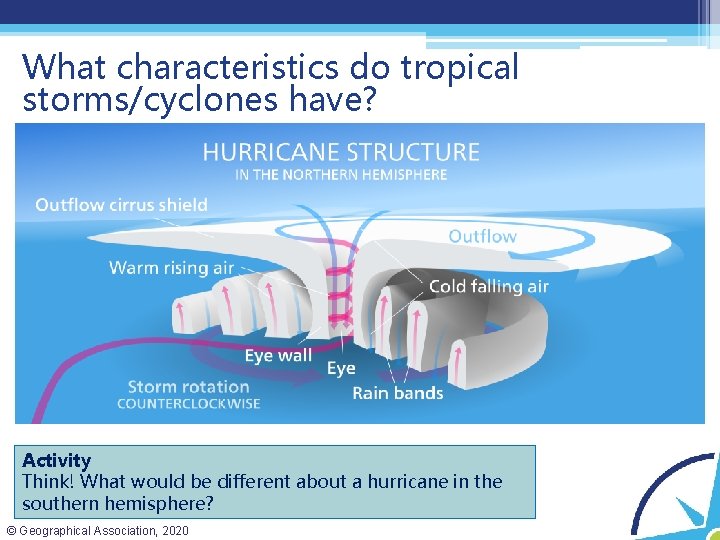
What characteristics do tropical storms/cyclones have? Activity Think! What would be different about a hurricane in the southern hemisphere? © Geographical Association, 2020
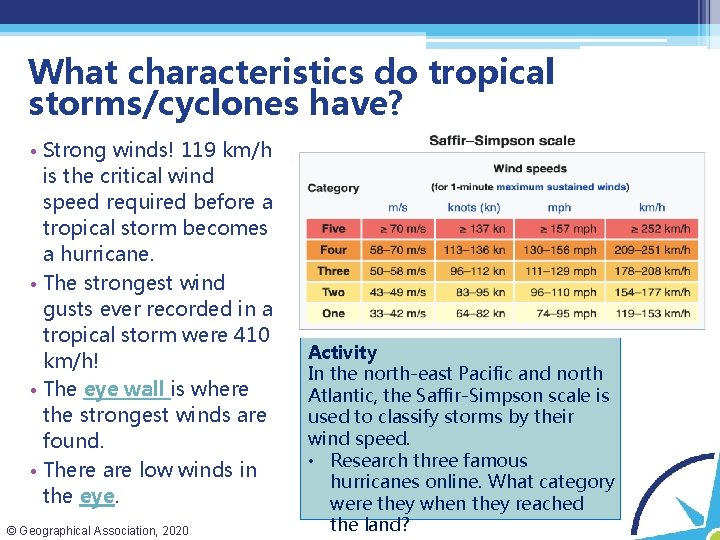
What characteristics do tropical storms/cyclones have? • Strong winds! 119 km/h is the critical wind speed required before a tropical storm becomes a hurricane. • The strongest wind gusts ever recorded in a tropical storm were 410 km/h! • The eye wall is where the strongest winds are found. • There are low winds in the eye. © Geographical Association, 2020 Activity In the north-east Pacific and north Atlantic, the Saffir-Simpson scale is used to classify storms by their wind speed. • Research three famous hurricanes online. What category were they when they reached the land?
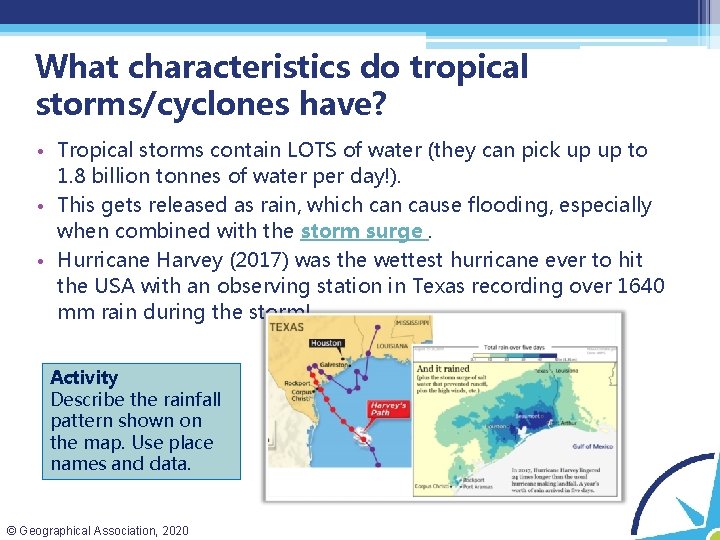
What characteristics do tropical storms/cyclones have? • Tropical storms contain LOTS of water (they can pick up up to 1. 8 billion tonnes of water per day!). • This gets released as rain, which can cause flooding, especially when combined with the storm surge. • Hurricane Harvey (2017) was the wettest hurricane ever to hit the USA with an observing station in Texas recording over 1640 mm rain during the storm! Activity Describe the rainfall pattern shown on the map. Use place names and data. © Geographical Association, 2020
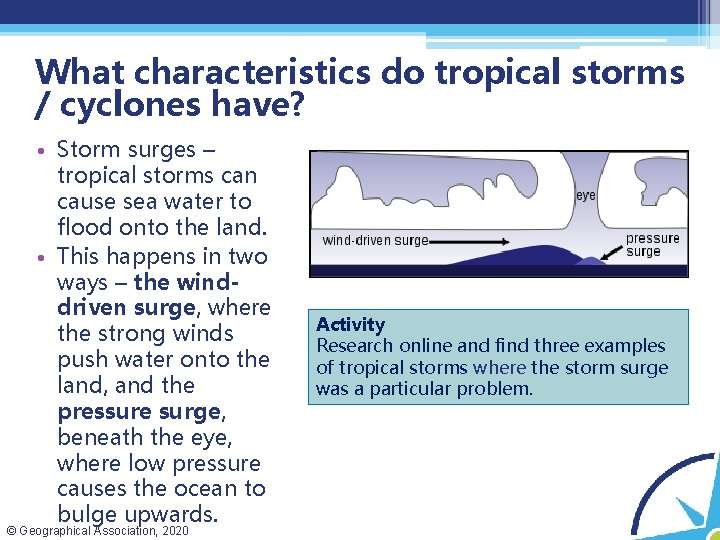
What characteristics do tropical storms / cyclones have? • Storm surges – tropical storms can cause sea water to flood onto the land. • This happens in two ways – the winddriven surge, where the strong winds push water onto the land, and the pressure surge, beneath the eye, where low pressure causes the ocean to bulge upwards. © Geographical Association, 2020 Activity Research online and find three examples of tropical storms where the storm surge was a particular problem.
Tropical storms/cyclones are NOT the same as tornadoes Whilst they share some similar characteristics (e. g. spiralling strong winds causing lots of damage), these two weather hazards are very different. © Geographical Association, 2020 Activity Read the information on this webpage. Create a table with tropical storms on one side and tornadoes on the other side. Put the following words in the correct column: • Travel thousands of miles • Small-scale (1– 1. 5 miles wide) • Form over the ocean • Large-scale (60– 1000 miles wide) • Short lifetime • Form on land • Last several days • Short distance travelled
Summary • Tropical storms need specific conditions to form (warm ocean water, low wind shear, converging winds, and the Coriolis effect). • Tropical storms have many hazardous characteristics (strong winds, heavy rainfall, storm surge). • There are different names and classifications for tropical storms at different wind speeds, and in different parts of the world. • Tornadoes and tropical storms are VERY different. © Geographical Association, 2020 Review activity Apply your knowledge. For an example of a tropical storm of your choice, find out specific facts about its formation and characteristics. For example: • Where exactly did it form? • How big was it? • What were the highest wind speeds? • How much rainfall was there? • How high was the storm surge?
Taking it further ‘Blown away: the physical facts of hurricanes Harvey and Irma’ Philip Monk explores the key processes explaining the formation and impact of hurricanes such as Harvey and Irma. © Geographical Association, 2020 Activities and reflection • Which conditions are necessary for the generation of a tropical depression? • Which conditions are needed to turn a tropical depression into a hurricane? • Summarise the physical impacts of hurricanes Harvey and Irma. • How successful were forecasts in reducing the impacts of these two hurricanes?
Links Awarding organisations Topic AQA 3. 1. 1. 3 Weather hazards Edexcel A Topic 2 Weather hazards Edexcel B Topic 1 Hazardous Earth Eduqas A Key Idea 5. 2 Weather patterns and process Eduqas B 2. 3 Weather and climate OCR A 2. 3 Environmental threats to our planet OCR B 1. 1 How can weather be hazardous? CCEA Unit 1 C: The impacts of extreme weather. © Geographical Association, 2020 Find out more • BBC Bitesize has specific information about weather and climate hazards. • The Met Office has more information about tropical cyclones. • This National Geographic video provides a great summary of what you’ve learned. • Check you remember how and why tropical cyclones spin here.
Glossary • Coriolis effect: where the Earth’s rotation causes things travelling around the Earth to appear to move in a curve rather than a straight line: this explains why cyclones spin. • Eye: the central, calm section of a tropical storm. • Eye wall: surrounds the eye of a hurricane. A tall ring of thunderstorms where the most severe weather and strongest winds occur. • Storm surge: water from the ocean that is pushed onto the shore by strong winds or low pressure in a tropical storm. • Wind shear: a change in wind speed or direction along a straight line. Strong upper level winds (high wind shear) can destroy a tropical storm. © Geographical Association, 2020
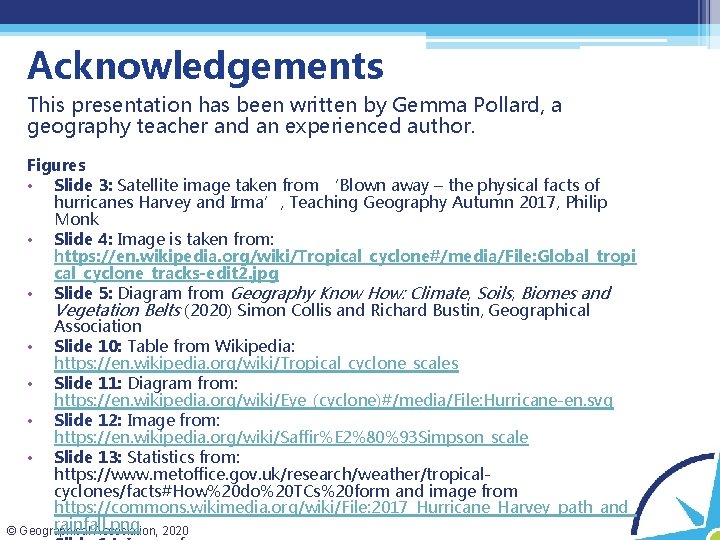
Acknowledgements This presentation has been written by Gemma Pollard, a geography teacher and an experienced author. Figures • Slide 3: Satellite image taken from ‘Blown away – the physical facts of hurricanes Harvey and Irma’, Teaching Geography Autumn 2017, Philip Monk • Slide 4: Image is taken from: https: //en. wikipedia. org/wiki/Tropical_cyclone#/media/File: Global_tropi cal_cyclone_tracks-edit 2. jpg • Slide 5: Diagram from Geography Know How: Climate, Soils, Biomes and Vegetation Belts (2020) Simon Collis and Richard Bustin, Geographical Association • Slide 10: Table from Wikipedia: https: //en. wikipedia. org/wiki/Tropical_cyclone_scales • Slide 11: Diagram from: https: //en. wikipedia. org/wiki/Eye_(cyclone)#/media/File: Hurricane-en. svg • Slide 12: Image from: https: //en. wikipedia. org/wiki/Saffir%E 2%80%93 Simpson_scale • Slide 13: Statistics from: https: //www. metoffice. gov. uk/research/weather/tropicalcyclones/facts#How%20 do%20 TCs%20 form and image from https: //commons. wikimedia. org/wiki/File: 2017_Hurricane_Harvey_path_and_ rainfall. png © Geographical Association, 2020