
The Forest Investment Program Recent Developments and Monoculture





- Slides: 11
The Forest Investment Program Recent Developments and Monoculture Tree Plantations Credits: ”Deforestation for palm oil in Peru” by Mathias Rittgerott/Rainforest Rescue/Critical Information Collective
The Climate Investment Funds (CIFs) The CIFs comprises 4 programs with a total of $8, 3 billion pledged Clean Techology Fund (CTF)- $5. 6 billion Pilot Program for Climate Resilience (PPCR)-$1. 2 billion Scaling-up Reneweable Energy Program (SREP)-$780 million Forest Investment Program (FIP) aims to provide direct investments to developing countries to support their development and REDD+ objectives
FIP Current Situation There is a total of 23 FIP countries: 14 of them already approved as pilot countries 9 elaborating their Investment Plans (IPs) After the Paris Agreement, the Intended Nationally Determined Contributions (INDC) may become a key source for the development of IPs The FIP also has the Dedicated Grant Mechanisms for Indigenous Peoples and Local Communities (DGM) and the Private Sector Set-Aside Program (PSSA) It has a protfolio of 47 projects which are in different stages: 4 under the PSSA 16 under the DGM 27 agreed in the IP
FIP Current Situation By December 2015, USD 775. 2 million pledged from which USD 555. 3 are endorsed The indicative allocation of money endorsed is: USD 455 million for IP USD 80 million for the DGM USD 20. 3 million for the PSSA However, the FIP is facing problems with: Limited availability of resources Mobilizing funds The disbursement is just USD 36. 1 million Grants vs Loans Grants (USD million) 6, 1 Loans (USD million) 17, 9 8, 2 15, 8 3, 15 20, 85 Guatemala 3, 15 20, 85 Mozambique 10, 8 13, 2 Nepal 6, 1 17, 9 Congo Republic Côte d'Ivoire Ecuador Source: based on table presented at the FIP Sub-Committee meeting in November 2015 by AU, CIF
FIP & Monoculture Tree Plantations Tree plantations are aknowledge as a key driver of deforestation in many IPs However, most IPs include plantations as positive to reduce deforestation Or the definition of forests leaves space for plantations For instance: Ghana: states the need for further research…”on crops and trees. . biofuels such as oil palm and jatropha, and trees such as rubber. . . to reduce the carbon footprints …” Indonesia: assistance to meet the increasing wood volumes for local and export demand. The private sector goal in FIP is to support the business of sustainable forestry both natural and plantation to be more efficient Deforestation for palm oil by Mathias Rittgerott/Rainforest Rescue
Example I: Support Project for the Development of Agroforestry in Four Provinces (PRODAF), DRC Based on plantations with a few species and monocultures in four provinces, assuming that plantations will have potential beneficial impacts Mainly aimed to establish palm oil plantations to reduce forest loss Degraded lands poorly defined and broad definition of agroforestry No mention if degraded lands were already supporting livelihoods and whose livelihoods No explanation on why support to semi-industrial palm-oil is needed and how reduces pressure on natural forests Decision to defer the consideration of the concept proposal until additional funds become available
FIP & Safeguards Guidelines or criteria related to the inclusion, full and effective participation of relevant stakeholders on matters that affect their distinctive rights When it comes to the local level, safeguards implemented are those of the MDB Recommendations made by CS and Indigenous Peoples observers to comply with the UNDRIP and include FPIC were rejected FIP guidelines have no specific criteria regarding UNDRIP or FPIC
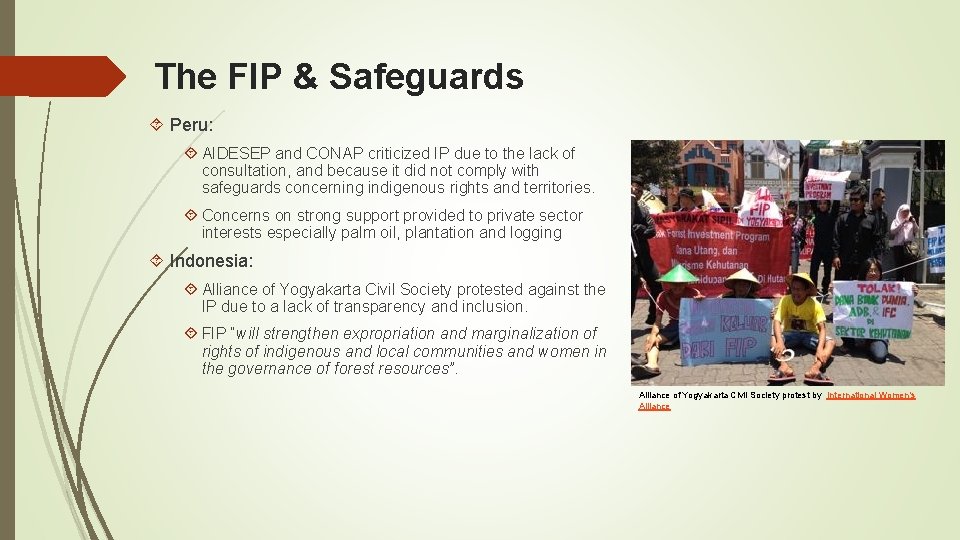
The FIP & Safeguards Peru: AIDESEP and CONAP criticized IP due to the lack of consultation, and because it did not comply with safeguards concerning indigenous rights and territories. Concerns on strong support provided to private sector interests especially palm oil, plantation and logging Indonesia: Alliance of Yogyakarta Civil Society protested against the IP due to a lack of transparency and inclusion. FIP “will strengthen expropriation and marginalization of rights of indigenous and local communities and women in the governance of forest resources”. Alliance of Yogyakarta Civil Society protest by International Women's Alliance
Forest Carbon Partnership Facility (FCPC) Another REDD+ related fund which also support plantations and have weak safeguards For instance in the R-PP of: Burkina Faso: different types of plantations, including commercial reforestation plantations, interesting private companies or communities is a measure to achieve REDD+ goals Indonesia: “Establishment of an additional fast growing pulp and timber plantations on non- forest and non -peat lands can create an alternative source of timber and reduce pressure on rain forests and will allow for a doubling in size of pulp and oil palm production and to a major increase in export revenues”.
UN-REDD Programme Supports nationally-led REDD+ processes The UN definition of forest does not distinguish between an old-growth forest and an industrial monoculture tree plantation Support national REDD+ processes leads to support tree plantations Plenty of REDD+ projects based on monoculture tree plantations Jari Amapá REDD project, Brazil: 65, 980 ha. Project run by logging and pulp companies Kikonda carbon tree plantation project, Uganda: 8000 ha of pine plantations. Law enforcement to impose fines, arbitrarily arrest people, confiscate cattle, deny access to water tanks constructed for the communities.
Thank you! Coraina de la Plaza Indigenous Rights Advisor and Research Assistant coraina. delplaza@globalforestcoalition. org