
THE FORENSIC NEUROPATHOLOGY OF BLUNT FORCE TRAUMA OF
THE FORENSIC NEUROPATHOLOGY OF BLUNT FORCE TRAUMA OF THE BRAIN Part 5: Diffuse Traumatic Brain Injury Bennet I. Omalu, M. D. , M. P. H. Forensic Pathologist/ Neuropathologist
DIFFUSE TRAUMATIC BRAIN INJURY • The sine qua non of Diffuse Traumatic Brain Injury is Diffuse Traumatic Axonal Injury • Typically associated with diffuse inertial biomechanical loading and acceleration-deceleration shearing forces Ø Axonal injury is not localized to a single region of the brain, it is diffusely spread • Para-sagittal structures of the brain are most vulnerable especially the splenium of the corpus callosum • Diffuse Traumatic Axonal Injury is associated with gliding contusions • Note that axonal injury may be associated with non-traumatic causes like viral encephalitis, hypoxic injury and toxic encephalopathies, traumatic axonal injury is solely caused by trauma
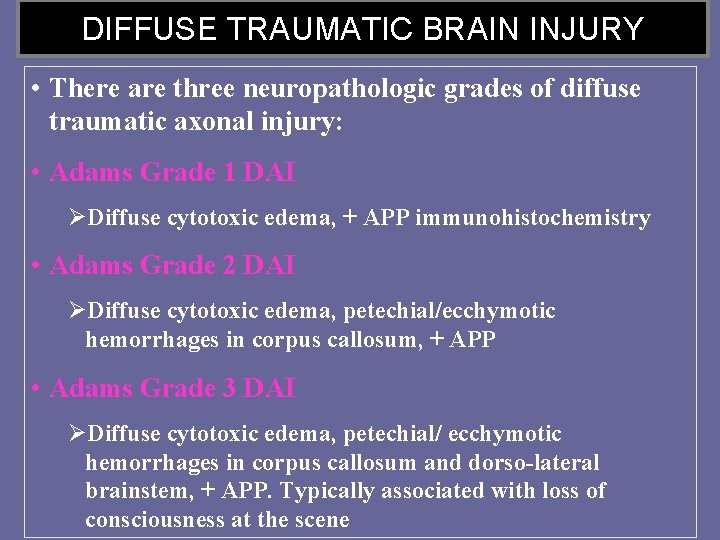
DIFFUSE TRAUMATIC BRAIN INJURY • There are three neuropathologic grades of diffuse traumatic axonal injury: • Adams Grade 1 DAI ØDiffuse cytotoxic edema, + APP immunohistochemistry • Adams Grade 2 DAI ØDiffuse cytotoxic edema, petechial/ecchymotic hemorrhages in corpus callosum, + APP • Adams Grade 3 DAI ØDiffuse cytotoxic edema, petechial/ ecchymotic hemorrhages in corpus callosum and dorso-lateral brainstem, + APP. Typically associated with loss of consciousness at the scene
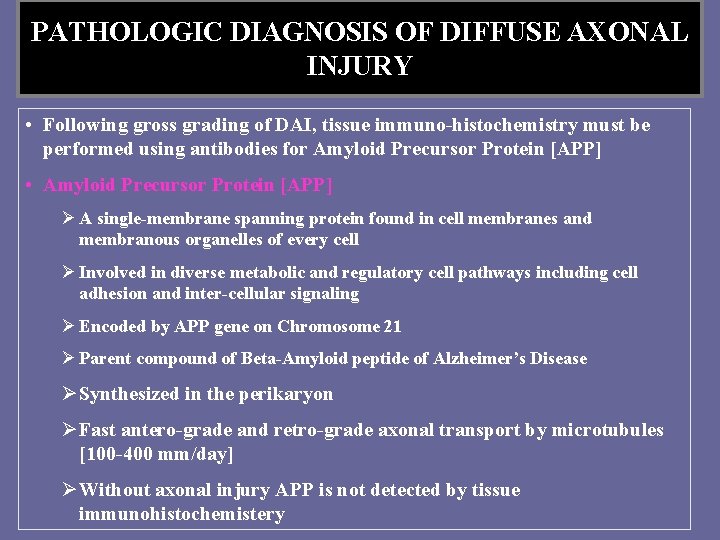
PATHOLOGIC DIAGNOSIS OF DIFFUSE AXONAL INJURY • Following gross grading of DAI, tissue immuno-histochemistry must be performed using antibodies for Amyloid Precursor Protein [APP] • Amyloid Precursor Protein [APP] Ø A single-membrane spanning protein found in cell membranes and membranous organelles of every cell Ø Involved in diverse metabolic and regulatory cell pathways including cell adhesion and inter-cellular signaling Ø Encoded by APP gene on Chromosome 21 Ø Parent compound of Beta-Amyloid peptide of Alzheimer’s Disease Ø Synthesized in the perikaryon Ø Fast antero-grade and retro-grade axonal transport by microtubules [100 -400 mm/day] Ø Without axonal injury APP is not detected by tissue immunohistochemistery
![PATHOLOGIC DIAGNOSIS OF DIFFUSE AXONAL INJURY • Amyloid Precursor Protein [APP], cont’d Ø Following](http://slidetodoc.com/presentation_image_h2/90712880f58ddf8d0748761ff5ba4137/image-5.jpg "PATHOLOGIC DIAGNOSIS OF DIFFUSE AXONAL INJURY • Amyloid Precursor Protein [APP], cont’d Ø Following")
PATHOLOGIC DIAGNOSIS OF DIFFUSE AXONAL INJURY • Amyloid Precursor Protein [APP], cont’d Ø Following axonal injury and disruption of the micro-tubule cytoskeleton, APP accumulates both proximally and distally to point of axonal injury Ø It takes APP 2 – 3 hours post injury to accumulate sufficiently to be detected Ø This can shorten to 1 hour with antigen retrieval methods Ø APP has been observed up to 99 days post injury [3 months] Ø APP associated with diffuse hypoxic-ischemic injury shows a geographic pattern of immunopositivity Ø Trauma-induced DAI exhibits a diffuse focal pattern of APP+ Ø Using silver impregnation and H&E stains, axonal injury can be identified after 15 hours of injury, axonal spheroids of Cajal, axonal viscosities and swellings may be seen Ø APP immuno-histochemistry is an important tool in medico-legal cases
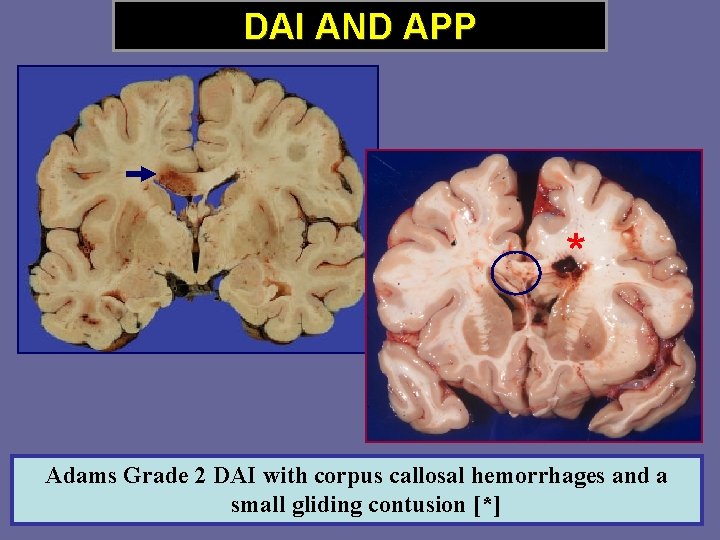
DAI AND APP * Adams Grade 2 DAI with corpus callosal hemorrhages and a small gliding contusion [*]
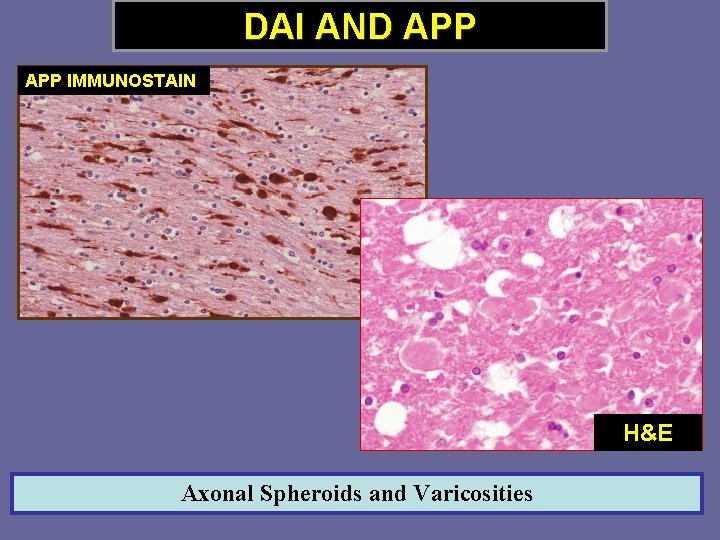
DAI AND APP IMMUNOSTAIN H&E Axonal Spheroids and Varicosities
OTHER TYPES OF DIFFUSE BRAIN INJURY • DIFFUSE VASCULAR INJURY Ø Presents immediately after trauma, usually fatal Ø Brain exhibits only peri-vascular petechial and micro-hemorrhages in lobar cortical white matter • DIFFUSE CEREBRAL FAT EMBOLISM Ø Associated with fractures of long bones with surgical fixation/manipulation Ø Associated with extensive soft tissue and crush injuries Ø Presents 2 to 3 days after trauma Ø Manifests as diffuse cortical white matter petechial perivascular hemorrhages Ø Fat stains show intra-luminal fat globules in penetrating parenchymal vessels Ø Peri-vascular rarefaction and demyelination may follow
- Slides: 8