
The Forces of Gradation Tectonics Gradation In the

- Slides: 22
The Forces of Gradation
Tectonics Gradation • In the last unit, we went over those forces which tend to build up the earth's crust and to increase topographic contrasts of all sorts. • In this section, we review those forces which tend to even out the surface of the continents. These forces break up rock materials, sometimes altering them chemically, erode them, transport them, and deposit them.
Agents of Gradation Things that do the breaking down • • • Running water Wind Gravity Glaciers/ ice Waves Chemical reaction
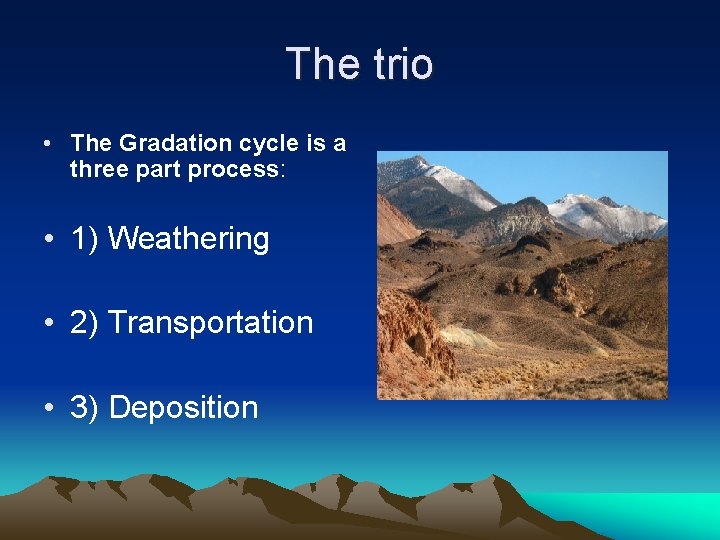
The trio • The Gradation cycle is a three part process: • 1) Weathering • 2) Transportation • 3) Deposition
Step one: WEATHERING • Includes all processes that decompose and disintegrate rock break rock down • Weathering produces REGOLITH that covers the Earth’s surface
Two types of weathering • Physical and Chemical Weathering:
Physical Weathering: • Breakup of rock into smaller particles without changing its composition • Compression, tension, and stresses are applied to the rock, eventually overcoming its strength, which results in deformation and failure
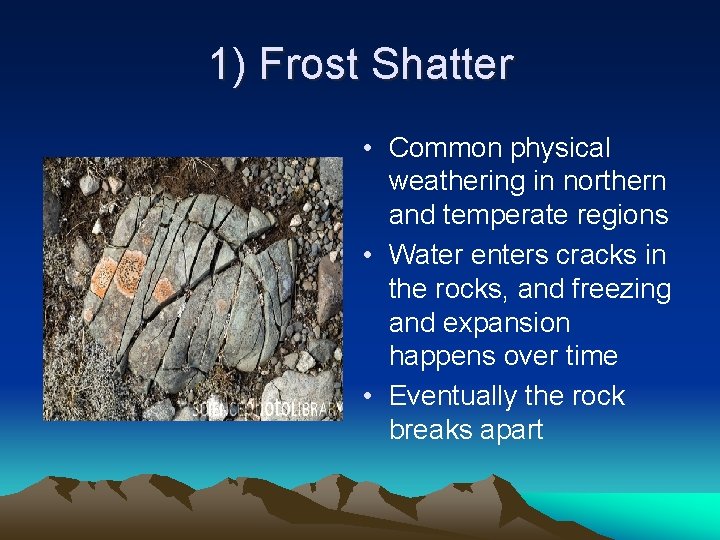
1) Frost Shatter • Common physical weathering in northern and temperate regions • Water enters cracks in the rocks, and freezing and expansion happens over time • Eventually the rock breaks apart
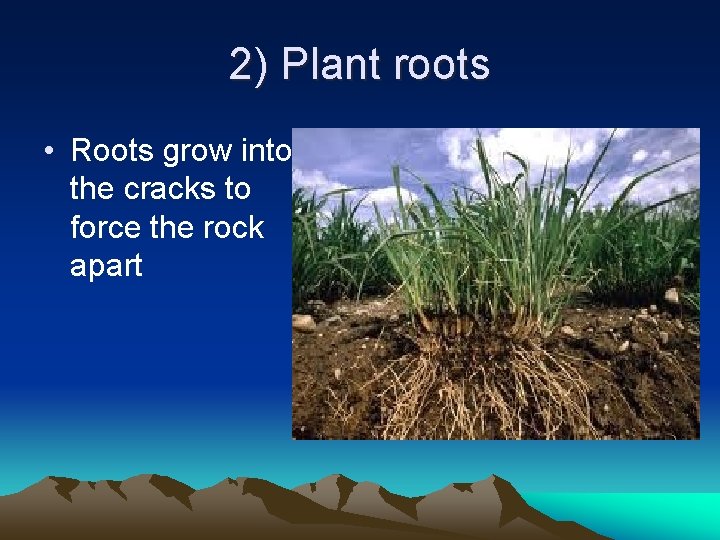
2) Plant roots • Roots grow into the cracks to force the rock apart
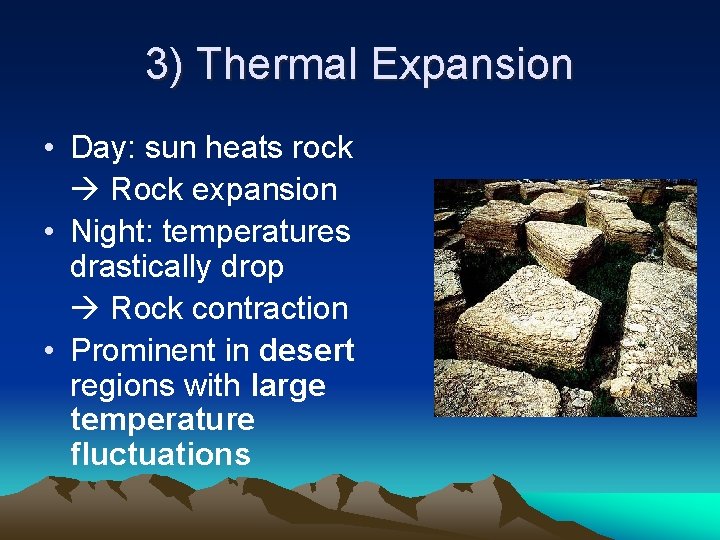
3) Thermal Expansion • Day: sun heats rock Rock expansion • Night: temperatures drastically drop Rock contraction • Prominent in desert regions with large temperature fluctuations
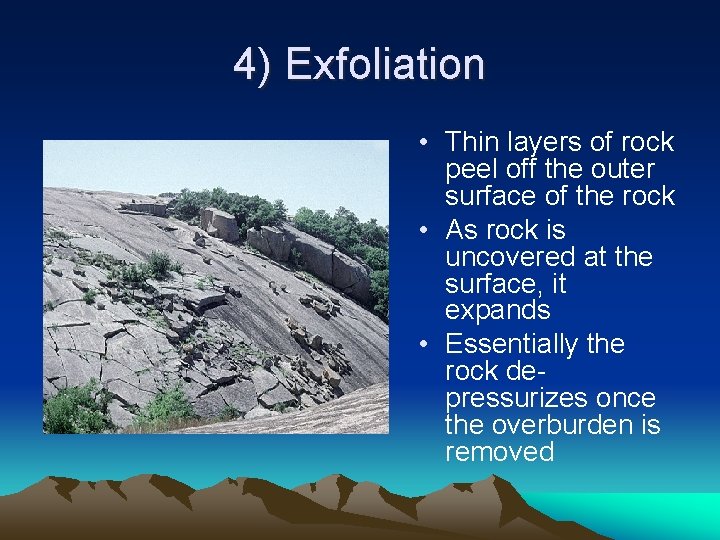
4) Exfoliation • Thin layers of rock peel off the outer surface of the rock • As rock is uncovered at the surface, it expands • Essentially the rock depressurizes once the overburden is removed
Physical Weathering Review • Frost shatter • Plant roots • Thermal expansion • Exfoliation
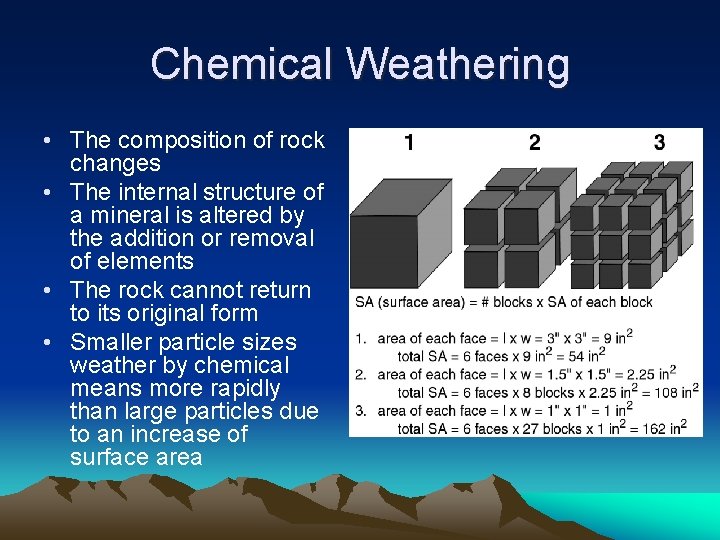
Chemical Weathering • The composition of rock changes • The internal structure of a mineral is altered by the addition or removal of elements • The rock cannot return to its original form • Smaller particle sizes weather by chemical means more rapidly than large particles due to an increase of surface area
1) Solution • Acidic waters (from pollution or natural) dissolve rocks (such as limestone) allowing for additional water to gain entrance • Is very common in areas that have a great deal of limestone (e. g. New Zealand)
2) Hydrolysis • Minerals chemically combine with water • Water replaces silicate in the rock and the dissolved minerals are transported away with the water • In other words, silicate minerals (unstable at the earth's surface) weather to form clay minerals (stable at the earth's surface). • Soils tend to have high clay content.
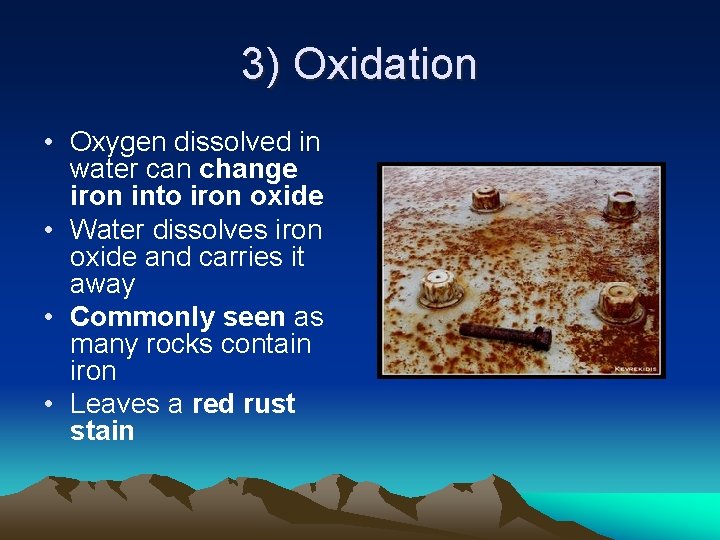
3) Oxidation • Oxygen dissolved in water can change iron into iron oxide • Water dissolves iron oxide and carries it away • Commonly seen as many rocks contain iron • Leaves a red rust stain
Chemical weathering review • Solution • Hydrolysis • Oxidation
Weathering facts! • Weathering happens most often where temperatures are warm lot’s of solar energy and high levels of rain • Thus, tropical climates are much more likely to have high levels of weathering • Sedimentary is the easiest to erode, and metamorphic the hardest • Steep slopes will often weather more quickly
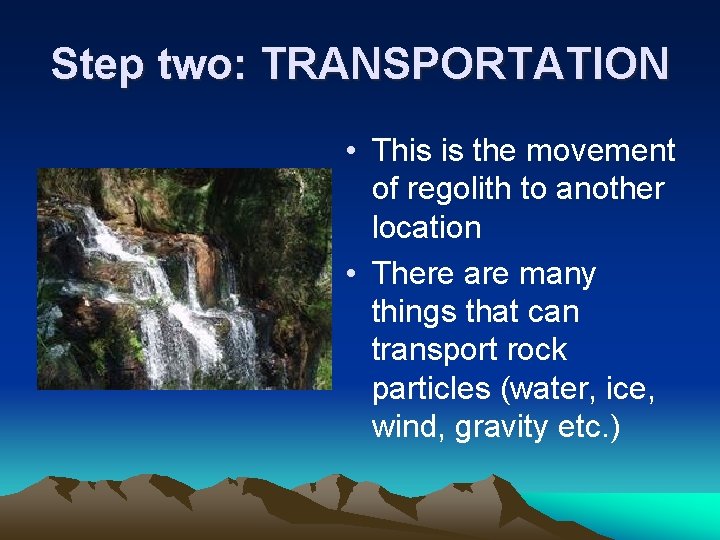
Step two: TRANSPORTATION • This is the movement of regolith to another location • There are many things that can transport rock particles (water, ice, wind, gravity etc. )
Erosion • We combine steps one and two and call it erosion • EROSION = 2 PROCESSES = WEATHERING + TRANSPORTATION
Step three: DEPOSITION • This is the stage where regolith, or rock particles are deposited, and they begin to build up, forming new landforms • We will learn more about this in mass wastage…
How do we tell whether physical or chemical weathering is occurring? • Jagged, broken rock, with little change in colour is normally PHYSICAL WEATHERING • Often rocks with rounded surfaces and changed colours are the result of CHEMICAL WEATHERING Also more likely to crumble under pressure (weaker) *** Keep in mind that some rocks will undergo both physical and chemical weathering!