
THE FORCES OF EVOLUTIONARY CHANGE MICROEVOLUTION Chapter 16

![] Founder effect – genetic drift due to a few individuals leaving a large](https://slidetodoc.com/presentation_image_h2/60b336cc49b481818f0afecbb0358fda/image-12.jpg "] Founder effect – genetic drift due to a few individuals leaving a large")
![] Population bottleneck – genetic drift due to high mortality in a population. F](https://slidetodoc.com/presentation_image_h2/60b336cc49b481818f0afecbb0358fda/image-13.jpg "] Population bottleneck – genetic drift due to high mortality in a population. F")
![Types of Natural Selection ] Directional Selection Environment selects against one phenotypic extreme, allowing](https://slidetodoc.com/presentation_image_h2/60b336cc49b481818f0afecbb0358fda/image-17.jpg "Types of Natural Selection ] Directional Selection Environment selects against one phenotypic extreme, allowing")
![The Okapi ] checking out the rump stripes](https://slidetodoc.com/presentation_image_h2/60b336cc49b481818f0afecbb0358fda/image-18.jpg "The Okapi ] checking out the rump stripes")
![] Disruptive Selection Environment selects against intermediate phenotype, allowing both extremes to become more](https://slidetodoc.com/presentation_image_h2/60b336cc49b481818f0afecbb0358fda/image-19.jpg "] Disruptive Selection Environment selects against intermediate phenotype, allowing both extremes to become more")
![] Stabilizing Selection Environment selects against two extreme phenotypes, allowing the intermediates to become](https://slidetodoc.com/presentation_image_h2/60b336cc49b481818f0afecbb0358fda/image-20.jpg "] Stabilizing Selection Environment selects against two extreme phenotypes, allowing the intermediates to become")
- Slides: 21
THE FORCES OF EVOLUTIONARY CHANGE MICROEVOLUTION Chapter 16
Evolution occurs at the population level as allele frequencies change.
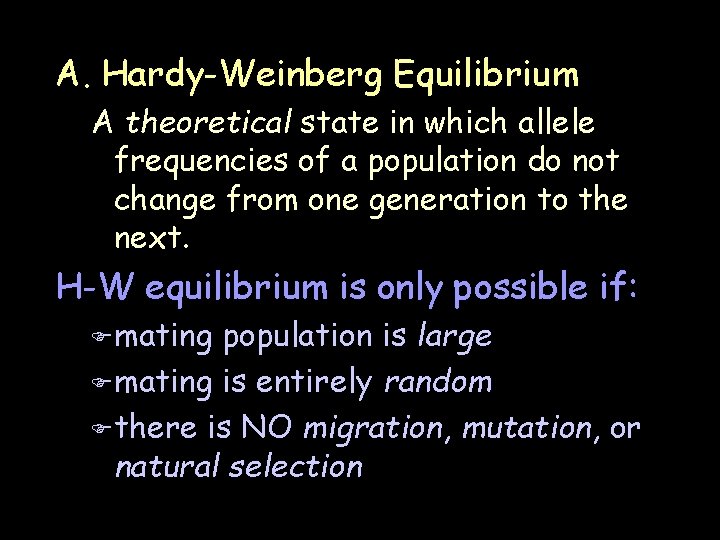
A. Hardy-Weinberg Equilibrium A theoretical state in which allele frequencies of a population do not change from one generation to the next. H-W equilibrium is only possible if: F mating population is large F mating is entirely random F there is NO migration, mutation, or natural selection
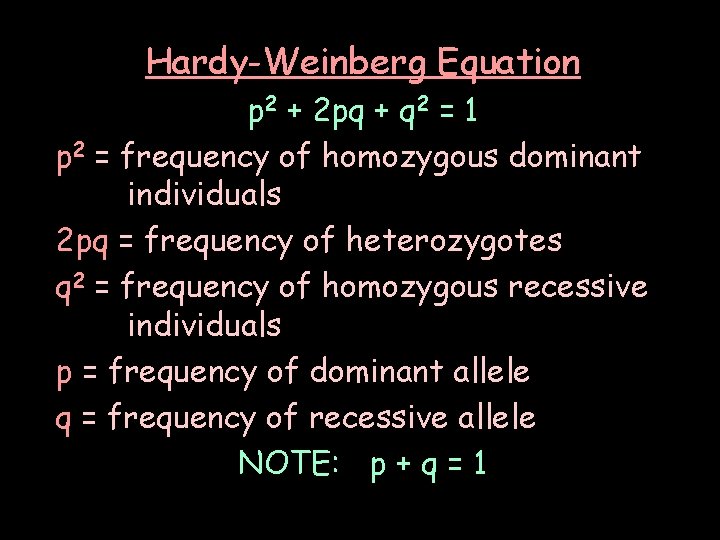
Hardy-Weinberg Equation p 2 + 2 pq + q 2 = 1 p 2 = frequency of homozygous dominant individuals 2 pq = frequency of heterozygotes q 2 = frequency of homozygous recessive individuals p = frequency of dominant allele q = frequency of recessive allele NOTE: p + q = 1
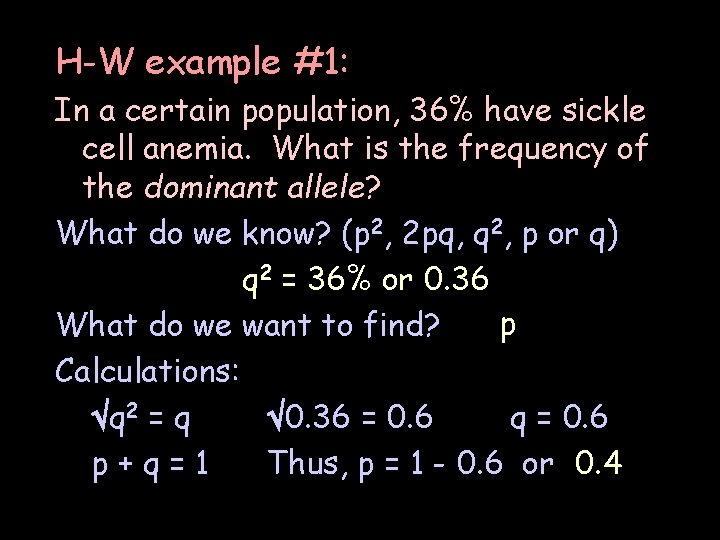
H-W example #1: In a certain population, 36% have sickle cell anemia. What is the frequency of the dominant allele? What do we know? (p 2, 2 pq, q 2, p or q) q 2 = 36% or 0. 36 p What do we want to find? Calculations: q 2 = q 0. 36 = 0. 6 q = 0. 6 p+q=1 Thus, p = 1 - 0. 6 or 0. 4
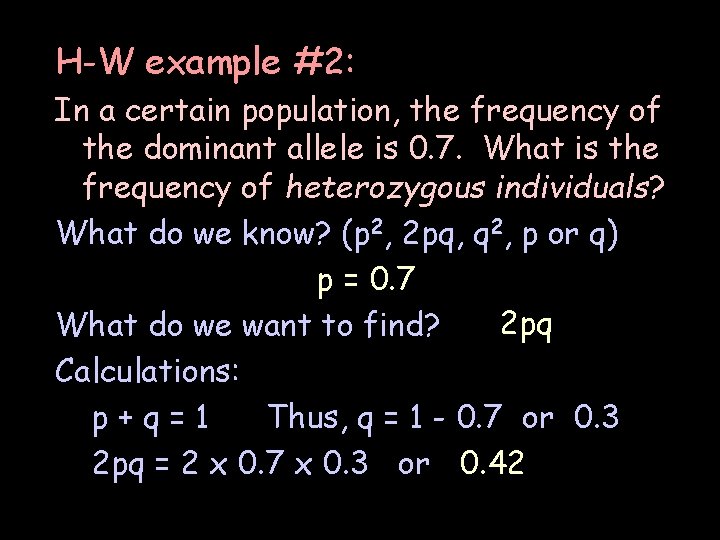
H-W example #2: In a certain population, the frequency of the dominant allele is 0. 7. What is the frequency of heterozygous individuals? What do we know? (p 2, 2 pq, q 2, p or q) p = 0. 7 2 pq What do we want to find? Calculations: p+q=1 Thus, q = 1 - 0. 7 or 0. 3 2 pq = 2 x 0. 7 x 0. 3 or 0. 42
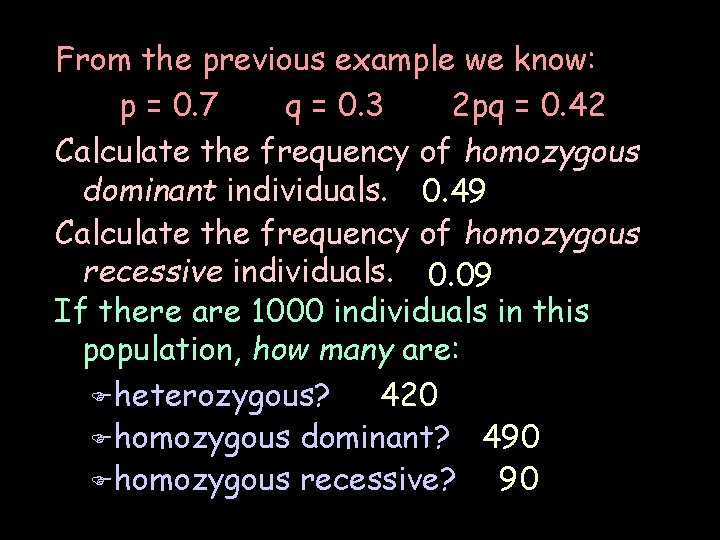
From the previous example we know: p = 0. 7 q = 0. 3 2 pq = 0. 42 Calculate the frequency of homozygous dominant individuals. 0. 49 Calculate the frequency of homozygous recessive individuals. 0. 09 If there are 1000 individuals in this population, how many are: 420 F heterozygous? F homozygous dominant? 490 F homozygous recessive? 90
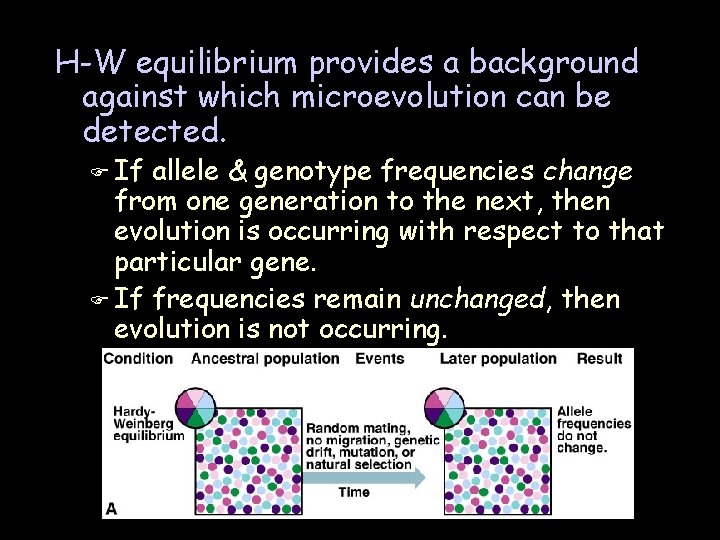
H-W equilibrium provides a background against which microevolution can be detected. F If allele & genotype frequencies change from one generation to the next, then evolution is occurring with respect to that particular gene. F If frequencies remain unchanged, then evolution is not occurring.
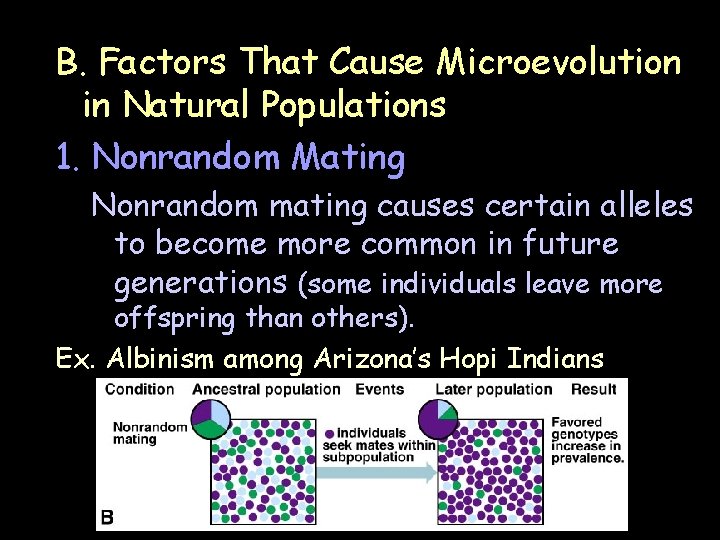
B. Factors That Cause Microevolution in Natural Populations 1. Nonrandom Mating Nonrandom mating causes certain alleles to become more common in future generations (some individuals leave more offspring than others). Ex. Albinism among Arizona’s Hopi Indians
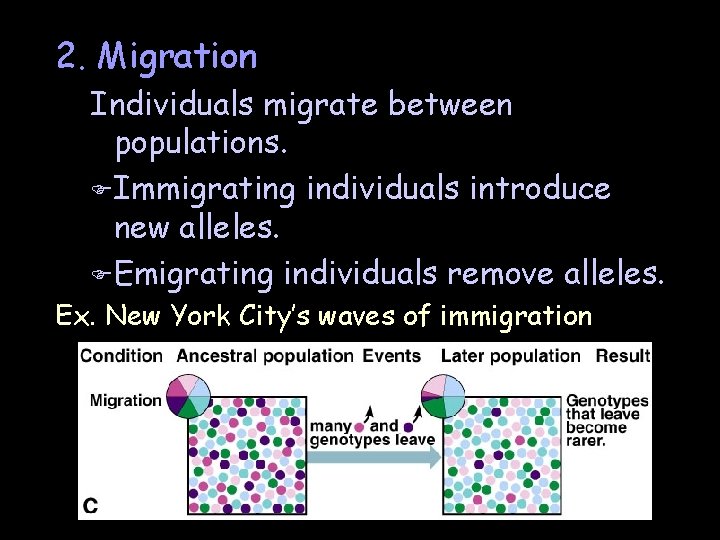
2. Migration Individuals migrate between populations. F Immigrating individuals introduce new alleles. F Emigrating individuals remove alleles. Ex. New York City’s waves of immigration
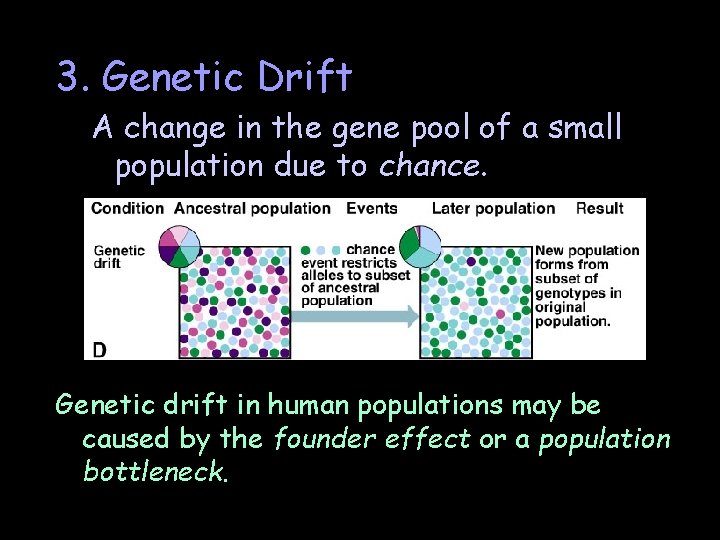
3. Genetic Drift A change in the gene pool of a small population due to chance. Genetic drift in human populations may be caused by the founder effect or a population bottleneck.
] Founder effect – genetic drift due to a few individuals leaving a large population to found a new group. F Unlikely that gene pool of founding population is representative of original population. Ex. Ellis-van Creveld syndrome among Pennsylvania Amish.
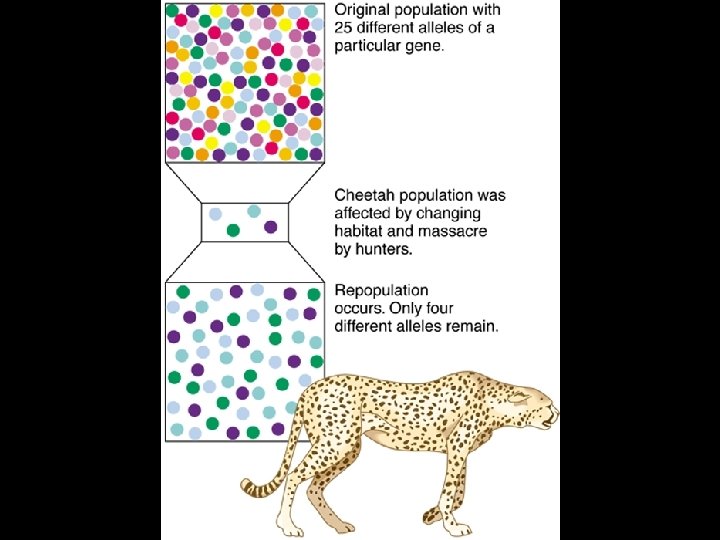
] Population bottleneck – genetic drift due to high mortality in a population. F Unlikely that gene pool of the remaining population is representative of original population. Ex. Pingelapese blindness among Pingelapese people of the eastern Caroline islands. (total color blindness and myopia, autosomal recessive nerve disorder) Decreased genetic diversity among Cheetahs.
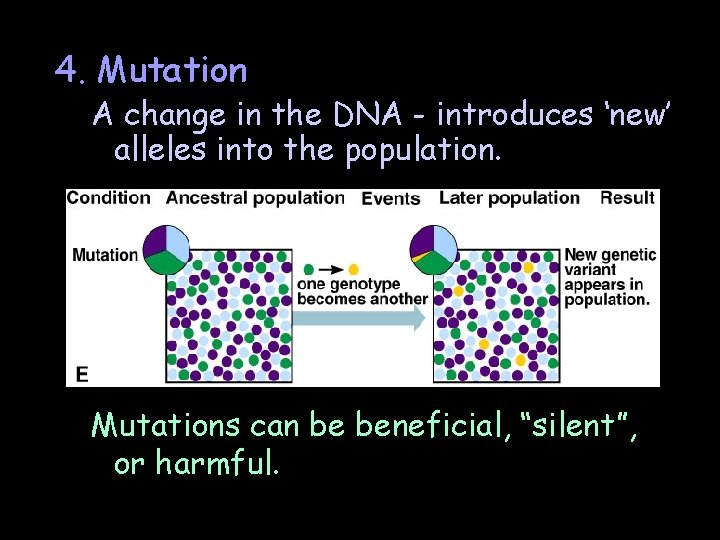
4. Mutation A change in the DNA - introduces ‘new’ alleles into the population. Mutations can be beneficial, “silent”, or harmful.
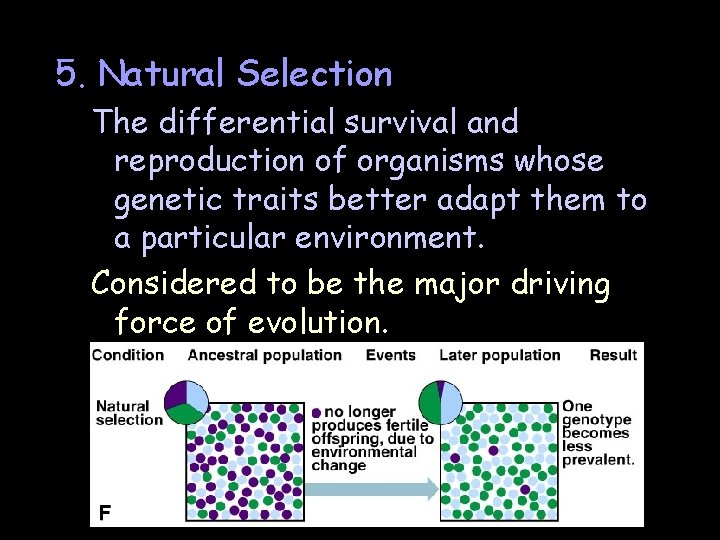
5. Natural Selection The differential survival and reproduction of organisms whose genetic traits better adapt them to a particular environment. Considered to be the major driving force of evolution.
Types of Natural Selection ] Directional Selection Environment selects against one phenotypic extreme, allowing the other to become more prevalent.
The Okapi ] checking out the rump stripes
] Disruptive Selection Environment selects against intermediate phenotype, allowing both extremes to become more prevalent.
] Stabilizing Selection Environment selects against two extreme phenotypes, allowing the intermediates to become more prevalent.
Balanced Polymorphism A form of stabilizing selection that maintains deleterious recessive alleles in a population because heterozygotes resist an infectious disease. F Sickle cell anemia is maintained because heterozygotes are resistant to malaria. F Cystic fibrosis is maintained because heterozygotes are resistant to cholera & typhoid fever.